#39 Geoff Saab: Low Risk Rules
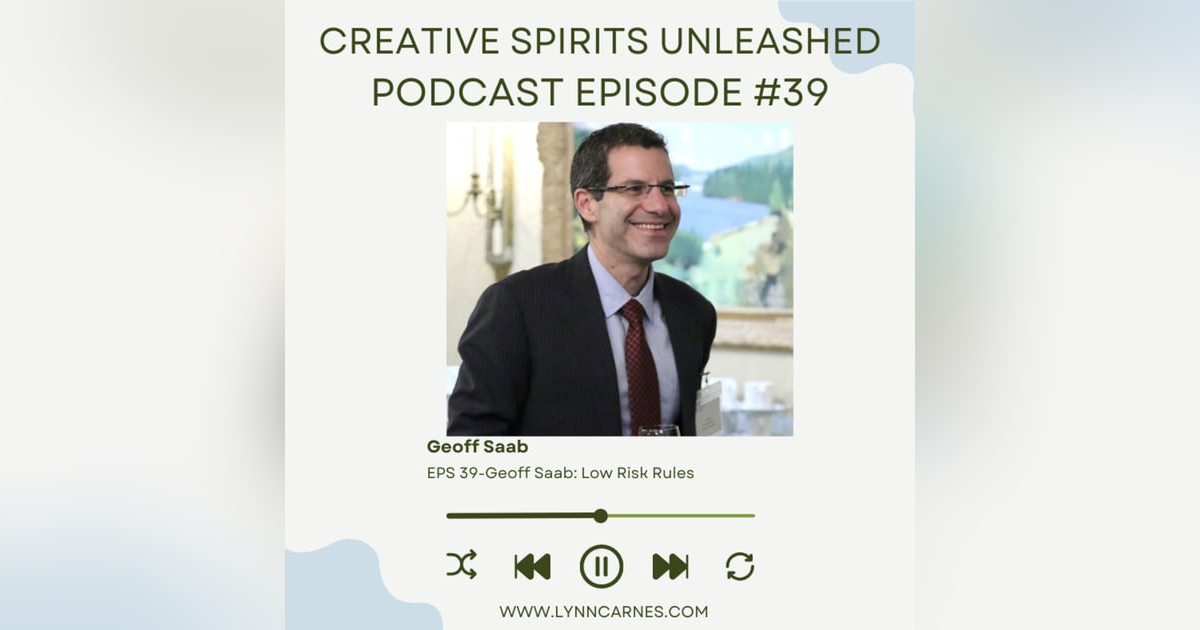


My guest for this episode is Geoff Saab, author of the newly published book Low Risk Rules, A Wealth Preservation Manifesto. If the word “manifesto” gets your attention, that’s exactly what Geoff was hoping for. He really does have a point of view on how to preserve wealth. His ideas apply to all of us, even though he wrote the book primarily for entrepreneurs who had sold their business.
Our conversation covered a lot of territory. One of the main themes of Geoff’s book and clearly, in his work with clients, is conviction. He has a point of view on the value of understanding and believing in the companies in which his clients invest. More importantly, he believes in going slow to go fast. His back to basics approach is both unusual and refreshing.
Geoff Saab is a wealth manager who has held various positions in tax, estate planning, and insurance, and now serves clients as a portfolio manager within an investment counsel firm. He spent over a decade working in a single family office, advocating directly on behalf of his clients. With his unique experience of working as both a wealth management industry insider and outsider, he has gained a deep understanding of how the industry works (and doesn’t work) for clients.
Disclaimer: This podcast is for information and entertainment purposes only. It is not intended to form the basis for any offer for any investment product. There are risks involved in any investment product.
Additional Topics
- So you sold your business, now what? Where do you invest your money?
- Entrepreneurs are living so much in risk, it’s hard for them to know anything different.
- Investment doesn’t have to be risky
- What do you do with huge blocks of time that you didn’t have before?
- Prestigious, Exclusive Investments aren’t always what you bargained for
- “Cool” investments aren’t always about you making money as much as it’s just something cool to be a part of.
- Concept of conviction
- When the whole world is going crazy, do you believe in what you own?
- Build your portfolio through concept of conviction
- Changing the mindset of your portfolio looking at it as a safety net.
- Basic fundamentals are the core of what makes the little things the big things
- What you keep out is as important as what you let in
Contact: https://geoffsaab.com/
Intro:
Welcome to Creative Spirits Unleashed, where we talk about the dilemmas of balancing work and life. And now, here's your host, Lynn Carnes.
Lynn:
Welcome to the Creative Spirits Unleashed Podcast. I'm Lynn Carnes, your host. I'm going to start with a disclaimer, this podcast is for informational and entertainment purposes only. It is not intended to form the basis for any offer for any investment product. And you need to remember there are risks involved in any investment product. Now, my guest is Jeff Saab, the author of a newly published book called Low Risk rules, a wealth preservation manifesto. That word got my attention, and it might have gotten yours as well. The word manifesto is exactly what Jeff has put together in this book, he really does have a point of view on how to preserve wealth. And his ideas apply to all of us, even though he wrote the book primarily for entrepreneurs who had sold their business and have significant wealth to invest. Our conversation covered a lot of territory. One of the big themes was, you know, it's, it was in our conversation, and it's in his book. And it's the idea of conviction, because he believes in understanding and believing in the companies in which his clients invest. More importantly, though, he believes in going slow to go fast. It's a back to basics approach. And it's both unusual and refreshing. Well, let me say a little bit about Jeff. He is a wealth manager who's held various positions in tax estate planning insurance. And now he serves clients as a portfolio manager within an investment Council firm. He spent over a decade working in a single family office, which is the office of a family business that has enough wealth to hire people to take to manage their wealth, advocating directly on behalf of his clients. He, he with his unique experience in working as a wealth management industry insider and an outsider, he's gained this understanding a deep understanding of how the industry works and doesn't work for clients. I would love to hear what you think about this conversation. I'm always excited to have a new author on the podcast. And I'm excited for you to find his his book at amazon or any place that you can buy books online, you can find him at Jeff saab.com. And you spell that with a G. It's Goffs, a b.com. And if you want to let us know what you thought of this conversation, go to my podcast page on my website at learn cars.com and click the Send to voicemail button on the right hand side of the page. Please rate the podcast if you enjoy it so other people can find it. And let us know what you want to hear in future episodes. Enjoy this podcast with Jeff shop. Jeff, welcome to the podcast
Geoff:
when thanks so much.
Lynn:
I have watched you well first let me start with people will have heard this in the introduction. But you have a book that just came out called Low Risk rules. And it's because of the book that we met because we were in the writing community and then in the writer salon together. So how does it feel to see a book with your name on it on Amazon?
Geoff:
It's surreal. It's I mean, it's been a long road, I guess we started this. I don't know about you. But for me, it was like something to do during the pandemic. We had just everything is just shut down. And I'd always had this thing in my mind that I wanted to write, but I didn't. I kind of said I'm not going to write a book. No one reads books these days, right? So years ago, I'd set up a website and tried to blog and I tried to put articles up and no one read anything that I did, I got no traction. And I'm not really self promoter, number one and number two, just from a regulatory perspective, like I'm in the investment business, just from a regulatory perspective, you can't really you have to be careful what you say in public. And you can't really say anything interesting, fortunately, because by the time it gets through your compliance department, it's been neutered. And if any of the listeners are wondering why all the investment ads and quarterly letters and everything that they read sounds exactly the same. That's why so I didn't want to do that. So we're at home and all of my meetings are canceled and all the As the dinners I'm usually at social events. I said, All right, well, might as well pick up this writing thing. Yeah. And it was a day that I got that email, both the reading community workshop. And it was like, today's the last day to sign up. And something just says, All right, let's do it. And we got into the process of doing it every day. It was the first time I written online that people actually reading it and giving me feedback. And it was awesome. And now here we are. Just over two years later, I guess. Maybe, almost,
Lynn:
like, right at two years, I feel like we started right about this time in 2020.
Geoff:
Yeah, possibly. And so and so yeah, it feels like it's been forever. And yet, it feels like it hasn't been any time at all. Because because nothing has happened. And we've been in a holding pattern, I guess these last two years. So it's really odd. But it's, it's an amazing feeling to come out of this period, which has been so difficult for everyone. And for me, as well, and to come out of it and have something like this. I feel like I didn't waste the last two years. It's a great feeling in that sense.
Lynn:
Yeah, it's interesting, because we do feel like, it's easy to feel like we might have wasted our time in the last two years, and yet you have a book to show for it. So yeah, describe who your audience is for the book. Because it's a fairly narrow audience. But it's I read some passages from it on your website. And I couldn't stop reading, like, I ran out of blogs. And I was like, Oh, one more? Yeah, I just, you're a great storyteller.
Geoff:
So I'll do more of that. My publisher told me when the book launches, you have to have four blog entries on at least four. So I've got some in reserve, I've got some deleted parts of the book, the book is, it started out as a guide for the person who sold the business. Yeah, the kind of economy that we've been in for the last, I guess, five to 10 years, there's been a lot of people making a lot of money, selling businesses, and a lot of them have made it especially what we've seen in high tech, a lot of people have made a lot of money in cryptocurrencies, like all sorts of kind of really high risk stuff. And I'll meet with them, and I'll talk to them. And there's, I think, a lack of appreciation for the risk that exists in the world. So I was writing a book. And originally, it was supposed to be kind of a lot more of a holistic view, I saw my idea was to start interviewing people who have sold businesses, because I got some really interesting stories from my clients. And from the people that I talked to that you think it's a time of celebration, you've kind of cashed in, I had someone called it with someone I was talking to called it I won the lottery. Yeah, like, that's how he saw it. But there's also and kind of this overwhelming thing that I kept hearing when I talked to people was, it's not a victory, there's, it's a really difficult adjustment in your life. Because you, you connect so much, and you identify so much with the business that you've built, that when it's gone. It's tough to deal with. So in my mind, the book was that was kind of part one of the book. And then part two of the book was to help give you some guidance on what do you do now? You know, you've got 20 million or 30 million in the bank, what do you do? How do you invest it? How do you hire a team to help you do it. And then the third part was supposed to talk about the and this is where the low risk of low risk rules come from, was supposed to kind of illustrate the investment philosophy that I think most people don't appreciate, but especially most entrepreneurs don't appreciate. And our philosophy really is that by taking low risk, you actually will earn higher returns over time, which is counterintuitive. So that was the original idea of a book. And then I had like three books written like when I first talked to my editor, her comment was you got like three books here. Yeah, I'm gonna cut this. And so I decided I wanted to focus on the investment side. So it's still the same audience. But by focusing on the investment side, I think it broadens it a bit. Because even if you haven't sold the business, you can appreciate the idea. It's still written to the entrepreneur. But I think if you're reading this as an individual who hasn't sold the business, but just has a portfolio, a larger portfolio to address. You can appreciate the thinking behind it because what it explains is and we're seeing it play out right now, so as we're talking, it's made 12 The markets have been kind of in freefall, we've we have cryptocurrencies collapsing, we have a lot of I think the high growth, you'll get a lot of the high growth names out there. I don't know them well, because it's not really the area that I plan. But a lot of these companies are down 70 to 80 90%. Even Yeah, so a lot of people are hurting. And it's the same people who made a lot of easy money for the last five plus years, particularly in the last two years. And so, really, what this book is about is it's outlining the philosophy around that, you know, it starts addressing the issue of what happens when you have more wealth than you need. So it's really written for the person who's got they know their retirement is funded, what comes after that, or what else can they do. But then an investment philosophy, because, frankly, this industry, the wealth management industry, is not it, it's a bunch of sharks, right? And, and there's blood in the water. And, really, the objective is, let's take in the book, I call it the juice. And if you if you have an experience gambling, you know, there's something they call the juice or the vague, and it's just that small percentage of the bet that the bookie is going to take to make it worthwhile for them. And, and basically, the whole finance industry is built on the concept of the juice, we're gonna squeeze half a percent of percent percent and a half, whatever we can get out of your portfolio over time, every year and your hope, we hope, you're not going to notice it, we hope we're going to make you enough money, that it's not going to be a factor. And we're going to do all sorts of like, really, we're going to package all sorts of fancy products and, and we're gonna give you promises of of, of low volatility and future riches and all this kind of stuff, we're gonna, we're gonna make all these promises. And then at the end of the day, we don't really care how investments do as long as you stick with us, yeah, make some money. The book is really about saying, forget what you're hearing, because there's a proven way to make money, it's actually easier than what they're pitching to you. It's time tested, it's the way that probably your grandparents invested with their brokers, when they were placed orders over the phone, and they weren't getting stock quotes all day long. But it works. And not only that, but academic research backs up that that a lower risk portfolio produces higher returns over time with lower volatility. The whole idea that you have to take risks to make money actually isn't true. And that's something in particular, entrepreneurs have a hard time, because that's how they meet. I mean, they were in the risk. Yeah, I use the David Foster Wallace water analogy, in the book. And that's the old story where the, the two young fish are swimming along, and the older fish stops them and says, How's the water? And one fish turns to the other fish and says, What the hell is water? Like, the the entrepreneurs are living, their water is risk. That's all they know. That's how they built their wealth. And so what I'm saying is, okay, now you've cashed in, the way you're going to protect the wealth is different from the way you built it. And we're going to do it with low risk, we're going to do it in a much different way than what you're accustomed to. But believe it or not, trust me, I'm gonna walk you through it over 250 pages, this is actually going to be better off for you in the long run.
Lynn:
You know, it, it does get to there's two parts of the identity there, though, that you just talked about that I think, make it much more difficult. One is the identity of, I'm tied to my business, and now I don't have my business. And the other is, I'm low risk is fine for all those other people, but I'm better than them.
Geoff:
Yeah, I say one of the things I say in the book is that people push back against it. They feel like it's a vote of non confidence against yourself. There. Yeah. Yeah. It's like, look, I did this once I can do this again. And in fact, the younger you are, when you sell a business, the harder it is for you. Because if you're 60 years old, and you've sold a business well, now my retirement plans done right, like now I'm gonna hit the golf course, I'm gonna hit the beach. If you're 35 years old, and you sell a business, you're wondering what's next? And you're wondering if you just got lucky, you feel like everyone else is looking at you saying act. I just, you know, he sold into a bubble. He got lucky. And you want to prove yourself again, one of the youngest people I talked to. And when he sold his business, he would have been in his mid 30s. around that age. He said that the six months after he sold his business were the most miserable six months of his life. He just didn't know what to do. Yeah. So there's very much this you lose your identity. And then you do also still feel have a need to prove yourself. And so you push, you get you kind of you, you keep it rolling, right? Like you're like, I'm gonna double down, what's the next? What's the next? What's the next startup I'm going to find?
Lynn:
Well, and and there's just something very practical in the day to day because this has happened for me a couple of times in my career when I took sabbaticals. And that is, what do you do when you're suddenly granted huge blocks of time you didn't have before? Like, wake up in the morning? And what am I going to do? And it makes me think a little bit of like, this is gonna sound crazy, but like, you leave a toddler on their own, you know, or a teenager on their own, they're gonna go get in trouble. So you leave entrepreneur with a bunch of money and no time, nothing to do because they have a lot of time. They could get themselves in a lot of trouble really fast.
Geoff:
Yeah, idle hands are the devil's workshop. Yeah, exactly. It's, it's, and there's a feeling that I think that's there's a big part of that is trying to prove yourself worth through your work. We're all I mean, that's what we all do. And we all place way too much emphasis on the things we produce, and the time we spend at work in terms of, you know, understanding who we are, and proving ourselves to other people and to ourselves even. And so yeah, especially if, if you if you're an entrepreneur, and you had a big exit, you devoted your life to this. You've given up you've missed family gathering. Yep. You've, you know, you haven't kept up with all the latest shows on Netflix, your heads been down, you've been working. And so that void is I wrote an article, it was an outtake from the book, I wrote an article on that. That's on the blog. It's called the crash. Yeah. And that was something that came out of the part one that was deleted. And, you know, that's, that's what happens. It's like, you reach this peak. And then you're like, is that it? Like, is that everything?
Lynn:
Well, and athletes do it? I mean, I think Tom Brady, what was he retired for all 40 days?
Geoff:
Exactly. I mean, that's a perfect example of someone who is operating at the peak of his profession, and just can't let go.
Lynn:
And by the way, did you see he's signed a 10 year deal to be an announcer? After so probably, as a hedge against what's going to happen? Because he's, it's clear, he's gonna have to retire. I mean, he's not going to be a 60 year old football player.
Geoff:
Well, we'll see.
Lynn:
Working on it, but but with the idea that he didn't want to have all that time.
Geoff:
So yeah, I think he's learned that about himself, right? Not only not only having all that time, but then saying, Okay, what do I do after and maybe lining this up so that he's ready to go? Yeah, I think it's also important to stress. You know, these, we're talking about exceptional people, when we're talking about someone who's who's had a big exit from a business, for example, we're talking about exceptional people who've done exceptional things. And it's thanks to them that a lot of people have jobs. It's thanks to them that that suppliers have someone to sell to, and customers have someone to buy it from, they've done something amazing. I don't think these people should ride off into the sunset. Like we need those people, those people are the ones that drive us forward. But I do think that, from an investment point of view, let's protect a good chunk of what you've got, right? Let's make sure the safety net is in place, then go play. I'm not saying don't go play. Because because I want you to do that. What I'm saying is, let's make sure we protect it. There's, you know, there's a story I know. And it was a met with a widow. And her husband had had built a company sold it in the 1990s. And the tech boom, then made a lot of money. He just kept rolling and rolling into new businesses. And when he passed away, she was left with kind of a I don't know how big the insurance policy was, but it wasn't a lot. And there was nothing else there. So, you know, we don't want that to happen. I think that's
Lynn:
really sad.
Geoff:
Yeah, I think it happens more often than you think. Because I, you know, I just, I constantly see these individuals who just they're on the treadmill and they feel like they have to take risk. They feel like they have to take risk, keep making money. The investment business takes advantage of that. says, Yeah, we're gonna we're gonna invest you in venture capital and, and hedge funds and all this crazy stuff, and they take advantage of that. So what I'm looking for, they just can't relax.
Lynn:
Well, it's like also a little bit of a private club, right? Like you haven't been given access to hedge funds, private equity deals, you know, you get to be on the inside. And I know for myself growing up in Texas, for example, The oil industry is really big there. And once my my dad, I grew up in the oil industry, my dad was a petroleum engineer. And at one point, we had some friends bring us an oil deal that came in through the investment world as opposed to directly through the oil business. And my dad just shook his head, and he goes, anything that's made it out into that world, you don't want to be a part of that club, because they're just taking advantage of you.
Geoff:
So, so before I did this, and the reason I have this, this viewpoint and these opinions, very strong opinions about the business, isn't just because these were my competitors, it's because I was a client. So I spent 11 years working in a family office, and I saw these deals getting pitched to the wealthiest. So like, when you say, just to clarify, you know, when you talk about a family offices as a wealthy family that's hired a dedicated team just to working with that. So what you're seeing when you're doing that the deals that are, the investments that you're evaluating are investments that are being pitched to some of the wealthiest people, and we're talking global banks would, would send you investments in like companies, you know, like I, I had an opportunity to invest in like a record that a really famous rock band was putting in, which was really cool. Like, I was talking to a manager of my email, and I was like, Oh, my God, I had an opportunity to put client money in an NBA team, like you're seeing these really crazy, but then the other thing that you start to realize is, these opportunities aren't making it to you, because you're so awesome. And they're so awesome. These opportunities are making it to you, because a lot of people have passed on them. Right? So, so you have to have your eyes wide open. And that's the thing is, I think that too much of the sales pitch is around that, you know, this is this is not everyone gets this, right, this is an exclusive club. Only some people can qualify for this. And it's all part of the sales pitch. And I say in the book, it's a brilliant sales pitch. Because could you imagine I mean, in this business, how do you make money, if I, if I can charge people more, I can make money. If I can lock their money in for longer, I can make more money? Well, when we're talking about these, I call them prestige investments where they appeal to your ego. With the prestige investment, I can charge you more because it's specialized. And I can generally lock you in for a long time. This is a trading on exchange, oh no,
Lynn:
if you're if you're an NBA team, you don't just go you know, click sell.
Geoff:
Right, so you're stuck. So if this company is losing money, you're gonna have it. You know, for years, maybe for decades, I've been able to get rid of this thing. So so it's a it's a perfect from from an investment firm point of view. I've just solved all my problems. I, I'm locking in your money for a longer period of time at a higher fee. Oh, and by the way, somehow, by marketing it as exclusive. I've got people lining up to invest in this. Yeah. Like, it's, it's wild. When you think about it, I call it a Jedi mind trick. Because people who should know better business people who should know better fall for it. And they fall for a lot of things in their investment portfolios that they don't in their businesses, and they should just use their business parts, when they're, when they're looking at what they're going to do after.
Lynn:
But there's that cool factor, you know, like you call it ego, but it's like, you get to say you're a part owner and whatever.
Geoff:
It's super cool, right? Like, restaurants are another one. I remember, I had a client want to invest in a restaurant, he just went to the restaurant a lot. He got to know them. Yeah. And it would be really cool to take a date to the restaurant and be a part owner of the restaurant. Right? Like, it's just like, it's really neat. And he had me look at it. So what do you think? I looked at the I said, Well, according to the shareholders agreement, the interest that you're that you want to buy for, I don't know, few $100,000 is worth zero. It's just it becomes this. It's a it's really cool. I mean, it's neat. And then you're invested in these funds. You get to go to these shareholder meetings on an island, maybe somewhere a lot of them are an offshore jurisdictions like it's,
Lynn:
it's cool. It is it is cool, but it doesn't mean you're making money. I know when I used to be a banker. And so when you said restaurant, I immediately was like, well, we just, you know, since something like 80% of restaurants fail within three years. They never were a bankable asset. It's a horrible investment, horrible investment. And I've actually had a restaurant as a client as a coaching client that's actually had quite a bit of longevity and a lot of profitability. But they they knew how much money they had on your plate when it went out. They knew the cost of every single item on the plate, you know, so they were very, very different than most restaurants. It's just like the cool factor we banked in enough fell team and we actually were able to bank them. We had a bankable part, and it was a very lucrative NFL team. So the cool factor was high, but they're not making necessarily their money on the team. They're making their money on the merchandise.
Geoff:
Yeah, I mean, and the problem is, I think when you go into a lot of these deals, you don't have any control. You're kind of your own limited partner, you're a minority owner, you're on point 1% or something. And you're at the mercy of other people who have other interests. Yeah, interests that are very different than yours. Yeah. So it's, I think that's a big part of the thing is, I want people to, like, let go of that. I say you gotta resist the FOMO. You've gotta resist this feeling that you have to be part of something because like you made your money by being an independent thinker, by doing things your own way, by challenging the way other people did things. Why don't you continue to do that? Why do you fall in line? When, when you're investing later on? It doesn't make sense?
Lynn:
Well, I think it comes to also to just our general relationship with money. And it is not a linear relationship money has an energy to it. And you know, you were talking, you use the language, somebody's out to prove themselves. Well, a lot of times the way we prove ourselves, is that scorecard what's in our bank account?
Geoff:
Yeah, well, I've mentioned more than once I've said, if your only identity is the money you have in the bank, you're not going to be a very happy person. And to many wealthy people. That's what they identify as, yeah, and it's hard to create some identity crisis to a certain extent, I find, especially when I'm dealing with children of wealthy families, who may not have seen the wealth being created, they only see they might have been very young or not even born, they only see the result. And often they're not thrilled with what they see. Right? Like, I think, especially nowadays, increasingly, young people are, they want to do good, like they don't, they want to perceive themselves as doing good and making a positive difference. It's not just about consumerism, it's not just about driving a fancy car, I'm amazed at how many like I couldn't wait to get my driver's license when I was 16. And nowadays, there's so many 20 year olds don't even own a car, like they don't care. It's so different, it's very different. But they really care about that. And they don't want to see I think a lot of them will rebel against wealthier parents, if they don't see some kind of purpose that the wealth exists for that it's in service of. And that's something else I talked about in the book is, you know, the, and I only covered very briefly in this book, because I did focus more on the investments. But at its core, the key, the key, I think being happy as a wealthy person is to forget that you're wealthy, like, it's just a tool. If you're counting your money, if you're watching your account, balance, go up and down, like you're gonna drive yourself crazy.
Lynn:
Especially in this market,
Geoff:
especially in this market, in any market, it's gonna force you to make mistakes. But most importantly, you know, I say the money is there to serve you. It's not there to serve your investment advisor. You know, you can't take it with you again, it's like, what are you? What's your why? What are you trying to do, whether it's charity, whether it's setting your kids and your grandchildren up are what like, there's all sorts of things. But really, if you focus on what you're trying to achieve, then you worry less about what you're not chasing returns. Chasing investment returns doesn't create a fulfilling life, you can have a really like, the more money you have, if you think about it the right way can really help you fulfill your life. You can have experiences other people can have, you're going to help people you wouldn't otherwise be able to help you can really make a difference and leave a mark. But you don't do that by chasing ever higher returns. I think you do that by simplifying the investment portfolio, which is what I try to help people do, which is what the book is about. Yeah. And focusing on the changes that you want, that you want made in your community and your family.
Lynn:
Yeah. Well, you know, it's I had a life altering moment, reading Warren Buffett's letter probably 10 years ago. I can't remember where I think he was still in the middle of the famous 10 year bet about whether or not these fancy hedge fund managers or investment managers, he, you know, you've probably can describe the bet better than I can but I think he took on the most brilliant investment minds and says and said over 10 years you can't beat the s&p 500 And they took him on and the bat was, you know, I think it was a million dollars going to the charity of their choice. And at the beginning, it looked like Warren Buffett was the dumb one. At the end, there was no way they could beat him. You know, the s&p Beat them. But that was a bat. And when he said he was going to have his entire investment portfolio, outside of whatever was in Berkshire, go to the s&p 500, which is a simplified index. And again, we're not making investment advice here. But this is what I read, that was a really life altering moment. For me, it was like, you know, it's actually pretty simple. And as long as this is the market, now, if all hell breaks loose, and we no longer have the system we have, it's not so simple. But then I'm eating, I'm eating fish in my like, instead of food from the grocery store.
Geoff:
Exactly. Exactly. So you know, a couple of things. I actually use that example in my book, because I talked about the hedge fund industry. And, you know, I think it's an industry that started with noble goals like it, they called hedge funds, because originally, they actually hedged like you could, you can count on them to smooth out your returns over time, what ended up happening is, I think the vast majority of them just became like other baskets of stocks. So you end up paying those higher fees that go with the more active management, but you're kind of getting the same returns. And so the bet with the Buffett, he took someone whose profession was to go out and find the best hedge fund managers. And I can't remember how many pick that might have been 10. Or
Lynn:
if it was like, I don't know why it was eight or 10.
Geoff:
But he went out. And he said, he said, I'm gonna give my money to these hedge fund managers, I believe that over the next 10 years, they're going to be a passive investment in the s&p 500. And they didn't even come close. You know, I think a big part of that is the fees that are charged. A big part of that is that when you've got somebody pursuing these kind of more complex strategies, they have to adapt to market conditions, which are always changing. I think I talked about it in my book. And I remember when I first pitched it to the, to the publisher, and I talked to someone who would become my editor, she said she was I really was interested in your book, because all of the investment books we see, everyone's talking about the positive aspects of indexing. And you said yours, you're bad mouthing, indexing. So I want to understand where you're coming from. So I'm not bad mouthing, indexing for me, I talked about the concept of conviction of really believing in the investments that you want. So if I have an apartment building, and you know, I've got a few units, and I'm making $50,000 a year and right in my apartment building. I know what that's worth, right? I'm getting that cash flow, and I can kind of like, I can, I can estimate what I what I would value that building at. If the real estate market goes crazy. And somebody comes to me and says, you know, I want to buy your building for$100,000. I'm gonna say no, like, I'm just gonna say like, I'm making 50 grand a year on it. Yeah, I'm in a good neighborhood. I'm fine. I'm not telling you this building for$100,000. But if every like if if like, my neighbor sells his building for $100,000. Now I'm thinking like, what's going on? Like, am I missing something, but I understand what I own. I have conviction in that apartment building, I'm not going to sell it. I think we need to think of our portfolio in the same way when the whole world is going crazy. Do you believe in what you want? So we're watching this happen? We're watching this play out right now, I don't know when people are gonna be listening to this. But by then, who knows where, where the world where the market is, right now. We're actually watching cryptocurrencies, like large ones with billions of dollars. Like get vaporize. It's really hard to have conviction in something like that. Because the whole value of the asset depends on what someone else is willing to pay you for it. That's where the value
Lynn:
is, right? It doesn't have any inherent value, otherwise,
Geoff:
it doesn't have any intrinsic value. And so, you know, what I say to the entrepreneur is, well, let's build a portfolio out of things that you understand that have that intrinsic value. So yeah, there might be a real estate portion and we don't manage that. But you know, you can have that. I talked about apartment buildings, it's something everyone understands. But you know, just think of some large blue chip stocks, right that pay dividends that have positive earnings and positive cash flow and have for decades right now These are boring stocks. They're generally nobody's talking about them. They're not on the front page of business section. They kind of go unnoticed and unremarked. Everyone's paying attention to all the high flyers, everyone's paying attention to Tesla. Everyone's paying attention to Apple. Buy me apples, a great company makes a lot of money. But oh, yeah. But what I think I'm trying to get at is like, everyone's trying to think that the way to make money in stocks is to buy something that's going up, and then sell it when it's really high. Like, I'm not sure. Whereas I think the best way to make money in stocks is to buy really good quality companies that you have conviction in their business, and just forget that you own, like, you're gonna make money over time. Where I think, and they criticize indexing a little bit, I think indexing is for the average investor, the right choice, right, you can keep your costs down, I'm just going to own a little bit of everything. That's fine. Yeah, I think for the average person, that's great. I wrote this book for the wealthier investor. And I think it was gonna make
Lynn:
distinctions. So
Geoff:
think about the wealthier investor is, as your portfolio size goes up, your cost of management goes down, proportionally, to what you've got. So you know, someone with$100,000 portfolio may be paying a percent and a half, someone with $100 million portfolio is going to be paying significantly less. And so the cost savings from from investing passively, are worth less to you. Just because the delta is going to be smaller. And the other thing that I think is really important, and I make this point in the book is you can't really passively, if you've got$100,000, fine, you can throw it all in the index $100 million dollars, and you throw it all index, you got to know what you own. And this is always changing. And sometimes it's hot, it's got stocks that are very expensive, that are very momentum driven, it's going to be more concentrated in the more expensive riskier parts of the market, market peaks. And so you need to hire a professional, right? You can't do it yourself, when you've got $100 million. Now all of a sudden, I've got a smaller delta between passive and active. I'm paying someone to manage my passive funds. For me anyway, I might as well invest actively. Now. I'm gonna invest actively, let's do it in a way that minimizes transaction costs and minimizes tax costs is based on these very long term. Fundamental, time tested ways of investing. And that is by this boring stuff that nobody else wants. It's that apartment building, right? Just buy these proverbial apartment buildings. And watch their business grow. It's gonna they're gonna grow slowly. They're not going to keep up with, you know, fads are going to come and go, yep, your neighbor is going to be getting rich. And your portfolio is going to be plodding along. But it's, but it's going to do well, I think, you know, looking at what the markets doing at a time like this, it's hard people are getting shaken in that conviction. If they bought peloton because they liked the bike. I think that stock is down 93%. Right. Whereas if they bought Walmart, I don't know where Walmart is today. But if they bought Walmart, instead, it's a boring stock. Everyone was talking about peloton, and you know, it feels cool when you're, you know, you're working out but you know, you own a piece of the company and all this stuff. But I bought Walmart,
Lynn:
and the pandemic, you know, they just missed what was happening in the pandemic, which was, you know, the one thing we can know about exercise equipment is it's great as a coat hanger after a while or something to drape your towel on and peloton
Geoff:
was brilliant, because basically the innovation there was the you had to pay a subscription for your car. So yeah. But But I think you know, it's a pandemic is a perfect example. If you had known two years ago, what was going to happen if you had known two years ago that two years later, we were still going to be dealing with it. And there's still gonna be travel restrictions and everything else China's still should their supply chains are a mess. If you've known this two years ago, you would have sold your stocks and walked away. Yeah, but we're up since then. We're up significantly since that. Another thing I talked about in the book is, you know, nobody knows. Nobody knows. Everyone's just trying to figure it out. So don't try and time the market. Don't try and get in and out. Don't try and you know, even something as as significant as a global pandemic. If you had perfect knowledge that it was going to happen, you wouldn't have made any money. Like you just wouldn't know. So now so if you can just own quality artists and tune out the noise, it's so much easier. It's just, it's just life is easier. I have less stress I'm not worrying about all this stuff, I just like, I've just got my blue chip stock portfolio, and I'm just moving on with my life. And I can have conviction in it and trust it, because I know what I own. That's all it is. And go ahead.
Lynn:
Well, I was gonna say, you know, let's go back to the part where you talked about that section you have on the blog of the crash. And what I'm hearing is, if I can know my wealth is taken care of, then I can focus if I if it's the people you're writing to, or the people who've had this, like liquidity event. Now I can focus on getting on with making my life rich and meaningful. And I don't mean rich in the money way, but I mean, rich in a fulfilling way.
Geoff:
Yeah. And then the portfolio is just a tool. It's not the focus. Yeah, it's a tool, right? I'm not going to use this portfolio to make my next $50 million. That's not what it's there for this portfolio is the safety net. So now I can go out and I can I can invest in that new startup, I can. You know, I can, you know, finance that, you know, water supply in the village in the old country, whatever it is, like I can write, I can do these things that mean something to me. And I'm not watching stock prices. I'm not trying to, you know, find the next Google or something, because you're not going to do that anyway.
Lynn:
Yeah, a lot of people are looking for that next Google and, and, you know, you said something really interesting. It triggered a memory I had from a couple that I encountered when I was in the banking world. And it was that I'm not going to, like, use this to make my next 50 million. And he was a serial entrepreneur, and they were in their 70s. And she had lived with this their entire marriage, I finally had a good nest egg, she's ready to retire. And he's wanting to plow all a lot of money into another business. And he was also going to be guaranteeing some loans and taking on a lot more risk and their wealth than she was comfortable with. And they actually sat down with us at the bank and said, we are considering getting a divorce. Not because we're splitting up, but so that we can protect the assets for her. Wow. Because that was his she had pushed him as far as she could go. Yeah, right. Like he wasn't going to stop and she had finally come to accept it. And in their mind, they I guess they hadn't considered other methods like trusts or other ways to sort of shield assets. But in her mind, the only way it was going to be shielded. And I don't actually can't even remember if they actually did it or not. But having met him, I could see her issue because he basically needed to roll the dice to feel alive.
Geoff:
And well, keep in mind, like the entrepreneurs are really tough to deal with, like you're dealing with very headstrong people. Yeah. And I, when I started writing this book, I said, I'm writing it just as much to attract the right kind of client as I am to repel the wrong kind of client. Some people do not want to hear this, and there's nothing you can do to change that. Like they have no interest in taking their chips off the table. They would die inside if they did that. And I mean, that's cool. Like I said, I think the world needs people like that. But I think that, you know, that's a stark example of, could you have, could you have done something? Could you Could we have like, diversified your resume feature, your wife has taken care of everything else, and then still allowed you to pursue this. Could we have tried to bring in outside capital? Yeah, that's a big flag, right? Like, if you're a successful entrepreneur, and you can't raise outside money for your next venture, maybe the market and the other investors are trying to tell you something. Right? Right. course they're not going to listen to it. That's like the type of person that says they they didn't make money listening to people. I don't think Elon Musk is taking advice from people. He's just doing whatever he wants to do. Yeah, right. So that kind of person is gonna say, I'm gonna charge ahead. I'm gonna do it. And and risk be damned, and downside be damned? And that's what they do.
Lynn:
Yeah. Well, there's a lot of threads we could pull from that. Because, you know, I think about the people that I worked with when I was in a big corporate environment at a bank, who tended to have more of an entrepreneurial mindset. And they didn't last very long. Partially because they were willing to take more risk and partially because they wouldn't listen. And generally, they went out and started their own businesses. And frankly, once I started my own business, and I'm, I'm more of a freelancer than I am an entrepreneur. But I'd say Jeff, within I'd say within three to five years of leaving the corporate world, I became unemployable. Yeah, I think I think I would listen to my investment advisors, but I wasn't I wasn't willing to play that game anymore.
Geoff:
Yeah, like I just like I said, It's a certain type of person. But that's the, you know what this is why I love working with entrepreneurs, because it's that it's that energy, like I feed off of it as well. I'm good at following the rules and playing the game. But, you know, there's also that rebel streak, and I appreciate I like being I like being in the inner world of that type of person. Because, yeah, like, at the end of the day, how do you do something like that exceptional, you're looking at the way things are done, and you're like, Ah, I can do better than that. Like, what are these guys doing? I can do
Lynn:
better now. There's a better way. And they've given us a lot of better ways to do things, you know,
Geoff:
yeah. And the book, I call them the heroes, because that's what they are like, the world without all the progress we're making is coming from these people. It's coming from the businesses that are created. And all of the all of the people with the safe corporate jobs wouldn't have those safe corporate jobs if it wasn't for those people who are pushing the boundaries. Right. Like, they're the heroes like, the in the investment business, these guys show up in their nice suits, and their and their next brochures, and they're trying to like, you know, sell you stuff. And I'm like, Well, you, you couldn't invest in their funds. That's kind of boring. What do you invest in these years, we're building something. And really believe in what they're building like, and I think it's speaking to the entrepreneur, because there that's that.
Lynn:
And that goes back to your, that's really what great way to connect it. So when you're talking to an entrepreneur, I sound like, if they are needing to find a good way to invest, you help them see the apartment building for what it is and say, Go help this other hero. build their business.
Geoff:
Yeah, like, and that's a good way to build conviction. Right? There's like, there's a, this isn't just lines on a graph. This is like a business led by people who are the best in the business. Right? Like, you get to a leadership position. And fortune 500 company, you know what you're doing, generally speaking, but it's like, you know, you're investing in those people, you're investing in their ingenuity. I use the example in the book of like, Hurricane Katrina, Walmart was more effective at getting supplies to the area than the federal government was 100% believe that. Those are the people you're investing in. Yeah. Right. So and so if we're encountering, like, we encountered COVID, you know, good example. You know, going back was, was Disney, which the stock isn't doing great today. But they had pivoted to Disney plus and online streaming and going directly to their consumer. And they did that. And even though the theme parks shut down, because of COVID, they were able to the stock did quite well, initially, because there was that pivot away. Yeah. So it's, it's, I mean, that didn't just happen. There was they didn't know COVID was coming. But there's a management team behind that. There's all sorts of businesses who made all sorts of pivots. And as I say, it's like you've made those pivots in your like, in your business career, you've pivoted multiple times. Yeah, right. And so am I gonna sell a stock? Because I read because the stock is down. And I read some article by some reporter who's never run a business in their life. Am I going to sell that stock? Because this guy says that the stock is expensive, and the earnings are gonna go down? Or am I gonna say, let's really understand what's happening in this business? So that's what I'm doing for them, right? It's like, we're trying to pay attention to what's happening inside the businesses. Were listening to what management is saying, we're looking at the numbers, and we're trying to evaluate whether it's a good business to own at any given point in time that patients with them, have you that's the conviction that I'm talking about, comes from knowing I own a business run by smart people who are going to figure this thing out.
Lynn:
That's everything. I mean, and in a lot of ways. That's what people like Warren Buffett have proven work over time study, because he's investing in things like See's Candies and Shaw carpets and Clayton Homes. And, you know, you think what the heck is Clayton Homes will drive down any country road, I do it every day. And you start realizing where did all those homes come from?
Geoff:
Was it like Buffett is he is who he is because of who he is. And when he's like, that's exactly at any end when he talks about these companies. He doesn't talk about them as investi companies, he talks about them as partners. Yeah. And, you know, we think about it the same way as like, I'm effectively for all my clients behalf. I am hiring the management of these companies to manage my clients might. That's it, you know, we're trying not to pay too much. I think that's kind of where our expertise comes in. We try not to pay too much for these investments. Sometimes you do never get it right But I think if you pay a fair price, what you ended up with is hopefully a long term partnership with the management of this company, and you know, the firm that I work for right now, we've been around for for 40 years, and their stocks and our portfolio that we've owned for several decades.
Lynn:
So you've been around for how many years? I didn't hear? Well,
Geoff:
the firm that I work for has been around forever. Yeah. So it's a minority,
Lynn:
he say, 48 years,
Geoff:
I think, 4041 or 4204. But that's multiple decades. That's a long time. Yeah. I mean, but there are stocks in the portfolio that go back that far. So really, you know, that's, that's how we think of things when we're buying a company's stock is, you know, the management is there. As a partner, really,
Lynn:
yeah, not long ago, I actually had a stock that I'd had for dang near 40 years. And I had I bought it and if I was a watcher, I would have gone crazy, because it was flat for most of that time. But I bought it based on good fundamentals of it was a bio, like it was a pharmaceutical type thing. And it was like, these guys are going to figure this problem out. And in the end, I think I sold it for 10 times what I paid for it
Geoff:
universally. I can say that the people who I've seen who come to me, who I've seen kind of in over 80 like older people who've made significant money and investment portfolios, have done that they've bought stock 40s 50s 60s And then held it and it's just compounded. And, and then my job becomes kind of how do you how do you manage the capital gains liability as you sell it down, I tell the story in the book of a client at a firm I work for in the past, and she had never made I don't think she ever made more than like $30,000 a year. And she built up a portfolio with several million dollars. And she had a very simple way of doing either like I'm just gonna buy, if I know the company, I like the company, I'll buy the stock. As long as the dividend keeps going up, I'm gonna hold it, I don't care what's happening. If they
Lynn:
ever right way to look at it, if they ever cut the
Geoff:
dividend, will I just sold the stock and I reallocate it to the other ones. And she accumulated a huge portfolio over the years. And it's funny because like she had no finance training. And it's funny because I remember at one point, I saw an academic paper that was written that talked about the subsequent performance of firms who cut their dividends and everything else. And basically, you know, confirming everything that she was doing. And I tried to find it for the book and I couldn't find this. Oh my gosh, what happened to it?
Lynn:
Did she? Did she reinvest those dividends as well? Because that would have helped the compounding effect.
Geoff:
I'm sure she did. She did not spend a lot. So there was a combination of being it's combination of being very frugal, and I drove she didn't have kids we talked about she wasn't married, which also helps. But you've accumulated this giant portfolio who really not spending a lot and saving and just kind of sticking to the basics. And you know, I talked about playing your own game. She knew what her game was. And she played it. Right? She didn't care. She invested through like the hyperinflation of the 1970s. And she didn't change her investment style. Because of that she invested through like wars and severe recessions. And like she nothing. Nothing changed what she was trying to do. And I'm sure if you're still alive today and still investing, I'm sure she wouldn't be in Bitcoin. I'm sure she wouldn't have bought peloton stock like I'm sure she kind of just want to stuck to what she did, and it worked for her. And all I'm saying to people is find the thing that works for you. Like Lynn, you mentioned, you mentioned passive investing and indexing. I think for a lot of people that works. Yeah. And a lot of the people I've met and I've talked to, especially if they've got a more technical orientation, engineers seem to like it. Kind of people with that analytical view, they understand the philosophy behind it, and they get their conviction through that. That's great, right? They're gonna stick with it. Entrepreneurs I find get their conviction through buying businesses.
Lynn:
That's a really nice distinction. And actually, I have to go back to something you said about the basics because it dawned on me. I you know, I'm a water skier and I'm also into horses. I just got off my rowing shell a little while ago, I was rowing. And I was thinking about the idea of the basics, because, you know, every horse trainer that I've ever worked with, that was really good. says all that really matters is the basic fundamentals like you see these horses do magnificent things, but it's because they can do the basic so very well. And in waterskiing, the coaches that I've worked with wading in the world will say, you know, that basic position of the of the person behind the boat, nobody's going to ever do anything dramatic if they can't do those basics very well. And I think you're just heading to a first principle of success, which is, the little things are what make the big things.
Geoff:
The older I get, the more I realize that we overcomplicate things. And I have overcomplicated things. If you can kind of stick to at the end of the day, there's a million different variables, right? Like we're always trying to predict, you know, what, what's the economy going to do? What are the markets going to do, and everything else is like, at the end of the day, if you can stick to a couple of key variables. I think you'll be right more often than you're wrong, you're still gonna be wrong, sometimes, you're still gonna miss things. But if you can be right, just incrementally more often than wrong. And I think that by simplifying, right, you stick to those basics. You talked about Buffett, I mean, one of the reasons that one of the reasons he's so admired is because of the way he can really simplify everything, the things he says to people, I think what he's doing behind the scenes is a lot more complicated than that. But I think it's still fundamentally being driven by that very common sense. Approach, like the basics will never change, then if you can develop over time your own in whatever field that you're in, if you can kind of figure out what's noise and what's worth paying attention to. And I'm, I'm still working with that. But I feel like I'm getting better at it. If you can focus on what's worth paying attention to, then it's just we're in a world right now. It's so loud, there's so much coming at you. Yeah. And filtering stuff out is maybe even more important. So what you keep out is almost more important than what you let it
Lynn:
I would say that's you just nailed one of the it's actually one of the critical principles in my book is the ability to discern signal from noise. And to actually like, learn how to just like, let's, let's take a practical example, you know, Southwest Airlines, was started on the back of a napkin with with Herb Kelleher and the other guy, I can't remember his name in a bar. And they laid out like on the back of a napkin, the business model, which is a fancy term for how do you make money. And if you can't, to me when I'm looking at businesses, and I used to do this as a banker, and a lot of times, I had to go evaluate a business, and just getting the financial statement was the work, right, not like a public company where the financial statements were out there, we had to get them. You know, if we could get a financial statement, we knew we had a good chance of landing a deal with them, I learned how to build a balance sheet and income statement by walking a factory. And actually, that's what I used to try and credit people to do. But if you can't understand it, so I'll give you an example of what it looks like to not understand it. If you can't, like look at it on the back of a napkin and say, Okay, you do this, you get this much money, you spend this kind of money, this is how much money comes out. But we were we were talking to somebody who was wanting to make a big real estate investment. And while he was investing relative to the potential sales price and revenue model didn't seem to make sense to me. And I kept saying what, tell me what's how you're gonna make money here? And he said, well, the consultants are telling me and he said that 10 or 15 times in the conversation, you're giving me that knowing smile. And at that point, I'm like, Well, if you don't even know your own business model, why are you putting so much money in it? And needless to say, he did do the deal. It ended up in devastating bankruptcy. So
Geoff:
you taught you sit, you said, you know, you gain that knowledge by walking the factory. Yeah. And that's, to me, that's the key. That's what this is all about. At the end of the day, you're building a portfolio, you're buying pieces of businesses. And so doing it in the academic finance way, of I'm going to use all these equations, and I'm going to study all these relationships, and I'm gonna buy baskets of 1000s of different shares. It's a commodity, right? At the end of the day, these shares are pieces of paper, they mean nothing. That's right. I can be trading anything. Or you can buy a piece of business that you understand. You don't have to have walked the factory floor. Yeah. But you can understand the concept behind it. And I think when we're talking about building portfolios, that's what it's about. It's about having that inside understanding of what it is that you want, and how are you going to earn that return. So you This calling you talk with did not didn't really understand their their business model, if you don't understand where your portfolio return is gonna come from, it can't just come from more people buying stocks, or, in my opinion, a vague notion that earnings are going to increase, but really like, what is this company? What's their? What purchasing power do they have? What is their cost structure? Like? What's the competitive environment of their industry? If I can understand all this stuff, I can have a lot more conviction in it. Yeah.
Lynn:
Yeah. And I mean, it's like, then you as the I mean, the old saying, Put your money where your mouth is, is the old saying of the entrepreneur, then you get to me, this sounds like you've learned how to build portfolios for entrepreneurs that satisfy their innate need to care.
Geoff:
I think it helps. And again, it depends on the person, but I think for the right person, you know, this, this message resonates, then we know they're the right person, that really, the idea is kind of, we're gonna protect your wealth the same way you build it. But what you don't realize is when you build it, there's actually a lot more risk than you realize, like a big part of it is luck. A big part. We haven't even talked about this. This is a whole other topic that I cover in the book is basically like, it's hard for entrepreneurs to admit that the reason they succeeded to a large extent is because some things fell the right way. And if they different way, they might have completely failed. I mean, we don't know.
Lynn:
You know, Jim Collins did a research thing on return on luck. Okay, the guy that wrote Good to Great, I heard him talking maybe to Shane Parrish on. This is a podcast, I love to listen to call the knowledge project. And I feel like it was on that podcast it might have I've listened to several Jim Collins podcasts, because I'm using his flywheel concept in my book, but that idea of return on luck, there's a real thing there. And the truth is, a lot of people fail, because they just missed the luck.
Geoff:
They just missed a lot. They had all the skill and, and a lot of people who've succeeded, I think it's, it's, there's a study that I cite in the book, and entrepreneurs don't believe in luck. They don't. If they did, they would probably never become entrepreneurs. It takes a certain type of person who is going to walk away from the steady paycheck and take the risk. A person has faith in themselves, and an internal locus of control a belief that you control their fate. And so when you discount the role of luck, I think you again, you end up with, I think, too much confidence in your ability to control outcomes. That's good when you're running a business. But it's not so great when you're investing because I think in investing so much as control. So what what I say to people is like, we're gonna protect your wealth, same way you built it, but we're gonna do it with a bunch of lower risk businesses than the one that you built it with. And if we can spread out our bets, and we can do that you're putting the odds on your side.
Lynn:
I like that. It's interesting. Do you listen, have you you know, Guy Ross's how I built this podcast? Are you familiar? He always asked the question at the end, how much of it was luck? Versus you? And you know, it's a variation on who, how they, how they did the different people admit, you know, the luck was there so well. So tell people as we wrap up, how to find your book, and how to find you on the socials and stuff like that.
Geoff:
Well, the book is available everywhere online. It's called Low Risk rules. A wealth preservation manifesto.
Lynn:
I like the word manifesto.
Geoff:
Yeah, I've gotten caught. It's it's an attention grabber. I like it. It's worked. People have commented about it. And it is it is a manifesto. It is yeah. You know, every chapter is kind of a belief, a directive. Yeah. around some of these themes that we talked about, so it's available everywhere. If you're looking for Jeff, Saab, Jeff is spelled with a ge ge o FF. And that's probably the best place to find
Lynn:
and Saab is to a so you've got two F's and two A's. There you
Geoff:
go. You got it. So and that's my website would be Jeff saab.com.
Lynn:
And that's probably the best way to find you is Jeff which is GE o FF s a b.com. It Yeah. And the blog, by the way, I love your blog. It's short, sweet to the point, but gripped me. I was like, I want 10 more. When I went to read them. Well, they
Geoff:
kind of that, you know, I might have discovered something there. Just out of pure luck, because those were all segments of a book and there was always supposed to be more there, but they're never I never wrote it. So I threw them up there. and they do I think they kind of leave. I've gotten that feedback from people and they kind of leave, they're either wanting a little bit more. So I don't know. But I'm going to try and put some more more stuff up there around around that topic of what happens after the sale. And then, you know, I'm, I'd like it to remain timeless. But I've toyed with the idea of even sometimes commenting on what we're seeing in financial markets. But for now, I've avoided that.
Lynn:
Well, you know, what you can always comment on is markets go up, and markets go down. And, you know, I always think about, like, we're in the middle of a big real estate boom, where I live. And the way I can tell the markets about to go down is because new real estate offices are opening. And every time people finally catch up and say, Oh, we got to put more people in, in the market and so forth. That's usually the best signal that things are not going to be great in six months.
Geoff:
So you can you can see, I was, I was around in the late 90s was around and Oh, 708. I'm seeing you know, I saw the same pattern leading up to this. The problem is when you can't, it's hard to say six months, because sometimes you might take six months. And it might be two or three years later. And in the meantime, you you lose patience, and you get sucked in. Yeah. It's the psychological element of investing such a challenge. Yeah. And that's why I think keeping it simple. Yeah. And limiting your options actually helps you in that way.
Lynn:
Well, I'm really grateful you were willing to have this conversation with me and share your wisdom with lots and lots of people. So everybody, go check him out at Jeff saab.com and get the book. He's a phenomenal writer. I love the way you tell stories. And it's going to be worth your time to read it. So thanks.
Geoff:
Thanks so much for having me. And I think I think I've mentioned this to you in the past, but I wanted to read thanks. Because very early on, in the writing journey. You were one of the first people in our group to actually have a book like physical form. And I remember looking at that, I think I remember commenting on your coverage saying, like, it looks so good. It's so professional, it was one of the things that really kind of kept me writing kept me moving forward was the idea that, hey, you know, one of one of us from this little small group here could make something like that. I needed a little bit more time. But But Lynn, you know, your your work was, was certainly inspiring that so much.
Lynn:
Thank you. I appreciate that. And it's been DITA because I, you know, we read along with each other's work and the community. And yeah, I could see where you were going. And I knew this was going to be a great book. So it's thrilling to have you here as it's coming out.
Geoff:
Thank you so much for having me.
Lynn:
Thank you and everybody. If you like the podcast, be sure to rate it on your podcast app, you can leave me a voicemail on my website, there's a button on the right, you just click send a voicemail, and I get to actually hear from you directly. So we'd love to hear that and look forward to seeing you at the next podcast. Thank you for listening to the creative spirits unleashed podcast. I started this podcast because I was having these great conversations and I wanted to share them with others. I'm always learning in these conversations, and I wanted to share that kind of learning with you. Now what I need to hear from you is what you want more of and what you want less of. I really want these podcasts to be a value for the listeners. Also, if you happen to know someone who you think might love them, please share the podcast and of course subscribe and rate it on the different apps that you're using, because that's how others will find it. Now, I hope you go and do something very fun today.


