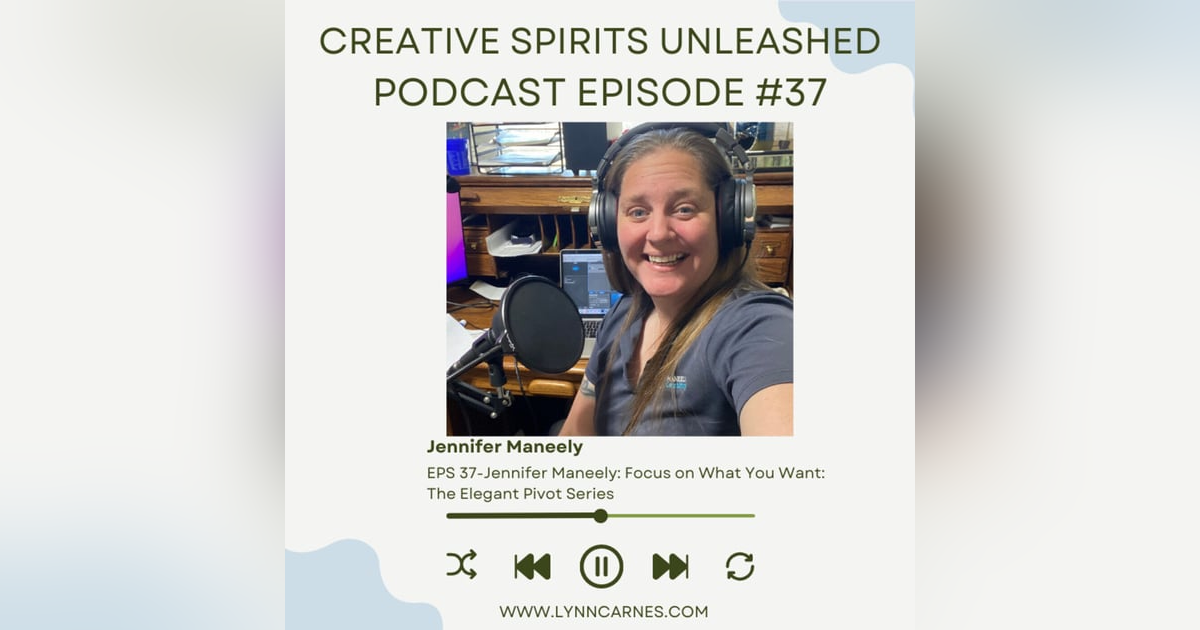
#37: Jennifer Maneely: Focus on What You Want: The Elegant Pivot Series


Don’t think about a big, purple elephant with white polka dots and a pink tail. How did you do? First you had to think about it to not think about it. That’s the point of the principle from chapter 9 in The Elegant Pivot: Focus on What You Want.
This week, Jen Maneely joins me again to share our stories on our successes and failures in applying this principle in real life. We never know where one of these conversations is going to take us. We both had a number of insights as we worked through several of our own situations, especially one we debriefed at the end of this podcast.
If you have been trying to assume positive intent and found it more difficult than you expected, listening to this conversation will be worth your time. Not only will you give yourself a break – because it’s harder than it looks – you will come away with a few tactics that make it just a little easier to get curious instead of defensive.
Additional Links
The Elegant Pivot Workbook
Guest Contact Info:
Website: ManeelyConsulting.com
Email: Jennifer@maneelyconsulting.com
Intro:
Welcome to Creative spirits unleashed where we talk about the dilemmas of balancing work and life. And now, here's your host, Lynn Carnes.
Lynn:
Welcome to the creative spirits unleashed Podcast. I'm Lynn Carnes, your host. I want to start this introduction by telling you not to think about a big purple elephant with white polka dots, and a pink tail. Don't think about it. Okay, how'd you do? Well, I'm pretty sure you first had to think about it to not think about it. Because that's the way our brains work. And that's the point of the principle from the chapter of nine avail of elegant pivot focus on what you want. This week's conversation is with Jen Mineola, who joins me again for another part in our series on the principles of the elegant pivot. You know, when Jen and I do these, we never know where the conversation is going to take us. We both had a number of insights on this one, we work through several of our own situations live and in real time, and especially one that was very cool at the end of the podcast, where we debrief the situation that we actually hadn't debrief some of the back story with and where we both had to work on focusing on what we wanted. So if you have been trying to assume positive intent, if you've read the elegant pivot and said, Okay, assume positive intent sounds like a thing I want to do. And then you found out it's really hard to do, then this conversation is going to be worth your time. Not only will you give yourself a break, because it's harder than it looks, if you've been saying I should be able to do this, why can't I, you'll find out, maybe it's harder than it looks. But also, you're going to come away with a few tactics that make it just a little bit easier to be curious, especially when you're under pressure instead of defensive. And both of those things, I think can make a huge difference in just how you move through life and how you handle situations under pressure. So I hope you enjoy this conversation with Jim Maneely. Jennifer, welcome to the podcast.
Jen:
Thank you. Here we are again, I love it.
Lynn:
Well, we are back for another chapter of the principles from the elegant pivot. And we're doing this just to get some texture to the principles because it seems so easy to tell somebody will just assume positive intent. Yeah, until they have to when the stakes are down. Yeah. And then it's really hard to assume positive intent.
Jen:
Well, I, you know, I was thinking about this. And I've been thinking about this for a very long time. But it's it's like, conceptually, these principles are really easy to understand. The practice of them is really, really challenging, especially in the moments.
Lynn:
Well, yeah, because a lot of times, it's impossible to actually believe that somebody else means something positive, because what you're experiencing is negative. Right? And assuming positive intent does not mean you believe they mean positive intent. It means for you to have the best next action, you need to operate as if they do. Yeah, yeah. And it's ticket in a way it's to load your tools to be ready to handle things, rather than set you up for the sort of low road fight as I think about it.
Jen:
Which is sounds so easy, and it's so hard at this. It's like, essentially, I get it. And I think about all of the moments in which I've had where it's so difficult, but what I'm really excited about is this idea of what we're getting ready to go into this chapter in your book. Focus on what you want. Yeah. Because that can help. That helps me like when I'm in the heat of the moment, if I can remember to take a step back and go what is it that I want? And let's go there. Right? You know,
Lynn:
and it needs to be done in a positive way. Like, when you if you tell someone this is an exercise I do in classes, a lot of times if I say to them, I am going to give you an exercise for I want you to not think about a big purple elephant with white polka dots. And with a pink fluffy thing tied to the end of his tail, do not think about that. Then I'll say what did you all do? But
Jen:
we couldn't help but think about
Lynn:
you literally cannot help. But think about it. Yeah. And I had a client who was really, really strong client, you know, running a company, it was sort of a startup, he'd built it up, he was the CEO. But he had one value, none of it was not a very similar mantra when they go into meetings. They had a, they had a mantra that said, Don't eff it up. I'm not gonna use the actual word. But the, when we actually started talking about this principle, I saw him just have like a light bulb moment, one day when he was like, Oh, wait. First, I have to think about effing it up. To not have it up, you know, it's sort of like, but I believe, focusing on what you want, which is what I titled that chapter. And I had to really think about how to title that chapter. Because I wanted to say, you know, you get more of what you touch, like I said, in the TED talk, but that's a passive statement. What you want is what to do, not what not to do, right? Because that's how our brains think about it. I mean, my dog is sitting over here, in the, in the room with me, and if I maybe not so, as much now because she's older, but if I would say something like, ball or squirrel, or her eyebrows. If I say Xena, there's no squirrel here. It didn't matter her bra. Her ears are up and her eyes are up. And she is sure that Yep, she's looking.
Jen:
All she heard was squirrel.
Lynn:
The thing is, not only do dogs brains, but our brains don't hear the not
Jen:
part. Yeah.
Lynn:
Yeah. So we have to have a way to find what we want, and focus on what we're trying to get done. And sometimes I find that to be confusing and hard for people, like a lot of times will I'll say, Well, what do you want this interaction? Well, once it's gone off the rails, what they want is I don't want to be wrong. I don't want to look like a fool. I don't want to make a mistake. But what do you want? Are you trying to solve a problem? Are you trying to help your team work better together? You know, are you trying to serve the client at the highest level? What is it that you actually are trying to get done here? And focus on that? Yeah,
Jen:
it's so interesting, because, you know, I was thinking about this, because I knew we were gonna, we were going to talk about this. But it's like having that clarity of what it is that we do want. And it's just like you said, so many times when someone says, what do we, what do you want, people do have a tendency to go into the things that they don't want? Well, I'm not really entirely sure what I do want, but I know what I don't want, you know, and then it's like, well, it's gonna be really, really difficult until you can have a little bit of clarity on and you don't have to have it all figured out. But a direction in a way that says, this is kind of where I want to go like, this is where I want to go. And this is where I'm going to focus on. And that is so important. And it's like, that turn in perception that turn and language that turn in the pivot. It's the pivot, right? It's the pivot of just taking like, that little bit of, I don't want this into I do want this can change someone's life very rapidly. And mathematically,
Lynn:
and even, even if it's just in the next moment, and that's the other piece, I think that gets at least it gets me off the rails is I get too focused on the end goal, which may be 50,000 steps away. As opposed to what is the very next step? What do I want right now? Yeah, that's towards the thing. I want 50,000 steps away.
Jen:
Yeah. i It's cuz I, we were talking, I have an accountability group. And there's a couple of people that are sitting down and they're trying to write an e book for their work, and they're having a really, really challenging time with it, and they want me and this other person that has done this, to kind of help them along with like, how did you do this? Right, and it's exactly what you just said, where it's, I have an end goal, which is the book, but if I sit down and I try to write an ebook, I stare at a blank page and get very, very frustrated with myself because there are so 50,000 steps in order to actually get from point A to point B, yes, the end result will be the ebook. But if I tried to sit down and write 50,000 steps at once. So it's like I had to go, what do I need to write? Right now? Like, what's the first sentence, it doesn't have to even be a good sentence. It just has to be a first sentence. It doesn't, it doesn't even it doesn't have to be. And I won't say good or bad. But it doesn't have to be a sentence in which I keep. But it's like, what's, where am I going in, it's like, I have to break that down. Or it's just almost too much. So there is the the idea of focusing on what you want, where it's like, okay, I have this end goal. But then, if the end goal is too big or too far away, it's like, Great, now we can focus on what's right in front of us.
Lynn:
Yes. And that that is the art of this. And you know, in one of the stories in the book, the famous Joe story in the elegant pivot, where Joe looks at me in the meeting, right after I had had this thought, you know, I've worked with this team for a long time, they might be ready for a new facilitator. Because, you know, honestly, I believe that every, every facilitator kind of has a repertoire. And so I was thinking, maybe, maybe my time is up, and I wasn't feeling bad about that at all. But when he said, we just need to do something different. Now I feel bad about it. Because I'm thinking, well, he's kind of just firing me right here in front of everybody. Because I just had that very thing, I do something different. And it's okay for me to fire myself, but it's not okay for you to fire me,
Jen:
in front of everyone else. Right.
Lynn:
And, and so then in that moment, I had the fortune to interrupt my first reaction, my first thought, which was How dare you? And first I had to just shut up. And then I had a look around and say, What does this team need? And how can I help facilitate that, and I had been teaching this team to assume positive intent. So there was another part, which is if I don't assume positive intent this moment, then I've kind of lost my credibility as a role model. And this is an opportunity to role model. So you know, I had enough presence of mind to be able to think that I still had to shut up because I wanted to, you know, and this is the reality of it like that, assuming positive intent doesn't mean we're like, Oh, happy no matter what, we're positive, we are going to wrestle with both sides of that equation. And then I had the presence of mind to be able to say to him, and to to the whole team. How can we do what Joe just said, which was Bill, by the way, it's Bill Goldsmith, he's been on this podcast to describe this story. But how can we have a different conversation than the conversation you all are always having? Yeah. And it was a transformative moment, because I was able to focus on not only what I wanted, but what he had his highest purpose wanted. And that's the thread I pulled. Yeah, instead of all the other ones.
Jen:
And it's, that's so this is the part where it's like, when I think about it for my life, and myself, and where I struggle the most, in this, like, it's really easy, again, conceptually, in these moments when we do it well, but when someone in this goes a little bit into what we're gonna go into deeper, the next one, but I think it's really important and relevant here, too. So I can't, I don't want to not talk about it. But it's, it's when someone is actually coming after you. And in that heat of the moment when someone has said something maybe in an angry way, and all of our stuff, all of our defenses, we get defensive, we get, you know, we start taking things personally basically going, Oh, someone is mad at us, I must have done something wrong. Just like you said, How dare you? Those first reaction, that's the part that it's so hard to pivot in the moment. And just all that it really takes to make that pivot of going, having the presence of mind that you so spoke of now. You had in that moment you had the presence of mind. So here's my question. In order for you to even to have that wasn't the mind in that moment? How much work did it take for you to get there?
Lynn:
Yeah, so that's actually the idea of my next of the book I'm working on right now, which is a pressure threshold, which is the idea that we all have a pressure gap, which is the it's the gap between our ability to to be at our best when the pressure is low, versus when the pressure rises. And where does that where do we hit a pressure threshold that says, I can't do this anymore? And, you know, you know, everybody? Well, I shouldn't say everybody, but it's pretty well known that one of the things people hate to do, for example, is public speaking. Why? I mean, you learned how to talk when you were very young, and you've been doing it very effectively, your whole life. And then you're asked to get up in front of a group of people to speak and all of a sudden, you're tongue tied, a skill that you've had your whole life you can't reach. That's it's not because you don't know how to talk, it's because your, your pressure gap has, you know, there's a gap between what you can do under pressure and what you can do when you don't have pressure, right. And the, you know, when I work with Bruce, I've talked about him a lot on this podcast, because he really showed me the other side of all the work on ourselves. Which is, it's not just that you have to rewrite your rules from your past, but you have to actually learn how to access tools under pressure. And those mental tools as he calls them, which are things like listening and hearing and patience and problem solving and timing, discipline, feel curiosity, and the big one to me is curiosity. So if you can find a way under pressure to just open up to curiosity, it makes you think, what's next? What's going on? How can I look at this outside as opposed to what's wrong with me? What did I just do? How do I keep from being wrong? How do I not make a fool out of myself? Right? How do I not get killed? You know, like, when we're, when we're skiing, for example, you and I just got back from a ski trip last month. And I found myself over my over my pressure threshold several times. And the way I got out of it every single time was to say, Okay, what's next? And how do I focus on where I want my ski to go? Like I had a transformative moment. There were no trees in the slope, much like I talked about in the elegant pivot when I talk about skiing, you know, to the clear, open whitespace between the trees. But just going down the mountain, what I found is the more scared I gotten, the more I looked at the tips of my skis as opposed to where my skis were going. And as soon as I started looking out and going, Okay, turn their turn there and my head, my my eyes lifted up, and I said, what's next? It was like, I knew how to ski again.
Jen:
Well, here's what's interesting that you just said that I, you know, want to call out is you brought up that your eyes came up. So like your, your body literally changed in that moment? Like kind of focused you on a direction. And I think we've talked about this. Maybe not on the podcast, but certainly just in conversations you have a great. You have a great thing that I've watched you do and team meetings that I remember to do sometimes, especially when I start feeling pressure, and it's the four on the floor.
Lynn:
Oh, yes.
Jen:
So let's, can you talk a little bit about that?
Lynn:
Yeah, yeah. So four on the floor is a way to immediately get grounded without using the word get grounded. Right? Because to me, if somebody says to me when you need to ground yourself, it's about like telling me to chill out.
Jen:
Right? Yeah,
Lynn:
it doesn't work. What you said to me is there's you're you're ungrounded, and you're good, and you're wrong, and you know, whatever. Well,
Jen:
and in the history of language, when if someone is upset, has calmed down ever worked.
Lynn:
Because what you're saying to somebody is, you know, actually, a lot of times somebody would tell me to chill out and I'm looking at it and going, I don't feel like I'm that I'm chill. And then I remember I am a high energy person, so it doesn't take much for
Jen:
me. So the floor on the floor,
Lynn:
or on the floor is it's a way when you start feeling fight or flight to come over because all of this goes back to our survival mode. It's a way of like putting your feet on the ground. And what I mean by four is the heels and the balls of the feet. Just see if I can feel equal weight on those four points. Yeah, and what that does is it just tells your body we're not going anywhere. Because what I have found is the first signal I'm going to feel fight or flight is my heel, start lifting. Because guess what if I'm going to run out of the room, or if I'm going to come across the table at you, my heels are going to come up. But setting them back on the ground has this calming effect that says, we're going to just sit here. And then the next piece of that is, and this is the key to trading for pressure threshold. It's learning how to feel the sensations of pressure, without having to do anything about it. Or having those sensations tell you that there's something wrong with you. Right? They're just sensations.
Jen:
Yeah. And then we make up the stories around what they mean. And sometimes our stories are always
Lynn:
that written, you know, when we were little kids. Yeah. And there's a story I will. One of my rules about being a good little girl happened when my mom, your grandmother, was she had taught me when I was about four years old, this was the rule, do not interrupt mom on the phone. I had sealed that rule in. So one day, she's ironing by the front of we had a big patio door that overlooked the, the backyard and she's ironing and the phone rang and she turned to go answer it course, this is back in the days when the phones are on the wall. And this was actually before the phones had long cords. So you were kind of like standing there, you know, a few feet from this place you couldn't walk around, which just seems so bizarre today. So anyway, she's stuck in that place. And I think she you she was in the kitchen where she didn't have a line of sight to me where she had left me on the floor. But as she spun around, she knocked the iron off the ironing board. Okay, stay on, on the carpet of a fairly new house. We probably hadn't been there a year. And my parents had built this house. It was. And I sat there and I watched that
Jen:
what am I doing? Here? I cannot tell mom and interrupt her or I'm gonna get in trouble.
Lynn:
Because I already was starting to feel that sensation of damned if you do and damned if you don't. Yeah, because I some part of me for years. Oh, kind of knew that was bad. But another part of me really knew not to interrupt her. In other words, that matter what was going to happen? I was going to have to feel bad. Yeah. And I wasn't really, you know, making a conscious decision to avoid the feeling. But I was making an unconscious decision to if not avoid it, put it off as long as possible. Mm hmm. Well, for the rest of the time we lived in that house, the imprint of that ironborn was on that rug,
Jen:
and that story imprinted in your fist. And
Lynn:
I got in so much trouble for not telling mom. Yeah, but the point being any time after that, that I felt that way, whether it was the teacher looking at me wrong for talking in class, whether it was mom and dad looking at me for getting me in trouble for whatever I did. Avoiding the way I felt was the name of the game. And that's what knocks our pressure threshold off is pressure does create those sensations. The training is learning how to live with those sensations without making them tell you that you're bad, that there's something wrong with you that you're going to fail that you're going to die.
Jen:
Right. And this is this is something that I want you to acknowledge a very important word that you just said, training. We have to this is not these are inherent skills. And I think that sometimes people forget that we have to be intentional in our kind of our creation of how we want these things to look. So people will say things like, well, that's just the way that I am. Anytime this happens, this is just what I do. And that's just the way that I am and, you know, we go there. But it's it's the idea of we actually have to be intentional and practice and work with it and play with it and talk about it and, you know, train ourselves on how to do it. Otherwise, you're right. That's just the way that it's always going to be.
Lynn:
Well it is The way you are I mean, it's okay. Because that's the way you have worked out. That's what I mean by rules. That's the way you've worked out the rules for life. Yeah. And, and yet, when somebody, like says, but I don't want to be it, the only time I want to work with them is if they say, but I don't like it. And I don't want to be that way. Like if it's okay, and if it's working, don't change it. Well, yeah. But yeah, if you. But if you say, I really want to be calm under pressure, then this is what we have to do. And the interesting thing is, you don't actually when I caught what I say, by training is, I'm actually starting to realize that the training is in happening in life. So I used to work with, I used to always want nothing to go wrong. Like, that was my goal. I just want everything to go smoothly, can we have no more irons falling on the carpet. But I had an event, you're aware of this, but I was by myself when this happened the other day that if I had been thinking about it differently, I think it could have gone very badly. So I you know, I was out with my horse. And I have a one of my rules. And this is this is, uh, this is pretty good rule is I don't get on him when there's nobody on the property. Because if something goes wrong, I want somebody to be able to help me. Right now. My picture for what could go wrong is I fall off, I need an ambulance to be called. And, and the people on the property will know it because the horses running around crazy and I'm dead on the ground or hurting. Right. I realized this the other day when I was I was riding and the guy that runs the property was a pressure washing and he's 100 yards away. And he you know, he's not really watching me. nor should he a fan. But I decided that this was a good day to try to do an emergency dismount on my horse. Because I had I had been watching the road to the horse and one of the demos was how to do an emergency dispatch dismount. And I was like, well, let's just make sure that never happens. And then I was like, Well, wait a minute, it could happen. You know,
Jen:
that's why they call it an emergency dismount.
Lynn:
Exactly. So So could you do it? Well, yeah, sure. I can. Well, don't you need to know. So I said, Okay, maybe I should try this. Well, I wear a safety vest that buckles in the front. And the way the safety vest works is it's attached to the saddle. And if I come off, and I did come off a couple of months ago, I was I was going I was cantering around on a barrel horse. And when you ask a barrel horse to turn right, by golly, they turn. It's a body. It's an eternity. And I didn't, I wasn't ready for that. And I was on the ground before I knew it. And the vest explodes. And now I don't have any injuries. So it explodes, it puffs up like an airbag. Right. And so I'm wearing this airbag vest with the buckle in the front and I'm on a Western saddle. Well, the emergency dismount involves leaning over on the horse's neck, and then removing your stirrups kicking your right leg over and then bringing your legs together and kind of dropping on both feet, you know, landing on both feet, preferably in a bouncy, athletic way next to the horse before I landed, but as soon as before, but after gravity took over, I realized that one of the buckles on the vest, not the release buckle but another buckle had caught on the saddle horn. And I am now attached to my horse. And I thought okay, this is not good. And it's he's not a terribly tall horse. And I'm pretty tall so I could have my feet on the ground. But the buckle and the vest was like pulled up. And there was so much tension on it that when I went it's a clip buckle when I went to unclip it, there was too much tension for it to bring me free. Now at this point, I realize this is a very high pressure situation. Because what I don't want is for him to start moving. Because if he starts running around are getting freaked out. While I'm attached to him, I'm a flapping MEATBAG on the side of that hole.
Jen:
Probably not a good situation.
Lynn:
This is the problem is there's no way for the guy up pressure Washington know this. So I thought okay, maybe I'll get him to help me. I'll call him well first, my first thought was okay, get back on the horse, you know, take the tension off. Well, the way I was positioned with best being stuck, I couldn't get a leg back up into the stirrup. Okay, so now call him well, the way I was positioned, my phone was in my back pocket, but I couldn't do that. And another part of me was like, you know, you need to stay present with this horse. You don't need to be getting on the phone where he's gonna think okay, it's time for me to walk away. Right? Because I'm almost one legged. Like I had one leg that could be on the ground. The other leg kind of couldn't write. Yeah. And I was like, oh, and then it really hit me. I was in a very precarious situation. So now I'm really like thinking, Okay, what do I want to have happen? Because I'm really clear eyed No, I, what I don't want to have happen. And it's like I have to unbuckle that because there's no way for me to get out of this fest otherwise. And the only way that's going to be unbuckled is if I can somehow release the tension enough to unbuckle it. So this is where you want to be doing your chin ups people because at this point, I grabbed some main, and I basically and the saddle horn and I pulled myself up and managed to while I was doing all that managed to get enough tension off of it to unclip it, and I was free. And then I had my horse's neck for not running away I love. But again, that was a moment where Panic was completely possible.
Jen:
Well, yeah, if you started really thinking about all of the things that could happen that were dangerous, which is part of what we do, right, like, Oh, God, if this horse starts running, please don't start running. Like I'm going to be dead or whatever that panic can set in. And then we can't think very clearly about how, how are we going to solve this problem?
Lynn:
Because but because as those sensations were running through my body, and believe me, they were Yeah, but because I didn't I did not beat myself up not even once. Not once did I go Boylan? Are you stupid? How? How stupid was that? How could you have? You know, luckily, I did not go there. Because I've been practicing in moments like this instead of going into the self doubt, the self deprecation the the, you know, complete self flagellation, of beating myself up. I continue to be curious, basically, about how am I going to solve this problem? Yeah. And that kept my mind focused on what I wanted. Right?
Jen:
It's so interesting, because I was, you know, I was just sitting here thinking of going, I am really good. If I am in a, in a physical situation, in which I have to solve a problem. And I'm maybe in a dangerous one. But as you know, like, I can keep my wits about myself until you can, until it's like over and then I may melt down later, right. But in that moment, I am really good at keeping my wits about myself until the danger is gone. And I don't I'm not entirely sure what the connection is. But I feel like I'm feeling like there's something here, where I'm not good at doing the same thing is when I am in conversation, it's like, my brain just goes blank. And I think like, sometimes it may be reversed for other people, I think in conversations from what I have seen with you even before all of the work, you know, on yourself, because I've known you for gosh, it seems like my whole life but even before all of this, this is one area in which I feel like you know you've done really well at is being able to be in the moment. Now. I'm not always saying that it you know, before you did the work, it always came out great. But but you know, like you were always very like you could you just very quick on it in conversation. Good, bad or indifferent, but very quick on it in conversation. And for me, I'm quick on it in those dangerous situations physically, not so great. In the in a conversation with someone. It's like, I just go blank, and I'm, well I Oh, panic, I go panic.
Lynn:
Well, but you cover your panic up very well. And I do actually, I've actually witnessed that because you know, in that very same arena, you remember the day when you were riding the other horse? And he stepped through the gate and got it caught on his leg? Yeah. And you kept your wits about you until Yeah, he was free. Yeah, like you didn't panic in the moment, which kept him from panicking. But once he was standing there all calm, you're like, Get me off this forum.
Jen:
And here come the tears.
Lynn:
But in the meantime, you know, and I wonder, you know, we'll never probably know but you know, for people who are trying to explore Well, why can't I focus on what I want? What is stopping me and or what rules have I created? It does come from your history, to a large extent some of it comes from your nervous system. But you remember I had a mom that was very big on the physical stuff. She was like, Don't go near the edge. Be careful. Be careful, be careful. She had dreams of that me going over a cliff when I was a little baby and so She kind of programmed in me to be afraid of physical danger. And probably because of my temper and the way I was with you, I probably programmed you to be afraid of other people's reactions.
Jen:
Oh, that's a good insight. Very interesting.
Lynn:
You know, you probably with the way I was you learn to cover up your discomfort because it didn't pay off.
Jen:
Yeah. Yeah, no, that's a, that's a really good point about, you know, the physical versus the conversation, maybe where that's coming from? And, you know, it's, it's, it's all like, you know, part of our history mode, right? I mean, history and culture, really have framed our, our perceptions on on the world, right. And it's like, until we can kind of be aware of the history and the culture and how it's framed us and that it's like, okay, this is goes into well, I want and so this has been my journey, in this is, I want to be good under pressure and conversation, because I know that somewhere where I'm lacking. So I do enjoy, and I don't enjoy, but I do enjoy. Like you were saying the mistakes cycle, right? Where it's like, I let's avoid the mistake. But how am I going to get good at it when these things happen in the world if I don't get opportunities to practice and uncover and debrief and work through? What's happening. So I can't always just avoid the moments in which someone's coming after me. And I shut down and, you know, can't quite verbalize what it is that I want to say in that moment. Unless I have those opportunities. And go, this is what what is this is how, okay, now, if I don't do it, well, like, let's take a look what came up for me? What were the sensations that were happening in my body? Where did I go? And sometimes it's like, it's very much on, you know, fight or flight in, it's like, oh, maybe next time, I can practice like the, like, if I don't do anything else, when you feel that sensation. Practice putting your feet on the ground
Lynn:
for on the floor it? You know, it's interesting, because I really do think it physiologically settled your fight or flight mode down enough that you can reach for your tools, you know, I have this shortcut called Are you going to reach for your rules, which is from your past are you going to reach for your tools, which starts with curiosity. And now you can be serious is to assume positive intent. So that you can then go into a problem solving mode so that you can listen because, you know, one of the big premises of of the work I've done over the last few years since I fell off the horse is the situation will tell you what to do, when to do how to do it will tell you how you can calibrate how hard to react, you know how hard like sometimes a big reaction is required. Sometimes it's not. And if I think about myself, I was a hot reactor, you know pretty much all of your growing up life. So I overreacted. You know, we always joke about the strawberries in the grocery store. But you know, are majestic damn minute moments, but think about how many times you witness may overreact to little things. Yeah. Yeah, you know, and so your view of the world had to be that if somebody you know, even the slightest provocation could lead to a blow up? Well, I am not going to in conversation have any kind of conflict or provocations, right. And yet, you know, we can't avoid conflict, we don't want to avoid conflict, conflict around ideas, is one of the most precious commodities we have as humans. Because we all tend to get tunnel vision, we need to see a bigger picture. We need other people to come in and challenge our point of view. So what we what we also need to be able to do is handle it when they don't know how to artfully keep from making things personal. Right? Because this is this is the thing. You know, if we say, well, I will have conflict with you as long as you do it right. As long as you don't punch my buttons. Well, you've just given them all the power. Yeah, they're your buttons. Yeah. Walk your buttons. Right.
Jen:
Well, here's here's the interesting thing that also came up for me when you were just talking And because of you overreacting, and this is where like, sometimes we got to also take, you know, the lessons and the Great, the greatness that comes with these things is I'm really good at defusing situations very quickly, are resilient. And I mean, because I can just see it starting to come very quickly, and I can go in, and I go, Oh, this is going to escalate very quickly. And so I can defuse the situation. And then a lot of that comes with being able to see the signs of when there's an overreaction getting ready for my history, so it's like, you know, we look at these things, and that's the thing is, when we can focus on what we want, right? Focus on that some of the things and especially for going into history mode, making sure that we're paying attention to some of our really, really great things that came about are things because we can't just all focus on Oh, these are the things that I'm not good at. Focus on the areas in which we are good at these things.
Lynn:
Yeah, right. It's the question of, well, what can I do here? What can I say here? Right? Yeah, is it where is the path I want to go. And, you know, the, if the path you want to go is that you never want to be wrong, that you want to be perfect, that you want to always look good, that you want to prove yourself, that's going to set you up in a certain kind of conversation, right? If the path is I'm working with somebody that I want to help make their lives better, through whatever service I provide, or whatever team member I'm working with. And we have a problem to solve together. And I'd really like to solve that problem. And I'd really like to have a strong team where we, you know, have a lovely, you know, ability to give and take and yield to each other and, you know, bringing out the best in each other and those kinds of things. If I want to actually create good work, then that's a different conversation. And that means I focus on what creates that not what makes me look good.
Jen:
And I think so one of the things that has come up, because I've been doing some reflection and kind of working towards being more of a I don't want to say like, but it kind of is like I want to hone my skills more in in my coaching to help my clients more, right. And what you just said, is something that I've been taking a step back, because in times I have been in conversations with my clients, and what's going through my head is, oh my god, what am I supposed to be doing here? What am I supposed to be saying here? What am I what am I what am I? How I suppose to whatever, you know, and what I think, for me when I take a step back, and I can go into it, and something I've been practicing a little bit more, because this is what I want, really is I am here to serve them. So having that different question of what do they need from me right now? Or what do they need? What is going to serve them best in this moment?
Lynn:
What is the first question I can I ask, what is the way I can hold space? What is the way I can show them their brilliance?
Jen:
Right. And sometimes what they need from me is to be quiet. And what I mean is not not to say that what I what I have to say isn't important. What I mean is is in those pauses in that silence, sometimes it's not more information that they need. What they need is to hear and feel what's coming up for them. And the only way they can do that is for me to not flood them with information. So it's the discernment, but the point is, is when I asked a different question that's not revolving around me. And it's focusing on what I really want. And what I really want is to serve them and help them it's a different question. Then if I'm asking myself, Oh, God, what am I supposed to be doing here? I don't know the answers are and I don't have what they need or whatever. I can go into that mode pretty quickly. Because you know, at the end of it, I want to serve them I want to help them but I can also go into I want to prove that I know what I'm talking about.
Lynn:
Whatever money is, right? Yeah, I
Jen:
was like, I'm gonna make sure I want to make sure that you know that I'm worth it. So what do I say in this moment that is going to help justify what you just paid? Right? That does not is a very different line of questioning than when I come back to center and, and stay very present in the moment. And for me of going, maybe you don't have a end result for them. Maybe we just see what is here right now. I think that's what's, you know, helpful, but it's a very different question. And it comes from that curiosity that you were just talking about.
Lynn:
And for something to work, you have to give up caring if it works, right? Because you actually don't own the clients and result they right. They do just have to show up with the right questions. Right, and you know, all that whole repertoire, but you own what you own, and they have to own what they own. And this is, you know, this is where the helicopter mom thing has come in, you know, over the years is we've gotten so focused on getting to the end state and thinking that we own things we don't own. Right. As opposed to recognizing what we do out and what we can control. You know that serenity prayer is, to me one of the most brilliant pieces ever. It
Jen:
is, it really is. And I think I whenever I think about the Serenity Prayer, as I come up, more and more. It's the wisdom to know the difference. Yes, is the most powerful line that I feel like runs through a lot of my stuff is just paying attention to that wisdom, that discernment of when and how like, so when does someone need information? And when does someone need, you know, me to be quiet and allow them their pain for their opportunity to have an insight that they very much needed without me coming in and trying to take it away? Because I don't want them to be in pain? Right? So it's
Lynn:
just really you're not wanting to be in pain? Because you don't want you don't want to feel the sensation of the client messing up? Because how does that make me look? Or does that mean I'm a failure? Or should I even be a coach? Right? Why am I doing this?
Jen:
But then when do you come in and kind of help them through their pain? When it's not? So it's so it's that wisdom to know the difference? And go? That is like, it's such a powerful thing. And I think when we think about focus on what you want, it's like, well, what do you want? And it's the wisdom to know the difference of thinking about what is it do I want and is what I want, really actually what I want?
Lynn:
Well, I've, you know, one of the ways I started shaping it for myself, when I started thinking about my rules, the in a way, they're a form of armor, and that I'm not, I'm not anti rules, you heard me say I have a rule about not riding my horse, with nobody there I am, all for the armor that has helped us survive in life. And it's sort of scaffolding that holds us up as these like squishy human beings trying to be in this, you know, trying to survive in this world, we need our armor, but a lot of times it isn't reflective of who we really are. And so who I really am, and sort of letting my true light shine through, it's hard for it to do that through armor without letting some of the armor go down or have cracks or something like that. And so to me every moment of where I might need to assume positive intent where I might have something feeling like it's not going well, where I might feel like we're making a mistake or we're under pressure is sort of one of two things is going to happen. I'm either going to build a little bit more armor, or I'm going to build a little more inner capacity. And if I'm going to I'm going to be uncomfortable either way. But if I if I can build a little more inner capacity, it means I'm allowing more of my light to shine through. I'm allowing more of my ability to operate without the armor, you know, to trust myself to show up. You know, I had a client many years ago who had emigrated to the United States and it had been ugly and it wasn't from Ukraine, but you know what's going on right? And now in the Ukrainian environment, you can imagine how the people in Ukraine was. So we never want this to happen again. Especially if once it's over and they've survived, it'd be like, I want to avoid that at all costs. Well, he was in a similar kind of situation. And he was trying to avoid, not only that, but anything that smacked of that. And I said, But you know, the truth is working to avoid it means it still has power over you. And the thing is, you can trust yourself to handle it, because you already have. So how about trusting ourselves to handle what we can handle? And then with that mindset, I welcome those moments. Right? Kind of like I welcomed the moment, believe it or not, when the horse was there, it's like, I do want to avoid that in the future. But not so much that I don't want to get back on the horse. In fact, the horse and I got, you know, I got back on him. Three minutes later, after I opened the gate to ride around the property, you know, I just don't buckle male, right? Before I get down, because I trust myself to handle it. So you're going to do one of two things, you're either going to build more armor, or you're going to build more inner capacity. And if you want more inner capacity, then you want as many of those opportunities because you said something really critical earlier, I want to go back to this. You said how can we do this because we've been in training. I think life is training. So we don't when we say when I say training, especially in this environment, where none of my clients can afford to go back to executive education. They don't have time to go into training, right? Yes, it's great for them to occasionally do come to coaching retreats, and things like that. But more and more, I'm finding that we're having to do it on the fly as we go, well, guess what? If that's the case, then every, every single time something isn't going the way you wished it would, you've got your chance, because it's in working on those things. You know, this is the thing, again, I give a lot of credit to Bruce Anderson, who I've worked with has been my coach for several years in this realm. It's not the end state, it's in getting to the end state that you become. And it's part of life.
Jen:
Well, this was, this was something I think that we discovered. And, you know, we knew but it we made a point not to do this for you really was like, you don't do the like one off workshops, or the one off retreats, there's always got to be that follow up in terms of being able to take what you've learned in these retreats, and then go apply it in real life situations. And like for me, I would get really frustrated, I remember going to these, like, you know, treats out with a couple and I waited, it would be really, really, really powerful. And it was awesome. But it was something that I had a hard time integrating into the rest of my life. Right? It was like, Well, okay, so I get that. And we're talking conceptually about what I need to do in life and in situations. But when the time comes, like I didn't have that support, or help to actually break down what was going on? And how could I do it differently? Or better? Or what happened? What was coming up for me what kept me from doing it, you know, all of those questions that come up when we're in these actual moments of the training, right? It's
Lynn:
the moment well think about it. That's making me remember this one situation with you. And I because you know, I would leave those retreats and have road rage. Right? Here I am in the woods, and I'd be at all kaum and so massive, and you know, and then I'd like be pissed off that a truck cut me off or whatever. And you and I had an experience together after our first visit to Bruce. I don't know if you remember. But first of all, we got in the car after the first day and you said we can never go back there again. We were down the road. It's time for our first guest stop and the exit that I wanted to take. Yeah, had a huge line of cars. And I don't know if you remember but I had a touch of road rage. I was like, Oh, I wish I had my James Bond car and I could just blow all these cars. So So what was interesting though, is you know, the next day, Bruce always insists that you talk to him the next day because he knows this stuff's gonna come up. And I told him about that incident and he goes, Wow, what a great opportunity to practice patience and it just kind of went Ding, ding, ding, ding ding in my brain. And I won't say I've been 100% since then. But I have used those moments. It's like, okay, here it is,
Jen:
well, in here's, in order for, like, when we go into the avoiding mode, right? It's like, oh, well, I don't want road rage anymore. So I'm just going to, and what we have a tendency to do, which is very natural, is to avoid or suppress the road rage, right? Like, we like we have it, it's coming up for us. But we spend so much time suppressing it and not letting it out. And that takes away our opportunity to actually experience what is coming up. What are the voices? And so it's when we have those opportunities, and we get to dive in and say, so like, what was happening when, you know, like, what was I thinking about when the road rage is happening? And all of those types of things. It's like, that's the that is the way in which you can actually change. The road rage is by uncovering what's causing the road rage to begin with, but we, we can't suppress it. And we can't avoid it in order to really rewire it. And sometimes that just, this is where we need people. This is where we need
Lynn:
you almost have to but you, but you just hit on a really key thing, which is it doesn't get rewired? Theoretically, it has to get rewired in the emotion at the time. Yeah. If because the, it's the emotions that are like the glue that hold it in there. That's the glue that holds our, the armor of our rules together. So if we refuse to feel emotion, then we are refusing to change, right? If we can allow the emotion and then change our set of thoughts about it change, but you do have to have somebody else show because that circle that circle, a mistake cycle thoughts that we've had, and this is all going to be explained better in my book when I when I get it published, but those thoughts are going to prepare your own thoughts or self perpetuate. Yeah. So unless somebody can come in there and help you sort of kick those thoughts into a different direction and an experiment your way into a new way of thinking. You're not going to rewire it, but you have to do it not from theory, but from actual feeling.
Jen:
Right? Well, and that's and that's the challenge. And that's, that's where people's it's like, we get resistance to want to get help from other people. But if we don't want these things, we have our ways of thinking. And it's really hard to not see it any other way. Until someone can kind of come in and said, Have you seen it? Maybe this way? Or have you tried to re language it or maybe like, look at this question. Because it's like, I mean, there's so many times where it was like I could not have said like I think about when we were doing our redoing your podcasts website. And I we needed to come up with an A new way to link over to the show notes, right? Yep. And I came up with a way. And I couldn't see any other way from my knowledge base in order just to understand how it was going to work. And you were like, well go, let's go get our website, guys, the professionals to do it. Right. And like, let's just see what they come up with. They may not come up with anything different. But let's just see what they come up with. Right. And part of me was like, No, you don't understand I have done so much research and spent so much time trying to think about another way that there isn't another way to do this. This is what we're going to do. This is what we're going to end up at. And they're going to tell you that this is what we're going to end up having to do, right? Yeah, because I couldn't see any other way. A great example. And they came back and they had done some research as well. And they came up with a different, much better solution to the problem, but because they had a whole different set of skills than what I had. So they could see the problem differently, to come up with an easier solution than I could have ever come up with because I didn't have the same set of skills.
Lynn:
Well, and the end state or the end result of that is that your life is easier every single time we publish it every single
Jen:
time because what I was going to do was going to put a little bit more labor intensive on myself for indefinitely. Yeah, like it was just always going to be a challenge to get it would have worked. But it was going to be so much more difficult for me And isn't that what ends up happening when we try to solve this ourselves? It's like look, we Can you get it to work, but it may not be as good?
Lynn:
Right? Well, and then, you know, let's peel back another layer if you're willing, because yeah, of what you're always trying to do is make sure you're responsibly using money. So you know, you know, the web guys are gonna cost something. So I know your first thought was, I should solve this so that we don't have to pay extra for the web guys. Correct? And was there any noise at all of I should be able to solve this? And if I can't, or if I have to call in the professionals? I'm maybe not as valuable as I wanted to be or anything like that?
Jen:
Absolutely. So some that one of the things that came up was not so much. Yes. About the money. So there's a couple of different things. Yes, I wanted to save money if we didn't have I'm always kind of like Small Business Economics, right? Yeah, we don't have to spend the money, let's not spend the money. And, and at the same time, where it's like, to a certain extent, I felt like if I could do this for you, it would justify my worth. To you, you know, where it's like, oh, look, I am saving her money. By by doing this, and it wasn't that much money. It was like it ultimately, I think the price for them was like 300 bucks. Now, that's right, what you're much better at for for that, as is seeing the down the road cost, because I would have been spending so much more time. So like in a year, in terms of the time that it was going to take me each time we did a podcast, oh, yeah, to redo everything, and then have to if you ever started working with someone else has to train them, and it would have been time for them and all of this stuff, it all of a sudden that you know what I thought was going to be saving you $300 was going to be costing so much more in the long run. And that's something that you could see differently than I could see. Yeah. And so that's that's the other thing is it's like, sometimes people can just see a different scenario with different eyes based on different experiences, that could actually solve a problem a little bit healthier. This is why I think it's really important that we always have people in our lives that we can go to not our friends, not our families, but but people that we can talk through about these things that can help us see the world differently. I mean, what is your tagline helping leaders see the world
Lynn:
inspiring leaders to smile with new eyes? And that is
Jen:
exactly what you're bringing to the table is helping people see the world differently. So it's more like helping me see that the website, guys, we're going to come up with a different solution that we're going to be better because they have a different set of skills, that we're going to ultimately save us so much time and money down the road.
Lynn:
Yeah. Well, and that was so for me back to the principle of this as we wrap up this podcast, focusing on what you want, because as as we were navigating those conversations. Yeah, I was I was aware that what I wanted was an elegant solution. That didn't create a lot of extra work. Yeah, not because I didn't want you to have the extra work. But because I knew it would just create friction in the system that we didn't need, it was going to be costly. So that's what I wanted to focus on what I wanted. But I also wanted to focus on that you use that word justify, but I did not want you to think I didn't think you could handle it. Right? I just wanted you to, like, look for another solution that might be beyond your horizon. Right. And that's for every boss that's listening to this, that is a fine line you're walking through, because trust me every single time your folks are trying to solve a problem like this, that reaches their edge of their capacity. They're having some self doubt, it's the human condition. And they may cover it up, they may seem appear confident and so forth. But what you are trying to navigate is keeping them sort of psychologically whole while at the same time getting the solution you want. Right. So that's a really, really great case study for what we were just talking about.
Jen:
Yeah. And it was beautiful for me to see and to bear witness to what was coming up for me to the opportunities of going you know, this is what I wanted as well. I just didn't see it as clearly. Because I had the self doubt I had, you know, had a lot of other things coming up for me.
Lynn:
Well, you probably have just that sentence that I I have in my head every day on something is I should be able to do this, I should be able to do this, this is my job, I should be able to do this. Yeah. And the truth is, you shouldn't like in the technology space, what you were doing wasn't even cape, which you've solved, didn't even exist a few years ago. Correct. So things are changing so fast. And we won't even go down that rabbit hole right now. But you shouldn't be able to do this, you know, just because you think you should be able to do this because it's in your job, your job is moving pretty fast. Right? And so, ya know,
Jen:
normal. And that goes into what is so important in being able to practice all of these things, even in this situation for me, when I was able to take a step and get out of my own way, and just listen and be in the moment and go with it. And like, okay, let's just see what happens. When I stopped taking it personally. I was able to get to the place and where it was like I could acknowledge and be grateful for the solution that you helped me see. Right? So you helped me kind of get my head wrapped around this. And it made me so much more grateful for the skills that the website had, without me going into my ego have gone, why couldn't I have figured this out and just be, I am so grateful, right? I am just so grateful that this was the thing, and then I could have never gotten there, I could have never gotten there. Yeah, and being grateful for that opportunity. Because I wasn't taking things personally, and I wasn't beating myself up because I couldn't have gotten there. You know, and I was able to see the beauty in the situation as opposed to, you know, taking it personally and going look, there's a whole lot of other things that I bring to the table. Coding and all the website back end stuff is not my genius and nor do I
Lynn:
expect it to be ready. That's a beautiful segue for the next one of these we'll be putting out it'll be about a month. We're going to do this again. Next chapter in the elegant pivot is take nothing personally. Because I think things personally is like Superman's kryptonite. It's the thing that will disempower you. So we will leave it with that. And Jen, what a fabulous conversation. Yes, thank you for joining me for these, this is really fun for me to continue to explore. Because, you know, just because I wrote the book, and I find myself saying to myself, sometimes I should know this, I wrote the book on it. But the truth is, I'm always learning to and I learned a ton in this conversation. So I'm super grateful for you joining
Jen:
me, it'll be too I had some really good insights as we were having this conversation. And that's, that's what, yeah, when we actually talk about these things.
Lynn:
Yeah, I think we both in fact, we're gonna have to go back and listen back to for those of you listening, if you enjoyed this, share it with your friends or colleagues, people that you think might find it useful. I don't recommend sharing it with them saying this is what you should be doing, because they're going to think there's something wrong with them if you do, but you don't tell them if you enjoyed it. And you can always leave me a voicemail. If you had an insight on my website, there's a little voicemail button on the right hand side of the podcast page that says leave a voicemail, and you can actually, like talk right into the computer and we can start a conversation like that. So with that, we will see you next time. Thank you for listening to the creative spirits unleashed podcast. I started this podcast because I was having these great conversations and I wanted to share them with others. I'm always learning in these conversations, and I wanted to share that kind of learning with you. Now what I need to hear from you is what you want more of and what you want less of. I really want these podcasts to be a value for the listeners. Also, if you happen to know someone who you think might love them, please share the podcast and of course subscribe and rate it on the different apps that you're using, because that's how others will find it. Now, I hope you go and do something very fun today.


