#1 Live Your Own Life
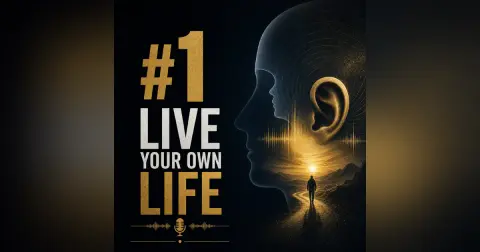


Are you living your own life, or someone else's? In this debut episode of Between The Ears, host Arnold Beekes explores how from childhood onward, we're trained to meet the expectations of parents, teachers, and eventually bosses, until "being good" simply means doing what someone else wants. Arnold explains why living two lives at once, someone else's during work hours and your own in the evenings and weekends, is a major source of chronic stress, and why that stress can eventually show up as back pain, burnout, or depression. He invites listeners to start looking inward instead of outward to figure out what they actually want, and to take back control of their own behavior. The episode closes with the show's signature segment on everyday beauty, including a story from Nanaimo, Canada, where a young boy's persistence in knocking on doors in the middle of the night helped save his father's life.
Topics Covered
- Why most people are living someone else's life without realizing it
- How childhood conditioning trains us to meet other people's expectations
- The link between living two lives and chronic stress
- How chronic stress can lead to burnout, depression, and physical pain
- Taking back control by looking inward instead of outward
- The practice of greeting strangers on daily walks
- The story of a boy in Nanaimo, BC, whose persistence saved his father's life
- The show's closing theme of "everyday beauty" and moral beauty
About Arnold Beekes
Arnold Beekes is the host of Between The Ears, a podcast built around the idea that your inner state creates your outer reality. Having lived in five different countries, Arnold draws on his own experiences to help listeners build a better life between the ears, one episode at a time.
Connect with Arnold Beekes
🧠 Inner Fitness for Modern Life: https://braingym.fitness/
🧠 Inner Leadership Training for Ambitious Leaders: https://www.brainathletes.club/
🧠 Innovation Mindset for Exponential Change: https://www.innovationathletes.club/
🤝 Join our free Brain Health community: https://www.skool.com/brain-fitness-7070
🎙️ Edited and Produced by The PodFather Network LLC
🌐 https://roycoughlan.com/
#BetweenTheEars #LiveYourOwnLife #InnerState #PersonalDevelopment #SelfImprovement #MentalHealthMatters #ChronicStress #BurnoutRecovery #MoralBeauty #TakeBackControl #PodfatherNetwork #MindsetShift #EverydayBeauty #SelfAwareness #BrainFitness
Welcome, I'm Arnold Bekus and I enable you to have a better life between the ears. Because your inner state creates your outer reality. Today's topic is to live your own life.
Now you might say, well, isn't that what everybody's doing? Well, I would say no, that is not what everybody is doing. I would say that the majority of people is not living his or her own life. Why is that? And what do I mean by that? The moment you're born with your parents, your parents start to expect certain behavior from you, like don't cry or sleep when we want you to sleep.
And if you are growing older, it's like you should clean up your room or you should eat all your vegetables. And that goes on and on every day. You should be nice and kind to your siblings and to your parents and even to strangers.
Yes, so what do you do when you are a good baby? When are you a good child? When are your parents proud of you? When you do exactly as they say. When you continuously meet their expectations, then you grow up further and well, maybe you go to kindergarten, but let's say you go to primary school. When are you a good kid? When you do exactly what your teacher tells you to do.
When you do your homework, when you get good grades, and you're not a nuisance in the class and you're not bullying other students. So you're supposed to meet the expectations of the teacher. The same goes on when you go to high school and even to some vocational training or something else or you want to be a plumber.
When is the teacher okay with what you do? Is it when you do exactly what they say, what the teacher tells you to do. When you clean up all your work and do your homework. The same is true if you go to university.
When are you a good student? When you do exactly what the professor tells you to do. Then you hopefully you get a job, you get work. When are you a good employee? When you do exactly as your boss tells you what to do.
And that process of meeting expectations from other people basically goes on until you retire or until you decide that you want to change that. Because in all these cases I just described, you are not living your own life. You are living someone else's life.
You're living the life of your parents, of your teachers, of your bosses, maybe even of your partner in a marriage. You are continuously living someone else's life and you think that you are okay if you constantly meet someone else's expectations. And that can go on for the rest of your life.
If that's your choice it's fine. But if you're wondering why you are stressed. Well I would say most people are stressed because they actually are living two lives at the same time.
You're living someone else's life during let's say office hours. And in the evening and the weekends you start to live your own life. That creates stress.
There's friction between those two. And because that is every day, day in day out, the rest of your life, that becomes chronic stress. And chronic stress is extremely bad for your health.
So after a while, and it can be years, you will get back pain, shoulder pain, burnout, depression, or worse. So what I suggest is that what is needed for a better life between the years is that you start living your own life. Yes, living your own life and no longer living the life of someone else.
And then you say, hey I no longer just want to do what other people want me to do. I would like to do what I want. But what is it that I want? It's a question which most of us is not easy to answer.
I gotta figure that out. What do I want? It's a topic we will go in another episode, but you need to start to look inside of you. So instead of looking outside of you to what other people want you to do, that you look inside of you and say, hey, what's it that I want to do? In that way, you're taking back control of your life.
Because actually what we did, we gave control of our life to these other people. To parents, teachers, bosses, spouses, the media. I would like you to take back control and control your own life.
And no longer let other people drive your behavior. And living your own life means that you start to do what's good for you. And that is the starting point for everything.
So I highly encourage you to start exploring whether you are living someone else's life or are you living your own life. In this podcast, we conclude each session with some examples of everyday beauty. Yes, everyday beauty.
Why is that? Because beauty and especially moral beauty, meaning examples of kindness, courage or compassion have a very positive influence on your inner state. And it is your inner state that creates your outer reality. So it's crucial to create an inner state which has high energy and a positive vibe around that.
And one of the biggest influences there is to see and experience and to develop moral beauty. Let me give some examples. When I go for a walk each morning and I go every day at the same time, you start seeing the same people.
Someone in a grocery store, a person who's sitting in their garden, people cleaning up the streets, maybe the garbage collectors, maybe there's someone you see, oh, that person must be going to work or to school. And even people here, early in the morning, they set up tables where they sell yerba mate, which is South American version of coffee, I would say. So if you see them each day, I suggest is greet the people you see.
Look them in the eye, if it's far away, if they're close, say, hey, good morning, good afternoon, good evening, what time of day it is, doesn't matter. And say it in the local language. And if they're at a distance, wave to them and smile.
You will be amazed what a positive influence it will have on those other people and also on yourself. By now I've lived in five different countries and in this way I get to meet a lot of people and I chat with a lot of people. And it makes my walk very, very pleasurable.
So I invite you to do the same. Another example of this moral beauty is a case of a boy in Nanaimo in British Columbia in Canada. And that boy went around knocking on people's doors in the middle of the night because his father had a heart attack or something like that.
So he rang a woman's doorbell at 3 a.m. And after knocking on many doors, that woman opened up the door and helped him and she performed CPR on his father for 10 minutes and saved his life. But it was the boy who refused to stop searching for help. He continuously, and by doing something which is very uncomfortable, he went out from door to door waking people up and say, hey, can you help me with my father? So that lady helped his father and now his father survived.
That's something totally incredible for a young boy. Those are examples of moral beauty. So I invite you to look for moral beauty or beauty in general or all in your daily life.
There's so many beautiful things, but they are small and it's the small things that make it every day. So thank you for today's session. And remember, we need your uniqueness.
Be a better maker for yourself, for others, for the world.

Explorer, Generalist, Innovator, and Trainer/Coach
Arnold Beekes is an explorer, generalist, innovator, and trainer/coach, and the founder of Arnold Beekes Creations and the Brain Athletes community. He spent his first 20 years working in technology and organisational leadership, managing teams ranging from 10 people up to 6,000 on a global scale, before dedicating the next 20 years to studying psychology, personal leadership, brain health, sports, and spirituality.
Arnold has been coaching in some form for over 50 years, starting as the youngest certified field hockey coach in the Netherlands at just 17. Having lived in five different countries, he draws on his own wide-ranging experience to help people build a better life "between the ears," one insight at a time.
Today, through Brain Athletes and his podcast, Between The Ears, Arnold helps mid-life professionals and young leaders break free from the invisible straitjackets holding them back, so they can reach their full potential and contribute to what he calls a Better World for All.


