Ocado's Leadership Change Puts Grocery Automation to the Test | Fast Five Shorts
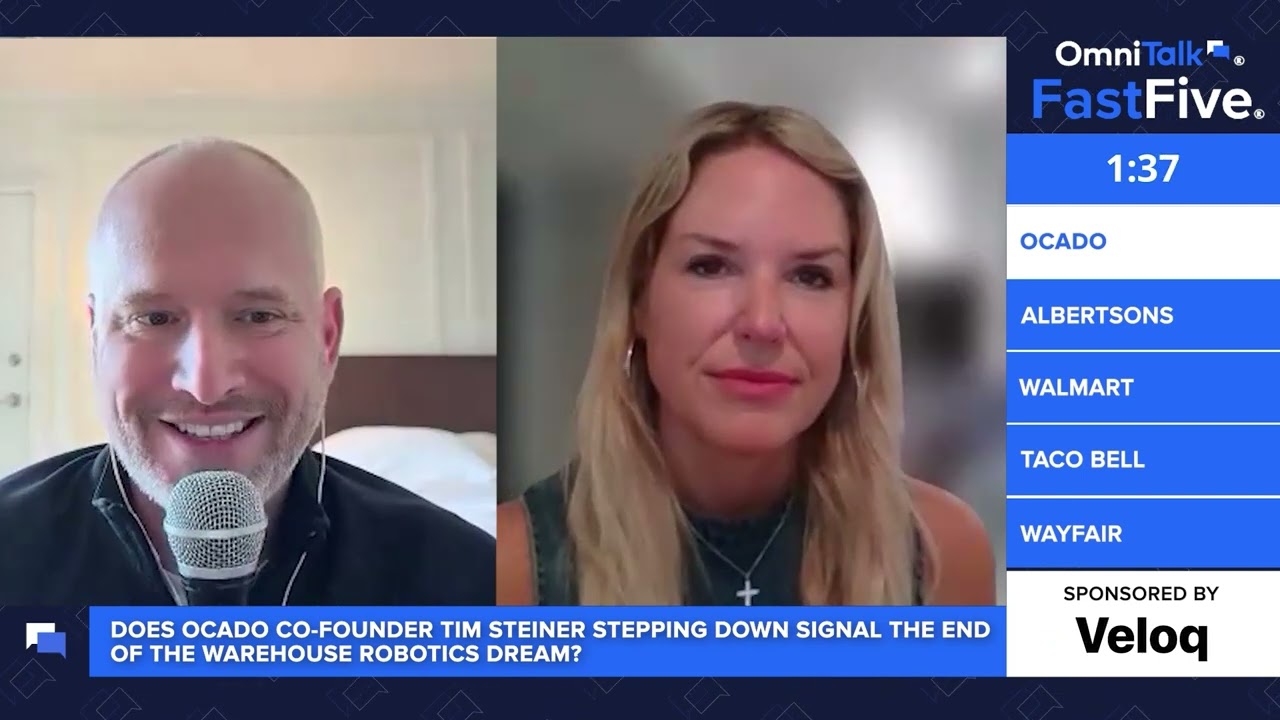


Ocado co-founder and CEO Tim Steiner is stepping down after more than two decades leading one of retail's most ambitious grocery automation companies.
Chris Walton is joined by Shelley Huff, CEO and Co-Founder of The Interval, and Chris Niesen, Founder of Peloton One Consulting, to discuss whether this leadership change signals trouble for automated grocery fulfillment or simply marks the next chapter in its evolution. They share their perspectives on warehouse robotics, grocery economics, and why automation still has an important role to play in retail.
▶️ Watch the full Fast Five episode here: https://youtu.be/-F7f2EFXG9k
00:00 - Untitled
00:00 - Leadership Changes at Ocado
01:03 - The Future of Automated Grocery Delivery
03:36 - The Importance of Leadership Succession
05:13 - The Transition in Leadership and the Future of Automation
06:28 - The Future of Grocery Delivery
07:57 - The Future of E-Grocery: Predictions and Implications
According to multiple sources, Ocado co founder and CEO Tim Steiner announced he will step down at the start of the company's 2028 financial year, capping a boardroom tussle over the future of the automated grocery fulfillment pioneer.
Speaker AOcado announced July 6 that Steiner, who co founded the company in 2000, will remain CEO through the 2027 financial year and into the succession process, which is expected to wrap up by the start of fiscal year 2028.
Speaker AWow.
Speaker AHe'll then move into a founder advisory role through 2029.
Speaker AReports indicate chair Adam Warby and board member Jorn Rousing pushed to accelerate Steiner's exit.
Speaker AYeah, I can imagine.
Speaker AFollowing a prolonged share price slump, triggering pushback from other shareholders who wanted more continuity.
Speaker AOcado shares are down nearly 25% year to date and more than 90% off their pandemic era peak as its core business of licensing giant automated fulfillment centers to grocers has lost momentum.
Speaker AShelley, going to start with you.
Speaker AWhat do you think Steiner's exit says, if anything, about the future of automated grocery delivery?
Speaker BWell, this is a big one.
Speaker BAnd I like the fact that the board has a long off ramp for you do Tim Steiner.
Speaker BHe's an incredible founder and a visionary, and an abrupt transition could create unnecessary risk, obviously.
Speaker BAt the same time, boards have relatively few levers when the business isn't performing, and so replacing a CEO is one of them.
Speaker BSo I think that there's obviously some things happening within this business that has prompted this transition, but I want to decouple that from what's happening with automated grocery fulfillment.
Speaker BI think it's.
Speaker BWe're actually having two different conversations here.
Speaker BSo I think automation is absolutely part of grocery future.
Speaker BIt's, you know, one lever.
Speaker BAnd I think the industry is learning.
Speaker BThere's not one fulfillment model that actually works.
Speaker BIt's a combination of them.
Speaker BAnd I think Ocado solved like a huge engineering problem.
Speaker BI think, you know, whether that technology can translate into an economic position is, you know, for its retail partners is, is the big question.
Speaker BSo I think a few key customers pulling back like Kroger doesn't necessarily mean the technology failed, but it does mean there's an economic question that's happening and potentially that Okada was really early where there's not necessarily the density to support the business.
Speaker BWhen you have huge investments in facilities like this that may be operating at 60% capacity, for instance, that's an economic drain and an economic killer.
Speaker BAnd so I think, you know, automated fulfillment, again, I think, has a future.
Speaker BI Think it's, what is the size of the facility, what is the density of population, what is the use case?
Speaker BAll of those things, you know, come into the conversation when we talk about these things.
Speaker BBut I absolutely think it has a place.
Speaker BSo the challenge is improving that robotics can pick groceries at this point.
Speaker BIt's proving that retailers can actually make money doing this.
Speaker AYeah.
Speaker AAnd that they have the demand to utilize the capital to the extent that is required to write that.
Speaker AWhich.
Speaker AThat being a key piece of the, of the Kroger situation, too, from my understanding.
Speaker AShelley, I want to go back to something you said at the beginning, though.
Speaker AYou said you like the long off ramp.
Speaker AIs that because Tim Steiner is.
Speaker AI mean, he's been there 26 years, give or take.
Speaker AI think that's the right math.
Speaker ABut is that because, you know, he's such a.
Speaker ASuch an important piece of that organization culturally, that it's going to be hard to replace it so quickly?
Speaker AIs that why you like the lengthy succession plan here?
Speaker BI do.
Speaker BI think it shows a level of thoughtfulness with the board because basically it's giving him an off ramp that says, here's how long we'd like you to stay in the business.
Speaker BAnd he probably was part of this conversation, obviously, in terms of what his willingness is.
Speaker BAnd it also ensures some continuity within the organization.
Speaker BAnd Tim is a visionary leader.
Speaker BIt's.
Speaker BIt's going to be very difficult to replace somebody like that culturally.
Speaker BHe's built this business, and so I think it gives them time to potentially find somebody who is operationally the person to take the business to the next level and, you know, is a commercial leader that could potentially come in and build, you know, bigger relationships, bigger B2B relationships.
Speaker BBut I absolutely think that that shows some.
Speaker BSome patience and some thoughtfulness into how this organization has transitioned and gives them time to.
Speaker BTo really do a proper search globally for the right person to come in and lead this business.
Speaker AYeah, it's going to be a tough task for whoever comes in to replace them.
Speaker AYou know, I almost wondered too, Shelley, as you're talking, like, do we get into, like a Steve Jobsian situation here, too, where we see Tim start, you know, come back at some point in time, because, yeah, maybe they just need a change in leadership right now, but you never know, you know, where things are going to go.
Speaker AParticularly as you described and discussed the evolution of automation in grocery, too.
Speaker ABecause I think.
Speaker AI mean, I know you and I believe.
Speaker AAnd I think Chris thinks.
Speaker AI'm curious to see what Chris thinks, too.
Speaker AIt's not like that conversation is really dead.
Speaker AIt's going to happen at some time.
Speaker AWe just got to get everything right and figure it out.
Speaker ABut Chris, what's your take on this situation?
Speaker CSo I'm starting with a story from a visit that I had last week to Boston.
Speaker AOkay.
Speaker CI was walking the streets of Boston and I saw a food delivery robot on a busy sidewalk.
Speaker COkay.
Speaker CAnd most people were navigating it incredibly fine until I saw an old man on his phone almost fall to the ground.
Speaker CThe point that I start with is that this is genuinely hard.
Speaker CFirst mile to last mile, real time, inventory, logistics, you name it.
Speaker COn top of that, yeah, there's a huge investment here.
Speaker CAnd I think what we're starting to learn is that the store network is beginning to prove itself in a way that the large fulfillment centers have not yet done.
Speaker CFrom a volume perspective, you think about speed, density, and the built in labor.
Speaker CThere's a lot of things there that are hard to beat.
Speaker CAnd we're talking about an environment right now where organizations are really thinking about where they place their bets from an investment standpoint.
Speaker CAI is there, but there's also a lot of sure bets when it comes to return on investment things like store remodels and other things.
Speaker CSo what I would say is we're a lot further away from automated grocery delivering at the at scale than we've been told for years.
Speaker AOkay, interesting.
Speaker AWhat makes you say that?
Speaker ALike why?
Speaker AJust because it's harder than we think?
Speaker CYeah, I think it not only harder, but I think it's a huge expense.
Speaker CRight.
Speaker CAnd so in organizations are thinking about where do I get the most return on my investment?
Speaker CAnd right now it's not in these large fulfillment centers.
Speaker CRight.
Speaker CStores are underutilized when it comes to delivering grocery.
Speaker AYeah, right.
Speaker AAnd that I think you're hitting on something too, which is if you had to, if you had to place your bets in terms of the timeline by which this rolls out, particularly here in the United States, you're gonna see more people go to the store fulfilled model.
Speaker AThey're gonna optimize their pick rates in the store first before they start investing in the technology.
Speaker ABut meanwhile though, I think we have to keep in mind Amazon is on the other side of this equation where they're going in the opposite direction because they don't have the stores and they're putting those micro fulfillment centers and they're putting the automation into them.
Speaker ASo the last thing I'll say here before we move on, this has been a great discussion.
Speaker AWow, what a great discussion to start out the show.
Speaker AI've interviewed Tim twice in the last year.
Speaker AI've been lucky enough to interview him twice.
Speaker AOnce at Grocery Shop, once at wrc.
Speaker AAnd every time I sit and listen to him, I just think, my God, I'm talking to an icon.
Speaker AThis guy knows so much about things, and he always leaves me with something that I had never thought about before.
Speaker AAnd the one point I just want to mention to everyone, because it kind of goes into what both Chris and Shelley have both been saying is I asked him on stage at Grocery Shop, I said, what's your one prediction for the industry in the next 10 years?
Speaker AAnd he said, he predicts there will be a day in the future in which E Groceries is the most profitable way to run a grocery operation.
Speaker AIt'll be more profitable than stores.
Speaker AAnd so if he's right, a lot of people thought he was crazy.
Speaker ALike, people in the audience were like, you're nuts.
Speaker ABut if he's right, what's it going to take to get there, and what does that mean for the industry?
Speaker ASo that's something I just love thinking about.


