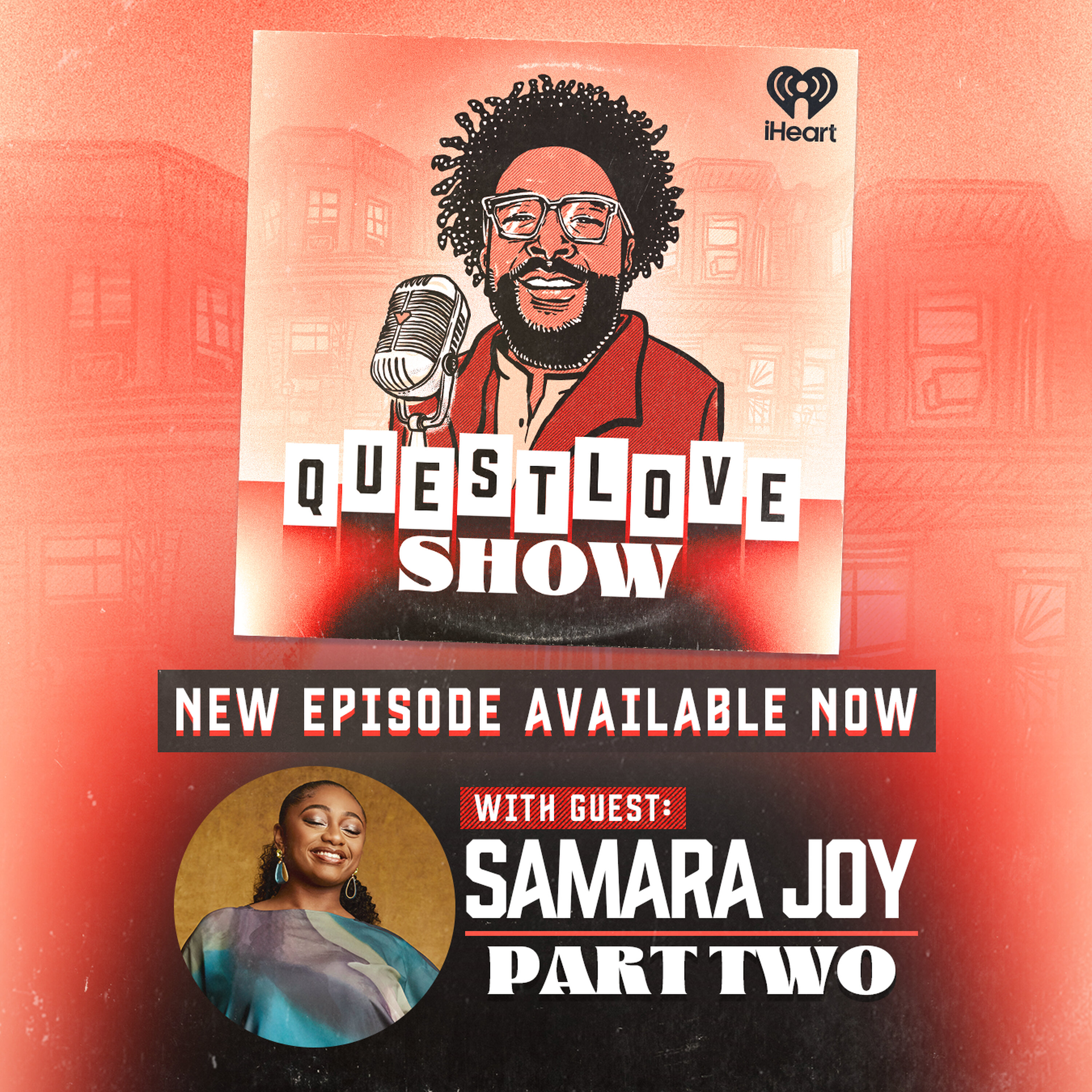
Samara Joy Part 2


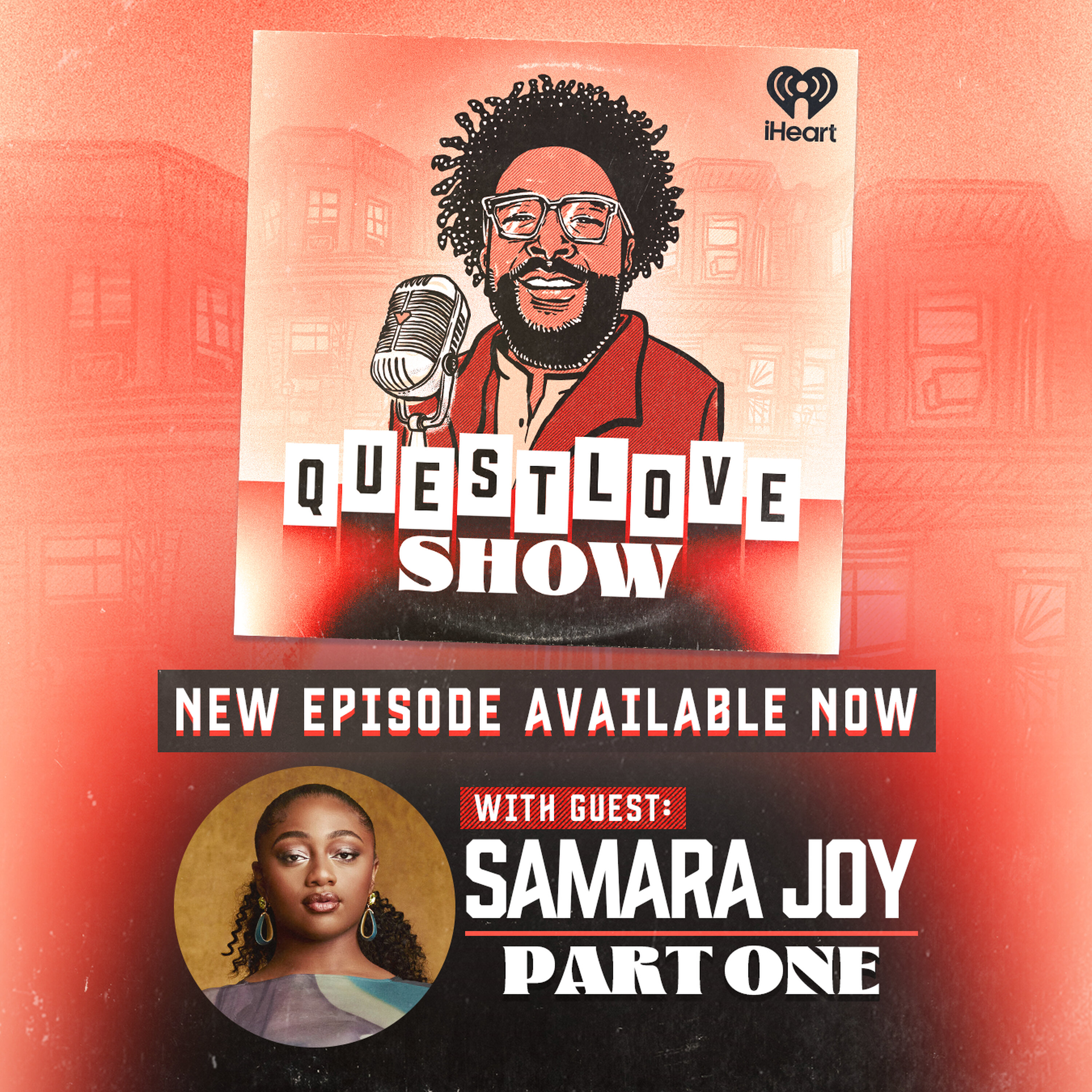
In Part 2 of her conversation with Questlove, Samara Joy unpacks why Carmen McRae is such a powerful influence on her singing. The Bronx native talks about recording at Rudy Van Gelder’s famed studio, and why those hallowed jazz halls are a perfect match for her voice. Joy also opens up about her musical family, the months she spent adding lyrics to compositions by Charles Mingus and Sun Ra for her latest Grammy-nominated album, and much more.
See omnystudio.com/listener for privacy information.
00:00:00
Speaker 1: Quest Love Show is a production of iHeart Radio people. What's Up? This is Quest Love And last week we brought you part one of my in studio conversation with Samara Joy. At the top of the month, she'll be competing for two Grammy Awards, all right, including Best Vocal Jazz Album for a Late Selpe Portrait. If you haven't heard already, to make sure you spend time with that album. And with part one of this interview, this is where I really got to learn her story and dig into her craft. So part two we're gonna have a little more fun. We talked about her time in the studio, her ensemble, and yes, where she gives her Grammy Awards. She's already one, all right, enjoy What was your first job ever?
00:00:49
Speaker 2: I was a cashier at shopwrite part time?
00:00:52
Speaker 1: Okay? What album have you committed to Memory from start to finish? No Skips, perfect album.
00:01:00
Speaker 2: The Audience with Betty Carter. That's live with John Hicks on piano, Curtis Lundy on bass, in Kenny Washington on drums. And he was actually my professor, but he was eighteen years old.
00:01:12
Speaker 1: Kenny Washington. It's nothing like I Got Gods with me.
00:01:17
Speaker 2: I mean, he was an incredible professor but also an amazing musician. I've gotten to play with him. But that album Betty Carter, she does things, the arrangements, the songs, the compositions.
00:01:26
Speaker 1: I love it, Okay, So it's kind of mad libby. The singer to whom everyone compares you to is.
00:01:35
Speaker 2: Saravon.
00:01:37
Speaker 1: However, the singer that you really pattern in your style after.
00:01:41
Speaker 2: Is Oh my gosh, Carmen McCrae.
00:01:45
Speaker 1: I'd love you say that if you can ever find there's a rendition she does of a song called The Mystery of Man. Got to look it up. It's devastating to hear, like just the way that she emotes in her voice. But what is it about Carmen mc Honestly?
00:02:01
Speaker 2: I think it's that, like she she's not necessarily mos acrobatic of singers. She comes from the school of Billie Holliday, as she says so herself, like that's one of her main inspirations, and so I think she just kind of gets right to the heart of a song, you know, And that's something I feel like I need to learn. It's like, as I'm learning the possibilities of what you can do with your voice. There's also something to be said about having taste and knowing when to withhold and knowing you knows more. Yeah, so I just in some cases. And so I feel like I listened to her over and over again, and I find something new every time, even if it's the simplest, you know, idea or riff or And she was also pianist too, So I admire that because I feel like she could pick out the pretty notes to improvise on on a melody that still go along with the chords without you know, maybe disrupting. But her rhythm was insane too, So yeah, I think her the way that she improvises on a melody, the way that her feel is like rhythmically interacting with the bank. And that's what I love.
00:03:01
Speaker 1: What other instruments do you play?
00:03:03
Speaker 2: I used to play bass electric.
00:03:05
Speaker 1: Used to, I mean like you forget after I used to.
00:03:08
Speaker 2: I used to because my dad he got me a Fender jazz bas for Christmas, along with our brothers Johnson Record and a couple more so, I was like learning their songs. Actually, host Johnson is like my I love his playing to the point where I was I looked up like an educational video that he did from the eighties. Yes, and I started off with I was like, Okay, I think that's time for me to put it out. Actually, but I play piano now, but I used to play bass. I miss it.
00:03:36
Speaker 1: Okay. Uh, name me an artist that we would be shocked. Is an influence on you or that we didn't see coming?
00:03:48
Speaker 2: I don't know if I'm non jazz predictable.
00:03:53
Speaker 1: You know, how's your Metallica history? How's your I.
00:03:57
Speaker 2: Feel like I'm so predictable. I don't know. My My origins are pretty clear. Hmmm. As far as lyricists, do you know of a lady named Margo Gierian. No, she only released one album to her name, but she's from Long Island and she is She was a vocalist. I can't remember what the name of the album is. I think it's like sing a song or something like that. But she's a really dope lyricist. And I've been learning how to write lyrics to jazz compositions and she did that a lot.
00:04:31
Speaker 1: So yeah, I was going to ask you about your vocal least game because I'm realizing that y're like.
00:04:37
Speaker 2: She wrote lyrics to an ornate Coleman composition called Lonely Woman. It's unbelievable. So she's one that I that I look up to that might be unexpected.
00:04:45
Speaker 1: Okay, I'm skipping now because since she brought it up. Okay, So in portrait of course, you know, every jazz artist does the American Songbook, you know, and they'll choose the safe ones. They'll choose autumn leaves or whatever. But you're like the you lay the gauntlet down, like you're choosing like Mingus' craziest period, even with sun Rot, so with Mingus alone. And I have an obsession and a love for jazz vocalise and you know, name it King Pleasure, Eddie Jefferson, Lambert Lambert Hendricks and Ross like all of the for our listeners. Vocalist is where I guess the rule is basically, you add lyrics to an existing jazz song and do you have to follow the pattern of what the solo is.
00:05:36
Speaker 2: You can, And I started off doing that, like writing lyrics only to the well writing lyrics to the melody and the solo. But now I just kind of write lyrics to the melody because the solo can be a little hard, a challenging when people doing triplets and sixteenth notes and stuff like that.
00:05:50
Speaker 1: So have you ever heard the grand Royal of all jazz vocalist posse cuts? Have you heard Freddy Freeloader by Yes Farren?
00:06:02
Speaker 2: Yeah?
00:06:03
Speaker 1: Yeah, all right. So during the pandemic, that was one of my favorite exercises. I would DJ like five hours online and I think one night I read the comments where someone was telling me that there's a story of how Hendrix like literally micromanaged Bob McFerrin, George Benson and Algio to follow the Coltrane Miles solos on the original Freddy Freeloader, And I was like no, and I stopped the record and I put both albums up and played them and realize, oh god, they're literally they left no stone unturned. So with vocalists, gee, and you started on the highest mountain, you started only Mount Fiji. How did you even decide for that particular song? Like because Mingus is frightening to conquer?
00:06:57
Speaker 2: Yeah, I mean, it's a blessing to have memusicians around you who put you on, for lack of a better word, like musicians they like I didn't listen to Sun Raw or Mingus before the band that I currently work with and so they're you know, listening to songs on their own time. They're listening to Mendelssohn and Revel and all this kind of stuff, and I'm just listening and absorbing. And so when I heard Reincarnation of Lovebird by Mingus, I realized that even though the melody is complex, it's still melodic, it's still lyrical, and I had the crazy idea to put words to it. And you know, standards one of I guess, or the bedrock of jazz music. You hear so many musicians, Max Roach, Bennigolsen, Miles playing standards and adding their own flair while also writing their own composition. So there's merit to doing it. But I guess they all learned form, they learn harmony, they learned ways to make the songs their own, and then wrote their own composition. So I guess that's how I tried to do it, as learned standards, learn you know.
00:07:58
Speaker 1: That's literally the best way to learn jazz is vocal wise, Like walk me through the process of I listened to the original and even as far as your lyric phrasing and whatnot, Like how long did it take.
00:08:13
Speaker 2: You to Oh, it took me like to learn the song. It took me at least six months because there were certain parts of it that I just couldn't I had to like slow it down because I couldn't hear like the exact pitches, and I need it in order to be able to think of words. Yeah, I have to like internalize the song and be able to sing it without the recording. And of course the arranger at the time had the idea for me to sing it completely acapella before all the music.
00:08:40
Speaker 1: That's what I say, and like, what the hell, you know?
00:08:45
Speaker 2: And it took me. It took me another couple of months to write the words to it because it's such a deep song. I wanted the words to kind of reflect that and be a compelling story that doesn't take away from the melody and take away from the story the melody is already telling. So yeah, it was a process, but I love singing it and now I feel like I've added another layer, you know, And I'm able to sing complex melodies that might not be written for voice, but you know, I can if it's in a certain key and in a certain range, I can make it happen.
00:09:14
Speaker 1: So will you try to conquer old Faris Sanders or Don Cherry or like, when you get into free.
00:09:20
Speaker 2: Jazz, maybe there's a vocalist, the one who sung Lonely Woman by Ornat Coleman, Jean Lee. She does she's like more. I guess she's classified as avant garde or free and she played with this pianist called Ran Blake, and so listening to her music and the stuff that she does with Anthony Braxton and stuff, I'm like, there's there's something here. I don't know quite yet. I'm still digging, but who knows.
00:09:42
Speaker 1: God damn, I never thought I'd mean someone who outschools me my own podcast. I want to know more sitting. You were born in Castle Hill? Yeah, right, all right, So that's not exactly the South. When I hear the Bronx, of course, I think of like, oh, well, hip hop started the Bronx projects. Isn't exactly the South Bronx. So what are your earliest memories or your fondest memories of growing up in Castle Hill?
00:10:08
Speaker 2: Well, it was my grandma's house. She bought it. She was from Virginia. She moved to Philly and then she bought that house. I want to say, in the sixties maybe late fifties, early sixties, because she wanted a family house and she wanted to be able to host people and have family and just have a place where we all could kind of settle. And so I grew up in that house. I grew up with her, and I grew up, you know, being friendly with the neighbors and my brother. You know, they're playing basketball outside my grandma, you know, making food, salmon croquettes and all that kind of stuff.
00:10:39
Speaker 1: So you're saying that, technically you should be a Philadelphian.
00:10:44
Speaker 2: I know, there's so many connections leading towards that. I'm that's adjacent, that's home.
00:10:50
Speaker 1: And then there was just a migration to the Bronx.
00:10:52
Speaker 2: Yeah, I don't know how it happened.
00:10:54
Speaker 1: Got it? Okay? Do you still have family in Philly? Like?
00:10:58
Speaker 2: Yes, yeah, all spread out. God, my grandfather still lives in West Philly.
00:11:04
Speaker 1: All right, So what TV show would best describe your childhood? Great? Now, I feel another like.
00:11:12
Speaker 2: No, I actually did watch Saturday like cartoons and stuff.
00:11:16
Speaker 1: Okay, so cartoons still existed when you in your memory back, So what TV show best describes your childhood?
00:11:24
Speaker 2: This is not a cartoon, but that's a Raven. I guess maybe that's still new school.
00:11:28
Speaker 1: No, that's old school now, Okay, Raven's forty.
00:11:35
Speaker 2: My uncle used to also burn CDs of like Looney Tunes and The Jackson's Variety Show and stuff, So I used to watch that too.
00:11:43
Speaker 1: Man, it's so dope. All right, who's your first celebrity crush?
00:11:46
Speaker 2: Oh my gosh. It was probably from some Disney Channel movie, maybe like zac Efron or something. Probably gotcha, which means it was ultimately Corby and Blue as well. So I'll say those two.
00:11:57
Speaker 1: I'm gonna pretend I know what those are.
00:12:00
Speaker 3: What's the.
00:12:02
Speaker 2: The style of cooking?
00:12:03
Speaker 1: I know, did posters adorn your childhood bedroom? And if so, who was there?
00:12:22
Speaker 2: I had a mix of posters. See, we would go to Blockbuster. I went to Blockbuster. I did rent DVDs You were.
00:12:31
Speaker 1: You was so born in.
00:12:34
Speaker 2: And so they would have like I think it was like Tiger Beat, like teen magazines, and my mom had a standing subscription with Jet in essence, and so it was a combination of like teen magazines and you know, black magazines that were on my walls.
00:12:50
Speaker 1: Got it, Okay, So I'm kind of placing a position as a musician where I'm judged by pop rules and hip hop, so everything's circular, looped and whatnot. And often I'm told, like, just keep the song as simple as possible. What is your process for writing original composition? Like what ritual do you have? Do you need to be in a space alone with your thoughts or is it you and someone else riffing and figuring out what it is.
00:13:24
Speaker 2: I don't write as much original material as I should.
00:13:26
Speaker 1: Eventually, you will say.
00:13:28
Speaker 2: I would say the one that I have that's on the album Peace of Mind was written and inspired by an Abby Lincoln record called straight Ahead. And there's a song on the album called in the Red and the composer and trumpeter Booker Little he wrote it to and he like, there's no defined time on the song. It's all like conducted, but it's like kind of slow and suspenseful, and he wrote it because he wanted to mimic or mirror the suspense that people feel when they're broke and when they're in the red. And I just thought about that tool, like that musical tool of like, oh so I didn't I didn't realize you could do that and express that kind of feeling through music. And if I did. I just didn't know it consciously.
00:14:07
Speaker 1: I'm totally channelling you out right now.
00:14:12
Speaker 2: And so with my first song, there's no defined time because it kind of came after the Grammys and I was feeling a little bit uncertain. There were people kind of projecting what they felt I should do. You have this attention, you can do anything, you can sing anything, yeah, or make the same record that you did that you know, and so I was just like, I don't want to do that, which is not a new feeling. Every artist has had to make that decision at one point or another, and so I was feeling that, and that uncertainty matched the suspense that I heard on that song, and so I wanted to write something that was dissonant that eventually had a constant resolution, which is Dreams Come True by Son Raw. But that feeling of being uncertain, of wondering what decision to make, of feeling like I'm trying to stay grounded by my life is just changing so much, and so I wanted to present that in the song, and so that was my inspiration for songwriting. At the time.
00:15:02
Speaker 1: I guess, uh, do you have siblings? Are you the only child?
00:15:05
Speaker 2: I have four siblings.
00:15:06
Speaker 1: Where do you fall in the.
00:15:08
Speaker 2: Second to last? I have three older siblings and one younger.
00:15:12
Speaker 1: And are they also artistically inclined?
00:15:17
Speaker 2: Yeah. My eldest brother, he was like in the early two thousands, he was like writing for Genuine and work with doctor Dre and all these different people. Is Antonio Okay, Antonio McLendon. My sister not so much. She sings when she's like around us, but she's more of a she's more of a business woman. My second oldest brother, Daniel, he was the one who put me onto Voodoo and you know he was he was listening to Kanye like he was listening. Sorry, I don't want to mention all these names out here, but but he was listening to a lot of stuff that I just hadn't seen or hadn't really been exposed to, Like Ryan Leslie. I had never listened to Diamond Girl and was like, I was like, what this is crazy? On ye sure, it was like, oh iTunes. I never I don't have my own laptop, so I don't know what that is. And my younger brother's into it too. But I think I think we're all musically inclined to one way or another. But they all influenced me in.
00:16:14
Speaker 1: An I gotta know what is it like recording at Van Gelder's studio. And I have to say, of the ten albums of Note that I know that we're recorded there in the last five years, yours is the only record that I feel really takes advantage of why that studio is so important.
00:16:42
Speaker 2: Thank you, because thank you so much.
00:16:45
Speaker 1: Yeah, because the thing was I listened to it and when I got to the fourth song, I stopped it, and then I went to my boys record and I'm like, wait, this sounds like this smooth jazz, like this is me. And I was just under the impression I always wanted to go there to record, but after nine or ten records where I'm like, well, wait a minute, besides the physical space like different is it like? And I was just so that I've been recording all my joins in Brooklyn, where the dap Kings are and whatever where it feels, and when I heard your record, I was like, wait a minute, it's possible, So what gives.
00:17:24
Speaker 2: I wanted to match the chemistry that my band shout out to my septeent, that my band had built on stage and the setting that we have where it's me, then the horns, and then the rhythm section. I wanted we've built this chemistry of playing together and matching each other's dynamics and stuff on stage. I didn't want that to go away and have to hear everybody through headphones. So I had the drums in the room. Rudy van Guelder is perfect. Shout out Maureen and Don Sickler. It was an incredible, incredible and Brie Lynch it is an incredible room. It is an incredible room and it's perfect for acoustic music. Drums in the room, horns in the room, piano, I think the only thing no base was in the room as well. I was the only one who was isolated because I make mistakes and I want to fix them. But other than that, I wanted to capture the same acoustic sound and that feeling that we get when we play together. And so everything was like two to three takes, Max.
00:18:14
Speaker 1: What you talked? You serious? Yeah, Well how long did pre production take?
00:18:19
Speaker 2: I mean pre production was touring, so we were on the road for two years. We went into the.
00:18:23
Speaker 1: Studio, but even when you're in a room together, they have to place things perfectly.
00:18:28
Speaker 2: Once we got adjusted, though, two to three takes eighteen songs three days.
00:18:33
Speaker 1: Are you ever going to return to that studio?
00:18:35
Speaker 2: Yes?
00:18:36
Speaker 1: Absolutely, Okay, we're friends now. Before I give them my business, I just want to witness this happening, because I refuse to believe that I was just on the impression that it'll never sound nothing will sound as good as any of the blue note stuff that he did, or any.
00:18:57
Speaker 2: Of the and they have so many great Mike's too.
00:19:01
Speaker 1: Yes, amazing, That's what I'm saying. How did you figure out the code that no one else figured out?
00:19:08
Speaker 2: The thing is Maureen, she's the only one. She's the only protege of Rudy van Gelder, and so she knows everything, the radar system that they use, all the buttons and stuff. They're all named in sort of an unorthodox way, and she's the only one. Like, nobody's allowed.
00:19:22
Speaker 1: Behind Yeah, are they preset or they're not?
00:19:25
Speaker 2: I think she sets them, but nobody's allowed behind her and behind the board. You can't be behind the board.
00:19:31
Speaker 1: So okay, one of those studios. Yeah, what is these significance behind the dear Beverly name for your imprint? What's the story behind that?
00:19:43
Speaker 2: My late aunt Beverly was a pianist and a vocalist, and the only time I met her was when I was just born. I was born on November eleventh, and a couple and a couple of weeks later was Thanksgiving and she was sick, and so she was kind of she was a little bit weak physically, and she got the chance to hold me a couple weeks after I was born, and that was the only time I ever met her. And since then, everybody says that I sound like her, and I even look like her sometimes.
00:20:14
Speaker 1: The genetics, Yeah, that's where it comes in.
00:20:16
Speaker 2: And so I wanted to name the imprint in honor of her.
00:20:19
Speaker 1: How did you choose the ensemble that worked with you on these and even with their producers? I know, Brian Lynch, like, how do you go about choosing this album?
00:20:31
Speaker 2: Was our first time meeting and working together. He's arranged and he's played with Art Blakey and the Jazz Messengers, but he also arranges and composes in his own right. And because this band disorted my first my first time playing with a larger ensemble with horns, how many pieces seven four horns, trumpet, alto, sacks, tenor sax and trombone, in rhythm section. I wanted to have somebody who had an ear for that music, but who also didn't try to come in and assume themselves as higher us, because we were the ones who I mean, the writers in the band are the horn players and the pianists, so they're the ones who are writing and we're the ones who are shaping it. And so I think he came in with an attitude, in a mindset of helping us and supporting us and not necessarily overtaking or anything like that. So I don't know, it just kind of came about. The band came about through multiple connections. I met the trombonist and tenor saxophonists in college, and the tenor saxophonist, Kendrick McAllister went to He has friends who went to Frost School of Music, University of Miami, and he also went to high school with them, and so that's how I met the alto saxophonists and trumpet Jason and David, and the rhythm section I kind of just met on the scene on the New York scene, jam sessions and whatnot. So it was multiple connections.
00:21:48
Speaker 1: You said my band a few times, like do you plan on keeping this unit or because oftentimes with jazz musicians it's almost like you meet who got called for the gig. Sometimes that's a weird I don't know if I could live that life. Like I love the fact that I played with the same people because we know each other, we know where we're going.
00:22:08
Speaker 2: And I plan on keeping this ensemble because we've grown so much in the years that we've played together already, and now recently we got the chance. They got the chance to write for orchestra for the first time, and so now we have stuff on the books with Atlanta Symphony, Chicago Symphony, New Yorkville, and I just feel like we've grown and we've developed and we've learned each other. But there's so much more to learn. But now it seems like they can write and not necessarily think of something for piano or something for trumpet, but it's for the person and for the range that they can handle, in the style and the attitude they can write for people. So yeah, we've learned each other to a point where I think it can grow even more.
00:22:49
Speaker 1: Is there a desire to ever record sound? Weird? Saying a modern sound modern for what you know period, a modern sounding LPI to pull in algio to do a soul album or whatever, like something outside of jazz. Do you have space for that yet or you're still just one step at a time.
00:23:15
Speaker 2: I think one step at a time. But a way that I try to explore and express that side is with my family. And so I recorded the full Holy Night with them right with my grandfather and you know, with my cousins and my dad and uncle. And it was such a great recording with Sullivan Fortner on the organ. Incredible that hopefully we get the chance to do an EP because my dad has like he has an arrangement of Mary did you know in Silent Night that we did on the last tour. That's really cool. We wrote an original song together.
00:23:42
Speaker 1: Nice.
00:23:42
Speaker 2: So yeah, maybe a holiday EP at some point. We can, you know, make it a little more fusion.
00:23:48
Speaker 1: I guess I feel incorrect in saying this since you are of the Elmo generation. Wow, actually you're younger than tip me Almo. Do you know this thing called tip me Elma? They came out there. Wait seriously, no, wait, I was kind of joking, but now he just stabbed Explain it.
00:24:07
Speaker 2: Explain it? Maybe I do.
00:24:09
Speaker 1: I'm just remembering, you know, Elmo was a character on Sesame Street, yes, which I was leading to. Was it like being on Sesame Street? Oh?
00:24:18
Speaker 2: Sorry, it was in the recesses of.
00:24:19
Speaker 1: My But I also realized that Tickle Me Elmo came out in ninety six, and that was that was okay great.
00:24:26
Speaker 2: I was not born back get it?
00:24:28
Speaker 1: Okay, okay, you get it.
00:24:29
Speaker 2: You were in first grade when songs in the Key of Life came out. That is I'm still on that. But anyway, Sayesmey Street was amazing. Sayesmey Street was so dope.
00:24:37
Speaker 1: Did you find yourself talk? Okay? So my one of my former co hosts of this podcast, Unpaid Bill, he's probably the person that brought you on the show. I did the show once and during breaks, I actually found myself engaging in real conversations with the muppets, and maybe seven minutes into the conversation, I was like, wait a minute, I'm not crazy, You're the one that's crazy. I'm still like talking to me. But they told me the role that they're not allowed to put the muppets down in front of kids or whatever, so they had to stay in character.
00:25:08
Speaker 2: So it was wild. I was still looking at the people while the cameras were rolling, and so one of my friends like, fixed your face to stop looking at the people on the ground. You need to be talking to the bumpets. And so I was like, you're right, let me smile and talk for the kids at home.
00:25:22
Speaker 1: So it was.
00:25:22
Speaker 2: Enjoyable, nice, It was so much fun.
00:25:24
Speaker 1: What's the three best concerts you ever been to?
00:25:29
Speaker 2: My first one was Aretha Franklin at NJ Pack. I was like eleven years old and I was right next to the spotlight.
00:25:34
Speaker 1: That's how I was eleven years old.
00:25:36
Speaker 2: Those bleeds.
00:25:36
Speaker 1: So this is twenty ten. Yeah, oh god, is this where she did Touch My Body by Mariah Carey.
00:25:42
Speaker 2: I don't remember that I did that really?
00:25:45
Speaker 1: Oh hell yeah, Oh my god. Arena, Oh one night she like seduced Maxwell was like she was wild. Yeah, she's wild, all.
00:25:55
Speaker 2: Right in peace. I think the second is more recent. I saw the reuniontor at the Barclay Center in Brooklyn with Kirk Franklin and the Clark sisters and Belanda Adams and Marvin Sapp and all these people. And the third one, I actually just went to the Vanguard. I've been to the Vanguard a couple of times, but McBride was there for his two week residency. I've seen Chris Potter there like it's always amazing.
00:26:20
Speaker 1: Yeah, I went last week to see him and told him I think next year I'll do one with him. Chris and I have a very unhealthy relationship to worshiping James Brown and the worships so deep that James Brown, I believe, is the only figure that is incapable of knowing what mediocrity is. And I'm saying that you usually, when we dismissed our artists or like whatever, it's never because it's bad songs. It's because it's just mediocre. It's like, all right, we heard that before. It's nothing special. James Brown will either change your life by redefining music or it's just so laughably humorous that to me it's even more genius. And so Chris and I kind of secretly, even though we're the number one and number two disciples of James Brown, behind closed doors, we only love his horrible work. It's an obsession. But you know, like something so bad it's great, That's what I'm saying. Like everything James Brown does is classic, including when he fails. He fails spectacularly, like horrible songs. So we want to do kind of a tribute band to only his bad period. The way to make that distinction is if he has a mustache with Yeah, the mustache period of James Brown is that means the music's.
00:27:57
Speaker 2: Not that good in loud and saying nothing, it's one of my favorite songs.
00:28:01
Speaker 1: Well, that's that's the good size a. He's right along, right, but for goodness sakes, take a look at those cakes. Is the mustache period of James Brown? So yeah, the titles alone, right, the titles alone, he cannot fail. Even when he's failing. It's it's life change. I assume you sort of gloss the earth a couple of times and touring what is the most beautiful city you've ever performed in? What's your what's the city that you love performing in the most?
00:28:33
Speaker 2: I think it's a tie between Paris and Bologna.
00:28:40
Speaker 1: Really, what is it about in Italy?
00:28:43
Speaker 2: I don't know. Paris is obviously so charming, and I've been there so many times and it still feels new, and it still feels like there's more to discover. Same with Italy. I haven't gone as as often as I want to, but it's so charming, that people are amazing. I feel like I can get around and learn the language a little little bit right and get myself, you know, at least a cup of tea or something. Maybe not a whole conversation.
00:29:06
Speaker 1: But if I could have a life redo. My relationship to Europe is just a little bit different because the first four years of The Roots life, like we ran away from home, stole our budget and got a flat in London and lived in Europe. We're soon going to do a scripted series based on our Fish out of Water experience and living in Europe. Wow. So like my experiences in Paris is like, it's not Paris unless someone's pulling a knife out on you and chasing you through the streets. And really, oh we're staying in like two star prostitute motels. I mean we're broke. You know. You get the pillow, you get the comforter, you get the blanket, this dinner tonight, bread and cheese, like we were. There's nothing like being a broke musician living in Europe. Like I know jazz musician that would tell me they would book you know, like the summers where you right half those cats tell me that, oh we don't even book like hotels. It's like at the end of the night they got to find somebody hook up with so that they can stay at our house or literally had Oh I'm serious, that's how That's how bad the Brokers is. So I love the fact that that, yeah, that you like appreciate, Like you talk about Italy, I'm like, oh, man, the time they thought we were the Nigerian drug cartel, like arresting us in them in the laundry mat Oh, yeah it was. We We have a lot of crazy stories, but I'm glad that those are your experiences. What city would you like to retire and if you don't retire in your native New York, what city would you ever consider, Like when all said and done, this is where this is my final stop, or you're in New York to the bone, I.
00:31:01
Speaker 2: Think I want to stay in New York, or at least near it. With all the beautiful places that we've had the opportunity to go, I still can't imagine, Like New York just feels like my home base. I will eventually probably want grass at some point, and not just be because I live in Harlem now, So that's true, just a little.
00:31:19
Speaker 1: I got a farm.
00:31:20
Speaker 2: State, Like, there's what about those taxes?
00:31:24
Speaker 1: Yeah, well, dude, I mean, what look what we do for a living. I know, I know, I get it.
00:31:33
Speaker 2: I mean I used to visit my cousin in Poughkeepsie all the time, and it's beautiful up there, so it's possible. And I love since you're Subway people, Metro North, Amtrak.
00:31:42
Speaker 1: You're young, you're in the twenties, trust me when you get up there.
00:31:47
Speaker 2: Huh on a farm.
00:31:49
Speaker 1: I panic purchased during the pandemic a farm. Yeah. No, it was great. It was and it was the only time normally should have been that for me to purchase. I'll just say this much. It just happened to be. If you remember in twenty twenty, the week that George Floyd happened during the pandemic, that is when all of upper echelon New York was like, oh, they're going to decend the right and literally I guess this couple that they were in their eighties, like if you live in this part, that's your third house, you know, like people like oh, I have a house up state and da da da dah. That's not their main house. That's like you know, they stay there a month or two. Literally, like their kids are calling from the Swiss house, like we gotta get mom and dad all before they destroyed New York, you know, so thanks to the fear of Black Lives matter. Literally in two days, they moved their parents out of the United States and sold me that place dirt cheap. It's still being worked on, so there's a lot of work had to be done, but it's I never thought that I would embrace trees and quiet and as and like I wanted to live in the city and the chaos and all that stuff. But I'd learned the power of silence. Ideas come to you song, ideas come to you when it's dead silent.
00:33:12
Speaker 2: And now you can just play the drums whenever you want, no disturbing of any neighbor. I guess you'd do that anyway.
00:33:17
Speaker 1: I'm pass that drum. I'm talking about movies and writing books in the world leadership, oh drumming whatever, I'll drum for.
00:33:26
Speaker 3: You when things get stressful.
00:33:42
Speaker 1: What is your have you allowed yourself as self care routine?
00:33:47
Speaker 2: I'm working on it now. See the thing, when you're on tour, you don't I don't really have one, or it just changes by the day. But now, at least for the next two months, I've like deleted all social media and if I allow log onto it to my laptop, it's only to check messages. I check out and make a list of all the books that I've bought and haven't read throughout the year, and and start. I just finished Warmth of other Sons by Isabelle workers In on the Great Migration is beautiful. I put a face mask in because I bought when we went to Korea. I bought so much skincare stuff I haven't used yet, and so I'm like, oh, this serum, okay, in this face mask. I put it in the in the fridge for a couple of minutes.
00:34:27
Speaker 1: How I snuck them back to the States, I don't know how, but literally, when I came from a.
00:34:32
Speaker 2: Full suitcase of all the same care products I could have.
00:34:35
Speaker 1: I had to kipling bags of just broke road masks because they never think about the beer true, so oh my god, yeah they got road masks.
00:34:44
Speaker 2: Okay.
00:34:45
Speaker 1: I'm fighting to stay.
00:34:47
Speaker 2: I cook, at least I try to. I like learn recipes nice and bake like I love making sweet potato pie. And I don't like asking my aunt to like make them all the time, Like I have to make them for myself at this point. So I'm learning how to make the podcast and all that kind of stuff. Yeah, I just sort of tap into stuff I don't get the chance to do. You got to go all right?
00:35:07
Speaker 1: As we wrap up, all right, what is the emoji that you overuse?
00:35:12
Speaker 2: The crying one? But I use it as a way of life, A laughter. I was going to say all the time?
00:35:17
Speaker 1: All right, gotcha. So most people will do a jazz album as a departure album. If you were to do a departure album, what genre are you picking? Drill rock or.
00:35:35
Speaker 2: Such an old head? I probably want to do something like in the style of Donny Hathaway, Donny Hathaway than you. How does that one? But I have nothing. It's like one of my favorite Donny Hathaway ROBERTA. Flack duets, as well as of course like where's the Love?
00:35:54
Speaker 1: And you have you ever met Leila?
00:35:57
Speaker 2: Yes? Yes I have. She's so dope.
00:36:00
Speaker 1: Yeah, she's incredible. So my last question to you, what is the one thing you hope that we say about you when all is said and done, when you have a full cannon under your belt? And you're in the sunset of it all. What's the thing that you want us to say about you.
00:36:24
Speaker 2: I hope that people say she's true to her music, but she was also a very genuine person. Like I never like to leave anybody, any single person, whether it's an uber driver or you know, security guard or whoever, with a bad impression. And I always tell everybody good morning. So I hope they realized that I was authentic in my music. I never strayed for the sake of relevance or popularity. I wanted it to be something of substance no matter what, whether people listened or not. And I was genuine.
00:36:56
Speaker 1: From the bottom of my heart. I thank you. I you know, I don't even want to do the hyperbolic like now I believe in music again, like it's all writing on your shoulders and your shoulders only. But yeah, I really absolutely just baffled by your talent and the potential of what you have to offer and where you put your Grammys.
00:37:20
Speaker 2: I keep it with my parents, but they moved.
00:37:22
Speaker 1: Okay, Well that's that's that's good. Usually artists do the thing I used to keep them in the bathroom. Oh, just as a I don't care Raphaels used to make his like a doorstopper. Oh my god, John Legend broke his. Yeah, but then I can't.
00:37:39
Speaker 2: Look at it. If I look at it, and I'll be like, I gotta practice today, you know, I can take a day.
00:37:44
Speaker 1: Well. The thing is, I used to be dismissive of it, and then I started dating someone and she was like, you're a little too self deprecating, Like these are coming out the bathroom, yeah, and we are putting them. Yeah, We're letting you celebrate yourself.
00:38:01
Speaker 2: So that's uh, one day when I'm actually done. But it's not done yet.
00:38:07
Speaker 1: It's never done. If I want to thank you for doing the Quest Love Show and you're one of my favorites, thank you.
00:38:13
Speaker 2: Likewise, thank you.
00:38:18
Speaker 1: Quest Loft Show is hosted by me Amir quest Love Thompson. The executive producers are Sean g Brian Calhoun and Me. Produced by Britney Benjamin and Jacob Payne. Produced for iHeart by Noel Brown, Edited by Alex Conroy. iHeart video support by Mark Canton, Logos Graphics and animation by Nick Plowe. Additional support by Lance Coleman. Special thanks to Kathy Brown. Special thanks to Sugar Steve Mandel. Please subscribe, rate, review, and share the Quest Love Show wherever you stream your podcast, make sure you follow us on socials that's at q LS. Check out hundreds and hundreds of QLs episodes, including the Quest of Supreme shows and our podcast archives. Quest Love Show is a production of iHeartRadio.