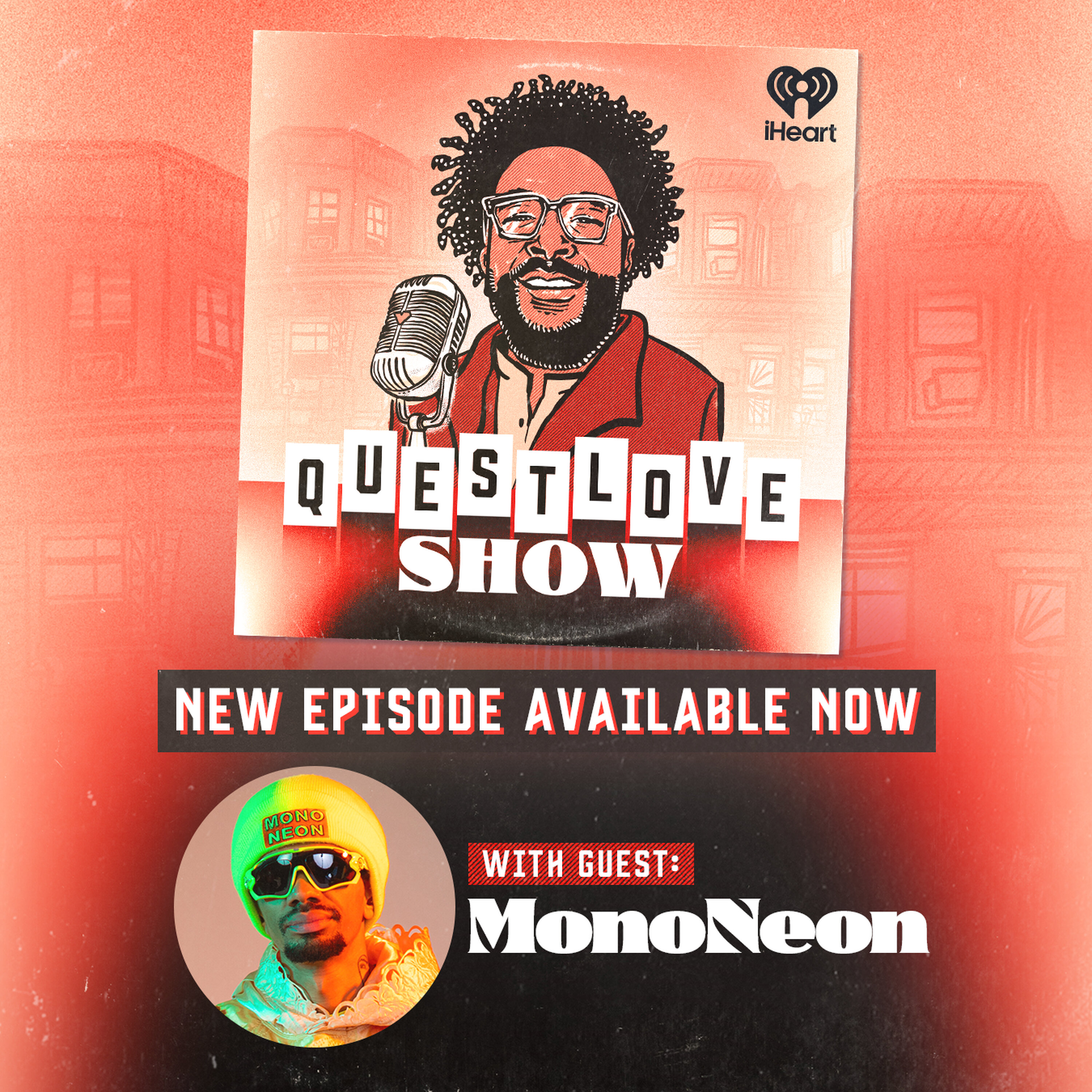
MonoNeon
Electric bass visionary MonoNeon joins Questlove to trace his journey from Memphis church kid and second-generation musician to Prince’s last-hired bassist and a viral internet force. He breaks down his flipped right-handed bass technique, neon-soaked persona, and Dada-inspired art mindset, plus the albums that shaped him. MonoNeon and Quest' dig into his speech-to-music videos, collaborations with George Clinton and Mac Miller, the lessons he took from Paisley Park, and how embracing “mistakes” and self-doubt became the engine of his ultimate goal: total musical freedom.


00:00:00
Speaker 1: Quest Loft Show is a production of iHeart Radio. All right, I promise you people that I haven't traded drumming in for base.
00:00:18
Speaker 2: But what a couinkydink. Here we are yet again on the.
00:00:22
Speaker 1: Quest Love Show, highlighting yet another ass kicking basis. Maybe I'm looking for collaborating. This is like the audition process, But this isn't any average run the meal influencer slash bass players we're talking to, you know, making trying to make ripples on the internet. Flee himself has declared our guest today air quote the greatest fucking electric bass player, and I'm inclined to agree. For my own band has covered his tunes from his his many records or his many viral videos that you've seen on social media because they are irresistible, ear candy and funky as hell. You know, the list is extensive. Of course, Prince knows what's up. Mac Miller knows what's up. David Staples, George Clinton, Cudan Archives, Georgie m Maldre, Pete Rock, Neo Nas, everyone knows the deal. His last project, that Dirt loves Me more than you, of course blew my mind and I was left with no choice. But to have our Court Left show QLs fam Brittany and cousin Jake get on the case so that I could chop it up with the one and only Mono Nia.
00:01:46
Speaker 2: Welcome to the Cost Left Show.
00:01:47
Speaker 3: I appreciate it, Thank you, ah Man.
00:01:51
Speaker 1: So I will say that I got hip to you well, Ladish, I'll say that a place called fantasy where like I really jumped aboard, like oh shit, I was in a record store once. I think I was in La at a Memba and I heard all I ever wanted to do is be a mystery. And you know what I'll later discover about you is your method of songwriting, like your courses and your verses to me are mantras and affirmations, very much similar to like another native of your hometown of Memphis, mister Maurice White, the way that he used affirmations and mantras, essentially tricking their large fan base into positivity, which is always a good thing.
00:02:54
Speaker 2: And you know, for me, just always listening to the core.
00:03:01
Speaker 1: I think for that song you did, the you find that freedom inside yourself, and I think when I heard that, it stuck.
00:03:09
Speaker 2: With me in a way that I didn't plan it.
00:03:11
Speaker 1: And so you know, I've been a longtime fan of yours, so I'm glad this is finally our chance to chop it up.
00:03:19
Speaker 2: Thank you for doing this.
00:03:21
Speaker 1: I wantn't know what is your first musical memory in life?
00:03:27
Speaker 2: Your first musical memory.
00:03:28
Speaker 3: I think being around my dad. He played well he does still plays bass, but he gave me my first guitar and I just flipped it over left handed when I was four years old. So I remember that. I remember him taking me to the Mphics and may to be on stage with him with Rufus Thomas just playing their guitar. I remember that stuff. So those are my earliest memories. You know, as a four year.
00:03:54
Speaker 1: Old, so you didn't have a babysitter, but the stage was your babysitter.
00:03:58
Speaker 2: And that's how your parent Yeah pretty much. Yeah, same with me.
00:04:01
Speaker 1: I played air saxophone in many a nightclub with my family until you know, it was like all right, we'll just have to played tambourine. And so talk about your father, like what are his his roots as far as the musical infrastructure of Memphis.
00:04:20
Speaker 3: My dad was like a studio ace in Memphis. He always gets like the first calls he played with the Barcades. Later on, when James Alexander for a minute, he played with Pop Staples and Mayvis Staples the Memphis Horn stuff Ja Blackfoot.
00:04:37
Speaker 2: Yeah, he pass on the other side of town.
00:04:40
Speaker 3: I didn't play on that record, but later on he played. You know, I did a lot of live shows with him and stuff.
00:04:44
Speaker 2: Gotcha.
00:04:45
Speaker 1: Okay, what did you learn from your father? The fundamentals at least?
00:04:50
Speaker 3: Well, actually, he really wasn't around when I was younger. He put the influence on me very early, and when I saw that, I just took it. But he really wasn't around, you know, because he he was a torn musician. He moved to Europe when I was pretty young, but he left such a huge big impact on me to the point where I didn't want to do anything else. I wanted to be like him. So and I'm still chasing that, you know.
00:05:14
Speaker 2: Yep. Okay.
00:05:15
Speaker 1: So I had James Alexander on the show recently and he gave me his version of Memphis. You were born in nineteen ninety.
00:05:27
Speaker 3: August ninety, Yeah.
00:05:29
Speaker 1: So where there's a different version of Memphis. Can he describe to me, like your version of Memphis? Like, what are your fond memories what are your first memories or fluzzy memories of Memphis, Tennessee.
00:05:43
Speaker 3: Well, I've come from a very loving family from Memphis, and music was and still there's a big part of you know, my family, just coming to family gatherings and reunions and stuff, and just going to church for my grandma every Sunday, the Baptist church, and even the pastor will let me up on his stage to play air guitar for some Sundays just to I don't know why, but he would let me. His name was revend Ac through Liberty Baptist Church where I got baptized at, and he would just let me come in, probably with my guitar or just let me just do whatever. And that's that was a big influence on me as well. And that's my memory of Memphis, being around my grandma at church and stuff.
00:06:27
Speaker 1: So you were an air musician even before you talk about being a visionary, before you even got an instrument.
00:06:36
Speaker 3: Yeah, you know, even a tour guitar. I have actually old VHS tapes of me in my grandma's living room playing with this toy guitar and just you know, visualizing it. I can just see me just wanting this shit so bad as a kid when I look back at that. So I'm just still chasing that childlike fascination with music. I guess I don't know.
00:06:57
Speaker 2: I absolutely do that.
00:06:59
Speaker 1: I wanted to know, is there a subculture in Memphis that challenges the mainstream in other words, you know, like for the outside of you know, I consider myself a music expert, so of course I would say, all right, Memphis, all right, the Sun Records and the Blues and what we basically know about Memphis. But I can't discount that Memphis also gives us an occasional rebellious spirit that just goes their own direction.
00:07:30
Speaker 2: I mean, you could say this about Maurice White.
00:07:33
Speaker 1: You also say this about Larry Dotson of ur K's.
00:07:39
Speaker 2: Yeah, so for you, you.
00:07:41
Speaker 1: Seem to embody a rebellious spirit. Was this an intentional thing or did you just like sort of morph into this?
00:07:50
Speaker 3: Well, I guess it was kind of intentional, But I definitely morphed into it because I'm naturally bashful and shy. So this whole thing of morning now to be upfront doing my own thing, it's really tough, you know, it's really hard, But I have a little more courage now to do it, and I'm not really afraid because I've been trying to let go of everybody's expectations of what I should be doing. So I'm really having fun with that, like peeling off those layers of just letting go. And yeah, that's what I'm doing now. So I'm still trying to find myself. I guess for.
00:08:25
Speaker 1: You in your everyday life, are you this person that I'm seeing now?
00:08:30
Speaker 2: Or do you morph into your everyday self?
00:08:34
Speaker 3: I'm pretty much like this all the time. You know. I even sleep with my quotes song sometimes because I love them so much. But yeah, I'm pretty much like this. But around my grandma and my mama. You know, so you're not DT.
00:08:47
Speaker 2: I meant like, when do you turn into DT?
00:08:50
Speaker 3: Probably around my mama and my grandma, my cousins and them.
00:08:53
Speaker 2: You know, I got you.
00:08:55
Speaker 3: They called me DJ, so I'm like DJ around them.
00:08:58
Speaker 2: Oh my fault. Okay, now you cool. I've heard I've heard you. I'm in DJ.
00:09:04
Speaker 3: No, are you good? D? I like DT too, It's too.
00:09:09
Speaker 2: Is pivoting easy for you?
00:09:12
Speaker 3: I usually could. I always pivot back to my mom and my grandma because they keep me, They keep you grounded. You know, not even trying. They just that unspoken love they have for me and I have for them. I need it, so I carried it with me everywhere I go.
00:09:27
Speaker 1: Eye you've said that you were self taught at four.
00:09:32
Speaker 2: You're a left handed bass player.
00:09:36
Speaker 1: Are you a traditional right handed bass player that still plays left or like, are you ambidection with it?
00:09:43
Speaker 3: I'm right handed, predominantly right handed, but like I'm with my daddy. My daddy, Dwayne Thomas, gave me a guitar at four years old. I just flipped that thing over.
00:09:52
Speaker 2: No one corrected you at all.
00:09:54
Speaker 3: I mean, of course all the old heads and then you if you play the other way, you probably sound better. I heard that along with time ago, and I didn't even switch over because I knew what I wanted to do, not really, but I just felt it. I'd like, I just let me just keep doing what I'm doing.
00:10:09
Speaker 1: Do you readjust the strings? Like is your low e on the bottom now instead of the top or.
00:10:15
Speaker 3: Yeah, my low my low e is at the bottom. It's just it's just a right handed thing, and I just I just flip it over with without changing stuff.
00:10:22
Speaker 2: Okay for you, if he handed any bass or any guitar. Can you.
00:10:29
Speaker 1: Keep the virtuosil levels up, like if given a traditional bottom, me on top and playing the opposite way or is it a struggles a little bit.
00:10:43
Speaker 3: I wouldn't necessarily call it a struggle because I just try to try to adapt to anything I'm in. Any position I put myself in, or any situation I have to go to. I just try to adapt. So if somebody hands me like a precision base, it's going to make me want to tap into something like James James. But still try to play my own ship as well, because I'm always gonna sneak my things in there somewhere. But yeah, I try to. I try to be adaptable and let you tell me what to do at first.
00:11:13
Speaker 1: So yep, I'll say, the first ten years of your life between ninety and two thousand, who were you shetting to?
00:11:21
Speaker 3: Let's see. Of course, my dad he was the first one, okay, and I my mama used to tell me stories about him, and I just used to find anything he played on something like what he told me he played on Animal with Okay okay, yeah, and he was actually credited on that album Gotcha okay and Contagious. He told me, you played on that nice Okay, he played on two albums, but he was really playing with them live when James left for a minute. Yeah, my dad, James. Definitely Guys from Home Jackie Clark and Spanky and Anthony Crawford, Okay, Brandon Brown, who else? Yeah, guys from back Home and stuff like that. And later on I started really listening to Victor Wooden because I never heard nobody thumb like that, So it's like, I want to try to do that left hand and see if I can do that. It never worked, but I put it in there somewhere. And later on I really started listening to Anthony Jackson, very very heavy, you know.
00:12:30
Speaker 2: Very Philadelphia.
00:12:32
Speaker 3: Oh yeah, that's my dude. Man. I go back to listen to him all the time, just to learn something new. Gotcha, that's my favorite.
00:12:41
Speaker 2: Gotcha.
00:12:42
Speaker 1: What were the five albums that defined you for the first ten years of your life? And I don't even mean as a bass player whatever, Like just between ninety and two thousand and what were the five records that defined you?
00:12:58
Speaker 3: Let me see them bad with albums titled but let me see if I can figure it out? Definitely hot butter so Isaac Hayes. Yes, yeah, I'm gonna skip over some gears, but two Against Nature Steely Dan Got You. Okay, let's see what is.
00:13:16
Speaker 2: It about that album that gravitated you.
00:13:18
Speaker 3: Well, first of all, that pristine production and mixing. You know, of course that's gonna make anybody listen if it just sounds good. But I've always loved Donald Fagan and he's always been an influence on me in terms of, you know, how I want to write and the way I hear chorus and stuff. I'm not much of a keyboard player, but when I go to the keyboard for some reason, I think of how he sits down at it and just do whatever the hell he does. But Donald Fagan is really a big influence on me, and especially vocally, I don't sound like him at all, but it's some stuff in there that I kind of sound like him a little bit. But no, but yeah, Donald Fag and that album. So that's the reason I like to it Against Nature, that.
00:14:00
Speaker 1: Album Got You, okay, yeah, yeah, and the other three Mothership Connection Okay, probably George Clinton and.
00:14:08
Speaker 2: Them yeah okay, yeah.
00:14:10
Speaker 3: Yeah, the album cover was pretty cool. That really influenced me a lot in terms of how I wanted to look when I saw that album cover Yeap Gotcha. At a very very early age, I used to stay at that album covered in my grandma's living room. I had the vinyl. I used to act like I was DJ wooded on the turntable in my grandma living room, just scratching it up and just playing around. So there was a big influence. What else, that's three my elementary school days. I have to say, voodoo D'Angelo.
00:14:42
Speaker 2: Damn that heard me When you said elementary.
00:14:43
Speaker 3: School, I mean it like that. I didn't know, but that damn ship was definitely you know, I didn't know what the hell was going on. I didn't know what I was listening to. But you know, guess what, we didn't know either. But it was one of those things, man, you just you couldn't stop listening to it and felt at home with that because you know, he came from the church too, you know. So yeah, it was just I ain't gonna get too much into that, but yes, yes, yeah, for real, I'm glad I'm saying that to you.
00:15:13
Speaker 2: Man.
00:15:13
Speaker 1: Yeah, I appreciate it, and I know he would appreciate it, Like I definitely know that he's a hip to your work.
00:15:20
Speaker 3: Okay, that's too Yeah, what's the fifth? That was four? Find a fifth one. It's probably gonna be another steally damn album. I would say, the damn it, the royal scam Steally damn.
00:15:35
Speaker 4: Yeah, what's weird?
00:15:48
Speaker 1: You just say you're not a keyboard player yet you released a keyboard album or a synth album.
00:15:55
Speaker 3: Yeah, thats just me sitting around. That's when I first got that that muse. I just opened the box, I plugged it in. I just told myself, just do something with it, just put out something. And I just did, you know, just messed around with it because I was trying to tap.
00:16:10
Speaker 2: Into my that's creativity, that's.
00:16:12
Speaker 3: My whole thing. But I'm not really a deep type of person.
00:16:15
Speaker 2: I just you just do it.
00:16:17
Speaker 3: Yeah, I just do it because I just look at it as as breathing. I guess I've been doing this thing for so long. I just it's just part of me. Shit, I just won't this shit. I just want to be part of the music. I just want to be in it.
00:16:29
Speaker 1: Let me ask you, because I will say that probably be one issue that sort of handicaps My peer group is literally showing up like I tell them all the time, Like, we don't have to be prepared. Sometimes we won't be good, but let's just show up and take one step in front of the other, one step in front of the other.
00:16:59
Speaker 2: And look, I'm guilty of it a lot.
00:17:01
Speaker 1: I was that person that believed in no, it's not ready yet, perfectionism.
00:17:06
Speaker 2: I mean, I'm the guy.
00:17:07
Speaker 1: I'm the guy that you know has been sitting on his album for eleven years now. But showing up, I believe is not only key in first, but it's really just the only rule. Like, so, I mean, have you always just been mis open to hey, where I plugging, let's go? Or like have you ever had trepidation or oh I'm not good enough for it? Have you ever been intimidated to be in a situation.
00:17:37
Speaker 3: That's what I'm working on working through now, is like feeling like I'm not good enough because I feel like that all the time. I wake up feeling like that. That's why I'm always so damn depressed. Probably, but yeah, that's what I'm working through.
00:17:48
Speaker 2: You know, just what is it that you want to master that?
00:17:53
Speaker 1: Like, what is the sign that you are satisfied with your skill level? Because I mean, dude, like you're leaving evidence all over the internet on why you are not to be messed with, Like, I.
00:18:13
Speaker 3: Don't look at it like that. I just, man, I just be doing shit. But I don't. I'm not where I really want to be in terms of how I actually hear myself, you know, not to be all profound and deep. But I'm not there yet, you know, So I'm not really I'm very hard on myself after every show, you know, I beat myself up. I try my best not to because it can be very draining, but I'm so used to beating myself up. I'm not trying to keep myself humble or nothing. But it's just I don't want to feel like I've arrived to nothing. I don't want to feel like, man, you're the baddest motherfucker in town. No, I don't want that. I just want to just be in the space of doing my thing and getting better and better.
00:18:55
Speaker 2: So is it hard for you to take compliments when.
00:18:57
Speaker 3: Yeah, I'm starting to say thank you now as opposed to say, man, whatever I tried, I still say I guess and I tried, and very you know, whatever I guess humble or whatever. I just I'm not deal with compliments. I just know I get it.
00:19:12
Speaker 1: Yeahs as a former student of Non deservingst University. Yeah, I will say that when you do arrive to that place.
00:19:25
Speaker 2: And the thing is is that even though I would say I'm more.
00:19:28
Speaker 1: Evolved now than I've ever been in the last like five to six years, I mean, you know, sometimes it's a struggle. I will say yesterday was probably on record one of the a very bad day, you know, because sometimes a dark commotion will come to light and you don't know how to handle it, and you know, but you're going to get to the place where you're satisfied and.
00:19:56
Speaker 2: That you own it.
00:19:57
Speaker 1: And you know, I love watching you get to the If this is not perfection for you, then I love watching you struggle to the destination. So keep on struggling.
00:20:07
Speaker 3: I'm struggling.
00:20:10
Speaker 2: The base really never.
00:20:11
Speaker 1: Gets the props that it deserves. Like why the bass as opposed to any other instrument.
00:20:18
Speaker 3: Well that's probably because my dad again, because you know I used to I used to see him thump a lot, and I didn't as a key. You don't know what's going on, but you're so intrigued, you're so fascinated by this, by your dad. By this guy is looking so cool. He got the ponytail, you got this purple base, which he actually gave me. I play, I play it with my grandma. Play that purple base with my grandma. And yeah, it was just because of him.
00:20:43
Speaker 2: Just because of your dad.
00:20:44
Speaker 1: Okay, yeah, you know seeing that I've heard you say a few times and this is this is what I really love about your creative ethos, your relationship to what I'll say, air quote mistakes keeps speak on why your theory of like mistakes are important ingredients for your creations, and that you don't believe in the idea of mistakes like everything is usable, Like as a chef, you will use everything.
00:21:09
Speaker 2: From the snout to the butt, like everything.
00:21:14
Speaker 1: What is your relationship with mistakes as far as your creativity is concerned.
00:21:19
Speaker 3: I just find so much value in just embracing the mistake as opposed to especially in musically just or just in life. Man, just just embracing it and just letting it be what it is and just letting it have its own story.
00:21:36
Speaker 2: Man.
00:21:36
Speaker 3: It's like I just I don't know, I really don't think too deep about it. I just I just love making a mistake a thing and it's it's so much life into especially playing live and stuff. I make a lot of mistakes, but there's something about giving that mistake energy and it blossoms into something so I wouldn't even think of you know. So that's why I embrace, you know, mistaken The Prince.
00:22:02
Speaker 1: Ever tell you his theory. He's like, if you make a mistake, then make it again.
00:22:07
Speaker 2: Yep.
00:22:07
Speaker 3: So that way, he told me, man, just own it on it. We was rehearsing in an MPG music club room and back there and I did something that he probably felt that I wasn't confident with it. He told me own it and own it, and that stuck with me ever since then too. Man, just you got to own it. If you're not confident with your shit, they gonna feel it too. So that's why I kind of have this attitude behind my mistakes, like it's mine, nigga, So I'm just gonna keep doing it.
00:22:34
Speaker 2: Yep.
00:22:35
Speaker 1: Like in your high school, were you uh in an environment in which you had like musical bands? Did you join bands as a kid or what were your high school teen years?
00:22:48
Speaker 2: Like? As far as uh gigging or big bass playing is concerned.
00:22:54
Speaker 3: I wasn't banned. In high school, I used to stay in the band class, you know, I just and they had a base in there. I used to plug my base in the in the room and just play with the horn players and stuff. I play upright in high school and but I used to stay in the band class. But a lot of my foundation was the church during that time, playing in church with all the badass organ players and piano players. And that's where I really get a lot of my shit from looking at the organ player's foot or the left hand and how they move and stuff. So really the church is a big influence, you know, on me.
00:23:23
Speaker 2: So gotcha?
00:23:24
Speaker 1: Can you speak on the metamorphoses of Mono Neon's journey, like as in the character, like the journey from DJ to Mono Neon? Like, first of all, where where did the name come from?
00:23:38
Speaker 3: I just like Neon colors. I love like well. I used to call myself poly Neon, but other than my Grandma's in my bedroom, my grandma's house. For some reason, I just wanted to change it because I got bored or something, so I just started messing around with this. But I just like Neon installations like Dave Flavin and some and just light shit like James Terrell. I used to go on the Internet and just research stuff about neon lights and stuff, so it just came from that. And I love vant guard art like movements like god, I is okay, that's where all the embracing mistakes probably came from, and the rebelliousness and this anti art shit you know that I keep in my head. Just just wanted to just, I guess, be different, but not really. I don't care about being different, being different, but yeah, God, I really influenced me a lot with the whole manifesto bullshit.
00:24:26
Speaker 1: So yep, got you, gotcha as far as your fashion sins, did you study much as far as afrofuturism is concerned, or is this just your inner nine year old self that refuses to grow up and you're in a constant state of play.
00:24:43
Speaker 3: That both all those things problems, especially I don't want to grow up at all. I'm thirty five years old, but now you know, it's starting to catch up to me that I may have to grow up, but just a little bit here, you know, But now I don't want to grow up. Fuck that shit. Now be a child for the rest of my life. Yeah, that Mothership Connection the album that that whole thing really influenced me, I guess in Booty Collins and all that stuff. So I come through that, you know with the I don't worry the goggles because of that. But you know, I'm just being me, I guess, but that's that is an influence.
00:25:15
Speaker 2: You know. Gotcha?
00:25:16
Speaker 1: Yeah? Can you talk about your like when you started getting session work? Was Neo your first like major client or yep?
00:25:26
Speaker 3: Because I remember recording that when I was going to Berkeley. The trumpone player asked me to come over to this spot to record that, and I think it was named Derek White trumpone player. Yeah, yeah, I think he produced a co produced that song I played on. But yeah, but that was my first major pop song I played on.
00:25:48
Speaker 1: Was playing something so structured and discipline a hard thing to do as opposed to wanting to break out of your boundaries and.
00:25:57
Speaker 3: Not not during that time because I really was, and I guess so called tapped into doing my own thing. I mean, but yeah, I was just trying to make the do happy with whatever I was doing.
00:26:09
Speaker 2: You know. So if you're in a situation in which you're not the final say, and a performance or whatnot, you know, like you might hear you might go to a relative minor of a note that sounds cool in your ears, whereas they're just like, nah, I'm doing a pop song, like just play basic and straight. Like.
00:26:28
Speaker 1: Have you been in a situation where like discipline was required for a client and.
00:26:38
Speaker 2: What your your instincts were.
00:26:39
Speaker 1: Telling you to go You couldn't because you have to play something straight?
00:26:44
Speaker 3: No, I'm I'm I'm cool, you know, being produced and someone told me to keep it simple and keep it what it should be and just you know, play the record. I'm cool with that, you know. You know, I don't mind it. I just want to make if I'm hired to do a session or whatever, I just want to make whoever is producing happy. It's not really about me. If you want me to do whatever, mone on, neon, shit, I will go there if you want me to, But I just come in. Just tell me what to do, and I try my best to do it for you.
00:27:15
Speaker 1: Actually, I'll ask you the opposite, because I'll say that I'll roll my eyes more. I mean, occasionally I'll get a collaborator that will use this adjective all the time, in which they'd be like Hey, man, I want you guys to rutify it. And I'm like, if you guys really knew the roots, then for me, like I'm a stickler to the original version, so like if an artist comes on the Tonight Show, like for me, it's it's shape shifting into what the song originally was.
00:27:52
Speaker 2: And I had this one client that, like, you.
00:27:54
Speaker 1: Know, they were supposed to sit in with us and one of their massive trillion selling, trillion units selling hits. We did it to the letter and they were like, well, I want you guys to roots a fire and remix it. And I'm trying to be like, yo, like when we go out there to do it for America and do it for Jimmy, like they're expecting, you know, the version that they grew up with, and they're gonna look at us like why are you guys trying to hip a fire for me?
00:28:25
Speaker 4: Though?
00:28:26
Speaker 2: That's the challenge.
00:28:27
Speaker 1: So do you sometimes run into a client that wants you that'll make a reference to like one.
00:28:33
Speaker 2: Of your Cardi b videos or anything like that, like, yeah, to look it up like you did that.
00:28:40
Speaker 3: That has happened before, And I kind of get annoyed, but okay, Yeah, but if you want me to be all quirky and stuff. I can give that to you, but sometimes it's not gonna work, you know. But whatever you want, you're paying it, So I do whatever, right, Okay.
00:28:56
Speaker 2: So you believe in giving the song what it needs, and.
00:29:00
Speaker 3: That's always important to me. You know. I don't come in with the ego. You know. I can be arrogant if you want me to, but I don't come in, you know, with it.
00:29:08
Speaker 1: Keep talking about your work with Georgia and Mandre. How did you two connect?
00:29:15
Speaker 3: The first thing I played on was I think it's called Miss One. I did that with a Danish producer, Chris one two. Okay, but yeah, the first thing I played on was miss One and like I think two years ago was the first time I met her in person, and yeah, I love her man she cool he yep.
00:29:37
Speaker 2: So okay.
00:29:38
Speaker 1: So yeah, you are in the age of where you guys can just collaborate by sending each other files and.
00:29:45
Speaker 2: Is that so?
00:29:46
Speaker 1: Is it jarring for you to come and create in person? Like for me, I like to create in person with the client. But I do know that there's a whole other generation that's just like, hey, you know, I'll see the.
00:29:58
Speaker 2: Files, put some stink on it, send back.
00:30:00
Speaker 1: To me, and then maybe five months later I'll be shocking.
00:30:05
Speaker 2: I'm like, oh this is the song I play.
00:30:08
Speaker 1: So for you, Like you can have absolute chemistry with someone without ever having met them.
00:30:14
Speaker 3: Yep, You've been like that for me for a long time.
00:30:18
Speaker 4: You know.
00:30:19
Speaker 2: Do you prefer that way?
00:30:20
Speaker 3: I mean, I'm used to it. I don't mind it, but you know, now I like to be in the room with people, man, because it's just a different thing you bounce off people with, you know, when you're in the room, you know.
00:30:30
Speaker 2: So gotcha? Yeah, okay.
00:30:32
Speaker 1: So you know Eddie Murphy is a major, major, major fan of your work.
00:30:37
Speaker 2: Has he ever reached out to you?
00:30:40
Speaker 3: Not personally?
00:30:41
Speaker 1: No, for someone that doesn't have a social media account, I'll say that. You know, he's extremely well equipped with like the idea of sharing viral videos and all those things. So you know, for him, a typical week, you're going to get like five to ten YouTube or take time or Instagram clips that he thinks it's hilarious or whatever. And you know, he went through a Mono Neon phase where it's almost like I was like, damn, like I bet you Mono neon has no clue that this guy sits and watches like hours and hours of his videos.
00:31:15
Speaker 3: Nope.
00:31:28
Speaker 1: How long does it typically take for you to once you decide that you're going to take a video and then find the harmonics? Like do you have this ability to even as I speak now, like to figure out like what key I'm talking in and where melodically my voice is going and and all those things.
00:31:52
Speaker 3: Yeah, but I would have to. I would have to record it. I don't hear right now. I would have to, you know, psychic and to actually because there's actual notes in talking, but when you repeat it, you can hear the note, you can hear the con tour, you can hear a groove in it if based on your sensibility. So that's that's what I be, you know.
00:32:12
Speaker 1: So I figured Party is a good subject for you to do this with because her voice is so melodic. Of the viral videos that you've done of people talking and you providing the musical backdrop of it, which one was the most challenging.
00:32:36
Speaker 3: Man probably a Cardi B one those early ones, because that's when I really kind of started developing it and making a song out of it, you know, making the track out of it because I used when I first started, I was just just mimicking, just finding the notes of a person's speech. But now I'm actually making songs, actual grooves and tracks something you can dance to from it. So I think the early Cardi B once was kind of hard for me.
00:33:04
Speaker 1: Do you have to sometimes adjust it rhythmically so that it makes more sense?
00:33:09
Speaker 2: Well?
00:33:09
Speaker 3: Probably yeah, for me to make mofa okay yep, yep, yeah, especially within the song structure. I wanted, you know, I want to have a groove to it, So yeah, I do structure a little bit different once to get to that part.
00:33:23
Speaker 1: Once those videos are made, do those grooves just lie exclusively there or will you sometimes return to it because, as you know, our listeners might not know.
00:33:34
Speaker 2: I don't know why we played.
00:33:36
Speaker 1: I think it's when Cardi B hosted the Tonight Show. We decided to do. They should have never gave some goddamn money. And the track alone, man was just like I remember once, I made a forty five minute loop to that song, just so I can walk like I'll do my morning walks and you know, from my apartment to work. When I tell you, I meant my walk change listening.
00:34:03
Speaker 2: To you playing that.
00:34:08
Speaker 1: Hell yeah, so it's like once those like you just move on to the next You never turn around to that.
00:34:15
Speaker 3: Sometimes I do, okay. Sometimes I go back and actually use it for one of my original songs. I put my old legs to it sometimes I yeah, okay.
00:34:25
Speaker 1: Have any of your subjects reached out to you once they've seen the video? Like has Cardio ever? Is she aware of these at all? Has she reached out?
00:34:33
Speaker 3: I think she'd sent it. I think Pete Rock reposted it one time a couple of years ago, and I think she come in it or something. I may be wrong, but got yah. I think a few people have seen it. I know Tiffany had it when I did something she did on the Breakfast Club about the man something I don't know. I re harmed that and she reposted it. Yeah yeah, I think some people be seeing it, but I don't care. Shit, I just be doing it for myself.
00:34:58
Speaker 2: Yep, got you ye? What are your upright base playing chops?
00:35:02
Speaker 1: Like, like, are you proficient in traditional upright bass playing?
00:35:08
Speaker 3: My peevocados? Shit is okay? You know, I need to work on my art, my bowling, but if you want me to play upright. You know, I'm not afraid to go nowhere. I play upright, you know, for a whole show if you want me to.
00:35:19
Speaker 2: Got you all right?
00:35:20
Speaker 1: So you're a Memphis native and you know blues and Memphis are synonymous with each other. How proficient are you as far as like the blues history of Memphis and are there any notable bass players of that genre that you feel are unsung or you know, not talked about.
00:35:43
Speaker 3: I would have to save my dad again, Dwayne Thomas, you know, so I always have to go back, because man, people need to know about his contribution, you know, and not to put.
00:35:54
Speaker 2: When they do Holy Ghosts? Does he did? He make James proud doing Holy Ghost?
00:36:00
Speaker 3: I got I got this cassette tape my dad played on with the Barcaes. This on YouTube. I uploaded the whole thing. I think I did what's on Facebook a summer huh? And yeah, he yes, he was that dude. Just to let you know I got you. Yeah he still is.
00:36:15
Speaker 1: James is so hilarious because, I mean, because of the history of that song. Holy Ghost was made in nineteen seventy three and just sat in the vault like it was nothing, and you know some five years later in nineteen seventy eight, they just made a quickie throw away album and I'm like, how.
00:36:35
Speaker 2: Could you throw away a song like this and just let it sit there? I don't like.
00:36:41
Speaker 1: Holy Ghost is my all time favorite Barca song. And I would imagine as a bass player like for you, like, what what are your memories of like watching them play? And there were a few times when Larry would call you on stage to play with him.
00:36:55
Speaker 3: Correct now that was rufous my dad to play rufus. But yeah, my mom used to pick me up from school elementary school to take me to go see the Barcades live. That's when my James was playing with him then. But Barcades is such a big influence on me and Larry Dockton. That's why I probably kind of flamboying with my whole style as well, because of seeing Larry with the snake and stuff and the blonde hair. I was just with him for his birthday. I hung out with him and stuff were real. Hell yeah big. I remember the yellow and white one he used to have around his neck, and.
00:37:32
Speaker 2: I could have sworn that was not real.
00:37:36
Speaker 3: That's a real snake.
00:37:38
Speaker 1: It's not have you ever asked him if the snake on the cover of the Cold Blooded album was his?
00:37:45
Speaker 3: Like, No, I didn't ask him. That was that a rattlesnake? Yes, I don't know.
00:37:52
Speaker 2: I got you.
00:37:53
Speaker 1: Okay, So for my my gear heads, what did you start off with and what do you continue to use to this day as far as your gear is concerned.
00:38:02
Speaker 3: First of all, it was a guitar. My daddy gave me a guitar, but I played it like a bass because that's all I knew was the thumping. I just used to thump. It was a guitar. Then eventually, you know, I actually had an actual bass, but I think it was an ab and as sound gear had a transparent orange finish. Yeah, it was an old Abinaz bass.
00:38:25
Speaker 2: And you mentioned you went to Berkeley. I don't know why.
00:38:28
Speaker 1: Every time I meet a Berkeley musician, I'm just like that experience would have been a nightmare for me.
00:38:34
Speaker 2: What was your Berkeley experience?
00:38:36
Speaker 3: Like it was terrible? Now, I was all right, I don't like going to school, first of all, but I'm glad I went because I met some cool people. But I hardly went to class though.
00:38:47
Speaker 2: Ye, what was your years there?
00:38:49
Speaker 3: Two thousand and eight to twenty ten. So I was there two years and I went back home.
00:38:56
Speaker 1: How do you decide who your tribe is or who your circle is?
00:39:01
Speaker 3: Actually? For me, it was that experience was eye opening. I just looked at that thing totally different because I was it was my first time being around so many musicians that were good, and they were I guess better than me. So I wasn't even trying to outplay nobody. I wasn't trying to be better. It opened me up to saying, Okay, there's a lot of good musicians out here, so you have to do something way totally different. So that's why I started tapping into wearing the neon colors, becoming a PERSONA really tapping into that because I just didn't want to just be a musician, you know, I wanted to be something else. So being at Berkeley was really an eye opening thing beyond music.
00:39:41
Speaker 1: I guess as far as your actual fully fleshed out mono neon character, when did when did you make your debut as far as soccer on bass, duct tape hats, goggles, like, when did this person come to like like I.
00:40:00
Speaker 3: I have to sock on my basis at Berkeley. I think I gotta look back and.
00:40:04
Speaker 4: What was the.
00:40:06
Speaker 2: Logistics of that this is just to be different or like? Was it?
00:40:10
Speaker 4: No?
00:40:10
Speaker 3: It was just I was just reading a lot about ready made art by Marcel Duchamp, that where he just, yeah, just ready may art where he takes this ordinary object and he may write some sort of pseudonym on it, or he may reposition it. And for some reason, I just I just wanted to do that with my bass. I like, okay, I since I want to be this just persona, I need to tap into something that's beyond music. Let me read something about visual arts, let me get into sculptures, let me be influenced by something else, because I can't continuously just be influenced by music, because it's gonna get boring for me. I want to be influenced by something else. So that's why I started reading about dot I and turning my bass into a ready made thing in my world, I guess.
00:40:58
Speaker 1: But so it like that what percentage of your live show is improvised and what percentage of it is actual? Like prepared set list A to Z execution.
00:41:15
Speaker 3: I have a set list. Usually I will say eighty percent of my show is improv. I have to have my my improv in there. But some of it is a structured I really don't rehearse a lot, so sometimes we get on stage and just wing it because we all know the song. So you know, there's a lot of mistakes in there. So it opens up a new world for me. But there's a lot of improv in there, but it is structured a little bit.
00:41:38
Speaker 2: Okay.
00:41:38
Speaker 1: So of the dozen plus albums that you've released, I'll say, for me, Jelly Belly, Dirty Somebody is one of a well, you know what, surfing my brain, there was a there was a there was a point. There was a point where I think I wanted to remake that join for us because I'm the groove is you know, otherworldly, but for you, like, what is what's the album project that's the dearest to your heart?
00:42:07
Speaker 3: Oh yeah, Crust the Neon Missionary Baptist Church. With my grandma. I've been writing songs with her.
00:42:14
Speaker 2: She's the number one collaborated Like.
00:42:15
Speaker 3: That's my my lady.
00:42:17
Speaker 2: Man.
00:42:17
Speaker 3: I can talk about her all day. I'm just that's all like being away from Homer, because I'd be wanting to just sit with and watch watch Prices, right, but yeah, that's my girl, man, and these times with her are very special to me.
00:42:31
Speaker 2: You know.
00:42:31
Speaker 3: I try not to read into it too much, but it's such a feeling sitting next to her and with my bass, my dad's purple bass, and she's singing old hymns she used to sing in the Baptist church. Yeah, it's just it's just one of those things, man, where I'm just happy that I have this time with her and actually writing original music for her to sing, and she actually loves it, you know. So I'm finding I'm finding her humping her ship.
00:42:55
Speaker 2: Brother.
00:42:55
Speaker 3: So it's just it means a lot to me.
00:42:58
Speaker 2: Yep. Yeah, I was gonna say I wasn't prepared.
00:43:02
Speaker 1: When you put out Crusty Neon Missionary and you open would.
00:43:06
Speaker 2: Take me to the water, I was like, oh damn.
00:43:10
Speaker 1: Like instantly I'm second grade at first Pentecostal, like at my at my grandmom's shirts, like I instantly started missing my grandmom.
00:43:18
Speaker 3: So that's my girl, man, such a one.
00:43:22
Speaker 2: I appreciate and love the way that you.
00:43:25
Speaker 1: I guess we could say documented recipes for us to stick to. I want to speak of your collaborations. So first of all, what's your decision process when it comes to like the many collaborative projects that you've done, like I know you've done Chris On Too before, or the Screaming Headless towrds those project, or even with Crass from Soul Life and drummer Joe Russo like Matt, or even with Corey Henry, or like when you do a project with people who are traditionally not like the musicians that you are accustomed to playing with, Like how do you decide like who the alpha is or who man's the ship or who lays the anchor, or like what the roles are? How do you collaborate with other people.
00:44:27
Speaker 3: I don't come in with no ego. You know, I listen more than I talk. Well, I don't talk much anyway, but I make sure I read the room the best way I can. And uh yeah, I just I don't decide who who is in control of the room. I just I just let it happen, and it's usually the other person because I'm not trying to control nothing. I just want to especially being a bass player and I'm hired to play in the band. I'm not trying to step out front. If you want me too, I will, but I'm just trying to just be there and play the best I can and make the person happy whoever hired me. So you can be the for all you walk to Just go ahead.
00:45:03
Speaker 1: Yep, yeah, But I mean as a creative I'm almost certain that you two have ideas and directions you want to go. Oh yeah, So is it easy for you to communicate to other musicians exactly what it is that you want?
00:45:19
Speaker 3: Nope, I just tell him, try again, Let's do some IW that's usually my thing.
00:45:24
Speaker 2: Yes, try something else.
00:45:25
Speaker 3: Yeah, let's try something.
00:45:26
Speaker 2: I got you you hold.
00:45:28
Speaker 1: I guess what I dub an unfortunate honorable title, which is I believe that you were the last musician that our dear brother Prince Roger Nelson hired before is passing in twenty sixteen, ten years ago. First of all, how did you guys come across each other? And how did he reach out to you or you him? Tell me this story.
00:45:57
Speaker 3: It was an email, you know, he wasn't a phone call. One of if it's manager, I think it was Phaedra somebody THEO or whatever. But they emailed me and they said, Prince wants you to come to Paisley Park to jam and That was late twenty fourteen actually, and I think the next day or two days later I went up there and Judas Hill was there, Dominique Tapling, Taylorn Lockett and we end up jamming with Judith that night. Then the next day we flew home. Then I guess that was my audition for Judas and Prince and I started working at Paisley Park early twenty fifteen.
00:46:34
Speaker 2: And what did he play? If you were on base?
00:46:38
Speaker 3: He wasn't playing. He was there though, because he would call Judith to tell the band to do something. So he was there.
00:46:44
Speaker 2: He heard hear the rehearsals. But was it in the midia?
00:46:47
Speaker 3: Yeah he was. No, he wasn't in the room, but he would call Judith to tell me or Dominique or Teyrn to you know, play something different or whatever. But yeah, so I didn't meet him the first time I went, but he was there. But when I came back he started coming around.
00:47:04
Speaker 1: Was it dark in there? And were those eyes staring at you from those paintings? I swear to this day that every time I passed those murals on his wall.
00:47:12
Speaker 2: Yep.
00:47:13
Speaker 1: It's almost like the Three Stooges as an episode when the eyes are like looking at you.
00:47:19
Speaker 2: What was it like walking through there? Man?
00:47:22
Speaker 3: There's so many words I can use to describe that experience. It was.
00:47:28
Speaker 2: Okay, So wait, here's the thing I don't know.
00:47:30
Speaker 1: Prince came into my life when I was eight, and what's weird is that you came on this earth a year after. Okay, so look, I'm I'm part of the and this is where Prince orgers get angry at me. But you know, most people when they have a magic streak, most artists have a magic and I know I sound like a critic right now, but just as someone that's observed music, most artists, if they're lucky, get a four year streak in which they shit gold. And Prince is actually a figure much like Miles Davis that was, in my opinion given in eleven to sort of twelve year period of which every SHOT's going in no matter where he shoots it from, every idea is just like changing your life and whatnot. So you came on Earth when Prince was already a legend. Yeah, And I grew up when Prince was a nobody and then six years later became a legend. So he was like he was everyone's secret niche artist and then became big with this. But for you, like, were you a student of his music? Did you know much about him besides hey, I know a genius lives in Minneapolis, or like, what did you know of his work?
00:48:59
Speaker 3: I mean, A, of course I knew A knew Prince. You know, I knew him. You know, I've seen on TV, I've heard his music. You know, his music was everywhere. But I didn't really listen to him like that as a kid, you know, I really as yeah, you know, you know, I really, but I knew it's it's just stuff. I knew the grooves, but he wasn't. He wasn't that for me. But once I started being around him and started, you know, having to learn songs and rehearse with him and play with him, that's when I started going back and listening to his stuff and started to really be influenced by that and started incorporating that. Not even intentionally, it just happened that, you know, because I was around him, and He's like, man, I want I saw so much of what I wanted to be in him. Once I started being around him, I was like, man, I really, whatever he's on, I want to I want to vibrate like that. That is pretty cool man. So it was that type of thing for me.
00:49:56
Speaker 2: Once in a.
00:49:56
Speaker 1: Blue moon, he would like, there's there's songs that haven't been released by him that I feel like are so the foundation of what the ground that you're standing on right now.
00:50:11
Speaker 2: I don't know if you ever heard his song movie Star.
00:50:16
Speaker 3: Man, that's my fabe. That's ye man, that quiet, that quiet fun whatever you want to call it. Man, it's such a that's my goal to I don't know why, but isn't that thing I want that? I want it?
00:50:31
Speaker 2: Yeah? Movie Star also to a lesser state.
00:50:34
Speaker 1: I'll say, probably the craziest song he's done is if you ever heard There's Others here with Us?
00:50:39
Speaker 2: Yep?
00:50:39
Speaker 3: It's yep, yep.
00:50:53
Speaker 1: He talked about him as a bass player, because I think of all of his mastery, and this is with lyrics, as a businessman, as a director, as a singer, as a harmonizer, as an engineer, I feel like the one attribute that he never gets enough phrase for, you know, is his bass play. Like it was a struggle just to get people to notice his guitar, Like people really didn't start noticing he was a guitar master until my guitar gently weeps moment and I'm like, dude, have you not seen or any of the clips?
00:51:32
Speaker 2: But he just talked about him as a bassist.
00:51:35
Speaker 3: Well, unfortunately he didn't play bass around me. I wish he did, but you know, the shit that he did play on, he just had this uninhibited type of rebellious whatever you want to call it, type of funk man that can't really be duplicated by anybody. You can learn from it, you can be influenced by it, but he had his own thing that was so uncanny. I don't know, man, he just had this weird type of funk that I just love and that I just gravitate towards and that I just learned from just just listening to it, and I've kind of found my own thing with it. Not I don't. I never try to be like him, but when I when I listened to him play, it's like I want a piece of it, and I just try to make it part of me, especially now, you know. So that's what I get from his bass plan. It's just that that rebellious type of funk, like he ain't trying to be like nobody else, but himself, you know. But you can hear the influences. You can hear Larry and Sonny, but he's still Yeah.
00:52:30
Speaker 1: There's a drop he does that's like a trademark of his, or on the one.
00:52:37
Speaker 2: Like he does a lot on Let's Work.
00:52:40
Speaker 3: Yeah, yep, yep, yep.
00:52:42
Speaker 2: Like did he make you do that a lot?
00:52:44
Speaker 3: In his Yeah, he would make me, would not necessarily make me, but he would tell me to play a certain way. He would tell me to There's a song called Stare. I didn't play on the song, but you used to play that a lot with him. There's a song called Stare, and I used to put a lot of you know how bass player. I put a lot of ghosts in it just to keep time. But he would tell me to remove it and just keep it clean. And I've kind of learned that from him, you know, within that song. So he would tell me certain things to do.
00:53:12
Speaker 2: You didn't want you to play ghost notes, not for.
00:53:15
Speaker 3: That song, not that well, he would he would let me do my thing, but if you want something particular, he would tell me, you know.
00:53:22
Speaker 1: Okay, only because brown Mark would be the opposite. He would say, principal wanting to play ghost notes and.
00:53:31
Speaker 2: Rumble more than the actual notes, and okaye, he.
00:53:36
Speaker 3: Likes that stuff too, but for that particular song, I would just remember him telling me, don't add the whatever.
00:53:41
Speaker 2: Yep, okay.
00:53:43
Speaker 1: The single you have that now, bottom Feeder with your Grandmam and George Clinton, which is such a full circle.
00:53:51
Speaker 2: Woman.
00:53:52
Speaker 1: You've worked with George a few times before. How did you guys meet up?
00:53:56
Speaker 3: The first time I played with THEO was at a festival music festival. I sat in with them. But I eventually started working with him on a song called Quilted, Me and my friend David Nathan. This is his studio now, all these keyboards, David Nathan. But yeah, the first song I actually deal with him was Quilted, And yeah, that's when we first started collaborating together on the song. But we went down to Telly Hassee and recorded his vocals and stuff like that. So whenever I do hang with him, I go down to tell Hassee to his studio, Yeah, and just just hang with him and smoke a lot of wee man smoking, which I don't mind. I don't mind smoking him.
00:54:36
Speaker 1: Yes, okay, So also I want to know about your work with John Brian and Mac Miller on a complicated song.
00:54:48
Speaker 2: How did how did that project come to be?
00:54:50
Speaker 3: I didn't give a chance to meet but actually we talked. He sent me a message on Instagram about that song. He send me the track and everything and told me to do whatever. And that was the last time we talked. I never you know, I didn't get a chance to meet him. But before he passed, he sent me that song and that was such a weird thing for him to send me that and he just passed away like that, and to meet him, it just I don't I don't do well with you know, death and stuff. Man, It just it just really fucks with me. But yeah, I wish I got a chance to meet him. But we talked, you know, through Instagram, you know, so yeah, gotcha.
00:55:26
Speaker 1: What determines you wanting to dive into this creative pool? Like when do you know it's time? Like okay, this is time for a new album? Or even how do you name your albums?
00:55:36
Speaker 2: Man?
00:55:36
Speaker 3: It just happens. I'll just be thinking of the weirdest combination of words like jelly belly. I can't remember jelly belly, bally, I don't know. I just I'm just first of all, I'm from Memphis. I'm country, so I'm just be it just happens, you know. It's just one of those things. But uh, I don't know. I just the album I'm working on now with my friend Davey. You know, he's helped me with producing and writing songs with him. So I'm the album that I'm working on is a bunch of duets.
00:56:07
Speaker 4: You know.
00:56:07
Speaker 2: I was just gonna say, is this the duets album?
00:56:09
Speaker 3: Yeah, we're working on that. You know. I've been getting people in and it's been coming alone.
00:56:16
Speaker 2: The song has two people or is that the whole?
00:56:19
Speaker 3: It's yeah, you me and another vocalist, or me and some more musicians, you know, one of those things. But it is a very one of my biggest collaborative projects. I got some pretty cool people on it. But yeah, that's I'm That's what I'm focusing on.
00:56:35
Speaker 4: Now.
00:56:35
Speaker 3: That's why I'm here, you know, trying to get shipped together. But yeah, that's the thing I'm working on. Do it thing.
00:56:41
Speaker 2: What is the singular moment that has changed your life?
00:56:47
Speaker 3: Let's see here, there's a couple of singles. The moment be fair though. When I started playing with Prins, that was the influence that that that put a fire under me. That's why I'm doing what I'm doing now, being upfront and just trying to show people what that experience meant to me. You know, being around Prince that was singler with my dude, David Nathan, working with him, you know, writing songs with him. You know, he's kind of taking me to honestly another level in terms of you know, production and being a singer. He'd be getting me out of my comfort zone with these vocals. But I'm satisfied. So working with Davy, you know, it's really pretty cool. That's a singular moment in my in my thing. And being around my grandma doing this time, writing songs with her and shit like that, you know, that type of shit. And just have touring my own music and being up there and trying to be a better front man and whatever, all those singular moments.
00:57:39
Speaker 1: So singing is someone of a like a vulnerable Hell yeah, it is exercise for you man, It's really vulnerable, you know.
00:57:48
Speaker 3: That's what That's why I wear the sunglasses in the mask stuff. Ain't It's not. I ain't trying to be no gammick enough, but I have to hide, you know, I just It's just one of those things like singing and hearing myself on those big as PA speakers. My little ass voice, man, is just so man like. God, damn, I don't want to hear this, but I have to do it. I gotta do it.
00:58:08
Speaker 2: That's what. Like. Your voice is so suited for the music. Like it to me.
00:58:11
Speaker 3: It's not to my ears. But I'm trying.
00:58:16
Speaker 2: Okay, well, you just got to own it. Get out of.
00:58:19
Speaker 3: My head, man. People don't really know I be in my head man though, I'm trying that. I'm working down. I'm getting there, I'm getting out.
00:58:28
Speaker 1: Is there a book or movie that changed the direction of your life?
00:58:34
Speaker 3: The passion of the Christ? Now, I'm joking. Probably I love comedy and comedians. You know, Commedians a big influence on me. So it would probably have to be Jim Carrey movie Pet Detective, Cable Guy.
00:58:49
Speaker 2: From your childhood.
00:58:50
Speaker 3: Yeah, man, all that type of stuff and uh stuff with David Allen Grier in it. And you know, I'm comedians are big influence on the blaxplotation movies with comedi and stuff. So it's that type of thing. You know. I'm not really on a profound type of movies type ship. Sometimes I am.
00:59:07
Speaker 2: Have you scored anything or no?
00:59:11
Speaker 3: Just no, I haven't got asked to score nothing. They don't believe in me.
00:59:16
Speaker 1: All right, I'm I'm gonna change that for you, Bron.
00:59:19
Speaker 3: Don't give me too much of a task, but yeah, I do it.
00:59:21
Speaker 1: Yeah, I got you, man, I'm I'm I'm gonna.
00:59:25
Speaker 2: I'm gonna.
00:59:25
Speaker 1: I'm gonna lead you to that water man talk about is it possible for you to enjoy music without participating in it? Like when's the last time that you were just an audience member without having to go on stage and play.
00:59:41
Speaker 3: The last thing I went to was a Zach Fox. He was DJing and Memphis. That's really the only thing I went to just being you know, audience. Yeah, and it still felt weird because I wanted to get on stage and just jam with him. But uh gosh, it's hard for me to go to concerts because I get anxious, you know, I want to be on stage. I want to sit in you know. So I really don't go to concerts just to enjoy, just to watch it. Yeah, it's hard for me. I should though, you know.
01:00:09
Speaker 1: But now so playing music is cathartic for you. But taking in music is Yeah, I.
01:00:16
Speaker 3: Really don't even listen to music because of that thing. I know. It takes I have to push myself to listen to music because I start thinking, Man, I want to write something like that, I want to sound like that, I want to play like that, I want to sing like that. So it takes me. I have to push myself to listen to music.
01:00:32
Speaker 2: Yeah, got you? Got you so? Okay?
01:00:35
Speaker 1: Well, when you talked about visiting George and fishing, I know he loves fishing to death.
01:00:43
Speaker 2: Too. Yeah, I do.
01:00:46
Speaker 1: During the pandemic, I purchased three of his pieces. He did a really beautiful canvas a mothership now painting, beautiful stuff that hangs in my kitchen right now? What every day activities are you proficient in that? We would be shocked that you partaken cooking, snowboarding.
01:01:11
Speaker 3: Boy, I don't do nothing but music, unfortunately, and just buy quilts off its y you really, I don't do nothing.
01:01:19
Speaker 2: You buy quotes like you you can crochet in it. No, I don't.
01:01:24
Speaker 3: I don't crochet, but I buy them. I have an eye for quilts.
01:01:28
Speaker 2: Okay.
01:01:29
Speaker 3: That's and sometimes I dabble into a little painting and see if I can tap into my alftracked expression to some stuff. But I really just do music, man. I sit behind my computer and just try to create and just post it and do it again, post it, do it again, post it.
01:01:45
Speaker 1: When do you first wake up in the morning, Like, what time do you typically the morning?
01:01:50
Speaker 3: I wake up about it in the afternoon.
01:01:53
Speaker 2: Okay, because.
01:01:56
Speaker 3: Probably about five in the morning. Okay, on my man, I'd be on my phone doom scrolling and shit and just trying to figure out what next video I can do, or typing in my phone like voice memos or some melody. I'll be hearing that happens like a lot. I got so much shit.
01:02:13
Speaker 2: I was just gonna say.
01:02:14
Speaker 1: When you get an idea for a melody and there's no acts around to really record it, like you're you just have to suffer where you are with your voice memo until you get home to record it.
01:02:25
Speaker 3: Usually if there's some stuff in here that I don't even go back to, but sometimes I do, but I raally go back to my voice memos.
01:02:32
Speaker 1: Once you go to your voice memos, can you still make out? Does it still sound the same.
01:02:36
Speaker 3: In your No? Sometimes I don't hate that, man. I thought I was the only one. I thought I was going crazy, but yeah, it don't sound the same. Sometimes.
01:02:44
Speaker 1: Yeah, I'll sing a song for an hour, each part, each baseline, each and then I'll go back to the next day.
01:02:50
Speaker 2: It's just like, yeah, yep, that's funny.
01:02:53
Speaker 3: Okay, all right, So my final two questions, Yep.
01:02:57
Speaker 1: When you were younger, what is your version of making it?
01:03:04
Speaker 3: Honestly, bro playing with the Barcades. I just wanted to play with the Barcades overy much. I don't know, like I'm just an old spirited person, but yeah, that was my That was my making it thing, just being on stay with the Barcades, because I used to just envision my dad just being up there, just funking out and stuff. But yeah, that was one of those things. Or playing with Mayev the Staples, or or playing with a big gospel choir, you know, because the church was a big influence on me. But yeah, it was one of those things. Just a simple thing.
01:03:34
Speaker 1: So even now with where Memphis stands, be it like new acts or even legendary acts Glorilla Yogatti or even back to you know, uh, Project Pad or three six.
01:03:49
Speaker 2: Mafia or even a ball m j G.
01:03:51
Speaker 1: Like as far as the hip hop community is concerned, have you done or had a desire to do any collaborations at all?
01:03:59
Speaker 3: Yeah, I was love to go. Really, it's one of my favorites right now, to be honest, so straight up Memphis, but yeah, I was. I want to do something with a Ball m j G. But I just never I tried to get something do something with Pat Pat Project Pat. That didn't work out. But yeah, I've always wanted, you know, to do that, but it's it's just never worked out. I want to do something with play a Fly. I want to do something with Gangs the Boot. You know, she's no longer hear the rest of Soul.
01:04:28
Speaker 1: So yeah, there there's actually a Project Pat roots song that probably won't ever see the light of day. No, Pat, Pat's one of our favorites. Like, yes, we always plays on the tour bus. So my final question is, when all is said and done, what is it that you would like us to say about you and your art?
01:04:52
Speaker 3: I guess I could just use one word, and it's very cliche, but just freedom, you know, not too deep, just freedom, just having to the freedom to be free. I guess, you know, I know that's very cliche, but just freedom, just freedom.
01:05:07
Speaker 1: George Clinton once said freedom is the I think he said true freedom is not having the need to be free, and I get that all right. Well, I will say this DJ brother mom On Leon. I'm very grateful and thankful that you are here to show us the light and just with your overall creativity. I'm a massive fan and I thank you for granting me one man audience to get all my nerdy questions out, and thank you for being on the Quest Lost Show. Thank you so much, and to all of you listening, we will see you next week on the next go round of the Quest Love Show.
01:05:52
Speaker 3: Thank you, my bae.
01:05:58
Speaker 1: Quest Love Show is hosted me a Mere Quest Love Thompson. The executive producers are Sean g Brian Calhoun and Me. Produced by Brittany Benjamin Jake Paine. Produced for iHeart by Noel Brown, Edited by Alex Convoy. iHeart Video support by Mark Canton, Logos Graphics and animation by Nick Lowe. Additional support by Lance Coleman. Special thanks to Kathy Brown. Special thanks to Sugar Steve Mandel. Please subscribe, break review, and share The Quest Love Show wherever you stream your podcast. Make sure you follow us on socials that's at q LS. Check up hundreds and hundreds of QOLS episodes, including the Quest Love Supreme Shows, and our podcast archives.
01:06:57
Speaker 2: Quest Love Show is a production of iHeartRadio