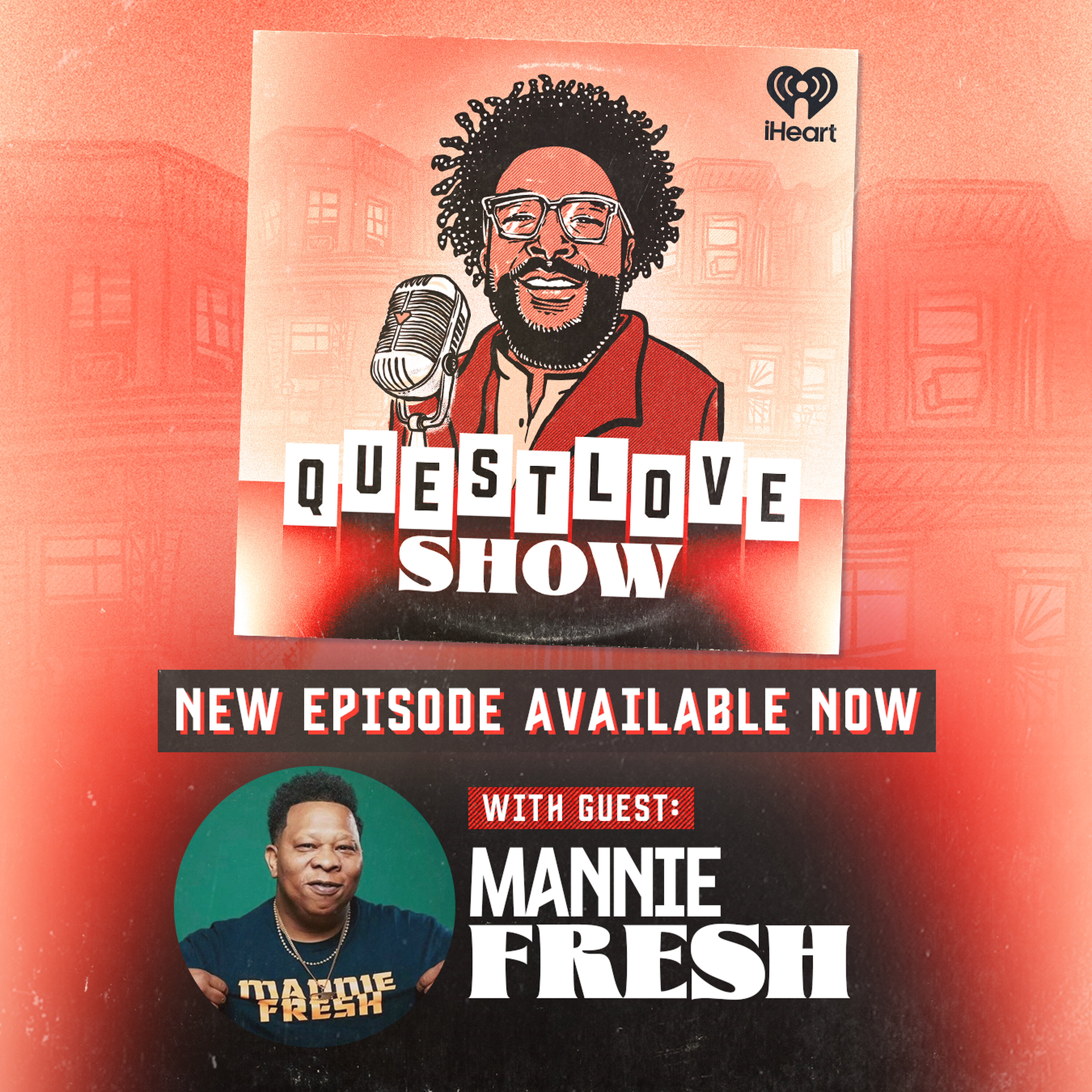
Mannie Fresh
Mannie Fresh joins Questlove to trace his journey from a DJ’s son in New Orleans to one of Hip-Hop’s most influential producers. He reflects on the birth of Bounce music, the creation of Cash Money classics like “Ha,” “Back That Azz Up,” “Bling Bling,” and “Still Fly,” working with Teena Marie, and his hopes for a unified Cash Money and No Limit moment. As Black History Month kicks off, this is Southern Hip-Hop history told straight from one of its chief architects—explaining how a rich tradition of Black music informed his inventive, era-defining style.


00:00:00
Speaker 1: The Quest Loft Show is a production of iHeart Radio.
00:00:11
Speaker 2: Good People, Good people. Welcome to the Quest Loft Show.
00:00:15
Speaker 1: Today.
00:00:16
Speaker 2: We have an absolute legend, an architectural mastermind of hip hop culture from the heart of the Big Easy New Orleans. Our guest today has brought a sound I will say, really brought the sound of the South to life and to prominence, anti dominance, literally defining an era with his unmatched production talent.
00:00:43
Speaker 1: We know all the icons that he's collaborated with.
00:00:46
Speaker 2: It's part of our daily fiber, our daily nutrients, if you will. From of course, his comrades Juvenile and Weezy and UGK and Trina and Ti I and two Chains, and the list goes on and on and on and on.
00:01:00
Speaker 1: A longtime fan.
00:01:01
Speaker 2: If you are a hip hop historian, of course you know of his entry into the game in the late eighties.
00:01:07
Speaker 1: Of course with M. C.
00:01:08
Speaker 2: Gregory, d our guest today is literally the Army and the Navy, the Space Force, and the Air Force and the Marines. He is the number one, two, three, four and five stunner. I'm glad I get to say these words. Manny Fresh, Welcome to the Quest Love Show.
00:01:24
Speaker 1: How are you?
00:01:25
Speaker 3: Thank you? Bro? That was an awesome intro. I'm gonna have to use that or something. You deserve it.
00:01:31
Speaker 1: You deserve it, man.
00:01:32
Speaker 3: Thank you, brother, I appreciate it. Thank you.
00:01:34
Speaker 1: This time we hold each other up in light.
00:01:36
Speaker 3: Yes, yes we should.
00:01:37
Speaker 1: You and I have done occasional gigs together.
00:01:40
Speaker 2: Yes, but aside from like the casual pleasantries and given pounds and whatnot, we really haven't officially kicked it.
00:01:48
Speaker 1: And I have so many questions. I have so many questions. Yeah, what is your very first musical memory?
00:01:58
Speaker 4: I just remember my dad always had in a gang of forty fives and just all of these soul songs that they made the house feel better, like you know, the songs that were like the cool, the Sam Cook songs like you know. When my dad would play those songs or whatever, it just made the whole structure of our house feel better, like you know. And we had no clue that we lived in public housing. We had no clue. And because those songs made it feel that good. So my introduction to music was through forty fives. That's what my dad was playing first, you know. And one of his favorite artists was Sam Cook and he played I mean, like the hell out of Sam cook songs and you know, and we knew the songs, you know, by my dad playing them, so we knew the lyrics to all of those songs. But to see my mom and my dad interact when those songs played, you know, it showed you that this is a part of.
00:02:53
Speaker 3: Music, is the glue to you know, to make things better.
00:02:57
Speaker 1: How many albums were in the household?
00:02:59
Speaker 3: Oh my god, God, bro, we lost.
00:03:02
Speaker 4: I wish my mom was here right now because you know, people would be like, nah, he exaggerating. I think we probably had over over the years, maybe thirty to forty thousand, forty fives that my dad acted. We had stacks and stacks of forty fives, like you know, because from his era of DJing, like you know, and that was the that was the first thing that DJ spent forty fives. And the crazy thing was a lot of them wasn't in the sleeve. They was just stacked up. And even some of my younger baby pictures, you know, people were like, well was that AI did you know? I'm like, that's really what I played with forty fives like that was that was my talk?
00:03:40
Speaker 2: I got you, no, this this is I'm glad to finally talk to someone that I had the same childhood. You know, growing up, we had about maybe four thousand, five thousand albums. I would judge records based on how they looked label wise, Yeah, hitting on the turntable. So can I assume that as a kid, were you a record obsessive or was it a thing where it's like.
00:04:11
Speaker 1: Your parents ramp it down your throat, so you just inherited.
00:04:14
Speaker 4: My parents kind of rammed it down my throat, like you know, my dad on played keys, he played drums, you know, and he didn't play professionally, but he knew how to play by ear. So it was always around me that you know, like this is something that you know, you're gonna have to tangle with it for a little bit, or you're gonna have to mess with it, you know.
00:04:31
Speaker 3: We had an old piano. Of course it wasn't on.
00:04:35
Speaker 4: Tune, but my dad would mimic the old songs, like the Duop songs, because all of those songs was probably two cards and just you know, like a little bass part and you know, and then I started on going, oh, it's kind of easy to play, you know, mimicking that or whatever.
00:04:49
Speaker 3: And then before you know, it.
00:04:50
Speaker 4: You know, you're doing things on your own and you don't even know like this is really you creating something because that genre of music, there was so many ripoffs of a song that you know, it was the same song where you were just like, well, you know, this is that song and it's also the Beach Boys song.
00:05:06
Speaker 1: You know the Blues and yeah, just yeah, I get it, I get it. You know. A lot of this is coming of course.
00:05:12
Speaker 4: You know.
00:05:13
Speaker 1: I was raised in Philadelphia, in the Northeast.
00:05:16
Speaker 2: I was basically just led under the impression that damn near one out of three people in New Orleans had some sort of musical talent. Was that just like a kind of like breathing air or eating bread, Like, oh, you have to eventually figure out some sort even if your desires not to do me.
00:05:40
Speaker 4: Yeah, and every neighborhood, every project that was a band being started somewhere like you know, and that was the norm. Like, you know, if you didn't pay attention to everything else around you, you played instruments, you know, And one of the cool things about New Orleans was if you did do that, you know, the street dudes would leave you alone because they knew how important it was to the culture. It was respected that you know, you did that. You know, it's tons of people that can tell you stories, like, you know, growing up in New Orleans, like they would just raise up my window and leave the window open because I was DJing, I was in, you know, playing something. They was like, hey, bro, can we just listen, you know while we're out here doing whatever we're doing. And I'm like, yeah, I just leave a window up, you know. And it was just you know, because I was in, I was trying to figure out whatever I was doing, whatever that mix was, whatever I was creating, but it was cool to them, and you know, and it would be like even if I tried something crazy growing up, they would send me on my way. They would be like, hey, bro, get back to music, dude, this is not for you. Go back to music.
00:06:40
Speaker 2: So in your childhood, what was what I would call hustle culture or get like how prominent.
00:06:47
Speaker 3: Again around all around me, dude.
00:06:50
Speaker 4: And luckily I grew up with guys that respected what I was doing and saw something in me, like you know, that was just like and I knew after trying something, you know, people always glorified that I was horrible at that that was not my thing, like I would have got everybody killed in myself tried it, but I was just like, nah, this is not for me, you know. And then when you're home, you know, somebody who you grew up with, one of your homies, he's just like, hey, bro, get off.
00:07:15
Speaker 3: The streets, get back to music, you.
00:07:17
Speaker 4: Know, and hustle. That just wasn't for me. And even I'm so glad my dad was just like, if you get in trouble for that, I'm not coming get you. Because I respected my dad like to the fullest, you know, and he was just like, there's so many opportunities out here for you, but if you if you're trying to hustle with your friends and you get in trouble for that, I'm not coming get you.
00:07:37
Speaker 3: And that's scared that he be g be was out of me.
00:07:40
Speaker 1: I know that film, bro, Yeah, I know that.
00:07:44
Speaker 2: I'm always curious about kind of the first generation of DJ's, those DJs that had to operate with one turntable or sock op DJs or whatever DJing was in the sixties and seventies, When did your father start dj.
00:08:00
Speaker 3: My father, he was a cook at the Roosevelt Hotel.
00:08:04
Speaker 4: He was a chef there and he actually heard a DJ like heard I forget who the popular DJ was. This was his story from what he was telling me. That was on a radio station, just on a radio station. But he said, when they had sock hops or whatever, you could not get those records. You couldn't get those songs or whatever, like the really really good songs like you know, because in those days you had you know, the way they operated, the way New Orleans operated or whatever. Everything was a paola. It was mafia influenced or whatever, and all of that even music. So he was just like they weren't invited to certain things, you know, like basically they would get the bottom of the bowl if it was a sock hop or whatever. And he was like a DJ didn't have the music of our culture or whatever. So he seen it as an opportunity to say like, hey, you know what this is missing. This is what's missing from our culture if we if we go somewhere, it was like we got to hear the same three songs over and over again. Where if it's on the other side of town, they get everything, you know, because there wasn't really no good DJs that could get good music. So what he did was he started hanging out at the radio station and figured out, like the way this worked, the way Paola worked in that time, was they would actually give the DJs. If you were a so called DJ, they would give you the records and give you a little money to break it, you know what I'm saying. So that's the way our whole collection of forty five's and all of that started. My dad would get records that, you know, some of them was good, some of them was horrible, but a lot of it was because he was he was going up in the ranks, and when he first started DJing, it appealed to black people. So you had all of these record companies going, this is the guy to go to. And he decided to make a living off of it. He was just like, you know what, I think I could quit my job and do this. And you know, he raised me and my two sisters off DJing. That was the only job I know my dad ever had after quitting, you know, his job from being a chef.
00:10:05
Speaker 1: What types of parties did he do?
00:10:08
Speaker 4: What was big in A in A in the sixties. I remember even talking about this with him. They had this gong show that they used to do. And the Gong Show was kind of like kind of equivalent to you know, mimicking a song or whatever and somebody would dressed up like the act or whatever and sang the song. But that was big, like you know, like like karaoke basically, like but that was big that you you dressed the party. If you did Little Richard, you had to show up dressed up like Little Richard, like you know what I'm saying. And and my dad was the orchestrator of kind of the Gong Show and that was a big thing for people in New Orleans to go out and do. And then from there it went to you know, like the little sock hop or maybe the gym or whatever, and all of and evolved. I remember finding like some of my dad's first amps, like the tube amps with no back on him, with just a plug in them.
00:10:57
Speaker 2: How did the music project in? I mean in days now we have cabinets and yeah, yeah, and.
00:11:04
Speaker 4: My dad had a lot of old equipment, like you know, the first generation PV speakers. Well you know, like those those speakers were you know, just loud. You know, you couldn't tune them or whatever. In the first generation apps that you know, you just plugged in them and the back was open, so if you stuck your finger in there or whatever, you was dead. And I saw it evolved from that to better equipment, you know, and I'm like, oh, well, you actually are moving, you know. And then from there it became like every hole in the wall bar, every every place in New Orleans my dad played. And then around somewhere around fourteen fifteen, I started hooking up my dad's equipment wherever he was playing. You know. He was just like, hey, could you go hook this up and then before you go to school, come back and get it. You know. I was driving without a license, me and my friend Wap, you know, my dad was she was this DJ van because that's what you had at the time.
00:11:57
Speaker 1: Right, Okay, so you got tricked into the family.
00:12:00
Speaker 3: Yeah, I got tricked into it.
00:12:01
Speaker 4: I got tricked into it by literally bringing his equipment, hooking it up, and coming back to get it. And one late night it was like a smoky hole in the wall bar or whatever. I kind of got there early, and my dad was like, long as you stay in the background, you know what I'm saying, and just stay out of the way. You can stay here because you can't get you know, So I was just in the background and I saw, like that changed my life for forever.
00:12:27
Speaker 3: I saw what the DJ do and what music do for people.
00:12:31
Speaker 4: What year was this, This was probably somewhere on early eighties, early eighties, like very very early eighties.
00:12:39
Speaker 2: In your observation of being your air quote your dad's apprenticed, when are you taking note of what works and what doesn't work? Because what I noticed about the most successful producers in black music the common denominator that they have handful of them. Jimmy jam is one of them. Doctor Dre's a great example of them. Of course, you know most people before they produce, they were once DJs. Like Dre's example is the reason why he's so good is because he DJ'd in some of the most hostile environments ever.
00:13:19
Speaker 1: And if you played the wrong song, that was your ass.
00:13:24
Speaker 2: Like you're responsible for the lives of if you play something that doesn't work. Yeah, so the pressure is on you almost to build the perfect house of cards. You're the perfect person that asks this question, because I will say, now you.
00:13:40
Speaker 1: Hold the key.
00:13:41
Speaker 2: There's the one record that will last fifty years that no matter what environment it's in, it works. When people play the intro to Michael Jackson's Don't Stop to Get Enough. It was that feeling when I play Smells like Teen Spirits. Sometimes there's that feeling there's no in the world, Like when the first four bars of back that Ass Up comes on. Yeah, it's almost like Pandemonium's gonna start in fifteen seconds. In your opinion, what was that record when you first started as an apprentice with your dad observing him DJ.
00:14:20
Speaker 4: Believe it or not, Marvin Gase got to give it up when that came on.
00:14:25
Speaker 3: It worse to this day when that came on wherever.
00:14:28
Speaker 4: He was DJ, and they went nuts, like you know, and I used to go out in pond, you know. And the crazy thing was that was the era when you could play the song three or four times, and he would play that song three or four times and the set probably was four hours. But every time it came on, it was like it was brand new. It would be like it was brand new to the crowd where you're just like wow, like.
00:14:52
Speaker 3: This really, you know.
00:14:54
Speaker 4: And we had so many songs that did that in New Orleans. Like how some people say playing the wrong song you would get fucked up. I was grew up on playing the right song. Like you know, I know exactly what he mean by if you played the wrong song, you would be you know. But mine was always kind of like play the right song, like you know, there's a moment where you know, drop this right now, and you know you're going down in history for you.
00:15:20
Speaker 1: How hard is it to break a new song?
00:15:23
Speaker 4: It's very hard, because let me tell you what's one of the things. Even with me, I have nothing against a young crowd, but I don't want to play for a young crowd. And that's one of the way even now, I don't want to play for a young crowd.
00:15:38
Speaker 3: I really don't.
00:15:39
Speaker 4: I have all of the songs, I have all of the ammunition, but I don't want to play for a young crowd because I have not figured out how to break young songs yet. I'm figuring them out as I go, Like I'll say, like, oh, that one is worthy, that one is worth, and you know, and it's and I got kids, I call them kids, but they grown ups, like you know, my own youngest son, it's twenty one, you know. So this is his error. And sometimes you know, he'll put the fear of God in me because because I'm listening to him, you know, when I'm riding with my son, is something I think is a jam and he's like, nah, Dad, that ain't it. That ain't the one. So I'm being polluted by sometimes that. So I'm like, you know what, I need to stick with what I know.
00:16:20
Speaker 2: Wait, wait, time out, because this is the thing. Though there's no cap, there's not brown nosing. But literally where we are now is derivative of what you created. Yeah, texture wise, what's hidden today is derivative from what you created. That it's like a kid in a candy store for you. So even you have doubts of what works and what doesn't work.
00:16:48
Speaker 4: Yeah, yeah, I mean the younger me, I never thought that way.
00:16:51
Speaker 3: I never did.
00:16:52
Speaker 4: But but you know, there's a thing that I don't mind saying it, even if you know it rubs some people to the wrong ways.
00:17:00
Speaker 3: There's too much.
00:17:01
Speaker 4: Music being pushed on us, and some of it is not music, you know what I'm saying. So that's that's what's kind of making it hard to say, like, well, what do I work?
00:17:11
Speaker 3: What song do I break? What song do you know?
00:17:14
Speaker 4: Because if I get if I check you know, my pool and I see like I got forty records today, and I'm like, how is this possible? And when you listen to like, I don't know, thirty eight of them, you're.
00:17:25
Speaker 3: Like, who let these people do this?
00:17:27
Speaker 4: And I understand, like some songs are supposed to be just a parody and sometimes it's just a fun record, but we got too much of that going on right now.
00:17:36
Speaker 1: See to this day, you still trust and engage your record pool.
00:17:40
Speaker 2: Yeah, I'm shameless, brou I willzam the shit out of people. You're like, wow, man, I open for you back, and dah da da da da da dah. I'll be like, yeah, just here to listen. I will zam the shit out of it.
00:17:53
Speaker 4: Just so I definitely do that if I hear you play, if you play something that I like, I'm a savanna. You might catch me over your computer taking a picture.
00:18:04
Speaker 1: Okay.
00:18:06
Speaker 2: See if if the legendary man in Fresh feels that way, then I don't feel so Baday.
00:18:11
Speaker 4: You know I've done it to Jazzy Jeff like, what was that what you just played? Jeff Like He's like, what, Like, what was that that you just played? I need to get that record, like, you know.
00:18:34
Speaker 2: Back in two thousand and five, there was a moment where Lenny Kravitz had a spot in New Orleans. Yeah, and so did Solange and the Fellas and I were about to make a new record, and we decided, Okay, New Orleans is the probably one of the last real like three places in the United States that still as a musical identity that's sort of singular, you know, like the DMV has it with go go culture, you go to San Francisco, whatever, There's just a different type of hip hop culture there.
00:19:12
Speaker 1: And for us, it was like, Okay, we're.
00:19:14
Speaker 2: Gonna buy two houses, move to New Orleans. You know, mess with some jazz cats, mess with some brass cats.
00:19:22
Speaker 1: We wanted to hook up with you.
00:19:23
Speaker 2: So initially, from January to like August of two thousand and five, our plan was we're gonna tour for eight months and then when it's time to make this new record.
00:19:33
Speaker 1: We purchased the two houses.
00:19:35
Speaker 2: We were ready voptorship ourselves literally two nights before Katrina. We were going to move down there, And part of me wonders, in some sort of alternate timeline, what would have happened if had we moved down there?
00:19:52
Speaker 1: For you, does it still feel the same to you? As it once was.
00:19:56
Speaker 2: Like now live with a bunch of disgruntled New Yorkers that are like gentrification, and this is not the New York I loved, And everywhere I go it sort of goes through that.
00:20:05
Speaker 4: What is Well, one of the things what's difficult with me too, is because I'm fighting for the identity of New Orleans to because we're not the same.
00:20:16
Speaker 3: We are not like, you know, culture wise.
00:20:19
Speaker 4: I think what happened was so many people after Hurricane Katrina moved away somewhere else and picked up they habits, you know, and some of them came back. You know what, Okay, you sound like you're from Atlanta. You sound like you're from just as small as Baton Rouge. You could have moved one hour out and you're just like, but you sound like you're from Baton Rouge. You don't sound like New Orleans no more. You don't move like and and I get it. That was a tragedy, so people had to, but it kind of it messed with our identity. It messed with our creativity and everything. So we are a city rebuilding our sound, you know, we and it's still you know, we're still waiting for some people. I don't know to come back or either to contribute, but we we we definitely we're a city that's rebuilding our sound.
00:21:06
Speaker 2: I was gonna say, twenty years after the fact, have you recovered twenty years after the fact?
00:21:13
Speaker 1: Or is this still something missing? Man?
00:21:15
Speaker 4: No, Yeah, that's something that does a disconnect with like even what I'm telling you with DJing, how that, how that has happened? There's a disconnect with younger New Orleans and older New Orleans as artists, Like, you know, you have younger artists that feel like, you know, if you're OJ status, then you know, you will waste the time, like you know, they just like, oh well, and when I grew.
00:21:36
Speaker 3: Up, we actually looked up to the.
00:21:38
Speaker 4: Meters, the Allen two Salts, you know, Erma tones, We looked up to everybody that was our you know, and we actually went to them for advice on how you got that sound or how you created this?
00:21:48
Speaker 3: How was that that warm? How is that? You know?
00:21:51
Speaker 4: And they didn't mind. But they're like, if you saying something to somebody young, because it's still that chip on their shoulder, you know, they're just like, well, dude, you just wasting time and the art of producing a song is gone. Like you know, when you produce a song, you sit with me, and we produced that song, not me sending you a beat, and like, hey, let's see what comes out, you know, And that just one of those that was so great about New Orleans that you could get a bunch of musicians together from from a jazz band, from a brass band, from a you know, and we can sit in the room and see what we come out with. You know, on the earlier Cash Money songs, Trombone Shady played on those songs when he was a kid, like you know, and that foundation some of that turned into Trombone Shady and then you're just like, wow, look at this played you know on some of these songs for wrestling tickets. That's all he wanted to do is go to the wrestling match, and then he turns into this icon like you know. And but but it was because we wanted to keep that guy off of the streets, because we saw how talented he was, and we also wanted to tell him whenever we got a chance to celebrate him, hey, bro, keep practicing, You're going to be something great. Now. There's a disconnect, like you know, when you when you're saying that to a younger artist, or you can't even call a younger artist. I'm going to show you. Notice, like I see kids all the time on the internet like spasing out, going crazy, and I just the inner me wants to reach out to them and say, hey, bro, what are you doing.
00:23:18
Speaker 3: It's not that serious.
00:23:19
Speaker 4: This is music, right, But if you do that, then you get called the clown or you ought to you know, you the week And I'm just like, well, I don't know how we fix that or how we you know, make that work. But there's something going on in the water or whatever happened that were not gelling the way we used to.
00:23:36
Speaker 2: There's a question I always wanted to ask a knowledge resident that's closer to my age that I never got to ask. Okay, I know that, you know, oftentimes music lovers will reminisce about yesteryear and how it was back in the day and music was way better back then. Da da da da da, And sometimes you know, I in doing research or just listening, I'm just under the impression that it's always been the same, meaning that there's a commercial artist, there's a moderately loved artist, there's an underground artist. There's a niche artist. Now here's the deal. I grew up in my crib with. In my actual childhood, I had one meters record. Yeah, it was reprise era meters. We know, there's two levels of the meters, the breakbeat, yeah, and then the more poly sophisticated I mean, you know, just kiss my baby, some shit works, you know what I mean. However, you know, I didn't discover air quote that meters until nineteen ninety when those first like five records were reissued. Were they a niche New Orleans group in terms of like if you know you know, because I'm just under the impression that even in nineteen seventy two, I can't imagine Sissy Struck getting airplay on the radio or that sort of thing. It's like, how popular were they in their time period?
00:25:10
Speaker 4: I think in New Orleans it was, you know, the Meters were gods. But outside of that, they were still trying to figure it out, you know, and nobody didn't Nobody thought this music was great because it still sounded New Orleans, you know. And then, like you said, the breakbeat era came and everybody was like, whoa the drummer and what he's doing? And these sounds are you know, they something crazy. But that showed you how much these dudes actually loved music, because I don't think they sold a lot of records. I don't think you know what I'm saying, they sold a whole butt to go back in right now, that's considered a failure, you.
00:25:44
Speaker 3: Know what I'm said. And there was a band who like we going back in there.
00:25:47
Speaker 4: We're gonna do another album, right you know, and we're gonna do another one. We're gonna change our name to Chocolate Milk and we're gonna do this, like you know what I'm saying, and then we're gonna go back to the meters. So and you got a lot of songs which which is so cool about an older era. And I'm not I'm not comparing like nothing new, but what was older Like a lot of those songs were the band members from other.
00:26:10
Speaker 3: Groups that were cool groups like.
00:26:11
Speaker 4: That that that sound was linked to other people, you know, like you take mister Big Stuff Gene Knight. You can hear the influence of Alan Tucson in that song, like you know, you can hear like some of the medias you know, like so that that that right there, that that. That's the energy that I think.
00:26:28
Speaker 3: Yes, music is.
00:26:29
Speaker 4: Still great, but we're killing that energy of the experience of knowing other people like you know, I think it's a big deal. Leo from the Meters called me like two days ago, but he's been calling me all my life.
00:26:41
Speaker 3: I think that's a big deal.
00:26:43
Speaker 4: When that guy calls me like you know what I'm saying and he'll just call it me like, hey man, I'm just checking on you. What you're doing, bro, Like you know what I'm saying, And I'm in my car going that's that's the meat.
00:26:53
Speaker 3: That's Leo the bass player.
00:26:55
Speaker 2: Leo is the king of the cold call boy, Yeah, it hit you like seven exactly exactly.
00:27:04
Speaker 1: Yes, you can you tell me how did you discover hip hop?
00:27:11
Speaker 3: Run BMC? Believe it or not, I thought.
00:27:15
Speaker 1: So even not even sugar Hill I was.
00:27:18
Speaker 3: I was okay with that.
00:27:20
Speaker 4: That was alright with me. It wasn't life changing until it's like really yeah, because I can tell you everything. Treacherous three, you know what I'm saying, Fearless four, all of that Grand Master Flag.
00:27:30
Speaker 2: How did sugar Hill era hip hop trickle down in New Orleans?
00:27:34
Speaker 3: Oh? That was incredible. That was phenomenal.
00:27:37
Speaker 4: My sister used to drag me to all of these school parties and I hadn't found myself as a DJ yet. I was just somebody who loved the music, like you know what I'm saying. And but that was the sugar Hill era. Flash to the Beat was one of my favorite all time songs. I heard that one time, and of course I was under age at my sister's high school dance and that came on, and that was one of the songs that changed me for forever. Like I was just like, oh my god. And there's a break at the end of Flash to the Beat where the beat changes and it's like boom boom boom. When you're hot, you're hot, and I was like, what is that when you're not?
00:28:16
Speaker 3: But that was you can't get to the machine, you know what I'm saying.
00:28:20
Speaker 1: I was going to say.
00:28:21
Speaker 2: Most people don't know that there are two versions of Flash to the Beat because there's the professional sugar Hill version, yeah, and then the version that they captured live at the Yeah, I believe right exactly. So wait, did you guys get both versions or were you Yeah, we had both versions.
00:28:43
Speaker 4: We had cat versions because you know, some kind of ways. Somehow my dad used to get these songs, you know, but he wasn't big on hip hop unless it was a song that everybody and they just stayed in a pile. So when when, So when I actually fell in love with hip hop, I went back to the piling and found all of these incredible songs that was like, oh my god, like you know, because my dad didn't play that. He played mostly disco. He played mostly soul records. And I was like, this is an incredible stack of records that you know, I want, like I want to hear this.
00:29:16
Speaker 2: But when I remember, so the reject pile is how you started building your.
00:29:21
Speaker 4: The reject polish listen, I had say, well, my dad didn't want I got, and then that's that's what built me. Okay, yeah, that's dope. And let me tell you one of the songs my dad slept on. He didn't not think it was a good song. She good times what and yeah, And that song was in that pile. And I remember playing the song and I was and I'm telling my dad, I'm like, dude, this song is bad ass. I don't know why you put that over here, but you might want to put this back put this in rotation in your you know, and because New Orleans was a weird place at the time, New Orleans, you rejected a lot of stuff like we had.
00:29:59
Speaker 3: A moment in New Orleans where we only played New Orleans.
00:30:03
Speaker 4: And we've had those moments a lot of times over you know, over time, where we're just like now, we don't want to hear nothing else but what we playing. And there was a few songs that you know that came through, but most of all it would be songs that kind of they sounded right to New Orleans.
00:30:18
Speaker 2: I was gonna say, what is the ratio between local support and local talent versus FuMO, Like, oh, we need to catch up with the rest of America. This is what the rest of America's playing. We need to get with it. But is just depending on you knowing what they want.
00:30:36
Speaker 4: I think New Orleans real real talk my era of when I started actually djam and started doing house parties or whatever, it kind of changed the scope of what New Orleans hip hop was because we were open to playing West Coast songs. We was open to playing East Coast songs. Before that, DJ's didn't do that.
00:30:55
Speaker 3: But this is a shift.
00:30:57
Speaker 4: Here comes hip hop, you know, and now everybody loves it. Everybody likes it, you know what I'm saying, and we're like, oh, we got easy Ease, we got you know what I'm saying. We got the West Coast is popping off and those songs are big. And at the time, I remember every time somebody came to New Orleans, I opened up, Like, you know.
00:31:15
Speaker 3: If it was a tour, but the tour was East and West Coast, you would.
00:31:20
Speaker 1: Be the opening DJ for whoever was in jail.
00:31:22
Speaker 4: Yeah, yo, what was your first l coolj easy, anybody that can run DMC, anybody that came to New Orleans, Like if it was a major concert, I would always be the opening DJ. I would always be you know, the guy who used to MC with me way back, Denny, Him and cut Creator grew up together. He was from New York, so I was in the group New York Incorporated, but it was my friends Denny.
00:31:45
Speaker 3: He started this group.
00:31:46
Speaker 4: Denny was one of.
00:31:47
Speaker 3: The first people who I saw transformed.
00:31:49
Speaker 4: We had no idea what that was, but he came from New York with it, and then he showed me so many different things that you know, because I thought I was God on the turntables, you know, because I'm like, I know how to back spin, I know how I got a little good but right right, And he just came and just read. And the crazy thing was he had a Newmark mixer with the turnnob. He didn't have a face, oh no, and you know, but he was doing all of this crazy transform stuff with the turnnob, like you know, and I was just like, wait, hold on. But that was my first time ever seeing the Newmark mixer and seeing twelve hundred turntables. My dad had a big Meter mixer. I think that was the company that made it. It was called Meter or whatever, but it was a huge, huge mixer and he had Technique turntables, but there was belt driven with the belt driven had some sheeper turntables without pitching. Nothing on it, belt driven, no pitch, no pitch, radio shack mixer, the.
00:32:48
Speaker 3: Realistic mix you had to be good. Yeah, no pitch.
00:32:53
Speaker 1: Wait, there's one particular record.
00:32:56
Speaker 2: I want to shout out my comrade Nordwar for bringing this to light because when he interviewed Lil Wayne, I was really unaware of just your origins. How did New Orleans discover and adopt trigger Man's Showboys? Like for people listening right now, the trigger Man break is what I typically called the New Orleans break, the Bounce break, which is.
00:33:29
Speaker 1: With the break. I did not know that was a New York record, and I never heard it.
00:33:36
Speaker 2: I mean I was pretty much aware of you know, hip hop radio as far as like cousins given me tapes from WB, like from Mister Magic Show, and of course we had Lady B in Philadelphia. But how did that record wind up defining a city?
00:33:56
Speaker 3: DJs? Honestly DJs. So this is what happened.
00:33:59
Speaker 4: For for maybe five years, we played the vocal side of the record, like, you know, just the regular vocal side of the record, and everybody in New Orleans knew this record, everybody in New York because that's that's an example of DJ's breaking the record. But it was broken New Orleans because like it just the storyline of it. The storyline of the song is like it's a criminal storyline, you know what I'm saying.
00:34:22
Speaker 3: It's two gangsters fighting over whatever.
00:34:24
Speaker 4: So that that fit in that era of you know, and plus it had that eight oh eight beat. For some reason, we have always been a city that's drawn to the eight oh eight, you know, I don't know. Maybe my earliest stuff was Miami bas and that was New Orleans introduction to you know, a hip hop producer.
00:34:42
Speaker 3: So all my earliest stuff was eight oh eight bass.
00:34:44
Speaker 4: So everybody thought like, okay, that's what this is kind of like what you gotta follow, like, you know, this is this is how you produce a song like and this is what we used to hearing. So the eight of eight always resonated with us. And then we start like the essence of hip We started doing calling response and what's nuts is this kind of started with my dad. My dad would let juven them rock the mic off of the trigger Man beat. And this was before a bounce was even called bounced. This was just in the projects where you would give an MC a mic and be like, hey, let's see who you know. But when the eight oh eight part dropped, that's when the crowd went crazy. It had like heart Linde drum sounds or whatever, and then it went and then it went then it went to that eight o weight drop. But when the eight o eight drop happened, that's when the crowd went. You know, you're just like, oh that part right there, and so you had MC's going well, can you make that part go back and forth? So that part became a part of the show, going like, hey, so just back spend just that part like on some grand Master flash it where you find a break in the song and you just like just this these four bars right here, this guy repeat and it became just calling response and mostly projects and block parties, and it would be like back and forth, Uptown did this Downtown, y'all gotta come harder, But it was always over that beat, like you know what I'm saying. And then if it was something where say like if it was a school dance and I was DJing or something, everybody met up at that school dance and then the best people would be like, hey, let's see who rocked this song the best. And before you know it, it evolved into Bounce and even the reason why we even call it bounced because everybody used to just kind of like do this off of every time it came on, you know, and we always shortened everything up. In New Orleans, the original song is called drag Rap. We called it trigger Man because there's a delay part in the song that go trigger man, trigger and everybody was like, so of course.
00:36:49
Speaker 1: It's called drag rap.
00:36:50
Speaker 3: It's called drag rap. But there's a.
00:36:55
Speaker 4: Part, the the lay part that says trigger man. Everybody always liked that little part, so this the calling the song trigger Man.
00:37:01
Speaker 3: It was like, hey, play trigger Man. I'll give you some history.
00:37:05
Speaker 4: So even that beat, like when we say that beat is more of like a bounce beat, It started with people beating on the DJ, like beating on the plexa glass.
00:37:14
Speaker 3: Go and play that beat.
00:37:15
Speaker 4: Play that beat, you know, play that beat, and then you know, people start calling it that beat. They're like, you know, you know what that beat is, and that beat is always a bounce like.
00:37:25
Speaker 1: I never knew that.
00:37:26
Speaker 4: Yeah, the earlier days, the essence of it, like the hand claps and all of that. I created that in the club that I was DJing at me and KLC, I used to bring my SP twelve because I was up against some dope DJs. It was KLC and it was this dude DJ Duck, and I was like, to make it a little bit better, I'm gonna start bringing my drum machines just on. So when the SB twelve came out, of course it ain't have nothing but probably four or five seconds, but it was genius because I could take this trigger Man loop, sample it and put some hand collaps on it. And whenever I did that in the club, and you know, it went crazy because everybody would be like, who has this song?
00:38:03
Speaker 3: What is this song?
00:38:04
Speaker 4: And I'm like, no, this is a sequence. This is something that and that became a big deal. And and every time you hear that that was something that I created in the club, and you know, and more and more people was asking for it.
00:38:18
Speaker 3: You know, Jubilee is getting ready, getting ready.
00:38:20
Speaker 4: That's people are like, wait, you did that song.
00:38:23
Speaker 3: I was like, you did that song? Yes, I did that song.
00:38:30
Speaker 4: Yeah, yeah, And folks is like, I didn't know y'all was like, yeah, that's one of my beats.
00:38:34
Speaker 3: Like you know what I'm saying. And that's kind of like the essence of hip hop.
00:38:37
Speaker 4: Hip hop, you know how it starts with a beat of breaking just some just a crazy idea. But Bounce is really Cameron Paul that the Brown Beat song and trigger Man. Now before Brown Beat, there was this dude, Derek Beat, who made rock the Beat a profile. Rock the Beat is actually the same song. We used to play Rocked the Beat all the time in New Orleans, just the instrumental woman.
00:39:03
Speaker 3: Is that boom boom ke boom boom?
00:39:07
Speaker 4: Yes, yeah, So we would always play rock to Beat, but nobody in New Orleans knew the name of it, so they just start calling it that beat.
00:39:15
Speaker 1: Wow. Okay, Okay, that's what's up.
00:39:20
Speaker 2: This is everything I ever wanted to know about New Orleans culture that I never got to ask.
00:39:26
Speaker 4: Yeah, because you got to think both of these songs by label status, I mean, by labels it was failures.
00:39:32
Speaker 3: Derrek Beat, Rock the Beat.
00:39:33
Speaker 4: You just like, nobody ever jammed that song or whatever, but New Orleans, yeah, trigger Man, nobody jammed that song New Orleans, like and Ali, both of them. Still they are legends in New Orleans. They could pretty much do whatever they want. And I remember the first time the group came to New Orleans, right and they performed, and this drug dealer dude got them, you know, and got them to come to New Orleans and they were singing like I think they had a song called Cartoon something or whatever at the time, and they did that and we was like, bro, y'all got to sing, just do the song, yeah, just do the song. And it was just like it was like, just do the song. And when the song came on, the crowd went crazy and it was just like dude, and we were just like, yeah, that's the anthem die.
00:40:15
Speaker 1: So they had no clue.
00:40:17
Speaker 4: Yeah, they had no clue none whatsoever. And they had to do that song three times back to back.
00:40:35
Speaker 2: All right, So you said run DMC was kind of your calling the hip hop Yeah?
00:40:40
Speaker 3: Yeah.
00:40:40
Speaker 1: What was the first live show that you saw with hip hop in it?
00:40:44
Speaker 2: Or releast, what was the moment where you decided, Okay, this is my calling, I'm in this culture.
00:40:50
Speaker 4: The first live show I think I saw was a young ll COOLJ when he was on Death Jam. And I want to say he's he was on that show, okay, and who else was on there? Nikki B what daddy? Don't no one heard him?
00:41:10
Speaker 3: You know what I'm saying.
00:41:11
Speaker 4: But to see when ll cool J came out in the crowd response and you know, this is your backgroard, this is your backyard, you in New Orleans. But to see everybody just damn like this is phenomenal, Like he got their attention for everything he does, everything he do, that was life changing. That was you know, and I was like, this is definitely what I need to do.
00:41:31
Speaker 2: When do you feel is though New Orleans really got its identity because I know that for first generational hip hop, it was like, all right, let's do what New York is sort of doing and try to sort of acclimate ourselves to what New York is doing or what you know, what's popular. But when's the period that you feel is like, yo, this is our shit and this is our culture and this is what we're gonna do.
00:41:56
Speaker 3: Believe it or not.
00:41:57
Speaker 4: It still has a lot to do with outcasts, like you know, the whole South's identity. Like, you know, I don't think production wise, we was there yet, you know, because the first generation of cash money a lot of people don't notice. They think like you know, from Juvie, and that wasn't the first generation. The first generation of cash money was bounce artists, you know, and we was trying to figure out what we was gonna do, if we was gonna stay there or whatever. And then you know, you got outcasts and they come out with songs that we can do this, but we were scared to do it where we actually you were scared. Yeah, we heard musicianship or whatever and all of that. We just didn't think that it was gonna be received well, you know, to say, like, you know what, this is not what hip hop sounds like to us, because a lot of stuff we was masked from, like you know, even though we was getting songs, but the favorite was the West Coast, over the East Coast and down South, I mean down south, but West Coast sounds songs sounded like kind of like Miami bass sounds just slowed down.
00:42:56
Speaker 3: They were all eight to eight driven.
00:42:58
Speaker 4: Like you know what I'm saying, So it kind of resonated easy to us. But then you had Dre that picked incredible songs the sample that we kind of knew them because my dad knew all of these songs, you know, he would call them.
00:43:10
Speaker 3: Out whenever dah da da dah.
00:43:11
Speaker 4: But it was just so genius, and I was just like, well, I want to do that, but I don't think they ready to let me do that, you know, because I've been known I'm still a DJ. I'm starting to get producer, you know, these credits and accolades or whatever, but I'm still a street DJ, and my job is to keep the party going. And what I was good at was finding these incredible eight to eight breaks from songs that you know and making that something my own. I was fearful of musicianship for a certain you know, and then I.
00:43:43
Speaker 2: Hear the way the way that I would dig for break beats from the seventies record you're digging hip hop to dig for eight oweight breaks?
00:43:52
Speaker 3: Yeah? Yeah.
00:43:53
Speaker 1: Do you like Original Concept?
00:43:55
Speaker 3: Yeah? Yeah. Pumped that bass and all of that. All of that was big in New Orleans. All of that.
00:44:00
Speaker 4: Yeah, that acknowledged me. All of that was big. What all of that was big in New Orleans?
00:44:06
Speaker 2: That's so crazy because like Original Concept, I'm not saying couldn't get arrested. But again, it's one of those if you knew, you knew, and because they have the deaf jam shield behind them, I always wanted them to be bigger than what they were, but only certain few knew about Original Concept.
00:44:27
Speaker 1: But you're taking this all in and.
00:44:30
Speaker 4: You ask any DJ from my era, anybody that grew up, not just DJs that grew up in my era of the House of Blues.
00:44:37
Speaker 3: When Pump that base came on, it got crazy. There them that.
00:44:42
Speaker 4: Get a little stupid, get a little stupid and pumped that and that's all it was, was an instrumental eight to eight instrumental.
00:44:50
Speaker 3: And you just rocked that the whole time and rocked that the whole time.
00:44:54
Speaker 2: Once I dug into your history and I'm talking about like like buck Jump Time, Yeah, the fact that you and Gregory and yeah mc gregory did a Freddy Krueger rap.
00:45:07
Speaker 1: Yeah before Jazzy Jeff in the.
00:45:10
Speaker 4: Fresh Jeff the Fresh Prince did it and the Fat Boys.
00:45:13
Speaker 2: So the musical underline was it was almost like it was at oh but with I assume that was a live brass bend inside the at least on buck Jump Time?
00:45:26
Speaker 4: Was that a buck Jump time? That was? So what happened even with that, it's a crazy story. I was doing a song for somebody else and they didn't show up, and it was an Alan Tucson studio and he was like, hey, you can have the studio since they didn't show up. Whatever you come up with, you can have it. So I called a couple of people. Greg was the only one that came. I was like, hey, I got a studio for a day, let's make a record. Like we could literally make a record. And that's what came out of it. Buck Jump, Who's on the phone? That was a sample that I got from actually his son, Reggie. He played me some stuff and I was like, and at the time, I had an SP twelve, so I only had a few seconds, and I was just like, hey, let me jack that that little sound right there or whatever, you know, And you knew on SP twelve you had the slide to make the baseline to make the notes or whatever. So I just made the notes on the slide or whatever out of just like a little bass clip or something that I fought, and you know, and me and Greg made that song and that was like that ran New Orleans for like ten eleven years.
00:46:25
Speaker 1: Okay. So in my mind again when I told you the story of like us.
00:46:30
Speaker 2: Wanting to move down there, yeah, there was a brass band that we took a liking to that we were going to adopt and have them on the album like incorporated with us.
00:46:38
Speaker 1: They were called the two b Continued Brass Band, Okay.
00:46:41
Speaker 2: And the thing was, I'd never heard buck jump time, So in my head, I'm like, yo, like, okay, I know with bounce music they're using eight o eight's and keyboards, but then we have like brass bands over here, like how come they never murge?
00:46:56
Speaker 1: Both magamated it.
00:46:57
Speaker 2: And then when I heard that, like, to me, that's what I wanted to achieve, to see if that could happen.
00:47:05
Speaker 1: How can that hasn't happened more?
00:47:07
Speaker 4: I think the thing was after me and him did it, because that song ran so long. By then hip hop had them changed, Like you had people that were scared to, you know, do brass music that you know, because hip hop, you know, everybody start to be, oh, I'm cool now I can't be associated with what this sounds like, you know, like with second line music sounds like or whatever I wanted to be. Yeah, because they felt it was old, like they felt like, you know, it's a lot of people that felt like, you know, it was old, you know, and it was just like and that was that was part of okay, something changing because this still this is still jamming music, you know. And even I was having a conversation with Kanye one day and he was telling me about huh and he was like, I don't understand, like how you did the drums like the snare rows and the dah da da da, And I was like, it comes from second line. I'm like a lot of it is second line because that's what I heard drummers do the little you know what I'm saying, And he was like, well, I was like I kind of just that was self examing, like before we had Sazam. You know, you heard somebody do something. He was just like, oh, yeah, I'm gonna keep that. What you said about on teen Spirit, the guy said, you know he got it from the Gap bandit the way it starts, right.
00:48:20
Speaker 2: Were you at all shocked at the way that How was embraced Because I tend to notice when big moments happened in hip hop history and how it affects people. Usually the first time when something stops you and you look at the speaker and you're like, is that allowed to happen? And the thing is is that I'm hearing it on Hot ninety seven.
00:48:45
Speaker 3: Yeah.
00:48:46
Speaker 1: I wish I could describe to you.
00:48:49
Speaker 2: The week that this came out, like it was almost like giving a baby a t bone steak. Yeah, I mean, something good but just absolutely foreign to you.
00:49:00
Speaker 1: It's like we looked at it and just didn't know what to make of it.
00:49:04
Speaker 2: But it was catchy as hell, and I feel like How was one of the songs that I wish I knew a better term than to make new York vulnerable because you know, like how stubborn New York was, like we're the Kings were and we're ruling shit and none of y'all saying we're number one, We're number one, like whatever New York's hip hop's version is of America first, you know what I mean?
00:49:30
Speaker 1: And in one.
00:49:32
Speaker 2: Fell swoop, people thought it was going to be Notorious Thugs with Biggie and I'm certain had had he survived and it probably would have had a video and would have probably did it. But how I managed to do something that I thought was impenetrable, like absolutely impossible, which was it broke New York down?
00:49:57
Speaker 1: And then jay Z turns around?
00:49:59
Speaker 2: Can you tell me even how jay Z wound up on the remix to it?
00:50:03
Speaker 4: Honestly, just knowing Jay you know, he's a fan of music, like you know, to just say, hey, this is my introduction to y'all culture, and this is y'all introduction to our culture, and it's all so crazy. At the time, baby them had no clue of what jay Z was and hip hop you know where you know what his stamp was. Then they knew nothing. Me and Julie was just like, hey, bro, this got a state like you know, and it was just like, well he wont he won.
00:50:30
Speaker 3: Our sound, he just won our dah da da dad.
00:50:31
Speaker 4: And we was like, hey, bro, we're trying to break this market like this is we need this to happen.
00:50:37
Speaker 3: And it was like, well, we don't even know who this dude is. Who is dadda?
00:50:39
Speaker 4: You know, because one of the things in cash Money that was big to Baby and Slim was cash money. That's it. We ain't doing nothing else. We ain't doing nothing outside of it. Outside of that, we ain't listening to nothing outside of that. You know. What made me a little different was I was a DJ, you know, I had to listen to everything, and they had no clue like some of these songs were influenced by other things, you know, huh. To me, it's kind of like a modern Man Tronics you know what I'm saying, Like it has you know, like it's it's more it's kind of like a Man Tronics song, you know, And I'm a big fan of Man Tronics. Like I'm a huge fan of Man Yeah, like you know, so to me, like there's elements of that in that song, like you know, from the drum switch to yes yeah, yeah, you know, you're right, it's a lot of that, you know, but talking to a slimming baby, you know, they kind of was like, no, this is and I'm like no, we all kind of influenced from different things. And then when Jay did it, me and Juvie of course, we was like, oh my god, this is it. Jay Z jumped on it.
00:51:44
Speaker 3: They you know.
00:51:45
Speaker 4: Baby then was like, na, bro, we don't. We don't, and I'm like, we do need this. I'm like, we need this co sign, you know, as well as what he's doing too. He wants the South, we want that, you know. And we did the Tunnel and it was terrifying because people told us just like you know, like like you you got folks whispering to you and your ear going, Bro, they're gonna kill y'all in there, They're gonna you know, and we just like damn, like even you know what I'm saying, We doubting each other before the performance, like you know what I'm saying, because we don't know the song has really took an off, you know. Okay, we get booked to do the Tunnel, but we don't know that New York is jamming this song.
00:52:22
Speaker 3: Y Yeah, hell. Yeah. We were scared. Forget nervous.
00:52:27
Speaker 4: We were scared, scared shitless, like you know, because it was so many, like you said, that New York attitude where they was like, bro, y'all gonna bomb y'all, you know, just right off through. Nobody telling you it's gonna be all right. It was just constantly y'all ain't gonna make it. This is it right here at the tunnel about the tell y'all up, they gonna tell y'all. And if you notice, when we did it, the crowd, you know, went crazy. But the after, the after it was like Julie winning the Olympics or whatever.
00:52:53
Speaker 3: He was talking so much shit.
00:52:55
Speaker 4: After after we performed, Like you know what I'm saying, he stuck his chest out and was.
00:52:59
Speaker 3: Like, yeah, we did it, and da da da dah, New York.
00:53:02
Speaker 4: You can't tell me nothing.
00:53:03
Speaker 3: It was just because it was so much pressure.
00:53:06
Speaker 4: It was so much pressure put on us where people was like, this is New York. You're not coming here with this shit. Y'all not gonna do this. And when the song dropped and the crowd went crazy, Bro, it was it was such a relief for us because I'm telling you to the time the song came on. We were scared as shit because it was that many people told us that this was not going to work.
00:53:28
Speaker 2: Dude, Like I would have thought the complete opposite, if anything. I thought the annihilation was y'all coming to New York and annihilating us, like not knowing that you guys were nervous about that at all, Like.
00:53:41
Speaker 4: Yeah, because it was told to us like, you know, like this this is no social media because we had no we had no idea what was going on on Hot ninety seven or what was going on in New York. We just heard that the song had momentum, you know what I'm saying. So we going, okay, did they did they book us here to you know, make fun of us and poke at us, or did they book us, you know, to have a good time. So it was it was, you know, and everything that we were getting from people that we really didn't know, but just that New York attitude was we was just getting y'all not coming in the tunnel with this ship, y'all not going you know what I'm saying, And every every artist in that era knew the tunnel was. It was brutal, dude.
00:54:20
Speaker 2: This is also the Penn and Pixel era of hip hop album covers. Yeah, so I was under the impression that every Penn and Pixel album cover was just under the same umbrella. So at one point I did think that No Limit and Cash Money were part of the same family until someone that's explained to me otherwise, No, these are two different camps.
00:54:43
Speaker 4: We all grew up together. Everybody just picked the side. That's the weird thing. But but but you know, that's that's kind of like how the East Coast and West Coast battle even started, like with people kind of putting their own spin on it.
00:54:55
Speaker 3: We never really had beef.
00:54:57
Speaker 4: The world assumed that we had beef because we was from different projects, different areas. But me and KLC, the dude from Beach by the Pound who did most of their stuff, we dj together as kids. You know, we grew up toget. We're still good friends. Mia X was in a group with me, you know, in New York Incorporated and she you know, and Mac who was on their Max's first song. I think he was nine years old. I did his song like you know what I'm saying. Wait what, Yeah, he was nine years old. He had a song called I Need Wills. It was a parody of I Need Love, Like you know what I'm.
00:55:29
Speaker 1: Saying, Well, was he won a bicycle.
00:55:33
Speaker 3: He was on a.
00:55:33
Speaker 4: Street car like saying the song to you know, to some girl, and it's.
00:55:37
Speaker 3: A video for it.
00:55:38
Speaker 4: It's literally a but but we all knew each.
00:55:41
Speaker 1: Other at the height of the madness.
00:55:43
Speaker 2: Not once was there a summit meeting that said, like, hey, let's do an all star record.
00:55:49
Speaker 4: It was friendly competition and people kind of made you know when you got those outside influences, like you know, when you start letting street dudes in and you know, and in that era that was big and hip hop, like you got your street friends with you and you got all but you didn't know like your street friends were the ones who was the authors of destruction, you know, like you like, this dude is the problem. He's telling you that these dudes is saying this, and they got some dudes over there saying, well, these dudes are saying that. So it kind of created a riff. But whenever we saw each other, like let's just say, we went to a club on a Friday night, the House of Blues, and we saw folks from No Limit. We saw we all got together and we kicked it and we hung but when we went our separate ways, it seemed like, oh, they hate each other, you know what I'm saying.
00:56:34
Speaker 3: But that never really occurred.
00:56:36
Speaker 2: As far as D Jay's concern and support, is there local mainstream radio support of the culture or did you have to figure out other ways to get the word out.
00:56:51
Speaker 3: We definitely had to figure out other ways.
00:56:53
Speaker 4: You know. It was a little different from us because we was kissing baby, shaking hands, making deals out the trunk, you know, doing things the old school way of making it work, you know, going from city to city, sharing the car, whatever we had to do, like, you know, and we would we would stay in the city till they got tired of seeing us, till they start playing records, you know what. We just like, well, we're gonna be here and we gonna find all of the good DJs, you know, and service them with these records and bother them or either pay them whatever it took, like, hey man, give that guy a little money and let him play this song, you know. And a lot of times the greatness was the song played two or three times and then it was instant, you know, people liked it, and then that that right there showed you if you do a good record, you make it easy for DJ like but it was if it's a hard record where you're like, ah, and we've all been in that position where somebody like break this record and you're just like, I don't know about one. But when you give them something to work with, they like, okay that this could possibly work. So and a shift what happens in Cash Money was Beiji chop of City.
00:57:56
Speaker 3: The format changed from bounce.
00:57:58
Speaker 4: To rap and and I was like, if we're gonna do this, it's gotta be something that's so incredible that you know it can't be you know, like denied. And when we did the Chopper City album and it was rapping and it had musicianship and it had you know, different like you know, and everybody was like, this is many fresh. We not used to hear them, you know, we know the bounce mann afresh. We don't know him to do like full production on you know, a whole album. And these songs got guitars and they got you know, keyboards. And when we did that, the radio and everybody jumped behind it because the streets were so hot on it. It was one of them albums where every car was planned so radio had to start playing it just by it was being forced on them by what the streets was doing. And when that happened, you know, we saw a shift.
00:58:58
Speaker 2: I've never seen an M depth interview with you. So the reason why I'm kind of nerd out on you, you know, peer to peers, because like I'm asking questions, I never got.
00:59:09
Speaker 1: To hear you answer because yeah.
00:59:12
Speaker 2: As far as so, I mean now that decades of going by and you've seen the effect of it, like is this the way that you imagine that it would happen when you first started out, or.
00:59:24
Speaker 3: Yeah, let me tell you.
00:59:25
Speaker 4: One of the things that even you know Juvie will say right now interviews, he says, I got on their nerves with my talks of how I knew this was going to play out because I always was like, dude, that's going to yeah. I was like, this is going to be big. I don't know about y'all, and if y'all don't like it, go home, like you know, I would literally you know, and it was just like, well, how did you I'm like, bro, I know, I know, I know, I know, Like you know, even when we was doing back that ass up. I changed the song three times and he was like, why are you doing this and what are you and I'm like, because this song is huge, you know, and at the time when yeah, I knew it at the time when we did it. The whole reason why I put the intro on it. It was kind of like like from old songs, from seeing my dad do things. When it came back to me, they was like, well, why do the intro when it was already done.
01:00:15
Speaker 3: I was like, well, the intro is the setup.
01:00:17
Speaker 4: I'm like, it's giving you a second to get ready. I'm like, this is going to give you a second to get ready when it drops down. It's on from there.
01:00:27
Speaker 3: You know.
01:00:27
Speaker 4: We had already done the song and I went back and did the intro to it, and it was like, well, why.
01:00:31
Speaker 1: Were you wanted the intro in mastering or.
01:00:33
Speaker 4: Yeah, yeah, And I was like, I want the intro on it and they was like, well why, I'm like, because this is the setup. I'm like, this song is going to play for forever and you know, and it was just like see when you start talking like that that shit you and I'm like I know this. I'm like, I know this song is the one this is going to play. You know, Julie will say, I didn't see it. He was like many saw it. Man.
01:00:55
Speaker 3: He was like, this is, you know, one of them.
01:00:57
Speaker 4: If you're gonna give yourself credit, and you know, you like, you know, I'm not braggadocious, but I will say I've foreseen that song being here that long.
01:01:06
Speaker 2: Of your creations, like what are your top three Manny Fresh creations?
01:01:12
Speaker 3: Still Fly?
01:01:13
Speaker 4: Because still Fly it's not really it's not a super produced song. What I'm saying like, it wasn't hard to create, but it was hard to do because I wrote.
01:01:22
Speaker 3: It from a real place.
01:01:24
Speaker 4: And when you would have a labeled at the whole premise of what the label thinks is we get money, you know. That's all we do is we get money. And they like and you talking about being broken, you talking about a quarter tank of gas and you eat, you know, and it was just like bro. And I was like, honestly, I'm like, this is on real life. I'm like, yeah, it's relatable. I'm like, this is everybody's real life, you know. And that was one of the songs it was hated on by everybody. Then it was just like, I don't know what he doing in there right now, but he about to destroy this with this song. And I'm like, this song is everybody's life in the world, like, and I'm like, you've been here one of these lyrics, you've been here, one of them, or all of them in the hook, you've been there. So when I was doing it, you know, it was it came from a real life place. I need to say this, and they was just like no, you know, like our whole thing is our asana is get money, get money, get money, and you know, and I remember saying this is the gift and the curse. And I had an argument with Baby about this cause I was like, I don't want to turn hip hop into get money, get money. I'm like, this is our thing. But I'm like I'm seeing all of these labels and all of these kids under a switch to.
01:02:36
Speaker 3: That's all hip hop is now.
01:02:38
Speaker 4: And I'm like I had to explain it to him and break it down like just a little bit, like you know what I have to and he was like, well, I don't understand what you're saying.
01:02:46
Speaker 3: I was like, there's genres in hip hop. We figured out that.
01:02:50
Speaker 4: We would be, I mean, the boldest, the biggest, and whatever that was that was cash money thing. I'm like, that's not everybody's thing, but it's turning into everybody's thing. That's this is what hip hop is turning into. So I'm like, you gotta be careful on how you doing this because what we're doing is we're making people believe that hip hop is money, girls and bitches.
01:03:11
Speaker 3: You know.
01:03:12
Speaker 4: What I'm saying instead is a culture is a love for this. And you saw a shift where it just turned to the bling and we're still in the bling era of hip hop where everything is get money, get money, get money. So when I did that, it was all kind of feelings of you know, like I said, what's big about that song to me is not how you know, like the production or none of that. It was the backstory of it. The backstory was I had to fight for all of that. Like what I'm telling you where I'm going, Like, hey, bro, I don't want to just do songs that are just that's all we do is, you know, we glamorize this. Like I'm like every album that we do that should be at least one two songs that got a message that comes from.
01:03:56
Speaker 3: How you really feel.
01:03:57
Speaker 4: Yeah, that's relatable and that was one of even some of the parts of you know, people are like, well, when you stepped off, what happened? Was it financially? Some of it was financially, but some of it was it was growth, you know, as a musician, as a producer, it was growth when I'm like, hey, I want to do this, I want to try this, and you're like, nah, but this works, and I'm like, it don't work for me, no more?
01:04:19
Speaker 1: Gotcha?
01:04:19
Speaker 2: All right, I'm looking behind you and over your right shoulder.
01:04:24
Speaker 1: Uh huh do you still use and that's be twelve hundred?
01:04:26
Speaker 4: Yes, sir, I got the SB right here, and I got the eight aweight right here at old MPC.
01:04:32
Speaker 3: Yes, this is my baby, bro, my sp twelve hundred to.
01:04:35
Speaker 1: This day, Like that's your weapon of choice.
01:04:38
Speaker 3: Yes, yes, yes, all right, let's go.
01:04:40
Speaker 2: To the opposite of still fly, which I would say is probably blink bling.
01:04:47
Speaker 3: Yeah.
01:04:47
Speaker 2: Now, it's so weird how a perception of a song can alter your perception of even patches, because everything that you used and bling bling, it's such a shiny sound, like the did the idea come first? Like, Yo, I'm gonna make a song about diamonds and you made it or was it just I know just how it came.
01:05:11
Speaker 4: I know how it. I was listening to Johnson Crew Space is the Place boom boom bum bum bum bum blah blah blah bum boom boom bum and I was like, God, damn, that's jamming.
01:05:23
Speaker 1: Like shit, look Arthur Baker right now here in this all right.
01:05:26
Speaker 4: You know what I'm saying. So I was playing like the Johnson Crew album the whole day, like Space Cowboy all of that, and went to sleep and the hook of bling bling came to me, like you know what I'm saying, Like I just and I was like, I better get up and recard this before.
01:05:42
Speaker 3: I forget it.
01:05:43
Speaker 4: I recorded it over what you call I recorded because I was listening to the Johnson Crew all day. I just recorded the hook over Space is the Place, you know what I'm saying, because I was like, you know what, just because I had my little recorder, you know what I'm saying, I'm like, the only thing I got was this, So I played it and I just did the hook over. So I was like I kind of wanted to have that feel, like you know what I'm saying. I was like, I wanted to have that, and I recalled and the next day I went in the studio and put it down, but I recorded it late at night because it kept coming to me.
01:06:12
Speaker 2: This is so crazy to me that like records that I think don't have an impact. You know, it's you mentioned the Johnson Crew. I just had Arthur Baker on the show, yeah, a little while back. And of course, you know after the deluge, the after effect of Planet Rock, you know, coming with play at your Own Risk and all this stuff, and then you know, pack Jam comes from the Johnson Crew. And I remember that summer of eighty three buying. I brought Nuclears and I brought the Johnson Crew, Space Cowboy, all that stuff. And I was just under impression that because no one, none of my friends knew that song except me, and so my mind, I'm just like, oh, this is probably like a flop record that's.
01:07:00
Speaker 1: Going to make sense to nobody but me.
01:07:02
Speaker 2: I Wow, Okay, that's amazing to hear that. One question I always wanted to know actually has to do with probably the most surprising cash money signee, How did Tina Marie wind up in you guys's stratosphere?
01:07:24
Speaker 3: All of us are fans, all of us. Okay.
01:07:28
Speaker 4: So, so Tina Marie was huge in New Orleans. I mean like like you know, she she would be equivalent to like Supernova in New Orleans.
01:07:40
Speaker 3: You know.
01:07:40
Speaker 4: So I think somebody told Slim that I think it was one of her attorneys that Tina was looking for a deal, and he was like, we'll sign her.
01:07:51
Speaker 3: We you know, we we we'll sign her. We'll do whatever it takes, you know.
01:07:54
Speaker 4: And he said, I know many loves Tina Marie, like, you know, because I had these times where I'm gonna educate you.
01:08:00
Speaker 3: We about to play some R and.
01:08:01
Speaker 4: B music if this is the last ten minutes of my set, and it was always square Biars, like I would you know I start off with Slim was like that he go with that every time. You know what I'm saying, right, I'm like, but Square Bars was always in the set, and I think it was it was just pure coincidence that this guy reached out to her and she was like, okay, I'm willing to do it. And when I met her, I told her like, I'm like, I'm a huge fan. You know, I love everything that you've ever done, you know, And we could have went on and on it because I definitely do know all Tina Marie songs, like just like anybody else in New Orleans. And I called my dad and I said, hey, you'll never believe who. And my dad was like, now you're doing something. All that other shit is all right, yeah, but that like you got Teina Marie.
01:08:46
Speaker 3: Don't you fail team to Marie?
01:08:49
Speaker 1: That is crazy. That's why I asked you the Meeters question.
01:08:52
Speaker 2: There's some artists that are so big in your life that you just assume, yeah, the world knows about it. Like when I was in ninth grade, love a girl just went top ten. Yeah, she had one pop hit that like the rest of America got introduced to her, you know, like they thought that was her first song, you know what I'm saying. But that's what I learned, like, oh, the world doesn't know about Tina Marie, Like she only means something.
01:09:19
Speaker 4: To us that is up in my own When you say, like your top accomplishments, that is one of them that means the world.
01:09:25
Speaker 2: To me, Well congratulations man. Yeah for me, it's I'm sad that that was her swan song. Yeah, but I too also got to meet her, like in the late nineties and whatnot. And you know, I knew of her struggles to try to get back in the game and get the lawsuits with her previous labels and whatnot. Yeah, I'm just so happy that not only like does she land the plane, but she got reintroduced to like a whole nother generation because oftentimes, like our greats, can easily get it just discarded and got about like yesterday's news.
01:10:03
Speaker 4: One of the things she asked when we was doing the song she wanted to she wanted something like still fly, she was like, and I was like, no, miss Marie, we're not you know. And she was like, you stopped calling me. And I was like, miss Marie.
01:10:16
Speaker 1: I was like, she want that bounce?
01:10:19
Speaker 3: Yeah, And I was like, I.
01:10:20
Speaker 4: Love your music and we gonna make music for you. So when we wrote the I'm Still in Love song, you know, she was open to it. She let me write some of it, she let me you know, and and I was like, we could do like this al greenflip, tell me what you like, and she like the dome throw to the do throw, and I was like, yeah, I'm like that's easy. I'm like, We'll come up with something real simple. And I'm like and we'll keep it with your crowd. I'm like, I think if we do something outside of that, you're going to lose your core audience. And you know, and she trusted me and and that right there, and that's like sometimes that's the difference between beat making and producing. You know, we got a lot of beat makers. We got a ton of that. We don't have a lot of people who in invest in who you're working with and and vice versa and who they working with.
01:11:04
Speaker 2: There is a period where I forget what year it was, but most told us like, yeah, like dog, I'm gonna mess with Manny Fresh and do some joints together. What's the personal work that you got to put in to know what fits an artists or not? Because I'm certain everyone's coming to you expected, yeah.
01:11:20
Speaker 3: Talk to you. I personally want to talk to you.
01:11:22
Speaker 4: And and one of the things I'm going to start off with and I've always been this way, I don't make hits, like you know, I'm like, songs can evolve into hits.
01:11:31
Speaker 3: I don't know how to make a hit record.
01:11:33
Speaker 4: There's you know, because a lot of people are like I need a hit, and I'm like, I don't know how to do that I know how we can be in hear and do some good songs and because and God's on is truth. If the song get handed off to the wrong people and they don't work it, then it's not a hit record. You know, it takes a village to make a song a hit.
01:11:52
Speaker 2: Okay, let's say this is five hours after you finalize the final mix of what we know as back that ass up. Where's the first place you're taking it to to know if it works or not?
01:12:07
Speaker 4: Oh, I'm definitely gonna The way I worked it was always a party. It was always the way I recorded, it was always a party. So our studio sessions, a lot of times I would gel off with people like you know what I'm saying. So if we had people around and and I and I saw that reaction of this is the one you know that that was it.
01:12:27
Speaker 3: That was the homework for you mean, the actual studio and the actual studio.
01:12:31
Speaker 1: Ah, but it aren't you afraid of a yes man?
01:12:34
Speaker 3: Yeah?
01:12:34
Speaker 4: But this would always be outsiders like where I'm just like, hey, what are y'all doing? Like, like, let's let's say, for instance, somebody else is in the other room. Well, we'll even say something completely different from me. They like, hey, you know John Legend is creating blah blah blah. And I'm like, okay, how many people that there's ten people? Come over here, man, y'all just check this out. Might not even say it was something that I produced or whatever. Just played three songs then let that one come on, just to see what the temperature was like. As a DJ like, I'm like, you know what, I'm gonna play like three songs and then I'm gonna sneak this one in somewhere and let's see what happens. You know.
01:13:10
Speaker 2: Okay, So for me, if the person stands completely still, I trust it.
01:13:17
Speaker 1: Yeah.
01:13:18
Speaker 2: If they bounce their head in the first six seconds, that to me is the death.
01:13:23
Speaker 1: Now.
01:13:23
Speaker 2: I don't know why, but I feel like if someone is afraid to be honest with me and tell me they don't feel it, yeah, they forced themselves to look at the ground and then they bounced their heads. How do you know if the response is genuine or not.
01:13:41
Speaker 4: But with us, a lot of times my DJ radar, you know, because I always picked the singles like for everybody on every album. You know what I'm saying. But it was always my DJ radar that was like this is the song, this is the one, so you know, and there was a weird period where, you know, where my Jedi powers were incredible and what I mean like, I would you literally say we're doing the single today, you and everybody would be like, oh shit, how you know that. I'm like, today is the single day? Like you know what I'm saying. And we might have did twelve songs and I'm like, but today we're doing the single. And that always worked, like you know, so my process was always like, Okay, this is cool, but none of these aren't the single, and today is going to be you know, what.
01:14:25
Speaker 1: Other talent do you have that we don't know about?
01:14:27
Speaker 4: Oh? Cars, definitely, you know. I rebuild motors, I restore my cars, all of that.
01:14:32
Speaker 1: I want to ask you so bad about car culture.
01:14:35
Speaker 2: But I'm not a car person, but I know that you are infamous for your car.
01:14:42
Speaker 1: How many cars do you own?
01:14:43
Speaker 4: Oh?
01:14:44
Speaker 3: Right now? Shit, bro, probably like about thirty.
01:14:47
Speaker 4: What is it about car culture that attracted you? It was always something with me and my dad. We always worked on and you know, and even if you was young and you had horrible cars, you learned how to work on them to make them, and that was the connection, my connection growing up. My dad had horrible cars. Then I had a.
01:15:05
Speaker 3: Horrible car, you know, and we always worked on them together.
01:15:08
Speaker 4: My first car was a Cavalier like a you know, a Chevy Cavil that was horrible, like you know what I'm saying.
01:15:15
Speaker 3: Everything was wrong with.
01:15:16
Speaker 4: It, you know. And then I got a mighty Colo later on. But you know, back then, you worked on your car. You couldn't send it to the shop. You figured it out.
01:15:24
Speaker 3: So you know, my.
01:15:26
Speaker 1: Actually work on it.
01:15:27
Speaker 3: Yeah, I had to work on my car.
01:15:28
Speaker 4: You know. My dad would you know, give me tips and pointers on how to do it because I worked on his van or his car with him. So that was that was the connection to doing it. And I think having crappy cars and just playing that's my car when you were young, when a nice car passed, it was like one day, I'm gonna be able to get some of these things, and I didn't believe it or not. That's my cool off period to me, that's my reset. If I'm working on my car or whatever, I'm calm, I'm good and the world passes slow, you know, because sometimes music gets crazy to me, like you know, and sometimes what people expect from you on what you just said. Folks always say, make me a back that ass up, and I'm like, I can't. That's that one is already done. It's in the camp. They'll never be another one of them. We might come close to it, but there there's you know, and we're not gonna try to redo that song over you know where it sounds, you know, like it's that song.
01:16:23
Speaker 3: And somebody like, I know what you tried to do, you know, got you.
01:16:28
Speaker 1: I considered working in the studio, going to the gym.
01:16:31
Speaker 2: Yeah, what's the longest you can go without creating a song, Like if you have an idea in your head that like, goddamn, this would work.
01:16:39
Speaker 1: But and I'll let it go.
01:16:41
Speaker 4: It's been a couple of months, you know why, Because I'm finding that the older I am, I can concentrate on one thing, I can't do both. So if I'm djaying, I really don't have no interest in doing beats, I really don't have no interest at all in doing beats. Last night, I did like some soul songs like the King George Got My Whiskey and and but and and and.
01:17:02
Speaker 3: Everything clicked so well.
01:17:04
Speaker 4: I did like five of them, like cause cause I got a guy that I work with that's asking me to like he was like, man, and I'm like, I love them songs. I love that circuit of like you know them them classic bluesy top like soul songs like you know one Monk, you don't stop, no show like, and I'm like, yeah, I'm like, bro, let's do them. And and last night, just last night, we did like four of them and dude was like, Man, you in the pocket right now? You really And I was like maybe because I haven't been around this that long and this is a different genre for me, you know, to to do this. But I also know for me to be good, I have to challenge myself. And and I know sometimes people don't want you to grow up. They want you to stay in this one little box or whatever. And you're just like, I'm like, that's hard for me. But I can express myself in DJing and and I love that because I can play Nirvana, I can play you know what I'm saying. I can play a hip hop from from from that to easy eat whatever I want to play or whatever, And that feels good to me. And that's the space that I'm in right now.
01:18:16
Speaker 2: If given an opportunity to just pick one artist to do an entire album with, who would it be?
01:18:24
Speaker 4: That's easy? It would be Marvin Gay. I mean, he is gone, but that's by far my favorite artist, Like you know, his truthfulness and in a lot of his songs, and you know, I'm like, damn, this took some guts. I mean, now it's easy to do that, but back then, you know.
01:18:42
Speaker 1: Exactly here, my dear is man.
01:18:45
Speaker 4: You know, if you listening to that with your significant other, you're just like, are you hearing what he's saying?
01:18:57
Speaker 2: My second and last question to you is, and I know that you know there have been.
01:19:03
Speaker 1: Fractured reunions, whatever one.
01:19:06
Speaker 2: I know you're tired of getting asked this question, So I'm framing it in another way. Is the cash money era or at least I don't know what it is as as a cash money fan that I'm hoping for, like a true reunion. Whatever is that in your rear view mirror now? Or is it still something?
01:19:28
Speaker 4: This is the problem we have like members that I would say, like incarceration came out, you know, went to jail came out in the world, changed the world changed around them, so I still think they playing catch up, you know. And it's the truest answer I could give you. And social media and the internet is not your friend. It's a tool that you use to sell something, you know, And we have this thing where it's like, hey, bro, you gotta stop with whatever you know, airing out your your goods, your bads and your uglies, you know what I'm saying. And when it comes to this, I just want you to come to work, like you know what I'm saying. And there's a disconnect to that. As a cash money fan, they want to hear cash money, you know. And what I mean is I get that we're all different individuals and you might have your record company thing going on right now and whatever you're doing, but you can't make it on this on this stage. And a lot of it is creative. That's that's that's what the argument to be. Like somebody going, well, you know, I got my own label and I got my own artists, and I want ten minutes to do that, and I'm like, we can't do that. That's not what our fans came to see. It's unfair to them. You can't make your label and your new artists off of this show. They are die hard cash Money fans. They came to see cash Money. They want us to sing the hits.
01:20:44
Speaker 2: Who's the diplomatic member of the crew that has the patience?
01:20:50
Speaker 4: Definitely say not everybody always say if anybody could put it together.
01:20:54
Speaker 1: Is me Alburnhams. Is that to lay on your shoulders there.
01:20:58
Speaker 4: Very very very very very because the truth hurts a lot of times. But I'd rather tell you the truth when I'm like, hey man, you're doing too much. You're doing this, or you're doing like exactly how I'm speaking it to you where I'm going like, hey, dude, I get it. You want to make your you know, whatever this thing is that you're building, but you got to understand that this is not what we're getting together for. We're not getting together. You got to do that on your own. You got to you gotta make whatever this thing is that that you're trying to do. We can't give you fifteen minutes for you to say something that you know nobody don't want to hear, you know, because it's not made yet. You trying to make another identity off of something that that's that's not what people came to see. Now I could tell you what we're working on right now. It's and it's looking up. We're working on a no limit and cash money tour. Like whereas both of us and I keep saying this, Bro, I can say this to you and you're gonna get it. I'm like, listen, sir, this is the fourth quarter. I keep and I've been saying this to everybody that's involved with me. I'm like, this is the fourth quarter. This is probably all throughout your career. This is the money that you didn't make. You can say it right now, this.
01:22:07
Speaker 1: Is Rolling Stone's money time.
01:22:09
Speaker 2: And I'm not and I don't want to, Okay, I don't want anyone who's listening.
01:22:14
Speaker 3: I don't.
01:22:14
Speaker 2: I don't want to prioritize the monetary benefits of it all. But it's like everything that you work for and building a legacy comes to this moment. This is this is where legacy truly starts. Yes, and if you just show up and curb your ego, just show up.
01:22:32
Speaker 1: Yes, ah man that.
01:22:35
Speaker 2: You know And dude, I'm not even ready for this, Like how big would that combination be?
01:22:41
Speaker 4: What you just said and meet and saying that, listen, bro, put all of that aside, you know, and I even have to bring up things that but they're very true. And I'm like, all throughout your mother's life or your father's life, how much money did they make, how did they get treated in life, and all of that, Well, this is the time right now that all of that is paidback, right now, at this very moment. If you put all of this foolishness aside, think about what you make a night, like, you know, for something that you love.
01:23:07
Speaker 3: This is something that you love to do. It ain't hard to do.
01:23:10
Speaker 4: Don't You're being doing everything you can do to destroy that.
01:23:15
Speaker 3: That's crazy, that's insanity.
01:23:17
Speaker 2: Look at new addition, Yeah, and you know, I mean, without being too TMI with it, I mean, there's a group of six individual members and at one point I know some of the ins and outs of certain beefs or whatever. But at the end of the day, when that introduction happens, the sixth of them are on stage thy and I know mentally, you know, there's a lot of Jedi mind tricking you have to do and juggling personalities that stuff. But man, if people could just especially for hip hop, man, I mean, one is surviving just just making.
01:23:57
Speaker 1: It to fifty, making it to sixty, make it at the seventies.
01:24:00
Speaker 4: Yeah, Bro, we're unicorns that don't happen in hip hop. It does not happen, you know when you're telling somebody that listen, bro, this is this.
01:24:10
Speaker 1: Is you are here.
01:24:11
Speaker 3: Yeah. Yeah, also you are on Earth. Yeah.
01:24:15
Speaker 4: And thirty years later they still want these songs that will that ever happen again in hip hop? You know what I'm saying.
01:24:25
Speaker 3: Here's the thing.
01:24:26
Speaker 2: I'm not even gonna front like I am the quirt carrying flag waving member. I meant what matters is I came to the altar. I was slow to come to the altar, but I can to the altar, and dude, like, I hope, I really hope it happens just just so that hip I mean, hip hop needs it, not even you need it or your kids.
01:24:50
Speaker 4: Absolutely right, there's a great thing in our culture that's happening right now. We are so brotherly love and sisterly love right now to its us our generation, you know what I'm saying, And that just that example can save hip hop and save this younger generation, like you know, by by giving examples, we are so like you know, like we man when we do shows, like you know, me and Juvie did a tour and that's kind of what started the whole talks of us.
01:25:19
Speaker 3: Doing it when Me and Juvie did and it was a very successful tour.
01:25:23
Speaker 4: But we also paid attention to what the fans were saying to us, you know, and we realized, like, y'all not just fans, y'all family, y'all been with us for so long, like you know what I'm saying, you know, and they just like, hey, dude, you know when somebody tells you like, man, Bro, I was in a dark place and this everything that y'all did, you know got me out of that. Bro, Your music, you know, just sometimes watching an interview and you say something positive you know that got me, And I'm like, this is a connection to a lot of people, and you know, and telling somebody why be selfish? Why are you something that's a gift, that's a blessing, like and this is something that you know your family wants, not just your fans, your family, because I consider anybody that way. You know, when you go somewhere and you got everywhere you've been like as the roots or whatever, when you was doing stuff everywhere that you've been. I'm more in a show. You have picked up some people that they friends, they genuine friends. Well, you know when when you're coming through somewhere and somebody's like, oh, that's that's my man. You know, I've known him for fifteen years coming to this and we have people like that in cities where I'm like, bro, there's no we are connected to these people. Come on, man, let's get out here and give them what they what they need and what they want.
01:26:34
Speaker 1: From your mouth to God's ears.
01:26:36
Speaker 2: Man, whatever you have planned in the twenty twenty six and beyond, I support it, and I thank you so likewise, and I'm glad we finally had our first conversation.
01:26:48
Speaker 4: Man.
01:26:48
Speaker 2: I thank you for coming on the Quest Left show. Brother, thank you man, Freaky Fresh. I appreciate it.
01:26:55
Speaker 4: Well, you already know I'm gonna see you somewhere, bro, because you know, I'm all over this, all over the place, you know, with this DJ thing, and that's healing to me. So I don't like to say, you know how some people say I could, I'll be all right, you know, I don't like that. I'm like, I would love to have my group, you know, and let's go down in history and make some incredible songs like the other people do, like the other races do, and other faces do, Like, hey, we need to do that, and you know improve you know the negativity and all of that wrong and everybody that said we couldn't do this as black men and we can't put this these beefs aside, you know. But until then, yeah, I will continue to DJ and you know, and heal people with music and bring my a game everywhere I go. But I would love, love, love love, and I hope all of them see this to have them all together on the stage and let's do.
01:27:45
Speaker 2: It, manifested, It's gonna happen, Yes, sir, it'll happen, all right, Well, thank you very much, and for all of you listening, Yo, this is a great grant, incredible Manny freaky fresh on The Quest Love Show.
01:28:00
Speaker 1: See y'all next week, you sir.
01:28:05
Speaker 2: The Quest Love Show is hosted by me a Mere Quest Love Thompson. The executive producers are Sean g Brian Calhoun and Me. Produced by Brittany Benjamin and Jacob Payne. Produced for iHeart by Noel Brown, Edited by Alex conn iHeart Video support by Mark Canton Logos, graphics and animation by Nick Blowe.
01:28:33
Speaker 1: Additional support by Lance Coleman.
01:28:37
Speaker 5: Special thanks to Kathy Brown, Special thanks to Sugar Steve Mandel. Please subscribe, Brain review, and share The Quest Love Show wherever you stream your podcast. Make sure you follow us on socials that's at q LS.
01:28:55
Speaker 2: Check out hundreds and hundreds of QLs episodes, including The Quest Love Supreme Show, in our podcast archives. The Quest Loup Show is a production of iHeart redem