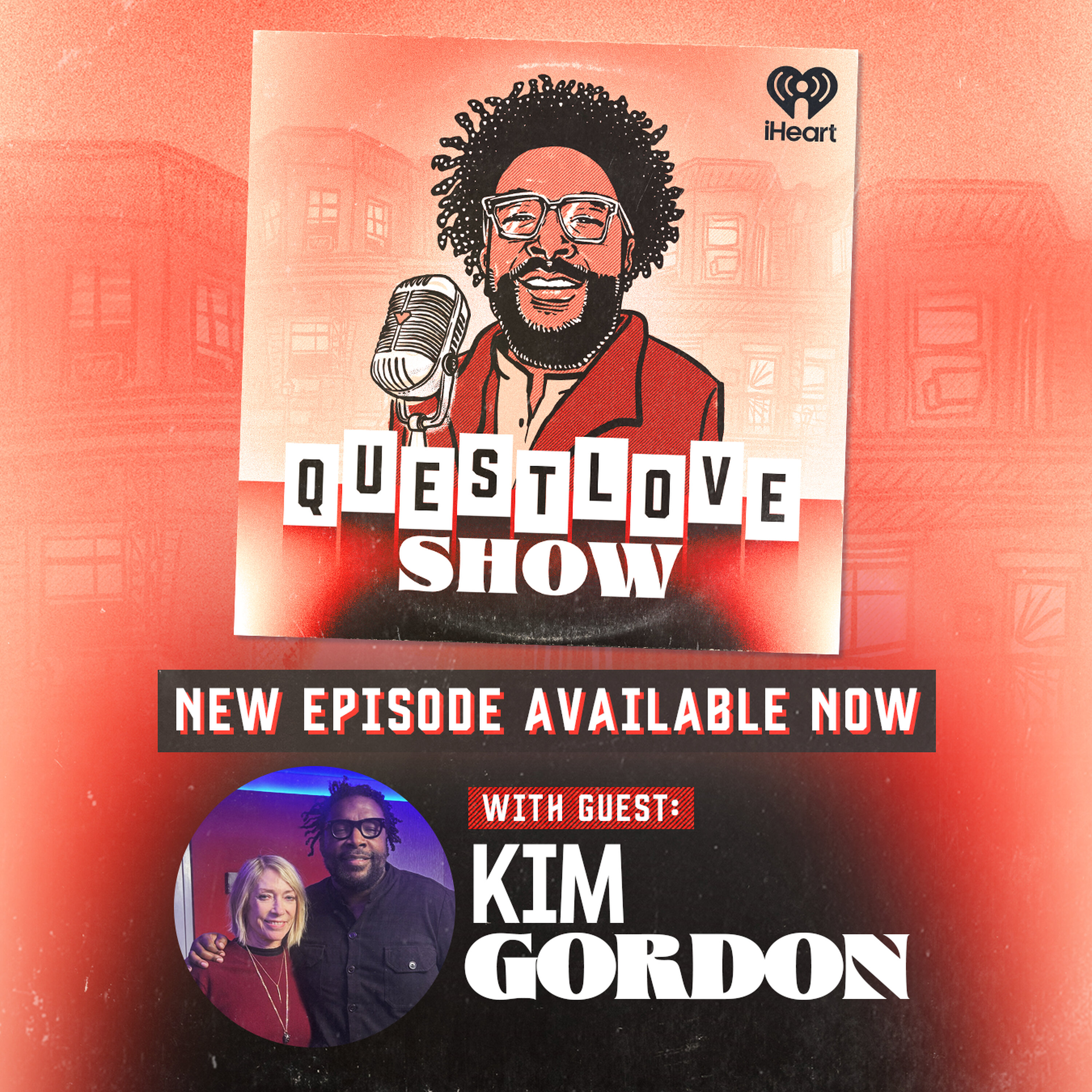
Kim Gordon
Questlove sits down with Sonic Youth co-founder and avant-garde icon Kim Gordon for a candid, funny, and surprisingly vulnerable conversation about imposter syndrome, the Downtown/No Wave era, and how a visual artist became a profoundly influential bassist, singer, and producer. Kim talks about embracing spontaneity in the studio, discovering dissonance alongside Public Enemy at Greene Street Studios, accidentally launching her solo career with producer Justin Raisen, and navigating motherhood. She also reflects on recently updating her memoir and her role in the film Chronology of Water. One of music’s enduring arbiters of cool joins The Questlove Show—take heed.


00:00:00
Speaker 1: Request Left show is a production of iHeart radio.
00:00:21
Speaker 2: Ladies and gentlemen, I cannot lie to you and say that our guest today has had some sort of hand and luring my very band to a certain label called GEFN DGC, even long before we met. As the co founder of the legendary band Sonic Youth, our guests has crafted a movement for more than four decades, inspiring anyone worth their grain of salt of greatness. Name them Nirvana's Magic Pumpkins, Pixie's Pavement, Dinosaur Jr. Pro Jam, Whole Radiohead Sugar. I mean, the list goes on and on and on. I mean this is the definition of when you hear people say like your artist's favorite or that meta rabbit hole. Our guests and bodies that today she said countless of I be here all day. We even just talk about the collaborations, always pushing the boundaries of creativity and staying fresh. An architect of patron, saint of many movements, pioneer of the downtown scene. Are you embarrassed when we come with way too many superlatives like.
00:01:31
Speaker 3: She's long for the daylight? Ladies and gentlemen, you.
00:01:33
Speaker 4: Can check out the imposter syndrome.
00:01:35
Speaker 3: For sure, I get the coolest bass player ever. Thank you Kem Gordon for coming to the Quest Left Show. Appreciate it. How WI great to see you. All right.
00:01:45
Speaker 2: Well, that's what I want to start with because I know that oftentimes there's the battle the idea of you versus what you feel is the authentic you. So to break the ice, I always wanted to ask you this, Can you tell me three things that you think are uncool about you?
00:02:03
Speaker 4: Well? I guess mostly like I don't think I'm cool, like I do battle like this kind of feeling of awkwardness to some extent, you know, unless I'm in a flow of working or doing something. You know, like I have a basket of different socks that I wish I could just get rid of and start over.
00:02:34
Speaker 2: I don't know, you know what, Actually, it's funny you mentioned that I kind of did that last week. I don't know why I decided to just have a sea change of all my T shirts, mind to wear my socks. I decided getting rid of whatever has collectively like just been there for the last decade and a half and just start over fresh. I don't know if that's my version of just getting a new haircut. I'm gonna change mind to where it started.
00:03:04
Speaker 3: Actually, you know, it's weird.
00:03:05
Speaker 2: I probably met you in the most ideal way whatsoever. So when you walk in a room, do you feel sort of self conscious because you know that there's an expected cool factor that we've tagged on you? Or do you just feel like you just blend in and no one knows that you've walked in?
00:03:25
Speaker 3: Yeah?
00:03:26
Speaker 4: I pretty much don't think anyone's gonna know who I am.
00:03:29
Speaker 2: Okay, so am I allowed to say where we first met?
00:03:33
Speaker 3: Where we were at a.
00:03:34
Speaker 2: New Year's e party at uh Natasha, right Natasha's house. It was so spot on and cliche that I was like, yeah, of course, Kim Gordon just walks into a Neyear's party inside in Natasha's house and is the coolest person in the room. Literally, like seven of us like just hushed down and then almost felt like our pressure was getting to you because I wanted to say something to you, but then I was like, no, she's probably in her head right now, so I didn't say it.
00:04:05
Speaker 3: But then eventually I did talk to you.
00:04:07
Speaker 2: But do you often feel that we're talking like geeking out over you?
00:04:11
Speaker 3: Or just no?
00:04:11
Speaker 4: I mean honestly, like, I think that's that's the last thing I think, okay, And I'm kind of a shy person, so people maybe expect me to be different, so they think I'm cool because well, I'm not saying a lot.
00:04:30
Speaker 2: Can I ask you, what's the best compliment you've ever received that you actually received it without like the imposter syndrome like sort of ducking out.
00:04:39
Speaker 4: Gosh, I don't know. I mean, I know someone said from my last record that I was a genre on to myself, which I guess I relate to that, okay, because I don't really like to think in terms of music genres or anyway.
00:04:57
Speaker 2: Well, I was going to ask later, when you create, are you sort of of the moment you don't know what's going to happen the second that you whatever you deemed your studio home base, do you know what's going to happen? Or are you a person that has to like pre plant way ahead of time?
00:05:15
Speaker 3: And then no, I'd.
00:05:18
Speaker 4: Like spontaneity and improvisation a lot. So I mean when I work with Justin, like, he'll send me some you know, beats and things, and I'll figure out what it is I feel drawn to and then you know, kind of write some lyrics. But then when I go in and put guitar down to make it kind of messier. You know, it's like having a white canvas, like you can't it's hard to paint on a white canvas.
00:05:48
Speaker 3: You have to right anyway.
00:05:52
Speaker 4: And then I'll but I'll tend to not really know exactly where things are going to fall. And then sometimes I'll just think, will just come out of my mouth, you know, Okay, what the hell is that?
00:06:04
Speaker 3: Can you tell me?
00:06:05
Speaker 2: What are the things that you did in the first twenty minutes of your day today?
00:06:09
Speaker 4: Well, I guess I looked at my stupid phone. Okay, I'm saying it. A friends my galleries, and so I went down on made tea and I talked to her. She just came back from the Miami Yard for her and.
00:06:23
Speaker 2: Okay, all right, this is rather random non sequitor. But I'll just ask what is the bravest thing that you think you've ever done?
00:06:30
Speaker 4: That's a tough one. I guess the bravest thing maybe was deciding to become pregnant and have a baby. It's sort of like a world of unknown.
00:06:42
Speaker 2: I want advice on that. I want advice on that because of all the members of the roots, I'm the one.
00:06:48
Speaker 3: That's childless still, okay, because I still.
00:06:51
Speaker 2: Think in terms of like, ah, this will slow me down. Oh this has slowed me down. But I'll also say that me coming to grips with that level of vulnerability, you know, I'm a very calculated or if I fail, I need to perfect this verse.
00:07:07
Speaker 3: I'm not.
00:07:08
Speaker 2: You know, we're the manual instructions for this, and I feel like that's one of the things where you just have to fuck it, like just let it happen. Yeah, right now, I'm probably as close as I've ever been to just like what else is left?
00:07:25
Speaker 5: Yeah?
00:07:25
Speaker 2: Dog, you did everything, Like it's not going to get more perfect than this.
00:07:30
Speaker 3: What was that feeling like really just giving in?
00:07:32
Speaker 2: Because I'm actually asking from an advice standpoint, how do you allow yourself the vulnerability to accept that type of love?
00:07:41
Speaker 4: I don't know. I mean, it's just like, you know, first of all, you you only live once that we know, so I don't know. I just felt like, oh, there's just like a whole set of experiences and there's something about when you have someone to take care of that's really dependent on you. It takes you out of your head, you know, in a nice way, and it's kind of you know, it's funend I do. I mean, yes, obviously, of course I highly recommend it. I'm not sure I recommend having more than one. I only had one. But I mean, you know, if you're like travel of you know, you work a lot, you know, it's difficult. I think it's harder for women because as equal as your relationship can be, it's still kind of a lot falls to the the mama somehow, you know, scheduling, Like you have a certain urgency towards your when your baby cries because it's hungry, Like you just want that's to stop, you know.
00:08:55
Speaker 2: Can you still be creative and balance? I think that's the thing that I fear the most. Like I'm so detail oriented that I almost feel as though I have to.
00:09:10
Speaker 3: That's a bad metaphor to you.
00:09:12
Speaker 2: I always use the term throw the baby out with the bath water, but meaning just in terms of of making sure that I'm one hundred percent present. Yeah, And I just always figured you can't serve two gods in the way that creativity is to me, for like music and fulfilming, all those things that I spend way too many hours doing that. But this is the closest I've ever been to just.
00:09:38
Speaker 4: Like, yeah, I don't know. I mean, it is a big change, but you still manage to do everything pretty much, you know, you just have to be more efficient, like you have different priorities, I suppose, and I don't know. My daughter's thirty one now, like you never really stop worrying about your child. I have to say, yeah, that's difficult, you know.
00:10:06
Speaker 3: Thank you, I appreciate that.
00:10:08
Speaker 2: Yeah, do you remember the very first creative project that you've ever done in life?
00:10:13
Speaker 4: When I was in kindergarten, I went to this lab school at UCLA where you sort of learned by doing. And I mean in kindergarten, right, you don't do that much. But we made clay elephants, like I learned the system, like I was good with my hands, I guess, And then so I guess that was my first creative Then when I went to first grade, they had me go back and teach the kindergarteners how to do it.
00:10:40
Speaker 2: So obviously your love for visual arts was early in this sort.
00:10:46
Speaker 3: Of yeah informed, Yeah, it basically.
00:10:51
Speaker 4: Just sounds cliche, but yeah, I always just wanted to be an artist. Gotcha, I just fell into playing music.
00:10:57
Speaker 2: So all right, Well, for me, I you know, gun to my head, I probably would say I'm a DJ more than anything. And maybe I forged this career in a band so I could make money so I could buy more records to be a DJ.
00:11:15
Speaker 3: So but for you, you still you feel as though the.
00:11:19
Speaker 2: I don't know, like visual arts or tangible arts or that that's your true first love, like as a creator.
00:11:26
Speaker 4: Yeah, okay, I mean I kind of think of myself it's hard to explain, but as an artist first, like an artist who makes music or an artist who writes.
00:11:36
Speaker 3: Yeah, artists first.
00:11:38
Speaker 4: Yeah, yeah, I don't think of myself as just It's not exactly the same as just being a creative I just I think spatially in a way.
00:11:51
Speaker 2: What's the transferable creative talent that you have that the world doesn't know about? Like you play basketball? Are you a gamer? What's your cooking skills?
00:12:03
Speaker 4: Like? I don't know I am a good cook? I don't know. I just I think I have a good special sense.
00:12:10
Speaker 3: That's a talent in terms of like functional and energy in a room.
00:12:15
Speaker 4: And yeah, I think what I like about playing music in a way is like I was kind of wanted to be a dancer at what point in my life? And uh, I know, it's just there's a lot of moving around on the stage, you know, and like you have a sense of how you can bring something different to what would be an expected rock show or something by how you move and where you move and things like that.
00:12:46
Speaker 2: All right, So in your position in a band, an iconic band, who's your north star? As a bass player, who's in your mind? You're vicariously living through? Like I know, I see the flea effect now with kids, were like all of a sudden, you have a bunch of these balancy kind of I'm like, okay, I know what you grew up with.
00:13:11
Speaker 3: But for you, who was your north star?
00:13:15
Speaker 4: I actually liked a bass player of in DNA, this guy Tim Wright.
00:13:21
Speaker 3: Okay.
00:13:21
Speaker 4: He used to play in his socks and he kind of used a guitar like the way held he almost held it sideways.
00:13:31
Speaker 3: Okay, and he would turn it's a weapon turn a lot.
00:13:35
Speaker 5: Yeah.
00:13:36
Speaker 4: Okay, But I don't play bass so much anymore, like I've been. I haven't played bass since the last Sonic Youth gig.
00:13:43
Speaker 3: Okay, but what was that also.
00:13:47
Speaker 4: But he was he was. He definitely inspired me.
00:13:49
Speaker 3: Yeah, gotcha and Sid Vicious, right of course?
00:13:56
Speaker 2: Of course, what are the first three records that you remember purchasing?
00:14:03
Speaker 4: Well, there's it's probably like a Beatles single, okay, but I don't remember which one. Like I used to walk up to the record store I lived in West LA and you know, ask is what's it's the new single out? You know? Okay, it's a new Beatles single out.
00:14:19
Speaker 3: So Beatles forty five would.
00:14:20
Speaker 5: Be one of them.
00:14:21
Speaker 4: Yeah, I had a Roy Orbison single. I think pretty Women. I had a Rolling Stones record, okay, like the first one. Maybe.
00:14:32
Speaker 3: Well let me ask what three records that you own? Do you think that we would be shocked that you listen to Tusk?
00:14:42
Speaker 2: I remember the day that Tusk came out, and it was like a marching band song, right, like they used marching band drums in the title track.
00:14:51
Speaker 3: And it was a double album. I remember them, not like is it a triple It.
00:14:56
Speaker 2: Was a double album, but I remember them. It came out with I was nine, right, so I don't have like real time memories, but I remember them panning the shit out that record.
00:15:07
Speaker 4: So yeah, people hated that record.
00:15:10
Speaker 2: So do you gravitate towards what we're not supposed to?
00:15:16
Speaker 4: Like, Well, that's funny. I mean I didn't actually get into that record to like two thousand and nine.
00:15:23
Speaker 3: But did you get into it because everyone else didn't like it?
00:15:26
Speaker 4: Well, I don't know, Like it's funny. My friend Bill Nace, who have this guitar improvtu I would. I don't know whether he just found it like in our shelf and he started playing it. We both just became obsessed with it and listened to it endlessly, And I have to say it's like the worst cover art ever, right, which I think was super expensive and yeah, way over budget the whole thing. But I don't know, is something about that record it reminds me I need to go home and play I've heard it in a while now.
00:16:05
Speaker 2: For me, I think that I'm curious about departure records. When I first started teaching at NYU, I'm always interested in the psychological angle, Like Okay, sly Stone has.
00:16:18
Speaker 4: That's a great documentary. By the way, Oh thank you both of your documentaries.
00:16:22
Speaker 3: I appreciate it.
00:16:24
Speaker 2: Yeah, like Slide had such pop success with stand that, why does he do this dark ass record or why would Prince follow up Purple Range with Around the World on the Day? What did Fleetwood Macfield after the rise of rumors, like, you know, to not ruin it, but not say you're scared so that you know this departure, I'm in a backfire for the Beatles, like Sergeant Peppers was hey, let's do show tunes and timpan Alley and it backfired. Yeah, So I'm always curious that when a band gets to that place where they're so big, do they follow up?
00:17:02
Speaker 3: I know this is a weird take.
00:17:04
Speaker 2: I admire Michael Jackson for trying to even think that he could top thriller like, oh, forty million, I'm gonna try one hundred million, which, yes, the quantity.
00:17:14
Speaker 3: Of it all is what. I also feel.
00:17:17
Speaker 2: Michael Jackson away literally and air quotes, but I actually admire the balls for him to actually say, now, I'm not going to do the cover record, or let me do my jazz record or my Joni Mitchell FaZe like whatever that is.
00:17:34
Speaker 5: So that'd be interesting, right, What is your all time favorite food?
00:17:51
Speaker 4: I don't know, like I like so many so much. I like, like maybe sobaz Okay, you know, I love French food too, you know, actually soup to poison last night. It was delicious, okay, but I there was something about so much to me that's so kind of pure okay and delicious.
00:18:13
Speaker 3: Gotcha. What's the last thing that you made for yourself?
00:18:16
Speaker 4: It was not probably roast chicken?
00:18:21
Speaker 3: Okay. Yeah, So keeping with the fringe, fancy, what's your all time favorite cereal?
00:18:28
Speaker 4: Paleo Grinella him erewhon.
00:18:34
Speaker 3: Yeah, even the way you sold it to me was like cool?
00:18:41
Speaker 4: Really, I mean I don't really eat cereal?
00:18:44
Speaker 3: You educated Cereal? I get it.
00:18:45
Speaker 4: There's yeah, yeah, I don't know. I just I basically don't feel like I've eaten anything if I have a Cereal?
00:18:52
Speaker 3: Okay, that's a lot.
00:18:54
Speaker 2: What TV show best describes your childhood, oh man? Or what TV show did you ever fantasize being a part.
00:19:04
Speaker 4: Of I loved Mister ed Talking Horse?
00:19:08
Speaker 3: That was your favorite?
00:19:09
Speaker 4: It was one of my favorites. Yeah, that in seventy seven Sunset strip? When is that older?
00:19:18
Speaker 2: Like?
00:19:19
Speaker 4: In fact, I would drive down Sunset trying to find the spot where.
00:19:24
Speaker 3: The opening yeah the opening was?
00:19:27
Speaker 4: Yeah? Yeah, where's words? Kookie or whatever his name is?
00:19:32
Speaker 3: Got it?
00:19:33
Speaker 2: Do you binge watch anything on television now, like, have you adapted to streaming culture?
00:19:38
Speaker 4: Yes?
00:19:39
Speaker 3: I what's your favorite ure? Well?
00:19:41
Speaker 4: I really enjoyed Line of Duty.
00:19:44
Speaker 3: Okay, it's a.
00:19:48
Speaker 4: BBC cop show about police corruption. I like all those shows about police corruption and were.
00:19:58
Speaker 3: You a Wirehead?
00:20:00
Speaker 4: The Wire? I mean yeah, those those are the classic shows, you know, got It, Got the Wires? Maybe my all time favorite show, Gotcha?
00:20:08
Speaker 3: Yeah?
00:20:09
Speaker 2: In your childhood bedroom the posters ever adorn your wall?
00:20:13
Speaker 3: Who adorned your wall in your childhood bedroom?
00:20:16
Speaker 4: I think Dylan probably?
00:20:18
Speaker 3: Okay, yeah, what era Dylan are you most loyal to?
00:20:23
Speaker 4: Oh? Only the early stuff. I actually don't really like anything after nineteen seventy.
00:20:29
Speaker 2: All right, so you're you're not a self portrait. I came into Dylan weird. My parents became the way that, like Reagan's Christian America just washed over the black community. My introduction to Dylan was Christian Dylan.
00:20:44
Speaker 4: Oh wow, yeah, I don't even know if I know Christian Dylan.
00:20:50
Speaker 2: Oh god, yeah, Like to this day, I'm the only when I told him, like, when you're going to wake up like his on the yellow slow train coming like I told him that, and he just looked at me, like I'm so sorry, Wow, Well, yeah, I started with his three Christian awn period and I think what I think Infidels broke that in eighty three. But I always get into the wrong rock album for every band, Like you know, you asked eight year old me, I'll be like, yeah, man Satanam Majesty's requests, it's cool, right, was like yeah, no, But I just always as a cool cover. Yes, there you go, that's there, that's their one saving grace. But you know, as I got older, then, of course there were people that set me straight.
00:21:49
Speaker 3: But yeah, I picked.
00:21:51
Speaker 4: I had an older brother too. He sort of make fun of me, like you don't know what he's talking about. Really, it's like, who does know what Dylan was actually talk came about?
00:22:00
Speaker 3: Were you the family black Sheep in terms of like your tastes.
00:22:04
Speaker 4: And no, not at all.
00:22:06
Speaker 3: Oh they were. There were more that were.
00:22:08
Speaker 4: Well, my brother was super eccentric person who later became schizophrenic, but and he was always getting into trouble.
00:22:18
Speaker 3: Okay, So.
00:22:20
Speaker 4: I was a goody goody one.
00:22:22
Speaker 3: Do you remember the first concert you ever attended?
00:22:26
Speaker 4: Actually, the first concert I ever went to was in Hong Kong when I was living there, when I was twelve. It was Herman's Hermit's.
00:22:38
Speaker 3: On an army base or no, it was my dad.
00:22:41
Speaker 4: Was a professor ATLA and he took some students there to start a study program at the college Chinese University, and they came while we were there and played. Yeah, they did a concert.
00:22:58
Speaker 3: I now know that when you do worldwide like, people were.
00:23:04
Speaker 2: Somewhat different now, but yeah, I know that back then, like, concerts were very different in terms.
00:23:09
Speaker 4: Of I mean, I actually don't remember, okay very much. I remember like in the the hotel bars there that sort of pretty young Chinese girls would wear boufont dresses and play beetle covers.
00:23:26
Speaker 2: Okay, okay, So this is different than the first records you owned because CD culture came later. Do you remember the very first CD that you purchased?
00:23:35
Speaker 4: Ah? No, thank you. CDs are just like you know, they might have been things we blagged from the record label or something, you know, right.
00:23:49
Speaker 2: Oh yes, I was going to say, oh wait a minute, so I asked, we sad this question, So I got to ask you this question. Another main reason why there's so much reverence and respect for you guys is simply because of the insane amount of times that Sonic Youth Records have fed the roots in terms of okay, and but by you saying what you said, I know that this isn't just something that's unique to me, which is you always visit the record label, You go into the supply closet, you take all the CDs right, and then you go to the village and sell them the bleaker bobs and then you know, Weezer said that they too lived off of the Blue Album and Piggerton by selling their own CDs too.
00:24:35
Speaker 4: Oh that's funny. I mean we when we first signed to Geffen or we took a bunch of stuff like like the guns and roses, welcome mat It's like Madonna candles and.
00:24:53
Speaker 3: The shame. I felt like, hey, what's that over there? And like you like the pink panthers.
00:25:00
Speaker 2: Like us, you know, like the trench coat with three people stacked on top of each other, Like that's us. Like take your shit out of the studio just to get money on Fridays.
00:25:12
Speaker 3: Yeah, I'll say, ah, ecstasy, Sonic Youth.
00:25:17
Speaker 4: Just I can't believe that we influenced your decision to signed a gun.
00:25:22
Speaker 3: Well, you know, it's weird.
00:25:24
Speaker 2: I had a manager that so something happened like around ninety to ninety three where he realized that because of us being a band, that that opened more doors than like there was no hip hop whatsoever really in Philly except for like specialized what about Yeah, But he would have to play rap shows and we got like the last days of like Nirvana being the household secret, like they play j C. Dobbs maybe a month before we played j C.
00:26:05
Speaker 3: Dobbs.
00:26:06
Speaker 2: So I think that my manager figured out a way that by ninety three ninety four, certain hip hop groups could sort of fit on the alternative stages, so like us doing Lollapalooza or anything with Jay's Addiction or anything with like just that first, Like you guys are probably the only guys that we didn't open for, but pretty much a big.
00:26:34
Speaker 3: Part of our growing as a group.
00:26:37
Speaker 2: Number one, whenever Wu Tang would mess up, we'd be the band of the call, Hey Wu ta claim's not going to make it next week to da da Da da da ke you guys feeling, So that was like half of it, and then the other half would just be us being the open act, like like Cypress Hill and public Andomy really had to pay almost a tiny credibility price because the rule was rap groups should only be a rap shows only, and if you're not with if you're opening for you too, if you're selling out, like right, right, So those guys called major flack and then around ninety.
00:27:18
Speaker 3: Three like no one cared anymore. That's when we arrived and literally like oh interesting, right when the sea change happened. Have you ever gone karaoke? Never? You've never gone karaoke?
00:27:29
Speaker 2: No, Okay, to be fair, I've only been twice in my life, and I think both times we're in Japan. But I head scratched at people that love karaoke because it's like, I tell my perform for a living so and to me, the only enjoyable karaoke is when people sound horrible. So that would never happen, so you would never be course whatsoever.
00:27:52
Speaker 4: To Yeah, I did. I did a song, a cover song that way for Addicted to Love. You know, they just have these this booth on Saint Mark's Okay, So I went there and I did that. And it was when the band was in the studio making shit up for the Weddy album, right, And I was kind of not down with that because it was just three guys like wasting lime, gotcha? And then I took that and actually took it back to the studio. We sped it up a little, and then I went to Macy's and made a video because I used to have these for nineteen ninety nine. You could go in and yeah, it tell us my favorite video. Just so great to like walk out pay nineteen ninety nine and have a two camera shoot.
00:28:40
Speaker 3: Right. Okay, what song do you love that you think everybody hates? Of our songs or a vinye song creator?
00:28:49
Speaker 4: Jeez, that's a tough question.
00:28:52
Speaker 3: Okay, have you ever made a mixtape for someone?
00:28:55
Speaker 4: I did make a mixtape for some actor once.
00:28:59
Speaker 3: Okay, remember what was on it?
00:29:03
Speaker 4: Sorry?
00:29:05
Speaker 3: All right? If you were to make me a mixtape with three songs would have to be on it? Having not really known me, well, I.
00:29:12
Speaker 4: Guess I would put a Brigitte Fontaine our ensemble of I forget the name of the record, but.
00:29:19
Speaker 3: Have you of Chicago or yeah, I might own it.
00:29:24
Speaker 4: They did an improv session together, Okay, Okay, noy the Pink record?
00:29:31
Speaker 3: Okay?
00:29:32
Speaker 2: Can I ask what song has the power to make you cry no matter how many times you hear it?
00:29:39
Speaker 3: Instantly? Maybe?
00:29:40
Speaker 4: Uh, Cortes the Killer.
00:29:44
Speaker 3: What is it about it?
00:29:44
Speaker 4: No, yeah, I don't know. It's just like the melody. It's like what he hits this one, you know something?
00:29:51
Speaker 2: Okay, when this gives me to this day and I'm I'm mad that it's not as accessible. But the Philadelphia song that Neil Young sings, I know people know the Streets of Philadelphia by Springsteen for that soundtrack, but when the credits go up, Neil Young has I mean, you know, like he has a very heartbreaking sounding like sensitive voice. But Neil Young singing his version of Philadelphia that has nothing to do with the Springsteen version it is.
00:30:24
Speaker 3: It is like one of the most heartbreaking.
00:30:26
Speaker 4: I have to check it out.
00:30:28
Speaker 3: One time I had to make a funeral mix and I thought.
00:30:35
Speaker 2: We put me moody sass songs on there, and it came up and I realized I overdid it, so like me running back to the ipile.
00:30:43
Speaker 3: Like trying to turn something else on.
00:30:47
Speaker 2: Okay, So I feel like your Downtown scene you'r Hashtager quote Downtown scene is well for me. The neo soul scene was supposed to be where I don't know if I owned it. I did completely disown it. But for you, what's one of the biggest myths of the downtown scene that you always hear that never happened.
00:31:10
Speaker 4: Well, you know, in the eighties, especially early eighties, people from Europe always wanted to come and do articles about the crossover between the music scene and the art world, which kind of didn't exist. I mean, it did exist in the very early eighties, like during the kind of the height of No Way Fans, and there were a lot of young artists who you know, were drawn and kind of part of that scene. But then by the mid eighties they were kind of just into their careers, you know, our careers, and and it was so it wasn't really what people thought it was in terms of this mecha like it was super bleak in the eighties, you know. Also, but that part is kind of I guess I can be nostalgic about that a little bit.
00:32:08
Speaker 3: Who coined the term no wave and is that really truly? Is it possible?
00:32:14
Speaker 2: Like is it just rejecting the idea of a title or is it kind of like you know, in the filmmaking world, where you know, Dog one ninety five was supposed to be this like restrictive movement and whatnot, Like, were there rules to the.
00:32:30
Speaker 3: No Wave.
00:32:32
Speaker 4: Not really. I mean I think it was kind of I think it was kind of nihilistic actually, I mean I some people might disagree with me, but like when you know, punk was supposed to be this movement that kind of obviously different fractions, but that destroyed rock, which it didn't. It was three cord rock and roll. It was just anti corporate, you know, it was different lyrics and a different sensibility of of what music was supposed to be. But No Wave was actually really deconstructed rock, like you didn't necessarily have. There's a lot of dissonance and density, and it seems just peculiar to New York, although Japan was kind of parallel, and Japan they had art movements that came post to World War Two, right like no Theater and anyway, it was kind of a nihilistic attitude, and so it's kind of interesting that that was pretty much particular to New York. And maybe the influence of like free jazz and you know, other different sounds minimalist composition, you know, Lama Young and junk age and people like that. You know, I think that sort of contributed to it a bit. But it was also just a feeling of like, no, this is this song isn't going to have like a beginning of middle ement, And to me it was very free music and that's what inspired me to play music.
00:34:20
Speaker 3: Gotcha, are any of the.
00:34:24
Speaker 2: Rules that you placed on yourselves for that period still exists for you?
00:34:32
Speaker 4: Yeah? Kind of in that the main rule was not to really learn how to play music, which is kind of a technique in itself, I realize.
00:34:45
Speaker 2: Okay, let's take if I would say the biggest year for Noise in my opinion, especially I havn't worked at a record store that year, I would say eighty eight. Now it's not like I think there was a collective meeting being had by various genres of music, but really just this movement starts like how where are you guys that even in the black music world, Like what Public Enemy is about to start doing with this aggressive noise sound? Like for me, like the day that the first song that they experimented with in which they really tested the limits of like what the hell is that was when they released a Rebel without a Pause in the summer of eighty.
00:35:34
Speaker 3: Seven, and it changed my walk.
00:35:38
Speaker 2: I almost had a hints in asque disposition in the hood.
00:35:42
Speaker 3: Hey guys, how you doing? You know?
00:35:45
Speaker 2: And you hear this and it changes you. Yeah, and I realized, like, oh, this is my first soundtrack to teenage angst like whatever I feel. But in general, like what is the genesis of the embracing of dissonance?
00:36:03
Speaker 3: And just was there a political anger in the air? Were you all Yoko Ona fans? Did you discover free jazz and the sixties? Like what was it? I don't know.
00:36:13
Speaker 4: I mean, I think it was just a very gradual thing like we you know, like we were influenced by the NOA Evands, We were influenced by free jazz. We we were certainly into Public Enemy and kind of related to their music in terms of density. And you know, we were recording at the same studio they were. And this is Chum King No, it was Green Street, Green Street. Yeah, yeah, yeah.
00:36:42
Speaker 3: I was about to say, just what was it like recording at Green Street?
00:36:45
Speaker 4: Beg man, Well, it was kind of funny because this engineer we had had never done guitar music.
00:36:53
Speaker 3: Who's your engineer?
00:36:55
Speaker 4: His name was Nick son Sana.
00:36:57
Speaker 3: Oh, Nick, yeah, Professor Nick Sonsano.
00:36:59
Speaker 4: Okay, we were the first guitar band he ever recorded. And I don't know really what he thought, but it was basically I think he understood it in terms of layers, you know, of sound, just the way he would record with you know, Public Enemy or Yeah.
00:37:18
Speaker 3: Professor Nick was one of the when I taught at NYU.
00:37:22
Speaker 2: He's one of the co teachers also long like Nixon, Sono did the Public Enemy records, like all the Bomb Squad stuff, Sonic Youth, like all these New York institutional bands. And then Bob Power also taught there and he's doing a tropical quest in De la Soul and eventually di'angelo the roots that.
00:37:43
Speaker 3: Stuff and so.
00:37:45
Speaker 2: But Nick told me something mind blowing about just his lack of experience as an engineer during that time period. And he informed me that like we almost did no automation mixing on Public Enemy. All that stuff was pre done, wow, which if you know their music, you're like, well, this has to be a post thing, and it's like, no, we always did it right preven.
00:38:10
Speaker 3: But for you in that time period, was it just not knowing.
00:38:18
Speaker 2: There were rules or just like purposely like how many we shouldn't do that or can't do that? Conversations were had.
00:38:26
Speaker 4: I mean not many, you know, probably there were just discussions about well it shouldn't go into the red or too far or something.
00:38:35
Speaker 3: I'm not satisfied until it goes in the red.
00:38:37
Speaker 4: I don't know, like, uh, I'm not sure. Like he was just super like agreeable, you know, got it, and we would try you know, Lee would try things out that we knew wasn't kinda and about the record but whatever, you know, like some of it did, you know, But yeah, I do recall. I think it was that studio where yeah, there'd be a number of fans on the board during mixing, you know.
00:39:03
Speaker 3: Right, and then you're just figuring out.
00:39:08
Speaker 2: So at the time, are you saying that both bands were making like you were making Daydream Nation and in the.
00:39:15
Speaker 4: Other room they were in the the newer room, you know, the I think it was an automated board. Actually, yeah, some kind of.
00:39:23
Speaker 2: So did you guys old board did you realize that you had two Nation albums in common at the time when you were making a.
00:39:31
Speaker 4: Little bad I mean that's where like, you know, we did cool thing and I asked Chuck if he would come and do this like he did kind of the most cliche thing right, but it was perfect, you know. Okay, but I just also remember uh waiting waiting for play, if you know, everyone waiting for Flay to come and then for like days or something, and then eventually you'd hear like his floppy feet going down.
00:40:13
Speaker 2: I always wanted to know when the Geffen Records deal happened, like, was there ever.
00:40:22
Speaker 3: A worry of like being on a.
00:40:25
Speaker 2: Major at the time, like you guys being on there was the cool factor. It was just like, oh, it's Geffen. It's cool because that's where they land, so it can't be that bad. But at the time, there was no you know, you guys had Donna Summer and Elton John.
00:40:42
Speaker 4: Yeah, I mean there was you know, like friends of ours, like or not friends, but Peers Whoskerdoo had signed to a major and replacements, and I don't know, I guess we figured like we were just always frustrated at our lack of distribution, so we that's one reason why we did it, you know. And we were just like, well, we've been together for ten years, so if it doesn't work, fuck it. Yeah, okay, Yeah, And it was a struggle for sure.
00:41:13
Speaker 3: Okay.
00:41:14
Speaker 2: So one of the biggest misperceptions about my band is because credibility was a major key factor for us critical claim credibility. Yeah, there was also this sort of what I will say, a kind of a false narrative, which was basically that, oh, well, you guys don't care about success. Like they were always like, yeah, I like you guys because you know, you do what you want to do and the label supports what you want to do. And I wish I could make music like you guys do. And I'm like, well, it's not like we're sun raw. This is we don't know how to write a good course. So like no one told us that we should only write sixteen bar and an easy course.
00:42:02
Speaker 3: Like so it's almost like I.
00:42:04
Speaker 2: Didn't know how to write accessible music and so but we basically got tagged with like, oh, well, we like you guys because you don't care about success. Okay, So in eighty seven eighty eight, what does making it look like to you? Is it a this one job is all I need to do to live in this apartment and pay all these bills? Or were you fine with a life where Okay, I play my band and sometimes, like the amount of people I've interviewed here and didn't know that.
00:42:38
Speaker 3: You know, Millie Jackson's telling me that she would gig.
00:42:41
Speaker 2: On the weekends, but then she used to work in the garment district from and this is with like Platinum Records.
00:42:47
Speaker 3: Yeah, so for you.
00:42:50
Speaker 2: What does making it look like, especially when you're tagged with this credibility.
00:42:59
Speaker 4: But we kind of had part time jobs, or at least one of us did. But the thing is is that we were kind of smart in that we we had a separate English label that we licensed to as well as a label here, so we would get licensing money from that, and you know when we kind of somehow got a little more money each time to record it a better studio, which was would be Green Street. I guess it just kind of, you know, was such a gradual thing when we did sign TOGEF and I guess we got I don't know, like it was kind of it was a tough record because well, one thing, we did have some backlash, like Steve Albettie was like, you guys, you know, we didn't talk to see for a long time. But uh, but you know the thing was is that, yeah, we could do whatever we want, but it's not like they really promoted our They didn't give us a giant marketing budget either, but we were able to actually have our own record label, s YR, and put out vinyl and they actually never realized that we were making money off of that. Not a lot, but you know, it's like.
00:44:17
Speaker 3: Is it frustrating.
00:44:20
Speaker 2: Being in the Moses position where you know, the beginning it was good for us, like this particularly sucks? Well, no, you know, this particular act that's opening for you is like, Wow, you've done everything in the US.
00:44:35
Speaker 3: Cool.
00:44:36
Speaker 2: And then like next year, oh, they're a massive square garden. Okay, cool, and this next opening act that's after the seventh time, then my self esteem started to go down where it's just like ah, man, like I'm not saying why I used to joke back then, like I don't want to be Fishbone, Like I don't want to be the band so cool that just traffic directs everyone to go in the red carpet and then suddenly you're going on the Moses arc thing and you can't have that what we used to call a Bentley moment. My manager's like, yeah, you guys just never had a Bentley moment. You didn't fail, but you just in your mind this idea of you slow motion in clubs and you know, rap shit, we never have that. But for you guys, was a disappointed not saying disappointing that you didn't get that level of vccolade, right, Yeah, like to watch people that you influenced.
00:45:38
Speaker 4: Yeah, I mean not really. I mean Nirvana was such an anomaly. And also I think our path had just been so like kind of slow and steady, and it allowed us to do other things that we wanted to do. And it's a fame like that as a it's just a freaky thing, gotcha. It really just brings up so much. So maybe other people in the band were more frustrated. I don't know, but it's kind of like, you know, we had our niche and we kind of were able to have a living and you know, I just feel now like I'm so pessimistic about the music industry and streaming and it makes me not want to play music.
00:46:33
Speaker 3: You want to take your ball and go home?
00:46:35
Speaker 4: I do?
00:46:37
Speaker 3: I know? All right? Well can I Okay? So the thing is, I'm I feel.
00:46:43
Speaker 4: Like I'm working for Lucian Grange, you know, like I'm his boy.
00:46:47
Speaker 3: Weren't we always?
00:46:49
Speaker 4: I guess.
00:46:52
Speaker 3: Weren't we all?
00:46:53
Speaker 2: What this is leading to is as a member of rock and Wall of Fame and whatnot, like in terms of making sure that these pioneering bands also get there.
00:47:05
Speaker 3: Would that mean anything to you to this point to get that last like, does that mean anything?
00:47:11
Speaker 4: What rock and roll Hall of Fame? Yeah, I don't know. It seems kind of meaningless in a certain way, like it's sort of a popularity contrast, Like it's not it doesn't seem anymore to be about like people who had significant impact or now it's just like, oh, they sold a lot of records.
00:47:31
Speaker 2: I know, but I'm just saying, like what And I know it's a weird question, like will you allow yourself to really enjoy getting the flowers or just.
00:47:41
Speaker 4: Uh, I guess. I mean when I was nominated for Grammys, I was even saying that I was kind of like, I hate the Grammys. It's just this music industry thing that I've never paid attention to my whole life. And you know, I don't quite It's it's nothing I like about the music about music is the industry. But at the same time, I did feel it was kind of fun to be recognized, you know, outside of my ghetto whatever.
00:48:16
Speaker 2: Well, because I think what's happening now is that all that you influenced. Have you allowed yourself to see that the influence is real? And again I'm asking you as a person who eighty percent of the time an act comes up to me.
00:48:33
Speaker 3: And says, oh my god, you changed our lives and da da da da, and.
00:48:37
Speaker 2: Yeah, the pre therapy me would just basically like, well, if I was so important, then why am I playing? You know, Kalamazoo Michigan State Fair and da da da dah. Like there was a part where I actually let that get to me. But then there's also a part where I realized that I might evaded in my own kind of sabotaging if you even though I'm still going on the path to I don't know where it is I'm supposed to be going, but I'm just one.
00:49:07
Speaker 3: Day at a time.
00:49:08
Speaker 4: But You're gonna have a kid.
00:49:13
Speaker 3: That's the that's the that's the reward. Let me ask you these last few questions.
00:49:18
Speaker 2: So one, how hard is it to embrace a new pivot once you've established yourself in and sort of flag planet your legacy in one area, which of course is in sonic youth, like in walking away from all those things and it being.
00:49:38
Speaker 3: In your rear view mirror.
00:49:40
Speaker 2: And not being jaded and cynical, Like how do you embrace other pivots that you want to do? Like how do you view collaborations now? Because collaborations were a big part of that world you came from.
00:49:54
Speaker 4: I mean it's been fairly kind of easy in a way because you know, like I accidentally made a solo record, and then I made another and another.
00:50:04
Speaker 3: How do you accidentally a solo record?
00:50:08
Speaker 4: Well? I met justin raised and through his brother. Okay, Like we were sitting next to each other at a restaurant and we suddenly found ourselves.
00:50:16
Speaker 3: That's how it came to be.
00:50:18
Speaker 4: Yeah, this girl started talking about their sex lives and tables were really close together, and we all looked at each other and like I was with this friend of mine. I don't know, And then we just started talking and he was like, oh, my brother's a producer. He worked this guy Ferrara, and like I don't care, you know, like that's not my world, right, But then his brother dm me and he said he was working on this Lawrence roth Brune record and they were having to people come in and do vocals and he kept sending me stuff, and I finally he sent me something. I felt, Okay, I can could be interesting. I should be open.
00:51:02
Speaker 2: Right when you collaborate with people, are you one familiar with the worlds that they come from or is it just hey, let's see what happens.
00:51:15
Speaker 4: Well, I don't usually collaborate with people that much, and so what happened was I was pretty skeptical, actually, but I did these vocals and he he took the leftovers and he made this trashy drum beat to go with it and send it to me, and I was kind of like, oh wow, this is kind of cool, Like he really understands my sensibility. And so I went back and did more vocals and put some guitar har down and that song became Murdered Out okay. And then about six months later we just started working together and he Justin's wild, but I I he does come from like punk rock, East Coast roots, and he you know, you haven't seen New Sonic cute and blah blah blah anyway, so we just he kind of just gets my vocal style, and I know I can go in with anything and he'll make it into basically.
00:52:22
Speaker 2: You talk about how the Collective Project came to be in terms of, like it's kind of DNA into a world of hip hop that really sounds natural, Like it sounds awesome if I say so myself.
00:52:39
Speaker 4: Thanks. I mean, he and his brother do like hip hop's beats and stuff for people, his brother more than he does.
00:52:47
Speaker 3: Cherry.
00:52:49
Speaker 4: I'm not a natural singer, you know, so I have a limited range, and so I get really inspired and I use things like space and rhythm and articulation.
00:53:02
Speaker 3: You know.
00:53:03
Speaker 4: That's so I was. You know, I was really happy to actually work work the beats on it, and then I would add my dissonant stuff, which you don't really hear in hip hop so much when they turn the rockets like three chord, like power cards.
00:53:21
Speaker 3: Hip hop, the supermarket music.
00:53:22
Speaker 4: Now, yeah, but I guess now like people are listening to like Chewgazing, well, are you the influenced kind of putting a sampling a lot of that? Funny? It's funny enough.
00:53:33
Speaker 2: I'm going to ask you the question that I hate when people ask me this question. You could pass if not. Is there anyone new that you listen to now? Like I hope that one day you and Tyler the creator run across each other, like it's interesting.
00:53:49
Speaker 4: He's always saying he's that a little like Tyler in this.
00:53:52
Speaker 2: Yeah, I was going to say, like you, you and Tyler, I think that that that should be a that's a project that I can almost Yeah, you guys should work with each other.
00:54:05
Speaker 4: I'm open to that. I mean I'm always a little like skeptical of like, yeah, working with someone with a big name, you know, like I did something with model homes. You know, this guy's experimentally. Okay, two guys, Yeah, we made a single.
00:54:21
Speaker 3: I love that.
00:54:22
Speaker 2: Now Tyler is a big name, it's a paralleled universe, but his beginnings are very.
00:54:28
Speaker 3: Much like it's.
00:54:30
Speaker 2: It's the downtown scene, like literally a collective, just the West Coast hip hop version of whatever you want to call it, the Mumblecred movement or right right, his version of Dogma ninety five. Like, I believe that both of you have your roots almost in the same parallel universe. Can you tell me how you got involved in the Chronology of Water project with Christian Stewart.
00:54:53
Speaker 4: Yeah, just I mean I knew Kristen a little bit, and uh, she just came over asked me if I would do the small part in her film and explained what it was, send me the script, and it just seems you know, fun I mean, I like her a lot, immense respect for her, and she's very articulate about what she wants and you know she yeah, just super smart.
00:55:19
Speaker 2: Now I know that you've revisited your first memoir, Yes, Golden Band, Why did you find it necessary to update the story?
00:55:28
Speaker 4: Just the editor had the idea to put out a ten year anniversary. Got it of it so and asked if i'd write a new chapter?
00:55:38
Speaker 3: Got it?
00:55:39
Speaker 2: Yeah, how cathartic was the whole process of unluding what it felt like to be in the experience from your point of view?
00:55:48
Speaker 4: I liked, I mean, I like writing it. Sometimes I feel like it's the only way I know what I'm thinking is when I start writing and stuff comes out.
00:56:00
Speaker 3: Who's that? Got it?
00:56:03
Speaker 2: In closing, I'll ask you, what's the one thing that you hope that your peers say about you?
00:56:11
Speaker 4: I don't know that I'm funny, okay. I mean there's a lot of humor in especially the new record. And yeah, I think people think of me as like super serious. I feel like as I get older, I'm not as serious.
00:56:28
Speaker 2: What's the one thing that the press never says about you that you wish we knew about you?
00:56:32
Speaker 3: Is that you have a sense of humor. Yeah, I guess so well.
00:56:36
Speaker 2: I thank you for answering my crazy questions, and I thank you for everything that you represented. And I know that sometimes when you're in this position you feel like no one's paying attention, or from one person that looked at a Moses figure that ushered in a movement, I just want to say thank you for that, like I was paying attention, and I appreciate your your work and your artistry.
00:57:02
Speaker 4: Oh thanks, I appreciate that makes me happy.
00:57:05
Speaker 2: The very cool Kim Gordon on The Quest Love Show and I'll see you guys on the next Proground.
00:57:10
Speaker 4: Mutual to you a swell thank you.
00:57:17
Speaker 1: The Quest Love Show is hosted by me a Mere quest Love Thompson. The executive producers are Sean g Brian Calhoun and Me. Produced by Britney Benjamin Jake Paine.
00:57:31
Speaker 3: Produced for iHeart.
00:57:33
Speaker 1: By Noel Brown, Edited by Alex Connelly. iHeart video support by Mark Canton, Logo's graphics and animation by Nick Lowe. Additional support by a Lance Coleman. Special thanks to Kathy Brown Special thanks to Sugar Steve Mandel. Please subscribe, rate, review, and share The Quest Love Show wherever you stream mer podcast, and make sure you follow us on socials.
00:58:03
Speaker 3: That's at q LS.
00:58:07
Speaker 1: Check out hundreds and hundreds of QLs episodes, including the Quest Love Supreme Shows and our podcast archives. Quest Love Show is a production of iHeartRadio