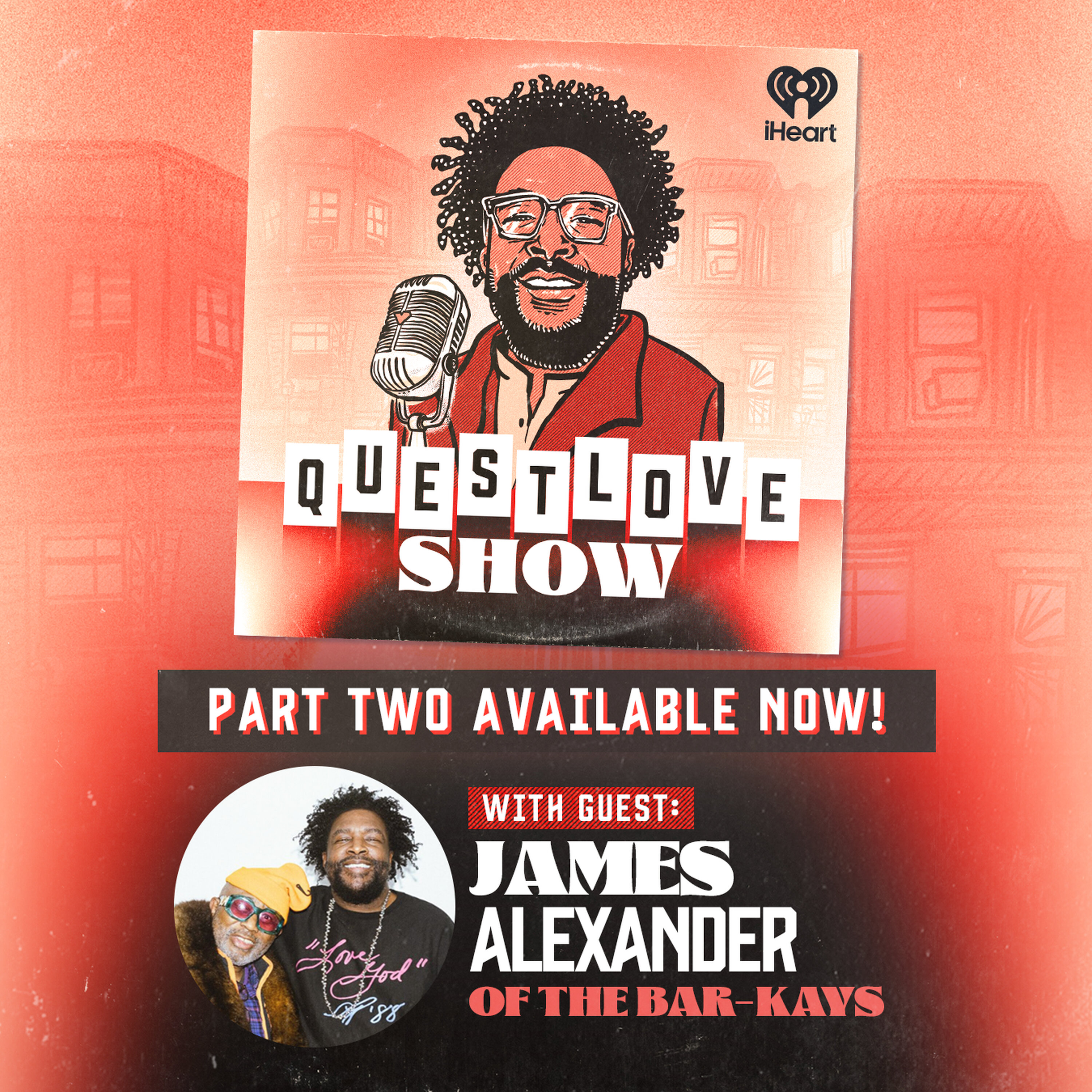
James Alexander of The Bar-Kays Part 2
James Alexander returns to The Questlove Show for a revealing deep dive into the rebirth and evolution of The Bar-Kays after tragedy, sharing how he rebuilt the group with vocalist Larry Dodson and crafted a louder, more aggressive funk-rock sound that pushed them into a new era. He reflects on becoming a go-to rhythm section for Stax Records and beyond, playing on classics for Rufus Thomas, The Staple Singers, and others, and revisits the making and lasting impact of “Holy Ghost,” their showstopping performance at Wattstax, the wild realities of 1970s touring and stagecraft, and the band’s constant reinvention through the 1980s. The Bar-Kays remain active today, and Alexander’s spirited storytelling makes clear why their legacy endures.


00:00:00
Speaker 1: Quest Love Show is a production of iHeart Radio.
00:00:09
Speaker 2: Yo Yo, what's up, y'all? Welcome back to Part two of the Quest Love Show. I'm Questlove in case you're lost, and right now we're talking to the legendary James Alexander of the legendary Barcas and James flew in from Memphis specifically to sit down with us at iHeart Studios. And if you haven't started with Part one, make sure you do. In that episode, we cover all the early days of Memphis, the birth of Soul Finger and playing behind Otis Redding and surviving one of the most tragic moments in music history. There's a lot of music history here, so let's get started. This is James Alexander of the Barcas celebrating.
00:00:54
Speaker 3: Black History Month American History Month.
00:00:57
Speaker 2: Make sure you honor this living legend of black by listening to part two.
00:01:01
Speaker 3: It makes sure you like it to subscribe us. Also, all right, thank you for starters.
00:01:11
Speaker 2: When did you even start with the idea of okay, let's rebuild a new band? Like how long did you take off before you was like okay, let's get to it.
00:01:22
Speaker 3: Okay.
00:01:23
Speaker 1: This happened in December nineteen sixty seven. By April of sixty eight had already reformed.
00:01:32
Speaker 3: A new band. How did you find these guys?
00:01:35
Speaker 1: I've tried to find a guy like each and every guy that was already that was in the group before.
00:01:40
Speaker 3: Found a white guy.
00:01:42
Speaker 1: They played the organ, you know, the same make the band up of the same landups, you know, the same instrumentation, a trumpet into tenor right in a rhythm section.
00:01:55
Speaker 2: So of course there's one main jarring friends between this band and the previous band, which is I feel one of the most unsung frontmen in all of soul music, really music period. First of all, how did you nab Larry Dotson away from the Timprez, a group that themselves were established and I believe stacks.
00:02:23
Speaker 1: So they weren't established then they were trying to come into their own. What happened was they were playing at a nightclub, and so by this point, you know what I'm saying, you know, came with the idea. I said, you know, it's time for us to do something a little different rather than being a totally you know, instrumental group. So I went to this club one night. Somebody had told me about this group called the Timprees, and I went and heard him, and to be quite honest with us, they alright, alright, okay, but this guy, Larry, I said, hey, man, I just came to check y'all out because you know, we thinking about getting you know, getting you know, getting the vocalists.
00:03:04
Speaker 3: In our group.
00:03:05
Speaker 1: He said, I'm down, I said, when I said, said, wait, wait wait wait wait wait wait hold up, dude, you're moving a little too fast, I said, first, because i've been you probably didn't know this, but see the TEMPERRIESE was his group. Yeah, So I said, man, you know we can meet, you know, a day or two later and talk about this thing. No, you can talk to me now, I said, dude. You know, you know I'm trying to be respectful. I ain't trying to talk to you on your gig. I'm trying to let you finish your gig. And I talked to you tomorrow or the next day or something like that, and I just had to say, I'm not I'm not talking to you now.
00:03:43
Speaker 3: Did that wear you that?
00:03:44
Speaker 2: In an instant he was just ready to leave us established because that could have happened to you too.
00:03:49
Speaker 3: He could be in the barcades and then I'm here I mean, I went, man, you have to understand, we're eighteen and nineteen.
00:03:56
Speaker 1: I wasn't thinking about nothing like that. Man, you know, I think about all of that now. Got back then, I was thinking about nothing. But you know, so you know, we finally talked and we ended up getting him in the group. I think this is around seventy one somewhere. I can't I can't even remote it. Anyway, I was working with a guy that ended up being my producer and manager, and we had started rehearsing with him.
00:04:21
Speaker 2: This is Alan Jones Jones. Yeah, okay, I have a lot of Alan Jones questions. Yeah, Jimmy jam And I had Alan Jones questions.
00:04:31
Speaker 1: I told Alan Jones, I said, man, you know, I don't know if this guy's gonna make it, because I know he probably would hate me for saying this, but he really wasn't ship.
00:04:42
Speaker 3: He wasn't they good v Larry Dotson. He was not that good. Okay, No, he wouldn't that good. But it sounds like someone I know had to learn you had to learn the ropes.
00:04:56
Speaker 1: Yeah, I learned the roses. I wouldn't say, you know, but you know, I went and talk to Alan. I said, man, I don't know, Man, I don't know if this guy gonna make it or not. Because, man, you because Alan before the plane Chris, you know, he had just got out of the army and he's the bass player by the way, too, and he was trying to get in, you know, trying to get in stacks, trying to get in something, trying to get into the barcades, trying to get in somebody's past.
00:05:21
Speaker 3: I don't know.
00:05:21
Speaker 1: We trying to just get in, okay, but he tried to get involved with the original barcades. We said, you know, we don't you know, you know, you know, because I'm gonna tell you after we got our first hind, I mean, I ain't gonna lie to you. We had the fucking big head, right because you know, hey, we came we were a square from nowhere. We came up and after we went there all that incident, now we don't go from that. We got a record out, we got tailor made suits, and we got you know, five or six, seven hundred dollars in our pocket. So we thought we were couldn't tell you nothing, couldn't.
00:05:56
Speaker 3: There me nothing.
00:05:57
Speaker 1: But anyway, we came up in the era where you your rehearse, you rehearse, you rehearse, you rehearsed, and you rehearsed, and you rehearse some more because of the repetitiveness. You know, I tell guys this all the time. You know, I have some guys. We call them gig daddies. And the gig daddy is well in this case. You know, I hate when a guy come to rehearsal, and when you get to the rehearsal and he comes to your rehearsal on his way somewhere else. Man, I'm coming here, but I need to leave. If you can't come and stay to my rehearsals.
00:06:35
Speaker 3: Though, don't come, got you right?
00:06:40
Speaker 1: So but anyway, we rehearsingharse and Larry kept getting better. He got so good until one incident. We were playing the La Sports Arena, and this is prior to the essential of Rick James. Man there and there were those cell phones, but Rick James had a big I don't even know it was a nikon or a counting camera with a lot of lens on it. So I've been knowing to us. Rick James was in the audience taking pictures of Larry Dotson's every move because by this time you know, Alan was I was gonna say gay, but no, I think I used a better word. Eccentric. Yes, okay, that's that's a better word to fitting. There's a spectrum, yeah, yeah, masculine special, Yeah right. Anyway, I tell people all the time, I say Rick James is a Larry Dotson on steroids.
00:07:42
Speaker 3: I mean, because this whole persona.
00:07:44
Speaker 2: I've always felt that Larry Dotson crawled so that Prince could run.
00:07:49
Speaker 3: Larry Dotson just had a presence.
00:07:52
Speaker 2: And the thing is is that I know that before the eighties there was kind of the spectrum that you could lie in between. Was like your softness was your falsetto smokey Ron Eisley soft voice, soft voice, or you're a Growland preacher, Teddy Pendergrass or Marvin Jr. Of the Dells, like your dad yelling at you. Yes, exactly. But I always felt that Larry Dotson had If Hendrick sang, I felt like that would be Larry Dotson. But even then, like, okay, I'm gonna give you an example. Let's take Don't Stop Dancing to the music. That's a very unusual song. Number one I've never heard crash Cymbals and ride cymbals use that much. Usually the high hat, which is supposed to be the metronome, is always silent, bleeds off the snare mic.
00:08:50
Speaker 3: We have two drums on there.
00:08:52
Speaker 2: Okay, if that explains it. I was about to say it sounds like a herd of elephants, and and Larry Dunson wouln't know that, by the way. But even what I'm trying to do is figure out how you guys went from your gup bucket Memphis discipline sound and the second that you start releasing like your records like anything before Cold Blooded.
00:09:17
Speaker 3: There was an aggressive rock feel to it.
00:09:21
Speaker 2: Now, most people I interviewed from the time period, it's like it's okay, Slide was.
00:09:25
Speaker 3: In this influence.
00:09:26
Speaker 2: Hendrix was an influence, but you guys like, it's one thing when your guitarist is loud. I e Ernie Eisley like Osley Brothers a soul, but Ernie's loud right, Funkadelic's funky. But you guys as a unit were more aggressive, more louder than anything.
00:09:45
Speaker 3: And I was trying to figure out what it was.
00:09:47
Speaker 2: At first I thought, Okay, was it the fact that the engineer didn't know better than use compression like everything's loud. Never heard drums that loud. It sounds like I heard of elephants? Like what was just the modus operandi in terms of.
00:10:00
Speaker 3: Of how we should sound? Were you trying to break out of the We trying to break out of the pack. We tried to break out of the pack.
00:10:07
Speaker 1: And I don't know way what pack that was, because God riscis so Me and Maurice Slide have had just as countless ours conversations about I missed that guess so much because it was kind of like we had a lot of one bad leader to the other conversations.
00:10:26
Speaker 2: Your directions are very similar, both from Memphis, both had original bands, both lost the original bands, and both had to rebuild the band. Basically go into the right define the seventies. Are you age wise? Were you slightly older than the cats that you hired.
00:10:44
Speaker 3: Didn't you? Guys? Yes? No, we were still all around the same age.
00:10:47
Speaker 2: Okay, okay, Mars was like ten years older than the rest of Earth Wind and Fire.
00:10:51
Speaker 1: So yeah, And but now you know the guys I have now of course younger.
00:10:56
Speaker 3: Yes, and I'm kind of like the og.
00:10:58
Speaker 1: In fact, I got to tell you this a little funny story. I said, because I got two or three bass players in mind, I'm gonna get this big king's chair. I would sit up on the throne with a grobo and a crown and with a magic wand to say.
00:11:13
Speaker 3: And just leave the band.
00:11:15
Speaker 1: That's some bull, but I mean, but you know, I was thinking about it anyway. As old people say, as lone, as the blood is running warm in my veins and I don't get off the riders of her fingers or something like that, I will still trying to do it.
00:11:32
Speaker 2: What was the first session that the new version of the Barcades did outside of the Barcades, Like, because of course Isaac is also in the sidelines, like he talking about the hot buttered soul sessions, and.
00:11:47
Speaker 1: Like I said, you know, Don Davis came around, you know, Al Bell started using us. Sometimes we played on some like I can't even think of the song right now, when we played on some some B sides of staples singers.
00:12:03
Speaker 3: But most of the staple singer stuff were done in most of the shows. Let's see. Uh, we played on some Eddie Floyd records.
00:12:10
Speaker 1: But the person that used us a lot in the studio initially as a rhythm section was Rufus Thomas.
00:12:19
Speaker 3: So it's that you guys on.
00:12:22
Speaker 1: That's that's our rhythm sex ah and okay, the two, the two, the breakdown, no breakdown, believe it or not.
00:12:32
Speaker 3: The breakdown was the Isaacca's movement. That was his rhythm section.
00:12:35
Speaker 1: Okay, the Funky Chicken and push and pull, and then I can't even remember the land up on the Memphis train. You know, train number one is gone, Yes, train number two is being I played based on that.
00:12:48
Speaker 3: But I can't remember who else was on that session.
00:12:51
Speaker 1: You know, by this time, you know, I started getting high, so I started to.
00:12:57
Speaker 2: Say, you're young and it's the psychedelic sixties. Yeah, yeah, So how are you guys adjusting to that part of rock star life?
00:13:05
Speaker 3: To be quite honest with you, we were a hot mess.
00:13:08
Speaker 1: I remember back during the time we were working on Black Rock was also during the time when it was drafting people. And I got a letter from the draft board, so I had to go down to the draft board. So I put on one of my outfits that I were on stage, and I smoked I half a joint of angel Thus.
00:13:30
Speaker 3: And I went down to stare them. No.
00:13:32
Speaker 1: I you know, when the physician came in to, you know, do the examination.
00:13:38
Speaker 3: I said, what are you doing to me?
00:13:41
Speaker 1: And I had this cape on and I had like a zoro head on the you know, a mask, and they fell for that, like okay. No. After they called on, they said, you know, call the police. And when they did that, I ran up out of there. And all I can remember is I ran around the corner and went into a phone boot and I think I called I called my girlfriend or something like that. I said, I man, this phone boove around here, come pick me up. And I got picked up. Now, madam, I'm hound angel Us got you. And also I had this guy told me that some man get you some lunum for and take you know, maybe you know seven eight little small pieces take it and drinking and swallowing. So when they do an examination you, they look at your stone, they see this a luna four and there's something's wrong with this guy.
00:14:31
Speaker 2: How long was it until they were like, no, he's not fit for fighting.
00:14:34
Speaker 3: They didn't call back no more. They didn't call me no more.
00:14:37
Speaker 2: So Verdie White told me a story that he starved himself until he was ninety six pounds. They were trying to draft him into the army, and he took three weeks to starve himself to like ninety six pounds, and they went into He's not gonna.
00:14:53
Speaker 3: Let it take that much. That our Little Richard story too, Give me all the stories. What else? Fourteen?
00:15:00
Speaker 1: Now the man you just learned how to play bass a little bit. So Little Richard is in Nashville at a club called in you Era, a club at this time Jimmy Hendrix's playing guitar, Billy Cox is playing bass.
00:15:15
Speaker 3: So they quit and moved to London.
00:15:20
Speaker 1: So Little Richard got this, you know, this residency gig at this club in Nashville. So he found out about this little young base player down in Memphis, and he says, we want to try him out. So now I go and ask my dad. I said, Dad, I got an opportunity to play with Little Richard. Will you please drive me to Nashville? And guess what my dad? My dad said hell no, I.
00:15:48
Speaker 3: Said, Dad, why?
00:15:49
Speaker 1: I said, this is the golden opportunity And he said no. I said why Dad? He said, because he assists it not gay not he said, not e centric or nothing like that, you know, older people. Then I said, Dad, please, So I finally convinced him. So, my dad had a forty four magnum Have you ever seen one of those?
00:16:15
Speaker 3: I do long barrow.
00:16:16
Speaker 1: I loaded it up, put it under the front seat of his car and drove me to Nashville to this club. So Nashville is about now. It's about about a three hour drive from Nashville to Memphis. Memphis to Nashville's about a three hour drive back then it took about four and a half hours because it was not expressway all the way.
00:16:38
Speaker 3: Gotcha.
00:16:39
Speaker 1: So he drove me to the club and walked me to the door, and he said, I'm gonna be out in the car sleep.
00:16:47
Speaker 3: But he said, it's just like this.
00:16:48
Speaker 1: He said, that's just to say anything out of the way that you you come out here and get me.
00:16:53
Speaker 3: And I killed this a little bit, and he was serious.
00:16:58
Speaker 1: Well, he was here to tell you at the time that I played with little Richard. Little Richard never said anything out of the way to me.
00:17:19
Speaker 2: You just brought up isac case and I forgot about something. How did the idea of son and chef start.
00:17:25
Speaker 3: Son a chef came from?
00:17:27
Speaker 1: To be quite honest with you, we were trying to find ourselfs okay, And we had recorded Chef with Isaac Cays and.
00:17:37
Speaker 3: Alan Jones was kind of like a visionary.
00:17:41
Speaker 1: We would have these grown conversations about stuff. In fact, most of the songs that you hear the bark as they came out of hours sitting up in the rest rut. Well, you may not stay in the rest rut that long. You sitting in the restrut and the waitress. Really, we leave so somebody else can occupy this space. When you said that, what can.
00:18:04
Speaker 3: I help you? You want something else? Yeah, can bring me another right, right, right?
00:18:10
Speaker 1: Ordered nothing to just give the cocals, right, But we said in riskurants for hours and hours, that was your office. Just talk back, Yeah, gotcha, go back and forth. That's how a lot of ideas and songs came up.
00:18:22
Speaker 2: I always wanted to know the inside joke with Jimmy Jamini is the method of the bar Kays kind of song cannon and how songs sound like other songs. But here's the deal. So I've been on a late night show seventeen years now.
00:18:43
Speaker 3: Wow.
00:18:44
Speaker 2: You know the thing is is that I'm also in hip hop, so I don't necessarily see it with the same scope that someone outside of hip hop would see it. Cause again it's like you could listen to fighting Fire with Fire. I clearly hear the ad libs of the Ojys when the World's at Peace live version from Live to London or whatever, even with shine sound like on your face or you know, or shake it from to the front or whatever. I do this practice a lot, which is I'll put a song on for ten seconds right, turned it up, then I'll stop it, and then I'll let like a minute go by, and then I'll be like, all right, let's start to play something. So even without like something, the band would catch on what I would do, but I purposely would play a song loud away so the influences in their head and then they start to mold it into another song. Is what is the process for which you guys are conducting songwriting sessions for this level of barks that I will.
00:19:56
Speaker 1: Tell you really what we did because we were a band, and you know, in the clubs, we were pretty much like a lot of bands, a cover band, okay, So we always made it a practice or whatever the hot songs were, we would learn them and then sometimes to start our writing sessions, we might play two or three hot songs, right, and then maybe this happens with a lot of bands, but we were the type band. If you play us, you could play on your face whatever the song may be, over and over again, and eventually we would end up playing away from it. If it makes any sense, then that But see, yeah, I mean flipping it. But the flipping that you talked about and the flipping that I'm talking about is two different things. My flipping is because of the and I don't mean this, I don't negatively or anything. But when we play stuff so repetitive over and over and over again, it starts sounding it takes song.
00:21:01
Speaker 3: The life of us, if that makes sense of sense? Gotcha?
00:21:05
Speaker 1: In other words, I could be played the same baseline that Verdein plays and it's gonna sound different from the way Verdein plays it because I'm different from Verdein, which that's a whole nother story.
00:21:17
Speaker 3: Because we have a base. I got you, I got you. What year did you sign to.
00:21:21
Speaker 1: Mercury in nineteen seventy six? Why did you choose Mercury? We didn't choose Mercury. Mercury chose us. Now what happened is the whole recording situation was way different than than than what it ended up being. Stax Records closed in nineteen seventy five.
00:21:41
Speaker 2: And there's one question I wanted to ask about that because, I mean, you mentioned the hippo drum and you mentioned Al Bell. How did al Bell wind up being the default leader of Stack?
00:21:53
Speaker 1: Like?
00:21:53
Speaker 2: What was this role in Stax if Stax was already being operated by someone else?
00:21:58
Speaker 3: Like?
00:21:59
Speaker 1: How did Al Bell Jim Steward moved Al Bell to Memphis from Washington, d C. Al Bell was a DJ in Washington, d C. And he had one artist. I mean, he had aspirations of being in the record bit and see back then, Okay, he had one artist that I know of.
00:22:24
Speaker 3: He may have had another one.
00:22:25
Speaker 1: He had another artist, but I can't think of his name, but he had Eddie Floyd. Eddie Floyd moved to Memphis with Albell. Okay, but he had another artist.
00:22:36
Speaker 3: I can't think of the artist an amis called the good Thing Man. Oh Frank Lucy. Was that his name? Frank Lucas? Yeah, okay, there you go. So Frank Lucas was the good thing Man.
00:22:45
Speaker 1: Yeah, the good thing Man. So Al Bell when he moved to Memphis, Jim Steward. No, he needed because he was dealing with predominantly black music. He needed somebody black to go in unicating smooth things out. And so the weird part about the whole thing is when Albell moved to Memphis. I don't know what if Sarah was, but they only had one telephone, so Jimp stew would be on the phone and al would need to make some phone calls like this, so he had to wait to jump still get other phones they could use the phone.
00:23:20
Speaker 3: Got you going back and forth one phone line operation? Yeah, right, gotcha.
00:23:25
Speaker 1: But Albill was just a unique guy. I mean a lot of people don't know. I mean when you get people like Barry Gordy. When Barry Gordon moved to California and Barry Gordon didn't do his way around, he called Albill to come and help him navigate, you know, how to operate gotch the record company.
00:23:50
Speaker 2: So, speaking of California, there's a very important question I forgot to ask you. Probably two of the films that I'm associated with are inspired by a movie that year in I'm talking about Dave Chapale's Block Party and of course Summer. So can you walk me through the process of what the Watstacks concert was for you? Was that just a regular concert and no big.
00:24:19
Speaker 3: Deal or no?
00:24:21
Speaker 1: When they told us that we were going to be involved with it, you know, even back then, we were trying to figure out a way to upstage. As you know, as a case was the undisputed headliner of that particular show, gotcha. So we went to California and we went down and where they had all the costumes and all that stuff like that. Now, O tell you what we wanted to do in the Los Angeles Coliseum. We wanted to rent some horses and chariots and ride into the Los Angeles Coliseum, ride up to the stage, and then jump off the horses and carriage and run up on this stage. Because you know, we had an all white Yeah, some of us had cape song. And so the Los Angeles called to see him. We're not gonna let you miss our turf, you know, miss out grass and stuff up. And then plus Isaac Cayes believed or not found out about it, and he said.
00:25:16
Speaker 3: He don't know. No, did he ever say he was the headliner? Yeah, he had to say. Yeah, he had to say.
00:25:27
Speaker 1: Now, man, you it makes no difference what we were the one that backed him on all the eight Isaacay's albums and all of that.
00:25:36
Speaker 3: That that didn't make any difference.
00:25:37
Speaker 1: I mean, because now he's the superstar Isaac's which me and him, you know, we had a big falling out on one of his sessions.
00:25:45
Speaker 3: He did, Oh yeah, what session.
00:25:48
Speaker 1: I don't I can't remember the session, but what it all amounted to was Isaac always like to record at night, right, And to be quite honest, I'm a I'm a.
00:25:59
Speaker 3: Freaking sleepy head. Okay, you know, night is the time to go to bed.
00:26:04
Speaker 1: But he always liked to start the session around seven o'clock at night, right. So this one night, I mean, we went the session, you know, and tuned up, were getting around waiting, waiting on the Maestro to appear. Eight o'clock comes by, still no nine o'clock, still no Isi. Ten o'clock, still no AI. Eleven o'clock. So I gets up and I tell the people, I said, look y'all, the hell with this, I'm out of here.
00:26:32
Speaker 3: I left and they said, man, where you going? I said, ben elf Isaac. I left.
00:26:37
Speaker 1: And that particular day, these guys at another studio called Lynn Lue Recording Studio and invited me over to their studio. They wanted me to play bass on a record by Tony Joe White.
00:26:51
Speaker 3: I don't know if you ever heard of him before.
00:26:53
Speaker 1: You may have heard of the record Poke Salern Annie Poke Salad, Annie Poke Salinn Annie.
00:27:00
Speaker 3: Never heard of this. I got to look it up.
00:27:01
Speaker 1: Ton Is your White recorded first, but Elvis Presley did a remake of it.
00:27:06
Speaker 3: Got You Okay?
00:27:07
Speaker 1: So we recorded that song. It was a number one pop record, okay. So I recorded that record with ton Joe White. So he had another song that he wanted to record, but the rhythm section was They said, man, I got this. I got one more song that I need to record, but we don't have the money to I don't have the money to pay y'all on it. So so you know, it's like a football thing, you know, the rhythm section. We hold, man, what we gonna do? And somebody said, well, man, you know what we already here, so so sof let's go record the song. And you know what the song was, hit me Rainy Night in Georgia. Really, yo, what happened? Tones Joe White wrote Rainy Night in Georgia. We did the demo and then gave it. The Brook Atlantic Records liked the demo so well they took Tony Joe White's voice off and put put Ben's voice on and put the strings on it. But well, that's you guys, Yeah, I.
00:28:07
Speaker 3: Mean that's people. I mean I was the only black gw on that.
00:28:10
Speaker 1: It was the white rental section that that recorded on Tony Joe White Scott.
00:28:14
Speaker 3: They just wanted me to play basse but I never was available.
00:28:17
Speaker 1: So because Isaac Case didn't show up, I just took that opportunity to to just say the hell with it. That went over to that session. Did he eventually show up or I don't know. I didn't never did go back that day and that that and that was the last time. Now whether he still used me for a while later, but he was working on getting you know, getting somebody else to replace my ass.
00:28:40
Speaker 3: At that point, I didn't really care.
00:28:41
Speaker 1: It didn't make any difference, you know, I didn't care, all right, So you were told no chariots, no.
00:29:00
Speaker 2: If you will again, is there any nervousness whatsoever if you're playing an event, like if I'm playing that event, I'm worried about if everyone knows who we are, if everyone knows the songs or oh we were.
00:29:17
Speaker 3: Kind of you.
00:29:17
Speaker 1: No, we didn't think about all that. But I have to tell you they're playing washtacks. At the beginning, I was beyond butterflies.
00:29:26
Speaker 3: I was scared of shit. What were you nervous about?
00:29:30
Speaker 1: I mean, I ain't never played in front of that many people before. I mean it was one hundred thousand people over there.
00:29:36
Speaker 2: What was the feeling like seeing the final product on the screen, the movie?
00:29:39
Speaker 1: I mean, I thought it was one of the most clever things that had ever happened. Which incidentally, Concord Records their headquarters was in Beverley Hills. Gotcha, FYI Concorders moved their headquarters from Beverly Hills to Nashville.
00:29:57
Speaker 2: Yeah, with Fantasy Records. Yeah. So one of my label people Collin right there.
00:30:03
Speaker 1: So in the lobby of Concord workers in Nashville, Like the lobby may be big as this room.
00:30:09
Speaker 3: The whole wall.
00:30:11
Speaker 1: Is a picture of the barks what stacks. So my attorney's in Nashville too, Okay, so he's cooking up something to use.
00:30:23
Speaker 3: That to our advantage.
00:30:25
Speaker 1: Oh, got you, because y'all must think something of us, even though it's of old enough to put our picture of the let's do something or something'll see what happens.
00:30:38
Speaker 2: Yeah, okay, So I have a question about the last Stacks album. Now, usually what labels will do, there's two ways to go about it. One of course is if an artist dies, they'll release a posthumous record like whatever was left over in the vaults, will cook something together, will sweeten it, new album by Otis Redding, you know what I mean, They'll have a posthumous record. But then on the other side of that coin is what I call cash in records. So Motown was notorious for this because look, I'm a young Jackson five fan. We all know the story that in nineteen seventy five they left the label. Of course, Michael Jackson becomes God six seven years later, but on the route to that, Motown is still releasing what I call cash in records. What they're contractually allowed to do. Whatever's in the vaults, just keep releasing.
00:31:37
Speaker 3: Now.
00:31:37
Speaker 2: You know again, I'm made nine, ten years old, so I'm thinking, oh, the Jacksons must be recording for Epic and Motown at the same time. My dad explains, no, Motown's just trying to cash in. Now that Michael's more popular now like Let's cash In. So I always saw the Money Talks album, as you know, it's nothing new. When Ohio Players went to Mercury, west Bound was still releasing Ohio Players records. When Funkadelic went to Warner Brothers. West Bound is still releasing Funkadelic records that they're contractually obligated. But the difference in nineteen seventy eight, and I believe this is either when Enjoy or Shine comes out, is Money Talks gets released at the same time, and which, in my opinion, contains my all time favorite song, which I consider your best song, which is Holy Ghost. You guys do something different that no other band does with their cash in record, which is you went out and actually promoted it as if normally. Again, it's like they're trying to cash in on us. Warner Brothers did it the earth Wind and Fire they blew up Warner Brothers re releasing that, you know catalog if Money Talks was essentially a whatever's left in the vaults compilation long after you guys went to Mercury. First of all, how do Mercury feel about you guys doing this? And why wasn't Holy Ghosts just on a Mercury record.
00:33:17
Speaker 1: First of all, Holy Ghost was not on a Mercury record because it was still owned by Fantasy Gotcha. And you know, if you know anything about record covers back in those days, they weren't having it.
00:33:28
Speaker 3: They kind of like this owned it.
00:33:31
Speaker 2: So Stax gave all their vault to Fantasy once they no.
00:33:34
Speaker 1: The any give its I mean just Fantasy inherited the ketalogue, gotcha and bought it or whatever.
00:33:41
Speaker 3: Whatever happened. So you were told this is coming out.
00:33:44
Speaker 1: I mean, we didn't know about it until after they said, Man, have you heard this? They just did a couple of two or three overdose on it.
00:33:50
Speaker 2: Yeah, But what I'm asking is, did they present it to you or was it like, let's fix it up a little bit and then you put it out.
00:33:58
Speaker 3: No, it was already fixed and they told us about it.
00:34:01
Speaker 2: So you're telling me that Holy Ghost when did y'all record that? It came out in seventy eight? But what year did y'all really record that?
00:34:09
Speaker 1: Probably seventy three or seventy three or seventy four somewhere we recorded them before stacks closed, and y'all.
00:34:16
Speaker 2: Were just like and whatever, Yeah, what the hell.
00:34:21
Speaker 1: Yeah, I seriously, I mean, see, you have to understand that because we were just in the studio all the time. We didn't really know I mean still at that point, we didn't know what we were doing. We were just doing something, man. We just get in the studio and do something, I mean skipping around.
00:34:42
Speaker 3: You know. I talked to Marcus Miller all the time, and he told me that.
00:34:48
Speaker 1: Man, he said, me and Luther used to sit up and listen to Isaac Hay's records. He said, the idea of Luther doing a cover song on every album came from every time I see him. I mean, man, we sit down and talk for hours and hours.
00:35:05
Speaker 3: Man.
00:35:05
Speaker 1: In fact, we've done a couple of bass clinics together that was officiated by Kirk Whale. A guy asked him and which it really made me feel kind of good because we had a bass players workshop and we had about forty bass players there. The music stores donated some practice amps. He told the bass players that could bring their acts with him. Got you and this one guy, you know, young dude, he's playing a six string bas I said, dude's planning a six string. I'm still trying to learn how to play four strings. But anyway, he asked Marcus Milly said, man, who were some of the people that you used to listen to when you was growing up? And he said, man, you know what. One of them was right here in the building and said who is that? He said, change all that, man, I almost fell out the chair.
00:35:56
Speaker 3: Have you heard yourself play on the Holy Ghost? I don't pay no attention to that stuff. Man.
00:36:01
Speaker 2: When my parents would go on the road, I would say at my grandmother's house, and I lived next door to a DJ, and we had thin walls in southwest Philadelphia, so whenever he's practicing, I could hear it clearly in my bedroom and he would extend that drum break for hours practicing on Holy Ghost. I mean, well, you know, and for you that's just a shrug, like is that song even in the repertoire today, Like.
00:36:32
Speaker 1: Oh yo, this is it's just it's a muss play.
00:36:36
Speaker 3: Okay. I'm glad you reas acknowledged that it's it's a musplay song in the repertoire.
00:36:40
Speaker 1: In fact, I was somewhere Jimmy jam was there and he said, man, And then I had this whole hour and a half conversation with him about that song because he said, man, when I was a DJ, and you know, he went to that hole spield and all of that. So and then then we were talking back and forth because a flight time we played Minneapolis one time and they opened for us.
00:37:03
Speaker 3: This was back when the time opened up for the bar case. No, a flight time, Oh, flight time opened up for it.
00:37:08
Speaker 1: Okay, this is when Alexander O'Niel was the lead, say gotcha, And I was in the dressing room.
00:37:15
Speaker 3: I was always intrigged by Terry Lewis.
00:37:20
Speaker 1: And in fact, three of my I mean, believe it or not, I mean Larry Graham, you know, like him, but three of my favorite bass players it's Terry Lewis, Robert Wilson. Okay, and cool there you go. Okay, they don't do much, but what they do, they don't have to do much. It's so tasty. So I mean Robert Wilson, I mean that. I mean God rest is soul. It's just something special.
00:37:50
Speaker 2: I want to know what the touring circuit was like in the seventies, all right, you told me the cameo story. At this time when like p Funk is using afrofuturists motifs, and spaceships and characters and freaky aliens and stuff like that, and earth wind and fire is using magic tricks and all those things.
00:38:15
Speaker 3: What are you guys thinking.
00:38:16
Speaker 2: On the sidelines, Like, how are you figuring out what your plan of attack is? I mean, besides an occasional appearance on either rock concert or soul train or something like that, I've not seen a good representation of like your live show in the mid seventies.
00:38:35
Speaker 3: And when I look at the back cover of Too How To Stop, and you see the smoke and.
00:38:40
Speaker 2: All of a sudden, the girl on the floor and all that stuff. I always wanted to know what your live show was like in the seventies.
00:38:48
Speaker 1: You know, we would you know, we would have powro and and you know they didn't you know, back in those days, they didn't have fog machines. So I'll tell you we got the idea of using smoking all that stuff like that. We got that idea from believe it or not, I continue the turner, okay, because let me tell you something. Even though I continue the turner, back in those days, they didn't have the repertoire for the you know, recorded music.
00:39:22
Speaker 3: They will act that you didn't want to go on behind?
00:39:26
Speaker 1: Really they were act that you didn't want to go behind, and Lord knows in the DC area you did not want to go on behind Chuck Brown?
00:39:36
Speaker 2: Is it cheating if Chuck Brown gets added to the lineup?
00:39:40
Speaker 3: Is it fair because he owns the DMV, he owns DC.
00:39:46
Speaker 2: So for you though, like, are you guys fully aware that a man like they're coming on?
00:39:52
Speaker 1: Like we gotta okay? You said, DC? What is the best city for the bar case as far as shows are concerned, Probably DC Chocolate City. What's the hardest city to penetrate? What's the hardest? I would say in New York.
00:40:10
Speaker 3: We're too cool for that. I mean, this is cold.
00:40:16
Speaker 1: But our strongest overall is the West Coast. Even to this day we have a huge uh Latino following. In fact, in the course of a year, we'll probably go to the West Coast, somewhere on the West coast, be it La Oakland, Services, Gold, San Diego, somewhere on the West coast, seven or eight times a year.
00:40:40
Speaker 3: Somewhere got you because they.
00:40:43
Speaker 2: Just I mean, hey, So, the one thing that I noticed about this band that most bands don't do is evolve and pivot. Now, I've seen every iteration of this band. I've seen the bar Kayes as a new jack swing trio in the nineties. I've seen the adjustment to the eighties. I thought was you know, like in Philly, sex Omatic got played every hour on black radio in Philly.
00:41:17
Speaker 3: Because the thing is, if you.
00:41:18
Speaker 2: Get a winning formula, sometimes that's your comfort zone. You want to stick with it, and then sometimes you gotta let go and wipe the slate clean and do something else. So you know, when you guys are leaving the era in which you know, the idea of fourteen member bands and all these things like the eighties are coming.
00:41:41
Speaker 3: Technology is coming into place.
00:41:43
Speaker 2: Like can you talk about like the making of like the Contagious Record, and like in in that that early eighties period when you guys are adjusting to drummer scenes, to synthesizers and to all those things, Like how easy or hard is it to adjust not doing what was killing two years ago at the LA Forum.
00:42:10
Speaker 1: I mean, for me, it was not that hard because my thing has always been about, let's try to do whatever works. I mean, you know, I learned a lot coming up in the beginning being around jazz musicians, A pure jazz musician. The stuff that we ended up doing. I mean, you know, you had these die hard jazz musicians, and man, I wouldn't do that. I don't give a damn how much money you make, you know, you know those musicians like that, I'm a jazz I'm gonna do jazz until I die. Well with me, bullshit, I'm gonna do something big, you know, make some money. So it wasn't all that hard to adjust. It's just because you have to understand that. For instance, are you for me with art recording studios. No, it's in Memphis, Tennessee. It's owned by John Fry, It's probably Yeah, it's the well Audit Recording Studio probably is the most technolog.
00:43:10
Speaker 3: Well now technically advanced studio in town.
00:43:13
Speaker 1: In fact, now I stand to be corrected, but I think it ranked rates number two in the world, behind Abbey Road.
00:43:21
Speaker 3: Got You.
00:43:22
Speaker 1: We hold the record for being at Audit Recording.
00:43:28
Speaker 3: Studio the most.
00:43:29
Speaker 1: In other words, it would be nothing for us to go in the studio and block book the studio for three months or four months.
00:43:37
Speaker 3: To all the records would be recorded there.
00:43:39
Speaker 1: All the records after Stacks closed, all the records after that was recorded at Audums now.
00:43:46
Speaker 3: Privor to stacks closing.
00:43:49
Speaker 1: We talked Jim Stewart and Albail into letting us go for a period and record in La at the record plant, a little bit in uh La, but mostly in San Francisco. It's you know sarce Alito. Yeah, okay, because with sarce Alito, when you booked the studio a Sarcelito, you get the house and the boat.
00:44:12
Speaker 3: So James talked about this.
00:44:13
Speaker 2: I know Prince recorded his first two records in the salce Alito record plant.
00:44:17
Speaker 3: So you get the house in the boat.
00:44:19
Speaker 1: So we recorded a lot there and I'm gonna tell you why.
00:44:24
Speaker 3: You show y'all, I don't want I don't know what it called it done or what.
00:44:28
Speaker 1: We looked at the back of the album covers and we said, if Stevie Wonder recorded uh his ship at the at at at the record plant, and if the Eyes of Rose recorded this stuff it uh and they and they used these guys that that were doing all this programming, you know, CIVI sized programming. More that if we recorded if Sly records at the record plant, this is where we need to be recorded.
00:44:53
Speaker 3: You should go there.
00:44:54
Speaker 1: But but little did we know that it wasn't the studio, it was the cats in the study udio. We I mean, you know we had we had wrapped our brain around that part of it, right, But yeah, but the art.
00:45:08
Speaker 2: And studios, Okay, it was fun in this situation. And you mentioned about the idea of a democracy for this period. Are you the alpha member of the band that makes the our decisions or is it like, all right, all of us get to say, all eight of us or nine of us get to say you mean.
00:45:41
Speaker 3: No, no, no, no, no no now no.
00:45:44
Speaker 1: But back then, back then, yeah, I mean it was kind of like the majority of rules. I mean, if it was nine people, you had to have five votes.
00:45:53
Speaker 2: And are these things for like small things like uh, sequence of the album or yeah, all of.
00:46:00
Speaker 1: That, all of that this single should be first? Or I had a little bore saying that because I just had the instinct about that song myself and Alan Jones, But even I gave him a lot of instinct because I have to tell you this for the story you heard the song called Attitudes by Yeah, is this attitude describes you?
00:46:26
Speaker 3: What else you want to be might not be what the people see.
00:46:29
Speaker 1: It's up to your adage attitude to describe the real you.
00:46:35
Speaker 3: But anyway, we got to fight.
00:46:37
Speaker 1: We got into we got into a fistfight on that song because the producer was in this studio. He was in the control room and we were out on the floor and the song is like about about two minutes and twenty seconds long. He wanted us to keep going right and half of us we got the signals all this, so half of the people stopped and half people got going.
00:47:04
Speaker 3: And so it came into men, man, where'd you stop? Man? We didn't know?
00:47:07
Speaker 1: Oh man, yeah, you fucked us all up? Man, and all that we get we get out of my face, and all of a sudden it turned into a brawl. Ready in the middle, you guys together or the group so we were all out on the floor. Turned into a problem we had. We we ended the session that day. We couldn't do nothing else.
00:47:26
Speaker 2: This is on Flying High on your Love album.
00:47:28
Speaker 3: Yeah after two I have to stop. Yeah okay, So when when.
00:47:34
Speaker 2: A conflict happens, how does it get resolved the next day?
00:47:38
Speaker 1: Uh, we come to the studio and we just listen, listen to stuff.
00:47:42
Speaker 3: I mean, it's it's almost like nothing happened. The day before.
00:47:45
Speaker 1: I mean, you know, hey, man, we ain't and everybody sail you know, we ain't nobody holding no blast like that you covered a hickey on your head or bloody nose or whatever. I mean, we come back and try to do it again, you know what I mean.
00:47:58
Speaker 2: Of the albums and in that period, like what is your what is your favorite? And I know you're gonna be like, once I make them, then it's behind me.
00:48:08
Speaker 1: Well, I think it would have to be Night Cruising, and uh, because that album we did something that we don't normally do. Night Cruising was one of those albums that we rehearsed on it for about a couple of weeks. We rehearsed every song then and uh and and demoed it. So we went to the studio. I mean we I think we record that whole album in uh, a little under two weeks.
00:48:38
Speaker 3: His run is on Night Cruising, correct, I think?
00:48:41
Speaker 1: So okay, we called the whole album and almost in less than two weeks. Because see here's his name. He was on tour and back then the record company. You know, actually you get penalized if your turning date is a certain day. I mean, we were so notorious until if we didn't turn the record in on a particular day that we supposed.
00:49:00
Speaker 3: To turn it in while we were good. Find like they would hold back money. Yeah, they hold back money from our recording fund.
00:49:07
Speaker 1: Say we was getting one hundred and fifty thousand for the recording fun they hold back ten thousand and that. And so you know, a couple of times we ended up being upsid down. I mean, we owed more money than we had to finish paying with.
00:49:23
Speaker 2: As I said earlier, the eighties proved to be kind of a hard time for some bands and some acts to hang on unless they went totally crossover. I mean, you know, a lot of the Black seventies funk acts, sole acts adjusted, porn and Sisters adjusted, Corner Gang adjusted. A lot of people went solo in the seventies. Michael went solo, Lino, Richie went solo. Was there any point where Larry felt like I could do this on my own or like you guys stayed together.
00:50:00
Speaker 3: Though, And that's the thing, Like we stayed together over forty years. What's the key to that? We just had We just had a.
00:50:09
Speaker 1: Mutual respect for each other up until you know, maybe you know, when he retired several years ago in twenty seventeen, and then he decided to come back out as Larry Dowson.
00:50:24
Speaker 3: Well, he wanted to come back out as the bar Case featuring Larry Dawson.
00:50:27
Speaker 2: To me, this is almost like movie worthy, scripted movie worthy. Now, I know with your album history, you're like this songs that doesn't matter. It was a Tuesday we made the Holy Ghosts and then forgot about it. How are you now with as far as like your archives are concerned, or your just memories.
00:50:47
Speaker 3: Like are you sentimental? Do you collect things? Do you?
00:50:51
Speaker 2: And how do you plan on telling the story of the barcas well?
00:50:57
Speaker 1: I'm in the process now of finish my book, and I must add my wife is probably gonna get me about this procrastinating about it, but my plan is to have it finished sometimes, I mean forty years out.
00:51:12
Speaker 3: I had hoped that.
00:51:13
Speaker 1: Having finished should be finished by now, but I'm a little behind. But I have a story to tell. I got a story to tell, I mean, and a mirror.
00:51:24
Speaker 3: We hadn't even.
00:51:24
Speaker 1: Scratched the service. There's a whole slash story. There's a Don Corneil's story, and you know there's I got a lot of stories. I mean, Slash saved us. Michael Jackson, there's a Jackson five story.
00:51:39
Speaker 2: What do you want us to know about the barcades that we don't know? And man, I'm gonna have you closed on the Slash story.
00:51:45
Speaker 3: Okay, okay.
00:51:46
Speaker 1: What you should know about the barcades is that, first of all, number one, the first thing you should know, AMIRR, I don't know what. I'm a bass player posing as a promotion man, or a promotion man posing as a bass player. I don't know what because I did a lot of independent promotion work. I never worked for a company. Uh yeah, I did that for for minute. I worked with for Selecto hits. I'm the one that introduced three six Mathia eight balling them JG.
00:52:18
Speaker 3: Timet, I totally forgot.
00:52:20
Speaker 2: We talk about how your son, the legendary Jazzy Fay sort of revived Memphis hip hop, which as if.
00:52:29
Speaker 1: Fay, how he did that is well, First of all, number one, he tried.
00:52:34
Speaker 3: To be an artist.
00:52:35
Speaker 1: First, he was an artist. He was on Electra uh in the day's uh. Doug Daniels at Electoral Bob Krastno was the president. Doug Daniels over promotions and then they decided to bring in Ruben Rodriguez, okay, his Pendulum Records, and so Ruben fired everybody at at Electra.
00:52:59
Speaker 3: And brought in Pen Recause. And that was kind of like the black part of Electra.
00:53:03
Speaker 2: We almost signed the pen shout out Togable Planet Jazz.
00:53:08
Speaker 1: It put out one album rising to the top, and he said, Daddy, I don't want to be no artist no more.
00:53:14
Speaker 3: I want to start producing. So he still was in Memphis, right, and uh, I know he didn't want me to tell this story.
00:53:22
Speaker 1: I went by some apartment one day, right, opened the door to his apartment, and this big puff of smoke hit me in the face.
00:53:29
Speaker 3: I got a contact high. There you go.
00:53:32
Speaker 1: I went ballistic. So he didn't have that many dishes in his in his cabinet. I went in his I went in this in the kitchen, and every dish in the kitchen I broke it. I just I went I went berserk. And then they and then everybody looking at me like you know, they thought of you know, I thought him as smoking crack or something. But that was I mean, I just went off. And then so I told him, I said, you're gonna have to make a decision in twenty four hours of what you're gonna do with your life.
00:54:05
Speaker 3: So he came back and he said, Dad, I don't know. I don't know what to do. I don't know where to go or nothing like that. I gave him a little more time, and he came back to me. He said he's gonna move to Atlanta.
00:54:17
Speaker 1: So he didn't have nothing, I mean nothing but what I gave him every now and then he called me and said, Dad, can you you know it was no cash out or nothing like that.
00:54:26
Speaker 3: Then say can you put me some on the wire. You know what I'm saying.
00:54:30
Speaker 1: I'm thinking maybe you know, like hey, one hundred bucks or something like that that I need five hundred bucks short on my rent.
00:54:36
Speaker 3: I said, you know what, you need to get a job.
00:54:40
Speaker 1: So that went on for one or two times, and then all of a sudden he started happening and I asked around. I asked faced in particular, and ain't no future in your front?
00:54:56
Speaker 3: Who's the mc bre Yeah, cause he stayed with him. She read when he first got to.
00:55:01
Speaker 1: Atlanta, facing that were on a BMI panel in Nashville.
00:55:06
Speaker 3: And you mean scarface, no baby face, oh baby Okay. So he kept saying that.
00:55:15
Speaker 1: Somebody was asking the question and he was talking about writer's block, face having writer's block come on, so even facing so he said, man, I had to writers block on this song. And uh, I founded that. This kid in Atlanta, they said he called himself Jazzy Faye. He said he said it in the track and he said it in amount of hours he had to set the track back. It was a Tony Braxton song, but I don't know which one it was that he had. He kind of like finished it in like a couple of hours, and he and he just, you know, he just thought he was amazing. He went on and on and on and on about him. So he started, you know, he just he started doing this thing. I had a problem with it because I was in the studio. I was in patchwork one day and j D was in there, Sean Garrett, Jazz, all of them. You know, they were smoking a little few blunts and they passed around to me and I wouldn't partake in it. So, you know, I have a tendency for going off. I got up and I said, you know what, I don't want your damn dope. I said, but y'all ain't gonna be shit until y'all bring an old ass person like me back from the day they make a hit for me. And then I left. Okay, I left the studio, and so I guess Jess felt bad. So about nine years ago he called me and said, damn, you need to come to the studio and he wrote a song for us called grown Folks. You don't need permission to do what grown folks do. You don't have to ask nobody, because guess what has grown there?
00:57:01
Speaker 3: It is. Yeah.
00:57:04
Speaker 2: I always wanted to have this conversation with you, and I thank you anytime. Thank you brother, now, even though I'm saying goodbye. If this is the encore, give me the Slidestone story. Slat Stone was.
00:57:17
Speaker 1: We was opening the show for slash Stone at the Cobo Arena in Detroit.
00:57:22
Speaker 3: Wait year this was.
00:57:24
Speaker 1: He just said, danced to the music out. Oh Jesus Christ is sixty eight era. Okay good. And he had an endorsement with Fender. Okay, uh, Fender gave it an endorsements. They had all Fender, Fender everything, Fender amps, get to us everything. We won our way to Detroit, we would have opened in that So whatever vehicle we were traveling broke down. So if we got to the venue, we weren't gonna have time to set our equipment up, because the promoter goes, whatever time we took the setup, you go deduct that from out whatever time we spoke performed. So SLID's dad and slide I came out said, man, don't y'all worry about techingyogy equipment out. Man, let's use some of this shit up on stage. And he let us use all this equipment. We didn't have to sit the equipment up. He saved us because otherwise we wouldn't have been able to do our set.
00:58:16
Speaker 3: And so you know, we became friends ever since.
00:58:20
Speaker 1: And I can't tell the Don Coneian story, but when Don Conneius moved from Chicago to La when he got his you know, because Soul Train was a local show, he got picked up by Tribune and then went national, Don called me and saim I know absolutely nobody in La.
00:58:42
Speaker 3: So I was in La.
00:58:44
Speaker 1: So I said, just meet me at the Record plant. So on his first night in La, I introduced him to slide Stone, Bobby Womack and Billy Preston and I and so see, so can you said, man for that, anytime you come to La you can do Soul Train. So I don't know what is official or unofficial, but we may hold the records.
00:59:11
Speaker 2: You guys are third behind the whispers. I can't tell you how I knew this, but I knew this.
00:59:17
Speaker 3: Yeah, you know too much. No, no, no, you're good.
00:59:20
Speaker 1: We probably hold the record for doing Soul Training, cause eventually we do. We had to do Soul Train at least ten or fifteen times.
00:59:28
Speaker 3: You guys are third. Uh.
00:59:30
Speaker 2: The whispers are first, O Jay's or second. You guys are third. Right in terms of solid appearances, yes that is.
00:59:39
Speaker 1: Yeah, but Dub we became friends in fact. Next week we leave to go on to sould Train crew Soul Train crews. Brother Alexander, thank you very much.
00:59:48
Speaker 3: Thank you.
00:59:49
Speaker 2: This is the Quest Love Show, so I gotta say see yall next week. The Quest Loup Show is hosted by me a Mere Quest Love Thompson. The executive producers are.
01:00:00
Speaker 3: Sean g Brian Calhoun and Me. Produced by Britney Benjamin and Jake Paine.
01:00:09
Speaker 1: Produced for iHeart by Noel Brown, edited by Alex Conroy. iHeart video support by Mark Canton, Logos graphics and animation by Nick Helloe. Additional support by Lance Colbert Special thanks to Kathy Wrong Special thanks to Sugar Steve Mandel. Please subscribe, break review, and share The Quest Love Show wherever you stream your podcast, make sure you follow us on socials that's at q LS. Check out hundreds and hundreds of QLs episodes, including the West Love Supreme Shows, and our podcast archives. The Quest Love Show is the production of iHeartRadio.