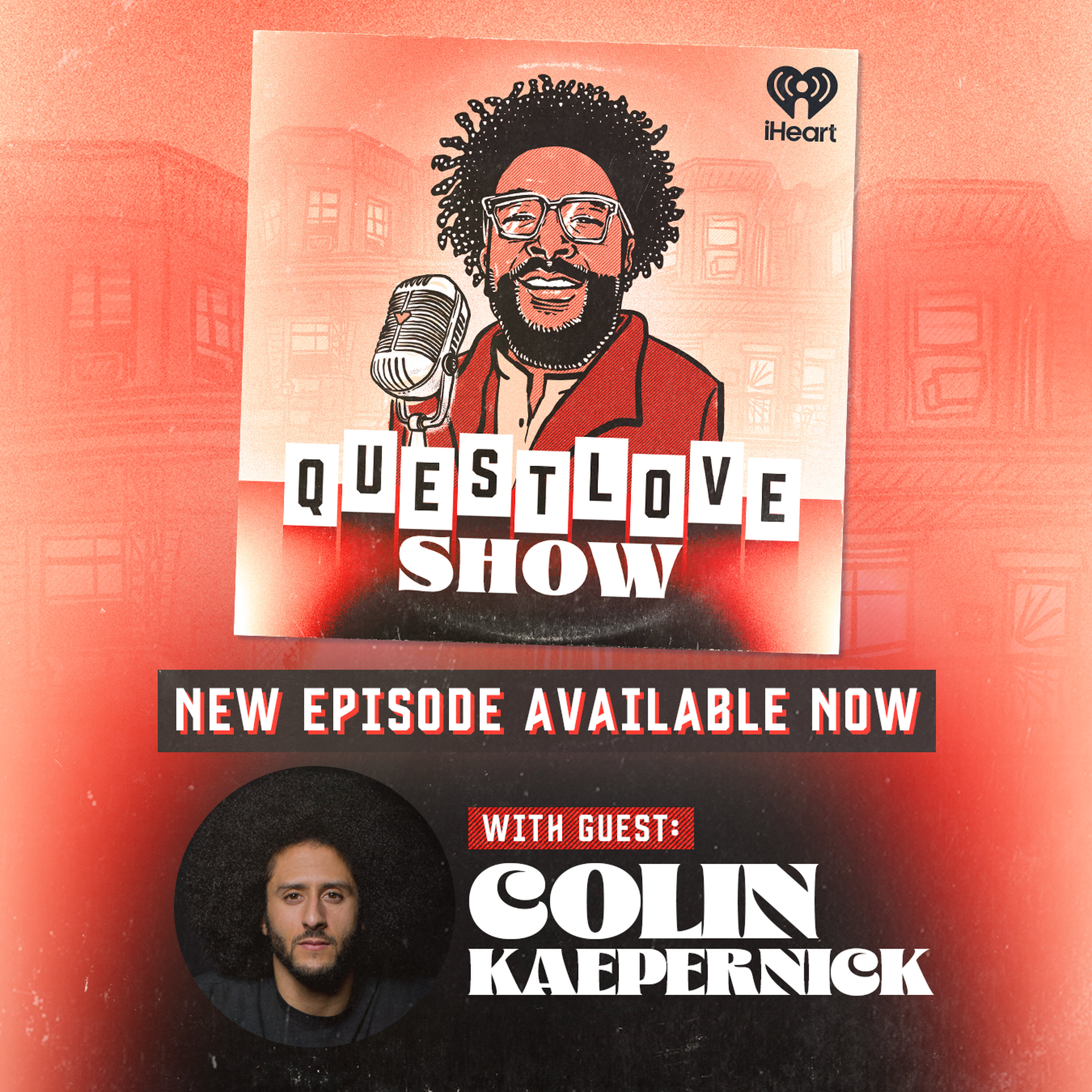
Colin Kaepernick


On this episode of The Questlove Show, Questlove sits down with Colin Kaepernick live on stage at Web Summit in Qatar for a focused (but abbreviated) conversation about discipline, courage, and purpose. Kaepernick walks through his morning training routine, reflects on his childhood and early athletic ambitions, and examines the influences that shaped his evolution into activism. He speaks about the ongoing work of Know Your Rights Camp, including its response to recent events, and shares how his Lumi platform is designed to expand student engagement, literacy, and AI fluency. The conversation captures where his journey stands a decade after he stepped fully into public activism.
See omnystudio.com/listener for privacy information.
00:00:00
Speaker 1: The Quest Love Show is a production of iHeart Radio.
00:00:13
Speaker 2: Hey people, what's up?
00:00:14
Speaker 1: This is Questlove, and this is the Quest Love Show, of course, and our guest today is the one and only Colin Kaepernick.
00:00:25
Speaker 2: So here's the deal.
00:00:26
Speaker 1: We taped this conversation earlier this month at Web Summit in Qatar in front of a live audience. This particular episode is shorter than the ones I'm usually known for. It's not the you know, pat Nick Mammoth length Questlove conversation.
00:00:47
Speaker 2: We sort of had a time limit on our hands.
00:00:50
Speaker 1: But even within those boundaries, I'll say that I wanted to approach Colin the way that I approach everyone who comes on the Quest Loft sh We talked a little bit about his childhood, how music played into his childhood and the role that it plays in his life.
00:01:08
Speaker 2: And it's also about the work that.
00:01:10
Speaker 1: He's building now with the Know Your Rights camp and a storytelling platform. Loomi and Kylin and I had connected before, kind of during the heat of the action. Unbeknownst to me, he's kind of adjacent in the neighborhood see him and nessa like kind of around the area. But you know, it never seemed like the right moment for us to sit down and break bread and really have a proper conversation. So I'm very happy that he made time to do this for us, since we were both in Qatar during this time period. But you know, it was great to sit with him in that space. You know, the space was like a very large space in front of audience, you know, a couple thousand people, and so it wasn't as sentitimate as normal episodes are, but still, you know, the energy was the same. And this is definitely not our last conversation, Like we just scratched the surface. So what you're going to hear is a snapshot, but you know it's one worth sharing beyond the large room of people watching us and guitar and as we honor Black History Month on the Quest Left Show this month and every month, Collins definitely someone that we.
00:02:25
Speaker 2: Continue to talk to in the future.
00:02:27
Speaker 1: He definitely does the work and he represents conviction, sacrifice and a commitment.
00:02:33
Speaker 2: To activating change. All right, so I hope you enjoy this guys.
00:02:47
Speaker 3: Okay, so welcome to the Web Summit.
00:02:50
Speaker 1: My name is Amir Thompson, otherwise known as Quest Love and shout out to my iHeart family out here, and I thank our guests for receiving us that website.
00:03:00
Speaker 3: I'm here for a very small sampling.
00:03:02
Speaker 1: Of what I do on the podcast, and we're deeply on it to have the one and only Colin Kaepernick with us today.
00:03:10
Speaker 2: How you doing.
00:03:13
Speaker 3: All right?
00:03:14
Speaker 1: So if you followed my career, you know that I entered this business thirty years ago as a musician as a DJ, and in the last five years, I've been doing everything well not but that, but in addition to that, so I'm about storytelling and books and movies and whatnot. And so basically our guest today has the same trajectory. Basically started out athlete, became a revolutionary activist and is now a storyteller helping others with the New Year Rights Camp and also with Loomi, your app. So we're going to ask you a few questions and our limited time here, I would like to know what is your morning routine? What is the first thing you do in the first twenty minutes of your day?
00:04:03
Speaker 4: First thing waking up always shower. That has to be to wake up, okay, and the part for me because I wake up to train early in the morning, so wake up at four point thirty by five o'clock, I'm training so that shower hot shower to be able to get everything moving ready to go. And then that last thirty minutes I'm into my workout routine. So hit the ground running is as soon as the day starts, and then take everything else from there.
00:04:36
Speaker 1: So without fail, training as is always the first thing in your morning, no matter what.
00:04:41
Speaker 3: If you don't do it, are you thrown out a whack?
00:04:44
Speaker 4: Or oh I feel so off if I don't do it, almost like my body reacts' is like, oh, we don't have to do anything today.
00:04:51
Speaker 5: Then so God starts the day with a workout.
00:04:55
Speaker 3: Okay, this is kind of a frothy question about your childhood.
00:04:57
Speaker 1: What television show would best describe what your childhood was like?
00:05:03
Speaker 4: Ooh, I would say Colin in Black and White is the best one that we made created. But beyond that, maybe the Power Ragers.
00:05:15
Speaker 3: Okay.
00:05:15
Speaker 4: You know, we're always looking at how we could be superheroes, how we could save things, how we could be better.
00:05:22
Speaker 5: So we liked being the heroes of the story.
00:05:26
Speaker 1: Okay, so even then you were sort of manifesting or see what your future was going to be. Even in your childhood, what secret talent of yours do you have that we don't know about?
00:05:38
Speaker 4: It's a great question. Most my talent has been primarily through sports. So I was going to be drafted by Major League Baseball coming out of high school. Okay, so baseball is an area that had a lot of talent in Unfortunately, I did not get any music talent.
00:05:55
Speaker 5: So I'm gonna leave that up to you. You can hold us down there, hold us out this four side.
00:06:02
Speaker 3: Okay.
00:06:04
Speaker 1: This year, twenty twenty six, of course, mark's the ten year anniversary of like your life pivot and to activism. Of course, you famously standing up for justice for those without a voice. I always wanted to know. So for me, music is such an integral part of my life. But during that time period ten years ago, what was the soundtrack?
00:06:27
Speaker 3: Was there a.
00:06:28
Speaker 1: Song that got you through that period, especially when you were in the thick of it?
00:06:33
Speaker 4: So interesting enough, during that time period, I actually had a soundtrack all wife Nessa. She obviously works Hot ninety seven, so she's been in the music industry for a long time, right. She knew a lot of my favorite songs, a lot of my favorite speeches, so she put together a playlist for me, that was my favorite songs and favorite speeches. That was like revolutionary music cut up and that was my pregame playlist for that entire season really, So that was everything from POC changes and Holler if You Hear Me to Malcolm speeches and Ali all of those innercut.
00:07:17
Speaker 1: Is there one song in particular that makes you always feel unstoppable when you put it on?
00:07:22
Speaker 4: So this fall is a little bit out outside of kind of the revolutionary music vibe DMX party up.
00:07:30
Speaker 3: Yes, okay that it's your adrenaline.
00:07:34
Speaker 5: It's all adrenaline.
00:07:35
Speaker 4: You can put that off for any workout, any pregame.
00:07:39
Speaker 3: It works in any age.
00:07:40
Speaker 5: His voice, his energy, like you could run through a wall.
00:07:45
Speaker 3: I got you.
00:07:46
Speaker 1: I always wanted to know when you do an active courage it comes from somewhere. Where does the source of your courage come from?
00:07:56
Speaker 3: Are you big on meditation?
00:08:00
Speaker 1: It's something that you ponder on an hour before, like, where's the source of your courage come from?
00:08:06
Speaker 5: I think a few different places.
00:08:08
Speaker 4: One knowing that you have people around you that love you, it's one piece of that.
00:08:14
Speaker 5: The other is doing the right thing. There's a.
00:08:20
Speaker 4: Morality, an integrity, a sense of obligation to do the right thing, and oftentimes that if we don't have the knowledge and insight, then it's hard to say, oh, is this the right thing? But once you have that knowledge, then it's an area that kind of forces you to action. And for me, that was a huge piece. And the third piece I think about is something that your first courageous act I took was.
00:08:53
Speaker 5: Was not a major one.
00:08:54
Speaker 4: It's trying out for a team knowing you might get cut, it's trying to lead a team knowing they may not follow you, and all of these acts. Over time, you get more and more confident in your ability to take these actions that may seem daunting. Like probably the first time you ever cut a track, it was like, oh, man, like what could come out of this?
00:09:23
Speaker 3: Well? I tend not to think about it and I just do it.
00:09:26
Speaker 1: But I think later in my career became there was a period where I started to overthink. And when you start overthinking, I think that's where pure artistry leaves, because you know, you're supposed to do things spontaneous, not you know, sort of ponder on it. I mean, it's good to plan and it's good to rehearse, but yeah, not to the point where it handicaps.
00:09:50
Speaker 3: You so exactly.
00:09:51
Speaker 4: So all that's say, like just the practice of doing things that may be uncomfortable gets you to a way that you can build courage over time through those actions.
00:10:03
Speaker 1: Oh yeah, Now, if I'm scared or fear, like even this morning, like going to the sand dunes to for the first time going down these mountains, I normally would have not done that, but yeah, sometimes you just got to lean.
00:10:16
Speaker 3: Into your fear.
00:10:18
Speaker 1: I always wanted to know was there a figure during the time period that offered you support or encouraged you that you weren't expecting, like during this early time period and your activism.
00:10:31
Speaker 4: So a few people that come to mind. The first one that I unfortunately did not have the opportunity to meet was Malcolm X. Like reading the autobiography of Malcolm X was life changing and life changing in the sense that a lot of that history, a lot of his life story was information that was misrepresented to me growing up as well. Right, he was not looked at as a hero, he was not looked at someone who was advancing society and communities. So for me, actually reading the autobiography was life changing. Ali was another huge influence there looking at his ability to stay steadfast in moments where the US and the world, well, I should say more specifically the US attacking him, stripping him of opportunities and titles and things of that nature. And then third one that actually got to spend time with was mister B or Harry Belafonte, being in New York. We used to go over there on Sundays, and it was like Sundays with mister B. And I loved talking to him to his last day. He was sharp, sharp, and I would ask him so like, what would you do in this situation? What are your thoughts here? And what was most interesting to me? He would never give me an answer, but he would tell me a story about an experience he had that was related.
00:12:02
Speaker 3: Yeah, And it.
00:12:04
Speaker 4: Was one of those moments that I will walk out of there sometimes and I would be frustrated because I was like, I just want the answer, like I need help. I'm trying to figure this out. I need to take action now. But he's forcing you to see it yourself, and he's forcing me to walk that path myself, as opposed to saying, well, here's the path I walked, walk it as well, and I have great appreciation for it because it forced me to grow in ways that otherwise wouldn't have got you, what is the best advice you ever received? The best advice I actually think about it comes from a poster I had hanging on my wall growing up.
00:12:56
Speaker 1: Okay, I was just going to ask you if you had a childhood poster in your bedroom, what was it?
00:13:00
Speaker 5: But ah, what was to I'm getting two pieces here.
00:13:04
Speaker 4: So first, this was a very like non branded poster to unidentified teams on it, but it hung next to my bed and it said the power to win must come from within. And what it made me think about consistently was while I was on the field, when I was in the classroom, while I was doing anything in life, it has to come from you. No one else is going to go out and do it for you. Now, people can help along the way and they can support, but ultimately, the success you want, the goal you're trying to accomplish, any of those things, it has to come from within you. And if it doesn't come from there, then you're really just kind of floating along hoping for things to happen, as opposed to taking action and having that power in that situation.
00:14:00
Speaker 1: Okay, so we live in America and twenty twenty six is already a lot even though it's the first month of it, because of your work and you establishing that Know your Rights camp. How does that play now that it's more urgent than ever with what is happening back home.
00:14:27
Speaker 4: Yeah, it changes some of the work that we do, but a lot of the work we've been doing because this is this is a much more heightened and advanced version of it. But a lot of the issues that we're seeing have been present. So a lot of that work is how can we accelerate it. So for example, we recently did a camp in La camp in La was immigration focused because of the environment of ice coming in, trying to raid schools, trying to raid business. This is how do we offer support and protection and guidance for communities that are being attacked in real time?
00:15:07
Speaker 5: So that's some of the work.
00:15:09
Speaker 4: The other part is and this was actually insight coming out of the camp in La. Yeah, we have an autopsy initiative where we do free second autopsies for people who have had loved ones that have been killed by police or while they're detained. Right, and one of the students we're talking high school students, middle school, high school students raised his hand as we were talking about the work we're doing in an autopsy initiative and was like, does that apply to ice detention centers as well? Which the immediate thought that comes to mind is this child knows someone who was killed in the ice detention center and is trying to figure out how do we get justice for them? How do we find out what actually happened. So a lot of the work we're doing is how do we accelerate partnerships, how do we accelerate resources, how do we shift some of what we're doing to fit community needs, and how we do that as quickly as possible because it is extremely urgent.
00:16:15
Speaker 1: I thank you for activating and least planting and your community activism.
00:16:23
Speaker 3: I have two minutes left. I do want to talk about Loomi.
00:16:26
Speaker 1: So, of course, you know, especially in the entertainment world, older people are really slow to embrace AI. You know, there's always conspiracy theories and whatnot. However, Loomy is counter to that. Could you speak on that and what does LOOMI.
00:16:41
Speaker 3: Offer like a younger generation, Like, what's your goal with it?
00:16:46
Speaker 4: Our goal there is we're trying to address the education crisis, first being student engagement, second being literacy, and then third being building AI skills so we have future ready students. And part of the reason this is so important for us is when we think about AI, when we think about the future, we have seen the impact that digital divide has had on our communities. Yes, this is generational impact that we still feel to this day. AI is also a technology that is going to be generationally gap closing or gap widening, right, and we want to make sure that our communities are at the forefront of this, meaning our students, our teachers, our districts have to be at the forefront. So we do a lot of work with our students. We do a lot of work training teachers, We do a lot of work training districts to make sure that they have the tools and the skill sets needed to be able to engage with the tools in a way that can help them advance as effective as possible.
00:17:53
Speaker 3: Gotcha.
00:17:54
Speaker 1: Okay, so my last question to you is, and you know, I am a person who I will say, in my kind of thirty five year history as a professional, I've always been a reluctant pivoter in terms of starting at one place and then somehow morphing into to what the universe wants you to be. For someone listening that is at a place in their life in which they're at a crossroads, at a fork in a road, could you sort of give them advice on how you adjusted to pivoting starting off with, you know, dreams of athleticism and ending up being much needed activists. First of all, is it a burden on you for us to place this on your shoulders? I mean, does it sometimes feel like a burden or do you now accept in your heart that this is your life calling.
00:18:50
Speaker 5: I don't look at as a burden.
00:18:51
Speaker 4: I look at it as a responsibility, gotcha, And I think collectively that's something that we should be looking at me We're we're seeing the implications of that not taking that approach come to fruition in real time.
00:19:07
Speaker 5: So I take the responsibility serious.
00:19:11
Speaker 4: I also know if that can help save a life, if it can help us advance as a society, if it helps make someone better off, those are all phenomenal accomplishments. And to your question around pivoting and being able to be in different spaces anyone who is going through that, the key thing that I would say is jump. And that goes back to the earlier conversation around courage, like I look at from that lens that it's gonna be uncomfortable, it's.
00:19:43
Speaker 5: Gonna be it's gonna be scary.
00:19:46
Speaker 4: And for me prior to this, I had never built an AI company before. Yes, but I had done a lot of work in media. I had done a lot of work in education. I had been and investing in the tech space. I sat on the board of Medium with Evan Biz who co founders of Twitter. So I got to learn from brilliant minds along the way that ultimately led to this path. But when my career was taken away in twenty sixteen, I could have stopped and been like, man, they took everything, like what do I do now?
00:20:23
Speaker 3: Gotcha?
00:20:24
Speaker 4: Instead, it's well, let me go find a way to be successful. And I actually fully don't know what that looks like in this moment, but I'm gonna keep putting one foot in front of another until I find that exact clarity as far as what I'm gonna do, how I'm gonna do it, and then make sure that I go be great at that.
00:20:45
Speaker 1: There it is Colin Kaepernick, Ladies and gentlemen, my name is Questlove.
00:20:50
Speaker 3: It's the Quest Love Show. Thank you our family at and enjoy yourself. Thank you, I appreciate it.
00:20:57
Speaker 4: Thank you all right, good people.
00:21:05
Speaker 2: I wasn't lying to you, definitely said it was. It was way shorter.
00:21:10
Speaker 1: Look, it wasn't my choice at length of the interview, nor was it Collins. So the deal is basically, I flew way over twelve hours to be in Doha for web summit for the conversation, and also DJ said that I did. I was slightly jet lagged, but I was fully present. But I definitely wanted to share some additional context. So when you do a summit like that number one, you're given a list of possible guests, and this particular year, there were several people I wanted to speak to, but I felt like Colin represented the moment, you know, kind of what Colin was pointing towards in terms of well, basically like where we are now. Almost felt like Colin was somewhat of a Paul Revere figure warning us about the future. And of course, now you know, the idea of speaking out, using your voice, using your platform for the climate that we're in right now is needed now more than ever and so pretty much. You know, when I found out, especially with his developing with the Know You w Rights camp, it was more urgent than ever and I'm glad we had the conversation. So, you know, shout out to Colin, and also shout out to Nessa as well.
00:22:40
Speaker 2: She's the architect behind the.
00:22:43
Speaker 1: Inspirational music and speech playlist that Colin spoke about. And you know, gratitude also to tone and to allow and if you want to know more about Colin's work at that kaepernickseven dot com.
00:22:58
Speaker 2: Kaepernick seven also get the.
00:23:01
Speaker 1: Loomy app, the Loomi app, which is basically I mean, its designed to help students foster skills and creativity through safe AI storytelling.
00:23:13
Speaker 2: That's available now. Yeah, so you know.
00:23:16
Speaker 1: Also, I'm not normally this guy. I never said these, well sometimes I do. But here we are in twenty twenty six. But follow and subscribe to the Quest Love Show wherever you stream your podcast, and you know, catch these full conversations on YouTube.
00:23:34
Speaker 2: We have a hell of an archive.
00:23:36
Speaker 1: If you're a longtime fan of the show, please tell people about the show.
00:23:40
Speaker 2: I appreciate it, leave a rating, leave comments. I read the comments.
00:23:44
Speaker 1: Yes, I'm still recovering after the quasi beat down I took for the open Mic Eagle app But you know, again, I told you all that.
00:23:54
Speaker 2: That was a really really hard day for me.
00:23:57
Speaker 3: And you know, sometimes you know, a god needs.
00:24:01
Speaker 1: A friend to talk to you, So it's like that sometimes. Anyway, people stay safe, stay informed. Yeah, I know it sounds like a cliche, but stay woke, stay aware.
00:24:13
Speaker 2: That is what staying woke means. Means.
00:24:15
Speaker 1: Stay aware, be careful of the information that you receive. Make sure don't just run off of headline clickbait. You know, and I'm a victim of it too. Sometimes I'll rush to repost something not knowing.
00:24:27
Speaker 2: Like oh, what's happening.
00:24:29
Speaker 1: If you live in a state that has early voting, I recommend it now whatever preparations you need to do for yourself, and also please make sure you're family members, older family members. I'm making sure that my mother, my sister, all my family members are prepared for anything that happens down the pike. Anyway, I would like to think that if your quest Love show listener, you know these things already. All right, take care of each other. Thank you all, and I will catch you next week. Thank you very much. The Quest Love Show is hosted by me a Mere Quest Love Thompson. The executive producers are Sean g Brian Calhoun and Me. Produced by Brittany Benjamin and Jaco Payne. Produced for Ihearten by Noel Brown, Edited by Alex Khn. iHeart Video support by Mark Canton, Logos Graphics and animation by Nick by Lowie.
00:25:33
Speaker 3: Additional support by Lance Coleman.
00:25:37
Speaker 1: Special thanks to Kathy Brown, Special thanks to Sugar Steve Mandel. Please subscribe, rate, review, and share The Quest Love Show. Wherever you stream your podcast, make sure you follow.
00:25:49
Speaker 5: Us on socials. That's at q LS so it.
00:25:55
Speaker 1: Got hundreds and hundreds of QLs episodes, including The Quest Love Supreme Shows and our podcast Archimes. Guestlam Show is a production of iHeart radioh