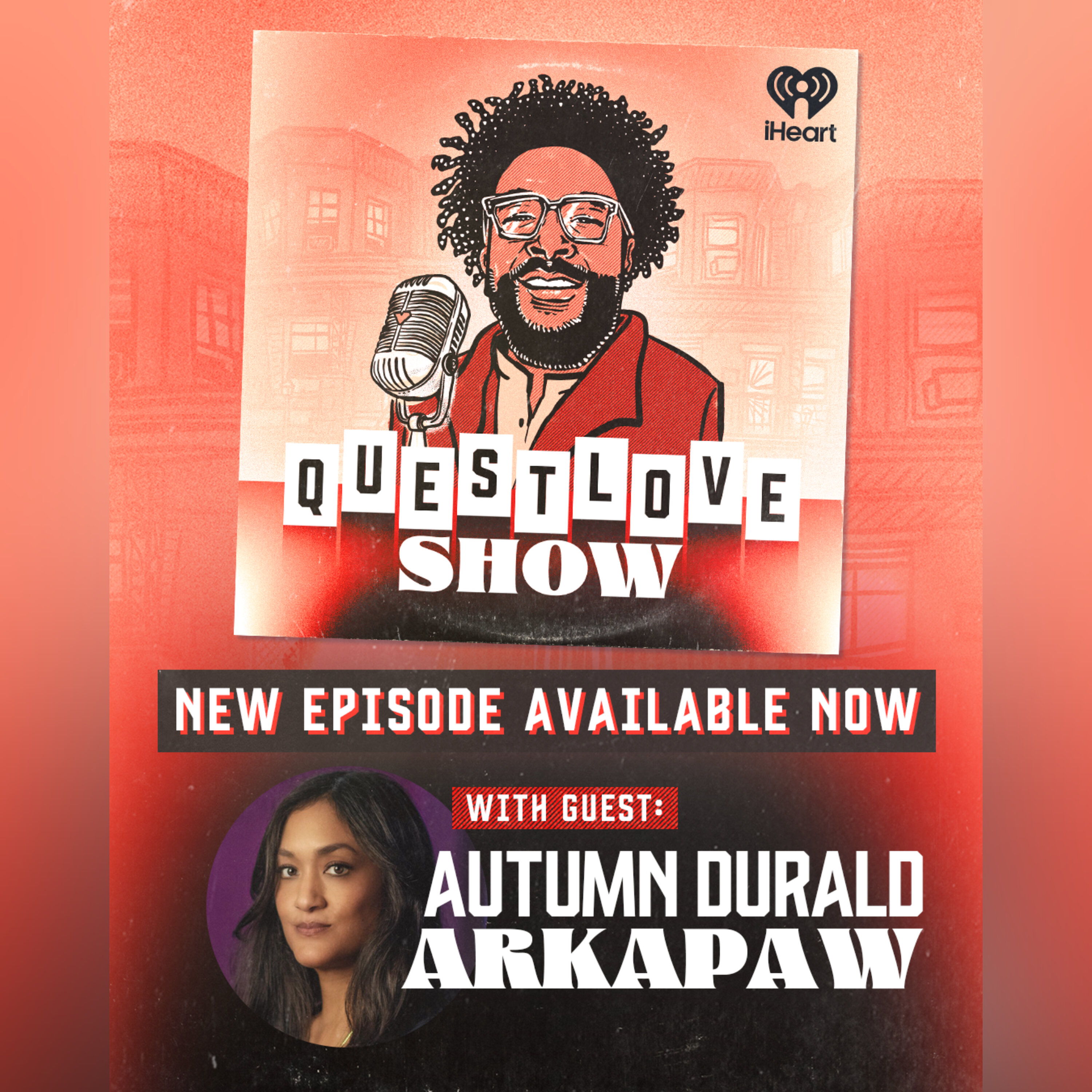
Autumn Durald Arkapaw


The Questlove Show sits down with acclaimed cinematographer Autumn Durald Arkapaw for an in-depth conversation on filmmaking, visual storytelling, and creative purpose. Autumn traces her path from photography to shaping films like Sinners, Black Panther: Wakanda Forever, and The Last Showgirl, while reflecting on how family, heritage, and collaborations with Ryan Coogler and Spike Jonze have influenced her style. She breaks down the importance of trust on set, building meaningful partnerships, and inspiring the next generation. Go behind the camera with one of today’s most visionary creators.
See omnystudio.com/listener for privacy information.
00:00:00
Speaker 1: Quest Loft Show is a production of iHeartRadio. We's Up, y'all.
00:00:11
Speaker 2: Welcome to the Quest Love Show, new era and format for QLs.
00:00:14
Speaker 1: After close to a decade.
00:00:16
Speaker 2: Of award winning podcast that you Know and Love, I'm back from a lengthy hiatus to have conversations with people I always wanted to get to know on a deeper level. Earlier this week, I spoke to Autumn Derout Archipele. If you've seen Sinners or Black Panther or Condu Forever, you've experienced Autumn's incredible.
00:00:34
Speaker 1: Work as a cinematographer.
00:00:36
Speaker 2: She also shot Beasty Boys Story and The Last Show Girl and As He's and Sorry It's Right Now Special. She collaborates on a higher level with Brian Coogler and Spike Jones.
00:00:47
Speaker 1: Autumn is a maverick.
00:00:48
Speaker 2: And I love how she was open about setting boundaries and a work, her influences, and how she finds joy and family and tennis, Yes, tennis. As you're hear in this comment, Autumn is soulful, innovative, and deeply passionate about her craft. I told her at the end of our top at I want to work with her someday, and I meant that to the fullest. That feeling only deepened after learning how she builds a vision, welcomes improvisation, and captures a wider perspective on life and art.
00:01:22
Speaker 1: My vision for this new chapter of.
00:01:24
Speaker 2: LS is to get to know people I already do on a different plane. And you know, we get to meet new voices who inspired me and Autumn Deroud Archapyle inspires me first with a work and men with this conversation.
00:01:38
Speaker 1: So please enjoy. Make sure you've.
00:01:40
Speaker 2: Seen Sinners as Award Seasons is approaching. I highly recommend it and look out for her upcoming collaboration with Ryan Coogler, which.
00:01:48
Speaker 1: Is The X Files.
00:01:49
Speaker 2: All right, thank you for joining us today.
00:01:52
Speaker 1: How are you?
00:01:53
Speaker 3: Thank you? No, your voice is so familiar to me. It's like, you know, when you don't know somebody but you've seen them you and listen to them. Wow, it makes you feel like you know them, but you don't know them. So it's nice to meet you.
00:02:06
Speaker 2: It's not false modesty, but I'm always under the impression that no one knows me, so I'm approaching this is if you never heard of me, or don't know who I am, or you know, but yeah, we're meeting we've never met before.
00:02:18
Speaker 3: Correct, I don't think, No, we actually haven't met before. No. The appreciation is ditto, So thank you for all of that. I appreciate that.
00:02:26
Speaker 1: Thank you, Thank you. All right.
00:02:28
Speaker 2: My first question to you is, can you describe to me the first twenty minutes of your morning This.
00:02:37
Speaker 3: Morning, I have a son. He is nine years old, but my husband's also DP. When we're both in town, it is my job to get up and do all the things that you would to get a child ready. So I woke up, and I did set an alarm because I just got back from Scad Film Festival where we got to screen Sinners and talk about it. So I woke up, I woke him up, I got his lunch ready, I got it, his breakfast ready, his long hair, so I brushed his hair and I chased him out the door and his father took him to school. Then I rushed to get ready for the zoom. And that's what it was.
00:03:15
Speaker 1: Okay.
00:03:15
Speaker 2: So, as a child who grew up with parents that did the same thing for a living, I got tricked into the family business. Both my parents were singers. By the time I was born.
00:03:29
Speaker 1: They were nightclub loungejacks. So yeah, in the seventies.
00:03:34
Speaker 2: I was there from like five until you're really when the roots started, so like from age five till eighteen. I got tricked into the family business, mostly because they didn't trust The idea of a babysitter wasn't a thing until the late eighties. So in the seventies, you it's like farm work. You just and I'm in the nightclub at one in the morning, like operating lights, cutting gels, monitors, all those things. If both of you do the same thing, is there a hope that there's a creative epigenetic passing of the torch? Are you leaving camera equipment? His version of my first sony like you know, no.
00:04:19
Speaker 3: I mean, I think for me, the allure is if he does have an interest when he say, thirteen fourteen in operating a camera, then I get to be close to him because we only have one child, and then I could bring in with me on all my jobs. Right, So if he's really into it, it just allows me to spend time with him because you know, when we make these films, as you know, when you do music, you're away for long periods of time. You have to juggle life and you know, schedules, so he is interested. I wouldn't say it's like his top thing. You know, he's he's kind of a builder. He likes building stuff. But he did bring his camera because he has a nice camera to his camping trip recently and made a bunch of videos and he was the only kid doing it. So it's there. I'm just not, you know, on the cusp. It's just like maybe it'll take off. Maybe.
00:05:08
Speaker 1: What was your first creative project in life?
00:05:14
Speaker 3: What I can remember the most, I think is being in high school and you know they have the labs, the photography labs. Yeah, the first time I felt like ownership of something that I made was the black and white photography class I took and having to go out there, you know, the assignment like go take some pictures whatever you like, like go talk to some people. And I remember taking a bunch of pictures and I still have them printed in a book. They're black and white. And I felt like a sense of power because I had made something. But also it was my own right, it was my perspective. I've never been asked that, but it immediately came to mind. So I feel like it had to be that class because that was the first time I think I did anything like I never I wasn't a painter, I wasn't good at drawing. So that photography class, I think was important. And like I guess that would be like ninth grade.
00:06:03
Speaker 1: Okay, what year was that? Do you remember who?
00:06:07
Speaker 3: Let's call it ninety four, nineteen ninety four, ninety five.
00:06:11
Speaker 2: Before then, was there a passion for photography? Were you reading magazines and seeing like her Brits or any Leewoods or any like?
00:06:21
Speaker 1: Did you have a north star for photography?
00:06:25
Speaker 3: It's interesting because I don't have anyone. Like my mom works in business. She always traveled a lot. She raised me. It was just me and my mom. I'm just myself and she was a single mom until she remarried and when I was in eighth grade. But you know, as far as like she would take me to films, we would go to museums. I always had art around me. But my grandparents my mother's side is Filipino and she was born in England and he was in the service, and they traveled the world for his job, Like he would be stationed in London and then he would go to the Americas in New York and they my grandmother always took photographs. I can't show you right now. It's on a wall, but a lot of the photographs are black and white photographs where they're center punched, and it's just like single shots of like my grandmother in New York or my grandmother in London, and they were always around, Like my mom always had him around, And that must have had an impact because till this day, like the way that I frame, I find that there's similarities. But that's like the first relationship I had with photography before doing art history in LMU undergrad where you're learning about you know, roth Cooe, where you're learning about Eggleston and then you're more versed in it. But they always had photos around our house growing up.
00:07:41
Speaker 1: You went to LMU, I did.
00:07:43
Speaker 3: I went to ELMU for undergrad.
00:07:45
Speaker 2: Yeah, okay, despite my quest loveness, I have a major fear of public speaking, kind of a therapeutic challenge. This was like December of the year before in twenty twenty five, or my therapist was like she knew that Noah was my favorite word. When it came to hey, quest, come speak to the kids, Hey chus, you want to talk to these you know, like and so it just so happened that LMU had given me an offer to speak to the graduating class, and I begrudgingly did it. Weird enough, I've made it about me by just telling that class how scared I was to do this, And somehow it became like.
00:08:29
Speaker 3: Yeah, when was that obviously before the podcast, like before this year?
00:08:38
Speaker 2: Yeah, well, okay, you know previously with the podcast. Uh, you know, I had four other co hosts with me, Like, I like community work, but when it's like one on one, that's like there's too much intimacy.
00:08:52
Speaker 1: So even this is.
00:08:53
Speaker 2: More or less like a somewhat cathartic therapeutic exercise.
00:08:58
Speaker 3: I was going to say, yeah, I like that, no thing.
00:09:01
Speaker 2: I specifically wanted to talk to people like one that I didn't know, like the back of my hand, and you know, kind of two strangers meetings. So that's what I'm doing. What is your favorite childhood memory from your home. It doesn't have to be in a major event like oh that time we went to Disneyland or whatever, but just like, what's your version of a happy moment from your childhood?
00:09:24
Speaker 3: Give me all emotional and shit. I think it's mostly like my it was always me and my mom, you know together.
00:09:33
Speaker 2: Yeah, what traits of yours do you think that you've gotten from your parents, either creative or personal.
00:09:40
Speaker 3: I think she's pretty resilient and very determined person. I think being raised by someone and always listening to her on the phone and doing her business work because she does international trade business and interacting with people. I was always worried about her, I think early on, you know, going out by herself, because you've become kind of the caretaker, you know, if it's just you and her. She's pretty tough. So I always tried to follow in those footsteps. And yeah, I mean we spent a lot of time together, you know, it's just us too. Like I grew up in northern California.
00:10:20
Speaker 1: Which city specifically, well.
00:10:23
Speaker 3: We first started out in San Leandro. I lived in Hayward as well, Bay area, you know, near Oakland, and we had a little apartment, you know, so I shared a room with her early on, and then she moved me to Danville, which is a less diverse community, to go to a better school because it had a really good public school program. So you kind of moved from like a diverse area into you know, most you know, I was probably the only mixed race kid. Maybe there were a couple of black people and a couple of Asians, but it was way, you know, nicer environment for her to be okay with, like single parenting and having good education. But that's my favorite. Yeah, I think just spending time with her because I'm that quality time kind of person. You know that that fills me up.
00:11:09
Speaker 1: You said that you were a parent.
00:11:11
Speaker 2: Is there a trade of yours that you feel like you've passed onward to your child? Yeah.
00:11:17
Speaker 3: I think my husband and I are always telling him like and I believe it because I think, you know, my mom told me, but you can do anything you want to do, you know, you really anything that inspire you, anything that you feel in your bones. Make sure you know we're there to help you with that, but also that like you, you have the ability to do that. And I think I was told that. My husband grew up in a very supportive He's Australian, but he has a big family, a very loving family, and I do feel like I reiterate that to my son a lot.
00:11:49
Speaker 2: So is it true that a friend of yours gifted you or purchased you a cinematography class at UCLA.
00:11:56
Speaker 3: Yeah, isn't that crazy. I haven't emailed him for a while. But when I graduated LMU, I got a job for AOL time warner. I was a temp you know, I had to like graduate get some money, and I got a temp job through a friend and I had to input. Like you remember when AOL had banners, Like it was the early stages, and the banners would pop up all over the place, like on the side and the top, and it would be like right, like buy this car, buy this Honda. I used to put together spreadsheets for those banners and support someone who was doing auto sales online. So I had a cubicle at a desk and I would do that. I would input all the stuff in you know, nice little paycheck. And I just started to be interested in cinematography. And I remember telling him and his father owned els, which is one of the biggest lighting companies that works with the premiers or big events around Los Angeles. So there's like this weird through line. And then on the side he's like, you know what, I'll help you buy that class. Like I looked into a night class. So when I would get off work, go to UCLA for the cinematography class like a little semester class, and I would learn what being a DP meant. I did the class, I loved it, and then I decided to quit, and he got me a job working at els to help lay the red carpet and put up the lights for the premieres. So I did, like Mission Impossible, Devilwaar's product, you were on the night shift. So I don't know if you've been to a premiere a little early, but you see people crawling around taping up the carpet, putting the lights up.
00:13:29
Speaker 1: Totally.
00:13:30
Speaker 2: I'm the DJ that they'll hire sometimes for events. Oh yes, So I have to be there early to set up and like, I love how the sausage is made in any thing that I go to. So as a new director, speaking of myself, I'm learning fast that my you know, team has to be intact. I initially thought that as a director that I'm part of the starting five players on the floor, and I learned quickly that I'm the coach and the cinematographer, the editor, the writer, the soundman, the colorists, like all those people are the starting five, and you're the coach. So because I came in backwards.
00:14:14
Speaker 1: At the top of the pyramid.
00:14:16
Speaker 2: Yeah, you know, for most people in film, I noticed that, yes, there's a pecking order for you. Was the desired destination always cinematography.
00:14:27
Speaker 3: My comfort zone is definitely where I'm at. I mean, I get asked a lot, I think, being a female DP at this level, because there aren't that many of us, you know, shooting this level of film historically, so the question comes up a lot, well are you interested in directing? And I think why that is is because you know, you get to a point on set where you're very versed in how a set's run. You're next to the director all the time I work with, you know, I do the big budget films with a lot of the effects. So they always just imagine, okay, well, well you must be interested in direct now, you know. And I think it's an interesting thing because I've now gotten to the point of my career where you work so hard as a female DP to be able to do those things, and then now they're already trying to like ask you to go this direction. So I hear that question a lot. But I'm so I think passionate about the way things are shot and lighting that I could never give that up right, so it's easy for me to position myself. And Ryan's like, hey, do you want to do this Rihana video that's up my alley Because it's music related, it's beauty related. I get to work one on one with a star and make them look beautiful and make them feel comfortable. But no, I think I'm lucky to have found a partner in Ryan because we have similar tastes and we like the same things, and I understand him really well. But to do his job like it is a very very difficult position to be. And as you know, I don't have a story that's like so in my bones that I have to tell and only I'm the only one that can tell it. Not yet, you know, maybe in the future there is something that only I can tell as a director. But I really do enjoy supporting him and the other directors I work with, because, as you know, it's just it's a very complex job to do everything well.
00:16:17
Speaker 2: Number One, you mentioned Rihanna's Lifted Me Up video. What was the creative decision behind doing that handheld as opposed to you know, crane and you know this is Rihanna, Like, I feel like every director has their uh, their Lawrence of Arabia, dream of like the or Citizen King, like the sprawling opening scene thing.
00:16:44
Speaker 1: Uh, and you know handheld.
00:16:46
Speaker 2: Is more of a we're all personal intimate things. But what was your decision behind shooting it that way?
00:16:53
Speaker 3: Yeah, we had a crane that we used. You know, the opening is a water shot. We shot some more stuff that I didn't use with the wide shots of the water before we went into intimate stuff. So that was done on a crane to kind of crawl over the sand. But I mean I came up in indies. I came up shooting music videos, fashion films that didn't have any money. So when you have a camera in your hands and it is an extension of yourself and your point of view, that's how you learn to find where the camera needs to be right. And so I'm very much an operator. I've operated most of my films, all the stuff that I do. So when I'm having to be in a situation where light is falling quickly, I want to be with her. I want her to move freely and do what she wants, but I also want to capture and get the right shots. Then you want to take as much control as you can, right I don't want to worry about it being on a dolly and moving the dolly. Then I have to worry about the dolly grip. Then I have to worry about all stuff. So I put it in my hands so I have the most control and I'm most intimate with her, similar to Last Showgirl, you know, with Pamela, like being close to the woman so you can move with her and find her beauty easily.
00:18:08
Speaker 2: In general, I want to know how much lee way or access or preparation are you given to your subjects that you're going to film, Like how do you even map out the choreography of how you're going to shoot that, what their strengths are, what their weaknesses are, or is this just taking direction from your director and you executing, Like how much leeway are you given to well? Actually, why don't we try this?
00:18:42
Speaker 1: And da da da da da. Like specifically, I want to know for the Last.
00:18:46
Speaker 3: Show Girl, Okay, well I'll start with that saying I think the best thing that you can do is work with people that allow you to exercise your creativity and have trust in you. Right when I work with Gia, you know, we started out running around, we shot Paloouto. We're running around with a bunch of kids with her friends. She's my best friend, so we talk every day. But it's someone I know really well, and I know what they like and I know where they want the camera. It's intuitive, like I choose people to collaborate with that we have that connection. So when it's with her, there's a lot of trust in camera that she gives me. And that's why that that kind of relationship works. Also with that scene, I remember, you have to be the best thing you can be as a DP is quick to make decisions and have solutions. So I remember I didn't have any prep there. I think Gia came up and said, Jamie wants to dance on that thing in the middle of the casino, right like we have some time, you know, in between like some other senior shooting. She wants to dance. She's gonna dance to this song. We're gonna shoot it. I'm like, all right, cool. So then I tell my gaffer, like to position the light and a good spot. I just evaluate, you know, that kind of podium that she wanted. I picked direction. I said, I'm going to shoot it from here because it was the best direction for lighting, and I moved a little bit of a key light for and then we just let her do her thing and I captured it, you know, while she was dancing and handhealth and that was it. And I think there are a lot of those types of moments that in the film like that, because you want to be free and vulnerable to like what the actor may want to do, but you also want to get those moments that the director wants, because Gia loves those non communication moments where it's just following women around and letting them. Like Pamela, we went on the parking lot on a weekend and Pamela just started dancing around and being funny and cute and we just captured it. So there's a lot of that For.
00:20:42
Speaker 2: You, though, how do you decide the thin line of what would be deemed an unflattering shot but staying true to what's needed to really make that film come alive. Because of course, you know, a lot of us know Pamela Anderson for like all these slow motion and glam shots and everything's perfectly edited and whatnot. But for you, how aware of you on how this has to look to make this film come along?
00:21:13
Speaker 3: We had been discussing it Gia and I for a long time prior to when we actually ended up shooting it. So she was always looking for someone to be vulnerable and not like have a lot of makeup on, to not go through makeup at the top of the day, and because that can be time consuming, to just be themselves right, to just be raw, and so that was the directive that was someone she wanted to play it. We knew that we didn't have a lot of money to make this film. We knew that we'd make it with a small group with friends on film. It would be very intimate where we would have all the control, and that was the most important thing because we made a film before that where we didn't have as much control, and we wanted to make a film where we had control. She has all the control, I have all the control, and we make it. That's very rare. As you know, it shouldn't be rare because we're the filmmakers and we both have director in our title, but it does happen, and it's unfortunate when you don't. So with this film, it's very much our retelling of that story, which is nice, like you can watch it and only you made those mistakes. You weren't forced into anything. As you know Pamela, I mean, she's just amazing, And same with Jamie. It's like they're okay with just being themselves. They're at that point where they're so confident in who they are that it's so enlightening to be able to shoot women like that, right, and so they put their trust in you that you know what it should be lit, like you know where the camera should be. So for that like I wanted to have a lower footprint, which meant using a lot of available light, which meant going into space is using a lot of practicals. And then just how I exposed it. You just need to know your exposure right, what you can push and what you can't. And that's just like having experience and trial and error, I think in spaces. So and then you as a woman, like I know where the beauty shops are, you know what someone will look powerful or where the camera needs to be. And then I also made lenses for that picture, so Hannah Vision and I made some lenses that have never been made before, anamorphic sixteen lenses because I couldn't find any lenses that I liked, so we made some so it has a very particular look that I feel is very flattering because it's very soft, old vintage glass. But I detuned it in a way that has a lot of fall off and is more dreamy. So that also helps when you're thinking about how this should look. You know, to pair the film stock with a beautiful lens, which also in turn, I think, as you know, like lighting and lensing are in conversation with each other. A lighting can only look great if the camera's in the right position, and it depends on what that lenses. So yeah, it was very thought through, but always with the intention of having a small footprint and not getting in the way of the process.
00:23:58
Speaker 2: What is your attraction to the anamorphic style of shooting, like, did you see it happened before or are you in a place where you're just like, I want to push forward the things that I'm not seeing that I wish I seen.
00:24:12
Speaker 3: Yeah, well, see, I went to AFI, so you know it's a playground for you to explore and ask questions and you have access to like camera houses and stuff. So early on before AFI, I was in love with the format because I saw films like Manhattan, The Last Emperor, these films are shot on anamorphic. They have a lot of scope, and I didn't exactly knew like the logistics of that format at the time, but it was like, what am I responding to? That makes me feel like, this is cinematic? What is this like? Because I saw a similarity in this format, right, you have twice the field of view, faces look different, there's more fall off, like all these characteristics that come with it. And then when I was at film school, I looked into it more and started shooting my own anamorphic and then you figure out how to use the format. But for me, it's just something that I think early on, when I was researching filmmaking, I was responding more to film shot and anamorphic and now it's just like kind of my thing. But I don't push it on directors. That's the thing. The director has to want to shoot in that format. You don't want to like push them into it if they're not into it.
00:25:31
Speaker 2: From one to ten, what is your tolerance level for a micromanaging director versus someone that just lets.
00:25:44
Speaker 1: You have the space to do what you do.
00:25:51
Speaker 2: Have you had an experience with a micromanaging director that's always oh damn.
00:25:56
Speaker 1: You don't even let me get okay.
00:26:01
Speaker 2: And the opposite, we could say, a more pleasant situation where you're given the leeway to show what you know and your education and it works out fine. Like you've been on both sides of the fence. Is there a way for you to describe both to me without compromising and putting yourself in No?
00:26:19
Speaker 3: No, of course. I think the thing about it is is when you get to a point where you feel like you have something to offer, right, and you can relate in music where it's like you have something to say. It's inside, it's in your bones. And the people that recognize that and see it in you and see it in your work and then ask you to come break bread with them and join their family and say, you know what, I see that magic and I want you to join me to help me tell this story because only you can be the person to tell it. And those are the people that I want to work with. And I've been lucky enough to work with those people like a Gea, like a Ryan, even with Spike, like you know, even though it was in a movie like these are very collaborate people. They're very talented people, and they have their own point of view and they know how to kind of explain it to you. And then they want to collaborate with you, right, So they have a vision that they hand off to you, that you work together with them, and it's very clear and it's a great relationship. And on the other hand, I've been in a situation where I think I've been hired because of my work, but then when we get to the point at which I need to execute my you know, and help them, they want to micromanage me. And so I'm not even allowed to get that out right. So it's already a conflict because it's like, you know, come play this music. Oh wait, don't play that, Like, well, the motherfucker why am I here?
00:27:40
Speaker 2: Why am I here?
00:27:43
Speaker 1: So now you're from the Bay Area. I was waiting for Ella or motherfucker? All right? Good.
00:27:48
Speaker 3: So I'm like, I think, for me, I don't put myself in those situations anymore. Life is too short. I have a family. I have to be away. And that's what's so beautiful with Ryan. It's like, you know, we go when we make these films, well Conda took a year long, and it's like he protects my time, he protects the effort that I put in. I know it will be worthy. I know I will be respected. I know that I will be able to collaborate on the highest level. So I tend to look for that opportunity because it is hard as an artist to just be you know, told no all the time, or the trust isn't there, or not being able to be brave like I want to work with brave people. I don't want to work with restricted people like scared people. Is that answer? I'm going off on a tangent.
00:28:33
Speaker 1: Talk your shit, talk your shit. Yeah, I like that. All right.
00:28:37
Speaker 2: If you were to recommend me three films that probably touches you the most, what would those three films be?
00:28:46
Speaker 3: Hannah and Her Sisters? So what do you allen? Film? The Last Emperor? Bertolucci, and Barry Lyndon Kubrick. Have you seen any of those?
00:28:56
Speaker 1: Yes?
00:28:56
Speaker 3: Of course, yeah, well that's great. Yeah it's not us. Some people say like, oh, I haven't seen Last Emperor, but that means yes in aphile, I suppose.
00:29:05
Speaker 1: Yeah.
00:29:05
Speaker 2: I lived on a tour bus for twenty plus years, and the thing is, yeah, I'm not going to just pretend that we were all these criteering collection nerds.
00:29:18
Speaker 1: It just became a point where I.
00:29:19
Speaker 2: Got tired of watching Friday and Juice and Scarface on the tour bus.
00:29:27
Speaker 3: Yeah.
00:29:27
Speaker 2: So I live in the East Coast, so in Philadelphia, New York, there's a you know, independent places like a TLA Video or Kim's Video.
00:29:37
Speaker 1: Where a lot of those.
00:29:39
Speaker 2: And even when I go to the like to La, like going to a Respudenz or going to a Sunset Boulevard, they just.
00:29:47
Speaker 3: Shut down the tower like it used to be Tower Records, and it turned into Amiba.
00:29:52
Speaker 2: Yeah yeah, tower, but also Amiba yeah yeah. And then that's when I discovered, oh, Criterion collect and now I want to watch, you know, things that I haven't seen before. Well, I'll ask you, are you a Criterion person or a two B person?
00:30:09
Speaker 3: To be honest, I didn't do the deep dive on Too be It and Criterion. I think I was after college. But now I'm just like, you know, Apple TV, which doesn't give you any of the extras, obviously, don't you that? Yeah, well but I do. I'm not gonna lie to you, like and I talked a lot about this with my husband. The more and more you shoot movies or work on film sets, Unfortunately, the less and less you watch movies, especially how they're made, because you you, I mean, you're there, you start to you know, you get to a point where but I did when I was coming up, Like a Thin Red Line is another one that I'd add to that three where I remember watching the criterion of a Thin Red Line to find out, you know, how they made that, and I was just blown away because I didn't know anything at the time, So I think it was more alluring when I didn't know stuff.
00:31:00
Speaker 1: We have to rapifire you on your profession.
00:31:03
Speaker 2: For the Disease special, I was just so obsessed with the diagonal framing, just the unorthodox framing of it. He just walked me through just the creative of that special.
00:31:21
Speaker 3: Spike and I met because he wanted to do a music video that didn't end up happening. We did that before Beastie Boys.
00:31:28
Speaker 1: Who was it for?
00:31:29
Speaker 3: It? By the way, you know who it's for, but I forget.
00:31:32
Speaker 1: I can't say, but.
00:31:33
Speaker 3: You would know. You would know, Okay, but it's escaping me now like someone important, and I was very excited. We went and scouted it. It didn't happen, so then we did Disease together. And what was cool about it was Disease was performing in Manhattan Beach in a smaller comedy club down by the beach, and so that was our first kind of, I guess dress rehearsal. So Spike took me down there. I met him there. He had a camera on his back the whole show. And this is like hour and a half I guess hour and a half show, and I had a camera on my back digital and we shot the show as like a dress rehearsal of like let's see how we vibe with disease. And this is something Spike wanted to do to kind of see the angles that would be good. It's not the space that we were going to shoot it, but it was kind of just learning, like a learning process. And what was so funny was, you know, having a camera on your back for an hour and a half is a pain in the ass. But I remember thinking like, well, Spike's doing it. I'm not taking this camera off my back, you know what I mean, Like, because we were rolling the whole time. We rolled the whole show, and it just forced you to kind of find perspectives and angles that were interesting because you know, it is when you hold on an angle for a long time, you know, it can get boring, and then you it makes you think about where's a better angle. So you're always one uping yourself trying to figure out what those angles are. But you're also keeping an eye on the other operator to see where they are right, so you can kind of dance.
00:32:53
Speaker 1: With each other and there's only the two of you.
00:32:55
Speaker 2: There's only two of us, and you didn't do a pre this mizone, this is your zone.
00:33:01
Speaker 3: I think that was the point of that dress rehearsal. Like we definitely had a talk when we went into the space. Right it's an empty comedy space. You know, we knew you'd be on stage, he'd have a little stool. And then Spike obviously was like, okay, well I think this or that because I remember adjusting some lights. So there was a conversation about it. But I think in the moment when you're trying to move around, you also have to just like think on your feet too. Even though we would say like okay, I'll take this side or that side, because I allowed him like he was, I think, you know, you want to make sure you're not stacking up, and sometimes I think he might have told me, like we can go to the audience sometimes all stay on him, watch me. If I stay on him, then you go here, you know. So there's a conversation that you would have with that operator. And so that was our dress rehearsal. Then fast forward we're in New York and you know, we also did a dress rehearsal there, but we're shooting on film, and I think in conversations with a Ziz, you know they wanted to shoot it on film. And one of the biggest references I think Spike amy was those old Richard Pryor shows that were shot on sick so I'll watched those. Obviously made sense to me. But it was a tall order because shooting, I think we had six cameras shooting simultaneously, knowing when to you have to change the mags so you don't miss a beat on each angle right, you have to coordinate.
00:34:16
Speaker 1: All of that.
00:34:17
Speaker 3: So it was a It was a lot of prep in the sense, like I remember with Spike, he's very specific, but also he wants to try things, so like we would set the camera up in different zones and we would figure out that was the right zone, and then we mapped it out. We also did a lighting test where we you know, we lit it, We lit the backstage, we tried some things, we developed it, we watched it to see if he liked it. So there was a lot of prep, I would say in that sense, because when you take it to film, you know, accidents can happen, so you need to be on top of your game and make sure all the operators and all the mags whiches are on time. We had all the monitors set up HD tap and I would you know, you know, you're doing a little bit of core nation. Spike did operate the on stage camera for one of the shows, I believe, and I think we shot two nights my Trippin' maybe, but yeah, I mean it was all coordinated, and so I think it was nice to do that smaller show with him. But he wanted it to feel alive, right, He wanted it to have the texture and the kind of quality that came from those old Richard Pryor shows where you can feel the grain alive. And so yeah, there was a lot of discussion, but we got very lucky. I mean, I wouldn't say we had like a bunch of jams or you know, because that shit is like you're sweating. Trust me, you're sweating.
00:35:36
Speaker 2: I wish concert films were shot that way. Like I just Spike is an idol of mine.
00:35:42
Speaker 3: Like yeah, he's so fun, Like I would say that right, It's like it was fun to work on and it's fun to watch because he creates that environment when you're making a film, like let's just do this, let's go here, let's you know, like I'm an operator, you know, it was. It was fun.
00:36:01
Speaker 2: So I experienced Sinners, flew out to La. My preferred destination points in Los Angeles is either the New Beverly to watch movies and Vista House to watch, both owned by Quentin Tarantino. Pretty much from not since I was a child. I come from also a place where before the VCR, you would go to a movie house at eleven in the morning and just stay all day, sometimes watching two three times in a row a film because you're like, there's no way IM see this ever get in life. And I will watch Sinners three times in a row.
00:36:41
Speaker 3: What are you talking about? What?
00:36:44
Speaker 1: I was obsessed?
00:36:45
Speaker 3: That's amazing.
00:36:47
Speaker 1: I was obsessed.
00:36:48
Speaker 2: So how much experience did you have with the large format sixty five millimeter, well one that format, but also with Imax, like is sixty five millimeter the same or is it two different cameras that you have to operate at once.
00:37:07
Speaker 3: Yeah, no, so it's the same negative running through both cameras but in different ways, So two different cameras. Like you just said, the anamorphic format is the wide screen, which is that two seven six hateful eight format that people are familiar with, and that is a sixty five millimeter negative running vertically through a camera which is a Panavision camera called a System sixty five camera. That camera is very heavy. That camera is not necessarily a handheld camera, right, it's a studio camera. It's on a dolly or whether it's on a crane or stuff like that. There's a high speed version of that that allows you to shoot high speed. That's a little bit lighter that we put on a steadicam sometimes, for instance the ononer that goes and follows missus Chow across the street and her daughter in the grocery store scene. So that's steadycam. And then you have the Imax camera, which is sixty five negative, same negative, but it's going through the camera horizontally and it's fifteen perfs, not five perfs, so much bigger, negative real estate, different cameras. So that's Imax camera. I had not shot any of these before, and you know, neither had my team, so Ryan myself.
00:38:19
Speaker 2: Yeah, not even for a black Panther was that used at all.
00:38:23
Speaker 3: No, So when you see that's the thing I think what was so great about Ryan's video where he explained all the formats is that a lot of people get a bit confused about when they go see an Imax film if it's Digital Imax or if it's film Imax. The only team that we're familiar with, like my you know, you and I that are shooting this format would be Hota and well Christopher Nolan, Christopher Nolan and Hoyta and then obviously Wally Fister with The Dark Knight was the first Imax film I went to see at the City Walk, And so that's the filmmaking team that's shooting film Imax in know, a large format that goes in between the formats. So so yeah, so when it came time to do this, we did our own testing, but it's not available to everyone. To be honest, those cameras that we use, there's only four of them for the system cameras, so it's not like multiple movies can be shot at the same time because those are the cameras that are used. So if that team is not using those cameras, then you know, we were lucky enough to get to use those cameras. So yeah, that's the format thing. And yeah it came up. I don't know if you read, but Ryan originally saw it as a sixteen millimeter picture. That's how we were supposed to do it as That's why I made those lenses for Last Show Girl because I was kind of thinking ahead and thinking like, oh, let me let me test these out and then we can use them on that film because we shot right after. But then we you know, obviously Ryan up the ante as he as he does, and we went you know, we tested thirty five and then we tested large format.
00:39:54
Speaker 2: So yeah, how much rehearsal do you get before it's the day the Day of Reckoning? Not to make it sound o apocalyptic, but it has to be a intimidating no like our mistakes allowed.
00:40:07
Speaker 3: I mean, I go back to what you that question you asked me for about my lane. I don't like how you said public speaking, you get nervous and stuff like I would assume when you're in your element and you're playing music, like that is your space, and I feel very confident in what I do and when I'm doing that's where I feel most comfortable. Prep is a pain in the act, right when you're doing you have you do all the tests and you have to like figure everything out. That's very tedious. But if you put a camera in my hand and I now know how to use it, game on, right. So I think for us we always have on movies, let's call it like eight to twelve weeks of prep. That's just rough number, But you have a lot of weeks to go over this stuff. You do not have eight to twelve weeks of prep to just mess around with the camera, because obviously there's a cost to that prep, right, So say you prep that kind of camera package for five weeks something like that. So what that means is you're at the camp, your AC's are at the camera house. They're testing the lenses that you want to use. We're running film through all of the magazines through the camera, we're looking at the film gate, we're doing shutter tests. So there's a lot of logistics that go into like making sure that these cameras are going to behave properly. You have a lot of technicians that are helping you do that, and I always feel like for me, I said this to the students recently. When I came up in film school, I didn't know as much as everybody else, so I was learning from a bunch of people, most of them were men, and I hated the feeling when someone was staring at me, look at me in the eyes, saying like, well, I don't understand what you're saying, Like I don't know what you want me to do, Like they were forcing me to like figure out how to explain what I wanted, you know, how I wanted the lighting to look, how I wanted to move the camera, And I felt very uncomfortable, right, And you can imagine like there's not you know, many of us. So I vowed to not have that happen to me throughout my career. So I had to go out always make sure I knew the cameras, always make sure I knew exactly what I wanted for lighting, and I learned. So I'm a very technical person and so I make sure that my shit is tight because I don't want anyone staring at me and being like, well, I don't understand what the fuck you talking about. You know, I don't know what you want. So I find that, like when I have that prep time, it becomes like a very tedious thing where I'm working with my team making sure that like I know the shit so that when we get on set and it's d day, like you say that nothing can get in the way of Ryan telling his story. That all the people that I've brought to support him, the focus pullers, the g and E, everyone is tight. Then that gives us the creative freedom to do what we want, so we're not having mistakes happen.
00:42:33
Speaker 1: Im that situation.
00:42:35
Speaker 2: How are you adaptable to freestyling or your plan B, your Plan C in case something goes awry? Is that also a part of the process of doing this?
00:42:50
Speaker 3: Yes, No, one hundred percent, because I think what Ryan loves to do too, and I appreciate this is like in prep, we bored everything he wanted to board the whole film boarded it. We do previous for the most you know, complex sequences like the one or the musical wunner or the train sequence. Stuff that we need to like guide a bunch of different teams, but also see ahead of time how it's going to plan out, so we know how we're shooting it, but it doesn't mean that we get there. We don't change it. And that's what I love is like you have a plan because you have to with that many people and this complex stuff we're doing, but we can throw it out if we want to because we're in the space Michael B. Jordan is you know, we're doing a blocking with him and all of a sudden, you know the sun's coming in, or you see these special moments that you want to adapt quickly too, because the actor is now in the actual space giving you shit in the rehearsal, so you don't want to stick to maybe what you thought of on the page in an office like six weeks ago. So yeah, we adapt, And I love that about Ryan because we have a plan, but we also like feel it out as well, and that's where you know, you can get extra stuff or you can have different versions of things. But no, I think the more you know, the more you can play jazz on set. Right, Like if you prep your shit tight before then you can be more free flowing and not be erratic I guess.
00:44:20
Speaker 2: I would assume that music sequence. I mean, there's so many iconic sequences, but for me, that's the one that grabbed me the most, and it came so early, so I don't know if I should call that the epicenter of the heartbeat of the film.
00:44:32
Speaker 1: But that's one of the things we're.
00:44:34
Speaker 2: Obsessed about, where it's like, how did that look on page? Because I feel like what was captured wasn't specifically written on page like it just I'll ask you, what was the most difficult sequence to shoot in that film?
00:44:49
Speaker 3: Yeah, it wasn't that one. I answered this once because I think someone asked me when I was talking about Imax on something and well, to go back to how it was written. It was beautifully written. But you know something like that is written in description, right because it's so like ethereal and surreal, and so when I first read it has so much imagination, So you read it, it makes you think, like on your own by yourself, right when you read it. And then I have a meeting with Ryan and then he's explaining what he wants to do with it, right, how it makes him feel, what his drive is for the scene. And then that's when it starts to fill itself out, and then you have meetings about it. He also did some rough drawings boards, you know, prior to us flashing it out fully, so I kind of after you see those, you have a bit of an idea of what he wants, but it is a kind of evolves, you know, based off of what he read. If you read that, which I'm sure the script will come out at some point. It's beautifully written, and so it is actually that cool on the page, but visually I think it turned into something much greater, obviously, but no, I think for me the hardest scene was the last scene that we shot, the fight in the river, the night fight, And I think for me, why I say that's the heart this is because number one, it's night shoots. Those are always difficult, But when there is VFX involved, I find it difficult because with VFX we try to get as most as we can in camera, but there's a lot of stuff that's being done way later, right and as a DP on set, you want to know what that's going to look like. You want to know how they're going to manipulate the image. You want to know the kind of the path that it's going and so when I don't have control, that's when I find it difficult because I need control. So that scene, I think, in itself was more complex because we did some work on it. Obviously we did most of it in camera. We did burn him, but you can see there's a lot of collaboration between make up, the effects, the actors, how we shot it. So that was the trickiest thing for me, I think, because it has an evolution, there's a fire, tornado, all this stuff like that.
00:46:49
Speaker 1: Where did you watch it for the first time with an audience.
00:46:52
Speaker 3: A real audience. I don't want to call it real because it was the premiere, you know what premieers are, right.
00:46:57
Speaker 2: But did you go to see it with non industry people like.
00:47:02
Speaker 3: I did after the premiere? So I would say the first time I saw it, well, the first you know, we watched it one hundred million times because we're doing the QC. I got to watch the print, I gotta do the HDR, I got to watch the digital projection. So I see it a bunch with Ryan.
00:47:14
Speaker 1: So you're tired of it a film like.
00:47:16
Speaker 3: This, you aren't because it makes you so happy. You know, it speaks to you like it speaks to your history, your culture, your your family, your relatives. So I didn't have a problem with it, you know, like watching it a bunch of times, I was very proud of it. So you're like, when you watch it, you're like, uh, but no. I watched it with a regular crowd in quotes regular at the premiere in New York. And then the first time I really watched it was at City Walk. I went to City Walk and I watched it with a real crowd. And you know, I think I get emotional every time I watch it, for sure.
00:47:47
Speaker 2: Yeah, I assume that the X Files are next, right, Yeah.
00:47:52
Speaker 1: How familiar were you with the.
00:47:55
Speaker 2: Series before you signed on to it, Like were you obsessive or like what was the process of tackling that?
00:48:02
Speaker 3: I was not. I am not. My mom loved that show. It's funny because I think Ryan said something to media recently that he's making it for his mom or like that, you know, she really loved that show, so he wants to do right by her. But my mom, I guess it was like in a time and of her place, like to watch that and be obsessive about like next week is this? And she would do that. But I never got that into it. I mean, I'm not versed in it. I did watch it throughout my life. Sometimes I found myself watching it. But I'm okay with that because I feel like, what's nice about maybe not knowing everything is you can be more imaginative because when he hands me the script, it's a new version of that, right right, same roots. I think not too long ago, I watched the first the pilot episode to revisit it, but I try not to get too much in my head, Like I'm more big on like him, having a conversation with him about what things mean, and doing my own homework than like watching it all and filling my head with like what was it makes sense?
00:49:00
Speaker 2: So you didn't like watch the box set twelve times over to make sure?
00:49:04
Speaker 3: No, no, no, no, We're we're about to get into prep. So I'm not in prep officially yet, so I'm going to have to revisit that.
00:49:12
Speaker 2: Well, especially with your line of work, how long do you give yourself in between projects to even commit to another project and go through the process of like sitting with it, doing some research and starting your notes.
00:49:24
Speaker 3: Like, no, no, it's such a good question because I think because my husband also a DP and he's he does movies, bigger movies as well. That I don't want to work all the time, you know, like I don't. I'm not like a back to back to back person. I think Last show Girl and Sinners, these are like my two best friends, so I you know, that had to happen like that. I wasn't going to not do those ones. But it's not something that like, I pour so much of myself into it that it's very draining by the end of it. So I'm not even thinking about like calling my agent, like what else do you for me? You know, Oh, it's not doing that.
00:50:02
Speaker 1: You're not a stacker.
00:50:03
Speaker 3: I'm not a stacker.
00:50:04
Speaker 1: Yeah, I'm a stacker.
00:50:07
Speaker 3: Well you'd be. Yeah, that's the thing. I think many people are. There are reasons why I'm not. But I also like fill it in with commercials. So like, for instance, you know, I finished Sinners, I'm back at home, and now I'm flying to Barcelona to shoot a soccer commercial. So I get to exercise, you know, shooting. I'm not doing a narrative, which is my favorite, but because we get to do commercials in between. I've been doing commercials since Sinners wrapped and the pilot, Like our dates have shifted a bit, so the pilot I was supposed to. You know, it's like when things shift, you kind of run with it. So I haven't put anything in front of that.
00:50:45
Speaker 2: Our commercial is your version of me going to a jam session at a jazz club to try new things out.
00:50:52
Speaker 3: Yes, that you get to work with your friends, right, Like your friend can call you like come jam with me, and they're like, okay, I'll come chat with you for a week.
00:50:59
Speaker 1: What is your other talent that's not film related?
00:51:02
Speaker 3: Tennis? I played tennis, okay, but I'm not like going pro or anything. But I find that like is very helpful to me, Like I have a coach, I'll go play, like I'm going to go play after this.
00:51:14
Speaker 1: What is your go to movie theater? Snack?
00:51:18
Speaker 3: Oh, popcorner, raisinets mixed together.
00:51:21
Speaker 1: Mixed together? Okay. What's the film that you've seen the most in your life?
00:51:26
Speaker 3: Probably Heat.
00:51:27
Speaker 1: I'm showing that for my birthday this year.
00:51:29
Speaker 3: Oh you are?
00:51:30
Speaker 2: I run out of movie theater the Saturday before my birthday and I curate not a twenty four hour but like sixteen to seventeen hour all day film festival.
00:51:44
Speaker 1: Like cartoons cartoons in the morning, and.
00:51:46
Speaker 2: Then a musical whatever I liked in the eighties, something in the nineties, a gangster flick, and usually ends with like a really horrible b film like that. How do you manage stress? Like how do you what's your self care routine?
00:52:01
Speaker 3: I like to be I'm a homebody because I spend so much time outside, you know, like I just did that film festival. I'll push myself to go do things because I think they're important. And like being at that festival, you know, as a representative. You know, they had me there, they gave me like I was part of a panel, but also the students that were there, Like I was texting Ryan and I was telling them. I was like I could count on two hands how many black women came up to me and said thank you for what you do and they wanted to meet me, like that was unheard of, like on two hands. So I had more than five and they were lovely students. And then when I have those experiences, it makes me go, you know what, this is why I'm going to go out and talk. This is why I'm going to do the interviews, because some girl is going to read it and it's going to be something that is important to her and so all that stress, you know, because you got to stack all the stuff, you know, it is for this time and period. It's worth it. And I do see Ryan doing that too. He's very inspirational in that regard, where like he he gives a lot of people his time and energy. And also his family is a great family person and I see that in him. So I want to extend that as well because I've been given this opportunity that many people do not get. So my self carries. I'll do all the stuff, but then when it's time to rest, I like to be in my home by myself if my son's at school or whatever it is. But I need a loane time. I need some space and time for myself, or I'll go Placennis Hennis is my Yeah. But if I'm on set and I'm stressed, someone might, you know, I might get upset, yell at somebody, go out a cigarette maybe something like that.
00:53:41
Speaker 2: Yeah, this has been really educational, and I thank you for giving me the honor of this conversation.
00:53:48
Speaker 1: I am such a fan of your work.
00:53:51
Speaker 2: Thank you so much, and I hope to one day to work with you.
00:53:55
Speaker 3: Very like Zacher, I like, you got a stack of shit that you need to do.
00:54:00
Speaker 1: I am.
00:54:00
Speaker 2: I'm definitely working until like twenty thirty two, so I really appreciate it, and thank you very much, ladies and gentlemen. This is Autumn Arkapale Am I pronouncing that correctly.
00:54:12
Speaker 3: Yeah, it's actually well you could say Arkapau. I think they it's my husband's last name, but they changed it. It's Arkapove, but when they immigrated it they changed it to Arkapau, you know, but yes, Arka Paul beautiful.
00:54:25
Speaker 2: Well, thank you very much for talking to the Quest Loft Show, and ladies and gentlemen, I will see you on the next go round.
00:54:31
Speaker 3: All right, thank you, thank you.
00:54:39
Speaker 2: Quest Left Show is hosted by me A Mere Quest Love Thompson. Executive producers are Sean g Brian Calhoun and me. Produced by Britney Benjamin and Jake Paine. Produced for I Heearten by Noel Brown, edited by Alex Convoy, iHeart Video support by Mark Canton, Logos Graphics and animation by Nick by Loewie. Additional support by Lance Colman. Special thanks to Kathy Brown. Special thanks to Sugar Steve Mandel. Please subscribe, rate review and share the Quest Love Show wherever you stream your podcast. To make sure you follow us on socials that's at QLs. Check out hundreds and hundreds of QLs episodes, including the Quest Love Supreme Shows, and our podcast archives.
00:55:38
Speaker 1: Quest Loup Show is a production of iHeartRadio