
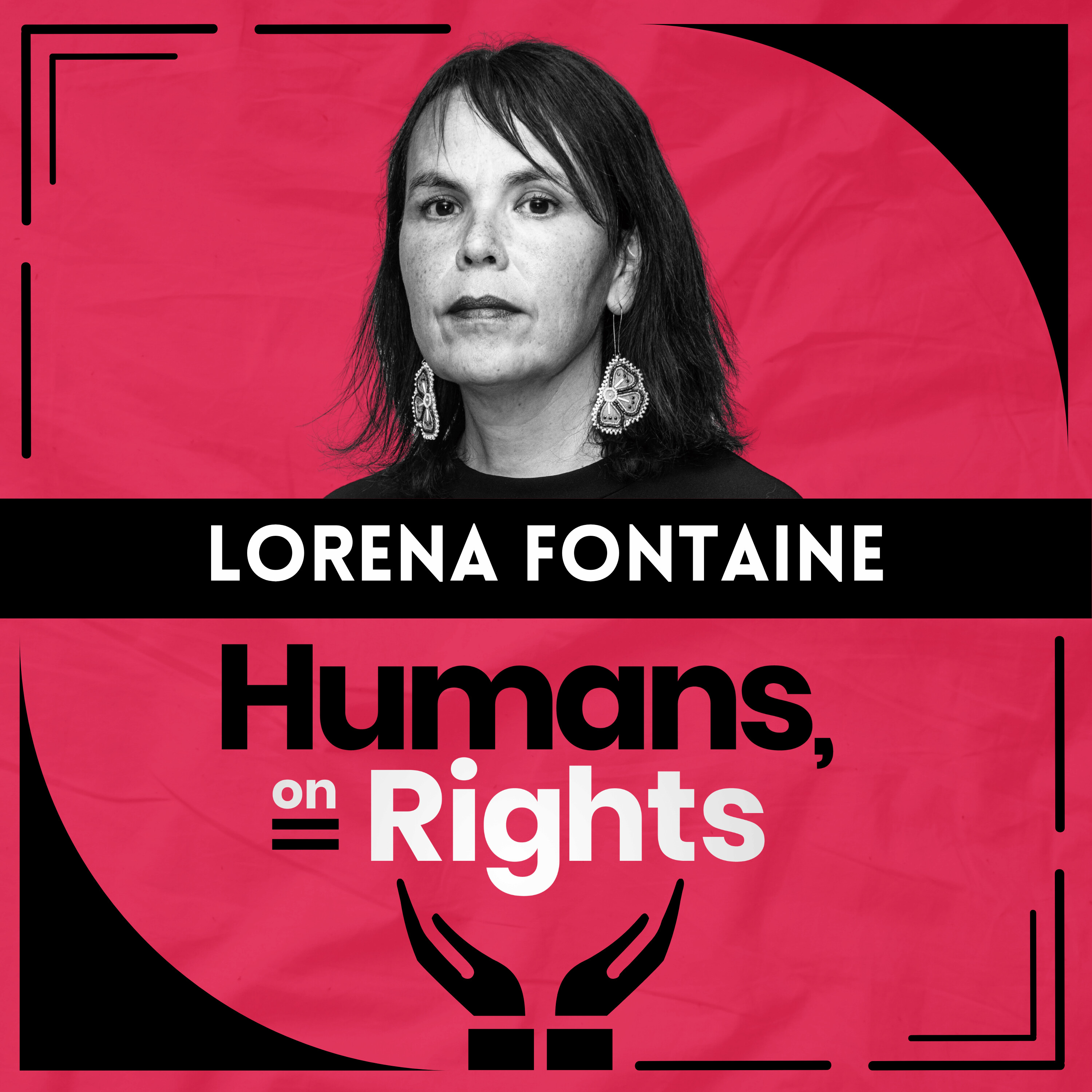
Dr Lorena Sekwan Fontaine: Linguicide and the Fight for Indigenous Language Rights

 Apple Podcasts

 Spotify

 Amazon Music

 iHeartRadio
When Dr. Lorena Sekwan Fontaine was a child, her aunts and uncles would turn their backs or leave the room whenever they spoke Cree. She thought they were hiding something from her. They were: the language itself, learned the hard way in residential schools, where speaking it meant being hit. That memory sits at the centre of this conversation with Stuart Murray, a wide-ranging look at what Fontaine calls linguicide, the deliberate killing of a language, and what it means for Canada's human rights obligations today.
Fontaine, a lawyer and professor and head of Indigenous Studies at the University of Manitoba, traces her path from a childhood split between English at home and Cree overheard in secret, to a legal career built on the realization that Canadian law had no real framework for what residential school survivors had lost. Section 35 of the Constitution recognized Aboriginal and treaty rights, but on language, she says, it was "an empty box." She and Stuart also dig into why the Indigenous Languages Act, which now folds language rights into Section 35, is a real step forward but still leaves Indigenous language rights far weaker in practice than the constitutionally entrenched rights of English and French speakers, particularly in education.
We're talking:
- Why Fontaine resists the term "linguicide" becoming a place where the conversation gets stuck, when the real goal is moving forward
- The gap between Section 35's language protections and the constitutionally entrenched rights of English and French speakers
- Her own daughter's education, and the choice to enroll her in French immersion when no Cree or Ojibwe option existed
- Whether Orange Shirt Day is driving structural change or settling into symbolism
- Her vision for twenty-five years from now: Indigenous languages on street signs and spoken at the counter, not just in the classroom
Read Fontaine's book, Living Language Rights: Constitutional Pathways to Indigenous Language Education, and watch the CBC documentary Undoing Linguicide, drawn from her doctoral research.
Stuart Murray 0:00
This podcast was recorded on the ancestral lands on Treaty One territory, the traditional territory of the Anishinaabe, Cree, Oji Cree, Dakota, and the Dene peoples, and on the homeland of the Métis Nation.
Matt Cundill 0:19
This is Humans on Rights, a podcast advocating for the education of human rights. Here's your host, Stuart Murray.
Stuart Murray 0:30
What happens to human rights when a person's language, the language through which they understand family, culture, history, and identity, is taken away. My guest today is Dr. Lorena Siquan Fontaine. She is Cree and Anishinabe, is a member of Sagine First Nation here in Manitoba, and is professor and head of department of the Indigenous Studies at the University of Manitoba. She is also a lawyer, and that combination-the legal training and the lived inheritance of the residential school system-has produced some of the most important work in this country on what she calls linguicide, the deliberate killing of a language, and what Canada owes in return. Her book, Living language rights, constitutional pathways to Indigenous language education came out last year. Lorena has testified before the Standing Senate Committee on the Indigenous Languages Act. She has served as a Canada Fulbright Research Chair. Her doctoral research became the CBC documentary *Undoing Linguicide* and she has carried this conversation to the Holocaust Memorial Museum in Washington and to genocide scholars in the University of Southern California. She holds the Queen Elizabeth II Platinum Jubilee Medal, and this year the University of Manitoba named her a Distinguished Alumni Award recipient. Dr. Fontaine, or Lorena, as I will call you, welcome to Humans on Rights.
Dr. Lorena Sekwan Fontaine 2:06
Well, thank you for having me.
Stuart Murray 2:08
So, Lorena, before we talk about sort of law and human rights, I'd like to talk to you about language, and I just want to get a sense from your perspective, Larina. Growing up, what did language mean to you growing up? When did you first understand that indigenous languages were actually a human rights issue?
Dr. Lorena Sekwan Fontaine 2:28
So, growing up, I heard English, of course, in my home, which was the predominant language. When I went back to the Pa, where the Opasque Nation, where my family is from on my mother's side. Everybody spoke Cree. The community, the adult generation. My grandparents didn't speak English. When I spoke to them, I'd have to have the conversation translated whenever I spoke, or when my grandparents spoke, and that was kind of normal to me. I didn't really know any other way. It was just the way my family was. I never questioned it. I think internally, I did feel kind of a wonder why when they would speak Cree, my aunts and uncles and my mother-they would turn their backs or they go into another room. It was almost like it was a code language for things that they didn't want us to hear. That was what I thought. Oh, they're talking about something they don't want me to hear again, so they go into another room or they turn their backs. But it was really they were hiding the language from us. They didn't want us to learn it. And on my father's side, we speak Ojibwe, and my dad would only speak in Ojibwe when he was around his brothers, because Ojibwe and the and the Cree dialect that my mom speaks, they're very related. So if my mom went into my dad's community in Saginaw, or vice versa, they would be able to understand each other. So there was this multilingualism in my family that I was not really privy to, other than English. And then, when I was about to start school, my parents put me into French immersion. It was in the '70s, and it was the start of French immersion in Winnipeg. And so, I was going to school learning French all day, and I'd come home to this kind of bizarre use of of language, and I didn't really understand that that was unusual until I was I had just come back from doing my master's at the University of Arizona. Obviously, the focus was on you know human rights to language. Culture identity-that's just common in international law. But here, when I came back, it was around 2003. It was the start of the residential school claims people were starting to file, and a right to language for Indigenous people or a right to cultural identity. Lawyers here didn't know what to do with that? I realized that the lawyers that were working on the case didn't really understand how to deal with loss of language and culture because our rights weren't recognized in the Constitution. There were no rights to language and culture for Indigenous peoples that were violated. I started reflecting on my own personal experience, I realized that my family situation was actually not normal at all, and I started questioning why, like why why were they hiding it? Why why didn't they want me to learn? Why was it so hard for for them to to speak to their grandchildren in the first language, I realized that they all had been harmed. They were afraid. They were afraid something bad was going to happen to us. They learned as children that if they spoke their ancestral language, they would be hit. They'd be punished. That was repeated until they stop speaking the language. When I started reflecting on this, I felt really sad. Is one word, but horrified. I just I kept thinking about young children at school. You know, you're excited to go there and learn, and the first thing that you learn is that your identity and your your language is not welcome there, and then you begin to associate those things with being punished and made to feel ashamed. I realized then that they were trying to protect us, but they would go to residential school. This was on my mother's side. They'd be punished for speaking their language, but my grandparents kept an only Cree policy when they came home, so they had to speak Cree. And I just thought, my God, that must have been so challenging, but also confusing for them to come home to that. My grandmother was so proud of our Cree culture and identity. She wanted to make sure that her children kept that language alive, that they they continue to speak the language.
Dr. Lorena Sekwan Fontaine 7:32
She made a decision when they would come back and were speaking more English and Cree that she wanted my grandfather to take them out on our trap line, which was way out in the bush. It was far to travel to, to hide them from the Indian agents at that time. She wanted a few of the kids to be reimmersed in the language at the at at the time because there was 15 of them. Anyways, when all these like memories and reflections and stories came popping up. It this was a huge human rights violation that had massive ramifications for families, for individuals, just our our whole being, everything about who we are that my grandmother loved and cherished so so much was something that we we felt ashamed in Canada, and that is what residential school survivors wanted to be dealt with in their court claims that lawyers didn't know how to handle at the time.
Stuart Murray 8:36
So let me just unpack a couple of things that you said because your life journey is is is pretty intense, and and from both a lived and academic experience, Larina, what, for example, you are a lawyer. Where did you get your legal degree, your law degree?
Dr. Lorena Sekwan Fontaine 8:53
So I received my law degree from the University of Manitoba. I went on to York University in my last year and my third year to do the intensive Indigenous lands and governance program. There was a an internship that was part of the program where we all the students go off for three months and do work. And I went to the Inter American Human Rights Commission in Washington D.C. the Organization of American States, and I worked with an Argentine lawyer who worked at the Commission. His name was Osvaldo Crimer. I learned about human rights. It opened my eyes to a new way of looking at law that I didn't learn in law school. That experience made me realize that there was so much more to to the law that I had learned in Canada. I think it also taught me about sort of like the true values that I thought that I would learn in law school that I didn't really get in my my law degree. I wanted to learn more, so I. Went to the University of Arizona to get my my master's in law, and in that program we worked on cases before the UN, the U.S. Supreme Court. Our professors were arguing cases on land rights. Again, the Inter American Human Rights Commission, and we also did work in community, like economic development, we worked with a lot of the tribes in Arizona. It it allowed me to a language that I didn't have when I was doing my law degree here in Canada.
Stuart Murray 10:32
It's interesting, Larina. You know some of the stuff that you did south of the border, for example in Washington, or as you did to in Arizona. When you look at what you learned there, and I'm just kind of coming back to one of the comments you said about what you felt you weren't learning in your your law schooling, if you will, in Canada, what can Canada learn potentially in terms of whether it's around linguistic rights for Indigenous peoples, or is there something to be learned from what you saw in both Washington and Arizona? I'm just trying to get a sense of, you know, we're going through the whole truth and reconciliation piece that always all of Canada is going through, and we're struggling in many many ways, and we can maybe get into that later. But I'm just trying to get a sense from you, somebody who's studied it, who's seen it, who has lived it, is there something that we can learn from a lawyer standpoint of what is happening, say, in Arizona or in the U.S. that is not happening in Canada?
Dr. Lorena Sekwan Fontaine 11:34
Well, I definitely wouldn't use the U.S. as an example, but I would say that human rights law is, I think really critical for Indigenous peoples when we're advancing rights to language, culture, identity, because there's a framework there, a legal framework that can be used. And I'll just give you an example. So when I came back from the U.S. after studying international law, I knew that there was a right to language and culture, like it's just part of the the framework, and they're embedded in treaties that Canada has signed on to. I attended a conference in Vancouver, and when I walked into this room, there was dead silence because the survivors had just asked the lawyers in the room, "What are you going to do about the fact that our children and grandchildren no longer know who they are? They're not speaking the language, and that is a direct result of what happened in those schools. So they weren't looking for individual compensation; they were looking for a recognition that that had been harmed. Their language, the culture, so that was like just having a conversation about that. The lawyers didn't know what to do, and they didn't say yes. Your rights were violated. Yes, we're going to work on this, and we're going to think through this. We're going to think through how to recognize that harm and deal with it in a way that gives you back some dignity. Right now, when we look at the Indigenous Languages Act, which was an important step forward, and not so much recognizing the harm, but I mean it did that. But it recognizes that Aboriginal people in Canada have a right to language under Section 35 in the Constitution. That wasn't there before. But so what? What does that actually mean? We have a right to language and culture. Is that helping us develop immersion programs is that providing us the adequate resources? And I'll go back to the experience that I had as a young child going to school. My parents had a choice to send me to an English program, and it was paid by the public in the public school system, or I could be sent to an immersion program, which was paid by the public at that time. I mean, it was starting it was starting to evolve at that point. But my parents didn't pay for anything. I just went to school like I would in an English program. At the very least, there are language rights associated in education now that children can be educated in either language? People come from all over the world to study our language rights in Canada, particularly around education. We have a base there to work from. It's not based on international law or human rights, but at the very least, if you're going to advance language rights for Indigenous people, look at what what's there. And at the very least, we should be identifying what those rights are in legislation. But we also are in a period where Canada. Is supposed to be looking at all federal laws and aligning them with the UN Declaration on the Rights of Indigenous People, but they've got this action plan that they're working on. They're not actually looking at at the laws and looking at UNDRIP to see what's aligning, and I would argue that the the language issue is something that could be done right away. You look at the provisions in UNDRIP that relate to language. There's there is ways to define language in the Indigenous Language Languages Act using international legal norms, but also the language in Andrip, and ensuring that language rights have some teeth that Indigenous people could go to court to ensure that our language rights, for example, in education, is being honored. But right now, it's it's an empty box, right? It's we have a right to language and culture, but really, what does that mean?
Stuart Murray 16:07
I always sort of just say, if you would be kind enough, just to when you mention the word undrip.
Dr. Lorena Sekwan Fontaine 16:11
Yeah, I think I said UN Declaration on the Rights of Indigenous People. Yeah,
Stuart Murray 16:16
you did. Thank you so much. And by the way, just one other thing, I just want to sort of go on record as you were very good to say I wasn't trying to use the United States as a place to learn from. I get it, but having said that, though, Lorena, I'd love to know the course that you took at Arizona
Dr. Lorena Sekwan Fontaine 16:32
University of Arizona in Tucson. Is the
Stuart Murray 16:34
reason you went to the course there because it was not offered in Canada, or was there something else that drew you down to study there. When
Dr. Lorena Sekwan Fontaine 16:42
I was at the Inter-American Human Rights Commission, the lawyer that I was working with was trying to expose me to different organizations that were working on advancing indigenous rights. And one one was the Indian Law Resource Center in Washington. There was a lot of discussion about this lawyer by the name of James Anaya, who worked on advancing land rights cases for people in the United States, but also in Latin America, and was working on a case called the Dan case at the time, and there was the Awasthingi case in Nicaragua. Anyways, there was a lot of discussion about him, and I had heard that they were starting. It was called the Indigenous Peoples Law and Policy Program at the University of Arizona. I wanted to go. I wanted to learn more. There is no program like that in Canada. The thing that I was really interested in is that there was James Anaya and Rob Williams was another Indigenous lawyer that were running the program, or well, that they were starting it up. But they would teach, but they'd also work on land rights cases for Indigenous people. So they were they were actually out there doing the work. They weren't just in the classroom teaching theory. And I was really interested in that, and there was a clinic, so we could help communities in around Arizona. And the program wasn't going to start until the year after that I would register. So I was so determined to enter this program, and I wanted to keep the momentum up that I registered in the trade law program for one year, and took courses before the Indigenous Peoples Law and Policy program started. Yeah, it was an exciting time. I learned so much about you know working with people, but also a different framework that I could that that I could see potential in helping Indigenous peoples that I didn't really see going through a Canadian law program,
Stuart Murray 18:47
and so if you were to look at today as 2026, we're having this conversation, Larina. Are there any universities, law departments in Canada that come close to offering that kind of a program today? The
Dr. Lorena Sekwan Fontaine 19:01
University Victoria with their Indigenous Law program. I wouldn't say that it it's similar to what I experienced in Arizona, but what they're doing there is using Indigenous legal principles. They're teaching students about Ojibwe law, Cree law, actual Indigenous legal principles to advance indigenous rights, which I think is is really critical. I think that law schools are doing a better job with teaching human rights law in in some law schools, but I I don't see a program specifically for indigenous peoples or lawyers that are working specifically on Indigenous rights in Canada.
Stuart Murray 19:47
Yeah, no, I, I'm just asking because I, you know, there's always opportunities to learn, grow, and sort of see where where we can be better. And you know, you've made your life and your passion to look at language rights. Human rights, and I want to come to the term linguicide that you have come forward. And I guess I just wanted to sort of ask this question, Lorena: When you you use the term linguicide, what exactly does that mean, and why do you think it's important that Canadians understand the destruction of Indigenous language as something more than simply a loss of culture.
Dr. Lorena Sekwan Fontaine 20:23
Well, that in and of itself is quite drastic. When you're killing a language, you're also killing the culture. Like I always reflect back on something my grandfather said before he passed away. He said, you know, like if people, other people from other countries start coming to Canada, and we're no longer speaking our language. They won't know who we are. It's a simple statement, but it's quite profound. I mean, I didn't start off with the term linguicide. I actually, I wanted to find out more about our languages. Like, what was it like before settlers started coming into our communities. We were multilingual, like we had our our language, but they were all distinct. I was told that we come from language families. We've got 11 or 12 in Canada, and from there, there's offshoots of these other languages. And our languages evolved according to our relationship to the land, and I'll just speak on behalf of Ojibwe and Cree from what I learned. And so, when we're out on the land, you know, like our our cultural memory, our historical memory, our our teachings, our our land knowledge comes from the language we speak, but it it also informs us who we are as as people, as individuals, our responsibilities to the land, our responsibilities to our mother, our father, our aunties, because our relationships are all different, and we have concepts in our language that inform us how to be in relationship to our families. My language will tell me how I am with my mother, which is very different than her older sister. I also think that it teach it gives us our intelligence. If you have a people that can't pass on that knowledge because there are language barriers. You're destroying a whole worldview and the ability to keep living with the land with dignity, relating to family. So I think culture is is huge, and I also think that people that speak under other languages understand that very clearly. Like you don't ever have to describe that, but the term linguicide I think helps us understand that the suppression of languages it doesn't just stop by preventing children from learning that language. It encompasses everything that I just expressed, but but more. So it allows us to start not just talking about the language, but everything around the language and what that means. And that harm doesn't just stop with you know a country implementing assimilation policies, and then it's a historic issue. It continues today in our school system, and I'll I'll just give you an example, like a personal example. When my daughter was about to start school, had there been an immersion program or an Ojibwe or Cree school program, I would have enrolled her in that program, and because I wanted her to learn her ancestral language, I couldn't pass it on to her. I enrolled her in French in a French immersion school because I know that kids learning other languages it's good for their brain. It was important. I think she knew English. She would learn English, but to learn another language in this that Canada valued was, you know, something important to me. And I just watched her grow through that school system. She had good teachers. They had curriculum. They had textbooks. The teachers had professional development, and by the time she was three, she was reading, writing, and speaking in French. So our school system still continues to deny children the ability to learn their ancestral language. So they're learning English and French at the expense of their own language,
Stuart Murray 24:41
right?
Dr. Lorena Sekwan Fontaine 24:42
So linguicide allows us to talk about the loss of language in much broader terms.
Stuart Murray 24:49
Lorena, just on that, I and and and I hope I'm factual when I kind of did my research on you that you did go down and you you have these conversations with the Holocaust Memorial Museum and. Washington, and I think you were at the University of Southern California talking to genocide scholars. Were you using sort of linguicide as your entry point to have conversations with those? I'll just call them scholars. There may be other people that you were speaking with, but is that kind of was that sort of your entry point?
Dr. Lorena Sekwan Fontaine 25:19
Yeah. So again, I guess it's the frameworks we use. Linguicide is, I guess, it feels new here.
Stuart Murray 25:27
Yeah, it's a new. I mean, until I started to do some research upon you, Lorena, I'd never heard of the conversation or that that title before, linguicide.
Dr. Lorena Sekwan Fontaine 25:37
Yeah, if you're in a a forum where people work within human rights framework, it's not new. People know the term genocide.
Stuart Murray 25:49
Yes, yeah,
Dr. Lorena Sekwan Fontaine 25:50
and understand the way that it has been framed in the Genocide Convention has its limitations. But really, the term genocide was talked about at the start of the creation of the Genocide Convention. Loss of language and culture were key.
Stuart Murray 26:11
And was that sort of the Raphael Lemkin convention that you're talking about? Yeah, for sure.
Dr. Lorena Sekwan Fontaine 26:15
I mean, he understood.
Stuart Murray 26:16
I'm familiar with that through the through the my work at the Canadian Museum for Human Rights. I sort of understood a bit about that, but certainly not to the depth of which you know it.
Dr. Lorena Sekwan Fontaine 26:25
Yeah, and so I think you know I work with Holocaust scholars who are they're really interested in learning about, in not learning, but discussing the harm to their language, you know, we talk about using linguicide as a way to frame that harm. Some interesting conversations are happening around that, and and I think those those conversations with other communities that have been harmed in that way are are really critical.
Stuart Murray 27:02
Yeah, I mean it's it's a it's an international conversation, and I think in many respects, Lorena, and we're not going to go down sort of this path, but I do think the term genocide, which you know Raphael Lemkin sort of presented in terms of what that meant, and I think a lot of people have looked at that meaning, I know that when I was at the Canadian Museum for Human Rights and and when Marie Sinclair was so so active, as we know in so many files, but certainly on the Truth and Reconciliation, we did an op-ed piece for the Toronto Star talking about what took place in Canada was a cultural genocide,
Dr. Lorena Sekwan Fontaine 27:42
right?
Stuart Murray 27:42
But neither, you know, Lorena. Just to put a, you know, sort of an underlying on it, as the sort of president CEO of the Canadian Museum for Human Rights, and Murray himself said, "Look, in his capacity, and he was extremely knowledgeable, as you know, his capacity to be the commissioner of the Truth and Reconciliation Commission. Neither of us had the mandate to use that term. It was really something that he and I basically felt that we could write about simply, almost as citizens, if you will, but that we had had some involvement in that process. So, you know, it's become very, very interesting to really sort of do a deep dive with you on the word linguicide and the importance of it.
Dr. Lorena Sekwan Fontaine 28:22
Well, I find it interesting that you use the word mandate to even use the term. So, what does that suggest?
Stuart Murray 28:30
Right, for sure. And I mean, we knew that we were in a position where we we we each had our own positions, but we were never asked to, or never was never given the opportunity to go out and say, "Look, here's what we we've been asked to sort of do a sense of what this could be. This was really sort of where we tried to say simply that we understand that nobody has asked us to make this comment, but what we have learned, we feel obligated that we need to share that, and that's sort of what we we did.
Dr. Lorena Sekwan Fontaine 29:00
Yeah, and I guess I I would also pause to reflect on the terms that we use to identify harms, if it is going to prevent the work from moving forward, because these terms can be loaded legally, and are we mandated to use it? Can we talk about it publicly without there being repercussions? How does it affect the political willingness to work on these issues if you use these terms? Because the most important is the work ahead. Like we should be moving towards whatever we call what happened in the past, so that children have opportunities to have access to their language and education, and that is what those survivors, I think, were envisioning when they had said, "What about loss of language and culture? In these claims, we want our children. To know who they are, we want them to go to school and to not have that experience that they had. And it's not to say that any kids in Canada would be punished today for speaking a language, but they should be able to come out of that education system knowing who they are and having some pride in their culture and their language, and for that for that education system to support the learning of those things, it's so simple, but yet it's it's not. And so, if we use the term linguicide or genocide to articulate that harm, and it prevents us from moving forward, you know, I've been reflecting on that a lot because I think the goal is to move forward so that our children have a better future. And ultimately, I think it would be wonderful if non-Indigenous children could go through an education system and know who Indigenous peoples are, and for them to be able to communicate in those languages.
Stuart Murray 31:05
Interesting and and Lorena, I this is a bit of a sort of a step back. If I you know sort of looking at you know one of the things that you know always occurs to me at this time of year is as we get closer to the end of of the month of September, you know Canada and well, Manitoba and Canada have. There's a you know a day called Orange Shirt Day. I just would be interested if you want to comment from your perspective when you talk about learning, when you talk about education, when you talk about the opportunities we have, and you know sort of that structure and what that looks like. You know, from your perspective, is there? Do you want? I just would be interested in your thoughts on on Orange Shirt Day. What does it mean? What should it mean? What might it mean? What can we learn? I mean, I think all of these things, as opposed to looking at it, and I'll just put a just pause for a second, Arena, to say that, you know, when I look at November the 11th, Remembrance Day. You know, my father was a was in the Air Force, and and so many members of men and women that went and lost their lives didn't come back. And I struggle personally with the fact that people look at November the 11th as a as a holiday.
Dr. Lorena Sekwan Fontaine 32:13
Yeah, you know,
Stuart Murray 32:14
it's oh, it's a holiday. If it's on the Friday, it's a long weekend. It's like, well, wait a minute. We've given so many opportunities to do we do because men and women went to war because they believed in in in strength and freedom of of what our country could be. So when I think about Orange Shirt Day, I'm I'm I'm struggling and I I would love to have these conversations because I need to learn what what Orange Shirt Day should mean to me.
Dr. Lorena Sekwan Fontaine 32:38
You know the reason why we have Orange Shirt Day is sort of like a day to reflect and remember the residential schools. It's symbolic. Every child matters. Like I struggle with with it too, but at different moments in time. Like I remember the first Orange Shirt Day on September 30th. There was a a march here in Winnipeg, down Portage Avenue, I think it started around Main Street. There were so many Indigenous people came out for that march. I saw cousins in cars, and they were like honking their horn as they came by because we were all excited to be there. It was still around the time of the TRC. There was momentum at that time, and I felt really proud walking down that street with Aboriginal people and non-Aboriginal people that were together. And I think that moment was really important because we felt like we weren't standing alone anymore. So that's important, but it's it's been a few years now, and now on that day, I some days I it I do treat it just as like a day where I can get things done. Some years I I'm a bit more reflective, so I'm conflicted about that day too. I think it's important. It has a purpose. I'm glad that they they do have it because it creates space for discussions to happen, for events to occur, and to continue informing the public. But like, is it having an impact? Is something to pause and think about. I know that when my daughter was going through high school. They there was a lot of preparation getting ready for that event, but I found that all the teachers were asking her opinion, like should we do this, and they got her doing a lot of the organizing because they didn't know what to do.
Stuart Murray 34:38
Right, sure.
Dr. Lorena Sekwan Fontaine 34:39
And I got so fury. I was so mad. Right? How dare you put that on a you know a 15 year old shoulder when she's still learning about and as impacted? Right. So I think it it allows for more conversations to happen because I went to the school and talked to them about it, and they did change. So they picked up the work. I I would like I would hope that it it is a day of reflection, but I also want to see where the change is happening. Like, are are these things really having an impact on our conversations about residential schools in Canada? Are kids coming out of their their K to 12? Do they know about schools? Do they know the impact that it's had on society? I think that each year, as we move forward, is that day going to be just something like you said, a holiday? I I would hope not. I think that there's still so much work to do in education, and I I think the amount of work is diverse across the country. I think Mattit Hope is doing pretty well. Ontario, I think there's still a lot of work to do. Like I think if we looked at across the country and see what they're doing in education is is where where still do we need to to do the work beyond Orange Shirt Day?
Stuart Murray 36:08
You know, you have a day; it has a name to it. It's it's a national day in Canada, Day of Recognition, Day of Reflection. But I I think you know one of the challenges is, and I think you said it exactly right. Is what are we? What are we achieving? And it's not that it has to be so prescriptive, but you know, to say you know during that day. I mean, I think it's interesting, as you say, to see non-indigenous people walking side by side with indigenous people, not behind or together, but side by side. Hopefully, physically and mentally sends an issue or a message that that we're trying to learn. We're in this together, but you know it is sort of interesting. And you know, and I'll just say that I I find myself also when I reflect on this, Larina, that I would I reach out to certain a number of my First Nations colleagues, friends, that I love to have the conversation with them because I, I feel a little paralyzed about what what I should think about or what I should do. I want to help, but where's that entry point? What does that look like? And part of it is to certainly sit down and listen, and listen to pretension or knowledge keeper or to an elder, or do different things to understand my my background. Lorena is that I grew up in Punishai, Saskatchewan, and so I was surrounded by four reserves. And my introduction to reserves was quite different than what I know today. I didn't see any of the things that happened at residential schools when I was eight, 910, 11. I played hockey with those young people, and so I look at sort of my own reflection and say, where can I make a contribution? And if that contribution is to sit back to learn and listen, I'm I'm very very excited about that because learning is something that I think we all need to do. But it's one day, you know, it's one day that they have, and so where do we go to progress this to say that it's not going to happen? I think, you know, I don't know whether it was. I quote Murray Sinclair as a lot of people do from his teachings, his speeches, his book, that you know the notion of the seven generations of how we got here and how do we sort of move past it, and I just, you know, hope that that I can, in my own small way, can play a role and try to advance the understanding of how we can make this a better country for those peoples that, you know, we're we're so wronged and so harmed in the making of what this country is called Canada.
Dr. Lorena Sekwan Fontaine 38:41
I think there's layers there of learning. It was only in 19, like in the 1990s, maybe 1995, 96, when I first heard about residential schools, which wasn't. It's that's not that long ago,
Stuart Murray 38:59
right?
Dr. Lorena Sekwan Fontaine 39:00
And yet, my parent, both my parents, both my grandparents had all attended residential school, and I was living that legacy of that harm. And I didn't know that growing up. There's been a tremendous amount of work since then, but there are still pockets of misunderstanding and lack of knowledge by Canadians, but also Indigenous peoples. Like we don't sit down at our table and talk about our family history in the schools. Like we just don't do that. So where are kids, Indigenous kids, learning about this? Often in university, places like Orange Shirt Day. I I remember when the TRC was happening at the national events. I always made sure that I spent one day sitting there listening to the testimonies because my father passed away before. People started talking about it publicly, but he had nightmares every night, and I never knew why. And so, when I sat and listened to survivors talk about what happened to them, it made me understand him a bit better, and also myself. There are a lot of kids now that weren't around during those days, where are they learning about the schools, and who's teaching them, and in what way are they able to, you know, reflect in a healthy environment about how those harms affect them in a personal way? So there's the the education within our communities that I think still has a long way to go, and the reflection that we need to understand the harms that still impact us. We see we see it on the streets, right in Winnipeg, people that are still very much hurting. I went and taught a course at Stony Mountain. A lot of those young men, when you sat down and listened to what their family life was like, all of them residential school survivors, they've never been. They've never had the opportunity to reflect on that and to to be able to discuss and think through the harm on their lives. And then I I think back when I started working on residential school claims, and I would say 99% of the lawyers that were working on those claims, these are educated primarily men, white men, had never learned about residential schools. They had to go to the library and pick up a book and read, so that they were informed about what happened in the school, so they could, you know, advocate on behalf of their clients. That was, you know, around 2005, 2003, in that range. Is the education system adequately equipped to teach on these subjects to kids at various ages. So, what what are Canadians learning? Like, what do we really know to be able to have these informed conversations? So, you know, we go back to what Marie said about education got us into this mess. It's going to take education to get us out of this mess, and I think that that you know is a really simple but very complicated thing to unpack when we think about what education is equipping us to engage in these conversations about this history that has has impacts on us all. Orange Shirt Day. It's it's an important symbolic day, but there's so much more work to to do.
Stuart Murray 42:47
You know, you you have been very involved in it. You you know, you're you're obviously an expert in the whole issue around language rights, human rights as a language as a human right. You know, Rena. You know, I'd like to get your sort of thoughts. I mean, you did appear before the Standing Senate Committee on Indigenous Language, the Indigenous Language Act. When you look at the fact that Canada has a constitution that protects Indigenous and treaty rights, and in that constitution, it does protect. I think is it Section 35, if I have that right, that protects Indigenous and treaty rights. And I just wondered where legally you felt Indigenous language rights fit with the Canadian constitutional framework, like the language piece. Is that is that very clearly spelled out from your perspective?
Dr. Lorena Sekwan Fontaine 43:37
Well, before the Indigenous Languages Act, we had Aboriginal treaty rights recognized in the Canadian Constitution under Section 35. It says that treaty and Aboriginal rights are hereby recognized and affirmed. Period. Right at that time, a lot of people, lawyers, constitutional experts called that an empty box because what does that really means, right? And there's been a lot of court court activity around defining what Aboriginal and treaty rights mean. And so, what the Indigenous Languages Act did is it says in there that now Section 35 includes Indigenous language rights. So, Section 35 now includes Aboriginal and treaty rights and language rights. They're recognized and affirmed, which you know is an important step. I don't want to minimize that because now we have, you know, if we go back to that conversation when Aboriginal people said, "What are you going to do about loss of language and culture? At that point, we didn't have the Indigenous Languages Act, you know the lawyers were kind of at a loss at that time. You know today we have the Indigenous Languages Act, so constitutionally we have now a recognition that Indigenous peoples have language rights under the Canadian Constitution. We. They also have language rights for the official languages, minority languages. So, language English in Quebec and French outside of Quebec is kind of how it boils down. But there's, you know, there's some complexities around there. If you look at the two, if you put some, when I teach, I'll put up section 35. I'll put up, you know, the Indigenous Language Act. So I said, okay, now we've got language rights under Section 35. They're recognized and affirmed. Let's compare, even just so language rights under the Constitution for French and English quite extensive. If you look at language rights in education alone. It's spelt out there that parents have a right, children have a right to learn at the public expense. So, if Aboriginal people and say the French language community went to court on these same issues, whose rights are are enforceable in a way that a court would understand. So there's an inequality there, right?
Stuart Murray 46:10
Yeah. No. I. I mean. I just under the you know sort of the heading of we've got we've got a lot of work to do. I mean, and I don't think that's a bad thing. It's just a matter of saying let's recognize it and sort of how do we tackle it? How do we approach it? How do we work together? What do we have that open mind to learn to try to deal with some of these you know challenges that that that we put upon ourselves as a nation?
Dr. Lorena Sekwan Fontaine 46:32
Yeah,
Stuart Murray 46:32
I wanted to just sort of get a sense that if we recorded this conversation, say 25 years from now, what would you want to be different about the way that Canadians understand Indigenous language and Indigenous rights?
Dr. Lorena Sekwan Fontaine 46:49
Well, 25 years from now, I hope that people know that there were at one point, you know, close to 100 languages in Canada and know where they come from, right? Sometimes I'll go into a class and talk about linguicide, but I want them to. You're you're in Toronto. You're in Winnipeg. What are the languages, local languages around here? Nine times out of 10, they can't answer that. They don't. They can't even identify the local languages around them, let alone the history, like what's happened, why are they endangered? I would love to to be able to walk down the street and hear that multilingualism that was here before settlers arrived. I love going to Toronto because I walk down the streets and I hear all these languages, right? That, and it's it's so vibrant, like you know the way people express themselves, like their body language changes, their voice changes. Like I I would like to see 25 years from now that that exists around the country for indigenous languages, saying street signs that our language has presence, not just in in a classroom, but outside on the streets. Maybe I go to the reserve and I go to Tim Hortons and I order my coffee in Ojibwe or Cree. Right.
Stuart Murray 48:15
Right.
Dr. Lorena Sekwan Fontaine 48:16
The other place that I was so struck by is I I went to Iceland a few years, quite a few, well, a few years ago, kids there-they know three, four languages, and that's just how they grow up. You go into the airport and you pick up a pocket book, and it's translated, right? I'd like to see that our languages are living and thriving in Canada, but that we have rights in the Constitution that are defined in such a way that protects them, that gives us the tools that if we feel that they're not being honored in our school system, in our health, you know, in government, in services, in court, that we have the ability to to advance those rights in court in the same way that French and English do. That there's protection there.
Stuart Murray 49:12
You know, it's just a it's a question that I I like to sort of ask some of my guests because when you're so immersed in something today, you know, as you say, you you we have our history, which we're trying to understand and learn about. But it's more important about the future. Where are we going? What are we doing? And so, if you say from 25 years from now to have that sort of that that multi ethnic conversations happening on street corners or involved in different ways, you use Toronto as an example, which I'm somewhat familiar with. I I sort of completely understand that, so I appreciate you sharing that, and I really appreciate you sharing your time with me on this podcast, Larina. Your depth and knowledge is-it's really impressive, and you know it's hard to you know in an hour. There's so much to cover. And certainly the documentary, the CBC documentary that Undoing Linguicide, and some of the things that you've been so involved, your book, which we'll put and make sure we have in the in the podcast episode notes if people want to get access to that or however that may be. So I thank you for taking the time. And and my my very last question, which I I really just always sort of say to my guests, Lorena, you know, when you agreed to do this, and I thank you so much for taking the time to do so. But in the back of your mind, or as we've been having this conversation, and I've been asking you some questions, is there a question that I didn't ask you that you you you were kind of hoping that I might ask you about?
Dr. Lorena Sekwan Fontaine 50:39
What I will say about all this work, you know, and why I got involved had to do with the vision that my grandparents had, and I think those survivors that advance their court cases, and you know, having a child and wanting the best for her, for her to grow up in Canada, feeling proud of who she is, being able to communicate in our ancestral language to her grandmother. Like I think the motivation to do this work-that's what-that's what drives me. I I would never want anybody to, you know, to have told my grandparents or survivors or my daughter that they don't have a right to speak their language and to live in a a country that is our homeland. Like it's just sort of basic common sense that seems so complicated. But I guess my motivation-that's where it comes from. My family.
Stuart Murray 51:47
That's a great way because the family-it's all about culture, it's all about learning, it's all about language, it's all of those things. So, so I would just say, Dr. Lorena Fontaine, thank you for the work you do. Thank you for sharing. Thank you for sharing this time on Humans on Right podcast. I really, I really value your time and what you do. So thank you so much for that.
Dr. Lorena Sekwan Fontaine 52:07
Thank you for having me.
Matt Cundill 52:09
Thanks for listening to Humans on Rights. A transcript of this episode is available by clicking the link in the show notes of this episode. Humans on Rights is recorded and hosted by Stuart Murray. Social media marketing by Buffy Davie. Music by Doug Edmond. For more, go to humanrightsub.ca. Produced and distributed by the Sound Off Media Company.
Transcribed by https://otter.ai