Women Episodes

13
Nov. 24, 2025
Revolutionary Artists with Zara Anishanslin
In this episode of Leadership and Legacy, historian, professor, and author Zara Anishanslin explores how art became a powerful form of leadership and resistance in London during the American Revolution. Through striking symbolism and emotional imagery, little-known Patriot artists transformed their creative talents into tools of protest, inspiration, and even espionage, revealing how art shaped the fight for independence in unexpected ways. Tune in for new insights into the hidden power of art, ...
9
July 7, 2025
Learning from First Ladies with Anita McBride
In this episode of Leadership and Legacy, Anita McBride—author and former Chief of Staff to First Lady Laura Bush—offers an insider’s perspective on the evolving role of America’s first ladies. Drawing on her own White House experience, McBride highlights how communication, altruism, and quiet courage have shaped some of the most impactful partnerships in presidential history. From behind-the-scenes influence to public leadership, she demonstrates how first ladies have helped to define the natio...
Guest: Anita McBride
6
May 4, 2025
Suffrage and Black Women's Leadership with Martha Jones
In this episode of Leadership and Legacy, historian and legal scholar Dr. Martha S. Jones delves into black women’s battle for voting rights that began, rather than ended, with the passage of the 19th Amendment. Through the stories of several inspirational leaders of the Black Women’s Club movement, Jones highlights how these women earned leverage in their communities, empowered themselves in their churches, and passed down invaluable lessons to the next generation. She also reflects on their la...
Guest: Martha S. Jones
5
April 20, 2025
Historical Lessons of Leadership with Catherine Allgor
In this episode of Leadership and Legacy, historian Catherine Allgor explores the early First Ladies of the United States, examining how they navigated gendered power dynamics within their roles. She delves into how these women found agency in a male-dominated world, leveraging the social sphere to influence Washington culture and shape political policy. At the heart of her discussion, Allgor emphasizes the importance of leaders recognizing and treating people as full, complex human beings. Tune...
Guest: Catherine Allgor

223
May 19, 2022
223. Attending a Lecture on Female Genius with Dr. Mary Sarah Bilder
In May 1787, George Washington arrived in Philadelphia to attend the Constitutional Convention. One afternoon, as he waited for the other delegates to show up so the convention could begin, Washington accompanied some ladies to a public lecture at the University of Pennsylvania by a woman named Eliza Harriot Barons O’Conner. Eliza Harriot, as she signed her name, had led a transatlantic life steeped in revolutionary ideas. On that May afternoon she argued in favor of the radical notion of Fem...
Guest: Dr. Mary Sarah Bilder
221
March 9, 2022
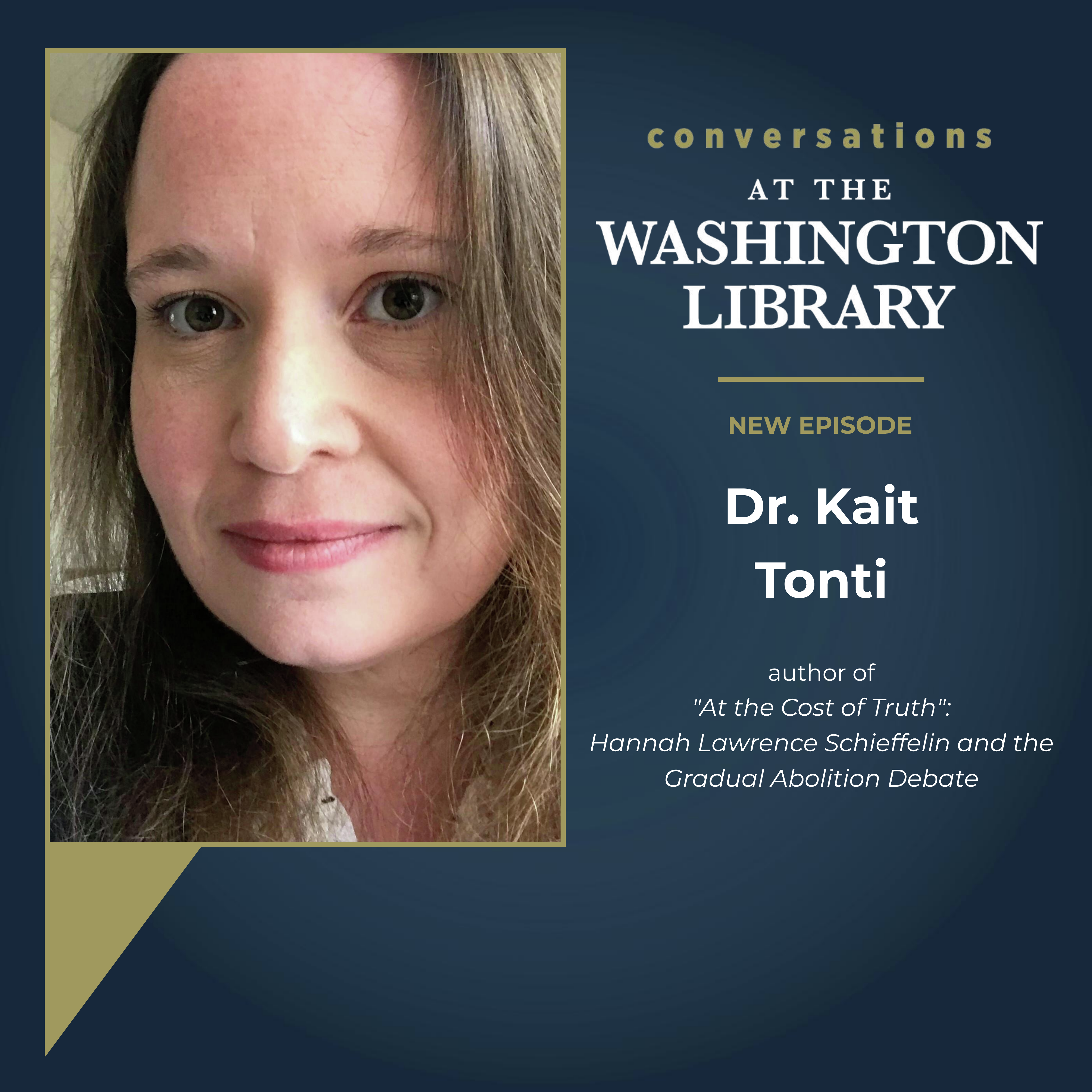
221. Reading the Political Poetry of Hannah Lawrence Schieffelin with Dr. Kait Tonti
Hannah Lawrence Schieffelin was an American poet who rhymed about some of the most important issues facing the early United States in the eighteenth century, including the British occupation of New York City during the American Revolution, the debate over the gradual abolition of slavery in the early days of the republic, and the legacy of George Washington. Schieffelin sat at the heart of the New York literary scene in these years, but until recently, most of her manuscript poetry remained u...
Guest: Kait Tonti

209
Sept. 1, 2021
209. Reading Letters by Early American Women with Kathryn Gehred (Summer Repeat)
If you pull any decent history book off your shelf right now, odds are that it’s filled with quotes from letters, diaries, or account books that help the author tell her story and provide the evidence for her interpretation of the past. It’s almost always the case that the quotation you read in a book is just one snippet of a much longer document. Perhaps, for example, Catharine Greene’s letters to her husband Nathanael offer the reader insight into some aspect of the family business she was run...
Guest: Kathryn Gehred

205
July 12, 2021
205. Grieving with the Widow Washington with Dr. Martha Saxton
In the eighteenth century, death stalked early Americans like a predator hunting its prey. In Virginia, as in other colonies, death made children orphans and wives widows, making a precarious existence all that much more challenging. For the Virginia elite, death also created opportunities for widows and widowers alike to protect their interests, their property, and their social standing through advantageous re-marriages. But the predator’s teeth never dulled, and when it took another life some ...
193
Jan. 21, 2021
193. Rifling through Washington's Receipts with Dr. Julie Miller
Take a receipt out of your pocket. What does it say about you? Receipts can tell us a lot about people and the world in which they lived. And George Washington kept receipts. On today’s show, Dr. Julie Miller joins Jim Ambuske to discuss the hidden lives we can find in Washington’s receipts and similar documents. Dr. Miller is a historian and the Curator of Early American Manuscripts at the Library of Congress, where she oversees a vast array of archival material, including Washington Papers. ...
Guest: Dr. Julie Miller
182
Oct. 29, 2020
182. Recording an Oral History of the Obama Presidency with Evan D. McCormick
What is a legacy? As the artist Lin-Manual Miranda tells us, it’s planting seeds in a garden you never get to see. American presidents, regardless of party, spend a great deal of time during their presidencies and after they leave office thinking about their own legacies, and how people will study and remember their administrations. Whether the 2020 presidential election results in a second term for President Trump or an inaugural one for a President Biden, both men and the people in their adm...
180
Oct. 15, 2020
180. Reading Letters by Early American Women with Kathryn Gehred
If you pull any decent history book off your shelf right now, odds are that it’s filled with quotes from letters, diaries, or account books that help the author tell her story and provide the evidence for her interpretation of the past. It’s almost always the case that the quotation you read in a book is just one snippet of a much longer document. Perhaps, for example, Catharine Greene’s letters to her husband Nathanael offer the reader insight into some aspect of the family business she was ru...
172
Aug. 20, 2020
172. Exploring White Women as Slave Owners in the American South with Stephanie Jones-Rogers
It’s easy to think of slave holding as a male profession. George Washington, Thomas Jefferson, Patrick Henry, and countless other men are often the names that come to mind when we think about early Americans who held other people in bondage. But white women, especially in the American South, were equally invested in slavery as owners in human property. A new generation of historians is helping us to understand why and how. One such scholar is Dr. Stephanie Jones-Rogers of the University Califo...
171
Aug. 13, 2020
171. Reinterpreting Mary Ball Washington with Karin Wulf, Martha Saxton, Craig Shirley, and Charlene Boyer Lewis
On today's show, we bring you the audio from our annual Martha Washington Lecture. This year's topic was Mary Ball Washington, George's mother, and the recent work by historians to rethink what we know about her life. Dr. Karin Wulf, executive director of the Omohundro Institute of Early American History and Culture, served as our guest moderator for this event. She was joined on the virtual stage by Martha Saxon, a 2020 George Washington Book Prize Finalist for her work, The Widow Washington: T...
157
May 7, 2020
157. Finding the Hidden Families behind the Boston Massacre with Serena Zabin
On the evening of March 5, 1770, Captain Thomas Preston and a small contingent of British Redcoats under his command fired into a crowd of civilians massing on King Street in Boston, killing several people. Many of us are familiar with Paul Revere’s famous engraving of what he called “the Bloody Massacre,” what we now know as “the Boston Massacre.” But Revere’s depiction of the incident obscures much more than it reveals about the thousands of connections between Bostonians and the British...
141
Jan. 16, 2020
141. Accounting for Women in the Business of Slavery with Alexi Garrett
When George Washington died in December 1799, it changed Martha Washington’s legal status. Just as she did when she was widowed for the first time in 1757, Martha once again became an independent person in the eyes of the law. She was no longer in the shadow of her husband’s legal identity. So what did this mean for Martha and other unmarried or widowed elite white women who ran businesses powered by slavery in early Virginia? How did they negotiate contracts, oversee enslaved labor, and manage...
139
Jan. 2, 2020
139. Harnessing the Power of Washington's Genealogy with Karin Wulf
Early Americans like George Washington obsessed over genealogy. Much was at stake. One's place on the family tree could mean the difference between inheriting a plantation like Mount Vernon and its enslaved community, or working a patch of hardscrabble. Genealogy was very much a matter of custom, culture, and law, which explains in part why Washington composed a long-ignored document tracing his own lineage. It was as much a reflection of his family's past as it was a road map to his future powe...
133
Nov. 21, 2019
133. Facing the Wrath of Rachel Jackson's God with Melissa Gismondi
If you know anything about Rachel Jackson, chances are you know her best as Andrew Jackson’s wife. You might also know that Rachel died in late 1828, just before Andrew became president. During Andrew’s presidential campaigns in 1824 and 1828, his political enemies attacked Rachel as an adulterer. Legally speaking, she was. In the early 1790s, Rachel and Andrew learned that her first husband, Lewis Robards, had never finalized their divorce. The Jacksons’ marriage was seemingly illegitimate. ...
124
Sept. 19, 2019
124. The Power Broker and the King Maker: The Life of Elizabeth Willing Powel with Samantha Snyder
In this episode of Conversations at the Washington Library, Samantha Snyder speaks to Jim Ambuske about the life of Elizabeth Willing Powel. Powel was a prominent Philadelphian who became close to the Washington family. Although her loyalties were unclear in the early years of the American War for Independence, she eventually embraced the Revolution. Powel was at the center of Philadelphia politics, but her influence reached beyond the city to the banks of the Potomac and places further afield. ...