American Revolution Episodes

14
Dec. 10, 2025
LIVE: Civil-Military Relations with Kori Schake
This live episode was recorded at Mount Vernon as part of The American Military at 250: The 2025 George Washington Symposium. In this conversation, Lindsay Chervinsky and Kori Schake discuss the history of civil-military relations from George Washington to today. Dr. Schake leads the foreign and defense policy team at the American Enterprise Institute, and is the author of The State and the Solider: A History of Civil-Military Relations in the United States. Leadership and Legacy: Conversatio...
13
Nov. 24, 2025
Revolutionary Artists with Zara Anishanslin
In this episode of Leadership and Legacy, historian, professor, and author Zara Anishanslin explores how art became a powerful form of leadership and resistance in London during the American Revolution. Through striking symbolism and emotional imagery, little-known Patriot artists transformed their creative talents into tools of protest, inspiration, and even espionage, revealing how art shaped the fight for independence in unexpected ways. Tune in for new insights into the hidden power of art, ...
12
Nov. 9, 2025
Thomas Jefferson and Leadership with Frank Cogliano
In this episode of Leadership and Legacy, historian and author Frank Cogliano takes a fresh look at Thomas Jefferson as a leader of ideas, a party builder, and the President of the United States. By examining Jefferson’s strengths and weaknesses, Cogliano paints a vivid picture of an unconventional leader who learned from his mistakes, balanced lofty ideals with the realities of power, and cleverly relied on others to handle political battles. Tune in for new insights into Jefferson’s evolution ...
8
June 22, 2025
Revolutionary Leadership with Rick Atkinson
In this episode of Leadership and Legacy, Pulitzer Prize-winning author and journalist Rick Atkinson delves into the nature of military leadership through the lens of George Washington during the Revolutionary War. Atkinson outlines the essential traits of an effective commander—unshakable resolve, strategic communication, and a keen ability to navigate the complexities of the battlefield across both space and time. He also highlights Washington’s political acumen and talent for recognizing pote...
Guest: Rick Atkinson

222
March 25, 2022
222. Winning a "Compleat Victory" at Saratoga with Dr. Kevin Weddle
The Battle of Saratoga in September and October of 1777 was a decisive turning point in the American War for Independence. The American victory over the British in northern New York put a stopper to London’s dreams of a swift end to the war, and convinced the French to openly declare their support for the colonial rebels. It was, in the words of one American participant, a "Compleat Victory." Yet, if we focus on the battles alone, we lose site of the entire campaign, the colorful personalitie...
Guest: Kevin J. Weddle

220
Feb. 18, 2022
220. Educating Early Americans with Drs. Mark Boonshoft and Andrew O'Shaughnessy
If you had been alive in eighteenth-century America, you would've had little opportunity for formal schooling or an advanced education. Unless you were among the elite or at least of some means, your chances of attending a local academy or Harvard College weren’t great. But the American Revolution ushered in a new era of education in the United States that paved the way for the educational opportunities we take for granted today. Education became seen as central to the survival of the republi...
Guests: Mark Boonshoft , Andrew J. O’Shaughnessy
215
Dec. 2, 2021
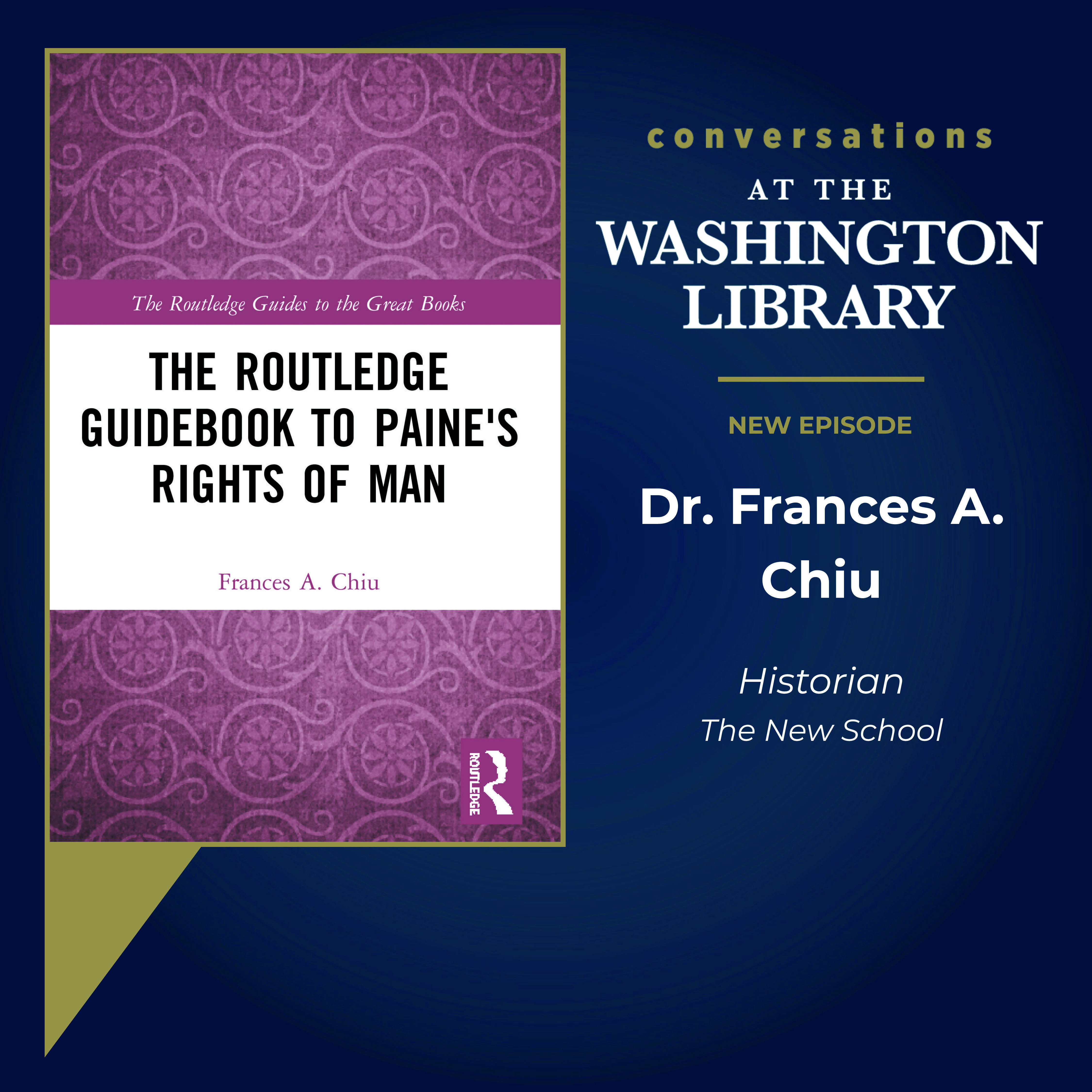
215. Reading Thomas Paine's Rights of Man with Dr. Frances Chiu
For most Americans, Thomas Paine is the radical Englishman, and former tax collector, who published Common Sense in early 1776. His claim that hereditary monarchy was an absurdity and that the “cause of America was in great measure the cause of all mankind” galvanized American rebels into thinking more seriously about independence than they had only a few months before. Paine would go on to publish The American Crisis and other writings during the America Revolution before trying to find his ...
Guest: Frances A. Chiu

214
Nov. 4, 2021
214. Weaponizing Settlement in Nova Scotia with Dr. Alexandra Montgomery
Although you might not realize it, in the years before the American Revolution, Nova Scotia was all the rage. People concocted various schemes to settle it, and the British government saw it as one of the keys to its new vision of empire after the Seven Years War. Nova Scotia has a fascinating, often troubled history. Indigenous peoples and European powers competed for the land, and access to the colony’s lucrative fishing grounds, drawing maps to stake their claims, making war, and in the case ...
Guest: Alexandra L Montgomery

212
Oct. 6, 2021
212. Recruiting the Hero of Two Worlds with Mike Duncan
To kick off Season 6, we bring you the story of America’s Favorite Fighting Frenchmen. In 1777, the Marquis de Lafayette sailed from France with a commission as a major general in the Continental Army. Unlike many other European soldiers of fortune, Lafayette paid his own way and had no expectation that he would be placed at the head of American forces. We best remember Lafayette for his service in the American Revolution, his close relationship with George Washington, and the key to the B...
Guest: Mike Duncan
5
Sept. 22, 2021
211. Revitalizing Myaamia Language and Culture with George Ironstrack (Summer Repeat)
In the eighteenth century, the Myaamia people inhabited what are now parts of Ohio, Indiana, Illinois, and Wisconsin. More commonly known in English as the Miami, the Myaamia figure prominently in the early history of the United States, especially in the 1790s, when war chief Mihšihkinaahkwa (or Little Turtle) co-led an alliance of Miami and Shawnee warriors that defeated successive American armies in the Ohio valley before meeting defeat at the Battle of Fallen Timbers in 1794. In the battle’s ...
Guest: George Ironstrack

204
June 24, 2021
204. Raising Liberty Poles in the Early Republic with Dr. Shira Lurie
If you’ve taken part in a part in a protest recently, perhaps you carried a sign, waved a flag, or worn a special hat. But if you had grievances in the American Revolution or early Republic, you might have helped raise a Liberty Pole. Now, you may ask yourself, what good is a large wooden pole gonna do about my high taxes? And you may ask yourself, do I really want to lift this heavy thing? Turns out, as the days went by in the late eighteenth century, many Americans thought Liberty ...
202
May 27, 2021
202. Digitizing the Maryland Loyalist Experience with Dr. Kyle Roberts and Dr. Benjamin Bankhurst
Maryland wasn’t so merry for some Americans during the Revolutionary War, especially if you happened to side with the king. Professing fealty to the Crown, for whatever reason or motivation, cost many Maryland colonists their property, and sometimes their lives. But for other Maryland Loyalists, like enslaved people, loyalism was an opportunity to achieve a different kind of American independence, or to turn ideas about class and patriarchy on their heads. Last week we, began our two-part look...
5
May 13, 2021
201. Uncovering the Virginia Loyalists with Drs. Stephanie Seal Walters and Alexi Garrett
Virginia was home to many of the most famous rebels like George Washington during the American Revolution, but it was also a den of Tories who remained loyal to the British king. Loyalists in all the colonies rejected what they called “the unnatural rebellion” and resisted Patriot forces as they tried to restore the king’s peace to British America. In Virginia, a civil war raged between white colonists, enslaved people who sought their freedom, and many more who just tried to stay out of the w...
193
Jan. 21, 2021
193. Rifling through Washington's Receipts with Dr. Julie Miller
Take a receipt out of your pocket. What does it say about you? Receipts can tell us a lot about people and the world in which they lived. And George Washington kept receipts. On today’s show, Dr. Julie Miller joins Jim Ambuske to discuss the hidden lives we can find in Washington’s receipts and similar documents. Dr. Miller is a historian and the Curator of Early American Manuscripts at the Library of Congress, where she oversees a vast array of archival material, including Washington Papers. ...
Guest: Dr. Julie Miller
188
Dec. 17, 2020
188. Exploring the Benjamin Franklin House of London with Dr. Márcia Balisciano
In 1757, Benjamin Franklin returned to London after an over thirty-year absence. He first ventured to the imperial capital in 1724 to continue his education as a printer; he went back in the late 1750s as a politician, after being named the London agent for the Pennsylvania Assembly. Franklin took up residence at 36 Craven Street in London, today just down the way from Charing Cross Station, and right near Trafalgar Square. For nearly two decades, with a short return to Philadelphia in between, ...
Guest: Dr. Márcia Balisciano
186
Dec. 3, 2020
186. Exploring New Frontiers in Early American History with Alexi Garrett, Michael Blaakman, Derek O’Leary, and Krysten Blackstone
In the eighteenth century, Benjamin Franklin and other early Americans likened themselves to a rising people who were creating something new under the sun. It’s fair to say that historians have a similar mindset: we’re constantly striving to uncover new evidence, make new arguments, and offer new interpretations that help us better explain the past. So on today’s show, we’re going to introduce you to just a few among a rising generation of historians who are doing cutting edge work in early Amer...
184
Nov. 12, 2020
184. Becoming Citizens of Convenience on the U.S.-Canadian Border with Lawrence B. A. Hatter
In 1783, the United States and Great Britain signed the Treaty of Paris, which confirmed American independence. As part of the treaty negotiations, American and British diplomats had to determine the new nation’s borders. They used maps like John Mitchell’s 1755 work A Map of the British and French Dominions in North America to figure out what separated the United States from what remained of British America in Canada. You can see a digital copy of the Mitchell Map here. In our own time, the U....
179
Oct. 8, 2020
179. Revitalizing Myaamia Language and Culture with George Ironstrack
In the eighteenth century, the Myaamia people inhabited what are now parts of Ohio, Indiana, Illinois, and Wisconsin. More commonly known in English as the Miami, the Myaamia figure prominently in the early history of the United States, especially in the 1790s, when war chief Mihšihkinaahkwa (or Little Turtle) co-led an alliance of Miami and Shawnee warriors that defeated successive American armies in the Ohio valley before meeting defeat at the Battle of Fallen Timbers in 1794. In the battle...
177
Sept. 24, 2020
177. Harnessing Harmony in the Early Republic with Billy Coleman
On September 14, 1814, Francis Scott Key began composing "The Star-Spangled Banner after witnessing the British attack on Fort McHenry. Of all the things he could have done after seeing that flag, why did Key write a song? And how did his new composition fit into a much longer history of music as a form of political persuasion in the Early Republic? On today’s episode, Dr. Billy Coleman joins us explore the power of music in the early United States, and how Federalists in particular used it a...
175
Sept. 10, 2020
175. Finding Redemption from Tyranny with Bruce Stewart
Conversations at the Washington Library kicks off Season 5 by exploring the life of a radical populist who never met a revolution he didn’t like. Almost unbelievably, Herman Husband participated in some of the most significant events in eighteenth-century America: The Great Awakening; the North Carolina Regulation Movement; The American Revolution; and the Whiskey Rebellion. Husband’s story illuminates the major religious, political, and economic upheavals that reshaped North America in this pe...
174
Sept. 3, 2020
174. (Recast) Tracing the Rise and Fall of Light-Horse Harry Lee with Ryan Cole
This episode originally aired in September 2019. You may know him as Robert E. Lee’s father, but Henry “Light-Horse Harry” Lee was so much more. Born into a Virginia dynasty, the man who would become one of George Washington’s protégés came of age with the American Revolution itself. Lee was a graduate of Princeton University, a cavalry commander in the war’s brutal southern theater, and he later served two terms as Virginia’s governor. He was a dashing figure who romanticized the ancient world...
170
Aug. 6, 2020
170. Forging a Founding Partnership with Edward J. Larson
Season 5 of the podcast drops in a few weeks. In the meantime, we're pleased to offer you Library Executive Director Kevin Butterfield’s recent live stream conversation with Edward J. Larson. Larson is the author of many books, including the subject of today's show, Franklin & Washington: The Founding Partnership. We need your help to make Season 5 of Conversations the best one yet. Please take a moment to complete our listener survey that will help shape the future of the show. You’ll find a l...
168
July 23, 2020
168. Mining King George III's Papers with Zara Anishanslin and Arthur Burns
While work continues on the podcast's upcoming Season 5, we’re pleased to offer you another summer interlude. For today’s show, we bring you the audio version of Jim Ambuske's recent live stream chat with Professors Zara Anishanslin and Arthur Burns about the Georgian Papers Programme. Now, most of you probably know that some Americans had a little - shall we say – disagreement with King George III two centuries ago. Something about taxation, tea, and tyranny. But did you know that researcher...
167
July 16, 2020
167. Reconstructing the Indian World of George Washington with Colin Calloway
Week 3 of our summer hiatus is another opportunity to bring you a fascinating look at early America courtesy of some of our recent live stream programming. On today’s show, we bring you Library Executive Director Kevin Butterfield’s conversation with 2019 George Washington Book Prize winner, Dr. Colin Calloway. Calloway is 1943 Professor of History and Professor of Native American Studies at Dartmouth University. He won last year’s Book prize for his latest work, The Indian World of George Wash...