
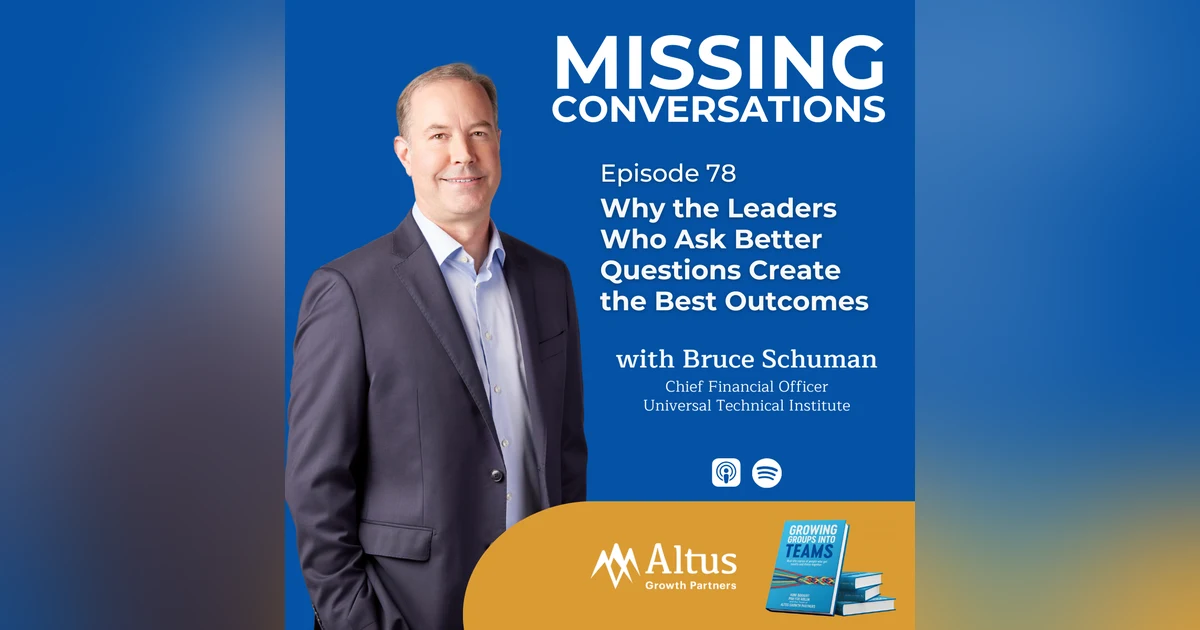
Episode #78: Why the Leaders Who Ask Better Questions Create the Best Outcomes

 Apple Podcasts
 RSS Feed
 Spotify
 Many leaders believe they need to have the answers. But some of the most powerful outcomes begin when a leader asks the question no one else thought to ask. In this episode of Missing Conversations, Altus executive coaches and hosts Dan Winter and Lynette Winter sit down with Bruce Schuman, a finance leader who has spent more than 30 years helping organizations navigate growth, innovation, workforce transformation, and operational scale inside companies like Intel, Vacasa, Kiavi, and now Universal Technical Institute. Bruce shares why the leaders and teams who create the strongest business outcomes are often the ones willing to slow down long enough to challenge assumptions, rethink the problem, and create the conditions for better thinking across the organization. Together, they explore leadership development, organizational alignment, innovation culture, workforce transformation, decision-making under pressure, and what it really takes to scale an organization without losing trust, clarity, or connection along the way. Listen in to learn how stronger questions, deeper partnership, and a culture of development can help your team lead more effectively through growth, uncertainty, and change.
Key Moments You’ll Want to Hear
01:48: What great CFOs do: moving beyond cost control to execute a bold vision responsibly and sustainably.
03:34: Why the leaders shaping the best business outcomes ask better questions instead of rushing to provide faster answers.
05:00: Decision-making under uncertainty: why high-performing teams move before conditions are perfect and learn faster because of it.
06:52: One of the costliest executive mistakes? Solving the wrong problem with operational excellence.
10:09: The cultural shift organizations need most: moving teams from task ownership to shared accountability.
11:00: What real cross-functional partnership sounds like: respectful pushback, challenging assumptions, and solving the right business problem together.
12:30: Bruce shares what leaders often underestimate when transitioning from large enterprises to faster-moving, high-growth organizations.
15:04: How finance teams become strategic growth partners instead of reporting functions and why that changes company performance.
17:13: How leaders earn influence and become trusted partners in the organization.
19:10: Why Bruce refuses to build “scorekeepers.” He wants people on the field changing the game.
20:44: How one department’s mindset can reshape organizational culture, collaboration, and decision-making across the company.
21:23: Why conversations after the meeting often shape culture more than the executive meeting itself.
24:52: Bruce shares the moment he realized finance was unintentionally slowing innovation by demanding certainty too early.
26:40: How leaders create innovation cultures: fund experimentation, tolerate smart failure, and stop forcing every initiative through the same ROI lens.
28:06: Leaders often say they want honest feedback. Bruce explains why few organizations create the trust required for people to actually give it.
29:54: The leadership growth edge: helping high performers acknowledge where they struggle so they can lead at a higher level.
30:22: How organizations create learning cultures where people feel safe admitting uncertainty and asking for help.
32:15: How strong leaders maintain high standards without creating fear, rigidity, or burnout across teams.
33:29: Why adaptive leadership requires holding firm to the mission while staying flexible about how teams achieve it.
35:40: How leaders scale organizations without losing people, culture, trust, or performance during rapid growth.
36:43: The workforce transformation challenge many leaders still underestimate and why skilled trades shortages could reshape the economy.
39:58: Bruce explores how outdated perceptions of success are shaping the future workforce pipeline and limiting career visibility for younger generations.
43:05: Bruce’s advice to emerging leaders: seek uncomfortable roles, honest feedback, and managers willing to invest deeply in your growth.
46:24: One of the fastest ways leaders build trust: showing teams how to receive uncomfortable feedback without defensiveness.
47:59: How leaders help organizations adapt to a “new normal” without exhausting people or overwhelming the culture.
By the end of this conversation, you’ll hear answers to:
How do leaders create a culture where people speak up, challenge assumptions, and contribute better ideas?
Many organizations unintentionally train people to stay in their lane. Bruce Schuman shares that strong partnership cultures are built when leaders move beyond simply asking teams to complete tasks and instead invite them into the bigger business challenge. That means creating an environment where people can respectfully push back, ask better questions, and challenge assumptions in service of a stronger outcome for the company. Bruce explains that trust grows when leaders consistently show they want people’s thinking, not just their execution. Over time, that shift changes teams from scorekeepers reporting results into strategic partners helping shape them. Timestamps: 10:09, 11:00
How do leaders balance high standards with team development during periods of rapid growth?
Bruce explains that growth requires both accountability and humanity. Leaders cannot lower the bar simply because growth becomes uncomfortable, but they also cannot ignore what people are navigating emotionally and operationally during transformation. At Universal Technical Institute, Bruce and the leadership team are helping employees adapt to a completely new pace of growth while continuing to invest deeply in development, support, and transparency. Rather than treating development as a separate initiative, Bruce sees coaching, feedback, and partnership as fundamental leadership responsibilities that happen alongside delivering business results. Timestamps: 32:15, 35:40
How can organizations innovate faster without creating unnecessary risk?
One of Bruce’s biggest leadership lessons came during his years at Intel, when he realized finance was unintentionally slowing innovation by demanding too much certainty too early. In the episode, he shares how organizations often hold every initiative to the same rigid ROI standards, which can prevent experimentation and breakthrough thinking. Bruce argues that leaders must learn to distinguish between decisions that require precision and decisions that require learning. The teams that innovate best are willing to move, test, adapt, and learn quickly instead of waiting for perfect information. Innovation cultures are built when leaders create room for experimentation while staying grounded in shared purpose, strategic clarity, and long-term outcomes. Timestamps: 24:52, 26:40
We accomplish the best outcome for the company when we're willing to ask the right questions, step back, and frame the problem correctly. ~ Bruce Schuman
About Bruce Schuman
Bruce Schuman is CFO of Universal Technical Institute (UTI), the nation’s largest workforce education provider in transportation, skilled trades, and healthcare. He brings 30+ years of senior finance leadership in tech and high-growth companies, and is known for building strong teams and scaling performance. He previously served as CFO at Vacasa and Kiavi, and spent 27 years at Intel in VP and Divisional CFO roles.
You can find him on LinkedIn at: https://www.linkedin.com/in/bruceschuman/.
About Altus Growth Partners
At Altus, we partner with CEOs and leadership teams who are serious about growth and willing to engage in new kinds of conversations to produce better results.
We care deeply about helping leaders and teams collaborate more effectively, navigate complexity with confidence, and foster a culture where people thrive. It’s in these environments that challenges are met with curiosity, people bring out the best in one another, and progress is anchored in shared purpose.
Because when leaders and teams are truly working together, they expand what’s possible and the meaningful impact they can make in their lives, their organizations, and the world around them.
You can find Altus Growth Partners on LinkedIn at: https://www.linkedin.com/company/altus-growth-partners/
About the Book
Growing Groups Into Teams: How do you turn a group of individuals into a highly effective, productive team? Growing Groups Into Teams is an unusually useful book written by a team of generative consultants and coaches who have helped thousands of groups become effective teams.
Through real-life stories combined with pragmatic advice, this book strengthens your ability to see what’s needed and take effective action:
-
What two promises turn a group into a team.
-
How to engage people to make those promises.
-
How to invite responsibility and accountability.
-
How to include and inspire people across differences.
-
How to build and rebuild trust, and more!
Regardless of how productive your teams are today, the insights in this book will help you grow to the next level to drive your business or organization forward. Order your copy today!
Order from Amazon: https://www.amazon.com/Growing-Groups-into-Teams-Real-life-ebook/dp/B0CJLC23VS
Order directly:
https://shop.ingramspark.com/b/084?l8SxF4Aexn9gq08iz7jFBbwutleujrftoZ2wAOFzCVH
If you're looking to expand your leadership influence, shift your results, and develop a highly engaged, accountable team, we’d love to talk to you. Schedule a conversation with an Altus Team Member here: https://calendly.com/prollin-altusgrowth/zoom-video-30-min.
Follow us on social media:
https://www.linkedin.com/company/altus-growth-partners
https://www.facebook.com/AltusGrowth
https://www.instagram.com/altusgrowthpartners/
Keywords:
#TeamDevelopment #FinanceTeam #WorkplaceCulture