Dread, Shadows, and the Stories We Tell Ourselves: Gothic Literature and the Supernatural
Gothic literature emerged as a powerful and enduring mode in the late eighteenth century, reaching particular momentum in the 1790s, when readers showed an unabated appetite for the bizarre, the macabre, and the supernatural. Although often associated with crumbling castles and storm-lashed landscapes, the Gothic was never simply about scenery or shock. It was a genre deeply concerned with fear, psychology, morality, and the hidden tensions of society. In an age shaped by revolution, religious doubt, scientific progress, and social upheaval, the Gothic gave imaginative form to anxieties that polite society struggled to articulate openly.
Classic Gothic tropes quickly became recognisable. Ruined or ancient settings suggested a decaying past that refused to stay buried. Ghosts, curses, family secrets, doubles, madness, and forbidden knowledge haunted both characters and readers. Innocent figures, often women, were placed in peril, while authority figures were revealed to be corrupt, cruel, or monstrous. Nature itself became threatening: forests, mountains, seas, and storms mirrored inner turmoil. These elements allowed writers to explore dread not as a fleeting emotion but as a sustained psychological state.
By the 1790s, the Gothic had split into two overlapping but distinct traditions: Gothic terror and Gothic horror. Writers of Gothic terror, such as Ann Radcliffe, aimed to unsettle readers through suspense, atmosphere, and anticipation. The fear lay in what might happen rather than what was explicitly shown. Radcliffe’s novels, including The Mysteries of Udolpho, often hinted at supernatural forces only to offer rational explanations, placing the reader inside a prolonged state of anxiety and uncertainty. Gothic horror, by contrast, confronted the reader directly with the unnatural and the grotesque. Matthew Lewis’s The Monk revelled in demons, corruption, and transgression, shocking contemporary audiences with its explicit violence and moral collapse. Where terror whispered, horror screamed.
The public enthusiasm for Gothic storytelling extended well beyond novels. Short Gothic chapbooks circulated widely, offering sensational tales at low cost. Ballads and poems with supernatural themes were memorised, recited, and endlessly reprinted. One of the most famous was Alonzo the Brave and Fair Imogine, which tells of a ghostly knight who returns from the grave to drag his faithless lover to hell on her wedding day. The poem was so well known that it inspired numerous parodies, a testament to how deeply Gothic imagery had embedded itself in popular culture. Ghosts crowded the stage in popular theatre too, thrilling audiences with trapdoors, apparitions, and moral reckonings from beyond the grave.
Romantic poets were equally drawn to the Gothic’s emotional and supernatural power. Samuel Taylor Coleridge used curses, spectres, and the supernatural as tools for moral and psychological exploration. In The Rime of the Ancient Mariner, the ghostly crew, the curse of the albatross, and the eerie calm of the sea transform a tale of maritime adventure into a meditation on guilt, isolation, and redemption. In Christabel, Coleridge introduced the unsettling figure of Geraldine, a mysterious woman whose vampiric qualities blur the boundaries between innocence and corruption, desire and danger. These works show how the Gothic could be subtle, symbolic, and deeply introspective.
A defining moment in Gothic history occurred in 1816 at the Villa Diodati, when a group of writers, trapped indoors by stormy weather, challenged one another to write ghost stories. From this contest emerged Mary Shelley’s Frankenstein, a novel that fused Gothic horror with emerging scientific anxieties and philosophical questions about creation, responsibility, and humanity. It marked a turning point, showing how old supernatural fears could be reimagined to address modern concerns.
The expansion of mass literacy and the rise of cheap print in the nineteenth century ensured that Gothic ideas reached an ever-wider audience. Newspapers eagerly published sensational accounts of hauntings, witchcraft, and cunning folk, blurring the line between reportage and entertainment. Penny dreadfuls transformed lurid news stories into serial fiction, none more famously than those inspired by Spring-heeled Jack, the demonic, fire-breathing figure said to stalk the streets of London. At the same time, novelists were reshaping older folklore into enduring supernatural figures, helping to create a pantheon of modern horror that would spread far beyond Britain. Gothic stories were written to scare and thrill, but also to warn, to instruct, and to reflect the fears and traumas of their age: industrialisation, urban poverty, changing gender roles, imperial guilt, and the fragility of social order.
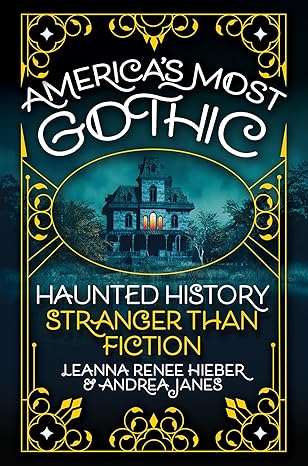
This enduring relationship between Gothic tropes and real human experience lies at the heart of America’s Most Gothic: Haunted History Stranger Than Fiction by Leanna Renee Hieber and Andrea Janes. The book asks a compelling question: can Gothic literary tropes help us better understand real life? The authors argue persuasively that they can. Rather than treating ghost stories as mere curiosities, they analyse them as meaningful cultural expressions shaped by dread, psychology, and place. In doing so, they echo the Gothic tradition’s original purpose.
In the introduction, the authors attempt the difficult task of defining the Gothic itself. They propose three core principles that underpin the genre: dread as the driving force of the story, psychological experience as its focus, and setting as an active presence that shapes events. These ideas are then applied throughout the book, as American ghost stories and urban legends are examined through a Gothic lens. The authors also reflect on why interest in the Gothic surges during periods of upheaval, suggesting that moments of uncertainty create a renewed need for stories that confront fear head-on.
The book is structured around seven recurring Gothic tropes: wild and foreboding landscapes, women on journeys, haunted houses, hidden chambers, mysterious omens, open crypts, and cursed families. These sections are deliberately arranged to mirror a Gothic narrative, guiding the reader from an ominous exterior world into increasingly intimate and disturbing spaces. Each section opens with a quotation from Edgar Allan Poe, grounding the analysis in the American Gothic tradition, and is followed by chapters exploring real ghost stories connected to each theme. A central photographic section reinforces the sense that these are not abstract tales, but stories rooted in real people and places.
Particularly striking is the section on women on journeys, which continues the authors’ work on female ghost stories and their social meanings. Here, familiar Gothic figures such as ghost brides are examined as reflections of women’s anxieties about marriage within patriarchal systems, even as such stories are sometimes exploited for tourism. Other chapters recover the lives of women whose histories have been distorted or overshadowed, such as Marian “Clover” Adams, whose suicide has often eclipsed her achievements, and Helen Peabody, a formidable headmistress remembered as a guardian figure beyond death. The inclusion of Charlotte Cushman, a queer actress who defied gender norms on and off the stage, complicates traditional Gothic roles. Described as a Byronic, Gothic antihero, Cushman demonstrates how the Gothic makes space for women who are powerful, flawed, unsettling, and resistant to easy categorisation.
The book also broadens the definition of haunting. In sections such as “An Open Crypt”, literal ghosts sit alongside metaphorical afterlives. The New England vampire panic, fears of premature burial among Spiritualists, and the disturbing case of Elena Hoyos, whose body was stolen and abused after death, all reveal how dread can arise from cultural fears surrounding death, medicine, and control. Elsewhere, places marked by racism, slavery, and violence are explored as Gothic spaces imprinted with historical trauma rather than spectral figures.
One of the book’s greatest strengths is its personal tone. Both authors share their own encounters with the paranormal and explain why particular stories resonate with them. These moments reinforce the central argument: that whether or not one believes in ghosts, such stories matter. They reveal how communities process grief, injustice, fear, and memory.
In this sense, America’s Most Gothic stands firmly within the long Gothic tradition. Like the chapbooks, ballads, poems, and novels of the eighteenth and nineteenth centuries, it treats the supernatural not as escapism, but as a mirror. Gothic literature has always thrived when societies are unsettled, offering a language of dread through which people can confront what haunts them most. You do not need to believe in ghosts to appreciate these stories, but by the end, you may find yourself believing more deeply in the power of the narratives we pass down, and in the shadows they continue to cast over our understanding of the world and what they reveal about ourselves.
You can listen to my interview with the authors of America’s Most Gothic here: https://www.podpage.com/haunted-history-chronicles/americas-most-gothic-when-history-becomes-the-haunting/ or https://www.youtube.com/watch?v=L3O3z5221-M
You can purchase a copy of the book here: https://www.amazon.co.uk/Americas-Most-Gothic-Haunted-Stranger/dp/0806543744

Host, author and producer
Hi I’m Michelle.
Teacher, podcaster, history and paranormal enthusiast and woman who wears many hats and spins many plates including dog whisperer- as you will often find Archie my dog- joining me during podcast recordings where he promptly falls asleep clearly not as enthusiastic about the subject as I am. It does mean his dulcet snoring can often be heard gently in the background- his contribution as occasional co- host needs a little work.
I live in Oxford in the United Kingdom and I love travelling and exploring historical sites throughout the UK for its history and haunted activity. One of the best gifts I ever received was English Heritage vouchers to use to explore various different historical sites. I had the best summer that year. (For friends and family possibly reading this please note that hint for future gift ideas!)
I started this podcast as an adventure through some of my passions. It has been immensely exciting getting to know lots of other people around the world who have these same common interests. I’ve been humbled by the encouragement and support from strangers and people who have become new friends! I truly could not do this without you.
This isn’t something I have done before and I’m learning everything as I go along - from equipment, to editing, to even creating this website. I’m loving it though- it’s a lot of work - but worth every second. Thank you for being patient as I learn and improve along the way. I have big dreams of where to take this podcast and community I hope we build here. If you wish to support that dream and this c…Read More
Sale!