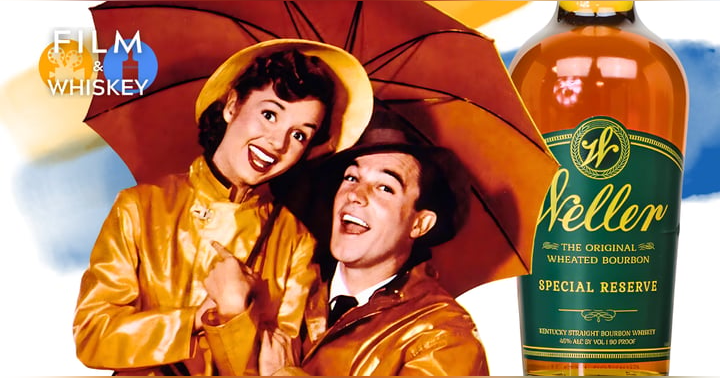
Singin' in the Rain (1952) / Weller Special Reserve Bourbon

This week on the Film & Whiskey Podcast, Brad and Bob revisit one of Hollywood’s most beloved musicals: 1952’s Singin’ in the Rain. And they’re not splashing through the puddles alone: friend of the show and ReserveBar’s own Lee Diaz returns to bring his signature blend of charm, film knowledge, and whimsy.
The trio dives deep into why Singin’ in the Rain remains a high-water mark for movie musicals: the dazzling choreography, Gene Kelly’s complicated brilliance, Debbie Reynolds’ breakout performance, and Jean Hagen’s scene-stealing comedic masterclass. From the satire of Old Hollywood to the behind-the-scenes stories that shaped the film, it’s a conversation as lively as a tap routine.
On the whiskey side of things, the guys uncork Weller Special Reserve, a bottle with a big reputation and… let’s just say some complicated feelings. Is it a smooth classic or the Lena Lamont of the Weller lineup? You’ll have to listen.
Plus: a spirited round of Two Facts and a Falsehood, a thoughtful Make It a Double pairing session, and Lee’s reflections on whimsy, Hollywood history, and ReserveBar’s Top Flight single-barrel program.
It’s one of our most joyful episodes of the season, and a reminder that sometimes all you need is a great film, a glass of bourbon, and a little whimsy.


Bob and Brad are joined by friend-of-show Lee Diaz to revisit the classic film Singin' in the Rain alongside a review of Weller Special Reserve bourbon. They explore the film's themes of whimsy, the transition from silent films to talkies, and the iconic performance of Gene Kelly. T
Then, they break to sample Weller Special Reserve, discussing its nuances of pricing and value.
Chapters
00:00 Introduction
04:02 Brad Explains the Plot of Singin' in the Rain
07:19 Personal Connections to the Film
17:53 Gene Kelly: The Icon and His Persona
23:56 Stylistic Choices and Cinematic Techniques
35:34 Whiskey Tasting: Weller Special Reserve Overview
56:10 Two Facts and a Falsehood
01:16:00Final Thoughts on Singing in the Rain
01:26:28 Let's Make it a Double and Final Scores
--
Film & Whiskey Twitter
Email us!
For more episodes and engaging content, visit Film & Whiskey's website at www.filmwhiskey.com.
[Brad]
In 1952, director Stanley Donen and star Gene Kelly gave the world a bright retelling of the dawn of a new era for film.
[Bob]
In 2025, we have a whiskey that leaves us wondering, are you my lucky star? The film is singing in the rain.
[Brad]
The whiskey is Weller Special Reserve. And we'll review them both. This is the film and whiskey podcast.
[Bob]
Welcome to the film and whiskey podcast, where each week we review a classic movie and a glass of whiskey. I'm Bob Book. I'm Brad Gee.
And this week we are revisiting the 1952 masterpiece, Singing in the Rain. Dude, this is one of those movies. I know that I keep saying it, Brad, as we revisit these films from season one for the first time in six years, but we had quite a few in this original season one lineup that are in that echelon of films where it's like, wow, I can't believe that we're actually talking about this one today.
And Singing in the Rain is definitely in that group for sure.
[Brad]
Yeah. And like over the years, like you just said, we've been doing this for six freaking years now, Bob. We have had some stellar guests on the list.
We've made friends with some incredible people. But talk about this top echelon. Oh, Bob, come on now.
The top peak echelon of guests we have with us today, the one and only Lee Diaz of Reserve Bar. What's up, dude?
[Lee Diaz]
Gentlemen. Man, so excited for this one. Thank you for inviting me.
[Bob]
Yeah, it's good to see you again, Lee. I'm starting to think that you have a type when it comes to the movies that you pick on our podcast. And that is like, that's the warm fuzzies.
And then, you know, honestly, that's OK, because I associate you with the warm fuzzies. You are just like the best guy to hang around. Last time you were here, I believe we were talking about Night at the Museum, and this time it's Singing in the Rain.
So, you know, you're two for two on the warm fuzzies, man.
[Lee Diaz]
Well, you did miss Everything, Everywhere, All at Once. Oh, yeah. And also a warm fuzzy.
Well, thematically, I put it in the category of whimsy. I really have a strong propensity for loving movies that just generate this idea of whimsy in some way. And really good just character development and just overall enjoyment.
And so that's, I think if you created a theme across those three, that would kind of be what my theme is. And it's kind of how I approach film as well. I think I tend to not be as critical just because I go in just saying, what am I going to claim from this?
And even if that's just pure joy, great.
[Brad]
Yeah, absolutely. Dude, our world could use a little bit of whimsy nowadays.
[Lee Diaz]
Don't we all need just a little bit more whimsy these days?
[Bob]
The other night, I actually took both my kids to a production of Elf the Musical, which I didn't even realize. This is me being out of touch with the current state of Broadway. I had no idea that there was a Broadway musical made from the film Elf.
And it was delightful, Brad. It was like a big old timey. The music reminded me of the producers.
It had that kind of like 1950s jazz kind of thing to it. Old throwback Broadway stuff. And you know what it had a ton of, guys?
It had whimsy. And it was wonderful. Not just whimsy.
Big fan. Whimsy.
[Lee Diaz]
And way to ruin my make it a double. I mean, really.
[Bob]
Oh, all right.
[Lee Diaz]
I'm just kidding.
[Bob]
We'll get around to let's make it a double in a little bit. But before we get there, we have to get into our first segment of the day, which we call Brad Explains. Brad Explains is the part of the show where Brad breaks down the plot of the film that he has just seen, at least for the second time this season.
And folks, by the way, if you are new to film and whiskey, welcome in. You picked a great episode to join us for. This movie freaking rips.
I love singing in the rain. What we do on film and whiskey is we review a new classic movie each week. And this season, we're revisiting all the films we talked about way back in season number one.
So that means that Brad has seen all of these movies at least once, which is a minor miracle if you know anything about Brad G. And Brad, this does strike me, though, as a film that you have seen more than two times even because it is just such a good, lighthearted, family oriented flick.
[Brad]
Brad, one that I've only seen two times.
[Lee Diaz]
I was going to say, I bet you it's only two times.
[Brad]
I never saw singing in the rain until we watched it for the podcast, and I have not seen it since. So here we are, Bob. Second time around.
[Bob]
I'm OK with that because you got to re-experience singing in the rain.
[Brad]
It's a heck of a movie, man. It is like, yeah, let's get into Brad explains.
[Bob]
Yeah, OK, let's get into Brad explains the way this works. Brad gets 60 seconds on the clock to break down the plot of this movie. Folks, if you have not seen singing in the rain, I believe it is like an hour and 45 ish minutes long.
So it's not quite the esteemed 90 minute film, but it moves at the pace of a 90 minute film. And it is I mean, I can't recommend it highly enough. If you haven't seen it, press pause here.
Go watch singing in the rain and then come back because Brad's going to spoil the whole thing.
[Brad]
Brad, you have 60 seconds on the clock and go singing in the rain is a film that follows a young cast as they are navigating the transition from silent films to talkies. You have Gene Kelly playing the star Don Lockwood and Gene Hagen playing the star Lena Lamont. And you realize very quickly that Lena Lamont is a terrible human being with the worst voice on the planet.
And the main characters are trying to figure out how do we keep our success in a world where we can't hide her voice any longer. On the way, they discover a young talent that I can't think of her character's name right now, but it's Debbie Reynolds. And she's awesome is what's her what's her character's name?
Kathy, Kathy, Kathy is discovered who has an awesome voice is a great dancer, and they turn her into a star and absolutely ruin Lena Lamont's career. I mean, they just brutalize her.
[Bob]
Yeah. Wow. I didn't realize how dark the arc of this movie is until you framed it like that, Brad.
[Lee Diaz]
Hold on, guys. Is this like the karate kid where we actually find out that he was the bad guy the entire time?
[Bob]
This we may have just reframed this entire film for everyone.
[Brad]
And on that note, go ahead. I mean, I will say Gene Kelly not known for being a good human being. No.
[Bob]
And that's another thing we'll get into here. So my first question was going to be for Lee. You know, we did circulate a list to all of our guests and say, pick from this list.
And you jumped at singing in the rain pretty quickly, Lee. So, you know, it's a movie that is incredibly beloved. It's not hard to understand why anybody would want to pick it.
But I am curious to know, like, what's your personal history with this movie? And why did it jump out to you from this list of season one films?
[Lee Diaz]
Well, I grew up on a lot of the classics and specifically these classic musical movies. I think they were constantly playing, just being in a house full of kids. And I just feel like they were always on.
And so for me, this is the type of movie that is a really nice throwback. I also love and well, you know, getting back to that idea of whimsy. I just love this idea of really viewing classic Hollywood as something that was sensational and beautiful and mesmerizing.
And I think that singing in the rain really captures that while also showing you like, hey, there was no CGI. These guys were just doing full cuts that were just miraculous runs of dancing and singing and transition that had never been done before. And to see it all come together, you know, back in the 50s is just amazing.
[Bob]
Absolutely. I think one of the places I'd like to start is rewatching it this time. You know, you notice new things every time you watch a movie like this.
And Brad, we've talked about this movie before. And we've talked about what I would consider its counterpart, 1951's An American in Paris quite a bit as well. And I'm sure that there will be lots of comparisons and contrasts to draw from those two movies.
But this time around with singing in the rain, what I really appreciated about it was how early and how quickly it is both a love letter to Hollywood and also very immediately is like this place is full of it. Everyone's a phony. You know, you get you get Don Lockwood attending the movie premiere dressed in all white.
He looks incredible and going, oh, I don't want to tell my story in front of all these people. His arm goes up like this and everyone cheers. And so, you know, from the very beginning, this is a manufactured publicity stunt for this guy.
And as he tells his story of rags to riches fame, which isn't really even told as rags to riches, it's told as a society boy makes good. They're showing you the real history of what's happening with him, which is like dancing in pool halls and sneaking into like dirty movies and everything else. And and the great thing is like from the very beginning, you understand this is a guy who has to be somebody he's not.
He has to project an image of stardom, even though he's just a regular guy. But they do such a great job of also balancing that with he does need to be brought down a peg or two. Like he's a good guy who's also kind of drunk his own Kool-Aid a little bit.
And the onset of this, you know, sound pictures coming into play are throwing him wildly into disequilibrium. And it's such a great setup for where the movie goes from there.
[Brad]
Dude, it honestly kind of reminds me of our conversation about catch me if you can a little bit like this idea that he is trying to create this false story, this false narrative for people to believe in. And yet it's coming crumbling down in front of his own very eyes. And he doesn't know who he is in the midst of this this story, this this fairy tale falling apart around him.
It's it's it makes for a fascinating trope in in movie storytelling. And it's interesting, though, to see it back in the 1950s, a movie in the 50s about movies in the 30s also replicated in the 2000s with Spielberg. Right, right.
[Lee Diaz]
Yeah. And I actually don't think Don Lockwood in this movie is a good guy. Right.
So I I actually don't believe really for the first part of the movie that he is actually a good person. I think that's why Cosmo is with him. Right.
Like, I actually think Cosmo as like the the beta to his alpha is actually the good guy who keeps him kind of grounded to some degree and keeps him almost like relationally aware of what's going on. Like Cosmo is always the guy who kind of course corrects. And clearly, even in the beginning, when they're in the premiere, Cosmo is kind of in the back being like this thing again.
[Brad]
Right.
[Lee Diaz]
And it's it's really like, hey, I've and then they show the the comeuppance of that career. Hey, they've had to struggle through it. And it's always been that same dynamic the entire time.
That dynamic actually still doesn't really change throughout the movie until towards the end where Cosmo becomes like the idea guy. But it really never changes completely.
[Brad]
I love I just love the running joke throughout the movie where like Cosmo just keeps getting promotions. It's such a great gag.
[Bob]
It's a very similar dynamic to like, you know, whoever is hanging around with LeBron when he goes to a team is like, oh, you're you're the player development coach now. Right. Have you ever coached before?
No. But now you're getting a million dollars from the Los Angeles Lakers. Congratulations.
Doesn't sound too bad. I think the reason I think the reason this movie works, though, is that it's able to have its cake and eat it, too. It's able to kind of skewer Hollywood and to clue the audience into the fact that like this is all a mirage.
Everything we're doing here, you know, you're on you're on the set with them as they like pull walls away and a guy's in full costume, like reading the newspaper, like, what's up, Joe? You know, and at the same time, it knows that you can't just have a movie where you're saying Hollywood is BS and it's all a sham and it's cynical. Like it also needs to participate in those illusions and sell those illusions to the audience.
So you have a moment like, you know, Don Lockwood's Cosmos car breaks down and he gets mobbed by a bunch of fans and he has to have the most acrobatic getaway jumping over trolley cars and into someone's passing car as they drive by. And it's like this is not reality. But this is what we want to see in a movie.
We want to see a movie star who, even when he's playing a movie star in his off time, is able to jump off of trolley cars into moving vehicles. Like I think it just understands how to entertain and the areas where you can, like, remove the wool from the audience's eyes, but then immediately put it right back over their eyes without them noticing. It's a magic trick in a lot of ways.
[Lee Diaz]
Well, I think even down to the red car that the trolley car that he jumps on. I mean, I think even within this, the movie entire like the entire way through also reminds you that it celebrates Hollywood and it to a larger degree almost celebrates L.A. And so like the trolley car he's jumping on is that Pacific Electric red car that during that time frame, everybody knew if you had been in L.A. anywhere, you rode on a red car. And so this is creating that connection between like we're not in a sound studio, which for the most part they were.
But here's the red car. Here's a little bit. Here's another piece of this experience here.
[Brad]
I also love how one of the key elements of Don's like redemption as a character is that his story of coming up is about him working really, really hard. And then you really kind of catch him at the peak wondering how to reinvent himself. And the key moment of reinventing himself is when when he decides to work really hard with his team that's been with him the whole time, you know, Cosmo and his new girlfriend.
And they they have to put together this whole grand scheme. It almost feels like a caper a little bit like they have to go to all these links to keep Lena from finding out what they're doing. And they have to record all the sound from Debbie Reynolds.
And by working really hard, he's able to pull off a miracle. And I think that's like something we want to believe in about Hollywood is that when you have the right people in the right place that work really, really hard, you can take anything absolute garbage like what the movie originally was at the first premiere and turn it into something beloved and beautiful. Yeah.
And like that feels like Hollywood at its core. Like you talked about Elf a few minutes ago. Elf is one of those movies that was made on a shoestring budget and has become one of the most beloved holiday films of all time.
Like those are the stories we love about Hollywood.
[Bob]
Yeah. And again, it understands where it needs to Hollywood eyes its own story, right? Like we're dealing with a major studio and it's standing in for Paramount monumental pictures.
And even within this giant studio system in the 1920s, you're able to have these three people just be like scrappy go getters and save this movie. Like where's the director? You see this guy, Mr. Dexter early on in the movie. And then all of a sudden, Gene Kelly's like, screw that guy. I'm directing the movie now. And honestly, like that kind of happens.
Well, I think that in a lot of ways, like it reminds me of Brad, all of our conversations we've had about Top Gun Maverick and how that movie is really just Tom Cruise making a statement about being a movie star in Hollywood in 2023 or whatever. Like that's Gene Kelly. He's like, look how I can direct this movie.
I do it so much better than everybody else. And one of the bits of trivia is that he had an ongoing feud with Louis B. Mayer, the head of MGM over his desire for control of his movies.
And so what happens in this movie? He convinces the head of the studio to let him have complete creative control. And dammit, if he doesn't save that movie, Brad.
[Brad]
Obviously, what else would Gene Kelly do? He saves everything. What an American story.
[Lee Diaz]
I love it. Unfortunately, Gene Kelly never had the heart change that Don Lockwood did.
[Bob]
Why don't we just go ahead and talk about Gene Kelly that I feel like we keep we keep kind of tap dancing around it around it.
[Lee Diaz]
Oh, man, way to go.
[Bob]
Here's the thing about Gene Kelly. I love Gene Kelly. Like, it's just I don't know if I've ever seen anyone be able to so sell and exude feelings when he's dancing.
And like when he even when they're just mugging for the camera as they tap and you see him do his big old smile and then kind of look over and then look back and they're having so much fun. You just feel like that is what a human being looks like when they are having the most fun they could possibly have. And it doesn't hurt that Gene Kelly is he was built a different way than any onscreen dancer had ever been built.
Like he's muscular. He's not built like Fred Astaire, who was really slender. And so he always had this kind of like man of the people thing about him that he was able to bring to the movies from Broadway.
[Brad]
He was like LeBron James of the 1950s dance scene.
[Lee Diaz]
He also wants to be known as the goat, too. But yeah, exactly.
[Bob]
He's impossibly good looking. He's a good singer. He's an incredible dancer and choreographer.
And then outside of that movie persona, he's known as being one of the most competitive. He's actually much more like Michael Jordan in his real life. The stories I've been reading even today of like I think at one point, Brad, we were talking about one of his movies and I mentioned that he had to drop out of being in the film Easter Parade in, I think, 48, where he was supposed to star alongside Judy Garland.
And at the very last minute, he broke his ankle and they had to tap in Fred Astaire and it became Fred Astaire's big comeback movie. And the reason that he broke his ankle, I found out today, is that he was in a competitive like pickup volleyball game that his team lost. And he got so mad at losing that he stomped on the ground in disgust so hard that he shattered his own ankle.
And then like 10 years later, you know, the peak of the musical had already happened. It's 1958. Kelly's getting older.
He was on a vacation in like the Swiss Alps and he found himself trying to outrace Swiss skiers who were training for the Olympics. And he was so competitive at trying to outrace them that he tore a bunch of ligaments in his knee, which then made him not be able to dance on screen anymore. That was like it screwed up his knee for the rest of his life.
But like that's the kind of guy he was. And he was driven so much by that competitiveness that he took it out on everybody else around him. It's crazy.
It's a weird story, man.
[Lee Diaz]
Well, first of all, that saved Judy Garland's life because, I mean, Debbie Reynolds nearly died. I mean, filming this movie and, you know, Donald O'Connor also nearly died filming this movie. So, you know, I feel like maybe Judy Garland was saved by not having to.
She caught a break. Yeah.
[Bob]
Yeah, man.
[Brad]
Yeah, she caught a break. Yeah. I feel like they need to make a documentary about him called The Last Dance in the Rain.
[Bob]
The Last Dance. And it's just Gene Kelly. But for some reason, he's got a Bulls jersey on.
He's just smoking a big fat stogie. I do think this movie, obviously, it is his most iconic performance. That's the Singing in the Rain number is like it's literal cinema iconography.
You can slap that picture on anything and people know who it is and what it's from. But it's also maybe the best kind of distillation of what Gene Kelly's onscreen persona was and what he was capable of doing. He was really good at playing like he could play wounded.
He could play hurt. He could play cheeky. You know, he could play, oh, I'm going to let this roll off my back and I'm palling around.
And then he could also just exude that joy. And it really is hard sometimes, Brad, to reconcile what you know someone to be like in real life with that sort of like parasocial relationship you have with the figure on the screen, because I never get tired of watching Gene Kelly. But I get tired very easily when I hear like, here's what he was really like, you know?
[Brad]
Yeah, I grew up as a Fred Astaire guy. I did not watch a lot of Gene Kelly. And so I don't have any attachment to him.
I kind of find him to be a little cloying at times. Oh, interesting. He just comes across like he's trying to be joyful.
And I don't always enjoy it. And I found myself at points through this movie when the camera's just on him for too long and you have a dance sequence that's eight minutes long, 10 minutes long. And you're just like, all right, is this are we done with Gene Kelly yet?
I really found myself earlier, Bob, you said that this was near the fabled 90 minute film. This film felt like a two to two and a half hour movie for me, man. It dragged at times.
OK.
[Bob]
Man, it's funny you say that because I've had that problem with this movie before. And then on this watch, I don't know if it was just that I'm comparing it to American in Paris, which we know drags. But I also have always I've kind of crapped on Stanley Donen versus Vincent Minnelli in the past, because Vincent Minnelli with American in Paris, it's so like painterly the way that he composes shots.
Stanley Donen is much more like utilitarian, like, let's move the camera. Let's do this. But what I really found incredible this time, I didn't realize this.
Stanley Donen's like 28 when he makes this movie. And really, and I think that he he already has a sense of like, here's how I want to use the camera. It's not the same as a Vincent Minnelli.
But even in that first scene where they're all outside of Grauman's and you get like they're trying to communicate things visually. So they'll do a quick cutaway to like two girls that are just like chewing bubblegum and holding an image of Lockwood and Lamont so that they can push in on that magazine and establish who they are. And then there's a shot of like everybody standing up for Zelda as she arrives.
And then you have that guy stand up right into the frame and go, oh, Zelda. And it's like it's such a weird off putting like extreme close up. But he's accomplishing like two or three setups in one shot.
It's that kind of Spielberg thing. And I think that this time through, I was so impressed not just by the camera work, but in how I think this thing freaking moves like gangbusters. And the only stretch that I think grinds it to a halt is that Gene Kelly.
I have to have a 20 minute ballet sequence in my movie. Yeah. But for the rest of it, it was like perfectly plotted for me because every scene either builds to a musical number or a gag or a stunt.
And it's like you get three forms of action, I guess, or three forms of entertainment. And every single scene is building to like here's a good punch line or here's going to be a tap dance number or here's Gene Kelly jumping off a trolley. And I'm like, this is all I want.
Inject this into my veins all day, man.
[Lee Diaz]
I think that stylistically, it's just a reset of the palette, right? Like I just think that when you get into this movie and funny enough, while I was watching it again last night, my mom heard it from the other room because I'm back in California right now. And she, dude, I listened to the goriest of films and all sorts of stuff and Discovery Channel and stupid ghost adventures and whatever.
But it's when I'm watching Singing in the Rain that she's like, what are you watching, right? And I actually think that it's just because it is such a dynamic change from what we are typically watching that you almost even have to reset your understanding of flow. Because Bob, to your point, I actually really love the flow.
And that's also why I really love the camera work, because there are these dramatic just runs of the camera for what seems like two to three blocks as they're working their way through scenes. And so those things are just dynamic and beautiful. The comedy is great.
The dancing overall is great. You know, so I think it all hits. It's just the packaging is now so dated and different that you just have to say, this is different.
[Bob]
Yeah, I almost had to watch it as like an action movie this time. You know, Brad, we've talked in the past about Raiders of the Lost Ark and how that's always cited as being, you know, is inspired by those serial short films that they would show before movies. And those are one real long, right?
12 to 18 minutes long. And how if you watch Raiders, it's like every 20 minutes there's an action sequence to pay off that reel of the movie. And this is almost like that, but almost on like a scene to scene basis.
There is there's a point to every scene of this movie. And the only one that I really noticed that didn't really have a point was the Moses Supposes number where they're just like, let's just let's just throw a bunch of crap on this guy and like literally throw stuff on him and make fun of him.
[Brad]
And then the scenes over might be the best scene of the movie. Guys, exactly.
[Lee Diaz]
So I didn't even care. You don't understand. They are they are unloading their past on him getting ready for the talkies.
[Brad]
Ah, it's a metaphor. It's a metaphor. This is Moses is from a long time ago.
[Lee Diaz]
They are they are the diction. He's there. They're working on their diction and they are getting rid of their past just like Moses did.
[Bob]
Just got to let it go. Am I right?
[Lee Diaz]
Let it go.
[Bob]
Lee, this is why we bring you on. This is the hard hitting metaphor that we were looking for today.
[Brad]
The scene that didn't make any sense to me was when they first show the talkies and then they show like a five or six minute dance sequence that you just does not need to be in the movie whatsoever. Like, I'm all about old movies and their excesses. That was the one part for me that I was like, I'm over this, even though it has one of my favorite shots where it pulls up right above him and he's looking up into the camera and you never see people with a camera.
This isn't a Dutch angle. This is like a Norwegian angle.
[Bob]
It's a crane shot. Yeah, and it's an homage to like those old Busby Berkeley musicals of the early 30s that were just really opulent like that. It has one of my favorite.
It has to be intentional. So I'm going to call it a punch line. But through the whole that whole montage, they cut to, you know, they're making this musical number, Beautiful Girl, and they're cutting to the director behind the camera and he's cranking the thing on a tripod.
There's one camera supposedly filming this scene on a little tripod, and then it ends with the camera like zooming up into the sky. And when they cut back to him again, he's still just cranking on the one thing. And then the head of the studio goes, that was stupendous.
And he's like, oh, thanks. And then they just move on with the rest of the scene. It's like, wait a minute, you accomplished that with this camera?
What are you doing?
[Lee Diaz]
Guys, it's a meta experience. I mean, we are we are outside of ourselves in this moment.
[Bob]
We're back into the everything, everywhere, all at once territory.
[Brad]
We are. I think one of my favorite gags is when the director of the studio, Monumental, walks in after the director has been yelling for like 10 minutes about the sound and he catches himself on the wire and rips it. What is this?
This is dangerous. Just goes flying. Yeah.
Gene Hagan is true.
[Lee Diaz]
I love when Laura's mic, to your point, is like everywhere, right? She's walking up and they're like, they hear the pearls constantly. And then when she turns her head, it's like, hello, what are you?
It's just perfect. And then they have to put it here and then they have to put it here. And that, you know, it's awesome.
[Bob]
Well, and I think that that gets back to this. It seems like a very kind of quaint movie now, but I think you have to remember a couple things. So first of all, it is lampooning things that were in the past when it was made.
So it's making jokes about how simplistic people and audiences were in the 20s. But it's stuck. It's still stuck using the conventions of a 50s movie to do that.
So it almost feels like double quaint to us to watch how they're portraying things. But I do think there are some things that you have to take note of. One of which is like there are not a lot of movies where the audience does get any sort of peek behind the curtain into how movies are made.
Like you had Sunset Boulevard a couple of years before this movie that kind of pulled back the curtain on the dark side of Hollywood. You've got movies like The Bad and The Beautiful, which come out this same year that do the same thing. But those are darker, almost noirish movies.
And this is one where it's like, hey, here's how hard it is to capture sound on a sound stage. And here's what happens when the film goes through the projector at the wrong rate. And here's what happens when the audio goes out of sync.
And these are things that like when have you ever seen a movie from the 1950s where a guy's going like and they're playing things in slow motion. That wasn't a thing you saw in movies before that. And to call it out, not as an accident, but like here's how we're actually going to make this movie play to mimic slow motion.
It was way ahead of its time.
[Brad]
Yeah, I the the sound design part of it just got me where it made me think of a video either I sent you or you sent me, Bob, about like, how did the Beatles capture such good sound for their rooftop concert? Right. And it's a great video because it dives into like how you how you record sound and the science of it all.
And it I thought of that as we were watching this, where it's like, I think this is just Hollywood people trying to like whisper to the audience, like, by the way, what we do is really hard.
[Bob]
Absolutely. But in a way that's still entertaining.
[Lee Diaz]
Yeah. Yeah. And I also think that one thing that I loved around this part in the movie is just this idea that came up, which was just when Lena and and Donner are in their scene and they're finally this is before the talkies, they're doing their scene and they're just going at each other constantly.
And so it looks like they're romantic and in love and everything like this, but they're just they're just jibber jabbering the whole time. It's it's anchorman. It is anchorman.
Yes. Yes.
[Bob]
And then he basically says, I'd like to punch you in the ovary.
[Brad]
You dirty pirate hooker.
[Lee Diaz]
You just took my other. Let's make it a double. Damn it.
Um, no, but then but then it just made me think like, oh, yeah, there were people that went like lost their job because they were no longer relevant. As talkies became a thing.
[Bob]
Yeah.
[Lee Diaz]
And that was a matter of bad voices, bad acting, bad script writing, because now they actually had to write scripts ahead of time and think about what was happening. Like all of these things now mattered.
[Bob]
Yeah, that that also has one of my favorite lines of dialogue where, yeah, you're right. They're mimicking or miming being in love with each other. And he's like kissing her hand.
And and she's like, sticks and stones may break my bones. And he's like, I'd like to break every bone in your body.
[Brad]
Bob, don't you mean to say sticks and stones will break my bones?
[Bob]
I think we should save our conversations about the other actors until after break. But before we get there, I do want to talk about to your point here, Brad, with that lovely voice you just affected. The reveal of Lena's actual voice is done so well because for the first like 10, 12 minutes of the movie, she doesn't talk.
And at first you like you don't realize that they're keeping her from talking. She just doesn't talk. And then they go out on stage to say thank you to the audience after the movie.
And he's physically pulling her back and she can't talk. And then you finally get her going.
[Lee Diaz]
What's the big idea?
[Bob]
This is amazing. It's like very clearly the inspiration build up. It's just it's beautifully played, man.
[Brad]
Oh, it's like so clearly an inspiration for the voice of Miss Piggy. Like I didn't even think about that. It has to be, though.
100 percent. Dude, it's incredible.
[Lee Diaz]
Guys, we really missed an opportunity by not having me not talk. And then you just displaying some phrases the entire time.
[Bob]
And then at like the 25 minute mark. What's the big deal? Man, I think we need to actually press stop and redo this whole first half.
Just like that, guys. Hey, what do you say we take a break here? Let's drink some whiskey.
It's been a long time, Brad, since I've tried our whiskey for the day. Weller Special Reserve. What do you say?
Let's get to it, man. What? All right.
So today we are checking out Weller Special Reserve. Brad, I've got this nice bottle here. Freshly cracked.
I know. Check out the sample bottle. I didn't even know they did samples of Weller Special Reserve.
Perfect. What reason is there to send samples to people for a readily available whiskey? I'm not sure.
I don't understand, man. Whatever. Guys, it's been a while since we've dipped into the Weller line, mostly now because they've decided that the only new releases of Weller they're going to do cost $5,000 and they call them Weller Millennium or whatever.
I see Lee caressing his bottle over there in LA, and he says that this is one of the more hard to find bottles in LA. So here's the thing about Weller Special Reserve. It's gotten the bump of the sheen of prestige that the rest of the Weller line has gotten.
It's gotten a bump. I will spoil my thoughts, not deservedly so. It just has a Weller label on it.
And so people are like, this should be allocated. This is a $25 bottle of whiskey that a lot of people cannot find, guys.
[Brad]
Yeah, it's insane to me because I think probably when we drank this in 2019, it was like a $23 bottle, maybe $24. Now it's $28 in the state of Ohio. So it's jumped up by $4.
Guys, this is a cheap whiskey. We are talking under $30. I love marketing and branding and all the things, but it's pretty wild to see what it can do for a product like this.
[Lee Diaz]
Yeah, this just basically gets to benefit from the Buffalo Trace wave of successful whiskey brands, right? I think once you find out it is coming from that brand, all of a sudden it has this mystique and automatic prestige that it does not deserve. Almost like a Lena Lamont film.
[Bob]
Oh my gosh. Is this the Lena Lamont of whiskey? What we need to have is just like a fourth camera set up where you just have the bottle going, what's the big idea?
Oh, guys, I want to dive into talking about this whiskey. So again, it is impossible. We're not blind tasting this.
We know what we're drinking. It's impossible to go into this without the allocation portion of it kind of coloring things because we are going to talk about value. And so we can't just talk about the price point.
We have to talk about how much you have to hunt for it to find it at any price point. So that will color our value score a little bit, but I'm going to try to remain as objective as I can, thinking about this as a roughly $30 bottle of whiskey throughout the rest of the tasting experience and kind of using that as a baseline. So I'm drinking it live.
Lee's drinking it live. Brad, you've already tasted it today. So I'll let you start with your notes here.
What are you picking up on the nose of Weller Special Reserve?
[Brad]
Yeah, man, Bob, this nose is there. It exists. It has an essence.
It's nice. It's fine. There's like honey.
There's some vanilla. For me, it got a little like a hint of like a grapefruit, like ewe de grapefruit. Just barely there.
It's like a nice, pleasant, average weeded nose. I didn't get much cherry on it, which I want to get out of a weeded nose. I'll give it a seven out of ten.
Like, it's decent. It's not my favorite.
[Bob]
Yeah, I think that, again, you know, you come into an experience kind of expecting something to be one way or the other. I was pleasantly surprised by this nose. I wouldn't necessarily call it a complex nose, but it does not have those kind of weeded bourbon characteristics we typically get.
Brad, the cherry cola is something we get a lot on weeded bourbon. I'm not picking that up here, but I feel like it does create a bit of a lighter nosing experience, not that it's like light on notes, but like I am picking up like a spiciness to this that I wasn't expecting. Right.
So it's obviously not a high rye bourbon like you would get from Buffalo Trace, but it still has some of those spice notes. It just has like these top notes to it that are a little bit more fruity, more like gentle herbs than like really heavy kind of dill or mint. You picked up grapefruit.
I'm not quite getting citrus on this, but I am getting like a little bit of apple on this. I think it's really nice. I'll give it a seven and a half, especially for a $30 bottle of whiskey.
[Lee Diaz]
Well, yeah, I think when you put it in context of being a $30 weeded bourbon, this, the nose says, hi, I'm bourbon, right? Like, I think that it's not extremely dynamic. It's not anything that's going to give you something that I know some people cringe when you say complex, right?
But I mean, it gives you those standard like cinnamon sugar, a little bit of oak, a little, I do actually get like maybe a little citrus, like the essence of orange, like citrus.
[Brad]
Yeah.
[Lee Diaz]
But it's not anything. Nothing is dynamic. Nothing is really saying, oh, get excited here.
It's like, this is a good standard bourbon. Yeah. Yeah.
[Brad]
No, I'm with you, man. I think for me, getting into the palette is where you really experience the price of it all. Uh, this is a very standard, boring caramel, vanilla, a little bit of brown sugar.
The honey kind of sticks around for me as like something unique about it. This is six and a half out of 10. Like, it's fine.
[Bob]
Yeah, I, uh, wow. I surprisingly do not like that that much. Yeah, here's here's where I'm at.
Just initial reactions. Very tip of my palette, uh, tip of the tongue was green apple. I got a ton of like granny Smith apple right at the front of the palette.
And I was like, yes, this is going to be great. And then immediately kicking it back to the mid palette back of my tongue. It's just bitter.
It's bitter all the way through. I don't have almost any hint of sweetness to this. It doesn't have a ton of that softness you come to expect with the weeded bourbon.
I don't get a lot of vanilla character. It's it's bitter oak with a layer of granny Smith apple peel kind of dancing over it. And I'm man, I just wish that there was more to it.
And I definitely wish I had a little more sweetness rounding it out. I'm going to give it a six out of 10 on the palette.
[Lee Diaz]
Guys, I think on the palette, it's probably my favorite part of this whiskey. Because I think that the astringent this comes in the finish for me. Like, I think it because it's a very thin whiskey.
Like it, it's a very, I mean, the, the finish comes in really quick. Right. So like, I think some of that astringent this is coming in towards the finish, but I do get almost like a candied apple.
I get almost a little bit of velvet, like a little marshmallow, like, like the velvety is more than the flavor and then some like chocolate. And then that role, like the sweeter chocolate. And then that rolls into something that's like the, you know, cacao, like 90, that's like, what am I eating right now?
Right. Like, that's where I started getting the astringent, like finish that just breaks everything, I think.
[Brad]
Yeah.
[Bob]
Yeah.
[Brad]
Yeah. I was gonna say the bitterness comes through for me on the finish. Like once it's kind of sat for a minute, I'm just like, oh, wow, that is cheap and bitter.
And I'll give it a six out of 10 on the finish. I think that like some of the bitterness is like a, like almost like a pepper, a little too strong. It gets oaky.
The, the caramel kind of dissipates for me, the honey dissipates. It definitely ends on a sour note for me. Yeah.
Yeah.
[Bob]
It tips way too herbal for me. And I say herbal, I'm not talking like a specific herb, but it's almost like piney on, on the finish for me. Really, really bitter.
I, in a weird way, I kind of prefer that to the palate though. Cause it's like, okay, I'm fully this thing now, instead of trying to be like a delicious bourbon that has hints of that thing. There's, there's no more pretenses.
Just, just be yourself, man. Be yourself finish. I will also give that a six out of 10.
[Lee Diaz]
Share your real voice.
[Bob]
Be your authentic self. I'm going to go six on the finish. Lee, where are you coming out on that one?
[Lee Diaz]
Yeah, I think on the finish, um, I'm maybe even lower. I'm like at a five. I just feel like the finish needs more.
And there are so many better 90 proof bourbons out there that have incredibly long lasting finishes that you're like, this just draws me into the next sip. This one just says, put me in a cocktail and let's, let's go party. Right?
I'm done. Don't need to think about it. Let's doctor this up with a few sweeteners and things.
And we'll have a good time.
[Bob]
Here's the thing though. Like we did bourbons, not necessarily known for their cocktail ability. Like they, they don't pack the punch of a high rye bourbon.
So they're not going to stand up to dilution as much. And they're certainly not going to stand up to a whole host of ingredients being dumped on top of them. I don't know that I would love this in a cocktail, Brad.
And I guess that kind of takes me to my balance over here.
[Brad]
Lee's trying to throw him a bone.
[Lee Diaz]
Get that weak stuff out of here. Bob challenge accepted. We're going to have to work this up sometime.
[Bob]
On the balance. I mean, I do think that it is fairly well balanced in that. Like there was no, there was no point in the tasting experience where it was like, oh my gosh, like I love this note.
It was pretty like standard and baseline all the way across. However, I mean, I, I'm just thinking of other bourbons in this price point that have a well-roundedness to them that this is just lacking. So I'm going to give this a six.
And I feel like in some ways, Brad, that's even being a bit generous here.
[Brad]
Yeah, I'm, I'm at the same spot on balance six out of 10. I, I, I don't think there's enough here to get pumped about. And it, it's, it tells you what it is and it kind of sticks throughout, but that's what gives it its score.
I don't enjoy what it is throughout.
[Lee Diaz]
I'm going to give you a softball leading into value, but I just think that, you know, again, when you're taking this at a $28 bottle, you're like, yeah, this is fine. Like, this is very cool. The problem is most people can't get it at that price point.
And so, I mean, we were talking about this before we started that. I was so used to just going down the street in Dallas and grabbing it that I thought I could do that today in LA. That was not the case.
It is sold out essentially everywhere, right? I could get 107 and 12, well, or 12 faster than I can a special reserve, which is just bonkers. And yeah, and even if I pay for the special reserve because it's essentially sold out everywhere, it's going to be at least $80.
[Bob]
Yep.
[Lee Diaz]
So when you're talking about this at $80, it's like, you know, it just makes me cry. So luckily I got to borrow this bottle. This was free 99.
[Brad]
Dude, that's a great value right there.
[Lee Diaz]
That's the best value. That's a 10 out of 10. My best friend absolutely bailed me out and free 99 was awesome.
[Bob]
Now that does take us into value here, Brad. Where are we at in the state of Ohio for Weller special reserve?
[Brad]
$28. Okay. Yeah.
$28. For me, for whatever reason, I don't even think this is a weeded bourbon, but for whatever reason, the thing that kept popping into my head was I could buy Cooper's Craft 100 for $30. For two more dollars.
Yeah. For whatever reason, that like set the standard for me where I was like, ah, like, and even in the, even in the weeded range, like larceny is $29.99. And I would much prefer larceny over this.
[Bob]
So before you even give your score, I think there are even other factors to consider here, which is like among the Buffalo trace portfolio. And let's even step out of weeded bourbon for a minute. You've got like the entire benchmark line priced beneath this.
Yeah. And there are really good bottles in that benchmark. The top floor is fantastic at 86 proof.
Yeah. Now the full proof is 125 and that's like 25 bucks. That's way better than this.
I think if you're talking comparable price, if you're in a control state, Eagle rare is 90 proof. Eagle rare is better than this. Regular Buffalo trace better than this.
And then you get into the weeded bourbons, Brad, and it's like, okay, you can get rebel 100 for 20 bucks. And that is a significant step up from this. What makes me really not like, what makes me really not want to give this a good value score is that I think about the fact that like, they know this is allocated now, which means they could put more effort into making it worthy of being allocated.
And they don't like they could take Weller antique and just dilute it down to 90 proof and sell that as special reserve. And that would taste significantly better than this. Would it though?
Hold on. Would it?
[Lee Diaz]
I don't, I don't think so. I don't know what their actual process is. I, I would want to steal the dilution kit from Knob Creek.
That gives you the numbers. Like here's, here's your numbers. I might actually do this and we can revisit this later, but I almost feel like when you take that 107 and you bring it down to 90, the big difference.
You're probably right here.
[Bob]
I think you're probably right here. Maybe I'm being a little too harsh. I'm just thinking to myself, I know what a watered down whiskey can taste like and how it loses that complexity.
I still think it might not have the bitterness that this one has. And so I might still just prefer this is a watery 107. So all that to say, Brad, even at $28, it's not really $28.
It's really like $50 when you consider how much effort you have to expend to get this. I'm going to give us a four out of 10 on value, Brad.
[Brad]
Yeah, this is a hard one to score. Just if I was scoring this just at $28, I think I would be at a five out of 10. Like it's not a great value, but it's, it's fine.
Whatever. When you consider the difficulty you have to go to, to get a bottle of it, it's probably like a three and a half to four out of 10. I think I'll land at a four and a half out of 10.
This is not a great value. There are a lot of other really good whiskeys in the $20 to low $30 range that you should spend your time and energy and effort to get.
[Lee Diaz]
Yeah, you really need almost like a prestige score to adjust for like the valuation of the bottle on the second, not even the secondary market, the retailer market that says we can charge, you know, quite a bit more when we want to, because of how popular it is. I mean, I really think that at anywhere between $25 to $30, I mean, I think it's actually also what it gives you as a consumer. And we don't really talk about this too much, but this idea that when people see it on your shelf, they're like, oh, you've got that.
Right. So there's almost like that perception of, you know, your stuff, you know, whatever you want to do with that.
[Bob]
Yeah.
[Lee Diaz]
So that's where I would almost put value. If you could get this between 20 to $30 at like a seven, seven and a half. And it's, it's not even necessarily because of the whiskey.
Some of it's just being able to say I was able to get this. And if you're able to get that at 25 to 30 bucks, that's awesome. Like that is like a seven and a half.
If you pay that retailer market, that's not giving you near MSRP at 60 plus maybe 80, maybe 90, which is nuts, then it's like a two. And so you really have to just play with those two things. Right.
[Brad]
Yeah. Uh, I will say Bob earlier, you mentioned that I drank this earlier, which I did, you know, I'm drinking right now.
[Bob]
Oh, the ultimate dagger, man. Good luck to us ever getting Buffalo trace samples again. I will say this.
[Brad]
Hey, this isn't as bad as like, what was it? Season two or three were for like the whole season. I was dude, you just crapped all over it.
[Lee Diaz]
You were talking about this. So I'm going to have to just open this up and yeah, this out.
[Bob]
Tell me how much better it is as we, as we get into the second half of the episode here. I will say Weller antique to this day is still one of my favorite bourbons. It's really good.
You know, I would, I put it in the upper echelon of bourbons I've ever drank. Probably not, but like, it's like a, it's like a rare breed for me where it's like, if I see it at somebody's house and it's like, oh, you've got a bottle of OWA, like give me some of that right now. It's just, it's so good.
It's so consistent. I just wish that this entry level version of Weller was as consistent. Brad, I'm coming out to a 29 and a half out of 50.
Where are you at on this one? I'm at a 30 out of 50, Bob. All right.
So we are coming out to a 29.75 out of 50 on average, or just a 59 and a half out of 100. This is well below the mark where we would start recommending. Listen, I do think if you've never tried this, this label of Weller before, and you're at a bar and it's like six to eight bucks a pour.
I think it's worth trying just to get it under your belt, right? Like it's, I don't recommend the whiskey. I recommend doing your own research.
I guess that's what I'm saying here. Yeah. Like Weller Antique is leagues better than this Brad.
[Brad]
Yeah. I, I haven't had Weller Antique in a long, long time, but I remember really enjoying it. And I know, I remember drinking this back in the day cause I had a whole bottle of it and even coming back to it like a year after we drank it being like, I don't know if this is that good.
Yeah.
[Lee Diaz]
All right. Having just opened this though, I mean, for our audio listeners, what are you drinking there Lee? Oh yeah.
So I just opened the Buffalo Trace bottle, which is also 90 proof. So Bob had mentioned, Hey, Buffalo Trace is a way better value, way better buy, way better flavor. So I did that side by side really quickly.
Cause it just happened to be right behind me because I have no storage for whiskey here in this house. So it's right behind me and it is heads and tails better. Like if you can get that and I know that's now like almost naturally available.
Oh, I thought they were opening that up now.
[Brad]
I, I haven't looked for it in a long time.
[Lee Diaz]
Yeah.
[Brad]
Yeah.
[Lee Diaz]
We'll get your Buffalo Trace people get on that Buffalo Trace bandwagon because honestly at the same, same price point, no brainer.
[Bob]
Well, I guess the only thing left to say is what, what say you bottle of Weller Antique?
[Bob]
What do you think I am? Dumb or something?
[Bob]
All right, guys, let's get back into singing in the rain. What do you say?
[Brad]
I just love that. Well, our special reserve will live forever in my heart as Lena Lamont. All right, everybody.
That was Weller special reserve. I did not expect us to crap all over it quite like we did guys. That was rough.
I don't know if Buffalo Trace can handle this type of bad publicity. If I'm being honest.
[Bob]
No, they are hanging on by a thread, Brad. Yeah. And this might be the final nail in their coffin, honestly.
[Brad]
Well, this week we might put the final nail in Bob's coffin, at least the coffin of his hopes because he's been struggling with our game. Two facts and a falsehood.
[Bob]
Two facts and a falsehood is the part of the show where Brad presents me with three items as fact about the making of this movie, one of which is a complete lie. Now, I do have a phone, a friend available here in our good friend Lee Diaz, who will be helping me make my pick this week. The problem is if Lee and I get the answer correct, I get one victory tallied in the win column.
If we get it wrong, it counts for two losses because we've got two brains working in tandem here to be wrong. So we get double counted against Bob.
[Lee Diaz]
You really have like 1.01 brains putting us together because having looked back at our previous episodes, I'm now 0 and 2.
[Bob]
Oh, no, Lee, no.
[Lee Diaz]
So phoning a friend in this case is not going to help you.
[Bob]
I might not actually seek Lee's advice, but Lee, if you just blink in Morse code at me, maybe we could get some communication going here.
[Brad]
The check's in the mail. In the mail, don't worry. Brad, hit me with your two facts and a falsehood.
Fact number one, the posters used in the office of the Moses Supposes scene are based on Gene Kelly's experience working with Edith Skinner, a famous vocal coach of the 1930s and 40s. Fact number two, Sid Charisse had to be taught how to smoke a cigarette for the Broadway ballet sequence. She stated that she never smoked another cigarette after that.
Fact number three, costume designer Walter Plunkett, which is just a great name, like fantastic name, name costume designer. Walter Plunkett. Good old good old Plunky had worked in films since 1929 and some of the source and was some of the and was a source for some of the gags about the perils of early sound shooting.
Gene Hagen loudly tapping Gene Kelly with her fan in the Dueling Cavaliers based on a similar incident with B.B. Daniels and John Bowles in Rio Rita. I hate this. Wow, that's hard.
I've not often gotten a speechless Bob after my three facts.
[Bob]
I know what Lee, I'm going to help you here. But hold on, let me let me ask a clarifying question. If Lee says something now, does it count as in like as input and advice toward Bob?
[Brad]
Based on your moral following of our Lord and Savior Jesus Christ, I will allow you to decide if it feels like he has given you advice and you deserve the extra loss or not.
[Bob]
All right, let me ask you this, Lee. Do you feel strongly about any of them or no?
[Lee Diaz]
I do feel strongly about one of them. And in my research, I can give you a little bit of context on another one.
[Brad]
Do does does does feeling strongly indicate like you just have like you feel very passionate about one of them or I might just have bad gas?
[Lee Diaz]
You never know.
[Bob]
Yeah, OK, so I'll say this real quick. The only one that I am kind of circling is number one, and that is just because it is the most boring and innocuous sounding one. It doesn't provide any context for anything.
It's just like the the phonetic diction posters were inspired by this person. Cool. And I had already said that Moses supposes might be his favorite scene in the whole movie.
So if Brad was going to make one up, I look at you. That's where I'm leaning. Lee, I'd like I'd like to hear your input here.
[Brad]
Here's here's what I will say, though, Bob. I feel like every season you have you swing back and forth where like for a while you're like this one's innocuous. It's probably true.
And then like four episodes later, you're like, this one's innocuous. It's definitely that one.
[Bob]
Brad, what I'm doing is I'm just trying to embody the wild swings in the American political system right now, you know, the same fact, two wildly different ways of interpreting it. You know, that's where I'm at. You're nailing it, dude.
[Lee Diaz]
Lee, where we at? OK, I will. I do believe number two is correct.
It is true as a wildly famous dancer. But not often enjoying the devil's. I don't know.
What do you call it? I was trying to think what the what the term was way back that I couldn't remember. I think that was her first and only cigarette.
[Bob]
Huh?
[Lee Diaz]
Cool. Yes. OK, so I do believe that is true.
[Bob]
You had suspicions about another one.
[Lee Diaz]
Yes. So costume design. So in my research, I did find and this is not directly related to the answer, but I did find that nearly half of the budget for this film went to costume, which tells me he is a wildly successful and long lasting figure in film and costume design.
Now, does that equate to being able to give people recommendations on on quips and things like that? We don't. I can't say, but nearly half of the budget went to costume.
[Bob]
Good old Walt Plunkett. That's good enough for me, man. That sounds like Walt knows what he's doing.
Brad, I'm going to go ahead and say number one is the falsehood. Count that how you will, whether that's Lee's input or not. But I was already leaning one and I'll just go with it now.
All right.
[Brad]
First off, that is 100% Lee inputting. There is no chance that that was not input.
[Bob]
Well, I will say he did not give me any recommendation either way. He never said that he thought one was false.
[Brad]
Luckily for all of us, it doesn't matter because you got it right, Bob. Yeah. All right.
Moses supposes. Indeed, Brad, guys. All I have to say is the IMDB page for this movie.
Two out of three facts are just restating horror stories about Gene Kelly to the point where I was like, I'm either going to have to pick two horror stories about Gene Kelly and then make up one or I just I can't pick any because, oh, my gosh.
[Lee Diaz]
Oh, the Gene Kelly two facts and a falsehood.
[Bob]
Yeah, it could have been. What forms of abuse did Gene Kelly employ on this movie? Which one's false?
[Lee Diaz]
Okay. The one I was hoping for, Brad, is and I found this so fascinating and it does get to his work ethic and his competitive nature that Gene Kelly was sick and had like a hundred and three fever while actually dancing and singing, singing in the rain, which is just I mean, when I'm sick like that, I'm like, I'll see you guys next week. Like, get out of here.
[Brad]
Yeah. And he was reportedly just as mean and brutal to the rest of the cast in between takes. I'm sure.
What a guy. What a guy, Gene.
[Bob]
You know, I mean, this is mentioned.
[Brad]
This is his the fever game.
[Bob]
That Jordan. Oh, yeah, he is like Jordan. Oh, my gosh.
Jordan took all his cues from Gene. Brad, we've mentioned before the very famous anecdote that, you know, Debbie Reynolds was, I think, 18 years old when they made this movie. She was not a dancer and she was not a singer.
She was just getting by on talent and vibes. And they're like, you know what? You should star opposite Gene Kelly in this movie and hopefully you'll learn how to dance because my guy is tough on people.
And he was ruthless with her to the point where, you know, it's a famous anecdote that they would they would basically drill these people until they were bleeding through their shoes. And she had something like that happening. She ran off crying and went to a rehearsal room and hid underneath the piano and just cried because she didn't think she could do it anymore.
And the story goes that she heard the door open and she saw a pair of feet walk in and somebody started asking, who's in here? Are you all right? And she came out from under the piano and it was Fred Astaire.
And she told Fred Astaire what was going on, and he helped her run her number and learn the dance. And that is I don't know if it's true or not. It's told like it's true.
And I choose to believe it, Brad.
[Brad]
You know, I I want that story to be true. I'm going to believe that it's true. I did read.
And once again, this is where I'll say IMDB is is just crap. But there was one that had the same story. But it was like she was 19 and had to take like three buses to get there and lived with her parents.
And the rehearsals were so long that she would just sleep on set half the time. And one morning, Gene Kelly came in and found her sleeping under the piano and was like yelling at her. So, you know, take it how you will.
Like that piano.
[Bob]
Yeah, exactly. Maybe they're both true. Who knows?
I do think we should talk about the rest of this cast, guys. We've talked we've just crapped all over Gene Kelly and Weller Special Reserve. So let's let's talk about things we like here.
And let's start with Debbie Reynolds, because, again, Debbie Reynolds became much more famous after this movie. But this was like her rocket to stardom. And she had just done much smaller parts prior to this.
She is absolutely effervescent in this movie. And yet, Brad, I think that we've we've had this discussion before. It's so strange that they chose to stick with her through this movie.
When you think about how demanding Gene Kelly was that she wasn't fired off, this movie is amazing because she doesn't do her own singing in this movie. She doesn't. I mean, she does her own dancing, obviously.
But you can tell that some of the numbers are much less involved than what Gene Kelly does with Sid Cherise in the ballet sequence. That's a much more complex dance. And so you're like, man, it's almost a testament to how likable and good at acting she is that she pulls off this role and wasn't fired from it because they easily could have plugged in like they could have just been like, hey, Sid Cherise, you're the lead now, you know, and they didn't do that.
But absolutely.
[Lee Diaz]
I don't think she has the the natural kindness and charisma that Debbie Reynolds has. I think that when you look at Sid's personality and approach and all the roles she's taking, it's not going to work to give you that counterpart to the Lena character, right? You need somebody who's almost like comes out of Kansas, a little bit kind and hopeful and, you know, you know, just has that that dream.
And she gives that right. And it really because she's living her dream right then and there. Like she is, to your point, just getting started.
This is her dream coming together. And I think you needed that in that role to really counterbalance the Lena character, which is just like, if you did, you know, I am who I am.
[Brad]
And it reminded me and I'm going to do the worst thing in the world. Bob, what's the movie from the 40s where the uncle is or like the cousin is coming into town and it's a black shadow of a doubt?
[Bob]
Yeah, yeah, yeah.
[Brad]
Who's the who's the girl from Shadow of a Doubt? Teresa Wright. Yeah, gave me so many Teresa Wright vibes like just bright and bubbly and kind and sincere.
I just I love Debbie Reynolds in this movie. And I think I like Gene Hagen more. Yeah, man, I think Gene Hagen freaking nails it.
I mean, she this this time through out of everybody in this movie. And we haven't talked about our boy, Donnie O'Connor. He's incredible.
He's so freaking good. I think Gene Hagen is the best because she has such a thankless role and she plays with she just oozes all of this evilness and this Marilyn Monroe bubbly this gone sour that just, oh, it's it's stunningly good.
[Bob]
So, I mean, you mentioned everybody else in the cast, so I guess let's take our pick on who to kind of drill down on here. Let's talk about Gene Hagen a little bit, because this is by far her most famous role. And it's funny because, like, I think people only know her for this.
And so we don't know what she sounds like. We don't know what she looks like outside of this kind of bleach blonde, loud mouth ditz that she is in this movie. And like the piece of trivia that I was talking about with Debbie Reynolds not doing her own singing, that scene where they have Debbie Reynolds dubbing over the singing of Gene Hagen in real life, they used Gene Hagen's real singing voice in place of Debbie Reynolds.
So it was really Gene Hagen doing her own singing. Yeah. And she has a beautiful, lovely voice.
She gets nominated for an Oscar for this movie, Brad. And she's the only actor to get nominated for this film. And I think it's absolutely deserved.
This is like when we still nominated comedic performances when they were good.
[Lee Diaz]
And I think one of the things there is when she is not talking, she is portraying poise and elegance and beauty and everything glorious about Hollywood and all of the things, again, that whimsy, right? Like all of those things that you hope and wish and dream about, like classic Hollywood was, the moment she opens her mouth, she changes not just her voice, her character changes. Yes.
So her mannerisms and her approach and how she interacts with people and what she's doing, everything changes. And it even changes from, oh, that's me to, oh, I expect this, right? And so just everything, like this tale of two cities, right?
Two so different people. And it's such a fun way to really look at, you know, Hollywood, right? Those characters, right?
The person you see and the person that might be back there.
[Brad]
And at the end of the film, she does this in-between thing with her voice that I think is so talented. It's easy to play fully an accent or to just do your own voice, but to go in-between how she does when she's giving her speech to her adoring crowd, where she's kind of taking on the lessons of the vocal coach, but they haven't fully stuck. So she has a few words that break through that's her own voice.
I think that's really talented for her as an actress to be able to just halfway play into this accent, but still do it like an accent that doesn't make sense for her. And then Jean Hagen herself doing an accent of Lena Lamont. It's such a talented performance.
The modern lookalike that I could think of that just clicked into my brain out of nowhere. It's not quite as pronounced as what you get with Jean Hagen in this, but hearing Margot Robbie in The Wolf of Wall Street give you just the white trashiest Brooklyn accent feels like the modern rendition of Lena Lamont.
[Bob]
Okay, let's talk about Donald O'Connor real quick. Donald O'Connor, I think every bit as talented of a dancer as Gene Kelly is. Moses supposes number is, I mean, aside from singing in the rain, right?
It's my favorite number in the movie because they are so athletic in the way they tap. And yet it's really cool to watch them dance side by side because they carry their weight and their balance in such different parts of their body. And so the way I don't know anything about tap dancing, I just watch movies, but like watching them kind of have to counterbalance themselves with their arms.
And then you see that Donald O'Connor has to kind of compensate a little bit more because Gene Kelly's center of gravity is so much lower than his. And so the bottom half of their bodies are in perfect sync. And then if you just look at the top half of their bodies, they're in wildly.
It's like watching two different size synchronized swimmers or divers jump off the diving board. It's such a cool athletic feat to watch. And then you've got the added bonus that he's just a way better comedian than Gene Kelly is a great physical comedian.
Donald O'Connor had a ton of personal problems in his life. He was an alcoholic, like a pretty bad alcoholic, and it really kept his ceiling a lot lower than it should have been. But man, is he just unbelievable in this movie, Brad?
[Brad]
And you get it from the very start, like his car pulls up and he steps up on top and the whole crowd goes, huh? Oh, and like the look on his face is the perfect like, I knew this was going to happen. So I'm going to put on a mask of fake horror.
And then he's like, has that resigned? Like, yeah, no. And then he moves into what you talked about, Lee, of like, he's sitting in the background, like, oh, my gosh, is this really what we're doing?
[Lee Diaz]
Well, I guess he's the perfect sidekick in this movie, right? So, you know, he's the Robin to the Batman, whatever you want, whatever you want to say. And I think that in that way, well, contrary to that, they give him those parts to really shine and show the level of his skill and his personality and just all about him.
And actually, I think of the two actors, male leads of the two male leads, like I actually think he really is the primary character, because I think for the most part, he carries the positive tenor of the movie so much better than Gene Kelly does. Right. So like, it's just such a dynamic shift.
And I think such a challenge where I just think he always carries the positive end of that that counterbalance and leads it so well.
[Brad]
He also has a way more modern sense of humor. Like, I feel like his humor is very like, not in a not a negative way, but a little bit biting, a little bit sarcastic, a little bit like pointing out the obvious, which feels way more like a 20, 21st century type of humor than something you find from a sidekick in the 50s. Like, he's supposed to just be this vaudevillian sidekick, but he's actually really witty and smart and dry, which makes him such an interesting character.
[Bob]
Guys, we have just a couple minutes before we need to get into let's make it a double. But let's just kind of leave a few minutes open here. What else about this movie do you want to make sure that we talk about it?
Obviously, it's one of the ten most popular classic films of all time. So we're not going to say anything innovative, but what stood out to you this time around that you just have to make mention of?
[Brad]
Dude, so the ballet sequence is way too long and I don't love it, but. It's when you get the long stage with, like, the four steps and it's just him and Sid Charisse. Like, it's one of the most famous dance sequences of all time for a reason, like to be able to do what they do with her train the way that she wraps in underneath him a few times.
And like, you have to just wait as a actor till it fully goes around you. And it's, I mean, 60 feet long. Like, this thing is huge.
It's moments like that, that it made me realize why I appreciate. Oh, gosh, we just had a baby. My brain literally just blanked.
La La Land. Bear with me, guys. I'm really tired.
Blade Runner 2049. That's the one. What a great musical.
It is scenes like that that remind me why I like La La Land so much, because you're not focused on the mass appeal of musicals. You're not focused on the big. You're focused on the beautiful and the slow and the artistic.
And there's something about that where I found myself drawn in. And I was like, I was literally sitting at my computer like, oh, I really want to just check something else right now. I want to look at anything other than I'm just bored.
I'm over this sequence. And then, boom, you get to that and I'm sucked in. I could not stop staring at it.
So I don't know for you guys if it hit like that, but it hit it just the right time where I was like, I need something to grab onto to keep watching this movie.
[Lee Diaz]
Yeah, I just love that they were able to poke at and celebrate Hollywood so early on in Hollywood's history, right? Like, they're really still so early in the evolution of film, as we know, kind of modern film, and yet they're able to understand how special it is. I think that whole Grumman's Chinese Theater, the whole entry is acknowledging how special every film, everything is.
Taking the time to sensationalize their story, but the reality is there's so much work behind it shows how tough it is to do all the things. And then the progression of it shows that you are always constantly growing and learning and evolving, even as an actor who is just an actor. And I love actually that idea where they're just like, well, you're just an actor.
Like, you don't even talk in films, right? You're just a body. You're just a warm body in here, right?
So I just love that they create this evolution that really celebrates kind of everything that film is, even as early as film is at this point.
[Bob]
Yeah, there were two things that stood out to me. The first of which is something that I will beat this drum until I'm blue in the face. And it's that one of my big problems with modern musicals is that they don't realize that the most dynamic way to film people dancing is to just sit the camera still and let the person fill the frame and to let the movement of the choreography be the movement of the scene.
And this is part of why even Spielberg's West Side Story, he has some incredible Spielberg winners in that movie. I don't find that to be as compelling as the original West Side Story. And part of it is the way it's filmed.
And Stanley Donen, for as much inventive kind of whip pans and stuff that he does in dialogue scenes, he knows better with Gene Kelly than just says like, you know, once in a while when Gene Kelly takes his hat off and says, come on with the rain, we will we will push in on him and we will like swoop over him every now and then we'll tilt the camera or pan left and right. But other than that, like we're just going to follow these two guys on stage singing fit as a fiddle. And their incredible movement is the thing that makes this scene have like dynamism to it.
And I just it reminded me again that it is a lost art just sitting in the camera still, you know, dude, less is more.
[Brad]
And this this goes back to like why for me racing movies often just don't vibe with me is because at the end of the day, the only way to capture speed is by sitting the camera down and having something go past the camera really fast. When you have a camera hooked up to the side and it's going along with the car like you lose the sense of speed that you're supposed to have. And so I'm with you, man.
Like these movies capture the movement. And I love the word dynamism. Like this movie has all of the energy because they're willing to do less with the camera and so much of it.
[Bob]
Yeah, the other thing that I noticed, and this is another conversation we've had throughout the years, Brad, I want to say it was Chuck Closterman. I heard somebody talking about this idea that like culture has slowed down. We think it's sped up, but it's really slowed down over the years.
And this movie comes out in 52, and it is lampooning a time gone by, which if you count backwards, it's about 25 years, like 1927, the jazz singer. It's 25 years. So all this stuff has changed in the world of Hollywood.
All these inventions have been made. All these innovations have been made that we can look back just 25 years and be like, ha, those rubes, you know, and then 25 years after this movie is 1977. We're in a completely different world again.
We've got R rated movies. Now the Godfather has come and gone. Jaws has come and gone.
It's the year of Star Wars. Think about from singing in the rain to Star Wars is the same amount of time. And then go forward another 25 years.
We're in 2002. You've got CGI is now a thing. You've got Lord of the Rings.
You know, Lord of the Rings. You've got the prequel trilogy with all CGI characters. You've got Dobby in a Chamber of Secrets.
That's all 2002. And it seems like we've taken a huge leap forward in technology there. And then you think to yourself, we're almost there now.
And I don't think there's been any innovating in Hollywood outside of like a, you know, like an avatar, I guess, is the closest we get. But all we're doing is making things more CGI now. And it doesn't feel like these last 25 years have allowed us to look back and be like, wow, we've come a long way.
I look back at Two Towers from 2002, and I'm like, this could be released today. And it feels exactly the same. It's just a very weird dynamic to have.
[Lee Diaz]
Well, and that's why I continue to go back to why I love the film and those dance scenes and those transitions. And you're not, none of that is CGI'd out or in. All of it is in very real time.
All of it is very hard work. And not to say that there isn't hard work going on now. It's just a different type of hard work.
And so to have it be the physicality and these actors who could kind of do everything and do it in a way that aligns with that time frame is just so fun to watch. Every time I go back to it, I'm just like, wow, who could have seen that all of these things could be accomplished in such a way? And it's so connective and it's so real.
[Brad]
Yeah. Yeah, Bob, it makes me think about not just things have slowed down as we've gotten more into this modern era. Have you ever seen the how color has become more and more muted towards the modern times?
And it makes me think about like, compare this movie to your average movie from nowadays. Like, I even think about a movie that we love, Bob, like Past Lives. Very muted movie.
There is not much color in that film. And when you look at something like a West, the original West Side Story, like the colors are brilliant in this film. And now we have, you know, La La Land.
It's on the brighter side for a modern film. Not super colorful. Like, yeah, there's so much that we've lost.
[Lee Diaz]
Yeah, I mean, we are all wearing black shirts. So it's true.
[Bob]
Yeah, I thought you were going to say L.A. is just one big parking lot, which is true.
[Lee Diaz]
It's true. My mom's actually been waiting in traffic this entire time. She's.
[Bob]
Yeah, exactly right. Guys, on that note, I think it's time for us to get into our last segment of the day, which we call Let's Make It a Double. Let's Make It a Double is the part of the show where we pick a movie to pair up with this one to make the perfect double feature.
When we have a guest, I always like to give them the option. Lee, would you would you rather go first or round us out and go last here?
[Lee Diaz]
Guys, with this, let's make it a double. I have a whole let's make it a movie night, so I would love for you guys to go first.
[Brad]
All right, I'll jump in first, Bob. My dream crossover would be if at the end of this movie, Gene Kelly and Donald O'Connor just together pull out a flamethrower. And Torch Lena Lamont just burn up to a crisp.
Because I think Once Upon a Time in Hollywood would be a great pairing with singing in the rain. Wow, I did not see that coming. Performers from a bygone era managing the transition of their career from one stage to the next.
The the amount of similarities are endless. I think it's the perfect crossover. And I really want to see Gene Kelly with the flamethrower.
[Bob]
I will be very honest with you. I thought you were going to go a very different direction when you said at the end of this movie, Gene Kelly and Donald O'Connor. And I was like, oh, we're because if you think about it, I'm sure there were a lot of very famous actors in the 20s who shacked up with another eligible bachelor.
And we just couldn't call it what it was back then. So back paramount monumental. Yeah.
Broke back monumental pictures. I think for mine, I'm going to go with a pretty obvious one as well. And Brad almost got there earlier when he was talking about Margot Robbie doing her Brooklyn accent.
I'm going to go with Damien Chazelle's film Babylon, which is very much about the the creation of the sound film, the upheaval that it threw into the industry, the lives that were affected by it. Margot Robbie is very good in that movie. I think it's an underrated movie.
It does not need to be three hours long. So if you are going to make it a double, prepare to take a pee break in the middle of the two films because you'll need it. But that's that's my pick, guys.
[Lee Diaz]
Guys, so I hate to tell you, Brad, Bob, but Brad is now my favorite of the two hosts of the Film and Whiskey podcast because I literally have a note right here that says one movie with direct inspiration of the time that I would absolutely skip is Babylon. I'm I'm going to say what I love about my movie and then say why I hate Babylon after that.
[Bob]
Hold on a second. We have someone else that needs to talk here.
[Bob]
What do you mean you don't like Babylon?
[Bob]
Sorry, sorry. I had to do that real quick.
[Lee Diaz]
Guys, I had to make this. Let's make it a movie night because I just had so much inspiration around this movie. The first one actually that came to mind for me and the actually the second one that came to mind to me, but it was mentioned so many times and it has to take like honorable mention is La La Land.
I think that this modern adaptation of, again, just this beauty and character and what I think is so interesting about that film is there's this like it almost flip-flops with Singing in the Rain where La La Land spends 90% of the film talking about the chances they didn't take or like where ego is too much or, you know, or they whatever it was that kept them from getting there and the last 10% shows if they had just taken the chances what that life would have looked like.
And in this movie, you get 10% or really 5% that first beginning that says how hard they had to work when they took all the chances and then the next 90% is like what life looks like because they took those chances. So it's like for me, I think that's just so cool.
[Bob]
But it's almost funny because I was going to say it almost parallels the ballet sequence more than anything like where he loses the girl at the end, but life goes on because that's the movies, you know what I mean? Like that's kind of how that ballet sequence ends.
[Lee Diaz]
Yeah, yeah. So but my actual film, which love or hate it, it just again puts me in that same place of the loving the beauty of or how I would idealize Hollywood is actually 2016's Hail Caesar. And the reason why I would put that in there is because it has these great dance numbers.
You have these pulling out of those dance numbers into showing the real personalities of these actors and being like some of them I love, some of them you are a terrible person. Like Scarlett Johansson actually plays a great terrible person, but a leading lady in this film, right? Like I just think that's done so well.
And it kind of gives you that again, like that color and the vibrancy and that love of Hollywood from the point of view of a Hollywood fixer, which is fantastic. If I was to keep it in this time frame, though, since we're almost at Christmas time, I would do White Christmas.
[Bob]
Oh, oh my gosh. And you just had to bring up White Christmas. Now Brad's going to talk about that for 10 minutes.
[Lee Diaz]
And I would just transition from Singing in the Rain into White Christmas.
[Brad]
And man, that's a good great night. That's a good combo. Because it's about it's about showbiz.
It's about the production behind showbiz. You have the general who's just like, yeah, I don't know much about this. Oh, no, don't worry.
We got dude.
[Bob]
So there we go. And Bing Crosby famously beat his children. So you got Gene Kelly, Bing Crosby, terrible human being, double feature.
It's great, guys.
[Brad]
Dude.
[Bob]
All right.
[Brad]
Can I say one last thing about this movie, Bob? I meant to say it when we were talking about Gene Hagen. She is she's a stout woman, like standing next to Debbie.
She like she's got some shoulders easy. And when she's wearing her hat, like the flapper kind of like skullcap almost. I thought it was Jack Lemon from Some Like It Hot.
I know joke was like, it's Jack Lemon.
[Bob]
Look at him. Yeah. The only reason you can get away with saying that is that Gene Hagen has been dead for decades now.
So we can talk about whatever we want to.
[Bob]
She's not coming after us.
[Bob]
All right, guys, it's time for final scores on this movie. It's hilarious that we're in this place, Brad, because, you know, I think when I watched this the last time, I was like, it's a ten out of ten for me. And then I watched it this time and I didn't like it as much.
I was bored. So I gave it like a nine or nine and a half this time around. I was like, I'm crazy.
It's a ten out of ten. And it sounds like you have taken my place in the cynical butthole realm. I mean, I don't know if I'd call myself a cynical butthole.
[Brad]
I would call you that. So that's totally fair. Lee, would you just call me a cynical or just a butthole?
Are you in between on this?
[Lee Diaz]
Probably just a butthole.
[Bob]
Yeah. OK, which which is the X axis and which is the Y? I guess we are.
[Brad]
What would you give this movie on a scale of one to ten? I think that this is 70% of very average to above average musical with like 30% some of the best scenes. Like there's a few parts of this movie that are great and a lot of it that's kind of boring and overwrought and just kind of takes its time.
I think that the greatness brings it up, but it can only bring it up to an 8.5 for me.
[Bob]
Wow. Oh, man. I think that that solidifies you in the cynical butthole.
So that's just me. Lee, where are you at on singing in the rain?
[Lee Diaz]
Well, Brad, you may no longer be my favorite host of the film at Whiskey Podcast.
[Brad]
This this really feels like a recap of our season one episode. Yeah, like Goodfellas. I'm like, yeah, like it's pretty good.
Eight and a half.
[Bob]
And Bob's like, I'm gonna murder you. Yeah, yeah. That's actually the predominant feeling I have right now.
[Lee Diaz]
So, man, I just think it really hits all of the right notes. I do agree there are some moments that are slow. I mean, as I was watching it again this time, there were definitely some moments where I peeled away from watching for a little bit and kind of got back in.
I think any film that makes me do that definitely needs to drop down in score. But at the same time, what they accomplished with this film and the cinematography, the dancing, I mean, the song, everything is just so dynamic and beautiful. I mean, I kind of put it at that 9.25 range, right?
Like, I really think it hits so well. And I do think that it is one of the better musical type films of this era that really helped define this era, right? And we didn't talk about it at all, but there are songs, I mean, Singing in the Rain, of course, but also like Good Morning, right?
There are songs here that I was singing it this morning as I was waking up, right? Because it was just back in my brain. And so I just think once you kind of get reacquainted with it, it's just such a beautiful, just lovely movie.
And something that I could easily go back to and watch it over and over and over again. It could actually be one of those movies if it was on TBS in rotation that I would just be like, oh, I'll put this on the background because it's cute. And wherever we are in the movie, I'll enjoy it.
And you just need a little whimsy in your daily.
[Bob]
Whimsy. That brings us to a perfect average of 9.25 on this film, which is a good bump up from where we were on American in Paris. I think that it goes without saying, all of us would prefer this movie to an American in Paris.
And all of us give a big thumbs up and approval to the life and decisions of Gene Kelly. Absolutely.
[Brad]
If there's any sign off on that.
[Bob]
For sure.
[Brad]
I try to model my life after it's him and Michael Jordan. That's absolutely right.
[Lee Diaz]
I will say there's one quote in the very beginning that he says like five times. And it's dignity, always dignity.
[Bob]
Always dignity.
[Lee Diaz]
Just like, no, that's not how you live your life. No.
[Bob]
Lee, thank you so much for joining us today. Tell the people where we can find you and plug anything you want to plug about Reserve Bar. Oh, my gosh.
Or just anything.
[Lee Diaz]
What do you want to plug? You guys can find me everywhere. Well, I will just brag about you guys for a little bit.
So Brad and Bob got to join me for some great single barrel selections in May and join our Reserve Bar top flight series. Panel as selectors. And so we have some really fun single barrels hitting the shelves over the next few months that Brad and Bob got to help with.
And I am so excited about being able to share those with everyone. But also, I was just it was just so lovely to hang out with you guys and be able to spend that time and be able to listen to how you're thinking about like new whiskey as we're tasting it on the fly. And then just argue with you in really kind words like ways about like what we love, what we don't love until we got to the perfect thing.
So always awesome. And that leads to reservebar.com. You can find those on reservebar.com.
We have great spirits, wine and champagne. I run our single barrel program. So if you ever have questions about our single barrel selections, you can always reach out to me.
I can be found on Instagram and answer reservebarspirits on Instagram. And then close to my heart is the city of L.A. that I feel is celebrated in this movie so well. And so I also run the Instagram account History of L.A., where I post daily historical photos about the city of L.A. and really the county of L.A. because there's just so much out here. But it's been just such a wonderful gift and way to celebrate just the dynamic of this city for the past five years. Go check that out. Some really fun moments in Hollywood's history on that account as well.
[Bob]
We're always honored when Lee joins us. He's a good friend and he's a good source of some inside jokes. Now we have a talking bottle of Weller Special Reserve.
We're going to have to work into future episodes here.
[Brad]
I feel like we just need to put the googly eyes from the Everything and Everywhere episode.
[Bob]
That's 100%. That's the next step for this pathway.
[Lee Diaz]
If you need to silence me a few times and then just write some quotes on the screen.
[Bob]
I think we're going to do that. It's going to happen. 100%.
We want to know what you think, Film and Whiskey Nation. Are we off base with just a 9.25 for Singing in the Rain? Or are we closer to where Brad lands on this one?
You can let us know on any of our social media platforms, Facebook, Twitter, Instagram, TikTok, or YouTube, at FilmWhiskey.
[Brad]
Or you can jump onto our Discord. We're on there every day. Talking whiskey, talking film, talking all sorts of things.
You can find a link to join our Discord server at the end of every single one of our show notes.
[Bob]
We will be back next week with a very special episode because it is the week of Thanksgiving. Or as we like to call it around these parts, Brad.
[Brad]
Hanksgiving.
[Bob]
Hanksgiving, baby. Tom Hanks. We are once again revisiting Tom Hanks' favorites.
And this time around, it's the 2002 Steven Spielberg classic, Catch Me If You Can. So join us for that one next week. But until then, I'm Bob Book.
I'm Brad Gee. And we'll see you next time.

Director, eCommerce & Single Barrel Curator
Lee Diaz brings a rare blend of storytelling chops, brand-building expertise, and genuine passion for great spirits to the Film & Whiskey podcast. As Senior Manager of Social Media & Digital Events at ReserveBar, ReserveBar, he helps shape how fans discover new bottles and new experiences, leading the company’s social strategy as well as its Top Flight single-barrel program, where he works directly with distilleries to curate exclusive picks for ReserveBar’s audience. His work centers on helping people discover new bottles, learn the craft of at-home bartending, and connect with the personalities shaping today’s spirits world. At
Before he found his way into the spirits world, Lee built an eclectic career across some of the biggest brands in culture—Fender, Hilton, and AT&T—where he developed digital programs that connected people, sharpened brand voices, and elevated communities. Whether he was spotlighting global artists, helping travelers find hidden local gems, or empowering employees to become advocates for their own company, Lee’s through-line has always been simple: use storytelling to bring people together.
His mix of curiosity, industry know-how, and genuine enthusiasm makes him a natural fit for Film & Whiskey’s mission of discovery, whether that’s a classic movie, a new bottle, or a conversation worth savoring.