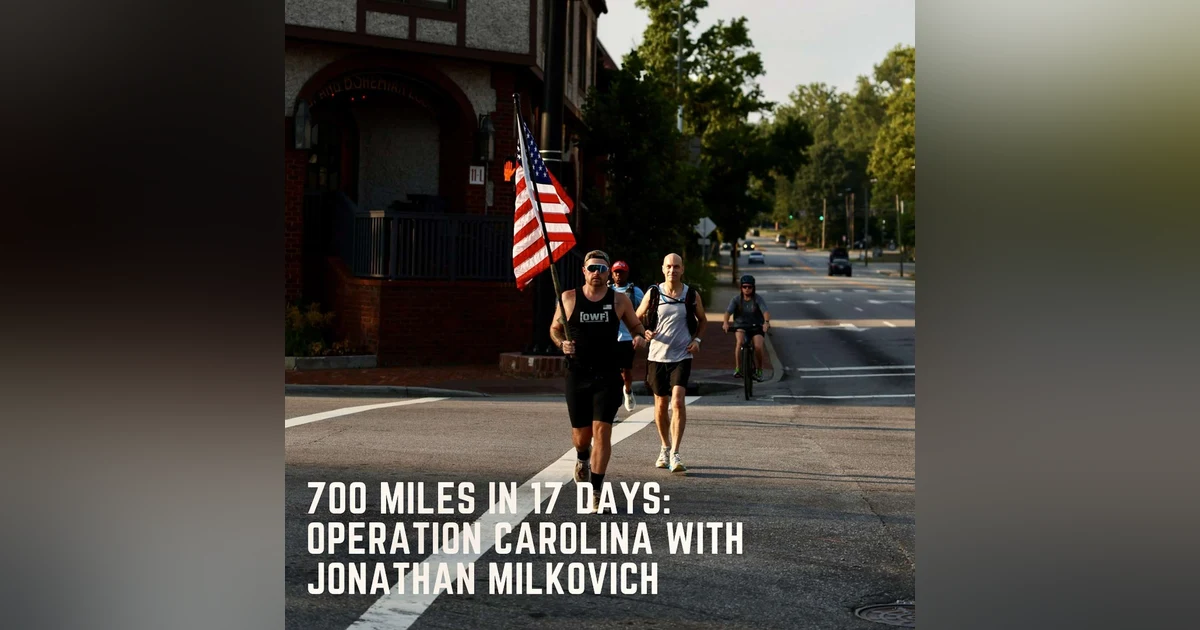
700 Miles in 17 Days: Operation Carolina with Jonathan Milkovich
Send us Fan Mail 700 miles across North Carolina in 17 days sounds like an endurance headline. But after talking with Jonathan Milkovich, it’s the reason behind the run that sticks. Jonathan is a lifelong runner, Army airborne infantryman, and founder of Operation Warrior Fit—a nonprofit connecting veterans, first responders, active duty, and National Guard through fitness, competition, and community. He shares the personal path that brought him here: a knee injury, the isolation of the COVID...

 Apple Podcasts
 Spotify
 Castro
 RSS Feed
 700 miles across North Carolina in 17 days sounds like an endurance headline. But after talking with Jonathan Milkovich, it’s the reason behind the run that sticks.
Jonathan is a lifelong runner, Army airborne infantryman, and founder of Operation Warrior Fit—a nonprofit connecting veterans, first responders, active duty, and National Guard through fitness, competition, and community.
He shares the personal path that brought him here: a knee injury, the isolation of the COVID era, the loss of a buddy, struggles with alcohol and mental health, and the decision to choose help, sobriety, and a different direction.
Now, through Operation Carolina, Jonathan is running 700 miles across North Carolina to raise awareness and funds while sending a simple message: sometimes one mile, one conversation, or the right group of people can become a turning point.
We talk about veteran and first responder mental health, suicide prevention, the power of accountability, and why building community may be just as important as the miles themselves.
Mike Andress
Host, Exploration Local
828-551-9065
mike@explorationlocal.com
Podcast Website
Facebook
Instagram: explorationlocal
00:00 - Why The Suicide Numbers Hit Hard
00:52 - A 700 Mile Run With Purpose
03:03 - From Cross Country To Airborne Infantry
04:18 - Loss In The Ranks And Quiet Grief
05:15 - When Slowing Down Made Pain Louder
10:31 - Building Operation Warrior Fit
13:27 - No Financial Barrier To Race Day
19:54 - Community As A Mental Health Safety Net
24:01 - Operation Carolina Route And Daily Grind
28:48 - Training Confidence And Mind Over Matter
31:20 - It’s Okay To Not Be Okay
33:31 - How To Apply Donate And Join
Why The Suicide Numbers Hit Hard
SPEAKER_00The number of veterans and first responders that take their lives every year is just to me, it's unacceptable. I ended up losing one of my buddies to mental health. And at the time it was something that I, you know, I dealt with by making sure all my other guys were good. I had the time to sit there and think, oh wow, this is hurting. Or like, you know, what are these thoughts in my head? And I wasn't dealing with them in the right way. You know, I was relying on the honky tonk every Friday and Saturday night. And Sober Me handles everything very well. But once I started drinking and everything, that was when kind of went downhill. And she said, you know, basically continue to do what you're doing, and you and I are not going to work out. Or, you know, let's let's straighten out what's going on. Let's get you the help that you need. And her and I both are very active people. She's like, let's let's start training again. Let's really get involved with some stuff again.
A 700 Mile Run With Purpose
SPEAKER_01Welcome to Exploration Local. I'm Mikey Andres, and I share stories that inspire us to get outside and explore. Stories about the people we meet, the places we discover, the brands we use, and the experiences that fuel a spirit of adventure. I encourage you to wander far but explore local. Because sometimes the best stories are found just beyond the familiar. Let's go. What would make you want to run 700 miles across North Carolina? Not over the course of a year, not even as part of some organized race, but 700 miles from Murphy to Manio in 17 days. That's what Jonathan Milkovich is about to do. Starting September 21st, Jonathan will take on Operation Carolina, running as much as 40 miles a day before finishing with a 55 mile push to the coast. But the more I talk with Jonathan, the more I realize this really isn't a story about running 700 miles. The run is just a vehicle. The real story starts years earlier. With a young man who ran tracking cross-country, joined the army, became an airborne infantryman, injured his knee, and eventually lost a friend to mental health struggles. But after leaving active duty, Jonathan found himself dealing with some struggles of his own. And it was his wife who finally challenged him to stop ignoring them and start dealing with what was going on. Part of that journey led him back to running, and eventually to a much bigger idea: Operation Warrior Fit. A nonprofit created to help veterans, first responders, and others find community through fitness, competition, and simply having a reason to get moving. And now Jonathan is taking that mission 700 miles across North Carolina. He's hoping to raise $75,000. He's hoping people will come out and run with him. But more than anything, he hopes somebody runs one mile with him, and that one mile becomes the first step towards something much bigger. I'm honored to host Jonathan Milkovich on this episode as we talk about Operation Carolina, the experiences that brought him here, and why sometimes the hardest journeys aren't really about the distance you're trying to cover. Let's join the conversation.
From Cross Country To Airborne Infantry
SPEAKER_00So I started out, graduated high school, did track cross-country, the normal runner stuff. You once you're a runner, I feel like you're always a runner. And my parents sent me off to college. It's you know, it's something we talk about to this day of, you know, I probably should have never been allowed to go to college at 18 years old.
SPEAKER_01I'm right there with you.
SPEAKER_00Should have, you know, found a job uh doing the trades or something for a little bit. But I ended up spending a couple years in college, had my fun. I learned a lot, you know, learned a lot about myself. Ultimately, though, failing out, joined the military, uh, went into the army back in May of 2017, and I ended up doing five years active duty. So I spent a couple years at Fort Bragg and then came down on orders and went over and spent some time up in um Anchorage, Alaska, up at joint base Elmendorf Richardson with the 501st, did airborne infantry. And when I was about two a year and a half into being there, ended up partially blowing out my knee and had to deal with that. And then once I got better, I was able to still, you know, do some different training and stuff, was still with my unit, and COVID happened. And so we were locked down, um, didn't really get to do too much army stuff for a while.
Loss In The Ranks And Quiet Grief
SPEAKER_00Unfortunately, though, that's kind of where the story of Operation Warrior Fit starts. I ended up losing one of my buddies to mental health. And at the time, it was something that I, you know, I dealt with by making sure all my other guys were good, going and checking on them, going and talking to them and really looking back on it, putting the spotlight on them, and not on, hey, I need to be dealing with this too. I'm dealing with it by helping these people. And, you know, at the time that's what I thought was beneficial. And, you know, about a year later, I get out of active duty. I still am serving with the Wyoming National Guard for another three years, but that's, you know, one week in a month and two weeks in the summer. And so I'm living a normal life for the most part. And I I tell everybody, a bunch of my buddies all decided we should go to the same college together. It was really good because I was able to have a support network. It was really bad because we all loved the local honky tonk on the corner every Friday and Saturday night.
When Slowing Down Made Pain Louder
SPEAKER_00And, you know, it ultimately took my wife coming to me and saying, Hey, you're not handling this stuff. You know, a lot of my injuries were worse than I thought they were, and they were probably bothering me at the same level while I was in, but I was doing so much. I was always working, I was always doing stuff. And so when I slowed down, I wasn't working full time, I was going to school in person full-time at that time. And I had the time to sit there and think, oh wow, this is hurting. Or, like, you know, what are these thoughts in my head? And I wasn't dealing with them in the right way. You know, I was relying on the honky tonk every Friday and Saturday night. And Sober Me handles everything very well. But once I started drinking and everything, that was when kind of went downhill. And she said, you know, basically continue to do what you're doing, and you and I are not going to work out. Or, you know, let's let's straighten out what's going on. Let's get you the help that you need. And her and I both are very active people. She's like, let's let's start training again. Let's really get involved with some stuff again. I like to tell everybody we're still very happily married to this day. Um, because you know, I did take that initiative and I had her support and I had all my family support to go get the help to start working out and do everything. And that's when we realized I had done half marathons, you know, 10 years before that. And fortunately, mom and dad, you know, forked the bill at that time, so I never really knew how much it was. And we go to sign up for our first half marathon that we're doing, and it's $200 plus. Keeping in mind, I'm not working. We're living off of her income in Fort Collins, Colorado. It's a little more expensive of an area. And for her and I to go to do a race on the weekend, $400 flat, that just to get into the event. That's not travel, that's not, you know, everything else that goes into running. And so we stepped back. I was very fortunate though that you know, I was fighting for other things at that moment. And so like the race day wasn't important. It would have been nice, but it wasn't important. And we continued on, and why right before or right after I'd gotten out, I really focused on veteran benefits with you know, what can my GI Bill do for me? Funny to say that because I failed out the first time. And you know, I completed I was at uh University of Syracuse or Syracuse University and graduated top of my class this past year, and then I actually finished my MBA this Christmas. Um thank you. And I'm looking to do a second master's degree. So, you know, if something's going bad, usually you can turn it around. And uh my mom loves it to this day now. She always looks at me and she's like, you know, you could have done it back then too. You know, I had it, I knew you had it in you. Yeah, they always do.
SPEAKER_01Yeah, different pathway.
SPEAKER_00Exactly. I like to take the long route, the scenic route. Yeah, yeah. Yeah, yeah. We started doing the research into like, is there a veteran benefit out there that helps people get to race days? Because everyone in service, everyone that's a first responder, we're all competitive people. We like competition, we live on the side of adrenaline. Like that was when I was my happiest was jumping out of airplanes and shooting machine guns and rocket launchers and stuff. And so we always, you know, we were looking for that thing of, is there something out there? And there are great organizations out there that focus on fitness, but there wasn't one that we could find. And at the time, I, you know, I always worried I was doing something somebody was already doing because I want to make sure that whatever organization was doing it was successful. And we've actually now basically been able to solidify that we're the only nonprofit that our like our very to the core goal is getting veterans and first responders out to active events, whether it's a 5K triathlons. Uh, we just brought on an event last week for uh competitive stand-up uh paddle boarding. Yeah, yeah, yeah. And you were telling me that's incredible. Didn't even know that was like a thing, but we we started building that and we started September of 2024. Um, you know, got all the paperwork in line with the IRS, which took about a year, and got our approval back in September of last year. So January 1st, we officially were operational. We work with local and nationwide race directors, event directors for any event that promotes an active and healthy lifestyle. And our goal is to get veterans, first responders, active duty, national guard, anyone that has served at home or abroad for our our country or your you know your city or county entries into active events. And and the idea behind that is one, you know, if you are doing physical stuff, it usually will help your mental health. But then also to be able to build a community around fitness. And it's the you know, you have a community there for you on race day. And the really cool thing about you know, when you're doing running events or triathlons or Spartan events or whatever it may be, yeah, you you should train for them. I'll say should. No show and go. I I I've done it a couple of times and it uh it's not the best case scenario a lot of the time, but you know, you should train, and and a lot of those programs sit 12 weeks long. And so if we're able to build communities around training, you've got somebody that's there for you while you're training, it helps you with your accountability, but then you have people there for you at race day.
Building Operation Warrior Fit
SPEAKER_00But the biggest thing for me is is building that support network after the fact. And what I mean by after the fact is you do a run, I I did a run this morning. Tonight, God forbid, something comes up and I'm like, hey, I really need to talk to somebody. A lot of my support network sits all over the country at this point. You know, I've got buddies that still live in Alaska, I've got buddies that live down in Miami, Florida. So they're not the quickest people in a dire situation to get face to face. And so the goal with like the community training and having people in your area that you can get in touch with, you can go do a run with, a bike with, whatever it may be, is 10 o'clock rolls around one night and I can make a phone call and that person could be face to face with me. Or hey, the next morning we're gonna go grab coffee. If you need me throughout the night, you know, you can call me 2 a.m., 3 a.m., whatever it may be. Because my my thought and my hope is that if you're able to get somebody face to face in a dire situation, that that could ultimately avoid, you know, a tragic situation that's happening. And and so that's part of what we're trying to do with these entries is you know, we start with the entry, but we ultimately want to have where you have a support community. You may come out and you may do a 5k and you're like, hey, I still hate running. Uh do a triathlon. You're like, yeah, it's not what I thought it would be. But hopefully in that process, you've built that community, and then you've got that community around you for if there's ever a bad time, you know, with everything that's going on. And so, I mean, I I personally love to go out and do different races. We were, you know, talking about a little bit before. This is a slow year for me. I've only done three races this year, but normally I try to have like this point last year, I think I was eight races in with like four more on my calendar. Cause it and it's part of what we're trying to do with the nonprofit, too, is it's like if you have something on your calendar, you're gonna want to go train, you're gonna want to go do something. And so that's the whole point. Right now we sit at uh 183 races are on our website. Gosh. Um, across the country, we're represented as of last night in 38 different states, including Alaska, which I think is cool having lived there for a while.
SPEAKER_01And these aren't races that people just can sign up and be a part of this. I mean, you go through a whole vetting process, they have to meet certain criteria and really kind of match your whole mindset and philosophy, right?
SPEAKER_00With any of our races, we have a 995, we call it a commitment fee. And that is because, you know, we're taking the time and we're trying to establish these races, uh, relationships with these different races and these different events and everything, because you know, they're gonna have races again next year and the year after that. And that those are the things that you know I want people to see. Oh, we have this local race in Greenville, South Carolina, and hey, I'm not ready for it this year. But for the most part, our hope is, you know, if we have them this year, that we'll continue to have them as long as they are a race, an event, whatever it may be, so that you can plan ahead.
No Financial Barrier To Race Day
SPEAKER_01So talk about that moment, like when you realized you wanted to do something different with your own experience, number one, but number two, all these races that you're putting together. Now we're doing something called Operation Carolina. What was the moment that the light bulb went off and you said, I really need to do something here?
SPEAKER_00The number of veterans and first responders that take their lives every year is just to me, it's unacceptable. I've always thought that I would own some sort of private business. And I've always been looking kind of what's that idea? So when I was going through all of this and absolutely loved the time that I spent, you know, helping a lot of my buddies with getting their benefits and everything sorted out after they served, I was like, why aren't we promoting, you know, being competitive? That is that is the the creatures that they make in service, be competitive, you know, be the best person that you can be. And why isn't there something out there? And and that's when, you know, everything that was going on, and my wife and I wanting to try and find races and couldn't afford it. My first thought was I don't want there to ever be a financial barrier for somebody else. So when that idea stuck, I was like, I have to do it. If you were to try to summarize in 10 seconds what the purpose of this is and what you hope the outcome is, it's to raise awareness for Operation Warrior Fit, you know, get veterans and first responders interested in it. It's also our first big fundraising event. So our goal is to raise $75,000 across the state, and that can be anything from uh donations specifically for like getting veterans and first responders into the event and you know, obviously other stuff to support our organization as we continue to grow. But ultimately it's awareness. Awareness. It's really get the communities involved and and have people start telling their story.
SPEAKER_01Yeah. So you mentioned your your past, and you mentioned when you would start to drink, and you know, you were fine when you were sober, then as soon as you started to drink, some of the things, you know, a different side of Jonathan sort of came out, and I'm sure it was sort of touching and reaching back into some of those traumas that are there and sort of unpacking them a little bit. And not to sound too doom and gloom, but there is this number 22, and the number of is is for every 22 minutes a veteran is committing suicide in our nation. And then also, I don't know what the stats are, but for first responders, they are significantly more uh, I guess, succumbed to PTSD than the average person. And so I would imagine that this awareness is something that you're hoping to, and and I don't think you could ever like overstate it. And and I would imagine, is this kind of something that you're hoping will will come a part of this as well or come out of this?
SPEAKER_00Absolutely. It's it's one of those things that you know I never I never saw combat. I never had a uh a foreign combat deployment. You know, I did some training rotations over um in some different areas, but I never saw the combat side of the military. And and a lot of our our people these days don't necessarily in my generation of the military, there's there's a lot less that saw it than right after 9-11, and you know, those those eight or nine years after when everyone was running pretty hot on deployments regularly on a regular basis. And and the thing is, is you are trained to ultimately be able to fight in a war. And it's one of those things that no matter what you do, the military is gonna be with you. The biggest thing that I tell people is like, one, it's okay to not be okay, and that goes for post-9-11 veterans that you know saw the combat, had to do stuff over there, and it also goes for the people that didn't necessarily get a combat deployment of any sort. It's okay to not be okay, and it's better for you to go get that help or or find a way to to handle it in a in a healthier way than to rely on, you know, drinking or to think that you shouldn't be here with us any longer.
SPEAKER_01Yeah, that's amazing. And not that you're out there fishing for it and looking for it, but I would imagine that maybe a part of this is you're you're really hoping that um you might be able to speak into somebody who is struggling with some mental health issues, or not that you're you know out there looking for the you know the boogeyman around every corner, which is mental health, but at least there's an avenue. People know that they're, hey, here's a space that I can come. And whether I like running or I don't like running, I know that this is a person with a you know kindred brother, you know, kindred spirit that's been into the military, the mental health you, you know, you're you're very vulnerable about that. So thanks to you for that. I would imagine that you would hope that some of those stories would sort of surface and you might be able to speak some life into it.
SPEAKER_00I mean, I can't tell you the number of 2 a.m. phone calls that I've taken over the years, and it's something that, you know, I had my buddies taking 2 a.m. phone calls when I was going through some stuff. And so one of the things that I'm just like wanting to do with this all is build that community that, you know, I may not necessarily be the person that you need to go talk to. I may not be the person that can 100% relate. You know, we can relate on military, we can relate on first responder, but I may not be able to relate specifically to your event. But if we're able to build that community, and and we're not even doing that just with Operation Warrior Fit, like my goal is to build a network of nonprofits. Like, I I 100% understand that I'm not gonna be the or Operation Warrior Fit's not gonna be the resource for everybody. So being able to understand, hey, this person needs they're they're having some issues because of you know, they don't know if they're gonna be able to pay for their mortgage next month. Cool. Well, we've already talked with this nonprofit, we think they're great. Here's this resource. If there's ever a point you want to get back into fitness, come back to us. We want to support you. But I think you need to take care of this first. Like we we know 100% that we're not gonna be necessarily the organization for everybody, and the same thing goes with other organizations that we're working with, even just specifically in the fitness space. You may not be a person that wants to go and compete at a 5k half marathon uh Spartan event or whatnot, but you want to be active and you want to be doing stuff, you want to go for walks, and so like we're working with organizations that offer those different fitness chapters that meet up every Thursday night and go do something.
Community As A Mental Health Safety Net
SPEAKER_01So we've mentioned headspace and mindset, you know, several times in this, and I can imagine just the few times that you and I have had conversation that we're now we're talking about back injuries, a blown-out knee, recovery, all of these sorts of things, and you know, you're putting in 70 miles this week, but you're soon to be putting in starting September 21st, 40 miles a day and finishing with 55 miles on that last day. So, how do you how how are you gonna kind of keep your mindset? Is this something that you feel like the the running and just being in that euphoric state, you know, with endorphins flowing and everything else just helps that? Or I mean there has to be a this whole concept of mind over matter has to come into play here.
SPEAKER_00I want to see how far I can push myself, and that was kind of the idea behind Operation Carolina is this is the first step of me really starting to see what limits we can push. You know, I ultimately one day want to be able to go and compete in Leadville and compete in Coca-Dona 250. And so why not do something that I have control over in the first the first try at it and then go from there? Most people's first try is like the app couch to 5k.
SPEAKER_01You know what I mean? You're doing I want to do a 300 mile or in or I want to be in Leadville and you know, but I'm gonna start with 44 miles a day. It's amazing, dude.
SPEAKER_00Yeah, no, I I appreciate it. And and one thing that you know I want to stress to everybody our organization is for anybody and everybody. I I always think it's a very funny thing. So one of my very good buddies, his wife, started running about this time last year. And actually it was beginning of this year. Uh it was kind of like her New Year's resolution kind of thing. And she had watched, you know, my wife and I running all these different events and wanted to get involved in it too. She's like, this looks like a lot of fun. I wouldn't necessarily call it fun, but it's enjoyable. And we she messaged me one day, and and you know, my buddy and and I are very close and we've become very close with their whole family, and we talk a lot of smack. Like she messages me and I'm like, what do you want? What are we? I don't want to talk to you. And she messaged me and she's like, Jonathan, you can't be mean to me when I'm asking you these questions. And I'm like, Okay, what's up? Like, I I I didn't know what was happening. She's like, Well, I want to start running. I was like, Okay. Like, what are your questions? And she was like, you know, I want to do my first 5k. I'm like, that's freaking awesome. Like, running is the one thing in my mind, or and being active in general, whether you are trying to do a triathlon, whether you're trying to do uh a Spartan event. Running, if you want a safe space with me, let's talk about being active because I'm not gonna talk smack about you, you know. Like that's that is one thing I will never look at somebody in any aspect of life that is out there that's running a 20-minute mile. That's freaking awesome. It's as it's as awesome as a dude that's running a six-minute mile, or the dude that's out there competing in a different triathlon, and you know, he's dead last, but he's proud of it. That is awesome. He finished, yeah, he finished exactly. And and that is that is something you know. I never want somebody to question should I be at an event? You train for it, you show up, you you deserve to be there. Plain and simple. Yeah, it doesn't matter if you are first place or you are last place. I mean, a lot of races now have uh it's called a DFL, dead effing last as an award now that they have in a lot of events. One of the buddies that I that I train with, actually, I was training with them this morning. His goal a couple of times has been he's like, I want that award. I want that one. Um and so we uh but that that is you know the biggest thing to me. It's equally impressive for somebody that has never run to be off the couch running their first mile to the person that is finishing Coca-Dona for their first time or finishing, you know, a backyard ultra and just PR'd with 150 miles that they did in a day and a half
Operation Carolina Route And Daily Grind
SPEAKER_00time.
SPEAKER_01Let's talk about the the route itself a little bit more because you talked about we're going from basically manio to Murphy or from Murphy to Manio. What do you hope to kind of see along the way? Because it's one thing to drive the state, it's another thing to run it at whatever pace you're gonna run it.
SPEAKER_00So I think it'll be cool to slow down and like really get to just just see the state. You know, you you drive over the mountains and you don't really get a long view of what we're doing. And so like, I mean, I'm excited to run up. We're running up the um, I call them the switchbacks between SoCow Falls and Cherokee. Yeah, yeah. Yeah, we're running up that, and we've got an escort with the um the Cherokee Nation is gonna be escorting us up that hillside, and I'm like, that's gonna be really cool because that's that overlooks a beautiful steep, yeah. That is why I say three and a half days or three and a quarter is when I'm gonna be like, all right, we can do this. We climb 2,900 feet in the first eight miles on day three. We'll crest at like 29 or like 3,000 feet, I think, at SoCal Falls. But the upside is the rest of the day is downhill. Yeah, so like we do, you know, through Maggie Valley, down do Canton, and we we end in Canton out where the clock tower is in Inca. Yeah, yeah. We'll end there for the day. And that's actually one of the things, too, that I like keep trying to tell myself is that day we're actually going home. We're not in a hotel, we're not in an Airbnb. We're actually going home, home. So I'm like, I get to sleep in my own bed that night, probably take a very hot Epsom salt bath, and uh, you know, just be comfortable for a little bit because our our ultimate goal is to be able to start usually six or seven o'clock every morning, and our our goal short of you know weather happening is a 10 to 12 hour day. So we're not doing anything fast, we're not going for a fastest known time this time around. Again, it is a community activation. Like I'm I'm the thread to all of this. That that is the main point of all of this. I want to do something hard, and I'm like, how do we get people involved?
SPEAKER_01What are you most excited about at this point? Like you haven't taken the first, I mean you've been training, but you haven't taken the first step on this particular journey. What are you most excited about?
SPEAKER_00The three days in the outer banks after everything. No, in a serious note, like I'm I'm really and truly excited to see who comes out. Really get a talk with people. I mean, I can sit one and talk about the nonprofit all day, and I can talk about being active and you know, enjoying every minute of it. And and really and truly, I think it goes back to what what we've said a couple of times now is getting that message in a year from now.
SPEAKER_01Yeah.
SPEAKER_00Hey, I joined you outside of Charlotte, or I joined you at the Charlotte Fleet Feet meetup, did a mile, absolutely despised you for me thinking that it would be a great mile, but now I'm competing in my first half marathon. So I really think that if I had to look a year from now, that would be you know what I hope I'm sitting down and reading one day. It's just that person that came out, ran the mile with us, and now is doing a half marathon, doing a high rocks or doing something like that.
SPEAKER_01I love that. What about some of the things that you're most uncertain about?
SPEAKER_00The 18,000 feet of climbing in the first three days. That really and truly is my my only true worry. There's gonna be wear and tear, probably gonna lose toenails. Uh um legs. I knock on wood, I haven't done it yet. But yeah, I mean, I I really think we get through those first three and a half days, and like our teams were we already sat down, we know those first three and a half days are probably gonna be longer days. It's areas that people probably aren't necessarily gonna be joining us, and so we've you know, we've sketched in the plan of possible 14-hour days, just really get through that climbing. And once we crest there at SoCal Falls, I think that's gonna be a party in and of itself. And then other than that, I mean, the one contingency plan that we have right now is god forbid a storm goes out into the the ocean there and the outer banks get shuts down because it's flooded. We do have contingency planning. I mean, that I would say is probably like the second thing that I'm worried about. It's just not getting to do the outer banks. I'm really and truly excited for it. Like it's something that I couldn't tell. I it's it's one of those as I train more every I would say almost every day. I haven't gotten a run-in yet. And you know, I'm sitting there and I'm thinking, like, am I gonna be able to do this? Like, is this something it's it's usually every afternoon, I'd say. But then I go in the after in the evenings, is when I do a lot of my workouts right now, and I get done and I'm like, yeah, we can do this, you know, knock out a nine-mile run in an hour and 20 minutes and feel fine after.
Training Confidence And Mind Over Matter
SPEAKER_00We did um one of the big things I'm working with my coach who I have to give him a shout out, Caleb McCoy out of uh Bryson City. He is an amazing individual, has his own amazing story that you know you can look it up on his social media, and he ran the TransCon last year, uh 2,800 miles in 66 days. Him and I have talked on and off for like the last year or so, and I got done with Phoenix, and I started writing my own training plans, and I'm like, these are working, I feel strong, I feel good, I'm good to go. And I started getting closer, and I'm like, I don't have the confidence, like I know I'm gonna be able to do it, I'm just gonna have to figure out how to do my training plan. And I was like, what better person to train me to run across the state than somebody that's run across the country? And so I finally messaged him and I was like, hey, this is my idea, this is what I want to do. Are you interested? And he came on and he's been coaching me now for the last three or four months. Best decision that I ever made, and amazing dude. He uh he's about to go crush it at the Mammoth 200, right around the same time that I'll be running. He's gonna be doing the Mammoth 200. Absolutely a dude to definitely get in contact with, has an amazing story, was really doing amazing things with his organization too. But he has me right now doing like so. I do a long run Friday night and I do a long run Saturday morning. So, like last night and to this morning, and within like 15 hours, I was able to knock out like 33 miles. Um, and that was with obviously a somewhat nice, uh, nice amount of sleep, but that's those runs are giving me the confidence to really be able to say, hey, I'm gonna be able to do this. I also love people that tell me, ask me those questions like doubtfully. Are you are you really gonna be able to run 40 miles a day? And I and and here's the thing is that just fuels me more, and it's kind of in the back of my head now. And when I start hurting day seven, and I'm like, hey, I don't know if I'm gonna make it another 10, we'll just start playing those like moments in my head of remember when that person was doubting you. Well, let's not doubt yourself, and let's keep on going, Buttercup.
SPEAKER_01Love it. I love it. You have when you think about a a veteran or a police officer or somebody that's an EMT or even somebody who loves somebody that fits into any of these categories.
It’s Okay To Not Be Okay
SPEAKER_01What do you really hope that they're gonna hear from you even in this episode? What do you hope that they take away from this episode?
SPEAKER_00To start, it's okay to not be okay. I can't say it much more simpler than that. It's okay to, you know, have depression moments. It's it's okay to hurt, it's okay to open up. Again, it's one that I'm working on too, but you know, it's okay to not be okay. Um, and I can't stress that enough. You know, I've seen that with you know older generations of people that I've talked to that mental health was not something that was talked about for years and years and years, and only recently have has that really started to be a conversation around stuff, and so I really want to make sure it's okay to not be okay. And the other thing too is is I was very fortunate and I'm very lucky that my wife was very understanding, and it wasn't just uh hey, drop everything, this isn't gonna work out, and I was given I mean ultimately an ultimatum, but a very good one that you know I do not I don't have any disdain towards her. It was spoken in love, I mean Absolutely, and for the spouse of that veteran of that first responder, EMT, nurse, whatever it may be, don't just give up because if my wife had just given up, you know, on me in that time, Lord only knows what would have happened, you know. I I wasn't again somebody that really had issues sober, but I would go to the bar, I'd go have fun, and I would have issues, not all the time, like I said, but you know, pretty regularly that it was it was enough to you know raise a red flag to her and and to my mother and everything, and so I you know, I ask anybody just give a chance, you know. And after you give a chance, I understand if it's not something that you know they ultimately want to do, but be a fighting person, but you know, with whoever you're with, like don't just give up on them.
SPEAKER_01Yeah, that's good, that's clear.
How To Apply Donate And Join
SPEAKER_01So, how can people get involved now that are listening to this and it's gonna be a few weeks before you hit the first day, and that's gonna be a 14-day event? How can they get in touch with you and how can they be a part of this?
SPEAKER_00So we have our website, operation warriorfit.org. That's got all of the information on there, anything from Operation Carolina to you know what we're doing every day. And if you're a veteran, first responder, active duty, and the first responder, it's you know, law enforcement, it's fire, it's EMT, it's um nursing, any of those fall under that category. Uh, you can hit the apply now button, fill out some information, and ask you some questions about your time and everything. You'll get approved, um, usually within like the first day. And then you have access, like I said, to over 180 different races. We've actually just cressed uh 3,000 single entries the other night. Wow. And we've got 38 states, including Alaska and Hawaii, that are represented now. We were supposed to have some people in Hawaii competing this morning, but the event got canceled to some weather stuff that's going on out there. Um, but we had somebody in Alaska two weeks ago compete. So I, like I said earlier, that's pretty cool to me. If you're not a veteran, first responder, active duty, national guard, whatever it may be, we do have the donate button. That is huge for us because that allows us to continue what doing what we're doing, reaching out to different organizations, being able to help us stand up that scholarship fund uh sooner rather than later, as well as just getting out to events and really start, you know, putting the word out there about what we're trying to do. Cause I really thought races were going to be the f the hardest thing for us to bring on into the um bring into our database for people to have access to. And it's been honestly like I can't explain to you enough how amazing the support has been. I I have people emailing and texting me every single day of like, hey, here's two entries to this event, there's two to this event, there's two to this event. I'm like, That's incredible. It's almost at the point where I'm like, hey, let's slow down for two seconds so I can catch up on my emails to make sure I'm thanking each and every one of you. Because everything that I send out, you know, like outreach is templated, but after that first response, it's it's always me responding, and it's always me because I can't thank people enough, you know, for what they're doing to support our organization, to support that veteran or first responder that may need it. When it comes to Operation Carolina, there is that section on our website. The route is on there. That's the biggest thing. Come out, run with us, cheer on the side of the road. Each day, there's a full statewide map. Um, and then each day is broken down as well. And you know, we've got some amazing hotel sponsors that are providing our hotel every night. We've got a company that's wrapping my wife's forerunner, it's going to be wrapped with all of our decals and everything, and all of our sponsors. If anybody out there knows how to set up a TV on the back of a car so I can watch college football while I'm running every Saturday. I won't be opposed to somebody reaching out to me about that. My wife thinks I'm kidding. I'm not. That is my favorite time of the year. And I'm like, why did I have to decide to run? Honestly, it's it's reasonable because otherwise I'd be running in the summer. Yeah, yeah. But, you know, I was like, what I was having a serious conversation with her. Like, how could I attach my iPad, have a speaker out there? And she was like, for what? I was like, college game day. I just I can run and watch it, like it's a dream for me. Yeah. Um, but yeah, no, people can get all that information there. And then our social medias are on there. On Instagram is our best. Uh, it's just Operation WF. There's all kinds of stuff that gets posted there. You can follow along with my training, posting videos almost every single day, uh, really just trying to give detail of what I'm doing. One of the big things with the nonprofit as a whole is we're as transparent as we possibly can be. Short of like just like disclosing uh possible partnerships that we're obviously like working on contracts with or something like that. We have all of our information out there. I have a binder on my desk of every paper document that the organization has received, and we are going to continue that, you know, as long as we stay an organization that one day, you know, the hope is we sit down with a a huge organization, and I can throw those binders down and say, Hey, give me a reason for you not to work with us. Nice. And they can go through every page and really like be able to see like we're not. I'm trying to be as transparent as possible. You know where the money goes, you know where we're getting our money, and you know, our ultimate goal is to get people out and get them active. So I want to make sure that people see that that is what we're doing. Follow my social media. Mine's just Milkovich Jonathan on Instagram. That's where a lot of our posting originates. Um, one of the cool things so on the state run, we'll have my wife is gonna be managing um the nonprofits Instagram, TikTok, Facebook, and everything. So that's gonna be more of you know, this is what we're doing, the storytelling of the event. My personal though, I get a man the whole time, so it's probably gonna get some nitty-gritty. You're gonna get to see some of the cool fun stuff. Probably hear me be a little bit more colorful of my my uh language, but really just like not necessarily that I want anybody and everybody to go out and try to run across the state, but I'm just a dude. Really just a dude at the end of the day that works a nine to five, you know. I my schedule's jam-packed and I can still make it work. And so ultimately, my goal is to show people too like you can do whatever you set your mind to, you just gotta figure out how to do it. And I know that's like the most cliche, like kind of BS way to say something, but if you really want to do something, you're gonna find a way to do it. And one, if you're a veteran, if you're a first responder, you're active duty, whatever, let me help you out. Yeah, and I'll help out anybody, but I can really help you out if you know you're our veteran first responder with our organization. I'm not one that likes to really gatekeep anything. You know, hopefully the run goes great. We do the 700 miles. You know, anybody that wants to try and do it again after me, more power to you, let me help you out. Like do it faster than I did it because then I got something to go after.
SPEAKER_01There you go. Stay stay competitive, give you a new finish line. Never, yeah. Well, I I appreciate you reaching out to me several weeks ago about this. And I think that you know, you might say something is cliche, but the the why behind it isn't. And for you, it's your own personal experience, it's your own care and love really for other people, and maybe people you don't even know, right? Uh, for this this whole big idea of helping to battle or give people an uh an outlet, a positive, constructive outlet for mental health and mental health awareness. And so for that, it seems like that really kind of drives you into everything that you do. So I would imagine that somewhere in the back of your mind when you're thinking about the things that are gonna kind of keep propelling you forward, it's not just the people saying, Hey, you can't do this, it's also those people you know that you're doing it for. Absolutely. Yeah, and uh, and I just appreciate you kind of unpacking this a little bit, helping us amplify your story a little bit more. The work you're doing is amazing. Mental health, thankfully, in today's age, it's not as taboo as it used to be. And so for you being able to do this and being able to raise the awareness in the way that you're raising it, um, kudos to you, brother. It's it's good stuff.
SPEAKER_00Thank you. Thank you very much. Hopefully, you know, in uh two months, you and I can be sitting back down and maybe have a little recap of the misery of 17 days and probably some wins and losses along the way.
SPEAKER_01Well, I'll be following your journey the whole way, there's no doubt about it. So I appreciate it. We'll be celebrating all those little lifelines along the way with you, too, man.
SPEAKER_00Awesome. You're more than welcome to come join us out on the route for a little bit, too. Give me a little cheer squad or something.
SPEAKER_01We'll do that, and we'll bring a little crowd to help do that too. Awesome, awesome. Good stuff, brother.
SPEAKER_00Thank you very much. I really appreciate you having us and you know being able to talk about this today because it is something, like you said, near and dear to my heart, and to be able to have a platform to talk about it, I can't thank you enough.
SPEAKER_01When Jonathan first reached out to me, it was because he was about to do something that immediately caught my attention. Run 700 miles across North Carolina. And that's what initially drew me into this conversation. But after hearing Jonathan's story, I think it's pretty clear that the 700 miles are really just the beginning. Because he's not doing this to prove that he's the toughest guy in the room. He's doing it to create awareness, to raise money, to bring people together, and hopefully to give somebody a reason to take that first step. Maybe that's running a mile, maybe that's training for a 5K, maybe it's a half minute for a work one year, or maybe it's simply finding somebody who can't.