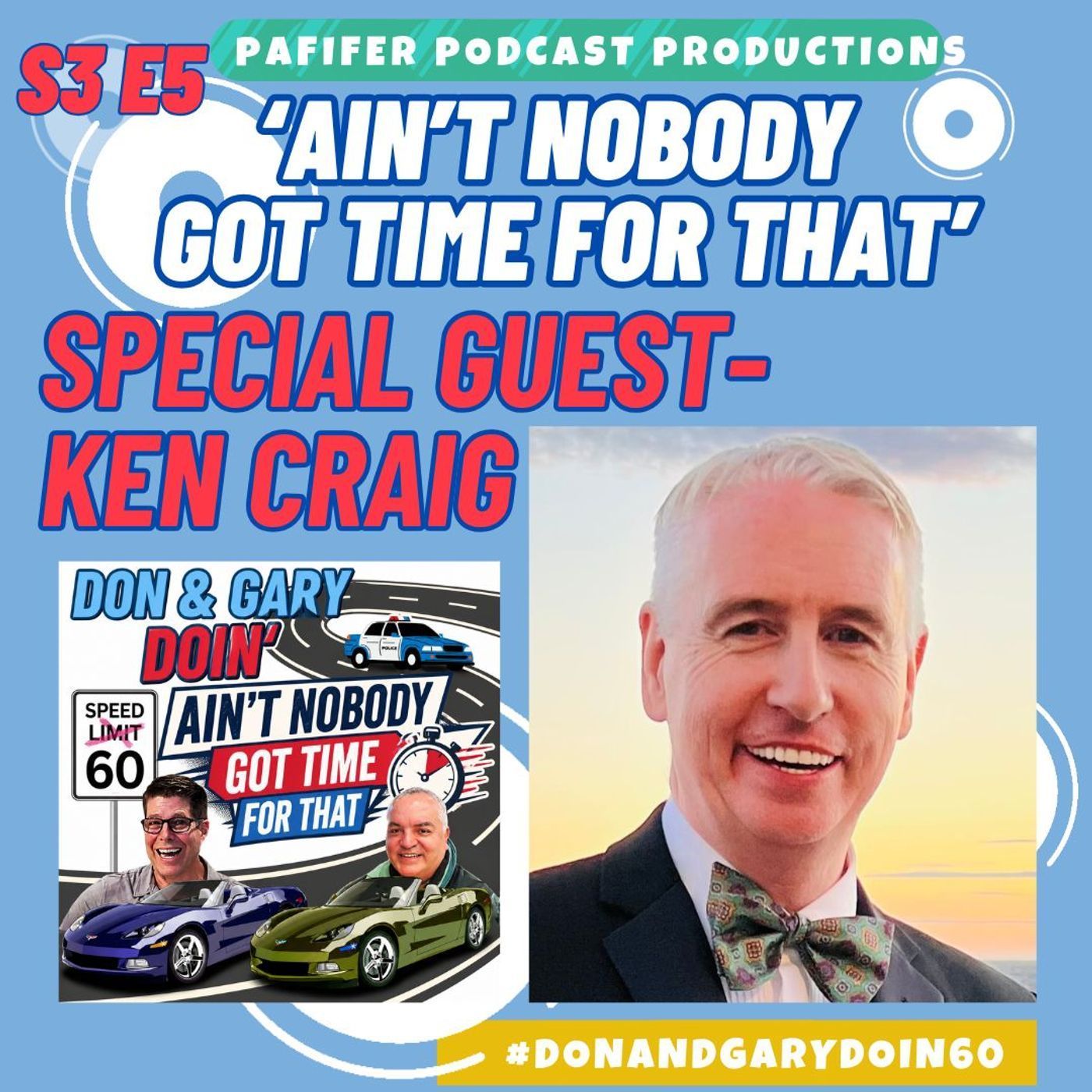
S3E5-'Ain't Nobody Got Time For That" Pt. 1-Special Guest Ken Craig


 RSS Feed
 🎙️🌈 You can’t have a podcast without a Blooper Reel! 😄
As we kick off our Pride Month Series, we're proving that bad connections, missed cues, awkward pauses, and general confusion are alive and well at... THIS age.
Join Don & Gary for the outtakes, the laughs, and Part 1 of "Ain't Nobody Got Time For That" featuring special guest Ken Craig. It's insightful, inspiring, and occasionally held together with duct tape and wishful thinking.
Because sometimes the bloopers are just as entertaining as the podcast. 🌈🎙️
ABOUT KEN CRAIG-https://www.castropatrol.org/chiefs/
What started as a community meeting about safety turned into a 20-year mission. and how a simple invitation to speak about self-defense led him to help build and lead Castro Community on Patrol, train volunteers, and teach more than 1,000 self-defense classes to the LGBTQ+ community.
Sometimes showing up for one meeting can change an entire neighborhood.
As a Grand Master instructor of martial arts and head of Triangle Martial Arts Association when CCOP was being formed in mid 2006, Ken was asked to attend and speak at the very first public meeting at Joe’s Barber Shop on 17th Street in the Castro. Shortly after that meeting an organizing group was formed and Ken was asked to develop and deliver the initial volunteer training materials for a walking safety patrol. The training content and concept was then approved by the San Francisco Police Department and by SF Safety Awareness For Everyone (SAFE) who were our fiscal sponsors at the time. Ken led the very first volunteer training class for CCOP on November 11, 2006 certifying the first 23 volunteers for patrol, and he has conducted most subsequent volunteer training class since then as our director of Volunteer Training and Certification for CCOP. Ken continues to update and enhance our training methods, policies, procedures, and methods in collaboration with the rest of the Chief’s of Patrol.
#CastroCommunityOnPatrol
@castropatrol
Don P-Pafifer Podcast Productions: So again, I'm sorry, this guest has been very problematic. I think we should send the keep the check. Don't send them or pay him anything. We've toggled him. He is toggled now. So hopefully, Gary, I'm so sorry to interrupt. Maybe we should start again. Well, I'm gonna see if I start talking. I only hear one of me right now, so this is good. Yes. Now can you talk? I only hear one of you also. I'm very excited. This is and I never want to hear more than one of you, Gary. So now that we've figured that out So this will be part of the blooper reel. Okay. It's always good to have those. Thing is in purple. That's a good sign. Mine's purple too. Ken, are you purple? â not today. So I turned off my echo cancellation. Now I only hear one of me. And that's more than enough, Reel. I don't know why we invited Ken on in the first place. â you shouldn't even. â hi! Hello. I'm getting that echo again. Don. Are you? Welcome back. This is the Don and Gary doing c Time's up. Thanks a lot for coming. I'll see you guys. Bye bye. Okay. Yeah. Yeah, we we're out of time. I'm sorry we didn't get a chance to talk more about anyway. I'm so sorry. All right, so where do you want me to start from the very beginning or? You you I mean, I I I try s let's do the beginning again. Just make it quick. Welcome back. Jesus. Are we rusty or what? Am I rusty or what? No, you're Don. And I'm Gary. Rusty isn't here anymore. Listen. I'm hearing you guys perfectly. Let's do this one more time. Heard that before. â Yes, yes, yes. Okay. I have a life. I gotta pee. No. all right everyone. Well, welcome. After â a few false starts, we're back. â our guest today is Ken Craig. He's a friend and neighbor of mine who I've known for twenty years. We have volunteered together for the fire department since two thousand six, so we're in our twenty first year. I started saying earlier we also both volunteered for the fire excuse me, for the â police departments Hi Gary. Hey Don. Welcome back. Thanks for joining the Don and Gary Purdue and 60 podcast. Still standing, still laughing, still probably should be supervised or at least observed by a professional psychiatrist. We're here to unwrap and unpack and navigate the world at his age. â okay. You can find us on Apple Podcasts and Spotify. Of course, watch us on YouTube at Pify for Pod. You can catch all of our old episodes there, all of our new episodes, all of our shorts and funny gag reels. So please take a look at that. So Gary, what are we doing today? Who are we talking to? So we have a guest who's joining us, as I mentioned earlier, someone we did not go to high school with, but he is a member of the club. disaster preparedness program. I did it for six years. Ken was actually instrumental in like putting that program together in the whole curriculum. â but he volunteers so much more than I do. And I asked him for a list and this is a pared-down list of only 11 different organizations he volunteers for â at different levels. And this is aside from his business that he co-owns with his husband. This is aside from â he's a neighbor of mine and a friend of mine. I've known him since 2006. So that is 20 years. Wow. you mentioned Kilt. So back in 2017, when I â went to the UK, it was for their wedding. They â he and his husband had at that time, at that point had been together 20 years, and they wanted to have a big celebration and and do like a â recommitment ceremony, if you will. you know, having a a life outside of all this stuff. I don't know when he sleeps. Sleeps overrated. â real quick. His current list, International Police Association, he's a member. The Federation of Gay Games Sports Committee member in martial arts. And we'll talk about that. â International Association of Gay and Lesbian Martial Artists, Secretary of the Board of Directors. He's a grandmaster ranked martial artist in three martial arts disciplines. Mm-hmm. And he said, you know, asked me, Would you go? And like, Abs Scotland? Absolutely, I'll go. but would you wear a kilt? â I'm sure I've mentioned once or like 15 times on this podcast and three Psych, yeah, I'll wear a kilt. So it was his wedding to â where I â where I wore the kilt. Yep. and I made a reference â also about his husband. He and his husband are local business owners here in my neighborhood. and I'm not even gonna try to pronounce them. Northern California Regional Intelligence Center, a private sector member, Federal Bureau of Investigation Citizens Academy, San Francisco Alumni Association member, San Francisco District Attorneys LGBT Forum member, San Francisco Police Department LGBTQ plus advisory forum. He's committee â community co chairperson. I'm a member of that â group as well. Since two thousand sixteen, so for the past ten years, his husband is the only man I've allowed to put his hands in my mouth. â community patrol service. He's the chief. â his main baby, this has been around celebrating his twentieth year, is the Castro Community on Patrol, one of the original founders and currently serving on the board of directors as secretary and as assistant chief. â ID eight, I ID. A local group in â our neighborhood that does a lot of community meetings, â they get politicians and they do safety meetings and so on. So it's kinda like a neighborhood association. Because he's my dentist. So pause two, three, four. â yes. So â he co-owns the business with his husband. His husband's the dentist, â and â and Ken runs the runs the show. So â that's who's coming on. People say that I do a lot of volunteer work. It pales in comparison to what he does. Yeah. On top of But it's not formally called neighborhood association. Okay. â and also he's a member of the safety committee in the Condo Development where lives. Okay, I need a glass of water or something. I'm tired. But yeah. â Ken, when do you sleep? As I said, sleep is overrated. Who needs it? We sleep and we die, right? â and and I did want to back up and say, â Being a business owner and and so on. Yes. Read reading his bio was like, â my gosh, we're gonna have to make a two-parter out of this one just to read his bio and all his volunteer work. And we'll we'll we'll go through â I've got the list and we'll go through it. But â one of the conversations we'll have with him is he and his husband are talking about retirement when. so obviously that'll fit into the theme of what we talk about. â and we'll talk about a few of his â favorite volunteer. I I I'm thinking his accent is French, but I'm not quite sure. At least you did not call me English, so you can live. But you're from I am indeed, as you well know, â from traveling there with me. I y I yes, I've mentioned, as I told Don, once or fifteen times that I wore a kilt to your wedding celebrating your twentieth â year. So which means you're coming up on thirty next year. That's crazy. That is crazy. efforts. â we can't do them all because there's a list of I've got eleven on the list and that's the short shortened list that he gave us. Yeah. And apparently as a teenager he did some â you know modeling and acting. â I know. We got a couple of samples of â the modeling and acting. So â to quote your girf f your good friend Lisa Renna, who is an actress and former star of Real Housewives at Beverly Hills. That trip was nine years ago. That seems astonishing, doesn't it? I mean sometimes it seems like yesterday and other times it seems like a hundred years ago. He's still hawking those pictures of himself in the kilt. Every single person looked fantastic in those kilts. So if you're ever looking for a good outfit, buy a kilt. They really do look good on â everybody. And who has just come out with a new book, you better believe I'm gonna talk about it. So with that introduction, do we is he â on hold? Do we want to let him? He's on hold just yet. So he's he's got four minutes. Something tells me he's gonna pop in right at ten fifteen. We're right at fifteen minutes in because we'd asked for that and he was he seemed to be very punctual person. â yes. Yeah. Unlike myself. Okay, so this is for four minutes. We gotta do this. Let's just do this for literally maybe we can make a And that trip by far was the most amazing trip I've ever taken. I've been to Europe many times, but â Paul and Ken do trips right. They travel often. They travel with friends. They are the organizers. You basically just show wake up on time and show up and they will tell you where to go and what to do. As long as you remember your passport, right? So yes. Yeah, this was the trip where John left his old passport â An â YouTube channel of people just watching us do this. And for our listeners, we're stretching, we're miming that we're stretching time. We're getting paid for this. All right. his new passport at home and brought his old passport to SFO. And so I caught the plane and I said, I'll see you in Scotland. But â amazing trips. It's the only trip I've done with them, but it's like a well oiled machine. And it's all Paul. â credit. He does all of that. He's a very good organizer. â so â one thing other thing we'll talk about at some point is â you two have talked about retirement. Yes. When and what that's gonna look like, and then we'll get at other things. But welcome. We can just jump right into it. Let's start with Castro on patrol. That's that's your big baby of twenty years. â tell us what it is, how it started, â all those things. The community safety walking patrol so started in two thousand and six following a number of violent assaults in the Castro neighborhood, the the LGBTQ neighborhood, â that got a lot of publicity. â so the neighborhood became very concerned about what was happening. â at the time there was a reasonable â association with the police department, but not necessarily any trust that the police department would do anything effectively. â as far as protecting the neighborhood any better. So the leather community actually came together, they started hosting meetings. I had been teaching another entity called Triangle Martial Arts Association, â where I used my martial arts experience to teach to the LGBT community. One of my students was a member of the leather community, said, There's this meeting happening about setting about the assaults. Would you come and speak at it? So I was Yeah, I'd be happy to. So I turned up, â the local supervisor was there, T V crews were there. there and people just come away with a very positive, empowering experience. So to me it is a an extremely powerful, cathartic, positive experience for almost everybody that goes to it. They explain the situation when he's walking in and the whole environment just like exploded in applause and so on. So it was I think it was a unique cathartic experience for him. And for almost everybody else that was there. You know that was a powerful moment. Listen, all you need is your bad mitten racket and our shuttlecocks and done. Gary, pack your bags. We're going to Spain. I had to test mine off. I listen suggestions because some people aren't smart like you. Gary needs a lot of suggestions. We would like a photo of you that we put on our artwork. Clothed, unclothes. Well, that's That's a good thing. None of your business, Gary. We're talking. Let the adults speak. â they started discussing what was happening and how they could resolve that or protect the community a little more. â I spoke about self defense 'cause I'd been teaching that for many years, â and about the need for people to look after themselves and perhaps to r return back to the Harvey Milk whistle days. And we could discuss that more if people don't know about that. But â that was a concept thing. So I thought I was going to a meeting to just discuss about safety and perhaps offer training every now and again. â Back it up. No, he asked if he wanted clothes or not clothed. So I might be using a bit of this footage just so you know for the teaser. One of my past lives I was actually an actor and a model, so I've got a lot of nude modeling photos. So I've I've had quite a diverse life on this. Well one of his email like call sums of a like send me something nude actor. I'm like, excuse me. Wait, nude actor or nude to acting? No no nude actor, yeah. I did a lot of â Two weeks later I got the call that the group that was meant to be doing the training programme for Castro Community Armed Patrol had dropped out and there was nobody to do it. So one of the local sergeants who was also LGBT from SFPD asked, You you do training for Triangle Martial Arts? Could you build a program â for Castro Patrol? So I said, Okay, I'll do that. So I thought I would build the program, train a few people and that would be it. And I suddenly ended up on the board and doing most of the training and and ending up helping to to run the organization. No to acting. I'm intrigued now. Maybe we should just do this now. Okay, it might be a three-parter. Or a threesome. Stop. so back I'm sorry, back to the back to business. Let's get back on point. Damn it. And to be honest, I I really enjoy it. It's a it's a very positive thing for the neighborhood and â we probably we we still I was doing self defense classes for the community through my Triangle Martial Arts Group and then it kinda morphed through Castro Community on Patrol into the Castro area. â so we've probably done over probably a thousand â self defence classes over that twenty year period. â so it's it's â kind of positive. I I enjoy it. Keeps me out of trouble. Well it doesn't really but what I forgot I forgot to mention on top of all this long list of things is that he's also involved, as he's mentioned, self defense classes and also â CPR classes because they've done them, you know, in my building â several times, and we try and promote it to â other buildings. So the Castro Committee on Patrol, was there another program that existed that you modeled this after or was it kind of you guys put it together yourselves? The answer to that is yes and no. â the Castro has had a long history â ever since it became LGBT, â it's had a long history of people going in and assaulting people and causing problems and targeting the LGBT community. So there have been various groups that had been stood up to try and look after the community and protect the community. â in general they only lasted typically about one to three years for various reasons. â a lot of times the the assaults would disappear, so the need for the organization kind of faded and people would drift away to other things. â sometimes it was because they got into trouble with law enforcement because they wouldn't work with law enforcement. â there was one particular group that walked around with â axe handles and shotguns and were protecting the neighborhood. â and that worked for about two years, I think, until there was an incident â where law enforcement had to get involved and there was the possibility of charges. â so that group disbanded. â so when we were setting up, â there's another well known group around the country in the US called the Guardian Angels. â Right. And they go about their operations in a slightly different way. They don't really work with law enforcement very much. â they see themselves as the law enforcement entity. They go out in large groups of fifteen to twenty and they largely intimidate the community that they're trying to protect and â and serve. â we didn't want that to be the case. So from my law enforcement background and my martial arts background, when I came into the the meeting and they asked me to build the program, â my thought process was we need to work with local government, we need to work with the law enforcement agencies, we need to build trust, â and we need to have a more long term concept. It can't just be reactionary. â we can't just be going out there to prevent these assaults and then the whole thing disappears and then three years later more assaults come. You have to build it again and then it disappears again. So I wanted something more long term. So the concept was more around the idea of if we go out on a patrol and it's quiet, that's a good thing and that's what we want. â And beyond that, teaching people how to look after themselves, concepts of what to do if there is trouble for them, â how to respond to it, how to react to it, â and how to help other people that are in trouble. â and building a a relationship with the police department and the DA's office so that we can help â individuals within the community understand how the how the legal system works. A lot of people are very unclear as to how the legal system works. how long it takes, â how complicated it is, â and how difficult it sometimes is to bring a case. â they only see it from their side of things. So the perception sometimes is that law enforcement isn't doing anything, they don't care, â they don't have any interest. â and a lot of times it's not that at all. It's just a miscommunication, misunderstanding. â so we try and plug some of those gaps to help the community know what's going on a little better, help people that have been victims understand how to navigate through the system and get information they need. â And the same time try and make the community just a little safer. There's also a trust issue between the community in certain cities. â and has been there's â years where the police department in general across the country was â you know, talked down to or whatever, they were seen as the enemy and like, no, but they're here to help. So there's a trust issue in some cases between the community and the police where maybe they don't want to reach out because they're afraid of I think certainly in the past the police department was one of the entities that was legally â prejudicial towards the LGBT community. They were raiding bars, they were arresting people, they were putting their photographs in newspapers when they were arrested, they were really destroying a lot of lives with that. â and I think a lot of chiefs of police now recognize that that was incorrect and it wasn't a good thing to be doing. â the challenge with that is even though most departments are better now and are more open and aware and understanding of the LGBT community. And the need for that to be a part of society and a part of their operations. Many people that come from smaller cities to larger cities like San Francisco still have that former idea of the impression and of the the biased and prejudiced police officers. And it's really hard to get over that. And unfortunately. And I've seen unfortunately in parts of the country that â that has changed with pr cities that are not as progressive where there have been raids on questionable â from questionable law enforcement in different parts of the country where they've actually gone into LGBTQ plus meeting spaces, bars, or whatever, what have you, and they've actually can tried to conduct some kind of a shutdown or try and take people in. So unfortunately, I was gonna ask on the flip side of that, have you seen any â spikes in notifications now from the community with the new administration? Have there been vigilantes out there that have been causing more of a ruckus. Fortunately not. â we did anticipate that. â during the first Trump administration. One of the things that we also do with Castro Community on Patrol is we connect to a lot of nonprofits within the neighborhoods. â so we're very well connected to what is going on at the base level as far as violence in the community, problem people and the unhoused that might have mental issues that do cause regular problems. So we try and keep a finger on all of those pulses. And when the first Trump administration came in, we recognized that this could be challenging for the LGBT community. So we kept a finger on that pulse as to what was going on. We talked to local non profits. â we talked to the entities that are out on the streets all the time. We can only go out when we have volunteers, so that's typically weekends and the evenings. â although we go out to special events, they're on the street much more. â so we did anticipate more violence or more people coming in and targeting. Didn't really happen in the the first administration. During the second administration with ICE and everything. We know that San Francisco was likely to be a target of ICE operations and a more expanded negative connotation. â fortunately, up to this point we have not seen that. But we have done work to kind of prepare. We're definitely talking to the police department in the DA's office. we've talked to Merluri. We had him at a meeting that Gary was at, â where Merlury and Chief Lew or no chief of police was there. And we discussed specifically ICE and what their response would be. â we had seen the DA the previous time and chatted with her about it. â so I I think it's up till now at least it has not been what we anticipated it be. â but that could always change at any point. So we're we're just keeping an eye on it. We're prepared and if something happens we will work with local law enforcement and we'll work with our local nonprofits to try and have a response to it. So I want to back up, â just clarify a few things about community Castro Community on Patrol. â so since twentieth year. So do you see yourself as â like a bridge between the police department and DA â and â the business owners, the community, the local organizations to kind of in a number of different ways. It works in a couple of different separate ways. â a lot of people think law enforcement should be because they're paid. â they think they should be handling everything that sing ev every single thing that happens in a neighborhood in a community. The understanding of how many officers are on shift on any given day â is not very well known within the local community. So the feeling is if you call for somebody being noisy on a street corner, â a unit should show up within five minutes, they should handle it and it should all be resolved. The reality is within most big cities, â at least San Francisco and many other cities, â law enforcement is responding to more priority calls. on a call by call basis. â their computers are filled with a list of calls that they've got to go to. â and they're running through those. But any more important call that comes in, that prioritizes â and they have to go to that instead. â so there's normally not enough officers to deal with everything that's going on in the community at any one time. So it does need some capacity to fill that gap a little bit with non sworn people that can maybe handle an issue without needing a police officer to turn up. So we try and fill that gap a little bit by making people more aware of what's going on and why there might be a slight delay of police coming. â and then the other side of that is just making people aware of what they can do themselves, when they should call, who they should call, â what they should do to try and record things, when they should report. â 'cause one of the challenging things within the community is a lot of people, sometimes because of past experience, sometimes just because of not really understanding how the system works, â choose not to call, not to report when they see things. A 'cause they maybe think somebody They don't to If I call and report this, they're gonna think I'm stupid and they're gonna give me a hard time over it. â so there's a number of different things that â make people believe they shouldn't make a nine one one call or they shouldn't make a non emergency call when they see something. So we try and just educate people and encourage them to make that call. You may be the only one making that call and it may be huge to make a difference to that situation. So And to the point you made earlier, San Francisco has never been known to be a city where we have â police like on the streets, like elite cops and walking into neigh the various neighborhoods. it's not because they don't want it's like we don't have enough police officers to do that. They're they're trying to keep up, as you said, with the priority of all the other calls that come in and they have to prioritize them. And, you know, maybe someone that got robbed at the liquor store is not as important as the woman who was, you know physically attacked or or you know, something worse. So they have to they have to prioritize and you just don't have the resources to to do that. Castro Community is also a volunteer base. All volunteer, all non sworn. So we are not police officers, we're not â official law enforcement. So everything that we do is basically trying to encourage people to conform and to be reasonable within the neighborhood. So we we try and encourage compliance but we cannot force it. â But I think also the one of the benefits of these types of groups is it's creating more community outreach. â neighborhood watches are also very effective. And that's just for being aware and even having just as simple as like locally here. We have a thread of phone call â phone numbers that we can put out like just be aware that this is happening right now, or just saw this, just so you know. So I think the more that you do the outreach to bring the community together, the less apt people are gonna be to not say something, see something and report it or at least put a string of information out there to their neighbors to know. Absolutely it it definitely helps. The more information that gets spread around â there are definitely people that will never hear the information 'cause they don't want to or they just miss it and they they don't get informed. But the more that we can inform people of what to do, what to think about and how to respond, â slowly the community becomes safer and better 'cause people are more willing to make that call. â Equally we can help â assuage real problems or real concerns. â Gary, I don't know if you remember, but there was a group called Patriot Prayer that planned to come into San Francisco with â long rifles, â automatic rifles and so on. And they were gonna clean up the streets of San Francisco. And this was their intention. They announced it publicly â for months before they were planning to come in. And the community got extremely concerned about what was gonna happen because these were the group that had also gone to can't remember the city right now. But they were in a a city where the vehicle drove through a group of protesters and killed a couple of people and they were on the streets. I think it was Missouri or somewhere. â so there was real concern within the neighborhood about â these people coming in and causing problems and being there with f with firearms walking around the streets. So we got together with the police department, the DA's office, the mayor's office, we started chatting, â the FBI was there, â we talked about what the plans were and how things were going to happen. And the city really had a good concept of what they were gonna do, we were able to bring some of that information out to the community and say, Hey, look, they're prepared, they've got plans in place. If things go bad, â they're ready to respond to it. And ultimately what happened was they had put so many restrictions in place that Patriot Prayer ended up at a small park, â outside of the city and that was the only impact that we had. â I think they did go to Golden Gate Park, but the Parks Police and the FBI were there, the F the â S F D was there, there was so many law enforcement that they really could not do anything effectively. So their their plans were quashed. â but just being able to provide that information to the community helped people feel a little safer and feel more comfortable. â so being able to be that bridge in that sense is a very useful thing for us to be. â I wanna touch back on the volunteers. So â volunteer based, how do you get your volunteers and how does one volunteer what do they need, what is required of a volunteer? The hardest thing is finding volunteers. we used to get quite regular â volunteers coming through annually, but fifteen to twenty joining us each year â until COVID. Covid changed everything. â we lost it changed everything for many, many people. â we lost most of our volunteers, so we went down to about six volunteers from â about thirty volunteers pre-COVID. â those six volunteers were most of the chiefs, the people that were running the organization and were deeply invested in it. So we kept it going during the COVID period. We were actually going out and putting up the signs for, you know, distancing and and chatting with people. â so we kept patrols going through that period. But since then, â every volunteer organization that needs volunteers has had a a difficult time in finding volunteers. I'm not quite sure what the genesis of that is, whether it's just people's lives changed after COVID and their focus changed, â whether they're just not ready to come back out and volunteer. But we have been finding it difficult to get volunteers. â to volunteer, we ask them to read an online manual, â which gives them most of the the training content. And then we bring them to a Zoom class, which is a two hour class. So we cover what's in the manual and we cover a few other things there. And then we just ask them to patrol with us, kinda like a walk along patrol for four supervised patrols. So they understand what we're doing, how we do it, â the policies and procedures. â and then it's just we ask for one patrol a month, which is a three hour patrol a month. â so it's a fairly low bar to to enter with us. Do you think it Dylan? But do you think it's anything to do with generational changes that are out there with the kids and I mean we're all over the in the same club, but do you feel that maybe there's a d a distance because of the generational gap that's taking place right now? I think that's undoubtedly a part of it. â I think there is a different focus on the the younger generation. They are looking at different things. They're involved in different things. I think it could also be that â because we're law enforcement and adjacent, I think a lot of young people are not necessarily really connected into what law enforcement is and how important it is and and how it really it has its problems, but it's an essential part of society. â so I I think for some people it just might be not something that they're interested in engaging in, finding more about or getting involved in. â so there's there's a number of challenges with finding volunteers in this particular realm. â so but it it's difficult to say for sure exactly what it is. And I think with any volunteer organization, because We both obviously volunteer for several is that there's â a certain population of volunteers that age out, move away, unfortunately pass away. â or they're very enthusiastic in the beginning and they sign up and and then burn out â my our list, 'cause T â you know, Ken and I are on the same team neighborhood team for the fire department. â when I took over as the coordinator, there was a list of like three hundred plus names just in our neighborhood of people who had done the training. Doesn't mean they're gonna show up to an event or to a deployment if something, you know, a real disaster happens, but that was a a hefty list. And I would go through and update it every so often and there's people that, as I say, age out, pass away, move away, whatever. â and I've over the years I've whittled it down. â for a while it was down to ninety names. I just went through another sweep. We're down to thirty eight names. Those are people that are all current in their certification. So at least they still have interest because you have to renew your certification every two years. But â if it's been like five years and they haven't shown up or done anything and like I'm sorry, bye. 'Cause you're gonna need to like Do the whole thing over again if you want to just But he said it's gonna be just gary thing. It could be generational thing. Yeah. And you know, honey, I'm not getting any younger. So No, you're not. Thank you, Don. But c can I ask one quick one to â Ken again. Ken, why all the passion for this voluntar why I mean, â where does this come from for you? Like is What motivates you so much to be so active in so many organizations? Where is that coming from? It's a good question. I I think when I was growing up in Scotland, â as a youngster, I knew I was a little bit different from everybody else. So there was a piece of me LGBT obviously, â in Scotland at that time, â which was way back in the Caveman days. â LGBT was not something that you wanted to say you were or accept, â wasn't very well understood within the community, so there was a lot of prejudice and a lot of violence towards it. â so growing up I understood that I had to hide that piece of me. I saw there was violence against people that were LGBT and I thought that was wrong and â I didn't really like that aspect of it. As I got a little bit older, I started getting an interest in law enforcement as far as â how that should help protect the weak and look after those that needed help. â although at that time, even in Scotland, law enforcement was very anti LGBT. The laws in the UK â were very anti LGBT. â so kind of what you probably know from America, if you were in a government job and you were found out to be LGBT, you were considered a security risk. So you would be kicked out and there would be news articles and it would be detrimental to your to your life entirely. kind of the whole â aspect of it was almost impossible to be LGBT and be open and be out. â so as I grew older I started to recognize that the only way that that could change would be to be involved. Get involved in government, get involved in law enforcement, get involved in making changes. â so as I got older I got more politically engaged. â from the age of twelve I was involved in the something called the Scottish Nationalist Party, which is a group that was looking for independence for Scotland. â Scotland has always been an independent country part of the United Kingdom. This is always confusing for Americans. So the United Kingdom has four countries. â Scotland, England, Wales, and Northern Ireland, which is a separate island. â both Scotland, Wales, â and Ireland â have always wanted to split away from England after that union was formed. â largely because England is the biggest country, so it has the most MPs. So whatever England wants to do, that happens because Scotland Wales and Ireland combined does not have more MPs than England does. So there's always been a reluctance and a resistance to that. Excuse me. So that kinda got me engaged in â civic action, thinking about doing things to to boost â Scottish nationalism, to boost anything that was â downtrodden or marginalized and being LGBT, I recognized that was part of that process. So the older I got, the more engaged I got, the more involved I became. â I wanted to join the police force, but at that time there was a lot of unemployment. â so the police were having very, very high standards for entering. So they required a university degree, they required perfect health. And I had a slight defect of one eye, â and that prevented me from joining the the regular police, the civilian police. So instead I went to the military police. â and the military police at that time had â requirement that you could not be LGBT. So I lied to get into the the military. I lied to get in there, â pretending that I was not LGBT, â joined the military police. And over that period of being in the military police and coming out of that, things in the UK changed. Politics changed, â the approach to the LGBT community changed. â but it was a very interesting change. I'm not sure if you know much of the history behind the LGBT movement and changes in the UK, but you may remember the minors' strike in the UK. It was a huge event that went on, I think, in the eighties in the UK. Eighties or nineties, â where the the miners went on strike to try and get better wages and better conditions. Margaret Thatcher was the prime minister at that time. She wanted to break the unions, so she decided to deploy the police and the military against the unions. â and at the time the unions did not have a huge amount of strength and support and they didn't have a lot of money in the background. So Thatcher was much more effective at breaking â the miners and â putting out breaking up picket lines and putting in â workers into the mines that were not part of the unions. Well there was a small group of LGBT people in London that were trying to promote LGBT rights at the time. They weren't being very successful, they weren't getting a lot of attention. And they were also looking at other groups that were kind of marginalized and were having a hard time to try and support them. So this LGBT group from London started raising money â to support the miners' groups. â so providing money so that they could pay the families that were basically getting no wages and were starving essentially. â so they started collecting money for the miners in Wales and sending it to them. And they were the miners were happy to accept the money and accept the food and so on. â until the group in London asked to come out and actually meet the miners and present to them as to what they were doing. And there you had the thing of the the rough and tough Welsh miners who were down digging coal, suddenly meeting these LGBT people that they had never known about in their lives, didn't know existed, were very uncomfortable with. â and over time that developed into a very positive thing. â the LGBT groups were raising money, they were going out to Wales, they were meeting with the miners, they were supporting them. â and that really â built a connection that would have been otherwise likely untenable. It probably would never have happened otherwise. That would have probably been an isolated thing. But after Margaret Thatcher, the Labour government came to power and the Labour government started thinking about LGBT rights and about the fact that they should perhaps change the legislation. But it was a very close vote. There were not a lot of votes in support of it. So it was kinda like a fifty fifty thing. The thing that swung the vote was that a number of people that had been minors during the strike had become MPs. They wanted to get involved in politics. They were sitting in parliament as Labour MPs. They remembered that the LGBT community had supported them during the strikes. So that was the swing vote that actually brought the legislation and that changed the law as far as LGBT things in the UK. So some things that would seem thoroughly unconnected and that you would think would never have any major impact had a huge impact in the UK. â and that really changed perceptions in the UK. Things started to change tremendously. And when I came back out of the military, HIV and AIDS was a a big thing in the UK. â so I joined a group that was doing body counselling for HIV people. â cancelled a couple of people during that period, â saw things change, thought saw the legislation start to change. and it it just made me realise that one person can have a huge significant difference to to a number of people around me. â so I I guess it it gave me the bug. It was like I I might not think I'm I'm doing a huge amount and I might not see the ripple effect that's going out there. But the reality is that one person can really change the world. So I think that's that's what keeps me engaged and keeps me involved. â and I enjoy it. I would rather do that than just go to a bar and drink all night or or sit at home and watch TV, even though I enjoy those things. But but it makes me feel good inside. But is Yeah, I'm sure. Is there ever a a fear that you're spreading yourself too thin? Because that's I mean that's those are a lot of commitments. Because I know you you give a hundred and ten percent everything. So when you look at just this list, which again is the pared down list, â I I can't imagine how you can full time job, business owner, all all of these commitments, have a little bit of free time, have time to travel with your husband and friends, and then just have some downtime where you just like I mean, do you ever just sit home and just do nothing? Yeah, actually I I find time. â it's quite interesting. I I did overcommit to a lot of things 'cause I found them interesting and it was something I wanted to do. Quite quickly. Th the military got me interested in martial arts and self defense. â but when I came out of it, I couldn't find a club that would be comfortable to join. But I was interested in meditation and â some other more ethereal things that people might not have been involved in at that point. â but I started to understand that balance in life was important. So while I was committing a lot of time to a lot of things. I needed my own time as well. â and I am a little bit antisocial. I I need my downtime, so even though I can spend a lot of time with people, I need a day or two or or an hour or two just to be on my own and just to do something separate. So I I've always recognized that was important and I've always found sometime somewhere to have that. â but I think â you know, better living through drugs, that that definitely helps it no, I'm kidding. But my my drug of choice is definitely whiskey. I I enjoy a nice fisk. Yes. Sit down with a a dram and just relax. So you do know that the meaning and power you do know the meaning and power of though. And you can use it attentionally. I mean I I don't use it too often. If I have the capacity and the ability to help and something needs to be done, I I will try and do it if I have the time. And I did recognize working with volunteer groups that a lot of times The people that are engaged in the volunteer groups don't always have all the skill sets or all the time or all the commitment to make things happen as they as I perceive they should happen. And I've always I think my father was like this as well. It's like if you want something done right, do it yourself. â so I do have a bit of that. It's â you know, do it yourself itis. It's like, okay, if I want this done right and I want it done the way I think it should be done, I'll just go ahead and do it and I'll get it done. â and that's that's always been a part of my nature. and I think because I was I wasn't Great in school. â I I didn't really enjoy school that much. I find that a little boring and challenging. â I liked individual things. â so I was middle boy of t three brothers, older brother and younger brother. â I was definitely the black sheep. My older brother black sheep. â my older brother and younger brother they were very much the same. They liked the same sports, they liked the same entertainment, they liked doing the same things. â they would play badminton and tennis and they would do all of these things together in team sports. I was off swimming on my own, I was off hiking the hills on my own. I was doing very individualistic things. â and I I think that is part of it as well. I I started to be okay on my own, okay doing things on my own, accomplishing things on my own. â so I didn't really need a lot of people around me. â and as I got into organizations I started to recognize that People had certain skill sets, but there were certain things we wanted to do that just weren't getting done. â so I just go ahead and do it and bring it back to the organization and normally it was appreciated. Sometimes it wouldn't be, but it's okay, that's fine. â so i I I just got into that habit. If I want it done, I'll do it. Yeah. Donovan, okay with you want to switch gears unless you want to Yes, I was gonna say that because â I I love this is fascinating too. And also congratulations on all of your successes â and continued success with this volunteering that you've been doing in and all the organizations. Hopefully there will be a s an uptick in people's participation and seeing the benefit of it because everyone, as you said before, doesn't appreciate the â municip the police department until they need someone. And I think there can be a lot of apathy until you truly realize how valuable the police is to every city. So â again, congratulations on that. I could continued success with it and we hope we can get you some more volunteers. Gary, I think we need to jump into something else.


