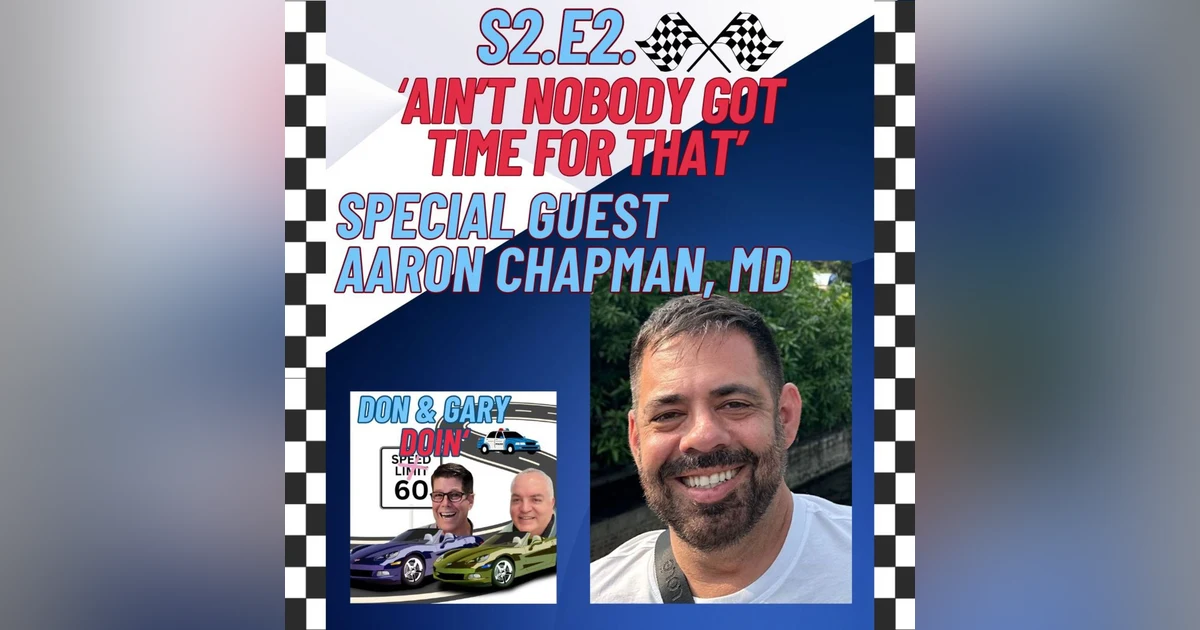
S2E2-Ain't Nobody Got Time For That-Special Guest Aaron Chapman, MD



 RSS Feed
0:03 Hi, Gary, Good morning, done. I'm good, Happy Sunday. Guess what I'm doing today, I'm making bagels. Yes, well, we'll see, because I've got guests from Brooklyn staying with us who tell me that there's no way that I can create a bagel that will rival a New York bagel. So you don't know what proved them wrong or what. I'm going to try and prove them wrong. If not, I will poison them and they'll never be able to tell how bad the bagel. It'll be the. Last bagel they have listeners and watchers. We are back and we have a special guest with us today. If you know us from three p's, you might recognize the name Aaron Chapman. He not only joined us once, he joined us twice in his professional capacity as a board certified psychiatrist. In some of our episodes on three p's we tackled some more serious conversations. One was on mental
1:34 health and one was on gender identity, and Aaron was kind of enough to join us in a professional capacity to guide us through that. So thank you Erin for joining us. Now you're the only person who has crossed over and been a guest on both podcasts, So I think acause. I'm honored to thank you for the invitation. Again, well, we have an ulterior motive because this podcast is called Don and Gary Doing sixty. But apparently we aren't the only ones who are doing sixty. Shut up, there are others. And when we got together several months ago, we were actually in between our birthdays. I had just had my birthday, yours was about to happen, and then just you know, Don's is a few weeks after yours, allegedly area But Don and I turned sixty a couple of years ago, so I'm going to just jump right into it, and well, welcome to the club.
2:37 You are now of the sixties. My birthday did happen as they tend to, and I'm now sixty. And how did that go from that transition from fifty nine being one day and then then you wake up the next morning and you're sixty? You know, I think for me it was a non event, and it's not the first time that I've done this. Maybe it's just something in my own personality how I prepare myself for these things. But I've been. Thinking about myself referring to myself as sixty. You know, at least for six months before the actual date. So when the actual date happened, it wasn't this big mental shift of oh my god, I'm now sixty. It just was the realization of something that I had been kind of incorporating processing for quite some time, thinking about myself as being sixty.
3:33 And did that happen with other milestone birthdays as well? It has? It has, And it's not something that I choose to do. It's not, you know, it's not like, Okay, you know it's June, now you should really start thinking about yourself as fifty or sixty. It's just kind of the way I've handled it. Right, Yeah, Because definitely there are people who whatever the age is, have an issue with it or you know, thinking things are gonna shift, and it's I've never had that issues. I think it's more in your attitude and how you live your life and you know, being positive about it. And the reality is that it happens everyone, right, Everyone is true ages, right, So it's not like it's only happening to you. So that gives me solace.
4:20 I mean, it also helps that I made some wonderful plans around turning sixty. Some of my favorite things like traveling and eating. So I actually turned sixty in Paris, France, nothing wrong with that. Had a wonderful dinner that night, you know, thanks to my husband in Paris, France. Right, So, you know, planning, you know, just some milestone activities you know, around that date. I think we're also helpful in terms of making it more enjoyable than you know, something to dread. Yeah, I did something similar. From my fortieth I went to Europe. From my fiftieth, we went to Italy and my sixth table was a party here. But yeah, but yeah, you celebrate it, you know, and include your family and friends and loved ones.
5:09 So well, Aaron, I have a question, because if I could, it's now sixties. It's just a number for all of us. It's literally just a frickin' number. Who cares. But it's interesting how much weight is put upon a number in our society, you know, just in general, because it's like one of those things where you're not really considered middle aged anymore at sixty, because we're not going to be around twenty. No, But I'm saying, you know, it's interesting to lose that because you know, in many most so you know, we're considered old. Like a lot of people say, well, that's old. It's like, you know, I don't feel old. I don't feel a whole lot different than I did in my forties or fifties. So how about you? Are you feeling good? Are you feeling it seems like you're doing well?
5:54 Right? You know, I feel good. I'm doing well. If you're asking that, you know, just so sort of from a very practical you know, physical you know angle. But but I I agree with you one hundred percent. I mean, do I feel like a different person energy wise? In well? I mean, of course your interests change, but just how I you know, how I'm approaching you know, the world, how I'm approaching life. You know, do I feel that different, you know now having turned sixty than I did when I turned forty or fifty. I don't, you know, I I think I don't feel that different. Good good meals, maybe different perspectives.
6:35 People trying to tend to label numbers and label people with the number and make so many assumptions about you know, well, maybe you shouldn't be doing that, Maybe you shouldn't be going to Paris, or maybe you shouldn't be climbing Mount Everest or maybe you shouldn't be taking you know, that long trip because you're ex age. And it's like, I mean, there's got to be a way to dispell that. Obviously by living our lives positively with a lot of forward momentum. All those things are very important to do, but it's so many people, so many people just tend to label on it. It just seems like it's almost a burden to have that label on it, and it's like having to disprove it in some way by being vital. Yeah, and I can see we're in my own mind that that frame shifts over time. So you know, now I'll start having those thoughts about someone in their eighties. Oh, that person's in their eighties. You know that vacation's going to involve a lot of walking, do you think? And I don't think of that so much, you know, for someone in their sixties or for me in particular, but to have that awareness that, you know, other people's frame of reference is quite different than where mine is right now.
7:50 Right, I'm just thinking like the millennials that are around, because I've got a like a house gift. Who's my sister in laws daughter, who's in her very early thirties, and I ask her so many questions about this because you know, you know, is they're very connected in a different way to social media or to how they process a lot of things, and it's a very interesting thing to get their perspective on what they think this is supposed to be. Luckily, she's very open minded and she's you know, she sees how vital we are. So I mean, I think it's important that also, you kind of it's kind of good to get a perspective from a younger person. And of course, you know, thirties, they're literally half our age. What were we doing in our thirties And it's a very different world right now for them. Absolutely, sorry Gary to mean to interruptew no, no, no, no, no.
8:38 I just wanted to pick up on something that Aaron mentioned. Was he mentioned his husband, So you are you still consider newly weed? How long don't you get married? Well, I'm not sure. We're yeah, sure, let's call us newlyweds. Yeah, we got married in May. So it's been a little more than six months. Okay, you know, so that that is probably a change since the last time I was on one of your podcasts. Yes, and you know this. This is number two for me, it's number one for him. Okay, but but yeah, it's a significant life change and probably you know, one that people don't necessarily associate with the age of fifty.
9:23 Nine, right, yeah, but big year for you. Then twenty twenty four. My goodness, it was wow. But so, how long ago did you meet? Darren and I met? You know, it's we met right before the world shut down in twenty twenty. Okay, we did meet online. We had perhaps had five dates. We met in the end of January of twenty twenty, but I had some vacation plans and he had some vacation plans separate from each other, with our own friends, and you know, so maybe by the time, you know, they said, you know, the world is shutting down and you shouldn't spend time with anyone outside of your household.
10:13 We had maybe had five dates, and we even did have the conversation we reflect with each other. We had the conversation of maybe we shouldn't do this anymore, because you know, I don't know who you're seeing. You don't know who I'm seeing. We don't live in the same household. And then at a certain point we stopped doing that, and we just thought, you know what, why don't we you know, I'm not seeing anyone, he's not seeing anyone. Why don't we just sort of figure this out as a bubble. Yeah, and so we became each other's bubble, really kind of not knowing each other very well, to be honest. But here we are, you know, moving into six years later and we're now newlyweds.
10:55 Wow. Well, congratulation. Although I did see you, you know after. You got yes, yeah, Okay. A couple of questions about that. Since you you bubbled together, does that mean you cohabitated or you were you were each other's bubble and you could intermingle that way. We did not cohabitate, you know. One of those weird things that happens, you know, when you meet someone and start a relationship and get married at fifty nine, is you know, ideally it's you know, two people who kind of have their settled life and their stable life outside of this coming together and you know, I have my home, he has his home, and you know we we didn't give that up. Okay, So did you share sour doughs starters to start?
11:39 Did you do that? The answer to that question is yes. And well, what was the other thing? Did you learn how to do cocktails together? Did you do learn a lot of. New I'm not sure that we learned new cocktails, but we certainly had our. Share of cocktails that's good. And we had our share of Zoom happy hours with this friends, Zoom happy hours with my friends. Okay, and one more quick one if I could. Gary, I'm sorry because now I kind of I don't know it was. It's called the Don and Gary show you. I'm trying to make it more Don and a little less Gary. Ah, Happy New Year, Just kidding, just kidding.
12:24 The other thing I was going to ask you, though, is you mentioned that you'd met each other on the apps. And I have to say, for our for us in our age group, that's not how it all started. For us. Back in our twenties and thirties, the. Apps weren't around. And I'm going to say the new all the kids are doing the apps and basically that's how they're doing the apps. So was it because I mean, you know, we used to go out. We would go to a happy hour, you go to a bar, a restaurant, whatever, You'd meet people that way. And the reason why I bring this up is because do you remember cruising? What cruising was? There is? Do I remember? Do I remember professionals? But you know, kind of something that came up, and something I was reading about recently was that the art of that is gone now because they're actually gone. One, there are a lot fewer spaces for people to go and do that. Two, you know, generations have shifted, and now the apps have basically taken over on how people can meet one another. So it's interesting how some of that intermingling and community has been taken away from us or changed. I won't say it's been taken away because there's still places to go, but it's not nearly the same game that it was twenty years ago.
13:37 I don't know. I've taken a different point of view on that, okay, And that you know, cruising has changed, and now you know, what is what people are doing online? You know what is what people are doing on Grinder and scruff, they're cruising. It's just it's just a different platform. It's a it's a you know, it's a different way of you know, essentially accomplishing the same goal. Well yeah, but cruising could also mean you're meeting someone you're not necessarily doing going right down to Sometimes it is, sometimes it isn't because sometimes actually I met my husband in a bar, you know, making that thing back across from each other face to face, and that was yep, you know, one hundred years ago. But now it's it's it seems like it's almost become so easy where you're just literally swiping through someone. You're going physicality first. Then you have to go through the process of what you did getting to know each other a bit, and that's that's a little more challenging. I think if you're doing it via phone, I'm not sure. I don't know how you did it specifically, but it's interesting how through the generations now it's changed dramatically. I do agree, there's still spaces to go to and still places to go and meet people like that. It just seems the majority of what's happening now is app driven.
14:59 No, No, I absolutely agree with you. You know, I I mentioned that this this marriage is number two for me and I had been married. For fourteen years. Prior to that, and then kind of emerged from that relationship recently divorced into a completely different world of you know, how people meet, how people mingle. You know, what's the purpose of the bars? Why do people go to the bars versus you know, the purpose of the apps? And you know, I ran into a friend a bar friend, you know, after I'm emerging from my last relationship, someone who I used tonew know from the bars, you know, before my first relationship, and he was telling me, you know, and he was right that, you know, the bar the purpose of the bars have changed.
16:02 You know that people you people don't. Go to the bars for the most part to meet They don't go to the bars to hook up, because you have the apps for that. People go to bars to meet up with their friends, hang out, debrief their week, and you know, and I think that's you know, I'm not going to say that that's one hundred percent accurate, but you know, I think there's a lot of accuracy to that. You know, people go to. You know, the bars here in San Francisco mostly with friends to hang out with their friends. And it's not you know, a cruising scene like it used to be. Sad. A question for the two of you, since you were both married, so don I'm going to have you do some math. How old were you when you got married?
16:50 I know, the answer, but I s want to see if you do. Okay, Okay, it was very recently, so it was a couple of years ago. So I was sixty. Yes, good, good answer. Yes for Gary to confirm that, because I wasn't sure. Yes, so yes, but I was twenty twenty three, thank you. See if I rely on Gary for all of these pertinent needs because I don't remember a darn thing. But yeah, I mean, but we'd also been together twenty two years prior to that, so basically we caved because our families were saying, come on, what's your problem, get together already put a. Ring on it. Exactly. No, So my question the two of you, because Don you were sixty, Aaron you're fifty nine, so I didn't realize Aaron had been married before. How old were you when you got married the first time?
17:41 Thirty five? Okay, which when I was what I was initial is going to say, was on average. It's like lay twenties to mid thirties was one. You know, guys usually getting married, well right, not all of us, but I digress. So the decision at fifty nine to sixty to get married just kind of walking through that. I mean, it's like how did that go? What? What is that? Like? I mean, is was that an easy decision or because at that point, you know, in Don's case, yes, you were together with with your husband for twenty plus years. But for someone who's thing like me, it's like you're set in your way. So at late fifties, early sixties, say I'm getting married, that's that's a that's a shift obviously, So I just wanted to kind of bring that up.
18:33 Was it? I can't say it was an easy decision, you know, I think there were some practical elements to making that decision, and as well as you know, impractical reasons for making that decision, you know, having found someone who I love and who you know, I want to spend my life with. You know, when I say practical, you know, there are all kinds of you know, practical financial considerations in terms of setting setting myself up for retirement and setting ourselves up for you know, if we are planning on doing this together. You know, there are some elements of being married that stabilized that for you, so that that that's the stuff that was completely practical. I think on the impractical part, you know, I'd already done this before and I think I probably entered it with you know, a little more fear in trepidation than than Darren did. And this is, you know, this is his first marriage, and I think, you know, it's I think it's something he wanted to accomplish in his life to be a you know, be a married man. You know, I kind of felt like I had already done that. I wasn't opposed to doing it again, but perhaps entered it with a little more trepidation and fear.
20:01 And don in your case, well you said it was a strong armed but no. On the practical side too, it's important because you know, as Aaron mentioned, there is a matter of combined property. There's the legality of these things. We've just actually completed the first two steps of our living trusts and wills together we own quite a bit of combined property. And then there's all of the other medical reasons that you'd want someone to have access to you and to your health and your care afterwards. Should as we get older, we don't know what the future is going to bring us. So on the practical side, to Aaron's point, I mean, it made perfect sense to do this because I don't want there to be any question about anyone else being involved with how my care is given to me in a certain stage of life, or if something changes drastically.
20:48 And that's the practical reality that we dealt with. Plus the fact that mom, you know, everyone started to give us a bad time by not being married. So that was the other side. That you were living in sin. Is that sin? Yes, constant sin. Well that's your whole life story. Moving on. Yeah, one question we ask our guests that are in the club, is there something that advice that you would give your younger self. And you can pick whatever age you want, be at twenty five, be at thirty, nineteen, whatever, with your all the wisdom that you have collected to date.
21:31 You know, I was thinking about that question, and yeah, there are so many different ways to answer it. But because we're talking about turning sixty, I can imagine, you know, just the sheer horror that I that I must have experienced at the age of thirty contemplating the idea that someday I would. Be sixty and. You know the reality, you know, and you'll even hear people say that, you know, oh, the gay community has no place for people, you know, once they're you know, forty and above and finding that that's just not true, you know, and and you know, things change. You know, I don't approach life, nor do I approach approach the gay community and my involvement in the gay community at sixty as I did in my early thirties. But but this idea that you know, that that oh, you know, you're you know, you're of no value, you know, as someone you know in your fifties, in your sixties in the gay community. Well, you know, how are you judging that?
22:56 Are you judging? You know, you know your value is one you know, taking off their shirt at a circuit party. But you know, if any I feel very much, you know, having a place in the gay community. It's a sixty year old place, right, It's but but that but that's there. And you know, and as I said, you know, I mean just just imagining the sheer horror that I must have experienced as a thirty year old, just contemplating the idea of someday I will turn sixty and I will have no value. And you know, I hate to say that, you know, Okay, I'm now married, but even someone in my you know, mid to late fifties, you know, the idea that you know you, no one would desire you, even that has no truth to it, right, It's true.
24:04 God, do you don't go on to anything else? Right? I mentioned quite a few things there too, because I think you'd mentioned you know, I was going to say, have you you and your husband talked about next steps when it comes to this age? You know, everyone is also pointing towards retirement, whatever that looks like, or not retiring, or continuing their careers, or also starting to think more proactively about what the next thing will be. Now, you know, all of us have different agendas, and perhaps you want to keep practicing forever and never stop it, or do you have an end date or have even just thought about that yet. I don't mean an end date, final end date. I just mean an endate towards.
24:45 Thank you, thank you professional. Although I probably have one of those two. We all have one of those. We just don't know which one it is or when it is. So, but I mean, what have you thought about what the next step might look like? Something that you know? Is interesting about sixty for me, you know, and I'm going to think about sixty almost more as a decade as opposed to an you know, a birthday or a year. But on one hand, people say, oh, what does it feel like to have turned sixty? There's something liberating about turning sixty. There's something liberating about being in my sixties because I think this is a decade for many people, and I think it will be for me of change and liberation to change.
25:38 You know. I think we are given. License to make significant shifts in our you know, in our career or to end our career. And I think most people do that in their sixties. And I have to say that approaching sixty for me was a combination of you know, I was there an element of dread, like, oh my god, I'm going to be sixty? Yes, yes there was. Was there an element of excitement that I'm going to be in my sixties and that's going to afford me, you know, at least from a societal perspective, you know, certain flexibility and freedom and so the to answer your question, you know, yes, we are talking about what is retired life going to look like? When are we going to pull the When am I going to pull the trigger on that? What what will life look like after that? Does retirement mean a complete cessation of work or does it mean, and I think that this is some of what I'm looking at personally. You know, does it mean more flexibility in terms of how I approach work at least for some period of time, you know, no longer working a job with a boss, but maybe doing some teaching, some consulting, something that are a little more you know, self driven.
27:03 And so I. In some ways welcome to sixty because of you know, and it's not that you can't make these decisions at fifty five. They're just more societally sanctioned to say, I'm making these decisions, making this change in my sixties, and there's a freedom that comes with that. I have also seen a lot of people reinvent themselves too, because you know, people are also saying, you know, with perhaps not retiring completely, but saying, Okay, I'm going to consult in my profession going forward, and I can choose when I work. If they're so lucky, if they have that luxury, which is wonderful because then they can also devote time to other things that they find more rewarding, or reinvent themselves to take some more paths towards their career that they hadn't taken the past. People are going back to school, people are joining organizations. People are not seeing as a stopping point, as you say, but actually a stomping off point and a diving board up into something new, a new pool of something else, which is very exciting to me because I think, you know, all of us have experienced some form of reinvention or either've been forced because there's also people are laid off at a certain age. They have to make decisions do I continue after I've been laid off from my job of twenty some odd years or whatever, because there is a lot of that based on age and also salaries where people are actually being taken out of their job or workplace and they're changing. So I think I agree with
28:34 you there's a lot of positivity out of this. You can make something really great out of a negative experience like being laid off from your job, to actually make take a new path. And I think that's a different perspective that maybe our parents' generations didn't have because you stopped working at sixty five or whatever the age was at the time. You literally just stopped. You got a pension, and you just. Golfed or whatever it was, because that's what people did. Yeah, people did, and I don't see that so much anymore. I look at it as if you are contemplating at this stage, what have I done? Have I accomplished the things that I wanted to accomplish? You know, I had a dream to do X and I just turned sixty and I haven't done that. So how you know, if you really want to do it, you got to do it.
29:23 You know, strike while the iron is hot, and maybe at sixty is when you are more stable in a lot of things in your life, so you're able to, maybe if it's a risk, take that risk, so you don't look back and say, oh, I should have done this, I should have done that. Yeah, I will share with you an ongoing discussion. You know that you know that Darren and I have and that I have with friends as well, and that is you know, some of the pitfalls, potential pitfalls that we see around us. Gay men generally don't play golf, but we do have a tendency to day drink, and so.
30:13 How to. You know, how to you know, create a retirement and a life after retirement that doesn't evolve into meeting up with friends and day drinking on a daily basis, and you know, I have to say that that, you know, that's actually a real fear, you know, because because it's something I see, you know, I see around me, you know, in terms of you know, gay retirees, you know, especially you know gay retirees who go to gay retirement destinations like you know, Palm Springs, Portavarta, that you know, I'm I'm hoping that retired life looks something somewhat more meaningful than taking up day drinking. Yeah, golf is unlikely. I've never played golf in my life.
31:12 Pickleball. It's all about the pickleb possibility. You're active, you can actually hold a glass of wine while you're doing because it's very civilized, so. You can permit it it is. But yeah, I agree with you. I think it's it's important that people don't fall into that I don't say trap, but into that trope maybe of thinking that, you know, that's what you do. Because in Palm Springs, for example, where we also spend time, there are many groups of older people that are getting together that are called primetimers of the desert. And guess what they do at three o'clock in the afternoon. They're drinking for a few hours. Oh, they're starting late, but I know, I think it's important.
31:54 That's why it's good to get into good routines or habits now or earlier than this. So you have those things if you're interested in exercise, if you're interested if you like to walk, if you want to start biking, if you want to play pickleball, you know, even golf. I mean, again, not many people play golf, but it's it's something that you're actually doing. What we're doing with this podcast, for example, I intend to take this further past, you know, for years to come in some version or form, and I'm learning new things. I'm learning how to podcast, I'm learning how to edit, I'm learning how to work with new apps and programs. So I'm actually very excited about being stimulated mentally on new things to learn and do because I was never adapt at technology, like much like our generation, I guess.
32:43 And don Ye also mentioned earlier, like you know, taking classes. Maybe you want to explore your artistic endeavors that you never got a chance to do. Go to yeah, go to the local university. It's all kinds of options available for you. So yeah, we definitely find things to do that don't involve sitting at a barstool. And I think I think in the last podcast where I joined. You, you know, we talked about my you know, well I would have been my partner at the time, but you know, having a place in Portsoaarta and giving some consideration to at least living part time, if not full time, in Mexico and meeting up with people there, establishing friendships there, which we are already doing, and just how many different volunteer opportunities there are for you know, Americans and Canadians who live there, you know, to support the community around them.
33:47 And you know, so those are things that I very much, you know, not only would I want to be involved in, but I'd almost feel that I need it to to create a purpose in a post retirement life. So you've been going there pretty regularly for a while now, or is it a newer destination for you. Well, it's a place that. I loved to go to occasionally probably for the last twenty five years. Oh okay, but the idea that hey, this could potentially be a retirement destination and as such, it's not just about going there on vacation and you know, just having a great time and coming back, but it's about meeting people there, establishing relationships there, learning about, you know, volunteer opportunities in the community and organizations that are supporting the community around Porto Aarta. That's something I would say perhaps in the last three years.
34:59 And it's a different approach, you know, to going to Porta i Arta. It's not about you know, what are the restaurants we're going to hit up, what are the bars we're going to hit up, you know, what are the shows we're going to see. It's you know, who are the friends that we're going to get together with. And so you ended up buying a place there. How was that a kind of since you've been going for so long that seemed like a logical decision to. Make or completely illogical? There was a fantasy element to it, to be sure, now having done it, was it a mistake? Absolutely not? But was was it always just this well thought out part of a part of my financial plan?
35:49 No, there was. There was a fantasy element to it, having a place in port of i Arta and that's been realized. And ask me in ten years, how did we use that opportunity? And I'll tell you, was it a really good idea? So bron and Gary down seventy comes out, we'll call you back and. Yes, right, please do well. By then we'll have been invited to stay at the house in Puerto Bayarda and then we can maybe we record from there, don And of course. You are invited and my WiFi works great.
36:31 Here's the thing though, it's forward momentum there is with that. I always feel like our lives need to move forward and having a place and to look forward to going to every season or whenever you want to or on a whim. What a wonderful gift that is to be able to just jump on a plane because it's a couple of few hours from La or from San Francisco. Yeah, so it's an easy trip. But also, as you said, establishing, there's a whole new environment that you're going to have that's away from the city, that's a very different So I love the idea of that because it just opens up so much opportunity to do and stimulate your mind and your health and everything. So forward momentum me and it's, like I said, something to look forward to, which I think is also important for all of us our in this age or state of our lives.
37:19 And I think something to be said for gay retirement destinations. I have friends who have moved to Palm Springs, and I think they share this experience with me. This experience that I'm having is I'm transitioning into Portovarta, is most of the gay men who live there came from somewhere else, and there's a hunger to establish community. And it's a different experience that I have when I'm there and when I talk to my friends who've gone to Palm Springs then I'm having here in San Francisco, in that you have a whole community of people that are recently arrived, they left wherever it was that they came from, and there's a hunger to meet new friends, established community, and you know, I find it easier, you know, to meet new people there then I'm experiencing here. And I have to ask myself how much of that is about San Francisco, maybe how much of that is about me? And I don't quite know, you know, but but it does feel that there is something to be said for this idea of the retirement destination.
38:40 You also mentioned when you say that, so you mentioned community too, because I think that's something that we're establishing in different parts of the country Palm Springs TV other parts of the country also. But one thing I'm seeing a little bit more of is the idea of communal living. I know that's not what we're talking about specifically, but communal living for people going oh old, straight, gay, whatever. There's a lot more of a search for that, and I've seen a lot more social media based on it, showing where people need to go to group together and perhaps spend time in their older years together as more of a community. So I think community is actually a big thing. You mentioned it on a broad spectrum with you know where you're looking at in PV and Palm Springs, but I agree, we're all looking for another community to build.
39:30 Yeah, what I was going to say is tied into that is that as I've gotten older, a lot of my friends for one reason that they have moved away. So my core group of friends has kind of thinned out. And so I came up on something I was watching the day, is it how easy is it to make new friends as you get older? And yes, I do a lot of volunteer works. I meet a lot of people of that, but it's I don't necessarily hang out with them outside of when we're together doing our volunteer work. Right, So I have my my neighbor friends that we try and get together once in a while, and then folks that have volunteer with. But I'm in an I'm in an office at home. I work by myself, so there's no relationships work relationships. I can hang out with all day and do something at night. So that's the challenge I've had where because I'm single, I don't I don't like going to the bars. Never did, right unless as you and such, I'm meeting with friends, okay, but in my well, in my elder years, done when I was younger, different stuff.
40:43 I've been a few hours in our time. But okay, it's like what. I've seen you, Gary, I know i've seen you well allegedly. Yes, I used to go to the bars a lot, but I don't unless someone's visiting and they want to go it hit the old haunts. Fine, But that's the challenge I have now is so I've actually looked at but they're super expensive. Look at those, you know, retirement communities that where you can be around other people your age and you know, and then intermix with them. But it's it's not cheap.
41:23 Nope, nope. So I yeah, So I'm kind of at that age We're like, well, I don't know what I'm going to do because I'm looking at you know, if I retire at sixty seven, that's you know, five years from now, and yes, I can continue living here and doing my volunteer work, but but the herd is thinning. So it's. That is so much you know what has been my San Francisco experience over the last decade. Yeah, And I don't know how much of that is unique to San Francisco. I think some of it is unique to the Bay Area. But you know, as I was approaching sixty now being sixty and you know, I have friends that probably range from you know, ten years older to me than me, ten years younger than me, no one was talking about doing retirement in San Francisco. Everyone was talking about, you know, when I retire, I.
42:22 Will go too. And then it started to happen. Gary. You know, I have friends who was on their bucket list to move to France. They moved to France. Other friends who just felt priced out of the area in retirement and moved to Santa Fe. Other friends who you know, felt priced out and moved to you know, Sacramento, you know, and that's accessible, but it's not like, hey, what are you doing tonight? Should we have dinner? Is you know, it's not that accessible. And then of course you know a number of friends who have moved to Palm Springs, as many gay men in California do post retirement. So everyone was talking about their retirement. No one was talking about staying in the Bay Area because of price, and then asking the question are we still getting you know, are we still getting our money's worth staying? You know, it's not the it's not the same place that many of us moved to.
43:32 And there's all the things that are going through my head and people have said, well, you know, why don't you move to X or retire to this? Like why would I move to a place where I don't know anyone when I have established from here, my family's here, you know, friends here. I would not want to pick up and move somewhere else just oh, because it's financially better. I mean, that's one way you can look at it. I don't want to do it based on that. And there's nothing wrong with living in the city forever. You know what I mean, there's nothing wrong with that. I mean, I love San Francisco. I hadn't really it wasn't my first choice to move here to the beach.
44:13 I mean, you o the beach, But I mean it wasn't my first choice to leave San Francisco because we've been here forever and I loved living there. We loved where we lived, loved our home, loved the family that was there, we loved all the friends that we had. But you know, to Gary's point, since we were actually I'm one of the herd that thinned out to the left. Yeah, you know, I was one of those people among many that left for whatever reason. But it's also very similar because you know, as I said, I have house guests here from Brooklyn. They're never going to leave New York. They are never going to leave Brooklyn. And I say that adamantly because I already talked with them about that, because you know, it's a different thing having people who also have perhaps rented their whole lives, had never had to purchase a home or made the commitment to a home.
44:55 The financial costs, you know, the tension of keeping that mortgage payment going, all those things, you know, so they're a little more used to paying rent or you know, a higher rent. But they're never gonna leave Gary Stan in San Francisco the whole time. Your family is there, your core is there. We can always jump on a plane and come see you. You know, it's like that's true. Yeah, yeah, I mean it's luckily it's close enough that yes, you can do that as it is Puerto by Yerta. You know, like. For me, he's pushing that one. That's right, Come on, I've done it a couple of times. So change the subject. One of our little segments, if we will in the club is ain't nobody got time for that? So we think about you know, you've you've been on this earth for sixty years, so you've lived a life, and so looking back or just other things around you at age sixty, what is it? They're like, you know what, I'm not putting up with that anymore, or I just I don't have time for that anymore.
46:06 Take it away. That's a hard one for me to answer, because I think in some ways I've become more patient. I'd like to think I've become more patient with age than perhaps. I was in my thirties and forties. But I think really, I think, you know, the core of your question is about patience, you know, and what are the things that I've become impatient of? And of course there are things that I am patient of, but I think, you know, for the most part, I feel myself becoming a more patient person. And I think that that's something that I've strived for, because I think there probably been times.
46:57 That I've been quite impatient. But I you know, things that are wasting my time, I think are things that I feel limited patients for, or this I don't have time for that I was just having, you know, I'm sixty, was having a conversation with a friend of mine in his seventies about, you know, how much garbage. Is on Facebook these days and what a waste of time. Facebook feels like it's becoming because it's just. All of this, you know, suggested for you material that has absolutely nothing to do with any interest I've ever expressed online, and you know, and ads and so you know, that felt, you know, and it felt like both of us were like, I don't have time for this, and both of us were giving consideration to if it wasn't for the fact it's how we keep up with our friends that maybe we would just throw it away. But I guess that's part of their algorithm in knowing that we're very unlikely to throw it away. So, you know, that's just a recent conversation about, you know, something that I don't know. Maybe the younger people are tolerating this, Maybe the younger people are appreciating this. You know, this suggested for you material that's completely out of the blue.
48:25 For us, it was like, this is wasting my time. Let me add to that. No, my take on it was okahead Gary, go ahead, please, No, I was gonna say. My take on that question was from my perspective was when I was younger, I'd be the type that I wouldn't say anything if something bothered me. I just you know, kept my mouth shut. But as I've gotten older, I'm like, you know what, that's not right what you just said or you just did. So I'm more likely to speak up now because if I waited around for someone to say something, everyone's eyes are divert they'd look down that you know, they might be tisking under their breath, but they wouldn't do or say anything.
49:09 And that's where I would say, you know what, that's just not right. You can't talk to him like that, you can't do that whatever, whatever the situation is. I just felt like someone needed to stand up for this person or for myself in whatever the situation was. So that's kind of where where that ain't nobody got time for that came from just as like I'm older, I'm wise her to have insurance. To Wanda exactly, So to Wanda Dot, i'd cut you off. You were going to say something, No, that's okay. I'm just gonna say. When it comes to social media, that's something I'm really interested to see how it evolved, because I don't have time for the toxic rhetoric that takes place on almost every social media page. So I don't have time for that, and I don't engage. I'm actually even considering whether or not Facebook is a medium I would use other than showing pictures of fuzzy doggies and unicorns and saying hi to my friends, because there's just so much other toxicity in there, which is what it meant for originally, and that can be said for most social media platforms. The one question I did ask my thirty year old guest here was that do you ever think the younger generations would turn away in some form from social media, and she said, I don't think so.
50:25 TikTok's been shut off today, So that's that's interesting that that took place. But again, who knows what the future of that's going to be because of the message that's happening, what's happening tomorrow. But I think I don't really have time for all the horrible negativity that spirals from political discussions that are showing a picture of a fuzzy kitty and all of a sudden it turns into political discussion and spirals out of now orders. Oh yeah, exactly, No more so. Yeah, although have you seen mention of people turning to another platform called blue Sky. Absolutely lot of people that are taking a look at that. Who knows well that will spiral into. I was gonna say, but then eventually will that turned into the new Facebook?
51:07 What were you saying? And then become No, I have an account on blue Sky. I haven't quite figured out how to how to make it interest, how to how to how to set it up so that it captures my attention, okay, which maybe means their algorithms aren't as good as the Facebook algorithms. Okay, yes, stick to fuzzy kiddies and unicorns. I mean, it's just the way to do it. Or saying hi to your friends from Portabayart. Guess where I am today? You know, exactly right like this, you know, like and subscribe. That's all we say, Aaron, if you do a. Good job of identifying these things that I am intolerant of and that I have no time for at sixty.
51:52 So, Aaron, exactly if you were a teacher, If you were a teacher, maybe you are an educator, if you could teach a subject or an age group, what might that be? Well, I I am a teacher. Oh wow, sorry, it's a side thing that I do. And you know, I'm currently teaching psychiatry or what they call behavioral medicine to a class of physician assistant students in Oakland. And this is something I've done probably for the last seven years, one semester, one semester out of the year, one evening a week and I enjoy that.
52:37 And so you know, what are the age of those students their thirties and forties. And I think, you know that's that's an age that I like. Now the question is what if. I just kind of went outside of my mind, you know, outside of my professional life, and wanted to teach something else political side, This might be an interesting one. You know, I would probably have to do some of my own self education before I, you know, wanted to teach other people. But you know, I am someone who's kind of, outside of psychiatry.
53:18 Been politically minded politics, public policy. That's probably not only probably in reality, that's part of what drew me to psychiatry or community based psychiatry as a field, is their few parts of medicine where you have that intersection between medicine, treatment, politics, and public policy. That changed five years ago where you know, are you know, infectious disease specialists became very political for a few moments, you know, during the COVID nineteen pandemic and they got to experience you know, that interface between you know, medicine and public policy in a way that you know, I've been experiencing, you know, my entire career. But honestly that that is one of the things that drew me to psychiatry, and especially public psychiatry, is how it exists on that interface with politics. And so if I were going to let go of the psychiatry piece, maybe the policy politic piece would be something that I want to teach.
54:29 I think that's incredibly important, considering so most people don't know how the House and Senate work, that most people don't know how we build laws or pass them. I think it's incredibly valuable for people if there was an interest in it, for most people to learn how government actually works and how we can affect it to work for us, as opposed to just talking about it on Facebook and not being knowledgeable. And where does conservatism come from? Where does liberalism come from? You know? Are we? Are we born that way? What are the life experiences that you know that might push someone in one direction versus another direction? All right, mister Fifer? How are we doing? We have with questions?
55:13 I know I have some stupid ones that I'm not gonna. Oh, come on, I like stupid. Okay, good. If someone were to play you in a movie, who would it be? Oh geez, see. Blanking on his name? But give me the movie? Who is the actor that played doctor Frankenfurter. In Tim Curry? Oh, Tim, Tim Curry and Curry. People told me from time to time that I resemble Tim Curry. And I'm not sure. I've never quite taken that as a compliment, but let's go with Tim Curry. But I think Gary, are we good? Do you think we got it? I think it's good. We had a really good conversation.
55:53 So thank you Eric for joining us yet again, our superstar guest again. Welcome to the club and look forward to seeing you here somewhere in the city at some point. We'll make that happen. Alrighty, all righty, thank you so much. Thank you later and Don good to see you again. Yeah you too, take care of Hi. Hey, everybody, it's Don from Don and Gary Doing Sixty. Unfortunately, for our closing segment, we have lost the audio and the visual feed that was originally recorded with both of us, but Gary has graciously and magnanimously allowed me to record this one on my own. So we wanted to thank Aaron for joining us.
56:38 You were great. Aeron, please come back and join us. You're welcome anytime. Watchers and viewers of the podcast, thank you for joining us at Donn and Gary Doing sixty. We hope you enjoyed spending quality of time with us. Join us next time as we navigate the world at this age don't forget. You can always find us at Apple Podcasts and Spotify, on Instagram at Don and Gary Doing sixty and of course on YouTube on the five for pods under Don and Gary Doing sixty. If you'd like to contact us, email us at Don and garydoin sixty at gmail dot com. Thanks for your patience. Sorry for the technical difficulties. They'll probably happen again, but we'll see you next time. We have lots of defot episodes coming in. They're in the canon, ready to go. Talk to you soon.
57:21 Five


