The Hidden Cost of Success (And How to Reclaim Your Life)

 Apple Podcasts
 Castro
 RSS Feed
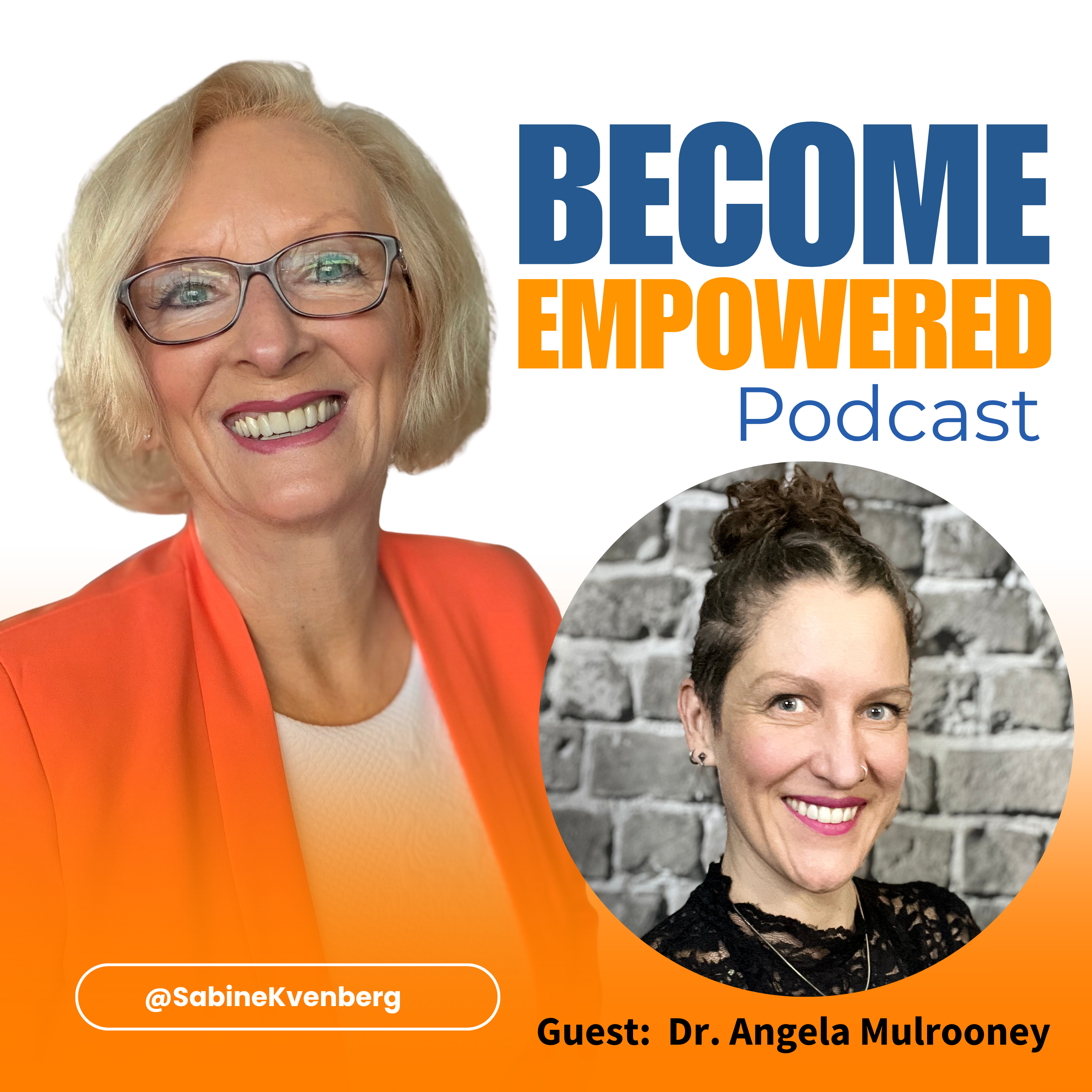
 In this powerful episode, Sabine Kvenberg sits down with Dr. Angela Mulrooney to explore the hidden realities behind success, burnout, and rediscovering purpose.
Dr. Mulrooney shares her journey from building a thriving dental career to experiencing deep burnout—and how that pivotal moment became the catalyst for transformation. Together, they unpack the pressure of high performance, the identity traps many professionals fall into, and what it really takes to realign your life and business with your true self.
This conversation is a must-listen for entrepreneurs, leaders, and high achievers who are ready to move beyond survival mode and step into a more authentic, fulfilling version of success.
You’ll learn:
- The real root cause of burnout (it’s not what you think)
- How to recognize when you’re out of alignment
- Why success without fulfillment leads to breakdown
- Practical insights to reclaim your energy, purpose, and direction
speaker-0: An interesting journey has definitely not been linear, as I'm sure it is for most entrepreneurs. And my big goal in this world right now is to solve the identity crisis that is hitting our seasoned professionals who are getting sidelined because of AI, because of ageism, and helping them to gain their confidence again to be able to create the impact that they still want to create.
speaker-1: Every great story has a moment. The one where everything shifts. Welcome to the Become Empowered podcast where real leaders pull back the curtain and show you exactly how they did it. I'm Sabine Kvenberg, performance communication coach, keynote speaker, author and your host. I have spent my career on stages, real ones and invisible ones. And I know this, the most powerful transformations don't happen in the spotlight. They happen in the quiet moments of decisions, resilience and radical courage. Before we dive in, if this podcast moves you, challenges you or gives you that one thing you needed to hear today, please follow, like and share it with someone who needs it too. That's how we grow this community together. Some episodes I'm sitting down with entrepreneurs, authors, speakers, coaches and bold leaders who have faced the hard stuff and kept going. Other times it's just you and me. going deep into the mindset, strategies and the gumption it takes to become who you were always meant to be. Either way, we talk confidence, leadership, resilience and the real story behind the growth. This is Become Empowered. Let's get into it. Angela Mulrooney focuses on identity architecture in the age of AI. The structure that connects lived experience, decision making, authority and trust. Angela, you didn't start out thinking you want to become an identity architect. There were several layers in between, right? So how did you start your professional career?
speaker-0: Originally I was a dentist and I had built a practice that catered to people who were afraid of the dentist. So we catered to cowards is what we called it. And because most dentists don't like dealing with phobic patients, they would send me their patients. So I was a referral based practice starting at 28. I was quite young, but I had gone and taken a whole bunch of education outside of my basic dental training to be able to do IV sedation, full mouth rehabilitation, all that kind of stuff. Unfortunately, I developed a condition called Focal Dystonia, which ended my career overnight. So it's a condition that actually is a brain injury from overusing your fine motor skill that kills your fine motor skill. So what should relax contracts and vice versa. like controlling a pen is challenging enough, let alone controlling a scalpel or a 500,000 RPM drill, you know.
speaker-1: That is, of course, where you are hit with the identity crisis, Correct.
speaker-0: So from there I built, I've built four more companies since selling my dental practice and I've sold three of those other companies. I've sold four in total. So the next thing I built was actually my professional dance company because I had danced professionally as long as I was a dentist. So I decided after I sold my dental clinic, I needed a break from dentistry. So I had always worked for other people and performed for other people. So I just built my own thing. â and we became the second largest adults.
speaker-1: did you build?
speaker-0: based Latin company in our city six months into me opening it. And this was during the oil crisis in Calgary when everyone was like, we don't need another dance studio. But I went in on what my niche of genius was in the dance market and grew really fast. then I
speaker-1: You did Latin dancing?
speaker-0: Latin contemporary, I was an aerial acrobat until my hand got messed
speaker-1: Okay, so then you sold that and then you started another business. What wasn't another business?
speaker-0: I didn't sell that one. started another company while I was still had that one. So I, I appeared on it another evolution. So with the education that I had in dentistry, cause I'd invest about half a million dollars into my education after finishing dental school to understand business and marketing and the skills as well. And so I built a consultancy for dentists that was really meant to help them to find their passion because I like drilling was so fun for me. I loved it. whereas most dentists kind of hate their life. So I wanted to help them find their passion and build their clinic around that instead of being like a jack of all trades kind of dentist is like, what do you actually like to do? You can build a company around anything. So helping them to build their business around what they were actually passionate about in dentistry. So we took that one global in a year through LinkedIn, which is where people were like, dentists aren't on LinkedIn. I was like, well, I was on LinkedIn. So I'm guessing the ones who are like me are actually on there. And so yeah, we went. we gained notoriety very quickly. And then people started asking me to help them with their social media because they had seen what I done with LinkedIn. And so then I started helping people with their LinkedIn and focused on seasoned professionals and then opened up the social media agency two months to the day before the pandemic shut down in Canada. And we exploded during that time because the dental clinics were shut down. I was like, well, we're not going to focus on coaching dentists because they don't want to talk to us right now. Dance was definitely shut down because we couldn't spit in each other's faces. â And then the social media agency, we grew from two and a half to 14 full-time team members in 10 months because I was known on LinkedIn. So people were coming to me. I was a professional speaker. So a lot of my speaking circle was coming to me because they didn't know how to talk to the little black hole without having a thousand people in the audience to play off of. So that grew really fast. And then I moved to Nicaragua a year into the pandemic and suddenly found myself in paradise, but not actually living because I was still working 100 hour work weeks. So I started to light matches and got rid of the dance company, got rid of the social media agency, got rid of the dental consultancy and went in on the identity work, all in on the identity work that I do now.
speaker-1: So your journey is very interesting because it gives it that red line that you, number one, have to adapt with whatever life throws your way. And number two, also listening and watching the business world, the environment, what's needed, what's out there, and you adapt it accordingly. to everything. So that is fascinating and also fun to see because with what you did, you always did what you enjoy doing. Like you were enjoying dance, right? Of course dentistry was your thing. Now you're helping others. Like for me, my background as an entertainer and a school owner for over 25 years. Now, that passion still continues. Now I'm helping entrepreneurs to get seen, get out there. So I get it. And what would you say to someone who is in this identity crisis, who maybe does not know where to go, what to do, because you have been in the identity crisis, because you identified yourself as the dentist, right? And all of a sudden you couldn't do that anymore. â Guide us through that process. How did you feel? How did it affect your life? And how did you get through and out of it? Bring us back to that very moment.
speaker-0: that very moment I had no idea what to do. So I looked externally to people who had dealt with people who were in this situation. Like I was pretty young to lose my career as a dentist. Usually it's in their 50s and 60s. So I just listened to everybody else and everyone's like, well, you've built this amazing brand. Other dentists refer you patients. Like the phobic population comes to you. Like you just put someone else in your shoes. And so I was like, well, they must know better than me. Cause I was like 32, I was still you're still a kid at 32, right? You don't have that much life experience, especially not with something this major. So I listened to them and just had this like every day that I went into the clinic, I felt like I was being torn apart inside. And the wound of like losing my dental care felt like it was always getting ripped off every day that I went in as well, because the people who were replacing me didn't, they weren't as passionate as me, right? And they were in their own way too, because they had sent me patients. They're like, well, I can't replace you because I was handing off my patients to like, why would I be able to now handle these patients? So it was really frustrating to see people not passionate when I was so passionate, like dentistry was playtime for me. So finally, kind of like when the global, when the oil crisis hit in 2015, that's when I was like, you know what? I'm out. I'm going to, whatever it takes to get rid of this practice, I'm getting rid of it because I could see the economy doing this. I had bought the practice during the global financial crisis, so it had slowly gone like this, but this was like a nosedive in our economy. And so I was like, you know what, every time I think about selling it, that pain in my stomach would disappear. So I got bold and decided to sell the practice and had no idea what I was going to do after. thought, well, I can go back to dance and just kind of like heal and, you know, tell stories through it. And so when I did that, it was really interesting because the day that I sold the practice and like handed the keys over, I could actually start tasting food again. I didn't realize like how much my sensory system was shut down because I was in this spin cycle of like, everyone's like, say holding out hope and I'm like, there's no hope. Like we've been, I've been told my career is done. this is, it's game over and time to move on to new things. But I was still being tied to the old identity and everyone was trying to keep me in that old identity as well who was advising me. And I knew from like the day that I got the diagnosis that it was time to move on, but I was scared too because I had built this thing. I'd invested my blood, sweat and tears to build that clinic.
speaker-1: You seem like you're always working from your head. Even when you get this diagnosis, you didn't take time to just cry or anything. You went right away, okay, what can I do? need to sell this to the practice now. It seems like to me, maybe I'm wrong, but this comes across.
speaker-0: Well, my body feels a lot of things, but I'm also very good at like shutting it down to get things done. Right. And by the time I got the diagnosis, it was six months in. I had cried a lot, but it wasn't. I wasn't able to figure out what was going on. I was just in the circle of like, what do I do? What do I do? What do do? I don't know what's happening. I don't understand why this happened. I've done everything right. And yet everything's being stripped away from me. Like it was â very disorienting. And then when they finally gave me the diagnosis, I sat back and went, okay, cool. Now I know there's not like all these paths. It's like there's this path of clinical dentistry is gone. You're not going to be able to do it. So then it started to be able to look at things more objectively. I put people in my practice and it still like didn't feel right. And so then finally, when I stopped listening to everyone else and just listened to me, then that's when I decided to sell it. Move on.
speaker-1: is a good point that you made because sometimes we just have to because there so many great opinions and so many great great pieces of advice and in some instances it's good that we get that advice and and then we can discern it but we also have to listen to our own heart and our own intuition that is a guiding light for us in in our life but it seems like it was still a lot of twists and turns in your life. why did you go to, where was it, Nicaragua or Uganda? Nicaragua. Okay. So what made you move there?
speaker-0: Yeah. It was a path of least resistance during the pandemic because Canada kept, we had all these lovely spikes. so borders, every time I put a pin in the map, the border would get closed to Canadians because we'd have another spike. I was like, Oh, I got to get out of here. Cause it was the first time in years that I had, I could see that I was going to be able to own my schedule the way I want to own it. Because speaking professionally, you're getting shipped out every week to a different location and you're booked years in advance. suddenly. All that got taken off the table and everything was online with the little camera. And so I was like, I want to see the world the way that I want to see the world. So it was path of least resistance to go down there. The funny thing is five days after I arrived, Canada shut down all the tropical flights because they were trying to prevent the spread with spring break. They didn't want people sneaking down to the tropics. I actually got stuck and my plan had been to be there for two weeks and then carry on. But when I got stuck, I was like, ooh, I'm a little bit afraid to go to other countries right now in case I get into a bad situation and get stuck there. I knew one person there already. So I decided to stick it out. And then I ended up there for three years, learned to serve. Quite a lovely life while I was running my businesses.
speaker-1: Yeah, that is fantastic. Sometimes it's like you get into a situation. â Like I said, in this case, you were stuck there during the pandemic and the travel was very limited, but you luckily ended up in paradise. you still were able, and that is another beautiful thing. When you have an online business, you can, in the days we live, you can do business from everywhere in the world. That's what I love. That's what I love. now I also read you are into, using AI to also help your clients â in your business. So tell us how does AI come into your world and, and how do you incorporate AI in your own business and also helping your clients with that?
speaker-0: Yeah, so my first foray really into AI was I got scared because I could see what was happening with it. I'm like, this thing's going to eat my lunch, so I better figure this out. So I took an AI mastery course. It was six months, like six hours a class a week. It was ridiculous. And we had to build a project in it. And the project that I built, what I decided to do was try and replace myself in the company with what I was doing to crack people open to figure out what they were really about. And so we turned a $5,500 process into a $497 product that we were actually able to iterate and make it better. So this is one of the things that I really work with people on is like, AI is going to eat your lunch. If you are just a chat bot, someone is asking you questions and you're giving good answers. AI is going to outdo you all day long. It may not be as streamlined as you would be, but people can get good enough answers that they feel it feels sufficient for them to rely on something that is less expensive. doesn't involve a human, way less cost. â So when people are working with me, we're looking at like, okay, what is happening in your brain that gives you that instant answer that makes you a good chat bot? Let's slow down that thinking process and figure out how we can turn that into a product that people can access your beautiful brain without you in the room. And so then we develop a product that has all those decision points in it and... we remove the bottleneck of the human because there's only so many hours a day that you can work or that you want to work. And then we iterate it to make it even better than you ever were. And then you can scale your impact that way. And the people that I work with are always impact driven. Yes, they want to make a living, but they have these beautiful histories of learning that they want to be passing on to other people with next generation, also their own generation. And so this gets them out of the way for the the foundational stuff and then if they choose to, they can still work with people directly on the higher level stuff that the machine can't do or that they don't want the machine to do. And so they can build kind of duality into their business so that it works really well for them.
speaker-1: So it's basically â you're cloning that person. In other words, got you, got you. So it's an application that people then have in their business. Is that what it is?
speaker-0: It depends on what they want to build and it depends on their process. So it's very, it's dependent on every case on what we actually build out.
speaker-1: Okay. And you're just working with, â with entrepreneurs or who is your ideal audience?
speaker-0: So there's kind of two sides. There's the high level professionals who are getting sidelined right now who are going, trying to get back into corporate seems very risky. So maybe I should be pivoting over to entrepreneurship. And then there's ones who are already in entrepreneurship who want to elevate it to the next level, who are seeing the impending doom of AI and what it's going to do to their business. And so they're trying to get ahead of it and also, you know, really create their legacy with these products that they're developing.
speaker-1: Yeah. Yeah. I see it too in my business and with my clients and specifically, â how can we set ourselves apart? Now, me being a communication and confidence coach and have been helping people to speak on stages or in a Zoom box, it really doesn't matter. Yeah. But it also depends on how they present themselves. So, and I think this is still that aspect that AI never can replace. So to have that fine balance, that's what I'm focusing on now, is very important. So what piece of advice would you give someone who stands on that pivotal moment to decide, what am I gonna do? Should I leave my job? Should I write it out and see what happens? What is your... piece of advice or recommendation.
speaker-0: I have an exercise that I have people do called the sticky note exercise. And if they're not willing, like if they are just trying to kind of do it themselves, I get them to write every skill that they have onto a sticky note and put it on a board or their fridge or whatever, and then leave it and then come back the next day and order them from most loved to least loved and then figure out in the most loved, if you were to go all in on three of your skills for the next five years, which ones would you do? And you're not allowed to do anything else. This is obviously theoretical. â What comes out in the wash is what they actually are passionate about. So then if they want to figure out the framing of that, then the unleashing influence system, which gives them their identity architecture is the step to go in. that's that what the first product that I built that replaced my $5,500 cracky open. â They can go in there and they just talk to the machine and it pokes them from all these different directions and pulls out information. The journey of just going through the questions. gives people realizations and then when they get the document they see themselves framed in a way that they've never thought about themselves before and suddenly they go â that is me and they're locked and loaded to actually do what they want to do and they may see that no I do actually want to work into a corporation or no I'm tired of that game it feels threatening right now like I could lose my job at any point maybe out be able to work for two years no I want to do my own thing and this is how I can leverage my beautiful history, my beautiful brain to create the future that I want.
speaker-1: Yeah, that is very good. the exercises that you have, I've done it with like in a different form. But what I like about is the sticky note because it adds a level of physicality to it. As you know, as a dancer, know, physicality is everything. And so I think that's a neat idea. That's a great idea. So for everybody listening to this, make sure, you know, this is something you can do. And if you want some more help with that, how can they find you?
speaker-0: They can find me on LinkedIn under Dr. Angela Mulroney and if they want to pop to my website unleashinginfluence.com is the place to go.
speaker-1: Okay, perfect. And I will make sure to put this in the show notes. So if there is one last thing that you want to say, or maybe there's a question that I haven't asked you, what would that be?
speaker-0: The one thing I want to tell people really is like, you have an opportunity, even if the world feels like it's unfair right now, you're getting sidelined, you don't know what to do. Take a step back and look at it as, okay, I get to reset my life right now. What is the life that I actually want to build? What kind of work do I want to have? What kind of life do I want to have outside of work? And reset to actually get to that point because anything that happens is an opportunity. take the opportunity to be sad and cry in the corner. Been there, done that. Totally fair. Or you can take it as an opportunity once you get out of that to like stand up and go, okay, no, this is my life. This is what I want to do and I'm going to do it and find the people who can help you do it.
speaker-1: I love it. Yes. So if you would describe Dr. Angela Mulhooney in like one short paragraph, how would you, what would you say?
speaker-0: â I would say that she has been slapped out of the sky by the universe over and over again and she finds a way to get up and evolve into a better version of herself each time.
speaker-1: It couldn't be a better ending for this podcast because this is what we are all about. It's to become empowered. I believe we have to become the person we are meant to be, to live the life we are destined to live. And as it's been shown in your life and on your journey that you're on, you had something different in mind, but the universe again has something different for you where you perhaps could even make a better impact in life. So it's very interesting. That was such a delightful conversation and I wish you all the best and I would like to know maybe 10 years from now, maybe even other things that you're doing.
speaker-0: Yeah, could be. I'm trying to like keep myself on this path and not go down so many different rabbit holes. You know it's hard as an auditor.
speaker-1: Yes, it is. Well, Dr. Angela, thanks for being here.
speaker-0: You're so welcome.
speaker-1: That was my interview and if you enjoyed it, us a 5 star review, leave a comment and share it with your friends. Thanks for listening. Until I see you again, always remember, serve from the heart, follow your passion and live the life you imagine.

