RESEARCH ALERT
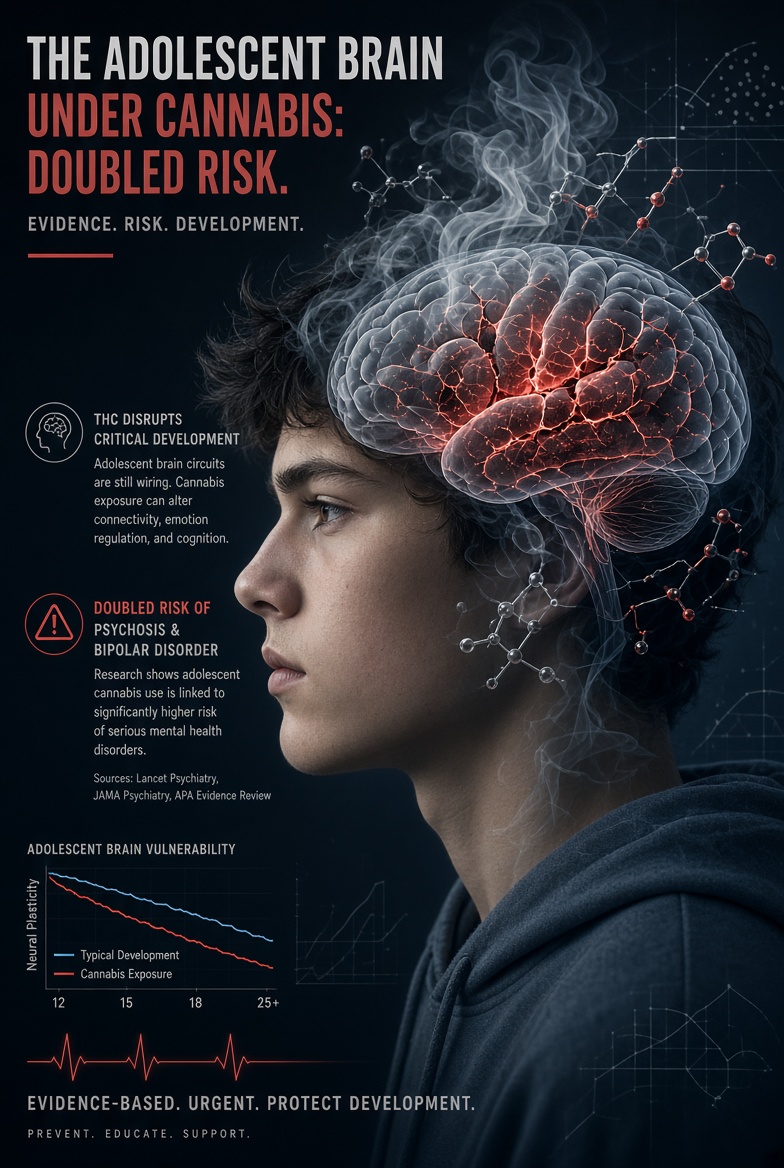
New Study: Teen Cannabis Use Doubles the Risk of Psychosis and Bipolar Disorder
A landmark study tracking nearly half a million teenagers just delivered some of the most alarming findings yet about marijuana and young minds.
Source: JAMA Health Forum | Published February 20, 2026 | Kaiser Permanente / UCSF / USC
2× higher risk of psychotic disorder 2× higher risk of bipolar disorder 34% more likely to develop depression 24% more likely to develop anxiety disorders
What the study actually did
Researchers followed 463,396 teenagers — ages 13 to 17 — for up to a decade, tracking them through age 26. These were real patients at Kaiser Permanente Northern California who were routinely screened for cannabis use during standard pediatric checkups between 2016 and 2023. If a teen reported using cannabis in the past year, researchers then monitored their health records to see what mental health diagnoses followed.
What they found
Teens who used cannabis were significantly more likely to be later diagnosed with a serious psychiatric disorder. The numbers are stark: psychotic disorder risk and bipolar disorder risk both doubled. Depression risk increased by 34%. Anxiety disorder risk increased by 24%.
"Even after accounting for prior mental health conditions and other substance use, adolescents who reported cannabis use had a substantially higher risk of developing psychiatric disorders — particularly psychotic and bipolar disorders." — Dr. Kelly Young-Wolff, lead author, Kaiser Permanente Division of Research
On average, cannabis use was reported about 1.7 to 2.3 years before a psychiatric diagnosis appeared. That's not a coincidence in timing — that's a window the researchers specifically designed the study to detect.
This wasn't about heavy users only
One of the most important details: the study measured any past-year cannabis use — not just heavy use or cannabis addiction. Even occasional use was enough to flag significantly elevated risk. This isn't a story about kids who are already in trouble. It's about the average teenager who tries weed.
The younger, the worse — and some risks don't go away
The study found that risks for depression and anxiety were strongest during adolescence and faded somewhat by ages 21–25. But the elevated risks for psychotic disorders and bipolar disorder did not go away in young adulthood. Those associations held firm even as the teens got older.
Does cannabis cause these disorders — or do troubled teens just use more cannabis?
This is the honest question, and the researchers addressed it directly. The study cannot definitively prove that cannabis causes psychiatric disorders. It's possible some teens use cannabis to self-medicate early symptoms they haven't yet been diagnosed with. But the timing — cannabis use coming first, diagnosis following years later — and the sheer scale of the data make a strong case that the relationship is real and not simply reverse causation. The researchers controlled for prior mental health diagnoses and other substance use, and the numbers still held.
Why this matters right now
Cannabis is more available and more potent than ever. Today's products are far stronger than what previous generations encountered, yet cultural messaging has shifted toward treating marijuana as harmless — even beneficial. This study, one of the largest of its kind ever conducted, pushes back hard on that narrative. Over 10% of U.S. teenagers aged 12–17 report using cannabis in the past year. This research suggests that's a public health problem we are dramatically underestimating.
"It's imperative that parents and their children have accurate, trusted, and evidence-based information about the risks of adolescent cannabis use." — Dr. Kelly Young-Wolff
The bottom line
This is not anti-drug alarmism from the 1980s. This is a massive, peer-reviewed longitudinal study published in one of medicine's most respected journals, tracking real patients over a real decade. The evidence is now hard to dismiss: cannabis use during the teenage years is associated with serious, lasting psychiatric risk — and the teen brain is uniquely vulnerable to it.