Joel Rakow on Life in Woke America, the Reedley Lab, and the Word That Vanished
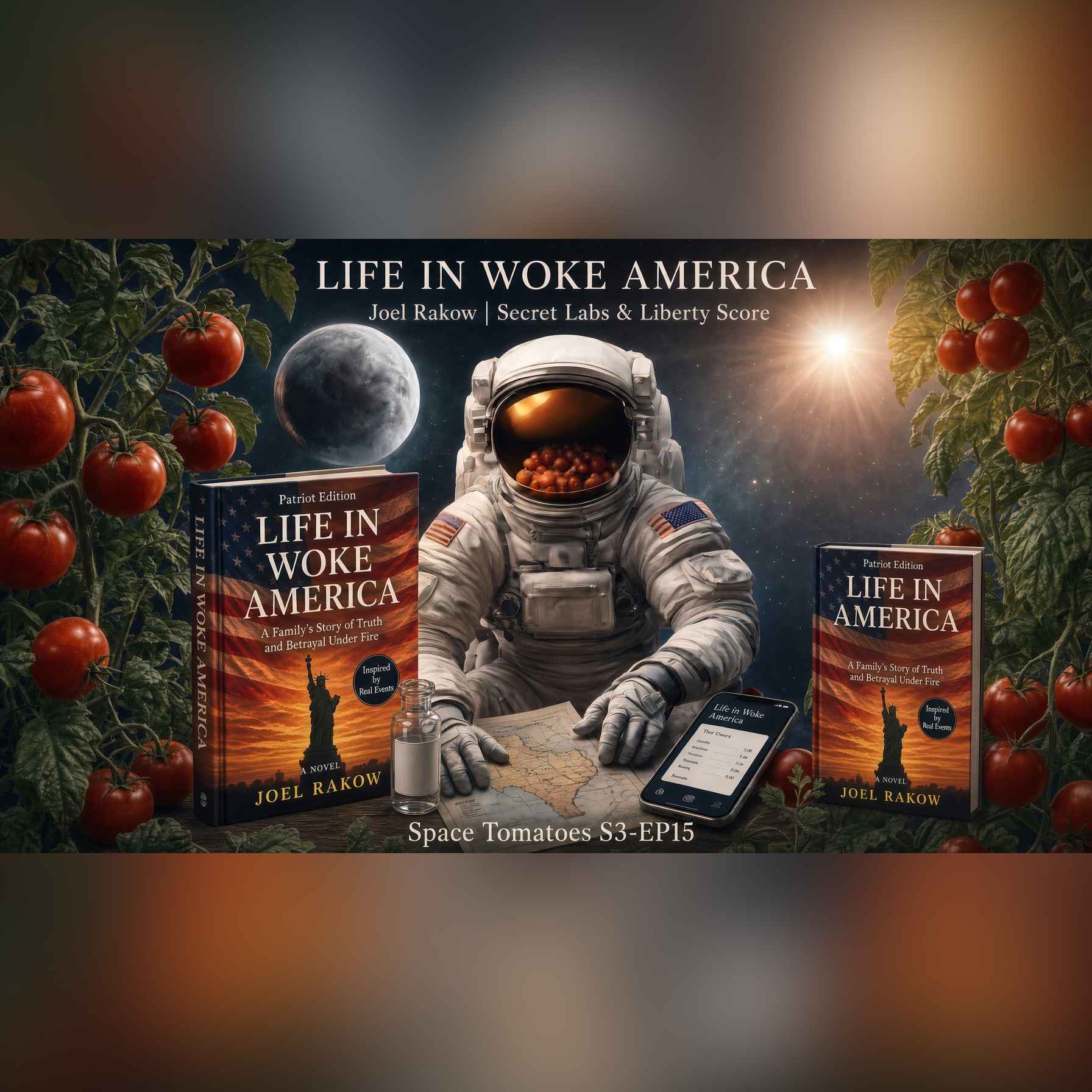
In November 2023 the House Select Committee on the Chinese Communist Party published the findings of a bipartisan investigation into an unlicensed laboratory found in Reedley, California: thousands of samples of labeled, unlabeled, and encoded potential pathogens including HIV, malaria, tuberculosis, and Covid; a freezer labeled “Ebola” holding unlabeled sealed silver bags; nearly a thousand transgenic mice engineered to mimic the human immune system, which lab workers said were designed “to catch and carry the COVID-19 virus”; and one line that did most of the damage, the CDC refused to test any of the samples. On Space Tomatoes S3-EP15, Joel Rakow, the author who turned that lab into the spine of a 450-page political thriller, brings the congressional photos to the table and then walks the conversation out to a Texas ranch to argue that the pursuit of truth is what actually went missing.
This is the full unscripted conversation: Life in Woke America with Author Joel Rakow, Secret Labs, and the Liberty Scorecard (S3-EP15), or watch it on the official Space Tomatoes YouTube channel.
Key Takeaways
- The Reedley lab is documented, not alleged. The House Select Committee report records who ran it, what was inside, and what the CDC declined to test.
- The operator was convicted. A federal jury in Sacramento found Jia Bei Zhu guilty on all counts brought by prosecutors, including wire fraud conspiracy, wire fraud, distributing adulterated and misbranded medical devices, and a false statement to the FDA.
- The federal agencies and the committee did not land in the same place. DOJ, FDA, CDC, and FBI concluded the pathogens were part of a failed COVID-test manufacturing effort and posed no public risk. The committee called the federal response a failure and subpoenaed its way to the file.
- Rakow's thesis is about the label, not the weapon. “Somebody in the congressional committee was able to argue the case that a single mouse is not a bioweapon” [12:24], and his episode argument is that this is the sentence that let the story die.
- His strongest verified detail came out of fiction: the lab's cover as a pregnancy test facility [13:51] is exactly what the court record describes, a business importing and reselling fraudulent COVID and pregnancy test kits.
- The Liberty Scorecard is his own build with his grandson, AI research in 30 to 40 seconds, a 0 to 100 constitutional alignment score, four or five stated reasons, and a shareable card. He describes it as a civic-education framework, not a legal determination.
The lab, from the record
The lab was found by a city, not an agency. Reedley code enforcement officer Jesalyn Harper ran the discovery in late 2022 off a code violation, and when she knocked, someone in personal protective equipment opened the door and hit her with an odor she could not immediately name. What the committee eventually documented reads like an indictment with receipts: the lab was run by a PRC citizen who is a wanted fugitive from Canada carrying a CAD$330 million judgment for stealing American intellectual property, a former senior official at a PRC state-controlled company with links to military-civil fusion entities, whose operation took millions of dollars in unexplained payments from PRC banks while running unlicensed. Inside were thousands of vials and biological samples labeled malaria, hepatitis, HIV, COVID-19, and Ebola, some labeled in English, some in Mandarin, some in codes nobody could read, plus a freezer labeled Ebola holding unlabeled sealed silver bags of the kind used for high-risk material. And the mice: roughly a thousand of them, genetically modified, per the Justice Department, with lab workers saying they existed to catch and carry SARS-CoV-2. The full report PDF is public, and Rakow read it. “There's no doubt that that was true. There's not a thing about it that was false… it was like rigorous. There were photos” [10:36]. Then the detail that convinced him the file was real: “I've seen all his driver's license with all three of them that all have the same picture but different names” [10:47].
Why the label matters more than the label suggests
The chapter at 12:09 asks the question most coverage skipped, and Rakow answers it himself. “Now I'm thinking, why did they call it a biolab and not a bioweapon lab?” [11:00] His answer: “Somebody in the congressional committee was able to argue the case that a single mouse is not a bioweapon… a single mouse does not have the lethality and the purchase required to be called a bioweapon, and the purchase of mice is not regulated in any way shape or form” [12:24]. That is the load-bearing claim of the whole episode, and it is a claim about language doing the work of oversight. It is also where the record gets complicated, and this post will not pretend otherwise. When the jury convicted Zhu, the Justice Department announced alongside the verdict that the FDA, the CDC, and the FBI had determined the pathogens at the Reedley warehouse were part of a failed effort to manufacture COVID-19 tests and did not pose any risk to the public. That is the agencies' position, and it sits directly against the framing Rakow builds his novel on. The federal case put the conduct where the money was: Zhu sold more than a million COVID-19 tests for close to four million dollars, employees testified he ordered them to lie about FDA authorization, and his partner Zhaoyan Wang left the country for China before the arrest. He was convicted on all counts in 2026, with sentencing set for October 26. Rakow's counter to the agencies is not a rebuttal of the test-kit fraud, it is the refusal to test in the first place, and the argument that a system which will not open the freezer is a system that gets to decide what the freezer contained. On the episode he pushes one layer further into the mouse-to-rat cascade, the theory that you infect rats locally rather than shipping contagious animals anywhere: “you get the uninfected rats and you put them in cages in Amarillo and you bring a few mice that are contagious… you didn't have to move a whole bunch of rats that are contagious at one time” [15:29], and then flags it honestly: “That's the theory that I developed for the story” [16:04].
The novel, and where the fact stops
Life in Woke America: A Family's Story of Truth and Betrayal Under Fire runs 450 pages and follows Army Private Xavier King, an orphan out of Amarillo foster care, who finds the Reedley facility, gives congressional testimony, and is then branded an extremist, threatened with a dishonorable discharge, and watchlisted by the institutions he served. Rakow says the book arrived whole: “The last step was I woke up, I knew exactly what the story would be… I just said, just do the work” [24:06]. The most striking thing about the fiction is how close one detail sits to the indictment. In the episode he says the operators “presented themselves as being a pregnancy test facility. That's how they got away with it for the couple of years” [13:51], and that is precisely the documented scheme, a company importing faulty tests from China and rebranding them as US-made, FDA-authorized product. What is invention stays labeled as invention, and he labels it on air: the forward operating base behind the girlfriend's property, the robot prototypes from an online mentor, and the info-war takedown are fiction, and he says so at 15:01, 17:44, and 16:49, where he is proudest of the restraint. “He uses InfoWare tactics so that they can take it down and he can vanish, and they'll never be able to determine that he's the guy that took it down” [16:49]. Havok pushes back on the genre's laziness and Rakow agrees, and the exchange about movie-grade ammunition nobody ever has to reload is the funniest stretch of the hour. Every main character carries deliberately ambiguous ethnicity, and the reason is a jab, not a hedge: “if you're going to have identity politics what do you do when you can't identify somebody to fall into a category” [23:16].
Death by a thousand cuts, in his words
The publishing fight is the part of the episode that plays out in receipts he can hold up. “I can tell you a story for every single step on how we got suppressed, banned, censored, slow walk, gated, everything” [26:50], and he says he wrote a four-part series on it about writing a conservative novel in Woke America. Then he shows the one that is actually documented in his own inventory. “We're printing 300 copies for the library campaign and the first books come out of the printer without that word… it's already been printed once before. This isn't the first printing… somebody took it out and nobody noticed it… they totally jeopardized their job to do that” [27:47]. Asked where it happened, he does not claim to know: “It could have been the art house… Every time I ask them, they're not telling me. But I'll get to it” [28:36]. Havok and LX do what this show does, they turn the grievance into a product idea: get the error copies, write the missing word in with a white paint pen, sell the copy they tried to hide. Rakow's own printing background is what makes the anomaly worth arguing about, because a repeat run normally reuses plates nobody re-submits, so a word does not simply fall off a press. The rest of his commercial record in this hour is self-reported and belongs that way: four and a half stars on Amazon, two book awards, moving from a small publisher to the distribution arm of what he calls the world's biggest book distribution company, a 100,000-store merchandising partner, 100 Texas libraries three weeks into a campaign, three bestseller runs on push. Libraries matter to him for a specific reason, “they're influencers in what's considered a good book because they don't do all the page turner stuff” [58:52]. Read those as the author's account of his own launch, not audited numbers.
The Scorecard, and the middle-class test
The reason Rakow's political material lands differently than a culture-war clip is that he anchors it on the least exciting possible metric. “What I used to love was that the government was evaluated based on whether the middle class was growing, getting stronger” [3:35]. And later, unprompted: “my faith in the government is measured by the middle class. And as long as the middle class is getting stronger, that creates peace on earth, as far as I can tell” [33:11]. He resigned from the Democratic Party in 2020, third generation in it, describes himself as socially liberal and fiscally conservative, and calls the current arrangement a role reversal where the standard flipped from the middle class to the fringe without anyone authorizing it. That is also where the episode gets most human: a Black family doctor who delivered his sister and performed his mother's hysterectomy, a border town twenty miles above the Mexican border, and the time an entire California HOA decided a Latin American family moving in was a problem to be solved, which he calls racism plainly and notes it was not in the South. Then the tool, which he built with his grandson. “With the advent of AI my grandson and I built an application, a mobile phone AI app that you can point to any civic, any public official… the AI does the research in 30 seconds, 40 seconds of how aligned are they with the constitutional values, then it gives a score and then it gives four or five reasons on why that score and then it creates a card” [56:53]. Free trial, roughly nine dollars a year at the pro tier, because “it's not an app that you use all the time” [58:33]. His framing of the Constitution is the sentence to argue with or agree with: “there's the Constitution, which is the bedrock of America, and everything above it is politics” [55:23]. His site is more conservative than the pitch, describing the Scorecard as a civic-education framework and application concept whose score is “an analytical judgment, not a scientific measurement, legal determination,” with AI used for research and human review on every published assessment. Score a politician you love and a politician you hate. If the number surprises you on exactly one side, you have found the honest part of it. He also states two contested claims on air that belong attributed rather than endorsed: that a colleague in his own division was grounded on a Quiet Skies name-match for six or seven months because the system had no real procedures, and, on the origin of SARS-CoV-2, that he can tell us “with 100% accuracy that it was not developed in a lab at all, period” [38:42].
Meet Joel Rakow
Joel Rakow, Ed.D. is the author of the political thriller Life in Woke America: A Family's Story of Truth and Betrayal Under Fire, a 450-page novel about an Army private from Amarillo foster care who exposes an illegal PRC-tied laboratory in Reedley, California and is destroyed by the institutions he served for the trouble. It is published by Manhattan Book Group, described on his own press release as a registered trade name of Mindstir Media LLC and a hybrid publisher, is available on Amazon and Barnes & Noble, and gives a portion of proceeds to veteran rehabilitation centers.
He is a third-generation Democrat who resigned from the party in 2020, and he says the break produced the book. He grew up a roofer's son twenty miles above the Mexican border, raised Jewish among migrant Okies with a Black family doctor his family kept from when he was two or three until he was twenty, and he describes his route out as a strong left arm and a quick bat that took him to a college baseball League MVP title, then an Ed.D., then what his site lists as a Harvard postdoctoral fellowship. His business record, in his own materials: founder and seller of multiple companies, more than three million educational products sold worldwide, translations in seven languages across 22 countries, Microsoft Partner of the Year and PC World Magazine Product of the Year honors, creator of the NeverCry cyber defense guide. He has served as cybersecurity faculty for the LAPD, professor at Boston University, and an FBI InfraGard member and speaker, and states that he advised the Secret Service and InfraGard on cybersecurity. Those credentials are his record in his own words and none of the headline ones have been independently confirmed.
He serves as a Court-Appointed Special Advocate for children in foster care and founded and co-chairs a Vistage CEO group in Amarillo, established 2021. He splits his time between the Texas Panhandle towns of Amarillo and Canadian and a beach town south of Los Angeles, is married more than fifty years to a rancher's daughter, and has six grandchildren. He and his wife quarantine out at the ranch, a late-1800s property so large that no living person had seen every inch of it until a fire a couple of years ago, neighbors with the T. Boone Pickens ranch, where cattle rustling is alive enough that he will tell you “the easiest thing to steal in today's world is cattle and oil” [51:05] and that a cow is worth about $3,000 a head. He created the Liberty Scorecard, a 0 to 100 civic-education framework scoring documented conduct of public officials against individual liberty, free speech, rule of law, equal protection, constitutional limits, and accountability. He also spent time as a National Park Ranger at the Black Canyon of the Gunnison, and will take a game of table tennis over an interview any day.
Where to Find Joel
- Book site, buy page, and free first chapter: lifeinwokeamerica.com
- Amazon: Life in Woke America | Barnes & Noble NOOK: listing
- X: @inWokeAmerica, the handle he gives on the episode. Also active on Facebook and LinkedIn
- Contact, as he gives it on air: Joel Rakow at lifeinwokeamerica.com
Related Episodes
- Life in Woke America with Joel Rakow (S3-EP15), the source conversation, chaptered from 0:00 to 59:00.
- Eight Stages of Revolution with Rick Hoppe (S3-EP8), what a state does when it stops believing its own reporting.
- The Liberty Solution with Derek Wills (S3-EP4), the argument that no agency gets to decide what is in the freezer at all.
- One Term Only with Evan Jaqua (S3-EP10), institutional capture from the inside, with a reform list attached.
- You Don't Own That Tractor with Geoff Wacker (S3-EP11), the ranch chapters' neighbor, on things you do not actually own.
Watch full video episodes on the official Space Tomatoes YouTube channel: https://www.youtube.com/@SpaceTomatoes-Podcast
External Sources
- House Select Committee on the Chinese Communist Party, Investigation into the Reedley Biolab: Report, and the report PDF.
- The Sentinel, Secret Reedley biolab operator found guilty by federal jury, on the conviction, the counts, the test-kit scheme, and the federal agencies' determination that the pathogens posed no public risk.
- Joel Rakow, author page and official press release, primary for all self-reported credentials and book details.
Final Note
Two things are true at once, and the interesting episode is the one that says so. The lab was real, unlicensed, foreign-run, full of labeled pathogens and humanized mice, and discovered by a code enforcement officer rather than a federal agency. And the federal agencies that eventually examined it concluded it was a fraudulent test-kit operation rather than a weapons program, which is the finding the committee refused to accept and the finding Rakow's novel refuses to accept too.
Play 6:52 first, where he puts the congressional photos on the table and asks why nobody called it what it looked like. Then decide whether the word that fell off his cover and the word that never made the headline came from the same reflex.
The War That Didn't Happen: Herman Forwood on Twilight of Democracy and the Empathy Cliff