The War That Didn't Happen: Herman Forwood on Twilight of Democracy and the Empathy Cliff
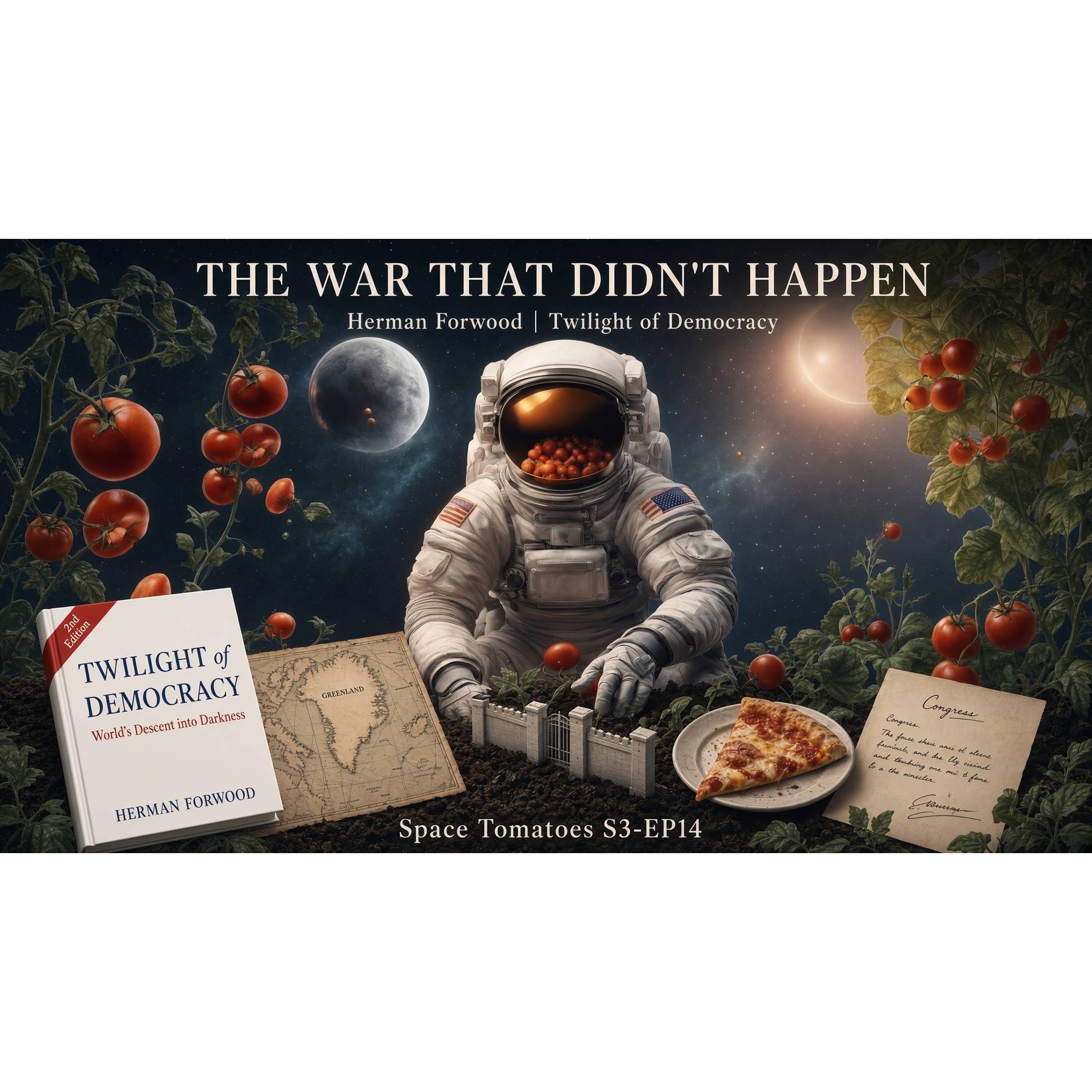
What if the war had stopped in 1939, after Kristallnacht and the invasion of Poland, and the world still had to live with what it almost did? That is the question Herman Forwood built a novel on, and on Space Tomatoes S3-EP14 he brings it to the table with its mirror image: why local tragedies spark outrage while distant catastrophes barely register, and what that gap does to how free societies decide who counts.
Herman is the author of Twilight of Democracy: World's Descent into Darkness, an alternate 1950 story he started in 2022, and the conversation with Havok and LX runs from that premise straight into Vietnam, both Desert Storms, Gaza, Iran, sanctions, and the empathy cliff. Listen here: The War That Didn't Happen: Herman Forwood on Twilight of Democracy and the Empathy Cliff (S3-EP14), or watch the video on the official Space Tomatoes YouTube channel.
Key Takeaways
- The counterfactual: an alternate 1950 with Anne Frank at 21, a weakened Soviet Union that never got the Nazi scientists, Japan left standing as a Pacific superpower, and an America that annexes Greenland.
- A war that ends early does not automatically heal. The book's world still has to live with what it almost did.
- Herman's empathy cliff: compassion that falls off a cliff about 20 miles from your driveway, and the research literature on compassion collapse explains the mechanism underneath it.
- A social media post is not a letter to an actual politician, and votes that feel useless become self-fulfilling prophecies.
- A free election is not a template you can mail to Palestine or Tehran, and sanctions mostly punish the people, not the fat cats.
- The detours are half the argument: The Man in the High Castle, Plot Against America, Operation Paperclip, a pizza treaty, cauliflower crust, HOA flower bed tribunals, and the pre-order for his next book.
The Novel's Counterfactual
Alternate history is a genre of consequences, and Twilight of Democracy stacks them carefully. The war stops in 1939. Anne Frank grows up to be 21. The Soviet Union limps along without the postwar catch that supercharged the American and Soviet rocket programs in our timeline, because in this one the Nazi scientists were never handed to anybody. In real history, Operation Paperclip brought roughly 1,600 German scientists and their families to the United States after 1945, Wernher von Braun included, and the novel asks what the 1950s look like when that grab never happens.
Then there is Greenland, the passage that earned the episode its best line, because Herman wrote that bit before the headlines caught up. In our timeline the island's wartime story is already stranger than most fiction. After Germany occupied Denmark in April 1940, Greenland was isolated and exposed, its cryolite mine at Ivigtut too valuable for aluminum production to leave unguarded. On April 9, 1941, Danish envoy Henrik Kauffmann, acting against his own government's instructions, signed the Agreement relating to the Defense of Greenland with Secretary of State Cordell Hull, letting the United States build and run defense facilities on the island. Denmark disavowed him at the time and ratified the deal after the war (Greenland in World War II). So when a 2022 novel ends with an America that simply annexes the place, it reads less like invention than like a prediction the news eventually signed off on.
The Empathy Cliff
Half the episode points the thought experiment at now. Vietnam's hearts and minds, both Desert Storms, Gaza, Iran's 90 million people, and Herman's central claim: empathy falls off a cliff about 20 miles from your driveway. Inside the fence, neighbors. Outside it, statistics.
There is real research behind the shape of that claim. Psychologist Paul Slovic spent a career on what he called psychic numbing, most famously in the 2007 paper "If I look at the mass I will never act": Psychic numbing and genocide (Judgment and Decision Making, volume 2, pages 79 to 95). The title quotes Mother Teresa: if I look at the mass I will never act, if I look at the one, I will. Slovic's finding is that people will move mountains for one identifiable victim and scroll past a million anonymous ones, because feeling does not scale with arithmetic. His subject was numbers rather than miles, but the mechanism is the same one Herman is pointing at from the other side: empathy attaches to the identifiable and dissolves as distance, whether of miles or of digits, turns people into data.
Herman's practical half of the argument is sharper for being simple. A social media post is not a letter to an actual politician. The post feeds the poster's audience. The letter has a recipient, an address, and a staffer who opens the mail. And the cynical loop that follows is the one every voter has felt: if you are convinced your vote is worthless, act accordingly, and prove it to yourself. Self-fulfilling prophecy, manufactured one abstention at a time.
Sanctions, Elections, and the Tylenol Bar
The foreign policy stretch of the episode runs against the grain of most pundit versions of the same topics. A free election is not a template you can mail to Palestine or Tehran, because elections are grown in local soil, not installed from a catalog. Sanctions, meanwhile, mostly punish the people rather than the fat cats, which is a lot easier to say out loud than to hear on a Sunday panel.
And then the line that should be on a bumper sticker, Herman's description of where the bar of political demand has dropped, from lift someone's life to: please don't kill me, and let me have the Tylenol. When a population's loudest demand is pharmaceutical patience, something has happened to the empathy cliff inside that country too.
The Detours
Space Tomatoes episodes are not interviews so much as joint walks, and this one takes the scenic route. Herman and the hosts pass Philip K. Dick's The Man in the High Castle and Philip Roth's The Plot Against America, the two novels that taught a generation what alternate history could do with an occupied or appeased America. They pass Operation Paperclip again, a pizza treaty, cauliflower crust, and HOA flower bed tribunals of terrifying specificity. Herman also brings the preorder for Secrets and Murders, his gated-community murder mystery aimed at spring 2027, which is exactly the kind of pivot this show does from geopolitics to cauliflower without a single cut.
Meet Herman Forwood
Herman Forwood is an author, podcaster, and lifelong student of history who believes the best way to understand today's world is to understand how we got here. He grew up in the Middle East through high school, and his interest in history has taken him from that region to communities around the world, where he has seen firsthand how culture, politics, and history shape the way people think and live. Those experiences feed both his writing and his conversations. He is based in California.
His fiction runs on that conviction: historical fiction, thrillers, and murder mysteries inspired by history, politics, religion, and the tensions that define societies. Besides Twilight of Democracy and the upcoming Secrets and Murders, he is the author of Echoes of the Ancients. He also hosts The Living Past, a history and current events podcast, and publishes essays on his site and Medium, including pieces on Charles Lindbergh and the threat of populism. His stated priority is telling: less interested in proving a point than in having thoughtful conversations that leave people seeing familiar issues from a different perspective. On S3-EP14 he holds to that standard while Havok and LX push back on every premise they can grab, and the book sells itself by the end of the second hour.
Where to Find Herman
- Website and books: hermanforwood.com
- Twilight of Democracy: World's Descent into Darkness on Amazon: amazon.com/dp/B0F7HZM3SG
- Secrets and Murders pre-order: Amazon or Publishizer
- The Living Past podcast: Apple Podcasts | Spotify
- Medium: @hermanforwood | Substack: @hermanforwoodbooks
- Instagram: @herman_forwood_books | Threads: @herman_forwood_books
Related Episodes
- The War That Didn't Happen with Herman Forwood (S3-EP14), the full unscripted conversation this post came from.
- Eight Stages of Revolution with Rick Hoppe (S3-EP8), the mechanics of how societies rupture, next to Herman's question of why they do not notice until it is late.
- One Term Only with Evan Jaqua (S3-EP10), the reform answer to the same political decay Herman diagnoses from the historical side.
- The Liberty Solution with Derek Wills (S3-EP4), the position that the state at the center of all these arguments should not exist at all.
- From Bronze Star to Plot Armor with Matt Hasty (S3-EP12), history's most brutal case study, illegal orders, argued by a man who took them.
Watch full video episodes on the official Space Tomatoes YouTube channel: https://www.youtube.com/@SpaceTomatoes-Podcast
Listen: Apple Podcasts | Spotify
External sources:
- Paul Slovic, "If I look at the mass I will never act": Psychic numbing and genocide, Judgment and Decision Making 2(2), 2007.
- Wikipedia, Greenland in World War II.
- Wikisource, Agreement relating to the Defense of Greenland, 1941.
- Wikipedia, Operation Paperclip.
- For the other book with this title: Anne Applebaum's nonfiction Twilight of Democracy (overview) is a different work from Herman's novel.
Final Note
Alternate history gets dismissed as escapism by people who have not read the good ones. The good ones are argument machines: move one event, keep the human nature constant, and watch what your own assumptions do in the new light. Herman's 1950 is a mirror with a 1939 hinge, and the empathy cliff is what the mirror is for.
Play the episode before you decide whether the war that didn't happen ever really stopped. Then order the book. Then order the cauliflower crust, because the HOA tribunals are worth the trip alone.
Joel Rakow on Life in Woke America, the Reedley Lab, and the Word That Vanished