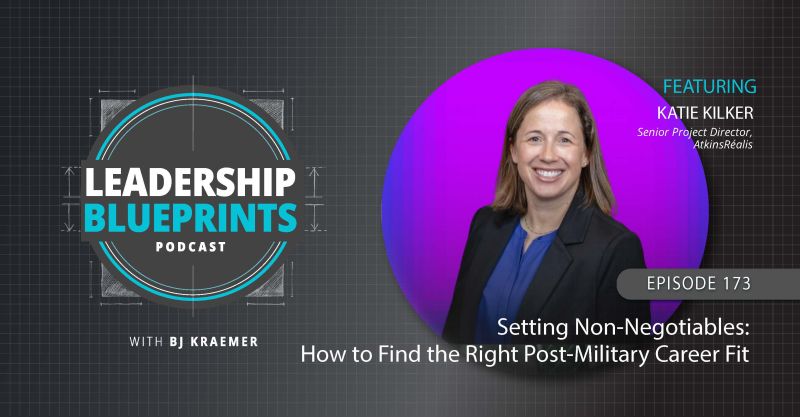
Setting Non-Negotiables: How to Find the Right Post-Military Career Fit with Katie Kilker



 RSS Feed
Joining BJ on the debut episode of our newly rebranded podcast, Leadership Blueprints, formerly Inspiring People & Places, is Katie Kilker, Senior Project Director for Federal Facilities in the Engineering, Design, and Infrastructure Group at AtkinsRéalis. In honor of November's Veteran Salute, DOD to AEC, we’re spotlighting Katie’s recent transition from active duty in the Air Force to her current role in the built environment.
Tune in to hear Katie discuss her journey to the Air Force, her formative experiences, what an Air Force career can look like, and her role at AtkinsRéalis. She also shares insights from “taking off the Colonel Kilker uniform” and stepping into civilian life, key elements for a smooth and successful transition, and valuable resources for those planning to transition.
Don’t miss the first episode under our new name, enjoy!
Key Points From This Episode:
• Where her career started and how she ended up in the Air Force.
• What started the process of transitioning out of active duty.
• How she started her transition early and figured out her must-haves and no-compromises.
• Key elements to a successful transition and her experience so far.
Quotes:
“If you fail to plan, you plan to fail. Start your [transition] plan early, be inquisitive, and learn about what you want to do and don’t just feel like you need to do what other people want you to do.” — Katie Kilker
“Being a leader, you kind of need to be extroverted for people to see who you are. You can’t just hide in the shadows, assess, and write notes and stuff.” — Katie Kilker
“Civilians — are the bedrock of the Air Force.” — Katie Kilker
Links Mentioned in Today’s Episode:
SAME Career Transition Workshop
Getting Things Done: The Art of Stress-Free Productivity
Military Retirement on Google Play
Military Retirement on Apple iStore
Drop the Ball: Achieving More by Doing Less
Welcome back everybody to the new and improved Inspiring People and Places podcast. We are now Leadership Blueprints, and today is our first episode. I'll probably do an explainer episode somewhere along the line of why we did the rebrand, but we've got a lot going on and I'm behind schedule, and I was not gonna not meet the schedule for the one November rebrand. So we're a new podcast, And it happens to be November, so November is our veteran salute DOD to AEC, and I am excited to welcome to the show Katie Kilker, who has recently transitioned from the air force to the built environment at Atkins Realis. Katie, welcome to the show.
Speaker 2:Thank you for having me.
Speaker 1:Excited to dig in. You're one of the first in a long time recent transitions from active duty into the AEC. So every episode starts with a little bit of information about who you are, where you are now, and then we'll go back to where it all began. So talk to us about your role at Atkins Realis and who Atkins Realis is.
Speaker 2:Well, Atkins Realis is a global company. It's actually pretty huge, but pretty small in The States. So it's about 40,000 globally, and there's about 4,000 in The States. Huge global reach, lot of experience and expertise that we can reach out to, but has that small company feel. I just transitioned from the air force after twenty two years, seven months, and a few days per my d d two fourteen.
Speaker 2:I always wondered how did anybody ever track it down to the days. That sounds kinda miserable, but it actually says it on the d d two fourteen how many days.
Speaker 1:There you go.
Speaker 2:But I transitioned and started with Atkins Rialis on the September 2, so it's pretty recent.
Speaker 1:I'm too Very recent.
Speaker 2:Seat. Yeah. Yeah. My title is senior program director, and it's hard to step into those shoes of that title because I'm new. I did so much time in the air force, and I don't know what it's like on this side of things.
Speaker 2:But Atkins Rialis has been great at getting people spun up, getting me paired with the guy who guys basically got me into Atkins Realis, which was Matt Anderson, a former air force officer who retired three years ago, kind of acting as my emissary and my soothsayer to help me navigate and joining the federal team working on air force projects, mainly right now focused on making connections, you know, seeing where there are requirements for the air force and how Atkins Rialis might be able to fill those requirements in a planning or design capacity.
Speaker 1:Awesome. So business development, seller doer, manager, kind of jack of all trades inside of the federal unit specifically focused on air force?
Speaker 2:Yes.
Speaker 1:Cool. I wanna talk through your air force career. And then because this is a DOD to AEC special here in November, I really wanna talk about your transition and all of the process. And I'll start out by saying Katie and I met through the SAME... What do they call it?
Speaker 1:Is it the transition workshop?
Speaker 2:The career transition workshop.
Speaker 1:Yeah. Career transition workshop where she met Jesse Kimberling Johnson, and then he introduced us, and we had a lovely talk. And Katie will... Maybe she'll end up at MCFA one day, but ended up taking her family to Colorado. Right?
Speaker 2:Yep.
Speaker 1:So I think where it all began at the Air Force Academy. But let's talk about... No. I'm wrong.
Speaker 2:No. No. It's okay. I did spend some time there, though.
Speaker 1:Okay. I thought I saw that. That's alright. We won't even edit that out. I...
Speaker 1:Just so everybody knows, I don't get it all right.
Speaker 2:And neither do I. I got my job title wrong. I don't introduce, like, myself by my title much. I just am who I am. So...
Speaker 2:Yeah.
Speaker 1:Titles don't matter.
Speaker 2:Project director.
Speaker 1:Yes. Project director. Well Yeah. Soon to be program. Once you close once you close a couple projects cool
Speaker 2:enough. Right.
Speaker 1:Alright. So talk to us about where your career started and how you ended up in the air force.
Speaker 2:So I started way back when, I guess. I'm an air force brat. So my dad was in the air force, and I actually swore I would never do this to my kids. And I felt kinda bad for the air force recruiters when they came to my high school. Everybody would go talk to the army or the marines.
Speaker 2:The marines would go do handstand push ups at the wall, and people were being challenged. And the air force guys just kinda sat back there waiting for people to come talk to them. And so I went and talked to him and ended up saying, okay. Yeah. I'll put together a scholarship application.
Speaker 2:Never thought I would stay in. Just thought I'd give it a try. So you get one year to try it out. I ended up liking it and went to ROTC at Georgia Tech. Oh.
Speaker 2:Yeah. It was challenging. You know, the thing when you got out of Georgia Tech, it was like, oh, I got out. That's what everybody said. I never thought I'd go do any more schooling.
Speaker 2:This was hard. I'm done. And then I commissioned through ROTC, and my first assignment was at Beale. So I don't know if you wanna go down the whole train of all the different locations. But
Speaker 1:I think that over twenty two years, you probably had some formative experiences. So why don't you hit us with the top of the waves of a lot of folks don't appreciate what an air force career could look like and how you ended up in the built environment side of the air force. So Yeah. Talk to us about that.
Speaker 2:Well, civil engineers, typically, back then, you all went to be CE or you were gonna be a pilot. I had no interest in driving a plane around. It just seemed kinda boring to me, so I wanted to go get into planning. I always loved SimCity. I was kind of addicted to that in college and had to get off of it.
Speaker 2:So I ended up going to be a civil engineer, went to Beale Air Force Base in California. And the civilians there were the huge reason why I grew, you know, because they were really deliberate about growing these lieutenants that just kept coming in just in batches. You know, every year or two, they'd get new ones, but they actually cared and were deliberate about developing us as a, you know, project engineer, a programmer, and all of that. And then from BIO, went on my first deployment to Aldafra and getting a chance to really be a designer and solve problems, not have all of the answers in front of you, reaching back to the resources back in The States to help. How do I how do I design a MOS pad, a mobile aircraft arresting system foundation, and a foundation for the lightweight fairlead beam?
Speaker 2:Like, figuring that out, understanding the geometry of how that whole system laid out on the airfield and how you need to plan for a tape sweep when the barrier is engaged. Someone's gonna pull the tape, and they're gonna knock out all the lights. So you gotta make sure you have recessed lights in those areas and just changing the whole thing out. That was a huge formative spot for me was learning that and getting a chance to do that. A lot of our engineers today don't always get that opportunity.
Speaker 2:Although with the new challenges coming forward with what we're doing in The Pacific, they will get more opportunities to MacGyver and design something themselves. Absolutely. I went to Korea, and I got to be the chief of construction management. That was one of my favorite jobs in my career, was having that portfolio of construction projects, having the team to make sure that we were going out and inspecting the projects, really helping people understand the difference between pouring concrete and placing concrete, working with a core because at one spot, they were definitely pouring it, and they were not placing it properly around the rebar. So we had to have them tear it out.
Speaker 2:But getting to be able to be in that position was was really fun. Early on in my career, I kinda decided that I wanted to do different MAGCOMs. I didn't want to be stovepiped in one major command where you're just doing Pacific or you're just doing air combat command. And so I was able to bounce from MAGCOM to MAGCOM throughout my career. It makes it hard because you don't always get to talk to the same people and keep building on those relationships.
Speaker 2:You're always meeting new people, new civilians because they are the bedrock of the air force, but it was great. And I feel like I've got... I'm a kind of a Jack or Jane of all trades and master of none. I'd like to be a master a bit more, but master of adapting. So
Speaker 1:Yeah. For those of us who don't know, me included, when you say, I understand major commands, I understand Pacific versus air combat command, but what was different about the roles and responsibilities in those commands? Or was it same mission, different environment, or was it?
Speaker 2:It's a different mission, different culture and philosophy because, like we were talking about a little bit earlier, often the air force is led by the pilots, and the pilots have different cultures. So air combat command is a little bit different than air mobility command. If you think... In in my perspective, right, air mobility command, it's a lot of crews, people that work on teams and small teams, and they kinda work together. The air combat command can be a little bit more pointy and a little bit more direct about how they're going after things.
Speaker 2:Air education training command, I had a perception of how that would be. It wasn't necessarily how it would go, but a lot more on accountability and setting the example. So I I took that to heart when I was the commander at Michigan State for ROTC, trying to make sure that we were deliberately developing and assessing and deciding who are the right people to go be officers.
Speaker 1:Does sound like you took different parts and pieces from those. Where did you retire out of?
Speaker 2:Air Force Civil Engineer Center in San Antonio, Texas.
Speaker 1:And what were you doing there?
Speaker 2:I was the military deputy for installations. And similar to my career, it's a little bit cats and dogs installations because it has real property, real estate development, planning, NEPA, base realignment and closure. It's very diverse. And then we were start... Also starting to get into lodging privatization towards the end of the time.
Speaker 2:So it was a little bit all over the place and always a challenge, always something new to go after.
Speaker 1:Great exposure to a bunch of different problem sets, not only in the built environment, but across kind of the installations. What started telling you that you're ready to transition off active duty?
Speaker 2:Great question. Because I was always ready to transition, really. I I I told you, I was gonna maybe do a year of ROTC, and I ended up liking it. Four years because I owed it. And then I'm like, you know what?
Speaker 2:I'm gonna get on my own time. I'll get out at six years. And then there was just always one more thing after another that was, like, a neat opportunity, a neat challenge. You know, I was selected for promotion to o six when I was the detachment commander at Michigan State, and I felt kind of an obligation to set the example of what a woman could do in CE and that this is a possibility because there weren't a lot of examples for me growing up. And the ones I saw sometimes early on were like, I don't wanna be that person.
Speaker 2:So I wanted to, you know, walk the talk and go do it. I agreed to take the assignment to San Antonio. San Antonio is not my vibe exactly. It's super duper hot. We moved from Michigan to Texas, and it was a 105 degrees in the summer.
Speaker 2:And that seems kind of minimal, but a big point for me was that my kids were, you know, in elementary school. And like I said earlier on, I said, I never wanna do this to my kids. You know, I didn't want them to constantly be uprooted. I always envied the kids who had some stability in their friendships and family, so I was eager to kinda develop some roots for my kids. They are now in fifth and second grade, so I definitely wanted them to get some foundation before going into high school, but the goal was always seventh grade.
Speaker 2:So I just didn't wanna put them through another move. And being a mom, we're often the CEOs of our family. So I was a leader in the Air Force and also trying to, like, lead the stuff at home. My husband has a career of his own as well and trying to find out the doctors, find out what are they gonna do after school, making sure they have friends. I just was getting...
Speaker 2:That was a lot. So I was looking forward to putting down some roots and starting that next career because I figure the longer you stay in, the harder it would be to make that transition. I didn't want to identify myself as a colonel in the air force. I wanted to be Katie Kilker, and I've done a lot in my life, but what's the next chapter? So I was ready to start that next chapter.
Speaker 1:Alright. So we often go into leadership lessons, but because we're talking transition, I I wanna hit transition first. How has it been? And talk to us about some of your lessons learned in taking off the colonel Kilker uniform and putting on the Katie Kilker civilian clothes.
Speaker 2:I mean, it's hard to pick a wardrobe. Right? So figuring out how to dress, I've always, you know, admired other people with their expressions and what they wear. But the transition's been good, actually. I have a network.
Speaker 2:I think that's really important. It was hard in the beginning for me. I started almost, like, two years ago, probably, figuring out transition and giving
Speaker 1:I think that's when we met.
Speaker 2:Yeah. Yeah. And Jesse was super easy to talk to, and he definitely has a style of his own. I love the sock expressions and the the lining of his jackets and all these things. Like, I'm just like...
Speaker 2:And he was just so personable. I loved that there wasn't this boundary between officers enlisted. Like, we were working together, And I love that that didn't kind of play into it at all. But it was hard because it was like, I needed to talk to people. I needed to kind of just listen to what their experience was and learn from it and maybe not have, like, an objective.
Speaker 2:When you're having those conversations with people, you're just learning. You're just kinda doing some market research. So that was hard to feel like I was just like, can we just talk? I'm, like, interested in what's your background. This seems interesting what you did.
Speaker 2:But developing and getting more comfortable with those conversations really helped me in the transition because it kinda took this amorphous blob that was the life outside of the air force and gave it some shape.
Speaker 1:To
Speaker 2:help me kinda figure out, like, where would my fit be? What are the things that are important to me, and what are the things I don't want to negotiate on? So, yeah, it's been really good. And I went to the career transition workshop in 2023, and I was just like, okay. This is gonna be my first or it's gonna be my only.
Speaker 2:I wanted to be prepared. If I needed to say, no. I'm gonna retire. I wanted to know what that life looked like on the outside. And then I got an opportunity to go again in 2024 and more conversations in that time frame.
Speaker 2:So talking with people who recently transitioned, one of them, Matt LeBlanc, told me that he'd heard from somebody else. It was the air force will take from you what you will give it. They will keep taking. They will keep taking. You need to figure out what's the right time for you and conditions for you to transition.
Speaker 2:I don't know if that answers your question, but I mean, I'm gonna Yeah.
Speaker 1:I'm gonna push on you a little bit.
Speaker 2:Okay.
Speaker 1:So one thing I heard was you started early, and it sounds like that was a great move. So Yeah. Almost probably eighteen months before you started, maybe even two years before you transitioned, you started thinking and talking to people and preparing yourself. Yep. And that's what we would call in the business world creating optionality.
Speaker 1:Because you kinda have time horizon, you can kinda play both worlds. You also hit on, like, your must haves and your no compromise. How did you start figuring those out?
Speaker 2:That's a great question. One of my friends in the conversations had kinda pointed me out to a coach. He was... Said, you know, you should check out Commit. And so this organization's a nonprofit, and they have career coaches that volunteer time to help military transition.
Speaker 2:And she was awesome. And maybe it's all obvious stuff for some people, but it wasn't for me. And just having these conversations with her, you know, she kind of helped me figure out, like, what are the things that are important to you? How do you feel right now with what you're doing? And, you know, help identify what you wanna do next by doing that.
Speaker 2:And she she kinda pointed out there's a difference. Right? You have coaches and you have mentors. And coaches are people that don't need to be walking in the space where you're going, but they're just helping you to find your spot. You know?
Speaker 2:What's the right thing that kind of capitalizes on your strengths and fits with your passions and aligns with your opportunities or locations and things that you value? So that was the coach. And then the mentor is, like, people that are kind of in that spot where you wanna go, and they can help kind of show you some steps to get there. And she was deaf... I I just, like, blew my mind a little bit with that whole coach piece, and she, through our conversations, kinda helped me identify the things that I valued and where there was incongruence with some of the things I was doing.
Speaker 2:Because when we're in the military, we don't get to pick where we go. We don't get to pick where we go. We don't get to pick what we're doing. And that was one of my frustrations in the military is that I've got two master's degrees, and I got my PE and, you know, eventually, recently got my PMP. And we don't often capitalize on those things within the military.
Speaker 2:And I was interested in those things, which is why I studied them or why I pursued them, but I didn't get a chance to use it. And so she kind of helped me stand up for myself and figure out what it is that I want to go do next.
Speaker 1:I have a lot of thoughts here, so let me see if I can synthesize quickly. I've got two things that I've put these in categories. When I was getting out, I like created like an engineer. This huge matrix of all these things versus the opportunities, like pay and geography and upward mobility versus entrepreneurship and doing work and content of work and all those things. One of our guests, General McCaffrey, he boiled it down a lot more simply to location, vocation, and compensation.
Speaker 1:And I think geography has to play in there too, or no, that is location. There was something else that I feel like didn't quite hit, but I thought that those three categories were very very very good categories. And I think his role was you can get two of the three. And when he boiled it down to that, I'm like... I started looking at it, I'm like, oh, that's a really good way to organize it.
Speaker 1:And I think to your point, the needs of the military, your case, the air force, my case, the army, it's like you don't get much of a choice in any of those three. So when you're getting out, now you have optionality in all of those three that can become overwhelming. So what did the coach say to you about that?
Speaker 2:Well, first off, I love what Jeremy McCaffrey said because it also lined up with what Sal Najomian was saying in the career transition workshop. And it's like engineers, I love Venn diagrams. Yeah. And it's the overlap of the different categories. And I do think that you can get more than two of the three, but I also think there's more than three.
Speaker 2:I think that there's also culture because
Speaker 1:That was... Culture was the one that I was trying to think of. Oh. I wrote them as I as I wrote them down, it was culture. So I'm glad you said.
Speaker 2:And to be honest, honestly, compensation probably should be one on its own, and how that compensation kind of flushes out
Speaker 1:Total package.
Speaker 2:Yeah. Yep. And it's not just the... How much are you paid? It's, you know, your time off.
Speaker 2:It's the other values that might be as part of that compensation. Do they pay for my Peloton membership? No. Atkins Rialis does not pay for my Peloton membership, but it's just those alignments. And, you know, she just kind of helped me figure out what are my values, what am I good at, and sometimes what I'm good at does not align with my value.
Speaker 2:Like, I can be really good at Power Point, but I don't really prefer to do it all the time. Right? Mhmm. Or I can be good at, you know, awards packages, but I really hate doing them. Like, maybe that's a better one because I really always hated that type of stuff.
Speaker 2:But, yeah, just kind of prioritizing what's important and what are the nonnegotiables. Because my husband, early on, we're looking at, do we wanna go to Colorado, Michigan, or Virginia? And, unfortunately, you know, we were talking to you, BJ, or I was talking to you, and and New Jersey seemed like an interesting thing. And husband said, absolutely not. So so we weren't gonna go there.
Speaker 2:So that was a really important
Speaker 1:We're not for everybody.
Speaker 2:Yeah. Well, we got a remoteness. You know what I mean? But figuring out how can you compromise too. Maybe Atkins Realis, where I'm based right now, I'm connected to an office up in Denver.
Speaker 2:I'm down in Colorado Springs. I can go up there, you know, once a week, maybe twice a month or something, or I'm just actually going on visits and stuff. I'm going to site visits, meeting with customers, and such. Yeah. It's just about, like, what are the things that are the hard and fast that you can't negotiate on, figure out where you can compromise, and where's that wiggle room.
Speaker 2:Yeah. And understand you're not gonna get it all. And I think you you figure out the rest of it through the conversations with people. You know? Like, because on paper, somebody might look like a fit, but in person, it may not feel right.
Speaker 2:It may it may feel a little bit too... Like, I talked to companies that were a bit more, and I don't think I fit in that environment. That was one of the things I didn't like in the military was we would go and go have drinks or something, but I'm like, but I gotta drive home. So I didn't like that... The incongruence there.
Speaker 2:So that's just something I'd rather not negotiate and not feel pressured into kinda thing. And having a diverse team, you know, seeing what it looks like on a company's kind of website and who are the leaders. Is it all people that look the same? Are they all the same age even? You know, like, are we having all different kinds of diversity?
Speaker 2:Because I think that that's walking the talk. Because a lot of people are good at talking about that stuff now, but how do you actually practice that? So
Speaker 1:I was curious. You said something like, I'm two months in. The transition's not complete yet. And we talk about how the transition's not this one time event. It's not just the preparation and then you're out.
Speaker 1:It's kind of this evolving thing of, okay, now I'm in a new seat. Now I've got a whole bunch to learn about the organization, because the dating phase and the selection phase and then the committing phase is a big piece of that, but the transition continues. How are you feeling the transition is going, and what are the... Some of the things a lot of people talk about impostor syndrome before we kinda got on. You're like, I come out of a leadership position.
Speaker 1:I don't feel like I'm... I've quite earned a leadership position here. Talk to us about that.
Speaker 2:Now if... Know I what it feels like to be on the other side. There's so much there. Let me unpack it. Well, I think the key thing is to try to find a trusted adviser.
Speaker 2:And, ideally, there's somebody within the company that you're working who can kind of act like that sounding board and just say, okay. Here's what I'm reading. Because you know what? Everybody's figuring it out. Even these companies who've been doing stuff, like, every day is a new challenge, and sometimes they don't necessarily do it as smoothly as you would expect.
Speaker 2:Like, oh, they've been doing this forever. It's just something different. It's a new thing. And the military, like, as a customer that we support and at Kinseralis is constantly changing. So if you're not changing, they're changing, and you have to constantly adapt.
Speaker 2:So getting validated in those feelings of that, what's going on here? You know? To bounce that off of... With somebody is really important. Some companies don't have a lot of military, and that's a different challenge for them, I think.
Speaker 2:And that's about, I think, maintaining your network outside of that company to still touch in with people who have transitioned and people that are going through transition just to continually kind of not feel like alone and afraid. Just kind of be able to to just talk with people and be deliberate about it. They'll be just talking about sports and stuff, but, you know, kinda go through some of the challenges that you're seeing because they might be seeing the same ones. You know? And the impostor syndrome, I think, comes down to hoping you found the right company.
Speaker 2:Right? Because a lot of people don't when they first come in. I have... You know, maybe I shouldn't out this, but I have no plans right now to change companies. I feel like there's reasonable expectations.
Speaker 2:And when I personally don't feel like I'm matching up with what they might want, we're kind of finding alignment with where am I in the transition process. You know? Like, hey. Am I getting paid? You know?
Speaker 2:What's my vacation look like? Or how do I even plan travel? Like, everything is different on the outside. And for people to kind of understand that you're still figuring these things out, but be ready to learn. Don't just expect for it to kinda land in your lap.
Speaker 2:Use your company's resources that they have and find your path. You know? Yeah. Go find your training. Come up with the plan and talk with your boss about it, and hopefully, it lines up with what they want.
Speaker 2:And if they don't, they should be talking to you about, okay. Well, maybe not yet for that one, but maybe start going down this path because nobody's just gonna plop a training plan in front of you necessarily and say, this is how you join our company. Some of it's gonna be, what do I not know and just start kind of going to those meetings or looking at those resources to get better at it.
Speaker 1:Yeah. I think we get spoiled in the military by being told everything that you have to do to check the block, to do this quarter this month, medical checkups, get your flu shot, and now I'm still... I just got an email today about getting my flu shot and the reserves. All of a sudden, a lot of that is not just organizationally driven and reminded, but you actually have to self advocate for yourself yourself and and self self navigate to find your way. And I I do think that's a huge growing pain for a lot of people.
Speaker 1:I will say we're probably coddled a little bit in the military because it's such a huge enterprise and everything is there at your fingertips. It's not when you transition out. So you got... You... There is a ton of learning, not just in the new workforce, but in the new civilian life.
Speaker 1:Yep. And then add on to that mom CEO, you've gotta do it for your kids too.
Speaker 2:No pressure. No pressure. Checklist. I love checklist. I was gonna mention at some point, here's my transition notebook.
Speaker 2:Like, have a transition notebook and put down... Because, like, all of these different conversations that you're having with people, there's gonna be good idea fairies that come up. There's gonna be things that you wanna follow-up on later. And, you know, it's really interesting, and I like looking back at my evolution of transition. And as it continues, I'm...
Speaker 2:I've got a new page for this conversation and getting some good nuggets there, like creating optionality. I like that one. But you've gotta be a self starter, and that's the thing. My perception, I didn't want to be so indoctrinated that I didn't know how to go get kind of on my own. Not like that would ever really happen because I'm a massive planner, but have a schedule.
Speaker 2:There's a lot of great resources that they provide you at TAP, transition assistance program, and people think, oh, there's this ETAP thing. It depends on where you are. It's called executive transition assistance program, and it's for chiefs and o sixes and above. And it's supposed to be a little bit better, depends on where you're going, but it is not your be all and end all. So it's like having those conversations, looking at other people's resources because there's other people who have developed also checklists to say six months out, you should do this.
Speaker 2:Three months out
Speaker 1:Right.
Speaker 2:Three months in, make sure you do this. Put it on your calendar. Make sure you register for TRICARE right away. Yes. There is a bridge time frame, but don't mess with that because you might get stuck.
Speaker 2:Right? You don't wanna get left holding the bag for some medical bills that you weren't kind of planning on. That wasn't very smooth for me, honestly, coming here to... I'm right next to Fort Carson. There's a army hospital there.
Speaker 2:I thought this would be great, you know, continuity of care while I was on terminal leave, which is such a horrible title, but, like, that bridge leave between. The medical was was really tough at that point because they wanted me to go to my doctor back in Texas. But I'm like, I'm not there. I'm here now. So trying to get through all that stuff.
Speaker 2:Put things on a calendar because I can't keep it in my mind. When I was in college, I did these psychology experiments that I got paid for, which is pretty cool, but some of them were talking about the amount of things you can hold in your head at one time. And it's like seven to 11 things in a list. And if you can just park it and not have to keep it in your mind and put it on the calendar when you need to think about it, it'll free up your mind for the things you gotta do right now.
Speaker 1:Have you read Getting Things Done? No. David Allen, who's the author of that, he was a podcast guest, he would agree with you.
Speaker 2:Yeah. It's Wasn't that like an Einstein kind of thing too, where he's just like, I don't need to remember phone numbers. I'll just write them down.
Speaker 1:Right. Yeah. Yeah.
Speaker 2:Yeah.
Speaker 1:I'm a big notetaker. Alright. Anything we didn't cover in transition?
Speaker 2:Okay. Well, I've got, like, a lot of notes that I was trying to kinda think of to make sure I was ready for it, but one of my friends who's actually getting ready to approach his transition, he recommended for me this app that's called Military Retire.
Speaker 1:Okay.
Speaker 2:And it's a really great resource. I love spreadsheets. I love playing with formulas and things. But as you're trying to figure out, like, what's the right time for me to retire and what is that compensation gonna look like, they factored in way more than I did on my spreadsheet. Like, they can also put in there, like, what state are you retiring in?
Speaker 2:Are they gonna be taxing your retirement? Are you gonna do survivor's benefits plan? Are you gonna do TRICARE? What are all those costs so that you know really what your budget might be really close to? It also throws in any VA compensation you think you might be getting.
Speaker 2:It's gonna get more tricky. I haven't had a chance to test it out for people that are on the blended retirement system, but that's a really neat app that I've been trying to push on people to definitely check out. It's worth the $5. It's not free anymore. I guess it was free at one point.
Speaker 2:So that's pretty cool. I did commit, recommend commit, recommend possibly checking out the American corporate partners. There's a lot of different ways. That's a bit more of the mentor side of things.
Speaker 1:Okay.
Speaker 2:Right? So that they can pair you up with someone who's in the industry, not necessarily, you know, federal or DOD, but somebody on the corporate side that can kind of help you figure out how do I work this transition. What does it look like? What does your day look like? So those are some of the big things, but I highly recommend everybody and anybody sign up for the career transition workshop.
Speaker 2:It has the perception of being for senior people, but it was really neat to see over the two years that I went that it was, like, mid career people sometimes or people that are looking at... After that first enlistment getting out. There was an intel guy there last time, and it's not... So it's not all engineers, but we have, like, the best program for helping people figure out what to do next, and it's a great chance to have conversations. Kind of like a round robin speed dating kind of thing as you go meet these people from different companies.
Speaker 1:Yeah. Awesome. Alright. We'll make sure we put military retire app and some of those other links in the show notes. Let's talk leadership, and then we'll close out with boundaries.
Speaker 2:Okay.
Speaker 1:You had some leadership lessons. I really liked what you were talking about when you were in the ROTC programme, or not when you were in it, when you're running the ROTC programme, because I think I like talking leadership, but I really like talking leadership development. So talk to me about the assessment and how you were figuring out if people were ready for officership and what some of your lessons learned there were.
Speaker 2:Oh, well, ROTC is interesting. And Michigan State, the nearest air force base was four hours away at right path. So also an atypical air force base because it's air force material command, and it's not that... You know, they do have planes, but it's not as plane oriented as air combat commander or mobility command. My impression was a lot of the cadets kind of looked at it as a club and didn't really understand that it was a development and an assessment program because not everybody is cut out to be an officer and what you're supposed to be doing there.
Speaker 2:No shame on that, you know, because the technician route is also really great to go and and figure out more about what you wanna do. Being clear on expectations and giving feedback, being deliberate about that written feedback is really important. People feel really uncomfortable giving. I think more so they feel uncomfortable giving than necessarily receiving feedback because, you know, there's a perception that that next generation is protected, you know, safe spaces and all those kinds of things. And I kinda felt that in some regards because people weren't necessarily telling them what they need to kinda get better at, you know, and giving them constructive feedback about how to improve, not being vague.
Speaker 2:Some of them weren't really good at keeping track of timelines or, you know, planning their lives. We infused a practicum where they had to develop a budget, figure out how to budget and figure out how to... Like, what you have and and what is available to spend. And that's a big question right there, but I think it's about being deliberate. And people don't like to be confrontational.
Speaker 2:Sometimes, I mean, leaders and followers don't like to be confrontational because it's an uncomfortable space, but I think that that's communication. And I think that that's where you can really be clear with, okay. I hear you say this, but is that what you meant? Or, okay, reading back what you told me now, okay, so that we can make sure we've got a plan forward. So those were key, I think, not just in the cadets, but in the staff that I had because some of the staff were very, just give this to all of us, and someone will do it.
Speaker 2:And I'm like, no. No. No. No. No.
Speaker 2:No. I need to know who this is being assigned to. They need to know that that's theirs, and then we can check back to see how it's going. So sometimes the flat organization kind of feel is cool. It's hip.
Speaker 2:It's collaborative and all these things, but there is some importance to have some structure and to have some ownership and accountability, which gives you an avenue for feedback and improvement.
Speaker 1:Oh, I think you covered everything, but the one piece I wanna hit on is I think confrontation is all in the... It's in the perception and it's in the positioning. If you think you're being confrontational, I think it's the thought process. It's like... To your point, receiving feedback, I think everybody actually wants it.
Speaker 1:And I think a lot of people crave it, but we dance around it because for fear, we're being confrontational as opposed to just, hey. This was the standard or this was the expectation. I love the after action review in the military because, like, hey. No rank. What went right?
Speaker 1:What went wrong? And Yep. I think where we get it wrong is we never learn. So it's like every AAR we open, I was like, oh, he said this last year at this training exercise. We don't always adopt our lessons learned, but I think the process of criticizing and analyzing and assessing ourselves is actually the only way we can get better.
Speaker 1:Because if we don't identify the gaps, whether it's in the plan or in the execution, how does anybody get better? Hope?
Speaker 2:Yep. True. I mean, but everybody's not
Speaker 1:we learn from that one.
Speaker 2:Not everybody's in the same spot, maturity wise or, you know, experience wise, and they may feel a little bit unprepared kind of a thing. And I think that that's where they could be a little bit in the defensive. Ideally, everybody's like, we're in this together. Like, that's that full performing team, right, when we're just like storm form norm perform.
Speaker 1:Yeah.
Speaker 2:Like, when you get to perform, you guys have developed. You've identified how everybody prefers to communicate. You have experiences together. It takes time to do that. And that's one of the things that drove me nuts in the military is that we keep talking about, like, transformative leadership, and I had this goal.
Speaker 2:I wanna be a transformative leader. That's what we all should strive to be. The problem is when you change MAGCOMs every two years and you change your team and they're switching out, like, every year or so, you naturally start becoming more transactional. And it was very frustrating to me because I wanted us to keep on elevating to that next level and help others that are following behind me, learn from others who came before me, all of those kinds of things, but it isn't sometimes kind of organically set up that way. But continually trying to be brave even though it's uncomfortable.
Speaker 2:I signed up and said, sure. I'll do your podcast, BJ, but I'm an introvert. And so it's tough, and it's awkwardly extroversion. Right? And so, like, being a leader, you kinda need to be extroverted for people to kinda see who you are.
Speaker 2:You can't just kind of hide in the shadows and assess and write notes and stuff. So... Yeah. So to me, maybe confrontation is not the right word to use, but it seems that some people feel that way. And recognizing that that's where I feel the perception can be sometimes is important to try to couch that and to soften it so people can kind of receive it the right way.
Speaker 1:I think you earned yourself another podcast, so I think we're gonna have to to do a podcast Boundaries.
Speaker 2:Are we talking about trends?
Speaker 1:We're we're gonna do boundaries and transformative versus... I mean, yeah, transformational versus transactional leadership. I think they're just too big of topics to to open right now, and I wanna respect your time. I will transition with... Because I think it's a really important topic of deliberate feedback.
Speaker 1:I think that anybody who's a leader, the power equation is such that an uncomfortable conversation is in the leader's hands to make it a comfortable conversation by ensuring that the environment's right. Like, sometimes feedback just has to be harsh. Right? Like, the mission's moving. I'm gonna be quick.
Speaker 1:I'm gonna be abrupt, and I may lash out if the stakes are high and the mistake is is really distracting. But in the best scenarios when very good deliberate feedback, and we talk about quarterly conversations at MCFA, it's on the leader to make the environment and the conversation comfortable. This is not me attacking you. This is me helping you. This is not me blaming you.
Speaker 1:This is me teaching you. And I think just those words allow the whole temperature to come down, and now we get to have a productive conversation about your career path or your development or how you could do better the next time. And if we maintain kind of a learning environment, if we encourage a learning environment, if we set the standard that this is a learning environment, I think all of a sudden, everybody's in a better position to receive. So, Lisa, you're listening right now. We're gonna book Katie for a winter podcast.
Speaker 1:I'm just kidding. Maybe. I do wanna get to some rapid fire questions.
Speaker 2:There's more questions. Okay.
Speaker 1:Questions. These are easy, I think. Okay. Any favorite quotes?
Speaker 2:Oh, jeez. Gosh. I'm not good at quotes, but the serenity prayer is important. I think everybody should know the serenity prayer, and I'm not gonna try... Do you want me to say that one?
Speaker 2:Because everybody should know that one. But it's about, you know, picking your battles, you know, figuring out where you can be value added to make a difference. And, like, Paul Cotaldo used to say... I worked with him a lot at AFKIC at Shaw when I was deployed. He would say, is that my problem, your problem, or no problem?
Speaker 2:So that was a a great quote from him. And the man in the arena is a great one that I didn't find until I was a squadron commander over a traditional civil engineer squadron. And I'd seen it changed the genders to be a woman in the arena. And Uh-huh. That has been an outstanding...
Speaker 2:It's a very long quote, but understanding that though I have suffered the slings and arrows, you know, that's what happens with the leader sometimes is that the leader is not the popular person, but does what is the right thing to do. And Teddy Roosevelt. Can be hard. Yep. It's a great one.
Speaker 1:There's something connected to that that Brene Brown wrote her book on, and I'm trying to remember what it is. I'll have to come back to it. But while I'm thinking about that, favorite books?
Speaker 2:Oh, jeez. Well, this is a great one for leadership, honestly, and it's like, don't make it through a lot of books these days except for, like, kids books. You know? Because I swear, ADD is a thing I have not been diagnosed with, but I think I might have, and that's what we do. We manage a lot of things, but it's it's called drop the ball.
Speaker 2:And I listened to the book read by the author. I don't remember the author's name, but it's awesome. You know, she is a dual career family, and it's about kinda finding out your why. Like, what is your mission and not sweating the small stuff kind of, you know, and figuring out what you need to outsource because maybe you don't need to clean your house. Maybe you should hire somebody to do that.
Speaker 2:One of the examples in the book has to do with... Yeah. Sure. Your kids, you'd love to get them those, like, individually made Valentine's cards that are super cute, but is that worth your time? Is that necessarily something you need to do?
Speaker 2:Should you just go buy the box of Valentine's cards and give that to your kid for them to give to school? It's about picking your battles. So that was a a great book.
Speaker 1:I looked it up really quick. It's Tiffany Dufu, d u f u. We'll put it in the... I like the subtitle, achieving more by doing less. So I'm in to read that one.
Speaker 1:And the
Speaker 2:There was another one for transition that I would say.
Speaker 1:Yeah.
Speaker 2:It's called... Well, there was a couple, but I didn't make it through all of them, but I got the gist of it. Designing Your Life. It's by Bill Burnett and Dave Evans. They actually started a course at Stanford for these, you know, students, these college students to figure out what do you wanna do.
Speaker 2:Because it's really hard to figure out, like, what do I wanna do when I grow up? You know, I came to be a civil engineer. It's because the air force wanted me to be a civil engineer. Is that really what I wanted to do? Should I just, like, scrap it all and figure out if I wanna go work at Starbucks or go work at the library?
Speaker 2:Or I thought about, like, doing the franchise opportunity with Big B Coffee. I love their coffee. Just do what you love. I love their coffee. But figuring out what works, and so that was a really neat one to kind of guide you.
Speaker 2:It's kind of like a workbook to kinda guide you through where do you fit.
Speaker 1:So That's great.
Speaker 2:Two highlight books.
Speaker 1:I looked it up. The one by Brene Brown that I was thinking of is daring greatly, which comes from the man in the arena quote.
Speaker 2:Ah, have to check it out.
Speaker 1:If you could have dinner with three people dead or alive, who would they be?
Speaker 2:You know, it would have been great if you would have told me that this is gonna be a question that you are gonna ask me. Well, what makes a good dinner companion is a good flowing conversation. So I pick you, BJ. You would be one of the people because it would be a learning experience conversation. And I don't know if you're a foodie, but I am, and so we could have some good conversations there.
Speaker 2:I love some of the Germans that I worked with at Ramstein when I was there. I've I've lived in Germany three times, and I would love to see them again. Not to name names, but there are two guys over in the engineering flight that were awesome, and I really enjoyed working with them. And I... I'm I'm just really impressed by how the local nationals on our teams deal with not just the cultural difference of us Americans coming in to tell them how we should do things on our base in their country, but also, like, the constant turmoil of leadership changing and styles changing.
Speaker 2:So they're just really fun to hang out with. And my old deputy from Ramstein, probably Anne Coverson, she's awesome. She's down in Texas. She's... That's her home that she's decided to stay at.
Speaker 2:But I look up to her, and I think we both learned from each other. So it was a... That'd be a great dinner companion.
Speaker 1:Awesome. Alright. I'll let you off the hook. That's all of our questions. You get to close us out, though.
Speaker 1:Anything that you want to share with our industry or with transitioning veterans that might be listening to this?
Speaker 2:I'll go cliche and say, if you fail to plan, you plan to fail. So start your plan early, be inquisitive, and learn about what you wanna do, and don't just feel like you need to do what other people want you to do.
Speaker 1:Awesome. Katie, thank you so much for your time. Look forward to seeing you in New Orleans at the small business conference, so maybe we'll get that dinner. And congratulations, you're the first guest on the Leadership Blueprints podcast. So thank you thank you so much.
Speaker 1:You did great.
Speaker 2:Thanks, BJ. Appreciate it.
Speaker 1:Alright, everybody. If you're enjoying the show, please share this with somebody who might benefit from our conversation, specifically any transitioning veterans. Until next time, have a great week and a great weekend.

