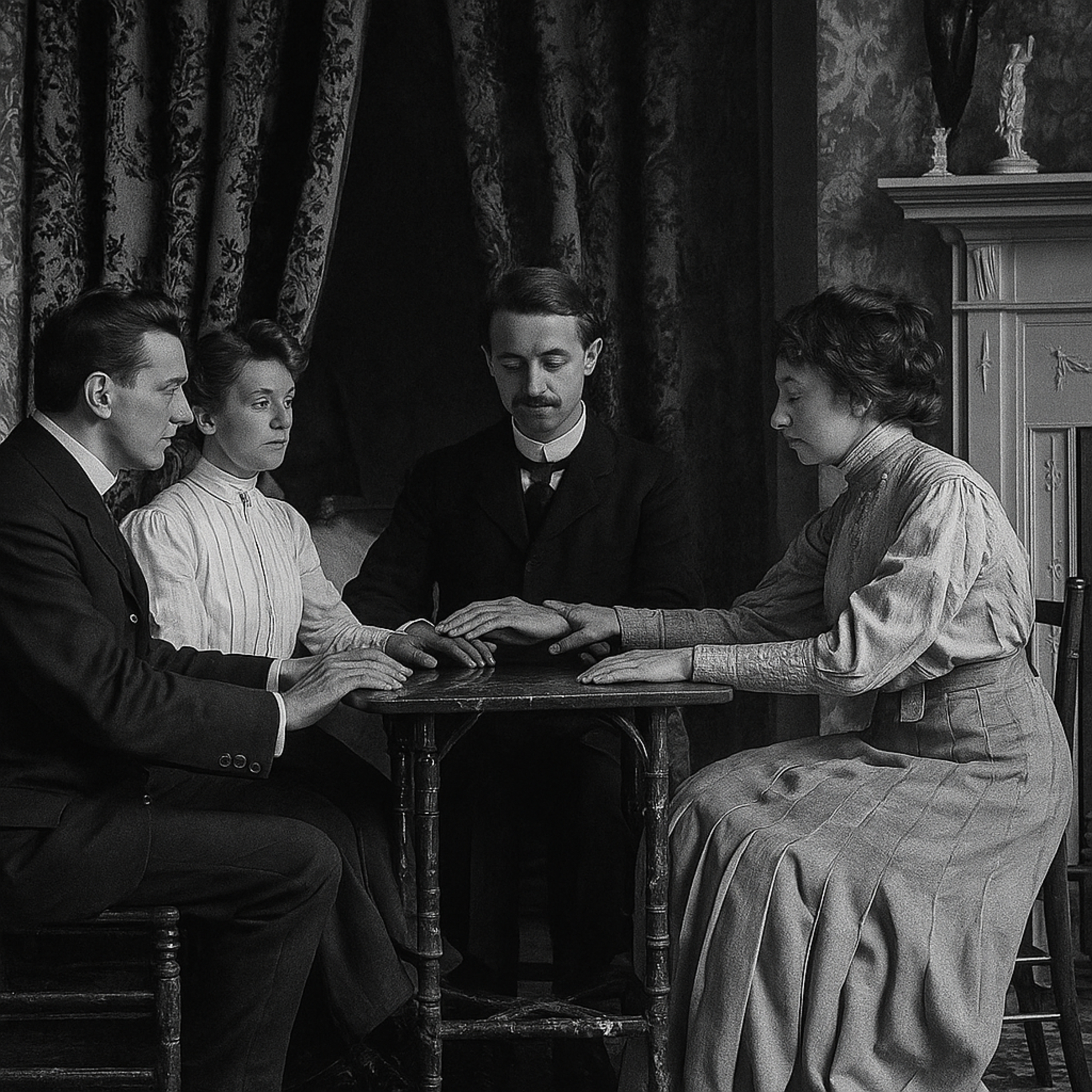
All houses in which men have lived and died, or haunted houses.
Through the open door, the harmless phantoms on their errands glide with feet that make no sound upon the floor.
There are places where history lingers, where time slips, if only for a moment, where echoes of the past whisper in darkened halls and forgotten corridors.
0:39
Old buildings hold more than just bricks and mortar.
They carry the weight of those who came before.
Laughter, sorrow, love, loss.
And sometimes, just sometimes, the veil lifts, revealing something beyond.
1:00
From spectral figures glimpsed in candlelight to stories carved into the very walls themselves, Haunted History Chronicles delves into the history, the hauntings, and the echoes of the past that refuse to fade.
But the journey for the podcast doesn't stop there.
1:20
We explore the strange and the supernatural, from folklore that has shaped beliefs for centuries to unexplained encounters that defy reason, tales of restless spirits, omens, cryptic legends, and mysteries that have endured through time.
1:40
Join me as we unravel the haunted, the historical, and the hidden.
So dim the lights settle in and step beyond the veil.
You can follow Haunted History Chronicles on all major podcast platforms as well as finders on social media to share in these stories.
2:04
Because history, folklore, and the paranormal are never truly silent, some doors, once opened, can never be closed.
In this hauntingly insightful episode of Haunted History Chronicles, step beyond the veil and into the enigmatic world as Spirit Guides with historian and spiritual researcher Nick Richbel, known for his meticulous and balanced exploration as spiritualism's shadowed past, Nick joins us to untangle the threads of belief, history, controversy, and identity surrounding spirit communication and those mysterious entities known as spirit guides.
2:53
But who or what are spirit guides?
What roles do they truly play in the world as Spiritualism?
And how have mediums through history claimed to communicate through them?
From the early seances of the 19th century to the cultural explosion as spiritualist practices, Nick helps us decode the spiritualism movements, meteoric rise, and the forces, both human and otherworldly, behind it.
3:22
We'll uncover the stories of famed mediums and their guiding spirits, examine the explosive popularity of spiritualism in Victorian parlors, and dive into darker chapters, allegations of fraud, Fort dream dramas, and the skeptical eye of people Like Harry Houdini himself, Nick also brings a critical lens to the social dimensions of the movement.
3:49
How did race and gender shaped the way spirit guides were portrayed and experienced?
Were these representations empowering or problematic?
And how did the spiritualist press and its followers grapple with these questions?
4:06
This episode is a deep dive into history, belief, and the unseen.
Whether you're a skeptic or a seeker, Haunted History Chronicles invites you to step into the seance circle and decide for yourself.
Our spirit guides echoes of the divine, clever illusions, or something else entirely.
4:43
Hi, Nick, thank you so much for coming back to chat with me on another podcast.
Hi, Michelle, great to be here.
It's a great way to spend an hour or so with you.
It's been a little while since you've been on the on the podcast.
Do you want to just reintroduce yourself with the listeners and share a little bit about your background?
5:01
Absolutely.
So I'm Nick Rich Bell.
I'm the head of Special collections and Archives at Clemson University in South Carolina, and I have a pH D in history that I received in 2024.
It's been a year now since I graduated from that program, and my area of research is the history of spiritualism, in particular Morris Barbonell and his spirit guide, Silva Burt.
5:27
So that was my dissertation and I'm now in the process of finishing up turning the dissertation into a book that will be published hopefully by next June 2026.
So I'm very excited to release that.
I've got 2 new chapters in there that are different from the from the dissertation and it will be heavily illustrated and it will tell a really good story about Maurice Barbonell and his life so.
5:54
Do you want to maybe just explain to again the listeners what spirit guides are in the the role they play in spiritualism?
Absolutely.
So in spiritualism, I kind of explain it that spirit guides would be a non physical entity that help and guide an individual on their spiritual journey.
6:15
And I kind of think of it and I explain it to friends is that, you know, when I'm in the supermarket or if I'm walking down the street and I'm having that internal conversation with myself, I think that's me talking with the spirit guide.
You know, I may not be necessarily hearing from them.
I mean, I might be like I'm ING and R ING over which mayonnaise to pick.
6:33
And then I might just feel guided to one section of the supermarket.
And that's kind of in a, you know, in a very easy to explain way of what spirit guides do.
And I think, you know, it's important to know that, you know, they guide and can help us with some advice and support, but they don't tell us what to do, right?
6:54
We still have free will, you know, we, we still make decisions on our own, but they're simply a spirit guide, you know the name.
They're there to guide us.
Some people will have them, as you know, levels of protection and they can shield an individual from negative energies or influences.
7:14
You know, if you're going into a seance, you may ask the spirit guides to provide, you know, a white, white of love and protection around the group to protect them from potentially anything negative that could come through.
You know, we could say they help with spiritual growth and they are believed to help in our personal and spiritual development.
7:35
And they encourage us to grow and discover enlightenment.
Enlightenment if you like.
And then, of course, you know, a big thing is communication.
Spiritualism at its core is about receiving communication from the spirit world.
And spirit guides can act as intermediaries between this world and the next, and they really facilitate that communication with other spirits or higher beings.
7:59
And yes, so that's, that's the core of that.
So my belief is the communication piece.
And I think it's important to note as well that someone may have a spirit guide today, but that spirit guide can change over years to another spirit guide as the individual, you know, changes their life.
8:16
You know, you could go from being a student with a particular spirit guide and once you graduate and you start working, you would have a new spirit guide who's helping you on this next stage of your life's journey.
So you mentioned the kind of the importance of spirit communication there.
8:32
What would what are the kind of the common forms of spirit communications And and again, how do how does that relate to spirit guides?
Right.
So mediums will depends on the medium they will work in a particular way.
So some medium mediums will hear words spoken from spirit guides.
8:52
Other mediums may see pictures that are presented to them.
So they then interpret to a message to someone they're reading.
And I even know some mediums who see their messages from spirit guides in the spirit world is like a movie.
You know, they see this whole movie play in front of them, which they then kind of interpret and share with the person who the message for spirit communication can come in written form.
9:17
You've got automatic writing.
Medium will go into a soft trance with the pen in their hand and we'll write the words that spirit is channeling to them.
There's a direct channeling.
So for example, Maurice Barbournell, he would, you know, Silver Birch, his guide would speak through him and Maurice Barbournell's voice would change slightly, which to differentiate his voice from his spirit guide.
9:45
Sometimes spirit guides will communicate to you in a dream.
You know, it's, it's often, you know, people who lost a loved one and then they have a dream about that loved 1 And I always say if that dream was full of love, then that was a visit from spirit.
10:02
But if it was, you know, an anxious dream or you know, it was upsetting, then that's not a true visitation.
There's intuition in, in a voice.
Like I said, you're walking around the supermarket or waiting for the bus.
You may, you know, you have that running dialogue in your head that could be spirit communication and other spirits will use signs.
10:22
You know, there's, you know, everyone says if you, you know, you see a white feather, that's a sign from a loved one.
If you see a cardinal bird, that's a visit from a loved 1.
And so, you know, symbols are interesting.
And then lastly, this is not involved in spiritualism, but some people will use tarot cards and pendulums or rooms to communicate with spirits.
10:43
But like I said, that's not part of spiritualism, that's more of a new way aspect of spirit communication.
So how do you think then spirit guides help mediums or individuals seeking communication?
Are there distinctions between their roles, for example?
11:01
Yeah.
So like I said, I think the biggest piece is there facilitators.
You know, I've talked when I talked about Thomas Lacey with you all those months ago.
Thomas Lacey has doorkeepers.
His younger brother Walter died at a young age and came back and he, Walter, the spirit guide literally was like a bouncer at the nightclub.
11:24
He would allow people in and he would block people from coming in.
So it's really that intermediary function.
If you like that the spirit guide can play there.
Like I said, they will help with the protection piece.
So often a medium will say maybe a small prayer and like I said, you know, surround me with white light of love and protection.
11:46
They will help mediums by providing guidance on how to interpret a message or symbol.
And they will also help with energy management.
So they assist in managing the mediums energy, ensuring that that person doesn't become overwhelmed or drained during a a seance or a session.
12:06
Often you will a medium who's been leading a seance could be very tired and unable to maybe speak for a while after they come out of their trance.
And then the distinction in roles.
So mediums, they have spirit guides who are working with mediums who like I said, really focus on facilitating this communication so that they can share messages with, with loved ones who have passed on and the people who are still living and want to hear from them.
12:35
And then after the individuals.
So for you and I and our everyday life, they're really focused on personal guidance, emotional support, and spiritual growth.
And they'll communicate through the intuition and subtle signs, like I said, showing a white feather or the cardinal that flies by.
12:53
So what would you say then the the concept of spirit guides really does kind of reveal about spiritualism's world view and the the understanding of the afterlife then?
So I think firstly, there's an interconnectedness.
It's, you know, spiritualism emphasizes interconnectedness of all beings.
13:12
And I think that suggests that the physical and spiritual realms are closely linked.
Of course, it focuses, you know, and highlights the continuity of life.
You know, as we know, spiritualism is really, you know, spirit communication and how, you know, as we experience physical death, that's not the end of us.
13:30
The soul goes on to a different plane of existence, if you like.
And then, you know, I think personal growth is important as well.
Spiritualism focuses on personal and spiritual growth.
You know, and I believe that individuals can evolve and learn through their interactions with spirit guides.
13:48
And then I guess with the understanding of the afterlife, spirit guides can help us understand that once we transition to this afterlife, there's several realms or planes, if you like, that spirit guides will live on because you keep evolving even after you you're no longer physically alive.
14:08
So spirit guides work on the other side and they can move on, such as Silverberg, Maurice Barbanel's spirit guide.
He made the conscious decision to return and work with Morris Barbernell as opposed to move to the next plane in the afterlife.
14:27
So how have spirit guides then been historically understood and used within Spiritualism?
So early spiritualism and even into today, I would argue, you know, spirit guides have been depicted as either specific historical or cultural figures.
14:43
But often, and this is where the problematic aspect of spirit guides comes in, and we'll talk about that in a bit, is that they've been portrayed as Native American people or other racialized spirits from Africa or the Middle East or the Far East.
15:00
So, so that's really kind of comes from the beginning of spiritualism, as I said, has trickled into today as well, or maybe a little bit less.
And then, you know, I think today, if we look at spiritualism today, you know, we talk about angels.
So angels may not.
15:17
I would argue that they are not spirit guides and maybe weren't human form, but they're some other worldly figure or other worldly entity if you like, that didn't necessarily exist on the earth as we do today.
15:35
So do you mind sharing some notable examples then of some famous mediums and their spirit guides?
Of course, there's so many to mention, Michelle, but a few that you know, immediately come to mind.
Of course, Maurice Barbonelle and Silver, but I know he was my dissertation.
But I think they're the the most famous that we would recognize.
15:54
There's Eileen Garrett.
She was a famous Irish medium that lived in New York, and she worked with an entity called Ivani.
And I think Ronnie wasn't necessarily a typical spirit guide.
He was this other world entity that I just mentioned.
16:12
She also worked with Abdul Latif, and Abdul Latif is seen across spiritualism as an ancient Persian healer who comes through in a healing personality.
Helen Duncan, the very famous Scottish medium in the United Kingdom.
16:29
She worked with a couple of guides, notably Albert and Peggy and Albert was particularly found out that a raucous kind of spirit guide Estelle Roberts.
She worked with Red Cloud, a Native American appearing spirit guide Muirig Morris in the 1920s nineteen 30s she had power was the name of her spirit guide.
16:54
Another Native American personality.
Then there's Leonora Piper who had Doctor Finn WE, who was a French doctor, he liked to give medical advice.
Florence Cook had Katie King.
The list goes on.
Michelle.
Are there any historical cases where spirit guides then have played a a significant role in spiritual practices or events?
17:19
Yeah, I think, you know, let's let's go back to my, my friends Maurice Barb and Ellen Silverbert.
Silver Birch talked, you know, about service.
This was key to to Silver Birch's kind of teachings.
Everything comes back to service and how I'm, you know, you work to help and support each other.
17:37
And he was, you know, selfless in his view of service as it being a means to spiritually advance both on this side of life and on the afterlife as well.
Silverbirch also emphasizes the importance of spiritual growth and evolution.
17:56
He taught that every soul is on a journey of continuous development and that our experiences on earth, both good and bad, contribute to the spiritual process progress.
For Silverberg, suffering was not a bad thing.
For example, which is quite interesting to read and think about because, you know, as humans, suffering isn't good.
18:16
Like we don't feel good about suffering.
But Silverberg says sometimes you have to suffer to suffer to keep going on your spiritual path.
And of course, life after death is really important.
With Silverberg, he provided insights into the afterlife and obviously reassures people that death is not the end.
18:36
You just transition to a different state of existence.
And again, the spirit world is just this wonderful place of continued learning and growth.
You don't pass on and stagnate.
If you want, you can keep improving yourself and moving on to other realms.
18:53
So why do you think mediumship, spirit guides, spiritualism rose in popularity the way that it did is, you know, especially in the 19th and the early 20th centuries.
Yeah, that that's a great question, Michelle.
So I think this is a well studied aspect of, you know, let's call it spiritualism, you know, encompass all of these mediumship guides.
19:17
You know, it started because they were religious doubts.
People started to question traditional religious beliefs and people, you know, those people were looking for alternative spiritual practices and spiritualism offered them this diversion from, you know, orthodox religion.
19:36
And I think it's also rose in popularity and, you know, especially the late 1800s because it allowed women and the possibility to move out of the home.
You would see women speaking on, you know, platforms such as Emma Harding Britain and Cora Hat and the Fox Sisters.
19:56
So it really allowed women to earn their own money if you like and leave the leave the home where they were traditionally kind of locked in if you like.
Of course, the wars is a well studied aspect of spiritualism and people turn to spiritualism in times of grief and loss.
20:17
So if you look at, say, the Civil War or the First World War.
There were many, many thousands of people who died, and that led people to seek comfort and reassurance through communication with their spirit guides and spirits in order to keep that communication going with your deceased loved ones.
20:36
You know, and people are searching for meaning in these times of social upheaval and change.
And spiritualism really offers that sense of purpose and understanding of life's mysteries.
It became popular as well, of course, because of the prominent figures that we saw, such as the Fox sisters, Andrew Jackson Davis and others who really bought spiritualism into the public eye.
20:59
But through demonstrating mediumship and spirit communication and then, you know, literally literature and media, we can see books and newspaper articles about it and we look at.
Maurice Barber announced time.
I've been studying the advertisements that appeared in the press as he did his propaganda tours around the United Kingdom on, you know, pretty much on a daily basis.
21:24
You know, spiritualism was in the newspapers.
So that, you know, creates A popularity for people.
And, of course, scientific interest.
Psychical research really took off in 1882 with this Society for Psychic, Psychic Research as they formed and they would conduct their investigations into the paranormal phenomena, which kind of lends a sense of legitimacy I would say, and scientific curiosity to spiritualism.
21:56
And I think you touched upon something really important there in terms of just the the way this manifested in things like in the in the media, in terms of print publications.
You know, this was something that was really being taken up and, and people were being exposed to.
22:14
And I don't know if there's other examples that you can kind of point to that kind of help to, to illustrate just how popular this became in terms of how this was kind of being put out there to the public in terms of how they were consuming it.
That really just helps to illustrate that growth, that surge in popularity.
22:33
Right.
You know, I think look at the spiritualist camps that were founded.
You know, we have Lilydale in New York State in the United States that was founded around 1879 and at the beginning was called the Cassadaga Lake Free Association.
22:51
So that became a meeting place in a camp for spiritualists and free thinkers.
They called themselves to meet, you know, as discuss and have their meetings together.
That became Lilydale Assembly in 1906.
It's still going today, hugely popular, their summer season and they draw, you know, many of the best names in mediumship of the day.
23:15
There was another camp called Camp Chesterfield in Indiana that was founded in around 1891 by the Indiana Association of Spiritualists.
There's another camp called Camp Silverbell, and that was located in the town called Ephrata in Pennsylvania, founded in 1932 by the very well known medium Ethel Post Parish.
23:37
And of course, Maurice Barbonell, he spoke at all all of these camps in 1937 when he did a tour of North America.
So you know that that demonstrates the popularity of of spiritualism by, you know, these three camps in, you know, not not too far from one another, but you know, and Camchesterville still runs to this day as well.
24:01
I think that points to just the the sheer volume of people that were clearly interested in obviously attending, just the numbers, the rise in people taking an interest.
Absolutely.
And the fact that it's still going today, you know, I went to Lilydale for a couple of days in, back in 2019 right before COVID and was astounded by the number of people that were there and, and the diversity of people that are interested in spiritualism, which I think helps, that speaks to its popularity as well.
24:30
Because spiritualism welcomes anyone, you know, you could be a practicing Catholic or Hindu and you're still welcome to come and learn about spiritualism.
You're not going to be asked to change your religion.
You know, you don't have to proclaim yourself as a spiritualist, but you're welcome to come and experience, you know, mediumship on what spiritualism has to offer and not give up.
24:54
And if any of your, you know current beliefs, if you like.
So you mentioned earlier, Nick, some of the the controversies that surround mediumship and and the use of spirit guides.
Do you want to just maybe kind of help illustrate that a little bit further in terms of what some of those controversies surrounding this is in terms of just going into that a little bit more detail to explain to the audience?
25:19
Absolutely.
So I think that the initial one that comes to mind is fraud.
You know, spiritualism throughout its history, since the very beginning, has met accusations of fraud.
You know, look at the Fox sisters who are the founders of modern spiritualism.
25:35
They were accused of fraud, and then they recant the, you know, admitted to being fraudulent and then they recanted their admission to being.
It's a very complicated case.
But and by fraud, we mean, you know, the Fox sisters were accused.
25:51
They were cracking their bones to make the rapping sounds that were so famously recorded to have started modern spiritualism.
So I think that's that's the, the biggest controversy is the fraud.
And that still runs to today, right?
Because it's, it's easy, I think, to deceive and trick people.
26:09
Other people could be concerned that mediumship exploits vulnerable individuals.
Like I mentioned earlier, you can be in your time of grief and then, you know, you're so desperate to hear from a loved one who's died that you may not be, you know, approaching the best medium who can help you or, you know, guide you through that, you know, sad period of time because there are people who do take advantage of of that, you know, they're not genuine mediums and they will, you know, take on you into, you know, giving money away.
26:43
You know, there's the scientific skepticism.
The scientific community has been pretty skeptical of mediumship and spiritualism.
Even today, the SPR will be, you know, sceptical about claims of mediumship.
And you know, that community, rightly slow, rightly so, demands empirical evidence for the phenomena.
27:04
And that's one of the things I love about spiritualism is that spiritualism welcomes these challenges from science.
And, you know, spiritualists are happy to prove that, you know, their mediumship is real and they're happy to be tested.
Of course, there's ethical concerns that tie in with this exploitation as well that I just mentioned because there's the potential for harm in spiritual practices.
27:29
Another big controversy is cultural appropriation.
You know, the use of spirit guides, especially those from indigenous cultures, raises issues of cultural appropriation.
This is an area I do struggle with as well when I've been doing my research into spiritualism because, you know, we can argue that spiritualism culturally appropriating another culture, which they have written no real understanding of in their real life, which, you know, I think is, is fair argument to make.
28:00
And then, you know, I think we can, you know, we just talked about newspapers and media.
I think the TV and cinema has done some damage to spiritualism, you know, with scary movies and Ouija boards.
And I think the portrayal of spiritualism in, you know, kind of current media, you know, is all about stereotypes and doesn't help spiritualism.
28:24
I think it does do damage to it.
And you, you mentioned in, in some of those examples, obviously the significance of fraud and how that's always kind of been there as part of the one of the concerns around spiritualism and mediumship.
28:39
And obviously you mentioned that the Fox sisters as an example of that other, other examples of notable cases where fraud was something that was alleged.
Absolutely.
One of the biggest ones was Nina Crandon, known as Marjorie So she was a Canadian born Boston based medium.
28:59
Her and her husband, Doctor Crandon, she was a famous medium, you know, the 1920s.
And she was investigated by Harry Houdini, no less, who had a real vendetta against mediums.
And he was trying to expose her as fraud.
29:16
And that's not uncommon for magicians or conjurers to do this because they would study a medium and then try and replicate what the medium had performed in terms of physical mediumship.
You know, in this case with Marjorie, she was so heavily tested and then she ended up, you know, quite a sad death.
29:35
I think maybe through alcoholism or something like the Fox sisters.
That was a sad story as well.
A couple of those turned to alcohol as they were accused of fraud.
And throughout their career.
And then in the UKI mentioned earlier, Helen Duncan was probably one of the most famous cases of a woman medium accused of fraud.
29:55
She was convicted in 1944 under the Witchcraft Act of 1735.
And people like Harry Price, the very famous psychic called Debunker, if you like, would accuse her of regurgitating cheesecloth that she claimed was ectoplasm during her sciences.
30:15
She was also accused of having two stomachs like a cow.
It was, you know, I think for her, it must have been a really hard life.
You know, she was strips and treated terribly.
And then her last conviction did see that the Witchcraft Act was repealed and was replaced with another act called the Fraudulent Mediums Act in 1951.
30:39
But sadly she died shortly after coming out of prison.
It was kind of a sad case for her.
And her, her court case is so fascinating because hundreds of people turned up in defense of her, which is astonishing.
To have this play out in the middle of London in the the height of the war, to have it spoken about in, you know, in Parliament, to have Winston Churchill writing about it in his personal correspondence, it's just incredible.
31:10
It's absolutely wild.
It is and it's fascinating and I know you've done some great research on this and blog posts and podcasts.
So everyone should listen to that because it's, it's truly a fascinating case of its time, especially as you said, with Winston Churchill getting involved in it as well.
31:27
You know, it's quite a, you know, like I said, a sad case.
You know, I don't believe she was wholly fraudulent.
I think sometimes mediums in general may, you know, play to the expectations of the person they're reading for.
31:45
You know, we talked about William Carr teaser before, who sadly, I think was a very genuine medium.
But then, you know, his greed and level of money took over, which led him to be a bit more fraudulent than you know probably he ever intended to be at the beginning.
And, you know, in the case of Helen Duncan, she was the the sole income earner.
32:04
So this was also the means for which she supported her children, her entire family.
So there is also that pressure of, you know, if nothing's happening to almost perform and do something for an audience because you have to, you have to have people coming back for you to be able to support your family.
32:22
And so I think there's an awful lot of things that makes it quite a complex world.
And I kind of tend to agree with you in the in the summation that you gave there.
I think there are some things that clearly point to, there are potential elements of fraud.
32:38
But at the same time, there is so many questions still unanswered in terms of what Helen Duncan was kind of being seen to be doing and the knowledge that she had that suggests there's something else at play as well.
So it's a, it's a fascinating case and she's a fascinating woman.
32:55
And I don't know if you know of any other kind of cases where alleged fraud is it has been examined in the the legal courts in the way that kind of was with with Helen Duncan here in the UK, if there's similar examples of that elsewhere.
I mean, the UK is, is kind of the hub for this and of course it has happened elsewhere.
33:17
But it, you know, in, you know, my research in Morris Barber now, he was involved in so many court cases, whether it was libel or accusations of fraud, particularly in the 1930s when I think it's when libel law changed and which made it possible to sue for libel.
33:36
But he, you know, he went up against Doctor Nandor Fodor, a very famous psychical investigator.
He went up against the Zumas, who were a married couple that had this conjuring act of thought transparent.
And it just evolved into this whole lengthy press battle and court case that he lost.
33:57
He didn't often win his cases, but you know, the fraud you know sadly does end up in in the courts on on many occasions.
Did you hear that?
34:14
Sounds like the spirits are reminding you that you can support Haunted History Chronicles.
If you love delving into the eerie and the unexplained, why not help keep the lanterns burning?
Head over to Patreon.
T Public or Kofi?
34:31
All the links are waiting for you in the description notes and on our website.
Get exclusive content, haunted merch and more.
Now let's step back into the shadows.
For more haunted history chronicles, and you mentioned a couple of people who have have kind of been part of the, the debunking, if you like, of some mediums, you know, Harry Houdini, for example, and, and Harry Price in the case of of Helen Duncan.
35:07
Are there any other figures similar to Harry, Harry Houdini and and Harry Price here that maybe were doing similar things?
You know, what were they kind of doing to to kind of help investigate or debunk the mediums in the way that we saw during this time frame?
35:25
Yeah.
So I mean Houdini and Price really come to mind.
They they're the, you know, the big names in in this investigations and trying to, you know, make fraud accusations stick.
As I said, you know, conjuras, Harry Houdini would attend seances, you know, Incognito in disguise in order to later demonstrate how what he called were tricks, how the medium performed that.
35:51
So with Mina Marjorie Crandon, he, you know, his accusation calls her is that she had a bell in the room and in the science room that was in a box that would ring.
And he claimed that she made that happen by using a ruler that would have been a pack attached to her that she could then, you know, make that bell ring.
36:12
He even went to Congress in about 1926.
And he was a staunch advocate to get legislation in force that would criminalize fortune telling and, you know, people who were accused of fraudulent mediumship to get them, you know, locked up in prison.
36:29
You know, his big thing is that these practices exploited grieving individuals.
And then of course, you know, he wrote books and gave lectures just like Price, right?
You know, Price was known for his rigorous scientific approach.
How scientific it was, I don't know.
36:46
I'd love to go back and look more into his archive to see, you know, exactly what he was doing.
But he, you know, again, that was his life.
His life was to try and expose mediums.
Mediums for fraud.
How have institutions like the Society for Psychical Research investigated mediums and and their abilities and so on and investigated that aspect of it?
37:13
Yeah, so the SPR Society for Psychical Research, I know you just released, released a really interesting blog post about them.
So people should go and read that, that this group, they were the first organization, as I said in 1882 to formally and organize themselves in order to conduct scholarly research into psychic phenomena.
37:34
You know, they aim to approach phenomena without prejudice.
You know, they were kind of open minded and I think they still are now, I'd like to say.
But they wanted to use rigorous methods as have been applied in other scientific fields.
37:50
They would do field investigations.
So the researchers would go and investigate sound Sears and haunted houses and other paranormal events.
And they really wanted to eliminate non paranormal explanations such as fakery, poor observation or misperception.
38:08
And then they would do controlled experiments.
So that would be for example to test claims and telepathy or thought transference or other psychic abilities.
And these experiments would involve strict protocols to ensure the the validity of the results.
38:25
You know, and notable investigation that the SPRSPR conducted was the Neapolitan medium.
You Sapia Palladino.
She was known for physical manifestations during seances.
And then while some people said that it was genuine, others exposed, exposed her as, you know, being a trickster.
38:45
And I think sometimes her, she herself would say she was tricking, but sometimes she was genuine.
So she's a definitely interesting case for people to look into.
So why do you think then just fraud, for example?
Why do you think that's become just as much a part of the story of spiritualism as the the practices themselves?
39:07
So I think, you know, part of it, again, as I said, spiritualism, they welcome the scientific aspect of this.
They want to be investigated or tested to so we can prove that it is is real.
And then, you know, I think it's important again, to look at the vulnerability of believers.
39:25
You know, there's the emotional needs of someone, as I said, who who's grieving for someone.
And then there's this strong desire for proof that does make it susceptible to believe in fraudulent practices.
Then the historical context, there's the early exposure.
39:44
You know, this fraud has happened since the very beginning, as we've said with the Fox sisters.
And of course there's a great public interest, you know, fraud, everyone, you know, sadly, the human nature, sometimes we want to see people fail, you know, especially if we're skeptical about spiritualism.
40:01
We're going to be very interested in these high profile cases, which is Palladino and Helen Dunker.
And I think, you know, this investigations and fraud is such a part of the story because of the figures that are involved.
You know Harry Houdini, this world famous magician, and who'd have thought that he would have become involved in.
40:22
You know, investigating potential fraud and mediumship.
So I think that's, you know, they're the key things that we need to look at.
And again, the cultural influence and the media influence, as we've talked about how media has sensationalized fraud cases and, you know, there's the the paranormal shows on TV will, you know, sensationalize what these investigations and experiments can look like.
40:52
I think you raised some really interesting points there because there is almost a little bit of celebrity who some of this isn't there.
There are some very big hitters, some people with real influence for whom, you know, if they are endorsing a particular medium or trying to debunk a particular medium, then their voices get heard.
41:12
And of course it keeps it topical, it keeps it in the mainstream media.
And I think media hasn't changed all that much in terms of, you know, there is this real kind of effort sometimes to elevate someone and all of this positive press, to lift them up and then to drag them back down off that pedestal.
41:33
And I think when you look at so many examples of, of mediums who have have been kind of in the public eye and are quite well known, you see that very much in the way that they're portrayed in journalism.
This rise where they're kind of endorsed and they're supported and they're celebrated and their stories put out there.
41:53
And then suddenly this crash that you just see then the negative press and the negative articles coming through, which again, I think just keeps the whole thing buzzing, doesn't it?
It's the sensationalism aspect for both sides of that coin constantly playing out it.
42:09
Does sadly, and that's people attached to that, which I understand because it is fascinating.
And I think just something important to note is that with spirit guides in particular, you know, it's empirically difficult to confirm a spirit guide is who they say they are because spirit guides are individual to one person.
42:31
It's not like if you go and have a reading and Grandma Jennifer comes through and you know it's her because she can give you specific memories and her personality.
But a spirit guide?
You can't prove one way or another that the Spirit Guide is who they say they are.
42:49
So earlier you mentioned obviously that some of the controversy around race and I think gender also comes into this as well.
How do you think race and gender have influenced the perception and and practice of mediumship and spirit guides?
43:05
I think these are very heavy influences.
You know, there's the historical context of the empowerment of women that I've mentioned.
Spiritualism provided one of those few platforms where women could assume a leadership role in the late 19th century.
43:21
And they were, they could gain public influence, I've said, allowed them to earn money and their voices were heard in public, which was very rare in other professions.
And then, you know, we had notable figures such as the Fox Sisters, Emma Harding, Britain, Leonora Piper, you know, this changed traditional gender roles and contributed to the feminist movement.
43:45
There's also the perception and skepticism aspect.
Female mediums were sometimes pathologized with their abilities being attributed to hysteria, for example, or other medical conditions.
And so this really reflects A broader societal attitude towards women and their mental health.
44:03
There was a gentleman called Frederick Marvin who wrote, he coined a phrase called medeomania, which basically said that, you know, women weren't mediums and were just hysterical because of their physiological make up, if you like.
44:19
And then, you know, we take a look at indigenous Americans.
The there's a portrayal of male Native American spirit guides who are powerful.
You know, they're Indian chiefs when they present themselves in seances.
44:36
Whereas when the female spirits of Native American origin came through, they're often shown as being innocent and naturalistic.
So, you know, there's this terrible stereotyping that has, you know, been portrayed in spiritualism across the years.
44:55
And obviously you just mentioned a really good example, I think of, of racialized, racialized stereotypes in in some of the depictions of of spirit guides.
Are there other examples?
Similar to that, you know, in terms of how they, how they're portrayed in spiritualist communities or in the press.
45:13
Absolutely.
So you know, and I'll pre empt this response by saying some of this language is not my language.
This is from a book.
This is what someone has written and it's language of it's time that I do not agree with.
But there was a gentleman, you know, 1940s north of England called Harry Emerson.
45:32
So he has a book called Listen, My Son.
Very hard to get, but if you can read it, it's fascinating.
During the 1930s, Emerson befriended a British medium called Hunter Selkirk, and he attended seances that included the spirit guide called Zuru.
45:49
He was Selkirk's chief guide and guardian, described as an old African Negro, a kind, gentle old soul whose very manner of speech is comforting.
So this book, you know, I would warn listeners, is full of, you know, racist language and and language we wouldn't use today, you know, because a frequent visitor to this Selkirk seance room was and I'm this is a quotation Topsy, a little coloured girl who is very witty and whose job was and I quote again to create harmony and good conditions for other visitors.
46:24
Her voice was that of a gay contented child, quite unlike mediums voice.
Then you know, imperial stereotypes begin to come in as Topsy was described as having fully materialized during one of these seances and her face was cold black.
46:42
And later she's described as having white teeth that showed up very distinctly in contrast to her little black face.
You know, these are, you know, it's shocking to read, but this is very common throughout spiritualism and spirit guides in how the spirit guides are racialized and and described such as that way.
47:07
How have you know organisations like the Spiritualist Press and Psychic News kind of address some of those those issues that you were just raising?
So, you know, psychic news, I I would say they address them head on.
You know, I would often question why is, is Silver Birch, for example, portrayed as a indigenous American?
47:32
And, you know, I, I think that comes down to just the portrayal of Native Americans as being, you know, in harmony with nature and spiritual people.
So the guide is, is shown to add credence to the messages that are being given because you're more likely to believe someone who's been portrayed that way than if it was say, you know, an East End London Cockney barrel boy.
48:00
But psychic news, you know, is full of discussions about spirit guides and and it's full of, you know, Native American guides that are talked about in the articles that were printed.
And Morris Varbanel was was happy to take on these arguments and, you know, and kind of defend this aspect of spiritualism.
48:26
Has there ever been a kind of an internal debate or, you know, a critique within the spiritualist community about these racial and gendered representations?
I don't think anything maybe formal is what we're doing today on my research, but you know that I know the discussions do happen.
48:44
I've had discussions with spiritualists about these topics, and it's always a, you know, a lively and spirited, pardon the pun, debate and discussion about these.
But again, you know, I think for spiritualism, it's more about the messages that are coming through than the spirit guide who's helping bring those messages through.
49:06
I think often in, you know, if you're in a development class to learn, you know, mediumship and you know, expand your skills, the teachers who are mediums, they will avoid, you know, discussions about spirit guides.
They want to focus on the techniques and how to do the phenomena as opposed to, you know, who is who that spirit guide is, as I mentioned earlier, because it doesn't matter because you can't prove by the way, that it is, you know, an indigenous American guide or it is a Chinese guide or it is a woman.
49:39
That's not the important part.
It's the message and how you get that message across that that is the the main focus of that.
And I think there's an element of, you know, these these questions, whilst they're uncomfortable for us as a modern audience, and rightfully so, you know, we, we can challenge the, the stereotypes today, but they were off their time.
50:01
And I think when we think of spirit communication and messages coming through all the literature and the experiences point to they come through to that person that's a sensitive person in a way that's going to be something that's recognizable to them.
50:16
And these were of the time.
These were the perceptions and the ideas of the time.
And whilst they may not reflect our ideas today, they may make us uncomfortable today.
But there is an element of it was part of the the history, it's part of the generational, you know, aspect to it.
50:37
And that changes.
And, you know, I think it's just part of the story, if you like, in terms of the growth that's happened.
And that will I think always be the case.
You know, in 100 years time, similar conversations might be had about what's happening in today's society and how, you know, these these kind of representations of spirit guides come through to people.
51:02
They may be critiqued in a in a slightly different way and look back on with similar kind of thoughts and kind of a critique of of what's happening in today's society for the same reason.
Right, I absolutely agree with you, Michelle, and I think, you know, we need to lean into this discomfort, have these discussions, not shy away from them, but let's talk about it.
51:23
That's that's my kind of motto on these issues.
Let's have a conversation because we can't hide away from from the history.
We can talk about it.
I completely agree with you and I think it's it's just part of the story.
51:39
It's part of the history.
And like you said, if we can talk about it, we can learn from it, we can grow from it and we can understand it and we can challenge it.
And I think all of those are good things rather than to to not discuss it, to not debate it is, I think a disservice.
51:57
I don't think that helps at all.
So I think it's it's something that's really vitally important to to look at and to think about and to consider.
Absolutely.
So what drew you then to study and explore the topic of spirit guides and mediumship, Nick?
52:14
So I'm, I think I've always been kind of aware or interested or of the belief that this physical life cannot be all we have.
Because if this is the case, it's pretty miserable, right?
We look at the world and especially the world today, it's challenging.
52:31
And if, you know, the day I die and that's it, it's sad, you know, and I look back and I think I must have been about four years old and I can picture it to this day.
My mum, I was the youngest child.
There was a brother after me who was stillborn.
52:48
And I can very clearly remember being at my mum's hospital bed when this happened.
But then, you know, in later life we had these conversations and my mum told us, no, you kids never came to visit me in hospital.
And, you know, I think that was some kind of spiritual vision that I have of that time.
53:08
And so I've always been fascinated by spiritualism and mediumship.
But it was really when I started work at the University of Waterloo and I got to know some of their seance collections that we've talked about, the Jenny Pinkock collection and the Thomas Lacey collection.
53:25
But I really became fascinated in the people involved in spiritualism and the phenomena that has been reported to be produced.
And I just discovered that there's this whole world of spiritualism and archives and people like Morris Barbanel and Helen Duncan and I, I find it truly fascinating to to continue researching this.
53:49
In what ways do you think modern spiritualism still, you know, either rely on or reinterpret the concept then as spirit guides today?
So I think probably we can look at the definitions of spirit guides as broadened.
54:06
And if we look at today, you know, I mentioned angels earlier, there's archangels, there's a medium or I don't know if he calls himself a medium, but Kyle Grey, that in Scotland he works with angels and he's produced some really interesting books about that.
Some people look to ascended masters as spirit guides such as Buddha, Jesus, and there's the the vision of our higher self or future self that comes into these expanded definitions of spirit guides into dimensional beings, such as Ivani, who I mentioned worked with Eileen Garrett.
54:45
Maybe it's a bit more new age than spiritualist, but it's, you know, I think it's all part and parcel of that.
And I think it's there's definitely a more eclectic and maybe we can say inclusive spiritual world, world view these dates.
What do you think the the kind of that continued interest suggests then about our our broader kind of beliefs and values still today then?
55:11
You know, I think there's just more understanding and maybe more belief that life does continue after physical death.
I think there's more interest in it, you know, and we talked a bit about the negative television and, you know, kind of film coverage of this kind of area.
55:30
But there's a positive side too.
There's mediums that have their TV shows that look very good.
There was one on TV that I was kind of, I'm not sure if I believe this.
And I saw them in person in a, you know, in an auditorium giving readings and it was fascinating.
55:46
And I left that 100% believing her, which I didn't from the TV show.
So I, you know, I do think that more people are, well, maybe not more people, but people keep coming to spiritualist churches because they, you know, they do have this belief that life does continue and they are able to communicate with loved ones.
56:09
And there seems to be, I mean, you mentioned obviously the, the broadening aspect of it and that there does seem to be a kind of a greater awareness and acceptance in, in kind of avenues that I would never have previously expected who see spiritualism being explored and touched upon.
56:27
Or I mean, I can think, think of the kind of the recent example of the series about Helen Duncan on BBC, for example.
I mean, when, when would Helen Duncan and her story have ever been on the BBC?
It, I mean, it was kind of an unheard off topic for the BBC, but they've really kind of started looking into some of these and shows that put some of these information out there.
56:51
UFOs, they've looked at kind of aspects of the paranormal and it's, there does seem to be this kind of almost like this movement, if you like to, to start to kind of explore these in, in ways and areas that just, I think previously we haven't seen.
57:09
And, and I think maybe that reflects what you were mentioning about.
There's something very inclusive about this.
And I think the more it broadens, the more people find their kind of little niche that really interests them, that allows them to explore some of these questions.
57:24
And these are questions we all have, You know, what happens to us?
What happens after we we are no more on this earth?
What, what is the next stage?
These are all things that we think about.
And I think when we have so many different areas that allow us to touch on it, to think about it, reflect on it, find maybe a little pocket that interests us, it does kind of, as I say, I think it does reflect what you were saying about how it, I think it's becoming something more and more inclusive, which is fascinating.
57:56
It is.
And I, you know, and I think you know, on the tail end of that as well, spiritualism, you know, you're not forced to believe everything.
You believe what you want to believe.
And I love there's a church in Canada that at the beginning of their service, they say, take what you can from today's service and just gently lead to one side that does not resonate with you.
58:19
So it really is a very personal journey on spiritualism.
And there wasn't this blanket set of rules that you have to follow and that you're expected to believe.
And just on the BBC, you know, I haven't seen the Helen Duncan series, unfortunately, being in America, but I've heard about it.
58:38
And I think that's fascinating.
You know, in Barb and Nell's time the BBC was staunchly anti spiritualism and I, you know, I would wonder what would Helen Duncan say today if, you know, she was alive and was like now your life is on TV and I hope she would be amazed that, you know, she achieved more than being someone just accused of fraud.
59:03
Nick, it's always such a real pleasure to chat with you.
This for me, this is such a fascinating subject matter and it's one that never stops giving because, you know, when you start to look into mediums and their spirit guides or spiritualism, you start to uncover these stories that maybe are lesser known and these accounts of people who are lesser known.
59:26
And I mean, some of the information out there is just so intriguing and so fascinating.
So it's great to kind of peel back the curtain a little with you and to kind of explore the topic with you, given that it's something that you're so passionate about.
And yeah, I hope we get to do this again because I think there are many, many more different curtains that we can peel back and and take a look at the topic again from different angles.
59:52
And yeah, it's just such a forthcoming subject matter.
I think that's fascinating for me.
So thank you so much for your time.
I love it, Michelle, and thanks for having me.
And like you said, you know, we're just kind of breaking the surface here with what we've talked about.
1:00:07
There's so many layers beneath it and I hope people listen to this, find something interesting and go off and research or ask questions and and find out more.
And obviously I will make sure to include details to follow you and everything on the podcast, description notes on the website so that obviously we can still keep abreast of what you're doing.
1:00:29
So when things like the, the book come out, people will be able to obviously know what's happening and when it's happening.
And yeah, I, I, I can't wait to see what comes in in the future from what you do because I'm very much looking forward to this book.
It's definitely, definitely going to be on my list of things to read the minute it comes out.
1:00:49
So I can't wait for that one.
Appreciate it.
And I'll say goodbye to everybody listening.
Bye, everybody.
Thank you for joining us on this journey into the unknown.
If you enjoyed today's episode, please subscribe, rate, and leave a review on your favorite podcast platform.
1:01:11
You can follow us on social media for updates and more intriguing stories.
Until next time, keep your eyes open and your mind curious.