Project Update: Mapping the Unseen — Major Advances in Poltergeist Research Tools
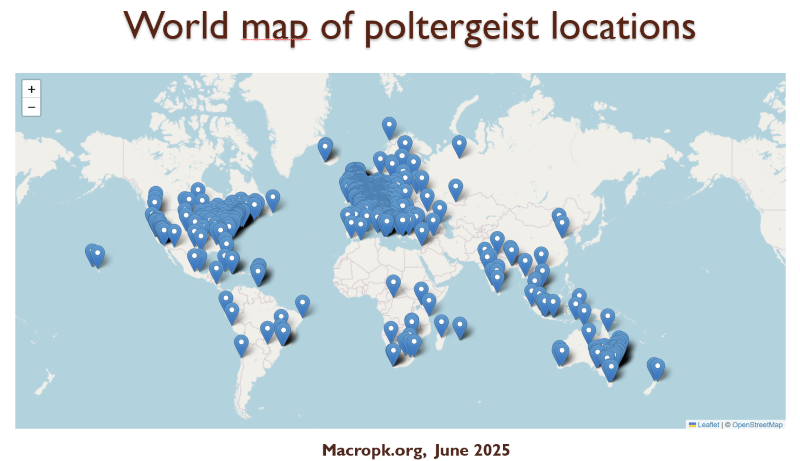
For those following the continued development of the macropk.org database and research platform, significant updates have just been announced — and they mark an exciting leap forward in the way poltergeist cases can be explored, analysed, and compared.
This important project, which some of you may recall from earlier podcast episodes featuring its developers and contributors, has steadily evolved into one of the most comprehensive resources for mapping and interpreting poltergeist phenomena worldwide. Below is a summary of the most recent enhancements, with a particular focus on tools that allow for deeper engagement with the data — and a more nuanced understanding of what these strange cases might have in common.
New Interactive Mapping and Search Features
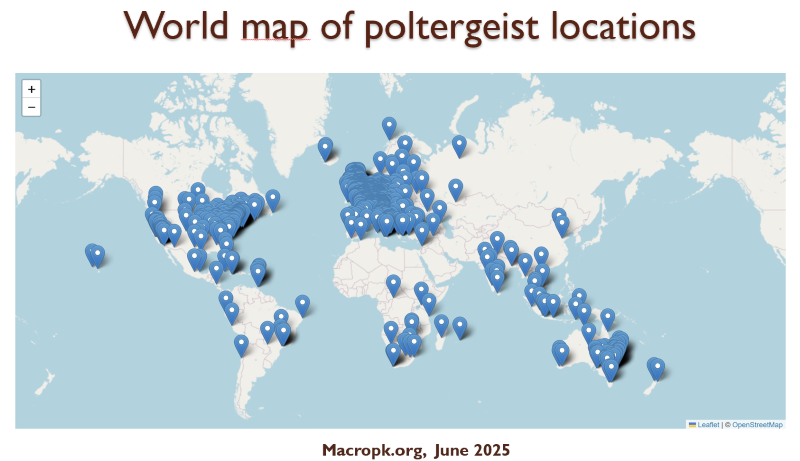
One of the most impressive new features is the interactive map function, which allows users to visually explore the locations of reported poltergeist cases across the globe. Using generalised GPS coordinates (typically of the relevant town or region), each case is plotted on a searchable map, with clickable entries that reveal key data such as the year, location notes, and links to detailed case files.
But it’s the depth of filtering that truly sets this apart: cases can now be selected based on their historical period, duration, quality of testimony, or by choosing from an astonishing 93 phenomenological parameters — ranging from object movement and rapping noises to visual apparitions, temperature drops, and much more.
This is not just a directory — it’s a research tool, allowing anyone to zoom in on trends, patterns, and outliers in the global poltergeist record.
Correlation Tools: Exploring Phenomena with Precision
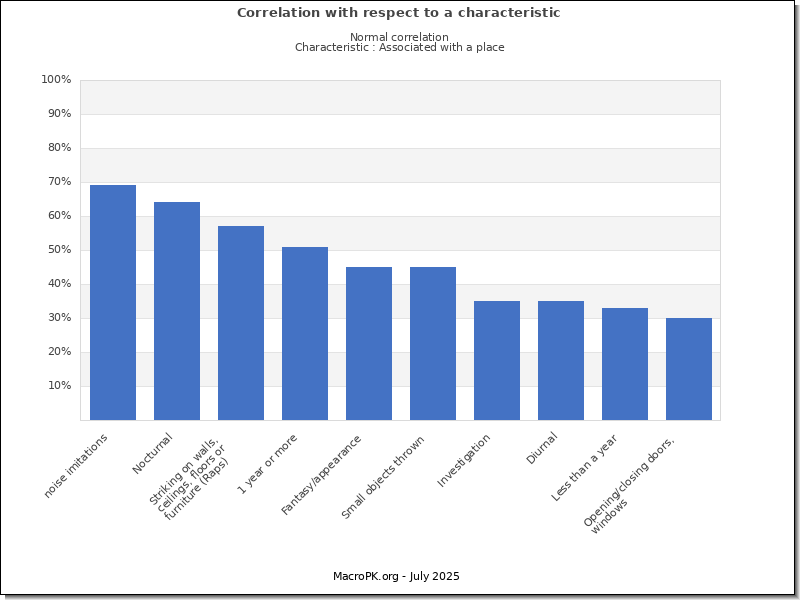
Another newly implemented feature is the correlation engine, which allows users to examine how specific characteristics are related across multiple cases. Want to know what other features are most commonly present in cases where events are "associated with a location"? Or which parameters appear most frequently in cases involving "agents under 20 years old"?
This new function allows users to choose a reference characteristic and see which others most often occur alongside it — either in general, or filtered by historical era, case duration, or level of documentation.
For instance:
Cases linked to a specific place show a strong correlation with nocturnal activity, banging on walls, mimicry of voices or noises, and apparitions — often in long-lasting cases spanning more than a year.
Cases involving agents under 20 tend to be shorter in duration, happen more frequently during daytime, and are more often investigated in depth. They also skew slightly towards female agents, particularly in older case records.
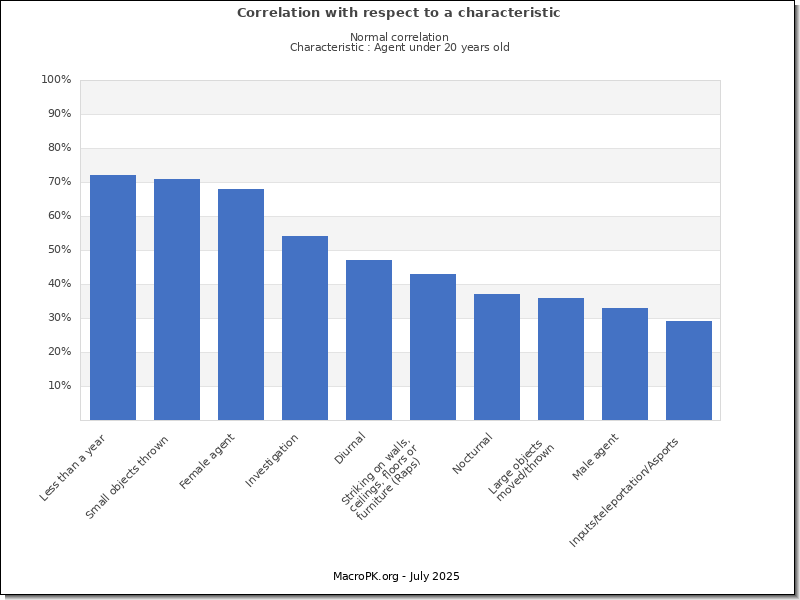
This analytical capability makes it easier than ever to test hypotheses and explore patterns across decades — and even centuries — of reports.
A Growing Network and the Global Poltergeist Archive
The team behind the project is expanding, with new contributors helping to process over 2,000 incoming cases from regions including Asia, Africa, the Middle East, and South America — many of which are being brought forward through collaboration with researchers like Paul Cropper and Keith Linder.
Behind the scenes, focused discussions are also ongoing with:
The Institut Métapsychique International (A-IMI) in France, to further analyse haunting cases
The Society for Psychical Research (SPR)'s Spontaneous Case Committee (SCC), with a view to joint studies and working group participation
Meanwhile, linguistic accuracy is receiving attention, with Martine Dagosneau now working to refine the English and German translations of the site — with Spanish and Italian support being sought next. Volunteers are welcome.
What's Next: Phenomena, Mediumship, and Experimentation
Looking forward, development will focus on three main areas:
Processing the 2,000+ new poltergeist cases now in the pipeline
Enhancing the database of physical mediums, including names, historical data, and related phenomena
Experimental documentation, particularly around:
Rotating objects
Metal bending
These experimental aspects may hold key insights into the physical dimensions of macro-PK activity, providing valuable new perspectives on an age-old mystery.
If you’re interested in contributing your skills — in research, language support, historical data collection, or analysis — the team welcomes new collaborators. You can get in touch simply by replying to this email.
This project remains one of the most dynamic and data-rich contributions to the study of anomalous phenomena today. For anyone interested in the mechanics, psychology, or historical patterns of hauntings and poltergeist activity, these new features are well worth exploring.

Host, author and producer
Hi I’m Michelle.
Teacher, podcaster, history and paranormal enthusiast and woman who wears many hats and spins many plates including dog whisperer- as you will often find Archie my dog- joining me during podcast recordings where he promptly falls asleep clearly not as enthusiastic about the subject as I am. It does mean his dulcet snoring can often be heard gently in the background- his contribution as occasional co- host needs a little work.
I live in Oxford in the United Kingdom and I love travelling and exploring historical sites throughout the UK for its history and haunted activity. One of the best gifts I ever received was English Heritage vouchers to use to explore various different historical sites. I had the best summer that year. (For friends and family possibly reading this please note that hint for future gift ideas!)
I started this podcast as an adventure through some of my passions. It has been immensely exciting getting to know lots of other people around the world who have these same common interests. I’ve been humbled by the encouragement and support from strangers and people who have become new friends! I truly could not do this without you.
This isn’t something I have done before and I’m learning everything as I go along - from equipment, to editing, to even creating this website. I’m loving it though- it’s a lot of work - but worth every second. Thank you for being patient as I learn and improve along the way. I have big dreams of where to take this podcast and community I hope we build here. If you wish to support that dream and this c…Read More
Sale!