Fairies At The End Of The Garden
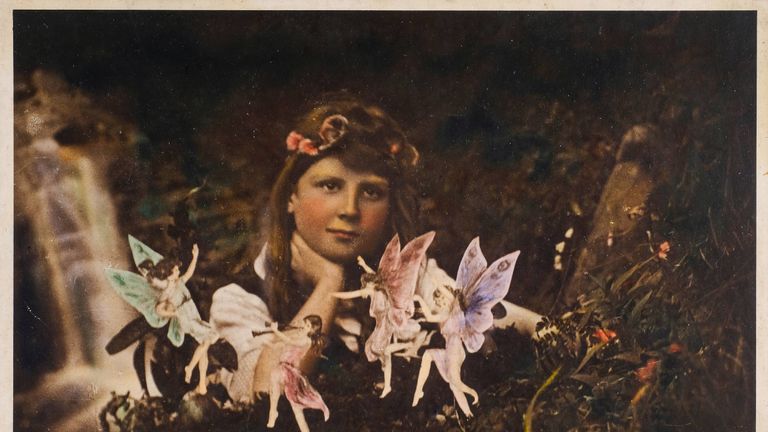
“Here are fairies at the bottom of our garden,” opens a 1917 poem by Rose Fyleman. That same year, two clever young cousins managed to captivate the world with apparent proof that fairies lived beside Cottingley Beck, the gently babbling stream that wound through the wooded valley behind their home in West Yorkshire.
In the summer of 1917, nine-year-old Frances Griffiths and her mother returned from South Africa to stay with the Wright family in Cottingley. Next door lived sixteen-year-old Elsie Wright and her parents. The beck—Cottingley Beck—ran through a small, tree-shaded glen beside their house. Frances and Elsie were immediate companions and spent every free moment exploring the beck’s mossy banks and overhanging rocks—much to their mothers’ despair. They habitually returned home drenched and muddied.
When scolded for their soggy return, the girls offered a whimsical defence: they had been looking for fairies. The adults, unsurprisingly, didn’t believe them. In response, Elsie borrowed her father Arthur’s Midg quarter-plate camera, determined to capture proof. Incredibly, within the hour they were back, triumphant.
Arthur developed the plate in his darkroom. The photograph revealed Frances, head turned in a shy smile, gazing skyward as diaphanous fairy figures danced before her. The image seemed impossibly delicate—fairies dancing among the ferns. Yet Arthur, a shrewd amateur photographer aware of Elsie’s artistic talent and experience in retouching, was unconvinced. When the girls returned with a second photo—this time showing Elsie communing with a gnome-like fairy—he suspected trickery: cardboard figures posed with hat-pins seemed most plausible.
In the years that followed, Elsie’s mother, Polly (an enthusiastic Theosophist), shared the pictures at a local Theosophical Society meeting in Bradford. The lecture’s theme was “fairy life,” and the audience—spiritually inclined—welcomed the images with eagerness. Edward Gardner, a leading figure in the society, embraced them as metaphysical evidence of humankind’s spiritual evolution.
To validate the photographs, Gardner commissioned photographic expert Harold Snelling, who declared them “authentic images of what was in front of the camera”—a carefully worded statement that avoided commenting on their paranormal nature. Gardner reproduced them as prints and sold them at his talks. Soon after, Sir Arthur Conan Doyle, an established spiritualist and writer of The Strand Magazine, asked permission to use them in his Christmas edition article on fairies.
Conan Doyle’s credulity remains mystifying. He was equally drawn in by the Piltdown Man forgery, another high-profile hoax that remained unexposed until after his death. For him, the Cottingley fairies were powerful evidence of the unseen world.
In reality, Elsie and Frances had staged the images using cardboard cutouts traced from Princess Mary’s Gift Book (1914), with wings added and held upright with hat-pins. Over time, additional pictures were taken—three more, including “Fairies and their Sun-bath” in 1920.
Perhaps part of the reason they were so readily believed was the bleak backdrop of World War I. Amid such horror, the idea of an enchanted realm just beyond the mundane offered comfort. Even the heartbreak suffered by Conan Doyle—who lost his son in the war—may have made him more receptive to the notion of magic in the everyday.
During the 1920s and ’30s, fairies and gnomes became staples of popular culture—in prints, pottery, ornaments. As cinema and animation advanced, fairy-tale cartoons sparked the imaginations of children around the globe. Many clung to the belief in the Cottingley fairies because they wanted to believe. Somewhere in rural England, a secret, magical realm remained, glimpsed only by a privileged few.
Sceptics continued to question the authenticity well into the 1960s. Television’s rise allowed for investigative journalism to challenge the narrative further. It was only in the 1980s, when Geoffrey Crawley of the British Journal of Photography undertook a serious scrutiny of photographic evidence, that the hoax was definitively exposed. Crawley concluded the images had been staged—with Elsie and Frances confirming this publicly in 1983. They admitted it began as innocent fun and quickly escalated beyond their control. Nevertheless, Frances maintained until her death that the final photograph—“Fairies and their Sun-bath”—was genuine.
Fast forward to July 2025. Two of these iconic photographs—Alice and the Fairies and Elsie and the Gnome—resurfaced at John Taylors Auction Rooms in Louth, Lincolnshire. They had been held for decades by Mary Anderson, Frances’s childhood best friend, who’d received them in school—unaware they were a fabrication. The lot also included a photograph of Mary and Frances from the early 1920s, plus an archive of related materials.
The auction on 29 July exceeded expectations. Estimated to be worth in the low thousands, the lot closed at £2,600—almost double pre-sale forecasts—selling within two minutes to a private London collector. David Whittaker, Mary’s son, reflected on his mother’s lifelong belief in fairies and her heartbreak following the confession: “She spent her life believing in fairies… she was completely shocked. Because of them she had spent her life believing in fairies!”
James Laverack, auctioneer, described the images as “very rare,” praising their condition and provenance. The story captured public imagination once more—this time not as proof of the supernatural, but as a cultural artefact entwined with childhood wonder, media influence, and the fragility of belief.
The sale of these photographs reaffirms that, although exposed as a clever hoax, the Cottingley Fairies endure—sprinkled through collective memory as symbols of longing for beauty, optimism, and something beyond the ordinary. They prompt us to ponder the interplay between innocence and invention, between what we want to believe and what is real.
You can watch/ listen to the following interview with Merrick Burrow here:
https://www.youtube.com/watch?v=2elqY9DDO4U
You can also listen to the following interview with Dr. Richard Sugg on the Dangerous History Of Fairies here: https://www.podpage.com/haunted-history-chronicles/fairies-a-dangerous-history-with-richard-sugg/
Link to the BBC article: https://www.bbc.co.uk/news/articles/cjdyllvj0e2o

Host, author and producer
Hi I’m Michelle.
Teacher, podcaster, history and paranormal enthusiast and woman who wears many hats and spins many plates including dog whisperer- as you will often find Archie my dog- joining me during podcast recordings where he promptly falls asleep clearly not as enthusiastic about the subject as I am. It does mean his dulcet snoring can often be heard gently in the background- his contribution as occasional co- host needs a little work.
I live in Oxford in the United Kingdom and I love travelling and exploring historical sites throughout the UK for its history and haunted activity. One of the best gifts I ever received was English Heritage vouchers to use to explore various different historical sites. I had the best summer that year. (For friends and family possibly reading this please note that hint for future gift ideas!)
I started this podcast as an adventure through some of my passions. It has been immensely exciting getting to know lots of other people around the world who have these same common interests. I’ve been humbled by the encouragement and support from strangers and people who have become new friends! I truly could not do this without you.
This isn’t something I have done before and I’m learning everything as I go along - from equipment, to editing, to even creating this website. I’m loving it though- it’s a lot of work - but worth every second. Thank you for being patient as I learn and improve along the way. I have big dreams of where to take this podcast and community I hope we build here. If you wish to support that dream and this c…Read More
Sale!