

 Apple Podcasts
 Spotify
 Castro
 RSS Feed
 Episode 326: The Cost of Not Listening w/ Nick Montalbine
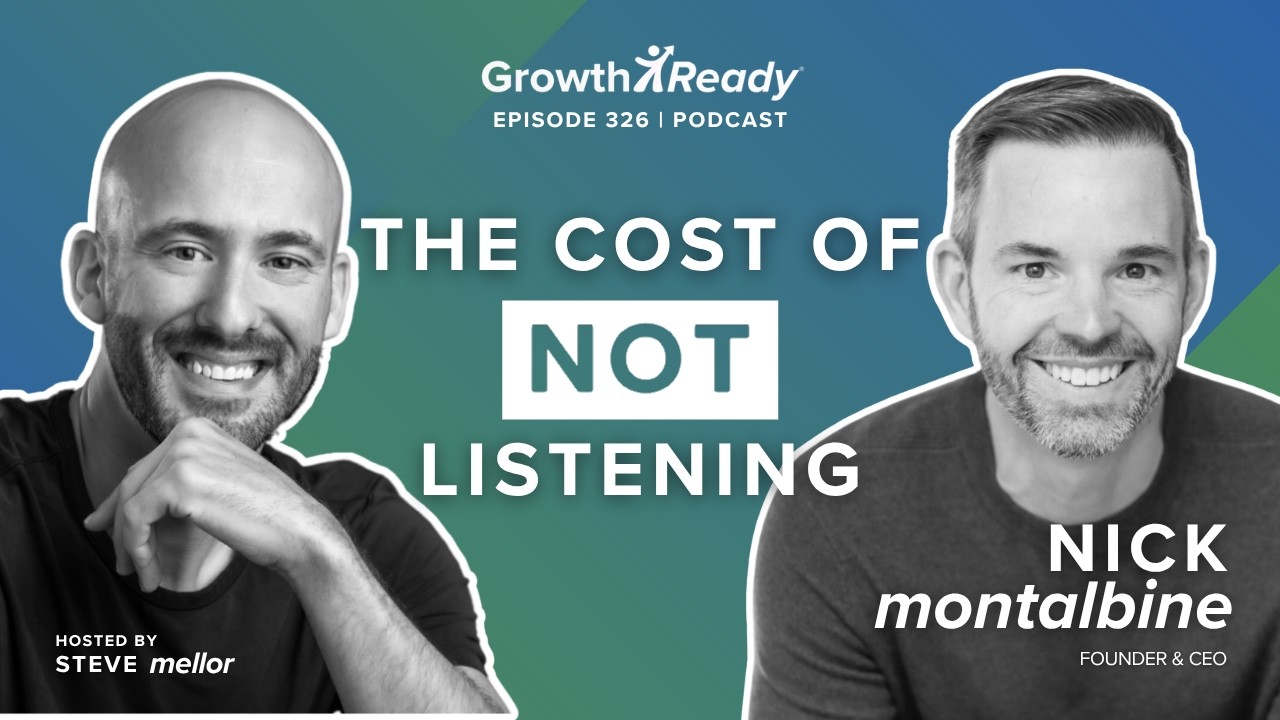
Steve sits down with Nick Montalbine, founder of Inner Voice Analytics, for a conversation about growth, change, listening to the signals around us, and knowing when something needs to change before the cracks become chasms.
Nick’s career has taken him from Nike and the world of Lean Six Sigma to entrepreneurship, leadership, and helping organizations better understand what their people are really experiencing. Along the way, he learned that growth does not always begin with a big breakthrough. Sometimes, it starts with the small signals we are tempted to ignore.
Nick shares a deeply personal look at the signs he experienced before leaving Nike – diminished pride in his work, irritability, insomnia, fatigue, and eventually a moment when he realized he had been overwhelmed for far longer than he wanted to admit. Those micro moments eventually became a much bigger realization: something had to change.
Today, that same philosophy shapes his work with organizations through Inner Voice Analytics, where he helps leaders listen more closely to their people before small problems turn into much bigger ones.
Steve sits down with Nick Montalbine, founder of Inner Voice Analytics, for a conversation about growth, change, listening to the signals around us, and knowing when something needs to change before the cracks become chasms.
Nick’s career has taken him from Nike and the world of Lean Six Sigma to entrepreneurship, leadership, and helping organizations better understand what their people are really experiencing. Along the way, he learned that growth does not always begin with a big breakthrough. Sometimes, it starts with the small signals we are tempted to ignore.
Nick shares a deeply personal look at the signs he experienced before leaving Nike – diminished pride in his work, irritability, insomnia, fatigue, and eventually a moment when he realized he had been overwhelmed for far longer than he wanted to admit. Those micro moments eventually became a much bigger realization: something had to change.
Today, that same philosophy shapes his work with organizations through Inner Voice Analytics, where he helps leaders listen more closely to their people before small problems turn into much bigger ones.
In this episode, you’ll hear about:
• The difference between micro moments and macro moments of change
• Recognizing the signals that tell us something is no longer working
• Knowing when to say yes and how to apply your strengths
• How family, health, and personal values shape the decisions we make
• Finding balance between strategy, the day-to-day, and listening to your team
• The importance of hearing the hard truths
• How ignoring small signals can allow cracks to become chasms
• Why our feelings and physical well-being are important signals, even when things look successful on paper
Whether you are questioning your next career move, leading a team through change, or simply sensing that something in your life is no longer working the way it once did, Nick’s story offers an important reminder: the signals are often there long before the breakthrough.
Listen now and ask yourself: What is your life or work trying to tell you that you might not be listening to?
About the Guest:
Nick Montalbine is the founder of Inner Voice Analytics, a consultancy that leaders turn to when something feels off, but the data says everything’s fine. He helps organizations surface what’s really happening beneath the surface using continuous listening and behavioral analytics to detect cultural cracks before they spread.
Nick’s work focuses on early signal detection, spotting disengagement before it turns into attrition, and helping leaders intervene before culture breaks. His approach blends behavioral science with AI-driven listening to build workplaces where people feel heard, valued, and motivated to stay.
With over 20 years of experience, Nick has led transformation efforts across Fortune 100 companies and complex systems in healthcare, retail, and finance. He’s held leadership roles at Nike and Legacy Health, where he helped guide large-scale organizational change by uncovering risks traditional metrics missed.
Leaders call Nick when performance dips, trust erodes, or culture starts to fracture, often before it shows up in turnover.
He lives in Oregon’s Willamette Valley with his wife and daughter, where they grow grapes and build a life with the same intentionality he brings to his work.
Connect with Nick:
Website: https://www.innervoiceanalytics.com
LinkedIn: https://www.linkedin.com/in/nickmontalbine/
Stay connected and keep growing with Steve:
• Book Steve to speak at your next event → www.stevemellorspeaks.com
• Support the GrowthReady Podcast by leaving a 5-star rating → Apple Podcasts
Connect with GrowthReady
Join the community and keep your growth journey going:
----
This podcast was produced on Riverside (https://riverside.sjv.io/QjdaMo) and released via ... (https://www.buzzsprout.com/?referrer_id=1968998)
Connect with Steve Mellor
Stay connected and keep growing with Steve:
- LinkedIn - https://www.linkedin.com/in/steve-mellor-cc/
- Instagram - https://www.instagram.com/coachstevemellor
- Book Steve to speak at your next event → www.stevemellorspeaks.com
- Support the GrowthReady Podcast by leaving a 5-star rating → Apple Podcasts - https://podcasts.apple.com/us/podcast/growthready-podcast/id1406082163
Connect with GrowthReady
Join the community and keep your growth journey going:
- LinkedIn - https://www.linkedin.com/company/wearegrowthready/
- Instagram - https://www.instagram.com/growthreadypodcast/
- Facebook - https://www.facebook.com/growthreadywithcoachstevemellor
- Official Website - https://growthready.com/
----
Nick Montalbine (00:00)
there was a long time where I ignored those feelings and what it did is it just built up inside of me and I remember it vividly. my wife and I were getting ready to have dinner. We opened up a bottle of wine and I literally had a tear come down my cheek. And it was one of those things where I just I didn't know why, but then I just kind of said I said, I don't know what's happening to me right now, but I just feel like
Nick Montalbine (00:22)
overwhelmed was like six exits ago and I'm way past that right now.
Steve Mellor (00:35)
What if the biggest problems in our lives and our organizations actually give us plenty of warning before they become problems? But we're just not listening. Nick Montalbine has spent more than 20 years studying what happens when we do and when we don't. After leading transformational work inside organizations like Nike and Legacy Health,
Steve Mellor (00:58)
Nick founded Inner Voice Analytics, where he helps leaders identify the cultural cracks and behavioural signals that traditional metrics often miss. Nick's deeply personal approach to sharing his expertise helps us understand the impact of burnout and overwhelm. But how there are signals our bodies and organizations send us that, if we were to slow down long enough to listen, might be one of the most impactful steps we can take.
Steve Mellor (01:28)
in service of our ability to grow. So let's find out what it means to Nick Montalbine to be growth ready.
Steve Mellor (01:37)
Hello there and welcome back into the most recent installment of Growth Ready. I am very much looking forward to this conversation with Nick Montelbein because there are components of Nick's story that really I feel resonate so much with what we're about as a podcast. And I cannot wait to reveal all of these different components to your journey and really the the insights and the the expertise that you're going to be bringing to us here today, Nick.
Steve Mellor (02:04)
But before we go any further, as you know by now, the question I have to ask you before we go any further is that of what does it mean to you, Nick, to be growth ready?
Nick Montalbine (02:13)
Yeah, no, Steve, thanks so much. And thanks for letting me be here with you all. I'm I'm looking forward to the conversation. But yeah, it's a great question. And when I hear growth ready, I think about becoming a different version of yourself. And that could be either intentionally or unintentionally. you know, I think growth sounds exciting, but in reality it often starts with that discomfort a little bit when
Nick Montalbine (02:34)
Something that used to work may not serve you anymore. It's not because you're broken, but maybe it's because like the next chapter of your life or work may require something different from you, right? And that sometimes may be learning a new skill or letting go of an identity that used to serve you. I've let go of a lot of identities that used to serve me. it may mean slowing down enough to hear what your body may need or what your team may need. Again, experience that I've had as well. I'm happy to dive into that.
Nick Montalbine (03:02)
So I think to me just really being growth ready means staying awake to those signals that might be going around you and then responding with intention.
Steve Mellor (03:11)
Mm. I see. I love how even in your answer it actually evolved in the same way that we need to be open to ourselves evolving. you know, just hearing how you initially respond with this idea of being a different version of yourself, but then being alert, being awake to this ongoing evolution, but the the acceptance piece too. So this there's certainly multiple perspectives that we're hearing in your response there. And I I I I wanna definitely go straight to
Steve Mellor (03:38)
maybe the origin, let's say, of that answer. And and you you alluded to many, many chapters and versions of yourself over the years. So I am curious when you think about the way you've responded to that question, where was it within your journey where you started to notice the truth in what it was that you've just shared with us?
Nick Montalbine (03:56)
Yeah, it's it did look, I think there have been a lot of micro points along the journey, but I think the biggest point was when I made the decision to go ahead and go leave Nike. so just quick story. I I spent close to ten years at Nike, and loved that brand. It treated us very, very well. there got to be a point where I just kind of lost myself where and I didn't know why. I had like diminished pride in my work.
Nick Montalbine (04:21)
Was just becoming more irritable. I had like in unexplained insomnia and fatigue, right? All these signs that were going on. and I kind of later figured out that I was actually burnt out, but not burnt out for the reason that normally we think about burnout, and I'm happy to dive into that as well. And I remember telling my dad at the time the story of like, hey, I think I'm gonna leave Nike. And he was like, Why would you do this?
Nick Montalbine (04:44)
and I think this is a generational thing though. You know, he's that baby boomer generation where it's like, look, you you got your job and like, hey, no, no job is perfect, but it's financially stable. I think night leaving Nike was that crux for me because it really made me realize that I really just thrive in that entrepreneurial type mindset that following where my creative energies are going.
Nick Montalbine (05:08)
You know, being able to create and solve problems, not being constrained by having to go ahead and go storytell thirty different people if I have to get something moved across the finish line. So I think that was that big moment for me. you know, again, there were those micro mom moments, but I think that was the big macro moment.
Steve Mellor (05:26)
Yeah, the the idea of the micro versus the macro, I think is really important to acknowledge when I think about the worlds I operate in today and the aha moments that a client can have. And typically they put this huge weight on the aha moment. And as a coach in those moments, my my job I feel is to help them see the seeds that maybe were planted
Nick Montalbine (05:47)
Yes.
Steve Mellor (05:47)
in terms of the awareness along the way. And and that that's what you were alluding to, though those micro moments are those seeds.
Steve Mellor (05:53)
And so often we're quick to dismiss that. We're quick w we we think we had this huge revelation in this moment. And in doing so, I personally think we're doing a disservice to the ongoing
Nick Montalbine (06:04)
Agreed.
Steve Mellor (06:04)
work, right? Wouldn't you say?
Nick Montalbine (06:06)
A hundred a hundred percent. And it's funny, you know, coming on into this conversation, I was reflecting on those micro moments. And and again, if you'd be happy to go dive into them, but I was thinking, like, hey, all those things did add up to this macro thing. And that's the thing. I've just become this belief that things happen for a reason. and yeah, it's a matter of appreciating those micro moments and reflecting on those. Because I think that kind of helps you keep yourself grounded in terms of like
Nick Montalbine (06:33)
I think sometimes people are expecting, like you said, this big aha, but it's like, think about all the small things that are adding up that's gonna equal the big aha, right?
Steve Mellor (06:42)
Mm. yeah, I would love to definitely get at least one or two examples of those micro moments. I think that that's the stuff that helps our listeners really understand. Well, am I going through a macro or a micro moment right now, Nick? But before we go to that, I think your commitment to s simply considering what the macro moment was maybe challenging you to do. I think that in itself as well, yes, an aha moment.
Steve Mellor (07:09)
And the awareness was established. But to your point earlier, the acceptance piece, the second part of that in your response, that is the work, and we will definitely go into that more here today as well. we have to stop for long enough in the awareness to then say, What is the awareness actually telling me? In your case, you go to your dad and you have the conversation and I think that on our growth journey is such a an important part that so often gets overlooked. It's
Steve Mellor (07:38)
Yeah, great aha moment. Gosh, I feel so much better for having that awareness now. But another 10 years could have gone by and you could still be operating in this unique way of burnout, as you mentioned earlier. Like
Nick Montalbine (07:49)
Right. Right.
Steve Mellor (07:50)
the aha moment was a realization. But what are you gonna do with that? And so I I I I look forward to moving to that part of the conversation with you with the acceptance piece. So let's rewind here. Let's go to these micro moments. I would love to hear maybe just a couple of examples of.
Steve Mellor (08:04)
What did what did a micro moment look like that was leading you towards maybe this eventual aha moment?
Nick Montalbine (08:10)
Yeah, I mean, I think there's there's been a handful of them, but I think a couple of them. a lot of people don't realize this. I actually started my career in the world of Lean Six Sigma.
Nick Montalbine (08:19)
and for those maybe that aren't aware of Lean Six Sigma, you know, really think about individuals that are really like process focused or looking at like, hey, how can we take waste out of the system, make things more efficient, right?
Steve Mellor (08:30)
Mm-hmm.
Nick Montalbine (08:30)
And so this was early in my career, and I thought that I was actually like this detailed individual, right? that I I was just really good at detailed.
Nick Montalbine (08:38)
And you know, reflecting back, yeah, I I'm I'm I'm okay with actually I'm not good with details. My wife will tell you that. but what I'm good about is understanding hey, here's your current state. What's the future? What should we imagine this future state look like? And how do we bring people on the journey? Right. And I think that's where that creative inspiration, that energy that I get comes from. It's that ideation. I love ideation. So I think that was one of those micro moments along the way.
Nick Montalbine (09:06)
You know, I I think also th there were there were other personal micro moments that were along this journey here where an example, I I was working in New York City in the 2008 time frame for a financial services company. and it was it was a ton of work, right? and I burnt out from an overwork standpoint, but I ended up leaving that organization to go work for a healthcare organization where I was traveling a hundred percent of my time.
Nick Montalbine (09:31)
And I was so I'm living in New York City, traveling back and forth from New York to LA every week. my parents had a second home in Orlando. So I was like, why am I paying ridiculous rent to go live in New York when I'm never there? So I moved down to Florida, met my wife, right?
Nick Montalbine (09:49)
But that was one of those micro moments though for me where it was like you may think it's hey, you met your wife, that's a macro moment, but it was a micro moment in terms of my journey because she has become that support structure for me, that sounding board
Steve Mellor (10:01)
Mm.
Nick Montalbine (10:02)
that says, Hey, you you don't seem like yourself or why don't you take this risk? Right.
Steve Mellor (10:06)
Mm.
Nick Montalbine (10:07)
So I think those types of things just kind of gave me this foundation. that I'm like, yeah, I feel like that we could go ahead and go do this together.
Steve Mellor (10:15)
Yeah, I and you've added yet another layer to this whole concept of what something can be both a micro and a macro depending on the lane, depending on the lens that you're looking through it. I obviously when you meet your wife, it's a macro moment. But the the the the support system, the the resource that she became in that aha macro moment back at Nike, she was playing a micro role in that aha moment. And I and I think
Steve Mellor (10:44)
That in itself too is yet another layer to this that we must consider is that can you also find a way to differentiate in such larger moments to see how it could even be a smaller piece of a bigger issue, for instance? And so I'm I'm really curious now when you think about that macro moment, for you to be able to use that and say that, well, this is why I believe when it comes to being growth ready, it's about.
Steve Mellor (11:12)
How do you embrace the ongoing different version of yourself that you're evolving into since that moment? How have you remained true to and remained aware of that very initial response that you provided to me in that in in the answer to that question?
Nick Montalbine (11:27)
Yeah, no, I I think it's it's something that's very top of mind for me, right? And the reason why is because I made this decision to leave a stable job at a stable company that had stable financials. It it's something that I need to go ahead and go ground myself in. so I am reflecting a lot and also trying to figure out do I need to continue to evolve, right?
Nick Montalbine (11:50)
And and I feel like I'm almost in that state right now where I think I think I do a little bit, right? Where, you know, here I am, I'm I'm I'm enjoying what I'm doing. I'm understanding what's working, what's not. there have been successes along the way, there have been failures along the way, but then I'm also starting to see that there are opportunities for additional pivots. what I'm trying to be careful of is I can be somebody that can be addicted to change or addicted to growth, right?
Steve Mellor (12:16)
Mm.
Nick Montalbine (12:17)
where it's like, hey, you know, I feel like it needs to happen. And since I left Nike, what I'm trying to balance right now is like, am I on this just constant change cycle now as a result? And that's a big question mark for
Steve Mellor (12:29)
Sure.
Nick Montalbine (12:29)
me right now.
Steve Mellor (12:31)
man, we might have to do a little bit of like live coaching in this one, man. I mean, I love that.
Nick Montalbine (12:35)
Yeah.
Steve Mellor (12:35)
I mean it just because I think conceptually it is one of those questions now, just because of the way the world's developing and the the emphasis that we're putting on personal development, that it's getting up there with, you know, what is the meaning of life? Is is the question of, you know, how much growth is enough growth? How much change is enough change? How much should I be investing in myself, evolving, etc.? And and
Steve Mellor (12:58)
Maybe it's an unanswerable question in a lot of ways. But I would love to just spend some time on that because I think for our listeners, like this is a growth podcast. So you would assume if anyone's addicted to growth or anyone's creating
Nick Montalbine (13:09)
Yeah. It's C Sos Minister.
Steve Mellor (13:12)
a platform, right, it's gonna come from this podcast. But what I love about it is that even just the way in which you responded to the initial question.
Steve Mellor (13:20)
I get to hear in that answer that there has to be an awareness to what is enough and what is too much in terms of how we are evolving and appreciating the fact that we are ever evolving. How have you started to simply navigate, let's say, creating an awareness to knowing okay, Nick is is too focused versus Nick is focused enough on topics such as change, topics such as growth?
Nick Montalbine (13:45)
Yeah.
Nick Montalbine (13:46)
Yeah. Love that.
Nick Montalbine (13:47)
A part of the change also in my life lately has now we have a two year old daughter.
Nick Montalbine (13:54)
Years ago two years ago. so she definitely has become kind of like that that cornerstone. And I was I was watching a documentary on Eddie Murphy on Netflix. And he mentioned something there. He says, if you make decisions through the lens of your children, you'll never make a bad one.
Nick Montalbine (14:15)
And that really kind of sat with me and continues to sit with me, where I could go ahead and just keep on changing and evolving and chasing, right? But I'm I keep on thinking, should I be doing that from my daughter's perspective? Like what am I trying to balance now? Right. Because I am
Steve Mellor (14:33)
Mm.
Nick Montalbine (14:33)
trying to go ahead and have a little bit more of a balanced life in terms of career, relationship, community, and self.
Nick Montalbine (14:43)
Right. and I think that am I am I making decisions from a mami standpoint, which is kind of that ego side of it, or am I kind of maintaining to that balance?
Steve Mellor (14:54)
Hmm. Yeah. What what lens are you looking at growth through? You know, I think that is such a powerful insight, but it's it's something that I really wanna challenge myself immediately just hearing you say that, because I I I think for me as I listen to you you know pose that that question really.
Steve Mellor (15:14)
To have that awareness of how you as an individual need to be evolving for what matters most in your life right now. And that's what I'm kind of hearing from you is to put your daughter first in a way that you've never had to put someone like that first since two years ago. It forces you to say, Well, I have to look at how I'm evolving in regard to what she needs before I potentially look at how I'm evolving in regard to what.
Steve Mellor (15:42)
anything and anyone else might need. I mean, that walk me through the comfort or because you alluded to the discomfort around that in your initial
Nick Montalbine (15:50)
Yeah. Yeah.
Steve Mellor (15:52)
response. Walk me through the level of comfort that you've had around that or discomfort around that that you've had in the last two
Nick Montalbine (15:56)
Yeah. It's
Steve Mellor (15:58)
years.
Nick Montalbine (15:58)
it's it's been a shift. It's been a shift because historically in my life, I've said yes to everything. I've said yes to opportunities, I've said yes to I could help. I said yes to just whatever, right? And and throughout that, it has opened up doors, right? And it has allowed me to go ahead and go continue to continue to grow and develop. now I don't
Nick Montalbine (16:21)
I I'm I'm being more careful with saying yes because it's like I wanna be present for her. Like I wanna be able to go ahead and go bring her to daycare in the morning, right? I wanna be able to go ahead and go pick her up. I wanna be able to go ahead and go have those moments with her and and and be present for her, right? And not be this,
Steve Mellor (16:41)
Mm-hmm.
Nick Montalbine (16:42)
you know, I may get to see her or cause, you know, I have to go ahead and go work super late or or not. So I I'm I'm trying to be more
Nick Montalbine (16:49)
cognizant of that, which has been very, very challenging for me. I'm getting better at it, because again, so much of my life I've lived it as it's me, I can make a hood and make decisions. And then I had my wife and we'd make decisions together and whatnot. but yeah, no, there there's a little bit of that discomfort. But again, I I do feel like my wife and I always say we don't want to be like in our 60s sitting on rocking chairs, just looking out off our deck, having regrets, right?
Nick Montalbine (17:17)
And I feel like I can confidently say right now I don't have those those regrets right now. Yeah, so far so good. Yeah. Yeah.
Steve Mellor (17:23)
That's good. Two years in. That's good. You know, keep it up. Keep it up. But
Steve Mellor (17:28)
the the the idea though is like I I I love how you bring in the idea of opening doors and you know, you you have opportunities to say yes, you have opportunities to say no. It it really brings into to my mind this idea of what is near and dear to the work I do is this idea of incorporating standards in and really
Nick Montalbine (17:46)
Mm.
Steve Mellor (17:47)
how do standards
Steve Mellor (17:48)
dictate the doors we open and the doors we don't. And listening to you here, I'm curious just how do you know? Like I know we're we're talking a lot to this idea of the role your daughter's played. And, you know, obviously we have people that listen to this that don't have kids and I want to be clear that we're not saying that everything that we're doing here is running it through the lens of
Steve Mellor (18:09)
the child or the spouse. Like it for me at the at the heart of this, you're you're making it clear to me that you have created a standard in your life that is your family and that that is such a priority for you that it influences the doors you do and do not walk through. But how do you know? How do you know when you're opening a door, what is your process? And again, it may not be clean, but I'd love to just talk through it with you. But what is your process to know right now that it's a door that's good for you to walk through versus one that isn't?
Nick Montalbine (18:37)
Yeah, no, it's a great question. And and I don't know if I've I've put a ton of thought into it, but I I as I kind of think about that question, cause right now I'm kind of in that space right now where there are a couple doors that are opening right now where I'm like, is it the right thing? And I think how I'm approaching those is first, do I feel like it's making use of my gifts or my strengths?
Nick Montalbine (19:00)
that I know I have, right? So I've spent a lot of work and I would challenge those because I love what you're bringing up here really too quickly too, by the way, that, hey, look, not everyone has that child or that spouse or whatever. so I've always felt that you should be really trying to dial in on what are those strengths that you have. Like I mentioned a little bit earlier, like I'm an ideator. I love to wonder, I love to ask big questions. I love to brainstorm those solutions, right?
Nick Montalbine (19:24)
So when I hear some people come to me about opportunities, I'm like, can I bring that to this opportunity? Right. So I think that's number one. I think number two is is it going to go ahead and affect me physically and mentally? Right. So I've alluded to it a little bit earlier. I've been in situations where I have like burnt out or I don't feel like I've been most physically healthy, right? And that is very important to me as well right now, too.
Nick Montalbine (19:50)
Right. so so I would say right now it's like, hey, am I bringing my gifts? Am I mentally and physically gonna be at my best? And I think those right now are kind of like those two bars for me that says, all
Steve Mellor (20:02)
Mm.
Nick Montalbine (20:02)
right, that this could be a good opportunity. And then also I think also it's like, am I gonna go ahead and go be able to collaborate and work with great people? Right.
Nick Montalbine (20:10)
I get energy from working being that brainstorm. I love ideas. I love bad ideas. I love really bad ideas because they're just like these
Steve Mellor (20:17)
Mm-hmm.
Nick Montalbine (20:18)
like nuggets of like brilliance in all of these. That's like, you know, that's interesting. What if we just morph that? So I think that's also something that that that I look for as well.
Steve Mellor (20:28)
I love I love we're we're creating your standards in real time. This is great. It's it's awesome. And and and
Nick Montalbine (20:30)
Yeah, I know. This is great. Yeah.
Steve Mellor (20:32)
so for me what I love about this man is like I again, it's why I wanted to lead this with like this isn't it's easy in these conversations sometimes to say like family first, spouse first, all the kind of things. And and
Nick Montalbine (20:41)
Yeah. Agreed.
Steve Mellor (20:43)
it's the cliche thing to say. And and wouldn't it be nice that we were all disciplined enough to literally stop every potential business engagement or client experience and go, wait, before I answer this, I have to think about this through the perspective of
Steve Mellor (20:56)
My child and my family. But you're you you've said it, you're a creative, you're a visionary. I'm very similar. We all have our other things that whilst they are our strength, they can also be the downfall of the neglect towards these very things in certain moments. We get so excited by the opportunity,
Nick Montalbine (21:12)
Yes. Yes.
Steve Mellor (21:15)
we get so excited by the people we want to work with that it's just like, Wait, I have a family, I forgot all about that, you know? A and and that's kind of what happens. That's that's the journey, that's the evolution that we're speaking to. And so I'm really
Steve Mellor (21:26)
Appreciative that we're able to quantify in a way now where we say, can I bring value? Will this affect me physically or mentally? Is the person I'm potentially gonna work with gonna excite me, challenge me in a way? And if if I can check all those boxes, family or not, at least I know as I walk through the door, I'm walking through with this clarity that on the other side should be what is right for me, right?
Nick Montalbine (21:53)
Yeah.
Nick Montalbine (21:53)
Yep. Yeah, a hundred percent agree. And I think I think and and I love the challenge too, by the way, right? And it because I do believe it does start with yourself. Because like back to the like maybe the three things that I just quickly outlined, right? Like if if if those things aren't true, if I can't bring my my the gifts that I feel like I have, if it's not gonna serve me mentally and physically, if I'm not gonna work with great people, and I take the opportunity, then that is going to affect other facets of my life. It'll affect relationship, family, community, and things like that. So
Nick Montalbine (22:22)
so no, I love the challenge on that. That was great.
Steve Mellor (22:24)
Hmm.
Steve Mellor (22:25)
Yeah, absolutely. And and for me, this is a great segue to the work that you're doing today because you're the the founder Inner Voice Analytics and so much of that work, from what I understand, and clearly you understand it a heck of a lot more than I do, so I'm gonna let you explain it in your own words, but there's a behavioral change component to the very service, the very business that it is you're you're now providing. So would love a little bit more context just around the idea behind it.
Steve Mellor (22:52)
And really the work that you're doing today. And then what I'm hoping here we can maybe do is kind of mesh the work that you're doing with your business a little bit with what we've just discussed through this first 20 minutes.
Nick Montalbine (23:01)
Yeah, no, absolutely. So so basically with Inner Voice Analytics, what we're doing is we're trying to go ahead and really take employee listening and employee experience and make it more adaptable, right? Traditional views on employee experience and employee listening, it's too slow. The pace of change.
Nick Montalbine (23:23)
is outpacing how organizations are reacting. What I mean by that is organizations will typically listen through an annual engagement survey. Maybe they'll pulse once or twice a year, right? That's not enough, right? Org changes are happening. There are political, economic, global events that are happening that are impacting the employee experience, and and and organizations are not receiving those signals in time. So what happens as a result is
Nick Montalbine (23:47)
All these issues that are happening from a people standpoint in organizations, they're preventable, right? But they're bubbling up so much where they these little cracks turn into these chasms, right?
Steve Mellor (23:57)
Mm-hmm.
Nick Montalbine (23:58)
and so what we do is we work with organizations to go ahead and truly help them become quicker and more agile in their employee listening. And they also let us outsource it to us, because we are a neutral third party where we can have those conversations with employees. And by the way, conversations, not in not surveys.
Steve Mellor (24:16)
Mm-hmm.
Nick Montalbine (24:17)
and the reason why we can get much deeper insight we hear the good, the bad, the ugly, right? And we could also protect the employee from
Steve Mellor (24:22)
Yeah.
Nick Montalbine (24:24)
an an anonymity standpoint.
Steve Mellor (24:27)
Yeah. No, I I love it. And
Nick Montalbine (24:28)
Yeah.
Steve Mellor (24:29)
clearly it aligns massively with just my world in coaching and it's a big part of why I was excited to have you on and and what I do find really fascinating about it, because unbeknownst to me, we were gonna talk about what we talked about for the first 20 minutes. Knowing what it is you do as a service to actually see almost the polar opposite in a way of what can happen if we're not aware to the micro
Steve Mellor (24:52)
So when we are aware, these micros turn into these aha moments where we become aware, we're awakened, and then we can start to accept potential shift in change of our behaviors. But on the other side, if we're not aware of the micros, these cracks become chasms, as you said.
Nick Montalbine (25:06)
Yeah. Totally.
Steve Mellor (25:08)
And it it really is just the the the antithesis. Like we're we're on both different ends of the spectrum. And so for me to to you know, firstly to hear what you believe in and then to hear the service that you're providing.
Steve Mellor (25:21)
Sounds like a match made in heaven, 100%. But in terms of really now, if we were to get into the other side, why is it, in your experience, why is it we're not slowing down? Because I'm hearing that. I'm hearing like it how can we possibly listen if we don't choose to slow down? Yes, the rate of change is so great. However, part of the adapting to that change has to be some commitment to slowing down for long enough to in fact listen. So
Steve Mellor (25:51)
Nick and your own expertise, man, like why why are we incapable of that? Why why can we not slow down for long enough to simply listen to a person within our organization, maybe even just listen to ourselves?
Nick Montalbine (26:02)
Yeah. I I I think it's sometimes people are uncomfortable with the hard truths, right? so sometimes it's even it's easy to ignore it. So like it just think about what we've been talking about from a growth standpoint, growth ready, right? Or my my example with Nike. I could have ignored back to what my dad was saying. Why would you why would you leave that company? You may not be happy, but it's a good it's a good opportunity, right?
Steve Mellor (26:27)
Mm-hmm.
Nick Montalbine (26:28)
just ignore it.
Nick Montalbine (26:29)
Right. How many people have ignored it, but has that regret? Right. So I think sometimes we are encoded a little bit to ignore some of those hard truths. And I think that also kind of translates over into the world of being a leader sometimes or being a manager. Right. or it's like, hey, if I do ask, like, am I empowered to go ahead and go respond? Right. Or I may not know how to respond. So like then I then I opened I opened up this uncomfortable conversation, right?
Steve Mellor (26:57)
Mm.
Nick Montalbine (26:58)
So I think it's, you know, it it what's interesting about our conversation here about growth is yeah, we have growth as us as us in individuals, but there should be some more growth with us as leaders, right? In
Steve Mellor (27:09)
Mm.
Nick Montalbine (27:10)
terms of how to go ahead and look at how am I how am I leading in a more balanced way? How am I looking at a strategic vision? How am I looking at the day to day? How am I looking at my team? Right. and I think a lot of times leaders are just they grew up where it's
Nick Montalbine (27:26)
I focus on my day to day and I'm really, really good at that and and everything else becomes noise.
Steve Mellor (27:34)
Yeah, the I'm hearing that over complication or over analysis of the next step. Like if if I were to stop and slow down and discover this hard truth, well geez, now I gotta talk to this person or now I gotta make a change in myself. It's w it's actually one of my favorite things I've I've done in keynotes where I go I talk about the truth and I I literally say, Hey, if we if I had an office back here where all we could do is talk about the truth, is is anybody running towards that office right now?
Steve Mellor (28:00)
like everyone's just like what what what is what is that what is that hesitation
Nick Montalbine (28:00)
Yeah. Yeah, yeah, yeah.
Steve Mellor (28:05)
about the truth what is that discomfort with the truth in and it's the the negative connotation that is associated with it undoubtedly but you've something I want to touch on before we we we potentially move on is is this idea of the you've said it a couple times now like finding a balanced way and what I would love to maybe help folks with is you know
Steve Mellor (28:26)
We we've heard about this word balance used in work life and and things like that. And you're now talking about it through this lens of of leadership. when you say balance, like what are we balancing? Like where does the balance begin? How does a person even figure out what is it I'm supposed to put on one side versus what is it I'm supposed to be putting on the other side? And and again, this may seem like a slightly ambiguous question, but I
Nick Montalbine (28:47)
Yeah.
Steve Mellor (28:48)
again, I I just wanna try to help our listeners maybe here.
Steve Mellor (28:51)
take what could be more of a broad concept and give it a little bit more meat, if you will.
Nick Montalbine (28:56)
Yeah, no, so it's a great question. Cause I think you're right, it is a difficult question. And I think the also the answer is it's that consultant answer is it depends sometimes too. But here's what I typically will go ahead and go talk to people about is look, if you are in an organization and you're leading people, I don't care if it's two people or two hundred people, right? I would go ahead and go look at how much time am I dedicating to the following buckets, right? And that there are basically three buckets, it should be four, but there are three buckets that I always nail hit really hit on.
Nick Montalbine (29:24)
One, it's strategic ones. How much time am I spending in the world of strategy? Okay. How much time am I spending in the world of the day-to-day? How much am I spending in terms of leading, investing, hearing my teams,
Nick Montalbine (29:42)
That alone, it's a it's like a three-legged stool, right? If I
Steve Mellor (29:45)
Mm-hmm.
Nick Montalbine (29:45)
have too much pressure on one of those legs, right, would most of the time it's it's the day-to-day side of it, the stool breaks. And I think that's what's going on in organizations is we're not having that awareness of how much time am I spending within those buckets, right? Because you do need to have, try to have equal pressure at any given time.
Nick Montalbine (30:05)
And I think sometimes just hairing those three buckets helps individuals sit there and say, you know what? Hey, yeah, maybe I'm not spending enough time thinking about that longer term vision, right? Or hey, maybe I'm not spending enough time getting the pulse of my team and having conversations with them about how do they want to go ahead and grow and develop? What's working, what's not, right? Because again,
Steve Mellor (30:25)
Mm.
Nick Montalbine (30:25)
that team side of it, that's where everything starts to bubble up. And that's why really my organization exists, right? Is because of that bubbling up, right?
Nick Montalbine (30:33)
So again, I know it's it's not a concrete answer, but I feel like it's a framework that people could go ahead and go run with just to evaluate what's happening with me right now. Am I balanced?
Steve Mellor (30:44)
Yeah, and I I appreciate the response because it's a starting point. I this is where I feel as though we do ourselves, if anything, but just the greater good at disservice at times when we we talk about, hey guys, just go find balance. And it's like, what the heck does that mean? Like what what does that
Nick Montalbine (30:59)
Yeah. All right.
Steve Mellor (31:00)
actually mean? And and how can we help people just understand if I were to start looking at myself, my organization through this perspective of finding balance?
Steve Mellor (31:09)
Well, here's a great place to start. Let's think about long term. Let's think about the strategy. Let's look in the present, the day to day right now. And for a moment, let's think who do we need to be talking to? Who do we need to be listening to? Support system, call it whatever you want to call it. The way you responded to that, what that at least allows me to understand, and I think our listeners therefore will, is that if I were to just try doing this with myself, you know, I I think I can do that. I think I can I think I can look ahead and say, what do I want and when do I want it by?
Steve Mellor (31:38)
I can stop in the moment and say, what does my day to day look like? And I can think about what does my who who are my resources right now or or who am I not spending enough time, more most importantly, listening to and leaning on that I could be, right?
Nick Montalbine (31:51)
Yeah, no, I think you're spot on. You're spot on. And I think it's just kind of having that reflective moment. It's no different than us as individuals. It's kind of like have that reflective moment, do that check in, right? It's like, where do I wanna be? I love how you framed it up as an individual. Where do I wanna be? Am I there, that current state? And like what do I need to go ahead and go do that? So I think that that's a great framework.
Steve Mellor (32:11)
Yeah. Well, to be honest, man, you gave me the answer yourself and and and 'cause
Nick Montalbine (32:13)
Yeah, so
Steve Mellor (32:14)
you you said it yourself earlier. And that's what I love so much about what it is you're doing. you know, we have people come on all the time who who are founders and and represent products and all this kind of thing. And we typically talk about the service, the product for all of two, three minutes, and that's fine. But at the at the heart of it, I'm always listening for well, where's the alignment? Where's the alignment in who you are, what you represent, whether your business was here today or gone tomorrow, and what does your business look like?
Steve Mellor (32:40)
And where do I and I'm hearing like you said it earlier, you at your best, you at your favorite, if you will, is when you are ideating. So you are thinking about where we are now, where do we want to get to? And the product that you're the the product, the service, however you want to put it, that you're providing is getting to the it's very much getting to the heart of that. Now, something I I definitely need to touch on with you is this idea of when do we know that this work should matter? Now, that's kind of one of those
Steve Mellor (33:08)
leading questions in a way because the easy answer is like it should always matter, right? But you had to have your aha moment. I've had to have my aha moment. Like other people maybe haven't had their aha moment yet. And what I would love for you to maybe just help our listeners with is if you've yet to have that, what does that look like? How do I get there? Like what what what could some of this work look like for me right now to potentially have this moment of awareness? In other words, how can you help us practice this awareness, Nick?
Steve Mellor (33:36)
in this moment so that we can start to maybe step towards this idea of also acceptance as well.
Nick Montalbine (33:43)
Yeah. Great question. I would start with that current introspective look right now and say, how am I feeling right now? Right? Do I feel like am I bored? Am I stressed? Am I complacent? Right? Cause I think sometimes those three things can kind of tell you a little bit that might something might be a little off kilter for you.
Nick Montalbine (34:05)
and and and just sometimes asking that, Am I bored? Am I under challenged? They sit there and say, Yeah, I I I do. I feel like that is. Then then I think it's kind of peeling that next layer of the onion back a little bit, of being like, All right, yeah, I do feel like I'm bored, I'm under challenged, or I'm just kind of just coasting. I'm I'm complacent right now, and I don't want to be that way. What's interesting right now? What are the some of those things that that
Nick Montalbine (34:30)
That have your attention that you may not be spending enough time doing. Or what are those some of those things that you've always wanted to do? project out a little bit. And like if I were to go ahead and go project out 20, 30 years, how do I make sure I don't have any regret? And if you feel like right now there's a gap between that, maybe it's time to spend a little continuing to investigate that a little bit, right? At least that's kind of how I continue to kind of operate a little bit, even if it's something as learning a skill of like, hey, I want to go ahead and go learn how to fly an airplane.
Nick Montalbine (34:58)
Right. It's like, hey, you know, I I feel like that I need to be challenged. This is something that I've always been interested in. So it's like, all right, I can go ahead go start flying an airplane.
Steve Mellor (35:08)
Yeah.
Nick Montalbine (35:09)
I don't know if that's helpful or not, but at least that's that's how I would go ahead and go start that.
Steve Mellor (35:13)
Well, I I think you're inviting us to lead with how we feel. And I think
Nick Montalbine (35:17)
Yeah.
Steve Mellor (35:18)
that's and there's nothing wrong in that. I typically we want to be able to have a tangible thing that we can actually put on a piece of paper or or s or have handed to us and say, like, this is the problem. Cool, now I know how to fix it. but you're inviting us to say whether you're experiencing stress, boredom, complacency, whatever it might be, that simply taking the time to acknowledge that.
Steve Mellor (35:42)
in itself, that's a feeling and that feeling is it's a symptom. Like what what
Nick Montalbine (35:46)
Yeah.
Steve Mellor (35:47)
is it but what is it a symptom of, right?
Nick Montalbine (35:49)
Totally. And you you touched on something that that that prompted another thing here about leading with feeling. Cause I think sometimes it'd say, Yeah, I I I I can lead with my feelings, but I can't afford to lead with my feelings. Right. Cause
Steve Mellor (36:01)
Mm-hmm.
Nick Montalbine (36:01)
sometimes there's that part of it. So in other words, hey, I might not be happy in my job, but if I left my job, I don't know what to do. Right.
Steve Mellor (36:08)
Mm.
Nick Montalbine (36:09)
And and so I just wanted to kind of quickly touch on like when I when I left Nike, there was that point where it was like, what are we going to do type thing? And we spend some time talking about like
Nick Montalbine (36:20)
what do we need to give up and are we happy with what we need to give up? Right. And and and I think sometimes kind of going through that exercise kind of helps a little bit too, right? Cause I think you can kind of get on this, like we need, we need this, we need this, we need this subscription, we need that. And it's like maybe you don't, right? And may help you open up that door a little bit wider to taking those leaps that you that that that you've always wanted to. So it did for us at least.
Steve Mellor (36:44)
For sure. And golly, we're we're pretty terrible at putting a value on our feelings or at least prioritizing them, let's put it that way.
Nick Montalbine (36:48)
Right. Yes.
Steve Mellor (36:50)
you know, and that's it's always funny I'm sure you can you can resonate with this is is when I meet with clients initially, like they typically make all of our work about tangible outcomes. They wanna make they like, what's the ROI? What's the ROI? And it takes about twelve to eighteen months of our work for them to finally grasp it's like
Steve Mellor (37:12)
I could tell back when we were having our discovery calls that you had this look in your eyes, Steve, that yeah, if you want to make this work about that as we get started, go ahead. But that's not what the work's eventually gonna be about. At some point, you're gonna own the fact that how you feel must be addressed within
Nick Montalbine (37:30)
Yes.
Steve Mellor (37:30)
the within the organization. How the leadership team feels must be addressed. If the leadership team is always to use a word, stress, complacent, whatever it is, the company can be
Steve Mellor (37:41)
per performing and hitting certain ROIs or whatever you want to hit, that's great. But that's a sign, that's a signal. And and
Nick Montalbine (37:48)
That's right.
Steve Mellor (37:48)
how serious do you want to take that?
Nick Montalbine (37:50)
That's right. Yeah. No, I you're you're you're you're spot on, right? What's the price of a a a a good, solid quality night's sleep without waking up three times in the middle of the night, right? It's hard it's hard to go ahead and go do that. So yeah.
Steve Mellor (38:03)
Yeah. Yeah. And you know, we capture this in this idea of and I I think you actually use some of this language too, with the business. we get caught in this drifting. You know, I think you I think you alluded it to more as cultural drift in in your work and and for me, we talk about it as success drift. It's like the this idea of the success gives us this feeling that we're doing what we're supposed to be doing. And you had it there at Nike. That was your story. That's the exact
Nick Montalbine (38:26)
Yeah. Right.
Steve Mellor (38:27)
story you share with us. Like successful guy.
Steve Mellor (38:30)
Drifting because because of all those reasons that you mentioned and and that is that sensation that we're talking about. It's that feeling of, yeah, the the information on paper says that things are right where they're supposed to be, yet every part of me is telling me there's a there's a disconnect, there's a gap. And
Nick Montalbine (38:47)
Yes.
Steve Mellor (38:48)
do my feelings, do my emotions matter enough for me to potentially make a a an aha moment turn into a a moment of change?
Nick Montalbine (38:57)
Yeah, no, you're right. I and and there are there was a long time where I ignored those feelings and what it did is it just built up inside of me and I remember it vividly. my wife and I were getting ready to have dinner. We opened up a bottle of wine and I literally had a tear come down my cheek. And it was one of those things where I just I didn't know why, but then I just kind of said I said, I don't know what's happening to me right now, but I just feel like
Nick Montalbine (39:21)
overwhelmed was like six exits ago and I'm way past that right now. Right.
Steve Mellor (39:25)
Right.
Nick Montalbine (39:25)
And and again it was ignoring a lot of those a lot of small signals along the way to your point.
Steve Mellor (39:31)
Yeah. Yeah. It's one of my favorite things to say. Our our body talks to us all the times, but we but do we listen to it? That's the question. That's the question, you know.
Nick Montalbine (39:35)
yeah. Yep. Right. Yeah. Yep.
Steve Mellor (39:40)
it's great stuff, man.
Steve Mellor (39:42)
Well, Nick, listen, this has been an absolute blast. I I I just I I knew we would have a lot in common in terms of what you're doing and the work you're doing and just really appreciate some of the the vulnerability of of of stories as well. It helps so much with with these great powerful insights. But before I let you go, as I always like to do, I just want to give you the room to really share with us where can we learn more about you, the work you're doing there with inner voice analytics, just anything else that you think our listeners could could benefit from learning more about you.
Nick Montalbine (40:10)
Yeah, no, I one appreciate the opportunity and love the conversation too. That this has felt truly like a conversation and and and I could tell we're both passionate about this. but yeah, no, I I have I have my website, intervoiceanalytics dot com. You're happy to go ahead and go learn more. I also have my own little personal in website, nickmodelbind.com. I'm on LinkedIn. I try to post on LinkedIn when I have an opportunity. but I'm always looking to connect. And the one thing that I would just always encourage people is just continue just to be curious, right? And
Steve Mellor (40:38)
Mm.
Nick Montalbine (40:40)
Just, you know, challenge traditional thinking, challenge your own perspectives. I wish, I wish we as a society would continue to challenge these perspectives that have just gotten so rooted in our identities, right? versus like, hey, let's have that debate, right? And because at the end of the day, we all have red blood running through our veins. so yeah, be curious and challenge.
Steve Mellor (41:00)
I love it. What a great message to end on, Nick. It's been an absolute pleasure, brother. I appreciate the time. And who knows, maybe you'll be a returning guest in the in the episodes in years to come because I I know I could certainly do this again. So just thanks again for the time. All the best with everything, brother.
Nick Montalbine (41:15)
Yeah, no, thanks Steve and happy, happy to be here.

Founder
Nick Montalbine is the founder of Inner Voice Analytics, a consultancy leaders turn to when something feels off, but the data says everything’s fine. He helps organizations surface what’s really happening beneath the surface using continuous listening and behavioral analytics to detect cultural cracks before they spread.
Nick’s work focuses on early signal detection, spotting disengagement before it turns into attrition, and helping leaders intervene before culture breaks. His approach blends behavioral science with AI-driven listening to build workplaces where people feel heard, valued, and motivated to stay.
With over 20 years of experience, Nick has led transformation efforts across Fortune 100 companies and complex systems in healthcare, retail, and finance. He’s held leadership roles at Nike and Legacy Health, where he helped guide large-scale organizational change by uncovering risks traditional metrics missed.
Leaders call Nick when performance dips, trust erodes, or culture starts to fracture, often before it shows up in turnover.
He lives in Oregon’s Willamette Valley with his wife and daughter, where they grow grapes and build a life with the same intentionality he brings to his work.