

 Apple Podcasts
 Spotify
 Castro
 RSS Feed
 Episode 327: How AI Drives Human Purpose w/ Dr. Jeanine Stewart
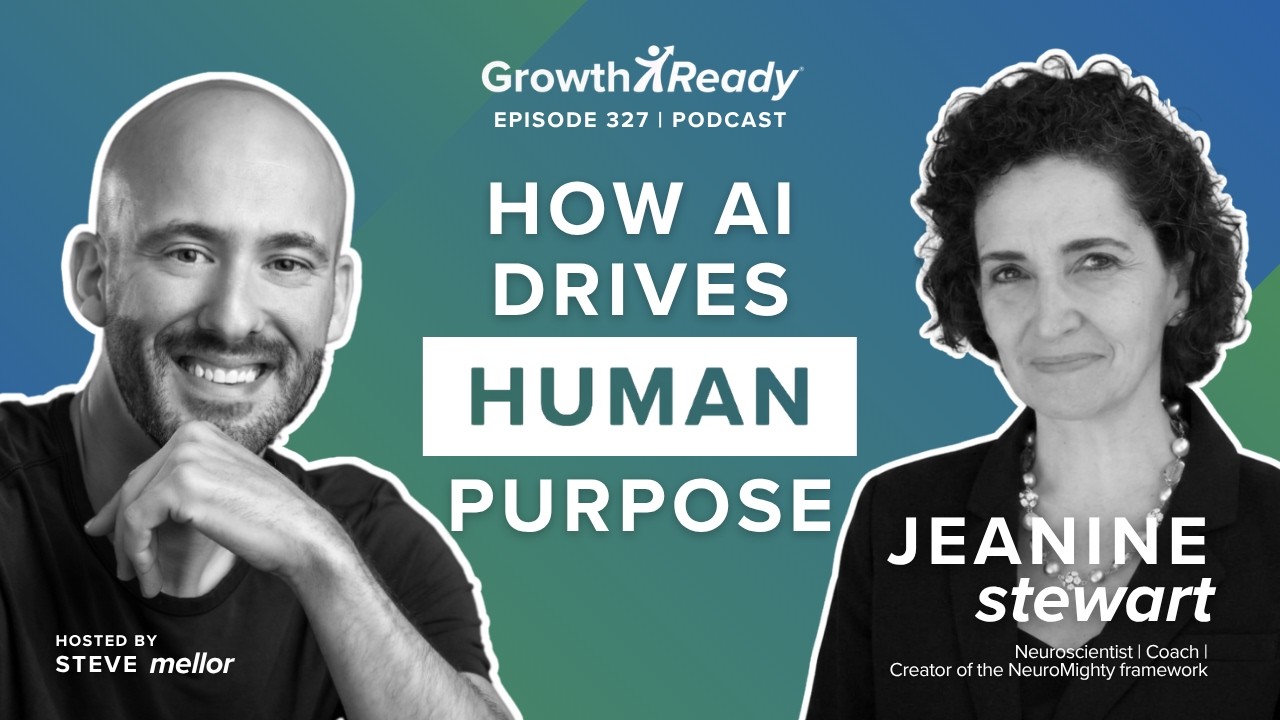
Steve sits down with Jeanine Stewart, PhD, Neuroscientist, Coach, and Creator of the NeuroMighty framework, for a conversation about failure, behavior change, human performance, and what it means to stay distinctly human in an increasingly AI-driven world.
Jeanine brings together neuroscience and coaching to explore how we grow through the moments when what used to work no longer does. For her, GrowthReady comes down to three practices: authentic curiosity, humble discernment, and impactful clarity.
The conversation also explores what those skills mean in the age of AI. As technology becomes increasingly embedded in the way we think, work, and collaborate, Jeanine argues that distinctly human qualities like curiosity, discernment, vulnerability, connection, and purpose become even more important.
In this episode, you’ll hear about:
• Jeanine’s three-part framework for being GrowthReady
• Why failure is often an essential part of meaningful growth
• Why we sometimes need to sit with failure longer than we want to
• How our relationships and social environment influence performance
• Why humans are wired for purpose, productivity, and connection
• How impactful clarity moves us beyond self-awareness and toward meaningful action
• Why lasting behavior change is so difficult and why practice matters
• The changing role of humans as AI becomes part of our teams and workplaces
Whether you are leading through change, adapting to new technology, recovering from a setback, or questioning whether the behaviors that brought you this far will take you where you want to go next, Jeanine offers an important reminder: growth is not simply about avoiding failure. It is about becoming curious enough to examine it, humble enough to learn from it, and clear enough to turn what you learn into impact.
Listen now and ask yourself: How is AI affecting your authentic curiosity and the relationships you have with others?
About the guest:
Dr. Jeanine Stewart is a neuroscientist and PCC-certified executive coach who works with senior leaders navigating the cognitive demands and complexities of AI-era leadership.
She holds a PhD in behavioral neuroscience from the University of Virginia, where she also completed a postdoctoral fellowship in neural plasticity, and has spent nearly two decades advising and coaching C-suite and senior leaders across Fortune 100 organizations, government agencies, and global institutions.
Her work is grounded in a simple but powerful insight: as AI transforms the workplace, the competitive advantage no longer belongs to the leader who processes the most information. It belongs to the leader who understands how to orchestrate both human and artificial intelligence.
She calls this capacity Multi-Cognitive Awareness, and it is the foundation of everything she does in her coaching, her keynotes, and her forthcoming book with the working title, NeuroMighty®: Working Smarter in a Multi-Cognitive WorkplaceTM.
Connect with Jeanine:
• Website
• Substack
Connect with Steve Mellor:
• Book Steve to speak at your next event → www.stevemellorspeaks.com
Connect with GrowthReady :
• Support the GrowthReady Podcast by leaving a 5-star rating → Apple Podcasts
----
This podcast was produced on Riverside and released via Buzzsprout.
Connect with Steve Mellor
Stay connected and keep growing with Steve:
- LinkedIn - https://www.linkedin.com/in/steve-mellor-cc/
- Instagram - https://www.instagram.com/coachstevemellor
- Book Steve to speak at your next event → www.stevemellorspeaks.com
- Support the GrowthReady Podcast by leaving a 5-star rating → Apple Podcasts - https://podcasts.apple.com/us/podcast/growthready-podcast/id1406082163
Connect with GrowthReady
Join the community and keep your growth journey going:
- LinkedIn - https://www.linkedin.com/company/wearegrowthready/
- Instagram - https://www.instagram.com/growthreadypodcast/
- Facebook - https://www.facebook.com/growthreadywithcoachstevemellor
- Official Website - https://growthready.com/
----
Jeanine Stewart (00:00)
when I look back on the things that have really made the biggest difference for my own growth and my own growth readiness.
Steve Mellor (00:06)
Mm-hmm.
Jeanine Stewart (00:07)
Unfortunately, failure or something close to failure is often a part of the narrative. And I think all the time as a parent about how hard we work to protect our kids from failure and from pain and from ever being hurt. But by golly, every time I look back and say the reason I succeeded is because I failed. It's
Steve Mellor (00:26)
Mm-hmm.
Jeanine Stewart (00:27)
always there.
Steve Mellor (01:39)
Hello there and welcome in to the most recent installment of the Growth Ready Podcast. I am so excited today to speak coach to coach. We don't do it too often on the show, but when we do, I make sure that we don't waste the opportunity. I make sure that we bring someone in who's going to be able to hopefully challenge some of my own perspectives around coaching, around growth, but certainly more most importantly, provide you, the listener, with some fantastic insights to take away. Jeanine Stewart joins.
Steve Mellor (02:06)
the show today. And Jeanine, before we go any further, you know that I cannot let us go any further until I ask you the question that I ask everybody. And that is, what does it mean to you to be growth ready?
Jeanine Stewart (02:19)
Yeah, I love the question and thanks for having me on, Steve. It's really a pleasure to be here. So when I think about being growth ready, I think a a lot of folks who answer this question probably start off with some version of having stared into the abyss that follows failure. And so I'll start there but say that growth readiness really involves at least three things one might do after that moment.
Jeanine Stewart (02:47)
And the first one I'll I'll say is authentic curiosity. The second step would be humble discernment, figuring out what really worked to help you move away from that place. And the third step, which is a final step, but the launch of a new practice is impactful clarity, kind of really understanding
Steve Mellor (03:12)
Hm.
Jeanine Stewart (03:13)
what one is going to build on.
Jeanine Stewart (03:16)
And then making that part of one's ongoing practice.
Steve Mellor (03:21)
I th I think this is such a fascinating way to respond to the question because for me i w we speak a lot and I always challenge our guests to try to refrain from doing so, but we will tend to at least start in ambiguity. We'll start with generalisms such as curiosity, discernment, clarity. We'll just start there. Big concepts. But you've immediately invited us to get very specific about those, ways in which we can use each of those
Steve Mellor (03:51)
In a way that encourages us, and this will be an interesting part of this, to for me to learn why it is we should be using each of those skill sets, if you will, behavioral tendencies. I know we'll talk a lot about behavior, but why it is we should be using them in the ways that you're inviting us to do so. But before we get to maybe some of those specifics, I would love to just go back and think, okay, where was it on Janine's journey that it became clear to her?
Steve Mellor (04:20)
that these three steps that you're inviting us and welcoming us into makes sense, that this is where we should in fact entertain the idea of what it means to be growth ready.
Jeanine Stewart (04:32)
gosh, how to how to make a very long story a little bit shorter. So I'm a neuroscientist by training.
Steve Mellor (04:40)
Mm-hmm.
Jeanine Stewart (04:40)
And like many coaches, actually, I had a career in I had a career that involved great success and also moments of of failure or struggle that really made me evaluate what do I want to do with
Jeanine Stewart (04:57)
all that I have learned and taken in and experienced and how do I want to go forward. So so the neuroscience perspective is part of part of what I'm leaning on here when I come to these three things, curiosity, discernment, and clarity. And the reason I choose those is these are the things that really lead back to how we show up with others. And that in turn drives performance.
Steve Mellor (05:28)
So there is a there's an end result in a way that you're welcoming us to here that you left out of the initial response, which I love. And th this idea that all of this work we should be encouraging ourselves to do and take seriously because we want to eventually arrive at a point where we can be with others and be able to integrate ourselves, lead, influence.
Steve Mellor (05:57)
engage with whatever it might be with others in a way because at the end of the day, that is how we can assess performance. So I almost want to go there before I even come back to those three components. Cause for me, what is it about that opinion of performance being driven by how we interact, how we engage with others? What is it about that that you've seen is
Steve Mellor (06:23)
True. Like why why do why should we be looking at performance that way?
Jeanine Stewart (06:27)
Yeah, I think that's a great question and a good place to start going deeper. first of all, my point of view on performance. I'm curious to know if this I know you're a you're an athlete, so I would love to know if you agree.
Steve Mellor (06:43)
Certainly certainly by
Steve Mellor (06:44)
certainly by mind these days. Not as much by nature, Jeanine, but certainly by mind. Okay. Okay. Love that.
Jeanine Stewart (06:47)
That's all right. I I well, I'm gonna challenge that. I wonder if it is part of your nature.
Jeanine Stewart (06:52)
because I I think that elite performance requires understanding how we are impacting others and also taking in with some nuance, how those others are influencing us. Like, we don't we don't perform alone on a stage throughout life, even if you're a solo athlete or you know a
Jeanine Stewart (07:15)
in a sport that emphasizes individual success, you are still surrounded by hopefully you get to that elite level because you surround yourself with the people who really help you to elevate your game. And I think that's true regardless of one's professional walk of life. I think that you don't get to elite performance without being very thoughtful about those interactions with other humans.
Steve Mellor (07:45)
where my mind immediately goes to from an athlete standpoint is it's there's a direct component of that of the day to day of the environment that I was operating in as the athlete, but there's this other version of it that I know somewhere else in the world right now that there is a person doing what I'm trying to do, and they're trying to do it to the level that I'm trying to do it to. And I'm in some way or another
Steve Mellor (08:08)
I am thinking about that person. That person is having an influence on what I'm doing. Whether it's every second, every minute, every hour. What it sometimes it changes depending on what I'm doing. But immediately that's where my mind went to is that w it sometimes this must be happening directly, but other times it's happening indirectly, if you will, of just it's something that you're not even seeing, but it's still a person of influence in your world.
Jeanine Stewart (08:33)
I love that. I love that take. When when I I've created a framework that I've trademarked that I call the Neuromighty framework. but it starts with the with the inner brain, which is kind of what you just heed up. So I have to just bring that forward for a moment.
Steve Mellor (08:49)
Yeah. Please.
Jeanine Stewart (08:51)
Because I I hadn't thought of it that way, but I think you're absolutely right. It's really important to consider
Jeanine Stewart (08:58)
What's what's contributing to our mindset of as we face a difficult moment or any challenge? and that notion that even somebody who's not physically present in front of us is still influencing the choices we're making, that's really powerful. And I totally agree with you. that's a a distinctive take on the concept of mindset, which is an overused phrase in coaching,
Steve Mellor (09:21)
Mm.
Jeanine Stewart (09:22)
or concept in coaching, but it's it's really powerful because
Jeanine Stewart (09:27)
If you look at it critically, you'll notice that we are taking in and being influenced by so much at any given moment in time. And pausing to make that more intentional or processing it more deeply really can be a game changer for the way we show up.
Steve Mellor (09:44)
Yeah, and w when we talk about the work that immediately just comes to mind with with that last point. I I I don't know whether we I mean, I think of myself as someone who is incredibly reflective, incredibly committed to vulnerability and and just openness, having my own coach, coaching others. I I'm thinking about a great relationship, open relationship with my wife of just always being on point of what's happening in our world and still
Steve Mellor (10:14)
I know there's a level of honesty there that is lacking if if I'm being truly honest with myself, of acknowledging the different influences on me from people around me. And it this is where I think we have a chance to really go into more of your neuroscience background, because I mean we use a term like the depth of the mindset. Like, help us appreciate how how deep.
Steve Mellor (10:42)
at times some of these potential relationships or these other external influences are actually having. Because I have to assume some of it we may never even be able to access. We may never be able to truly understand just the sheer depth that this can have an impact.
Jeanine Stewart (10:58)
Yeah, and we don't want to go too too deep. I as in as in I I I do
Steve Mellor (11:00)
Sure. Sure. Can get scary.
Jeanine Stewart (11:03)
have a tendency to I can geek out, but I but we'll
Steve Mellor (11:05)
Yeah. I like it, but
Steve Mellor (11:07)
I invite a little bit I because I don't consider myself I I enjoy having someone who considers themselves more of a a geek who likes to geek out because I think it's I I welcome I welcome that. I welcome it. Yeah.
Jeanine Stewart (11:13)
Okay. Thank you. Thank you. I feel welcome. I feel seen. But
Jeanine Stewart (11:20)
you know, what what I think is really interesting about about where this conversation is going is when I talk to clients about mindset and the power of mindset, I am aware that that I have to I have to be cautious about implying that it's that that it's all on you.
Jeanine Stewart (11:43)
as an individual to sort out how to how to inspire yourself, for example, or or how to motivate yourself. You can go inward and connect to your social network through your mindset. Does that make sense?
Steve Mellor (11:58)
Yeah, absolutely.
Jeanine Stewart (12:00)
we have this really active and important social brain network that is activated
Jeanine Stewart (12:09)
We talk about it more overtly or explicitly as something that's activated when we're interacting in a team environment, say. But it can be activated in subtle ways through that inner awareness, reflection, sort of self-motivation, commitment, self-reflection. We can consider ourselves in a social context without leaving our house to go be in a room with a group of people.
Steve Mellor (12:35)
Mm.
Jeanine Stewart (12:35)
We need
Jeanine Stewart (12:36)
that too, but we we have a lot of access to our social, to the social power
Steve Mellor (12:41)
Mm.
Jeanine Stewart (12:42)
and and presence that we're a part of just within ourselves. And I think that's that's one of the things coaches can help to unleash that's really powerful. Because motivation's hard. It's hard to keep ourselves motivated. Other people fuel that, whether they're present with us or not.
Steve Mellor (13:03)
Yeah, and my my thought immediately from the coaching side goes to allowing someone the space to almost accept like we can we can allow cause cause there is that consensus of, you know, comparison is i is the thief of whatever. Like i and and for me, I hear that and I go, Yeah, but it it's healthy to an extent. It it's healthy to a point where we're welcoming like
Steve Mellor (13:31)
What parts do we need to be considering come that moment when we are in a room of some sort that is of higher stakes, that does require some form of performance. I think from a coaching side of things, what we allow for a client deciding to do this kind of work is we open them up to the possibility that they may consider other perspectives, that they may consider
Steve Mellor (13:57)
Other views and or personalities that had they not been willing to do this work, one, they wouldn't have thought of it, but two, they wouldn't be prepared for it either. And I think that part of this I find so fascinating from a performance because I'm so much of this I'm thinking about for the first time with you. You can probably even tell I'm externally processing with you too, is thinking about the social component in a performative perspective, but not from a
Steve Mellor (14:25)
the way it can sometimes be branded, that fakeness, that mask, if you will. I'm hearing you position this as a, how do we, how do we consider this in a way so we can actually elevate performance? Come as our best version, if you will.
Jeanine Stewart (14:41)
Yeah, and I'm crafting this as we speak as well, Steve, and finding it finding
Steve Mellor (14:45)
Yeah.
Jeanine Stewart (14:46)
it is stretching me to really think about this. you know, the the reality is that if we're in a if you're in a learning environment and somebody brings a scenario and asks you to really think about what you're learning and apply it through a scenario, you're doing a similar thing to what we're describing at an individual level. It's
Steve Mellor (15:06)
Mm.
Jeanine Stewart (15:07)
it's a perspective taking challenge at an individual level.
Jeanine Stewart (15:10)
going to ask you to really consider how how does it shape your performance to you know process in advance what it might look like to try a certain approach in front of a certain audience knowing that some people will be aligned with you and others might be curmudgeonly in that moment. What are the curmudgeons thinking? What's their motivation and how does that influence the way that you choose your words?
Jeanine Stewart (15:39)
or s or strategize your approach. There's there's just so much work that can go on internally, but it's still s in social context. And that can
Steve Mellor (15:48)
Yeah.
Jeanine Stewart (15:49)
really shift the way any of us show up in a difficult situation or under pressure.
Steve Mellor (15:55)
Yeah. And where I love where we're going here is that if I'd if I'd taken you on your initial response to the question around authentic curiosity, humble discernment, impactful clarity, it would be easy for one to assume that we were going to go into a conversation based around the individual and really not overly consider the impact and which is why I'm so thankful that we got that additional context because
Steve Mellor (16:23)
Now I'm hoping that with what we've discussed here in the last already 15 minutes, that we can now hit on each one of these three. Cause I want I want to give you the opportunity almost to now state your claim for why not only should we be curious, but there should be this authentic component to it, as we will for each of the other two as well. So what is it about curiosity that when practiced in its most optimal, let's say?
Steve Mellor (16:50)
Not to that that's what I'm assuming from your answer that you would make the argument that this would be the optimal way to practice it. But what is it about curiosity that is important that we are authentic in how we practice it?
Jeanine Stewart (17:00)
Actually, what I love about the way I've been thinking about curiosity, especially in the AI era,
Steve Mellor (17:05)
Mm.
Jeanine Stewart (17:05)
is its messiness, it's inherently human messiness. And yeah,
Steve Mellor (17:09)
Please go please go further with that. I love that.
Jeanine Stewart (17:12)
so I so I I I feel like I need to create a little bridge here in the conversation because you said something earlier that that made me think, my gosh, that's exactly how how I crafted, you know, my my whole business.
Jeanine Stewart (17:27)
orientation right now came out of a moment of saying who else is out there in the world and what might they be doing
Steve Mellor (17:36)
Mm.
Jeanine Stewart (17:38)
in not only coaching but I'll use the phrase thought leadership but I don't love it. So coaching and and just pushing pushing the edge, pushing the the pushing other professionals to really think about what we're doing in this moment. and I
Jeanine Stewart (17:54)
went back to the essential neuroscience that I work with in an applied way as a coach and as a as a an educator in the corporate space. And I started thinking about what it means to be human in this moment where we've just recently added AI non-human entities that sound human and kind of come across as human. We've added them into these social environments that we operate in.
Jeanine Stewart (18:23)
And that's having an impact on the human. So, first of all, I just became really curious about what's going on with people in this moment?
Steve Mellor (18:29)
Uh-huh.
Jeanine Stewart (18:32)
What does it mean? And not philosoph, not just philosophically, what does it mean, but like what does it do to my cognitive process? So,
Steve Mellor (18:40)
Mm.
Jeanine Stewart (18:40)
as we're talking, for example, about perspective taking, I have an easy
Jeanine Stewart (18:46)
Pretty easy time doing that with humans I've worked with quite a bit. And it's still challenging, but I know what the human game is, if you will.
Steve Mellor (18:55)
Okay.
Jeanine Stewart (18:55)
But I don't necessarily know when or how or why an AI agent or or bot is going to screw up. I s like I I know what good output looks like. And maybe 80 or 90% of the time their output looks decent.
Steve Mellor (19:16)
Uh-huh.
Jeanine Stewart (19:16)
But I have to be so vigilant to spot the ten percent or so that's crap. Like it's it's challenging. So that's
Steve Mellor (19:23)
Mm. Yeah.
Jeanine Stewart (19:25)
challenging in new ways. And if I'm creating a team that involves both humans and bots, I've got to allocate my attention differently than
Steve Mellor (19:36)
Mm.
Jeanine Stewart (19:37)
I used to. And I've got to attend to nuances in the environment that just didn't exist.
Jeanine Stewart (19:46)
a couple of years ago. And those things are really creating some interesting new cognitive pressures and cognitive challenges. So
Steve Mellor (19:53)
Mm.
Jeanine Stewart (19:53)
as I got curious about that, but also started thinking, what other thinkers are out there in the world approaching this? How might they approach this? What can I offer to that imagined conversation? Because this goes back a couple of years for in my history. I was imagining having future conversations with
Jeanine Stewart (20:13)
great thinkers and you know, coaches and scholars and practitioners of all types, and trying to imagine what what what could I bring that would be distinctive and interesting and helpful and potentially impactful. And so that that was a messy curiosity, but it also brought forward a lot of my authentic interests and goals and hopes for the future, hopes in terms of the ways that I might
Jeanine Stewart (20:42)
make a difference or matter to some of the leaders I work with.
Steve Mellor (20:45)
Yeah, and and it's funny, you almost you pretty much answered the question I was about to ask there right at the end 'cause I wanted that little bit more context for our listeners, 'cause I think so many of our listeners are probably right now where you were a couple of years ago in terms of considering how they may position themselves in this world that seems to be now encouraging them.
Steve Mellor (21:10)
To become more efficient and in doing so potentially remove part of their authenticity. And what I heard there right at the very end is that you're inviting us to consider going in search of that 10% as you alluded to, because we still want the work that we do to matter. To and and I'm from hearing you right too, mo most importantly to to ourselves. Like that that was the am I hearing that? Like you're almost sticking up for
Steve Mellor (21:39)
What you represent, if you will.
Jeanine Stewart (21:42)
Yeah, not only that, but what my clients tell me they need over and over, which is which is purpose and connection connection
Steve Mellor (21:48)
Mm-hmm.
Jeanine Stewart (21:49)
to the outputs of their work. That's
Steve Mellor (21:51)
Yeah.
Jeanine Stewart (21:51)
a very human thing.
Steve Mellor (21:53)
And that that is love how you put that because I I think that's really what I hope people are hearing right now is this is the necessity for holding on to the authentic component of the curiosity because we've never been given more tools to be curious than right now.
Jeanine Stewart (22:11)
Yeah.
Steve Mellor (22:12)
Right. But that's it seems hugely opportunistic, but it's also kind of terrifying.
Steve Mellor (22:18)
You know, because we can get lost in that process. That's kind of what I'm hearing. If you're not determined on the front end to come out of it with I still want to have a purpose. I still want to have passion when I come through the end of this. I don't want to stop and go, thank goodness for that A I bot, now I have an answer. You know, that doesn't necessarily give me purpose.
Jeanine Stewart (22:36)
Hundred percent. And I, you know, I heard there are a couple of well known speakers and pundits names that we're familiar with that I heard in an interview a couple of years ago musing about what people would do with all their free time now that there's AI. But the reality is that humans humans actually are wired to be productive. We are wired
Steve Mellor (22:58)
Mm.
Jeanine Stewart (22:59)
to matter to one another. And we don't want free time that is aimless.
Jeanine Stewart (23:06)
By and large, you know, with the occasion yes, there are human exceptions. By and large, as a population, humans want to matter.
Steve Mellor (23:17)
Hmm. Which brings in the need for the discernment is what I'm hearing. Is
Jeanine Stewart (23:22)
Yes.
Steve Mellor (23:22)
like that so what role does humility play in discernment?
Jeanine Stewart (23:28)
Well, I think I think it's understanding first of all, you know, starting with the notion that failure matters in this whole being growth ready and this is just someone
Steve Mellor (23:36)
Yeah.
Jeanine Stewart (23:37)
who's who's been been around seen the sun circulate past her for more than a couple of years. I look, I when I look back on the things that have really made the biggest difference for my own growth and my own growth readiness.
Steve Mellor (23:52)
Mm-hmm.
Jeanine Stewart (23:53)
Unfortunately, failure or something close to failure is often a part of the narrative. And I think all the time as a parent about how hard we work to protect our kids from failure and from pain and from ever being hurt. But by golly, every time I look back and say the reason I succeeded is because I failed. It's
Steve Mellor (24:12)
Mm-hmm.
Jeanine Stewart (24:13)
always there. So so the humility and discernment go together in my mind because we really have to acknowledge that.
Jeanine Stewart (24:23)
It it's from that from that perspective of that moment when you're really down and out that you have to kind of look around and go, All right, what do I have to work with? How can I get myself out of this hole? And then when you do, you have to be humble enough to say, you know, it was it was this messy process or it was that authentic choice or it was you've gotta understand and discern what made a difference because there's a lot of noise in those moments.
Jeanine Stewart (24:52)
Right, there's a lot of noise, we add to it with our frustrations and our emotions. But if you clear all of that away and get really essential about it, you'll often see that there there are two or three things you really can take away and weave into your new way of being on the other side.
Steve Mellor (25:10)
Yeah, the the question you're inviting there that I gravitate towards is this what made a difference? 'Cause I immediately you can invite then, that mistake that I made made made all the difference. Like and and there was and the lessons that came from that mistake and the lessons that came from that failure. and that was my hope from this conversation too, secretly was can we can we
Steve Mellor (25:34)
throw a couple of powerful questions at our at our listeners that would you put two coaches in a room I think we can come up with at least a couple, right? And so for me hearing you sort of work through that and and and help me understand that this idea of humility, yes, typically it starts with some form of failure, but the humility piece is not just simply acknowledging, hey, I failed. It's how can I even step into the fact that I I actually grew in a specific awareness. I actually
Steve Mellor (26:02)
gained and benefited in a way, not because of something great that I necessarily did, but something I actually I screwed up, I messed up. I did something messy and I came out of it for the better. And is it powerful for me to actually acknowledge, yeah, it was it was actually that hole you fell in that now gives you the awareness it's benefiting you, right?
Jeanine Stewart (26:26)
Yeah, and the other thing I'm thinking of from my coaching practice and my experiences with clients is you really have to stay in that space mentally of the failure. You really have to study it longer than
Steve Mellor (26:40)
Mm.
Jeanine Stewart (26:41)
you want to, quite often. there can be times when
Jeanine Stewart (26:45)
Revisiting it just feels like scratching open the wounds instead of turning it into gold. And and the coaching perspective is there's gold there. So we're gonna mine it just a little bit
Steve Mellor (26:57)
Mm.
Jeanine Stewart (26:58)
longer to pull out the essential pieces that really shine. And that's that's what's gonna make a difference. So you have to sit with it and get uncomfortable with it even after you've survived it. That's not something a lot of us want to do.
Steve Mellor (27:12)
Mm-hmm.
Jeanine Stewart (27:12)
but unlike unlike therapy, we don't stay there. We're really focused on what do we t what do we pull out and use to fuel our forward progress. So getting essential, what are those essential pieces that really really make a difference?
Steve Mellor (27:27)
Yeah, I've yet to I've yet to meet a I've yet to meet a coach. A good coach. Let me preface that. I've yet to meet a good coach who is willing to move on from a failure quicker than a client. Typically the client is is like, let me acknowledge it and hop along like on to the next thing and and and
Jeanine Stewart (27:43)
Yes.
Steve Mellor (27:44)
this idea of really use seeing it as gold, something I I I coined a a little while ago is that most failures eventually turn into chips on the shoulder.
Steve Mellor (27:54)
of some kind. It's this this memory that kind of sits with a person and they typically have a more irrational, if you will, connection to it. And I always say, let's let's befriend the chip. Let's get to know the chip. You know, that chip got them they worked his way on there somehow. Like and I don't see you being quick to to get rid of it. So why don't we just get to know it if it's gonna hang around. It might actually be a benefit to us at some point. but I I love where we're going here. And before we go to the third and final part of your initial
Steve Mellor (28:22)
Answer that of impactful clarity. These these two components so far of authentic curiosity and and humble discernment, you know, going back now to how you prefaced a lot of what we're talking about from this performative component and and easy for me to always step into through the athlete mind. Like Jeanine, you're you're just inviting us to practice, is what I'm hearing. Like you are inviting everyone listening right now, whether it be
Steve Mellor (28:48)
components of their curiosity, components of their failures over time. You're inviting us to say, not only do you want to be aware that we can use these skill sets, but you're saying practice it, practice it, and practice it again. Simulate whatever word you want to insert in that place. And I'm curious this in your work when you think about your clients,
Steve Mellor (29:09)
how evident would you say is this concept of practice in order to perform? How evident is this idea of practice?
Jeanine Stewart (29:20)
That's a good question.
Jeanine Stewart (29:22)
What's what's going through my mind is how I've seen the these issues change in importance in the last maybe 18 months that I've been working with leaders and their teams. I am fine and again, I you know, my lens is that the that the presence of AI is changing the human dynamic that's showing up both in the way leaders are
Jeanine Stewart (29:48)
approaching and motivating their people and in the way teams are coalescing or or not. So I so these these three, I've been thinking about these three topics of curiosity, discernment, and clarity a little bit differently in this era. I see them as the human superpowers for this era, for this moment, in part because these are the things that keep coming up. So what I would say is they're very, very present. And
Jeanine Stewart (30:16)
I am still pushing pushing my clients and my my fellow coaches to think differently about these issues and topics in this era because the world is changing. I'm seeing really formally functional teams starting to trip over each other. Whose job is it to edit the AI output? Aren't I too high level for that kind of work? And and from there flows all kinds of friction.
Jeanine Stewart (30:46)
So if you're not curious in that moment, if you're not discerning what really makes the difference for getting people unstuck when they're facing new challenges, new and mundane challenges,
Steve Mellor (30:59)
Mm.
Jeanine Stewart (31:00)
or things that seem mundane at first, those things get overlooked. And so, how can we bring this conversation back to some human essentials, which I think ultimately are going to help us also to
Jeanine Stewart (31:13)
solidify what's the role of the human that just can't be replaced by technology
Steve Mellor (31:18)
Mm.
Jeanine Stewart (31:19)
in this era. So I'm seeing good things come come of these conversations around these topics, but I I think it's old topics revisited in a new way.
Steve Mellor (31:30)
Mm. See what what I like about that the presence of mind is allowing us to keep thinking differently. And again, I I really appreciate how you brought performance up so early in this conversation. And I want to keep challenging everyone listening to keep thinking through that as the outcome. Because if we're constantly challenging ourselves to think differently, then we're challenging the body to work differently.
Steve Mellor (31:56)
No different than an athlete is trying to physically do that each and every day. And you've you've used the term the human game earlier. You're talking now about the role of the human. These are big questions. These are huge questions that you're encouraging not only for us to sit and think about, but in your world, you're challenging people to do work towards. You're you're trying to help people say, if I were to define my role as a human, where would I start? And
Steve Mellor (32:24)
I gotta be honest with you, most people listen to that kind of question, they're gonna probably immediately feel pretty overwhelmed. Like the idea, the idea of answering that. So before we because we're trying to get to this idea of impactful clarity, we're gonna get to that. But how does someone even entertain this type of work? Having the way I just prefaced it, the fact that this could seem very overwhelming for a person to sit down and start working on.
Steve Mellor (32:49)
How does someone even entertain starting this kind of work? Or what are you noticing in your clients that they're bringing initially, let's say, into their work with you that shows that this is in fact something they're willing to maybe entertain?
Jeanine Stewart (33:04)
That's a great question. I think what I'm seeing is more acknowledgement of what I'll call micro failure. So so
Steve Mellor (33:16)
Mm. Say more. Say more.
Jeanine Stewart (33:18)
in the you know, in the setup to the podcast is we're talking about what it takes to be growth ready and and we often start with, my moment of growth comes from acknowledging that whatever I was doing didn't work.
Jeanine Stewart (33:31)
it doesn't have to be a knockdown, drag out, or or career, you know, major career ending moment. I I coach people who've been through that too. But what I'm seeing more of and and engaging more actively with clients lately is the micro failures. It's I had a set of assumptions, they are failing me. And I I don't have a lot of time or or capacity or my business doesn't have the doesn't have the patience.
Jeanine Stewart (34:01)
For me to fail any further. We need to turn this around now. So it's those micro moments of saying what I'm what I've always done isn't working, what I'm accustomed to is not holding up. That that's like a micro failure. Recognizing that earlier and engaging in a coaching relationship with those micro failures, it's it that requires ongoing active practice of vulnerability on the part of leaders.
Steve Mellor (34:31)
Mm.
Jeanine Stewart (34:31)
And that
Jeanine Stewart (34:31)
that big V word that Brene Brown made so famous and that so many people love in concept, we're really not sure how to activate that. But this is
Steve Mellor (34:40)
Yeah.
Jeanine Stewart (34:41)
the moment. Like that's essentially human. This is the moment. And it triggers that cascade of curiosity and discernment that we're talking about.
Steve Mellor (34:49)
Hmm, this is the moment for vulnerability to it it's no good conceptually anymore is what I'm hearing. We have to get into
Jeanine Stewart (34:55)
Right.
Steve Mellor (34:56)
practice of it. But as I was listening there, the the way you speaking about micro failures and and I the irony in this is hilarious as I explain. I assumed when you said micro failures, you mean a series of results. And then you provided that story of how the assumptions
Steve Mellor (35:18)
led to and so you took what could easily be seen as a result, but really it's the cause of. You flip that and just immediately by assumption implies it is not in fact the end result that is the micro failure. It is it is the behavioral tendencies leading to the outcome. I I just I'm so hopeful that people have now heard that because I think that is where you're encouraging us right now, Jeanine, to do the work.
Steve Mellor (35:47)
'Cause it's easy to I I think it's really easy to sit down and list all our failures from a result standpoint. Behaviorally, that's a whole different bag of work and it is not easy work. I mean, did I did I hear that correctly?
Jeanine Stewart (36:03)
Well, I think you shaped it correctly. I think what I'm I'm
Steve Mellor (36:05)
Ha ha ha.
Jeanine Stewart (36:06)
sitting here w with is you are elevating very much my own thinking and stretching me as we go, which is brilliant and it's what a great coach does.
Steve Mellor (36:12)
Yeah.
Jeanine Stewart (36:15)
but I love I love that frame. I think
Steve Mellor (36:17)
Mm.
Jeanine Stewart (36:18)
yes, you're absolutely right. Well said.
Steve Mellor (36:21)
Yeah, and so let's go to impactful clarity now. Because I I ador before I've even given you a chance to explain it, I already adored it the second you said it. I think it immediately suggests the way in which we should all be aspiring to achieve clarity. But in your own words now, I'd just love for you to really just present that to us all, what you really what you're meaning and encouraging us to to look for in impactful clarity.
Jeanine Stewart (36:44)
Well, we've really been talking about and and sort of teasing out what does it mean to have a growth journey, not just
Steve Mellor (36:51)
Mm.
Jeanine Stewart (36:51)
be growth ready, but engage that readiness throughout this process. And impactful clarity goes beyond navel gazing. Like we can I I've had I've had people say to me, I've got great self awareness, which means I can tell you all about myself. And
Steve Mellor (37:09)
Mm-hmm.
Jeanine Stewart (37:09)
that's not impactful.
Jeanine Stewart (37:12)
What's more what's impactful is understanding what do I need to bring forward in this moment? How do I know? What evidence have I gathered through the struggles of my past, large
Steve Mellor (37:21)
Mm-hmm.
Jeanine Stewart (37:22)
micro? And you know, what what can I do with this now so that I can build back better? So even if if it's a micro failure, which means this morning didn't go well, this evening has to things have to turn around by this evening. That's sort of the time frame a lot of our executives are working in.
Jeanine Stewart (37:41)
That's fine. But the question is how do you quickly gather the information you need in order to turn it into impact? And that kind of clarity, that that's much much more dynamic than I think what a lot of people assume I would mean by saying clarity. You gotta have clarity.
Steve Mellor (37:59)
Mm. It's so funny. Your impactful clarity makes me think of even how I've positioned this idea of growth ready, in that the clarity allows you to provide the impact is kind of how I heard that. Because for me, the work that I do in this idea of growth readiness is that I am trying to help people move their focus away from the growth that they want.
Steve Mellor (38:26)
And to focus on the readiness that can create it. And and and it's this I it's this kind of play on words. We're always drawn towards that first word. And you completely got me hook, line, and sinker. Cause I'm like, okay, you're trying to get someone thinking about how can I make impact? How can I make impact? Which you are to an extent, you are. But what I love about the clarity with this, it's it's this idea of once I have clarity, how can I then become of impact? Like, what will that clarity do for me?
Steve Mellor (38:54)
in order to then better influence others. And and
Jeanine Stewart (38:57)
Right.
Steve Mellor (38:57)
that for me is so it it it that's the challenge. Like that's the challenge that I heard straight away in that explanation.
Jeanine Stewart (39:05)
Yeah, that's so well said and so generous. thank you for reframing that way. Because I I really I think that you know, again, if we're if we're wired to have t to to seek purpose and to matter and to make a difference for for communities that we operate in, work groups, etc.,
Steve Mellor (39:26)
Mm-hmm.
Jeanine Stewart (39:26)
then we want
Jeanine Stewart (39:29)
Any clarity we're generating, any work we do to get clearer about what needs to happen is hap all of that process is s in service to our impact. And so that's really what we're what we're talking about here. Easier
Steve Mellor (39:43)
Mm.
Jeanine Stewart (39:44)
said than done though, right?
Steve Mellor (39:46)
'cause what 'cause what we're talking about, Jeanine, is behavior. And like I I I I love how I love how this without really using the word too often over the last almost now forty minutes, we've had a conversation about behavior. And it's about time we start letting folks know that behavior's super difficult. To do it well and to do it consistently well, it's so difficult. And I I think
Steve Mellor (40:14)
We don't give ourselves anywhere near enough grace for how often we don't do it well. Like it's okay. It's okay that we don't do it well. And because of that, we don't give ourselves anywhere near enough credit when we start to do it consistently. We just go, finally, I'm doing it finally. And it's just like you're not you're not appreciating the body of work and the journey. Again, it goes back to my time in athletics when when an athlete would do what it was
Steve Mellor (40:41)
skill wise they've been working on for so so so long. It was straight away it was like, okay, I've done it now. What next? I'm like, no, you just we we can't just move along. We've just missed all the recognition opportunity for the growth that you just discovered and and went through. For for you, what are we what are we still not discussing when it comes to behavior? What are we still missing when it comes to the importance of the work behind some of these behavioral tendencies that we've
Steve Mellor (41:10)
Been talking about now.
Jeanine Stewart (41:13)
Two things are going through my mind. One is, and I'd love your thoughts on this, I I often say to my clients that working with a coach is a leadership competency. And and really it's in service of this kind of both examination and understanding of behavior, and also change, behavior change, which is super,
Steve Mellor (41:32)
Mm-hmm.
Jeanine Stewart (41:33)
super hard, especially when we're in a context that is controlled by so many other people.
Steve Mellor (41:38)
Mm-hmm.
Jeanine Stewart (41:39)
Right. So those people aren't necessarily going to change. They're providing triggers for my behavior or influencing my behavior in a variety of ways. How do I create sustainable behavior change for myself that's going to have impact in an environment that I have to keep operating in? And working with a coach is a key competency, in my view, to
Steve Mellor (41:58)
Mm-hmm.
Jeanine Stewart (41:58)
bringing about that behavior change. so I'd like love to position that and get your thoughts on that.
Jeanine Stewart (42:06)
The other thing that's coming to mind for me is making it simple. Like how do we make it simple? And that's sort of that's why I have built the NeuroMighty approach. My goal with that, and we don't have to go into great detail about it today, but my goal with that was to simplify what can we pull out of the vast trove of data about behavioral neuroscience and really
Jeanine Stewart (42:32)
bring forward to clients the most essential things that will drive behavior change reliably. And so that's, you know, making that easier is part of my why.
Steve Mellor (42:43)
Mm. Yeah. My my immediate thought as you you brought about this, you know, we've used a lot of different terms, but I love how you positioned vulnerability earlier. You know, leadership competency, right? I mean, it's been talked about, written about for a long time now. And how do we actually go from it being conceptual to being behavioral? Coaching. Coaching. Like that, that's
Jeanine Stewart (43:07)
Yeah. Coaching and
Steve Mellor (43:09)
it. And and and so for for for coaching to be a leadership
Steve Mellor (43:12)
competence, it has to be because that's the catalyst for identifying the necessary behavior and then changing the necessary behavior. Like I it's the catalyst for all of it.
Jeanine Stewart (43:22)
I'm often curious about the athlete's experience with regard to that. Because if you're going to be an elite athlete, if you're gonna operate at the level that that I know you have operated at, where it's it's a big part of your day and your week and lots of other moving parts have to have to keep moving as well. Learning how to work with a coach in that context, must have been a really interesting process.
Steve Mellor (43:49)
I I've done so much I I'm five years removed now from coaching at an elite level. I'm almost twenty years removed from actually competing myself physically at a at an elite level. And you know, what I what I've been able to reflect on in my coaching time is that, you know, the calm demeanor that I might have with you here, Jeanine, was not necessarily the demeanor I showed up with every single day as a coach in the sports world and very much hit a lot of those stereotypical
Steve Mellor (44:19)
personas at times. And for me, I actually go back and look at those times that really irked me the most, that really did get me hot as a coach. And I always assumed in those moments that someone wasn't doing something well enough. And that's why I was getting irritated. And it's in the years since as I've started to work with the executive more than the athlete that I came to realize that it was an acceptance to settle below a capability.
Steve Mellor (44:48)
Or an acceptance to settle below, as we're talking to, a behavioral standard that they themselves had committed to investing in. That's what I've come to learn because that's actually what irks me now in this world that you and I operate in. And now I challenge people very differently. I don't stand up in my chair and scream at people and blow whistles the way I used to. But now it's more about like when I feel that internal energy shift in myself.
Steve Mellor (45:16)
It's when I look across and see a client who, in some way or another, despite committing to this behavioral change, they're allowing themselves to settle for something less. And they're not being to your words, they're not being curious enough in terms of representing who it is they are. They're not being curious enough to investigate as to how they can shift and fix or whatever word is it you you want to fit in, you want to place in that moment.
Steve Mellor (45:46)
And so for me that that's really where I start to go to now as we're talking through this, is that this idea of the competencies around what we're talking about, I can't help but lean back on that time in in sport and think exactly that to everything that we're talking about.
Jeanine Stewart (46:04)
That's a really nice way of putting it. And I I think that that willingness to settle is that's one of those things that one has to discern. You have to understand
Steve Mellor (46:15)
Mm-hmm. Yes.
Jeanine Stewart (46:17)
or consider the possibility that something that feels immovable may still actually be modifiable. Like you actually can put the people around you to make the modifications necessary to get out of that.
Jeanine Stewart (46:32)
situation or to shift it or to create the change that you need to create in order to achieve higher performance, especially if your your performance is tied to the behavior of others.
Steve Mellor (46:45)
Yes.
Jeanine Stewart (46:46)
You've got to activate the cascade that's going to make it all possible. That's
Steve Mellor (46:50)
Mm-hmm.
Jeanine Stewart (46:51)
very hard to do on your own.
Steve Mellor (46:52)
100%. 100%. Well, I know we've maybe stayed away somewhat from discussing Neuromighty, the book, so what I want to spend the remaining time with you today, Jeanine, with is this idea of firstly tell us more about what it is the book is going to cover. Really just conceptually at the surface, what it is you're presenting and and and maybe inviting us as as potential readers to
Steve Mellor (47:18)
to to to lean in with with this book. And then finally please don't forget to tell us when we can expect to to see the book and or or if or access the book, whatever. Mm-hmm.
Jeanine Stewart (47:28)
Thank you. Yes.
Jeanine Stewart (47:29)
So the book is is focused on this combination that I mentioned earlier of AI, neuroscience, and leadership. So
Steve Mellor (47:35)
Mm-hmm. Mm-hmm.
Jeanine Stewart (47:36)
it's what is what does it mean to it's not a book about AI, it's a book about the human. What does it mean to add a non-human entity to our to our cognitive world? And to constantly be pressured to or invited to think about the impact that we're having.
Jeanine Stewart (47:56)
on others in society, on other humans, but where AI is a part of creating that impact. So the book is set up to look at some stories and examples of what is happening in the sort of stories from the early days of of this grand social experiment we're all a part of. I've been coaching a lot of leaders, as I said, and teams.
Jeanine Stewart (48:22)
Who've been encountering some surprising, interesting, but very relatable experiences with
Steve Mellor (48:29)
Mm.
Jeanine Stewart (48:29)
this new tech human interface. So we'll take a look at those, but also look at given the the issues that that can be created, how do we find the essential path forward? What is the way forward? And that's where we're applying some of the wisdom that has come from behavioral neuroscience.
Jeanine Stewart (48:51)
is going to be helpful, I think, to a lot of people. So the book is mainly looking at ourselves, looking at the groups we're a part of, and sorting out what do we what do we need to do more of or bring forward more intentionally in this era, which comes back to things as simple as the things we've been discussing today, curiosity, discernment, clarity, and some related strategies.
Steve Mellor (49:15)
Hm. And the book will be out when?
Jeanine Stewart (49:18)
The book will be out by the end of this year.
Steve Mellor (49:21)
Okay. To be to to be determined. To be
Jeanine Stewart (49:24)
She said. Yes.
Steve Mellor (49:27)
determined. Well, the good news is that you won't have as long to wait as a listener because the day that we're recording isn't actually not going to be the day that we release, it's going to be a few months until then. but my belief is that having had this conversation with you, you very much opened the door. You've just given us a little creak, a little sneak peek into maybe what we can expect and that for anyone who really
Steve Mellor (49:51)
has the appetite now, the courage, I would almost argue, to really put themselves in front of the mirror reading a book like this. I I can only assume it's going to be a a challenging book for someone to read and to be challenging themselves on. I will personally look forward to reading it and I hope that many of our listeners choose to do the same. But for now, Jeanine, like I said at the outset, I don't do these episodes with coaches too often. It's why I'm very picky about the ones that I do.
Steve Mellor (50:19)
choose to to to welcome in. I'm so glad that I used one of these rare opportunities to do so with you. This has been an absolute pleasure. please let us know before I let you go where we can actually learn more about you and anything else that you think we need to know.
Jeanine Stewart (50:35)
Thank you so much, Steve. And you can follow me on LinkedIn. Jeanine Stewart PhD is my LinkedIn handle. Yeah, I have a newsletter there called AI Neuroscience and Leadership. And I also have a substack called NeuroMighty.
Steve Mellor (50:51)
Neuro Mighty. Well, if you're not following, subscribing to any of those things, please do. Jeanine, again, thank you so much for just the generosity of insight and wisdom today. It's been an absolute pleasure and all the best.
Jeanine Stewart (51:02)
Likewise.

Neuroscientist, Coach, Creator of the NeuroMighty framework
Dr. Jeanine Stewart is a neuroscientist and PCC-certified executive coach who works with senior leaders navigating the cognitive demands and complexities of AI-era leadership.
She holds a PhD in behavioral neuroscience from the University of Virginia, where she also completed a postdoctoral fellowship in neural plasticity, and has spent nearly two decades advising and coaching C-suite and senior leaders across Fortune 100 organizations, government agencies, and global institutions.
Her work is grounded in a simple but powerful insight: as AI transforms the workplace, the competitive advantage no longer belongs to the leader who processes the most information. It belongs to the leader who understands how to orchestrate both human and artificial intelligence.
She calls this capacity Multi-Cognitive Awareness, and it is the foundation of everything she does in her coaching, her keynotes, and her forthcoming book with the working title, NeuroMighty®: Working Smarter in a Multi-Cognitive WorkplaceTM.