“Surveillance Pricing,” AI Hype Rapidly Becoming Reality, and the Realities of Rapid Delivery | GrocerTalk
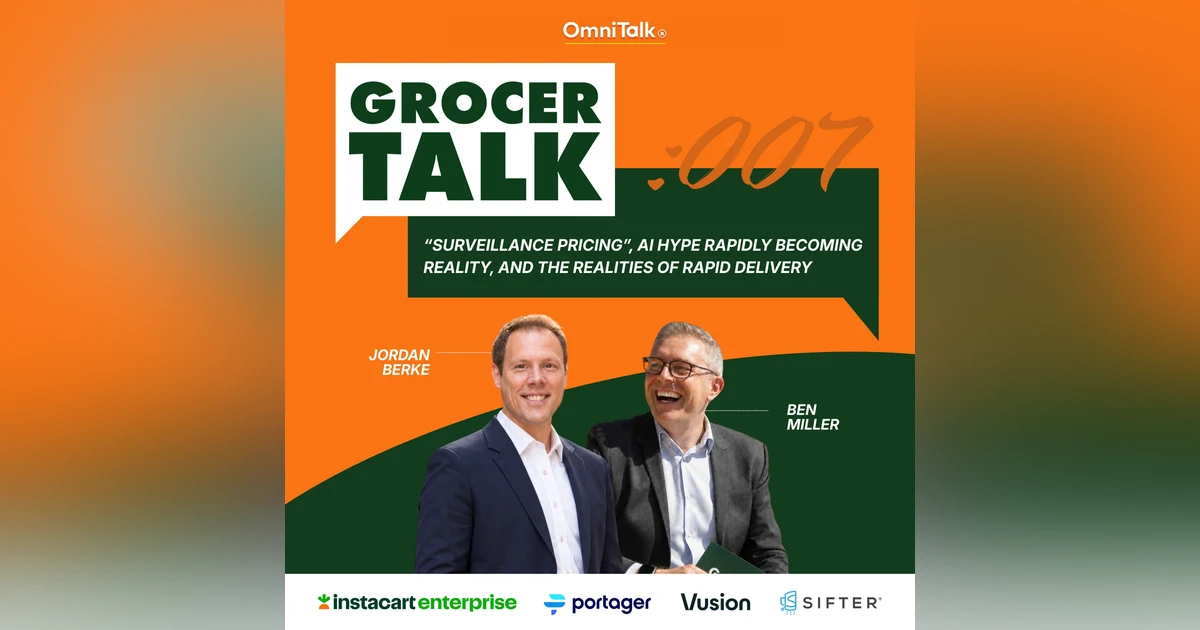

In this episode, sponsored by Instacart Enterprise, Portager, Vusion, and Sifter Solutions, Ben Miller is joined by Jordan Berke, Founder & CEO of retail consultancy TOMORROW, for his first time on GrocerTalk. Jordan shares a little about his retail background and the work he’s doing at TOMORROW before he and Ben jump into surveillance pricing, the realities of rapid delivery, AI hype becoming reality, and whether retailers are actually listening to their shoppers.
This week, they discuss:
• Seattle approving its Fair and Transparent Pricing policy to ban so-called “surveillance pricing,” and Walmart CEO John Furner laying out the principles that will guide Walmart’s use of AI and pricing technology. (Source) (Source)
• Tesco store employees raising concerns about the operational impact of its Uber Eats and Deliveroo partnerships, and what grocers need to consider as more ecommerce fulfillment shifts into stores. (Source)
• Instacart CEO Chris Rogers’ claim that AI will transform grocery more than any other retail category, what AI shopping agents could mean for the industry, and the growing questions around who ultimately owns the customer relationship. (Source) (Source)
• Sam’s Club giving its members a bigger role in shaping what it sells through its Member’s Mark Community, which now includes more than 200,000 shoppers providing feedback on products, merchandising decisions and the broader member experience. (Source)
Plus, Jordan joins Ben for GrocerTalk Grab & Go, where they share the grocery stories that have caught their attention this week. Ben digs into Instacart’s latest marketplace partnerships, including Dollar General joining the platform with no price markups, and keeps an eye on the potential sale of Tesco’s Central European operations.
A few things worth checking out from this week’s episode:
Catch up on Omni Talk’s Groceryshop 2026 coverage, including conversations with some of the biggest names across grocery, retail, technology and CPG. Watch the latest interviews and episodes across the Omni Talk LinkedIn page, podcast channels and YouTube.
Episode 007. Welcome to GrocerTalk.
P.S. Be sure to check out all our other podcasts from the past week here, too: https://omnitalk.blog/category/podcast/
Music by hooksounds.com.
00:00 - Untitled
00:24 - Walmart CEO John Furner Responds: Principles for AI Pricing
01:42 - Guest Introduction — Jordan Burke, Founder & CEO of Tomorrow
16:50 - Headline Two — Vusion Sponsor Break (Connected Retail Solutions)
24:16 - Instacart CEO: AI Will Transform Grocery
27:52 - Why AI Will Transform Grocery — The Case for a Once-in-a-Century Shift
42:13 - Grocer Talk: Grab and Go (Rapid‑Fire Retail Roundup)
This week Seattle approved its fair and transparent pricing policy.
Speaker ACitywide legislation against so called surveillance pricing.
Speaker AIf you've not been paid attention to this, then now is the time because legislation is now active in New Jersey, Maryland, Connecticut as well as Seattle that limit what grocers can do with dynamic pricing.
Speaker ANow one person who is paying close attention to this is Walmart CEO John Furner.
Speaker AHis letter on Friday established the three principles wall multiple use to guide its use of AI pricing.
Speaker ABut has Ferna been too conservative with a capital C here?
Speaker AIs the perceived problem even real to start with and does it even matter?
Speaker AIn the court of public opinion we explore all of this, plus AI hype rapidly becoming reality and and the realities of rapid delivery, plus a whole lot more.
Speaker AWelcome to grocertalk.
Speaker BAI will transform grocery more than any technology that's come before it.
Speaker ANo grocery CEO would do dynamic pricing based on individuals in a physical store.
Speaker BWhat's not debatable is that this is a moment of clarity, Ben.
Speaker BESLs are here to stay.
Speaker ACentral to the relationship between any grocer and his customers is trust.
Speaker BAs an omnichannel operator, your store associates are your armed forces.
Speaker AI think it comes back to one of our universal rules of retail that no good ever comes if you surrender ownership of the customer.
Speaker AHello everyone, I'm your host Ben Miller and this week I'm delighted to be joined on the podcast by founder and CEO of retail consultancy Tomorrow, Jordan Burke.
Speaker AA very warm welcome to grocertalk, Jordan, and thank you.
Speaker BGood to see you.
Speaker BWelcome home after.
Speaker BI know a very busy week last week.
Speaker AYeah, likewise.
Speaker AI think we've both been on the road.
Speaker ABut look, Jordan, before we get into that, this is your first time with us on Grocer Talk, so for those that don't know you, please can you share a bit about your background, your retail experience and then tell us what Tomorrow does.
Speaker BAbsolutely.
Speaker BSo thank you so much.
Speaker BI am a 15 year retail executive.
Speaker BI spent those 15 years at Walmart and my role at Walmart during that time was leading digital and Omnichannel for Sam's Club and Walmart, primarily in China.
Speaker BSo I was based in the China market but also chairman of Walmart's Global Omnichannel Forum which meant overseeing our strategy and big bets from media to marketplace to membership across our Omnichannel portfolio globally.
Speaker BBut eight years ago I founded Tomorrow and we are a global digital retail advisory firm and so we focus on helping retailers accelerate growth and profitability.
Speaker BAnd we are all former digital retail leaders and operators.
Speaker BSo our differentiation is that we have been there, we have walked in the future shoes of the world's best retailers and figuring out what it takes to break through and that's what we do globally.
Speaker AAmazing.
Speaker AThere is so much experience that I get to tap into today.
Speaker AI'm really looking forward to this conversation.
Speaker ABut John, just to give us an example, can you tell us of maybe one or two kind of public domain projects that you've worked on just to just so our audience understand the sort of the retailers and the sort of topics that you cover it tomorrow?
Speaker BGreat question.
Speaker BYeah, we, we work with typically the leading retailer in a market or in a segment.
Speaker BAnd so one of our proudest accomplishments was being asked to help shape Walmart plus at Walmart so early days 2019, helping to shape what that proposition looked like around the world.
Speaker BIn Australia, Kohl's with a C has been a client.
Speaker BWe're helping to shape their Omni Grocery proposition and accelerating that growth has been incredible.
Speaker BAs has in Europe.
Speaker BMigros, Turkey's leading grocer and one of the most innovative retailers in the world, working with the team to really optimize their data and media monetization strategy.
Speaker BSo around the world, elite retailers looking to break through.
Speaker BThat is where tomorrow is most trusted.
Speaker AOkay.
Speaker AAnd John, you are going to help us think through some really meaty topics today.
Speaker ASo let's, let's get into it because this week's Grocer Talk, which is of course brought to you by with the help and support of Instacart Enterprise, Portager Vusion and Sifter.
Speaker AAnd in this week's Grocer Talk, we've got news on Tesco staff complaining about the impact on store operations from recently signed delivery partnerships.
Speaker AInstacart CEO's claim about the impact on grocery of AI and Sam's Club giving its members an increased role in product development.
Speaker ABut we start today with retail news out of the wonderful Pacific Northwest.
Speaker AAnd for a change, it's not about Amazon.
Speaker AHeadline number one is sponsored by Portager, a groundbreaking purpose built AI platform for retail negotiations and joint business planning, helping merchants prepare smarter, negotiate stronger and maximize value.
Speaker AVisit Portager AI to learn more.
Speaker AAll right, let's get into this.
Speaker AHeadline number one comes from Progressive Grocer which reports that the city of Seattle has approved the fair and transparent pricing policy.
Speaker AIt's a measure designed to stop grocery retailers from using personal data to set different prices for different customers.
Speaker AThe legislation prevents large online and brick and mortar grocery retailers from using sensitive personal information including race, gender, or even social media activity and chatbot conversations to determine pricing offered.
Speaker ATraditional coupons and transparent discounts for groups such as seniors and veterans remain fully protected.
Speaker AThis is the latest so called surveillance pricing legislation which is currently gathering momentum in the US After New Jersey became the first state that to legislative back only in July.
Speaker ANow that bill also controversially included a one year moratorium on further use of electronic shellfish labels in grocery stores across the state.
Speaker ARight.
Speaker AAll this led to Walmart President and CEO John Furner to publish a blog post on LinkedIn on Friday where he set out three commitments.
Speaker AI'm going to share this.
Speaker AI think this is useful context, Jordan.
Speaker AThey were firstly the Walmart one won't set different prices based on who a shopper is or the time of day and that they won't use shopping tools to be able to differentiate.
Speaker ASo here he's talking about Sparky.
Speaker ASo saying Sparky anything put into that won't be used to change prices personally and that Walmart will continue to use personal information, responsible and respect individual choices.
Speaker AOkay, a lot there because this is a real meaty topic.
Speaker AJordan, say look, I'd love to know what you think.
Speaker AFirstly tell us about personalized pricing in grocery stores, whether you think this is a concern worth actually legislating against.
Speaker AAnd then I'd love to talk about John Furner and do you think he has drawn the red lines for Walmart in the right places?
Speaker BWell, John's done an amazing job in the moment and I'll explain why there.
Speaker BBut back to your first question, a topic worth legislating against.
Speaker BWe could debate that.
Speaker BBut I think what's not debatable is that this is a moment of clarity, Ben.
Speaker BAnd I think the industry can actually take a sigh of relief because what grocers and retailers more broadly have been wanting to do, they can still do.
Speaker BOver the last four years we've talked to publicly listed retail CEOs, private retail CEOs.
Speaker BNone of them have had the vision of really doing personalized individual level shelf pricing because they've known that that's not going to work in as high profile an industry as retail is.
Speaker BAnd so they have been finding clarity that they are able to do loyalty program based couponing, cohort based discounting, that they can use ESLs in the ways they're intended to be used, which is in price, accuracy and efficiency.
Speaker BI think the industry is excited to have this clarity because now they can do the things they've wanted to do without uncertainty of what's legally acceptable or not.
Speaker BSo I Take it as a very positive and yeah, something that probably ends up getting clarified now.
Speaker AAll right, let's unpick a few bits of that Jordan, you talked about, and I'm paraphrasing here, no grocery CEO would do dynamic pricing based on individuals in a physical store.
Speaker AHave I interpreted that correctly?
Speaker AAnd if so, why?
Speaker BYeah, even whether it be in the physical store or even on the app, this idea of a Ben Miller price versus a Jordan Burke price is something that, that was discussed for a minute, but is clearly not something that we've seen retail CEOs and leadership teams embracing.
Speaker BNow, let's face it, that is a policy that is not unusual in industries like the airlines, even in ride hailing.
Speaker BSo it does exist, but it's one that I think our community as retailers has embraced.
Speaker BDoesn't make sense for our industry on a number of levels.
Speaker BSo it hasn't been something that has been explored, pursued, and in many ways, Ben, we've heard from retail executives and boards this is off limits.
Speaker BSo the good news for the consumer is this is not something that's been pursued or conceived as being a strategic lever for, for a long time.
Speaker BThe good news for retailers is what they do do today and what they want to continue doing, which is to reward cohorts of customers that spend more, that shop more frequently, that have certain basket needs.
Speaker BThey can still do that and not be concerned that they're breaking any policies.
Speaker AYeah.
Speaker AAnd I think, Look, John, I think I'd go even further when I think about the grocery industry.
Speaker ACentral to the relationship between any grocer and his customers is trust.
Speaker ABecause what is being sold is what you put in your body.
Speaker AYou know, the levels of care, the levels of legislation and the level of protection in the grocery industry are huge.
Speaker AAnd I think, you know, the idea of personalized prices breaks down that trust in a way that I don't think any physical grocery retailer could come back from.
Speaker BWhich is why, Ben, I'm going to build.
Speaker BJohn Furner's response in real time was so compelling in our view, because what did is he achieved multiple goals with one fell swoop of a blog post.
Speaker BFirst, he stated that Walmart's EDLP heritage and EDLP commitment is based on trust and the idea and you'll have seen the poke in the first sentence that we don't want customers to have to think, is Tuesday a better day to shop at Walmart than Wednesday?
Speaker BThat's a poke at the high, low retailers that Walmart has competed with for many years.
Speaker BAnd interesting for those that Read the policy out of Seattle.
Speaker BWe'll see that Kroger was not only mentioned early in the policy, but consistently as the example of someone that has the potential to do things with pricing that might break trust.
Speaker BAnd so John was clearly making a statement that the Walmart pricing philosophy is more trust driven than what you'd find in a lot of other places, but also just the speed of response.
Speaker BWalmart historically has not been as forward on pr.
Speaker BI know for many of us in the recent industry we think they are, but historically they would be on the back foot and not want to speak on a topic.
Speaker BBut John's leadership, I think to go out so quickly with such a clear statement and commitment is just an incredible leadership moment and is going to serve them well.
Speaker ASo there's three principles, Jordan.
Speaker ASo number two, we won't use shopping tools in ways to enable us to differentiate prices.
Speaker ASo that's sparky.
Speaker AThey're AI and I think that's really clear.
Speaker AThat's great.
Speaker ANumber three, we'll respect personal information.
Speaker AFine.
Speaker AI think we'll take that as a given.
Speaker AI think it's number one that I want to challenge whether they've been too conservative and that's what have said.
Speaker AWe won't set prices based on time of day as well as who the person is.
Speaker ADo you think by doing that they're preventing themselves using commercial levers?
Speaker AI mean on that principle, are they still able to, with true face, put markdowns at the end of a day to clear bakery and fresh to reduce waste?
Speaker ADo you think he's maybe gone too far on that one, Jordan?
Speaker BGood question.
Speaker BI think we both can be pretty confident that John and the team at Walmart and Sam's club have been thoughtful about what they can and can't do.
Speaker BAnd so things like produce markdowns over the course of the day, I would bet are nuanced out of that statement because those markdowns, they have to be, don't they?
Speaker BOf course, those are for all you, all customers, those are consistent.
Speaker BThat's, I think what he has confidently said is everything we do, we would be able to open the book and show that we are not targeting an individual.
Speaker BWe are not trying to take advantage of certain need states like during a time of day when a family might be more desperate because they need something last minute.
Speaker BWe're not going to exploit customer relationships in pricing.
Speaker BWe're going to do things that are transparent, are consistent, are fair.
Speaker BAnd so it's a great question, I think to be confirmed, but I would bet that there's some nuance in that first point that allows them to still do what is fairly standard.
Speaker AI think it all comes back to that trust thing.
Speaker AI think, Jordan, there's a couple of bits of clarity that I would add in having looked at the various pieces of legislation.
Speaker AYou know, one of the eye catching things about the New Jersey legislation was the moratorium on ESLs.
Speaker AAnd lawmakers across Washington state as well as in Maryland and Connecticut, there was lobbying that pushed for that.
Speaker ABut that hasn't actually gone through into any of those bills.
Speaker AI see that as a relief because if this pr, if this legislation really is about protecting pricing, you know, versus labor and you know, I think there needs to be an honest debate there.
Speaker ABut if it is about pricing, removing the ability to use technology to take cost off the show floor, off, off the shop floor, I think removing that lever would be a very negative and regressive thing to do.
Speaker ASo I think that's a positive.
Speaker AJordan, I guess final point on this, if you've got any other thoughts on that and also practically if you're a grocer in any of the other states looking in.
Speaker ASo what would be your recommendations of next practical steps to take in light of this movement?
Speaker BYeah, I think there's two things that come out of this moment which is the clarity that consistency of these policies has provided in the sense that what is acceptable is discounting based on cohort in simple terms.
Speaker BSo the ability to do targeted discounting based on certain behaviors, based on certain segments of your customer population, that activity continues to be fully endorsed.
Speaker BAnd so that's great.
Speaker BNobody has to be concerned about doing that.
Speaker BI think to your final point on the value of ESLs.
Speaker BI think now we've seen more often than not government saying we support the use of this technology, just not when it's used for some type of targeted, again I'll use the word exploitation of customers.
Speaker BAnd so it is something that again I think is a clarity point that ESLs are here to stay.
Speaker BThey have a role to play.
Speaker BThey are an enhancement to the operation, to the experience and enough government decisioning that maintains that.
Speaker BI think that retailers should be confident that those investments can continue.
Speaker BYeah.
Speaker AAnd I think it's no surprise that Walmart have been on the front foot as they have had one of the largest and most high profile rolls out of ESL technology.
Speaker ASo I'm sure that's not coincidental.
Speaker AThe really interesting conversation.
Speaker ABut let's move on to headline number two which is brought to you by proud sponsor Vusion the global leader in connected retail solutions, helping grocers improve productivity, execution and the customer experience from shelf to checkout.
Speaker ASo visit fusion.com for more.
Speaker AOkay, headline number two comes from the Grocer magazine where technology editor George Knott has discovered Tesco store employees taken to Reddit of all places, to complain about the impact on store operations of Tesco's new UberEats and DoorDash owned Deliveroo partnerships.
Speaker AAmong comments like ridiculous, a nightmare and genuinely destroying the store.
Speaker ASo I'm glad to see my British brethren are keeping their chins up here.
Speaker AComplaints focus around the volume of orders and the associated demands of picking and replenishment, taking store colleagues away from other tasks, especially staffing checkouts.
Speaker AOne Tesco Extra that's the large hypermarket format store managers is quoted as saying.
Speaker AI never see my staff as they are always picking.
Speaker AIt's taken over the whole store operation and it's total chaos.
Speaker AJordan Right.
Speaker AReally looking forward to your views on this one.
Speaker AI know Tenerio you've done a lot of work on with partners.
Speaker ASo look, stepping back from Tesco's clear implementation challenges as we see the E Comm Fulfillment pendulum currently swinging back to store for base fulfillment, what should grossers be doing to protect the in store experience for their regular shoppers?
Speaker BFirstly, Ben, never a good day at the office to walk in and see your store associates on Reddit or in the media saying that something you're doing is destroying the store.
Speaker BSo let's both have empathy for the ECOM team at Tesco and so we recognize that moment and that is hard.
Speaker BBut if we zoom out and we think of the trajectory of grocery, we are firmly in, as you know, the on demand grocery era.
Speaker BAnd not just in the uk, US but globally.
Speaker BWe are seeing such a transition to consumers expecting not just same day but same hour delivery or pickup on grocery.
Speaker BAnd it is such a powerful proposition when it works.
Speaker BAnd in order to make it work, the stores almost always have to play an essential role.
Speaker BAnd let's acknowledge that Amazon in the us, uk, Canada is leaning into on demand fresh with its three hour proposition and even faster with dark stores.
Speaker BBut as an omnichannel grocer, the store has to be at the heart of your strategy to win on speed and flexibility and even economics.
Speaker BSo it's a critical thing that stores play a key role.
Speaker BAnd I think what Tesco's situation implies is they have really sat out the on demand marketplace moment until now, right?
Speaker BThey've had their own on demand proposition in whoosh.
Speaker BWe know Oliver have leaned in there, but until now they've not sold on Ubereats or on Deliveroo.
Speaker BAnd so when you as a retailer add a channel, you do need to prepare that there is going to be a demand influx, a surge.
Speaker BAnd so thinking about how you prepare your stores for that and the best practice that I think we've seen at tomorrow around the world is not just be ready and sequence that volume so that your stores can ingest it, but also prepare dedicated picking space for on demand fulfillment.
Speaker BNo, Tesco does this in many cases have your highest velocity lines in a dedicated space so that your pick team, whether it's in house colleagues or gig teams, they can pick most of that volume in that space and not need to be traversing the floor and disrupting customer experience.
Speaker BWhen that's phased in right.
Speaker BAnd scaled right, we see that up to 20%, 30% of store volume can be E Com and it's not felt by the customer in a, in a bad way.
Speaker BAnd so I think that journey of how to go from sales floor picking to dedicated space picking and evolve the store itself over time is essential to having the experience.
Speaker BGood for associates, good for customers, good for the P and L. Yeah.
Speaker AAnd it feels like Tesco may be going through what we saw from Target just a couple of years ago, where the amount of store pick that was going through their ecom business absolutely dented the store experience for shoppers and for Delki and the team are unraveling that at the moment.
Speaker ABut it's been a cycle.
Speaker AI mean Jordan, we talk sometimes about the transition from store pick model.
Speaker AWhen you reach a certain level of scale and density, the micro fulfillment works and then when you reach a certain level of scale and density and capital costs and in labor cost, then, then kind of large automated fulfillment, it kicks in.
Speaker AHow does that progression and that logic flow change when you suddenly throw a volume of kind of gig workers, gig pickers, gig delivery that you don't have full view over the demand and you don't, you don't control the in store teams with.
Speaker BYou do have full visibility and control over the demand.
Speaker BSo that the nice thing is you as Tesco or a retailer do have the ability to phase up that volume and demand.
Speaker BAnd there are a number of things you can do to make the store more functional as an on demand pick space.
Speaker BAnd I'm sure Tesco team has done a lot of this.
Speaker BBut where the gig driver enters the store for a handover or a pick, you know where they park that vehicle to do that there's all kinds of engineering decisions that can release valve some of that dent that you described on the customer experience.
Speaker BBut there's also a very valuable maturation and progression journey that retailers go that depending on the volume of online demand, the format through which you fulfill that demand should evolve.
Speaker BSo whether it's sales lore sub 100 orders per day to dedicated pick zone from 100 to 500 orders per day to semi automated dedicated pic zone above 500 to 1000 to maybe fully automated co located micro fulfillment beyond that thousand and that progression generally holds but it does require e common ops to be fully in sync about space allocation and wage allocation.
Speaker BIt is not easy to land that right, but it's landable.
Speaker AAnd there may be a painful reality in the short term that there needs to be just some more investment in hours to be able to cope with all the pressures and the newfound pressure in the store which which is as we said, the implementation phase.
Speaker B100% You as an omnichannel operator, your store associates are your armed forces.
Speaker BAnd so I feel for Tesco because to have that kind of pain point out there means that there's a bit of misalignment.
Speaker BI'm sure they're going to get it fixed.
Speaker BThey probably already do.
Speaker BYou want the stores to want the demand to be ready to see Amazon in their crosshairs and be ready to attack with you, not against you.
Speaker BAnd so I think getting that alignment and maintaining that is what elite omni operators strive for.
Speaker AOkay, let's move on to headline number three.
Speaker AHeadline number three is brought to you by Instacart Enterprise, which give grocery businesses the technology to grow online and in store with one modular platform built for how grocery actually works and built to scale with you.
Speaker ALearn more at company.instacart.com forward/grocertalk and headline number three features Instacart CEO Chris Rogers Supermarket News reported that Rogers opened the Grocery Shop 2026 conference last week and that he, quote, didn't hold back.
Speaker AAnd when asked what impact he thought AI would have on the customer experience in grocery, he said he believed and it's another quote, AI is going to transform grocery more than any other technology shift to date and the grocery is going to be the category out of every retail category that is most transformed by AI.
Speaker AOkay, John.
Speaker AHis belief was centered around the complexity of grocery and therefore the scale of the scope that AI has to simplify it for shoppers.
Speaker AAI agents really were the talk of the show in Vegas last week, coming at the same Time as Amazon asking Meta to remove it from the muse AI agentic experience.
Speaker ASo look Jordan, I know you spent last week immersed in AI as well, so really keen to explore this.
Speaker AI guess to start off with, do you agree with, with Chris Rogers statements here or.
Speaker AOr is this just a sound bite provoked from a cheeky moderator?
Speaker BAnd the answer is yes.
Speaker BThe.
Speaker BThe boldness is great.
Speaker BI absolutely love Chris taking such a strong position.
Speaker BAnd I think we have to understand he's made two statements.
Speaker BOne of them I fully believe is accurate and one of them I think the jury's still out.
Speaker BMeaning when he said AI will transform grocery more than any technology that's come before it, I'm a hard yes.
Speaker BOkay, this is an electricity level or beyond moment.
Speaker BNothing that's come before it will transform the grocery industry more than AI.
Speaker BAnd that is, I firmly believe.
Speaker BAnd so that's, I think where Chris is already spot on.
Speaker BAnd I would bet that whether grocery is transformed more than consumer electronics, pharmacy and other segments of retail, I think is the open question.
Speaker BThe reason is because of what he said.
Speaker BGrocery is the most complex of retail segments with the biggest baskets, the lowest net margins and the most complexity to get done.
Speaker BGreat.
Speaker BAnd so the question of whether grocery will change more than any industry, I believe Ben, comes down to who's changing it, because you need someone who can bring together an agentic experience that gives us the selection we need as consumers, gives us the pricing we expect, the speed we need, the personalization we need, which across a 70 item basket just is harder than a gift checkout, a fashion experience and others.
Speaker BAnd so yes, Chris, you're right.
Speaker BNothing will change grocery like AI.
Speaker BBut grocery may not be changed as much as our other sectors.
Speaker BIt'll depend on who leads it and how good of a job they do at identifying it.
Speaker AInteresting.
Speaker ASo look, let's pick up those two bits.
Speaker ABut firstly, why are you so strongly in agreement that AI will change Grocery more than any other technology that we've seen?
Speaker AThat's a, that's a huge statement.
Speaker AAnd you're clearly all in on this, Jordan, Tell me why.
Speaker BI know I don't want to make it lightly.
Speaker BI think we have to think back over the technology that's transformed Grocery and compare it to electricity, to compare it to the upc, compare it to automation in supply chain.
Speaker BAnd I think if you look at all of those moments that have changed what it means to be a grocery retail and shop grocery, this one legitimately has more impact and part of it, and I'm Nuancing on Chris's statement is it's not only going to transform what it means to consume, but it's also going to transform what it means to buy, plan, market and operate as a grocer.
Speaker BSo on all sides of what it means to be in grocery, it is going to transform and we're already seeing that happen.
Speaker BBen in the last 18 months, Walmart as an example has changed more more than it has in its last 72 years.
Speaker BIt is already having that level of an effect on an organization of Walmart scale and maturity.
Speaker BAnd so no doubt this is, like I said, a once in a century or beyond technology shift.
Speaker BWe have a firm belief that that's legit and not hyperbole.
Speaker ASo when you say Walmart's changed more in the last 18 months, what do you mean?
Speaker AGive me some examples about the change that you've seen AI enable Walmart to make.
Speaker BI think if you speak with brand manufacturers that interact Walmart, if you look at the experience that Walmart's putting forward in its assortment, in its pricing, in its marketplace, what you'll hear and what you'll see is the average Walmart associate, particularly in the home office, is using a combination of agents and tools that allow them to do things that they were never able to do.
Speaker BAnd it is a noticeable delta and one that from John and Dave Gugina down is an absolute commitment and they call it reaching co intelligence, the ability to be co intelligent as an associate where AI and you as a team member combine to achieve things that were never possible.
Speaker BThat is a mission and a journey that Walmart's on and at a pace that they've never been on with any of their previous transformations.
Speaker BSo we're seeing it clearly in ways of working and we would argue from a sparky perspective, we're seeing it on the front end.
Speaker BThey are a top three agentic commerce experience globally already, which is amazing.
Speaker BIf you go back to the E commerce era, it took 10 years for Walmart to really get behind it and create world class experiences here.
Speaker BIt's 10 months.
Speaker AWell, so on the second bit I'm going to share a few facts that came out Grocery shop last week.
Speaker AJordan, I know your team was in Vegas and I know you weren't, so you might not have picked up on all of these, but there was a number of people were pushed on evidence or proof points about the impact that their AIs shopping assistants have given.
Speaker ASo start with Kroger.
Speaker AWe had Yale on the podcast.
Speaker AYale wouldn't.
Speaker AYeah.
Speaker AKossad wouldn't actually give numbers.
Speaker ABut he did say the basket size is incrementally strong across shopping assistant users and also said that they were surprised to find that adoption was relatively evenly distributed across customer segments.
Speaker ASo we had heard that before DoorDash users said that the users of Ask DoorDash had 50% larger baskets and checked out five times quicker.
Speaker AAnd Albert Hein again, we had Albert Hein on the podcast.
Speaker AThey said that now.
Speaker ASo Albert Hein for people that don't know, that's our hold.
Speaker ADelezer's fabulous supermarket banner in the Netherlands.
Speaker AMarket leader Netherlands said now 20% of his customers use their AI agent, which is called Stein and they spend 56% more on average than the average customer.
Speaker ANow the great thing is because we were able to have a conversation with SHIELD from al behind, we could probe a bit on that.
Speaker AAnd look, he acknowledged and I, I think the same maybe there with DoorDash that this is kind of correlation rather than necessarily causal because it's their biggest shoppers that are you that have adopted the technology first.
Speaker ASo it is 50% incremental.
Speaker AIncrementality we've heard from a couple of people might not be solely down to the agents themselves, but I think that the common theme we were hearing from people who shared numbers and people that didn't was number one, people are spending more, not less when they use the agent because there was a concern that it would lead people to have more focus baskets and spend less.
Speaker AAnd secondly, that adoption has been universal across demographics rather than being necessarily a young or tech forward thing for people to do.
Speaker AJohn, really interested if that resonates with what you're hearing as well.
Speaker BIt does.
Speaker BThank you for sharing that Outstanding shout out to Albert Hein also, we're huge fans, incredible retailer.
Speaker BBut also to Yale to hear Kroger talk about.
Speaker BI watched his session on video and the discovery that customers are actually more comfortable spending time finding items that they might not have found previously because of the AI assistance does track with what we're seeing because a good agentic layer in the experience is almost like a superhuman agent or assistant that's walking with you through the store and helping to answer questions, remove friction, find things you might not find otherwise.
Speaker BAnd so what we're finding, whether it's Omnichannel retailers or even Amazon with Alexa for shopping, that it is leading to people spending more because they're having a better experience and they're getting solutions that they might not have known were there with that retailer and might have gone to a peer.
Speaker BAnd so we Think that that will even out over time as people might not consume more just because of agentic net net but we think that share gains will probably move those that get to world class.
Speaker BFirst are we're already seeing locking in some incremental share in a way that's.
Speaker AExciting and that's probably the next thing I want to touch on on this because if there was a word of the show in Vegas last week for me it was disintermediation.
Speaker AThe number of conversations of people thinking about where will this take us if it goes too far down the agentic route are we going to see our baskets this intermediated across either marketplaces or particularly the LLMs, the super scalers.
Speaker AWhat advice are you giving to the retailers you work with about how do you where should you try to own the customer in an agency commerce world.
Speaker BFor grocery Ben it's not just at grocery shop or retail club, it's boardrooms at retailers around the world.
Speaker BWe probably spend more time in board sessions on this topic than anything right now.
Speaker BAnd I want to clear we call it the $1 trillion question in retail because the unknown about where the labs want to be in terms of commerce, whether they want to be marketplaces at OpenAI and Google and Anthropic or do they want to be enablers of retailers commerce experience that is a significant unknown.
Speaker BAnd so the first thing that we advise is eyes wide open unvarnished perspective that there is some risk that these labs may want to enter commerce in a way that could have a disintermediating effect.
Speaker BSecond, control what we control which is that if as a retailer we can create world class agentic experiences in our category we have a potential to be more trusted keyword that we've already talked about today.
Speaker BRelevant, more personalized, more capable than a broad line.
Speaker BCall it, you know, a horizontal agent as Andy Jassy calls it.
Speaker BSo the ability to create a great experience like Yale and like Tony Hsu and the team are doing that is an incredibly important step right now.
Speaker BAnd then finally to figure out how do you interface with the LLMs in a way that allows you to be discovered and there in activity but not giving up your identity in a way that allows you to keep owning that customer.
Speaker BSo that balance of interface but not compromise.
Speaker BAnd so the path is really all of those things have to be considered and you have to create optionality in a way that doesn't lock you in to one in a way where you can't pivot.
Speaker AYeah, really interesting John.
Speaker AI think it comes back to one of our universal rules of retail that no good ever comes if you surrender ownership of the customer customer and I think planning that through just to final this one, I know we've talked quite strategic quite often today there was a wonderful session at Grocery shop where it went really practical gentleman called Caleb Carr who looks who does all the data and back end work at Snooks Market to enable their agency tool to work.
Speaker AShared a couple of pieces of advice and I think the two that were really interesting for me number one is if and this is great for the supplies and CPGs listening a lot of these tools that are springing up can only access the data that you have given to them so they the retailers can build a tool that says help me create a meal that with only so many calories proportion but if you haven't provided calorific data as part of the data that you put into the ecom system, your products will not show up in that answer.
Speaker ASo I thought that was really interesting.
Speaker AThe second from a retailer perspective is he said they were surprised about the systems and diversity of systems they needed to connect to make it happen because they found that one of the top questions when they first launched it wasn't how do I plan a Super bowl party or how do I feed my family for under $40?
Speaker AIt was what time does the store open and that what that system was not connected into the agent.
Speaker ASo I thought those two we've gone really practical from being really strategic.
Speaker ABut I thought both of those were really interesting.
Speaker AAll right John, I'm going to take us on to headline number four, which is brought to you by Sifter.
Speaker ASifter Solutions Powerful API seamlessly integrates advanced medically tailored dietary and nutritional filtering into virtually any grocery or wellness platform.
Speaker ASifter makes healthy outcomes possible.
Speaker ASo learn more@siftersolutions.com and our fourth headline this week comes from Grocery Dive and it's more news coming out of Grocery Shop last week as Sam's Club chief merchant Myron Fraser revealed in his Grocery Shop keynote that Sam's Club has developed a scaled feedback mechanic with its members called Sam's Club Members Mark Community.
Speaker AAlready comprising more than 200,000 shoppers, the community offers customers the opportunity to share feedback on merchandising decisions and shape the private label offer of the retailer.
Speaker AAny Sam's Club member can join by the app and Fraser gave examples ranging from new cookie flavors to the composition of Thanksgiving meal deal where direct feedback has changed their approach.
Speaker AIn his keynote conversation which was with OmniTalk Retail CEO Chris Walton Fraser also said that members mark community participants feedback on other parts of the Sam's Club business like checkout experience and scan and go development.
Speaker ASo kudos to Chris for the scoop here.
Speaker AOkay John, do you like this mechanic from Sam's Club or do you think in any way undermines decision making ownership of Sam's Merchants?
Speaker BI love it and I think it's just another signal of the continuous innovation and adaptability of this business.
Speaker BThe origin of this is interesting Ben, because many Sams or with Sam's will know when John Furner came to Sam's Club about eight years ago, he immediately brought in a member sensitivity, a focus on member feedback that is quite present in the business.
Speaker BHe put monitors around the Sam's Club office and in offices of merchants where there's a stock ticker type feed feed of member feedback direct from the app, direct from clubs.
Speaker BIt created this mindset in the building that we need to stay closer to our member than anyone does in retail and really sense what she needs and expects.
Speaker BAnd so this is an incredible natural innovative evolution of that.
Speaker BSo kudos to Myron and the team for really leveraging that to make better merchandising decisions and be faster at sensing to product than their peers are.
Speaker BAnd I think it's showing up in assortment.
Speaker BWe're seeing really, really good progress at shelf at Sam's Club and I think it's translating to results in the business.
Speaker BBut like he said it's not just products, it's the scan and go product has benefited from continuous feedback.
Speaker BThe E commerce team.
Speaker BIt's really an org wide culture of sensing member needs and reacting to them in a thoughtful way that I don't think dilutes decision making I think enhances.
Speaker AOh fascinating and really interesting to hear about the screens in store.
Speaker AYou know merchandising club stores fascinates me because every SKU has to work so hard when you only have such a limited number that is doing such volume and and you know, and ultimately Jordan, it's another core rule of retail that no bad thing will ever happen if you listen to your customers.
Speaker AOkay, we this has been such an interesting conversation but before we let you go we're going to do our grocer talk grab and go.
Speaker ASo this is where we both get to share a couple of stories that have caught our eye in the world of retail in this week and beyond the big headlines of the week.
Speaker ABut things that we think people listening should pay attention to.
Speaker AAre we going to do them fast?
Speaker ASo rapid fire.
Speaker AJordan, what's the first story you think we should be paying attention to and why?
Speaker BI would click into Yale's announcement at Grocery Shop about Kroger's AI strategy.
Speaker BIt's really the first time a four fully articulated AI strategies come forth from Kroger.
Speaker BThe phrase that caught our attention is grocery as a managed service.
Speaker BThe idea that customers can decide how involved they want to be in a grocery shop.
Speaker BAnd Yale and team will provide agentic experiences that can augment that in a way.
Speaker BSo click into that.
Speaker BIt's worth a read.
Speaker BBut second out of India leaked news that Amazon's putting $3 billion into its quick Commerce business in India.
Speaker BWe know that Quick commerce had its first era and that didn't end so well.
Speaker BAnd we're now in era 2.0 and India really is the tip of the spear.
Speaker BAnd we think what Amazon does in India ends up in Ohio, ends up in London.
Speaker BThey really are figuring out quick commerce there.
Speaker BSo watch that battle that they're in with Flipkart and the others there and what they can take from there to export.
Speaker AOh, two really interesting stories.
Speaker AThank you, Jordan.
Speaker AAnd if, if you haven't, there is our interview 10 minutes with Yale where he took the costet from Kroger where he discusses it is on the Grocer Talk feed.
Speaker ANow look, I'm going to throw two back at you.
Speaker AFirstly, there was a whole series of announcements from Instacart last week about new marketplace partners.
Speaker AThere was an innovative North America wide deal with Airbnb to bring groceries to holiday makers which is a lot of flight fun.
Speaker AThere's an interesting deal with Gopuff which brings them as well as onto the Marketplace but onto the Carrot Ads retail media platform.
Speaker ABut the one that I found really striking is the news that Dollar General Nationwide will join Instacart's marketplace and it's doing this with no price markups.
Speaker ASo going back to our earlier conversation about agentic and about price transparency, I think for all other grocers operating catchments, I think that's one to pay attention to.
Speaker AThe other one for me it's a story that I've been tracking, Jordan.
Speaker AIt's about it's the sale of Tesco Central European operations.
Speaker ASo that's exiting from Hungary, Slovakia and the Czech Republic.
Speaker AThis week we had reporting from Supermarket News that there are three interested parties, all of which I find intriguing.
Speaker ASo the first is Ajo Delez, so he's got a great business in Czechia with Albert.
Speaker ABut the other two, Geographies would be New Lidl, which is also present already in the region, and the third is Bedronka.
Speaker ANow Beadronka is a fantastic Polish discount chain owned by Giorno Martin, the the Portuguese group.
Speaker ANow to date almost the entirety of the Be Drunk cooperation has been focused on Poland.
Speaker AThey have a couple of stores now in Slovakia, but this would be significant geographic expansion.
Speaker ASo that is one that I am going to keep a very close eye on.
Speaker AAnd that brings us to the close Today's podcast was produced with the help and support of LSA and is brought to you exclusively as part of the Omnitalk Podcast Network.
Speaker AOmnitalk exists to highlight the trends, technologies and innovations shaping retail and Grocertalk now does this specifically for the global grocery and CPG industry.
Speaker AThanks as always for listening in and please remember to like and leave us a review wherever you happen to listen to your podcast or on YouTube.
Speaker AAnd you can follow us today simply by going to YouTube.com omntalkretail Jordan if people listening have enjoyed your input, I'm sure they will have done and want to get in touch with you.
Speaker AWhat's the best way for them to find you and to contact Ben thank you.
Speaker BTomorrowRetail.com is a great place to go.
Speaker BMe and tomorrow on LinkedIn is a great place to follow and we are like you typically out and about.
Speaker BSo any event that you're at, look for us.
Speaker BWe'd love to connect.
Speaker AFantastic.
Speaker ASo until next week, on behalf of all of us at Grocertalk and Omnitalk Retail, thanks for tuning in.