Kroger’s Q2 Reality Check, AI Shopping Assistants & The Changing Grocery Landscape | GrocerTalk
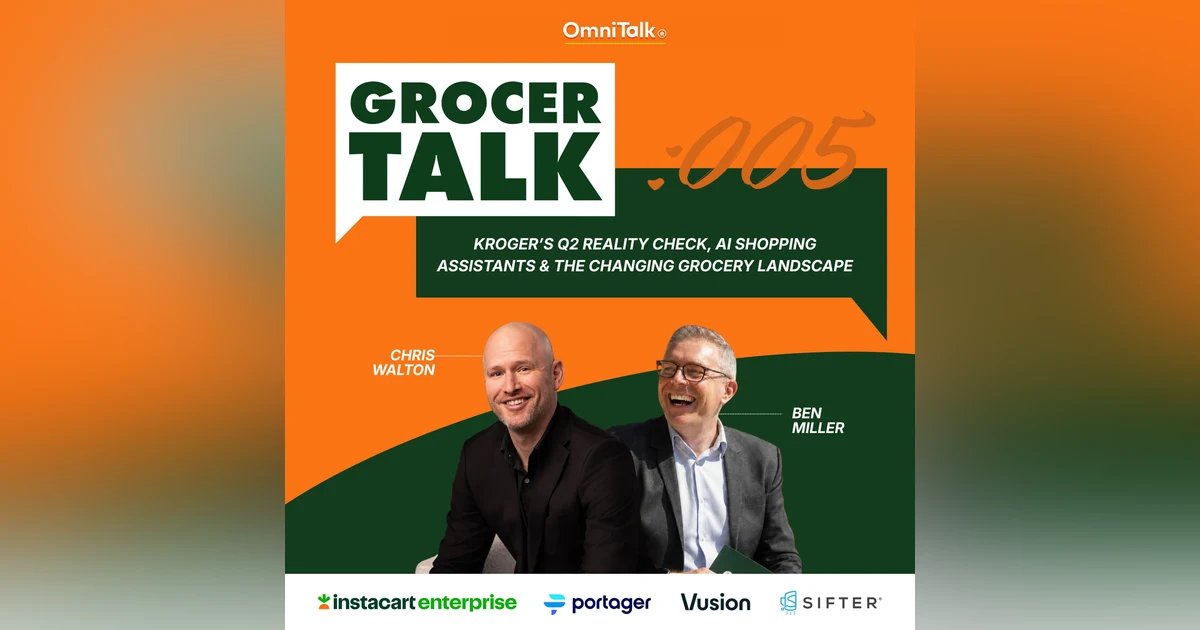

In this episode, sponsored by Instacart Enterprise, Portager, Vusion, and Sifter Solutions, Ben Miller is joined by Chris Walton, President and CEO of Omni Talk, live from NRF Retail’s Big Show Europe in Paris, to unpack the latest grocery news and trends shaping the global grocery and CPG industry.
This week, they discuss:
• Kroger’s stalled performance and lowered 2026 sales outlook, examining whether the challenges facing the supermarket giant are specific to Kroger, the broader supermarket format, or consumer confidence. (Source)
• Instacart and Shipt launching AI-powered shopping assistants, and what the latest developments in AI-powered grocery shopping mean for the customer experience retailers should be working toward. (Source)
• Walgreens partnering with Looma to deploy in-store advertising screens, and whether working with a partner that provides hardware, content production, and measurement is the right approach to in-store digitization. (Source)
• Albertsons expanding its board and naming Meg Whitman as its first Executive Chair, examining what the appointment could signal for the company and the wider grocery industry. (Source)
Plus, Kim Schneider of Vestcom joins us for Five Insightful Minutes to explore how grocers can maximize their investment in shelf-edge technologies.
A few things worth checking out from this week’s episode:
Don’t miss our exclusive interviews from NRF Retail’s Big Show Europe in Paris, featuring the retail leaders and innovators shaping the future of grocery and retail. Catch them on the Omni Talk LinkedIn page, podcast channels and YouTube.
Register for Omni Talk’s Fall Conference Season “Must-See” Tech Preview: https://www.linkedin.com/events/omnitalk-sfallconferenceseason-7486477216600518656/theater/
Episode 005. Welcome to GrocerTalk.
P.S. Be sure to check out all our other podcasts from the past week here, too: https://omnitalk.blog/category/podcast/
Music by hooksounds.com.
The last few weeks have been reporting season for many US Grocers.
Speaker AAnd we've been reporting a reoccurring picture that despite economic headwinds, grocers have been seeing sales up, full year, guidance up.
Speaker AWhether it's been discount like Walmart and strikingly Target dollar stores like Dollar Tree and Dollar General, or club like BJ and Sam's, it's been a similar story.
Speaker ASales up, guidance up.
Speaker ATherefore, the Q2 results from Kroger published on Friday hit with a jolt.
Speaker ASales flat, full year, guidance down.
Speaker AUnderstanding this trend resonates well beyond the borders of the U.S. kroger is, after all, the world's largest operator of supermarket format stores.
Speaker ASo let's unpick that today.
Speaker AWelcome to Grocer Talk.
Speaker AOf all the listed supermarkets in the Q2s, Kroger's come for the best.
Speaker BThe big two are coming for the business digitally.
Speaker BAmazon and Walmart are going after quick same day delivery and they're starting to have an impact.
Speaker AWhat would you want to see in that Strat update?
Speaker BIt's like dating band.
Speaker BPeople are only as loyal as their options.
Speaker BAnd the marketplace effect on grocery is gonna make a lot of people more attractive, cheap dates over time.
Speaker BThat's why you make the big buck.
Speaker BThat's why you're making incredible amounts of money to do what you do.
Speaker BI hate it.
Speaker BI hate it.
Speaker BI hate it.
Speaker BI can't say it.
Speaker AHello, everyone.
Speaker AI'm your host, Ben Miller and we are recording live this morning from Omnitalk's very own podcast studio at NRF's Big Show Europe in Paris.
Speaker AAnd I'm joined by OmniTalk Retail CEO himself, Mr. Christopher Walton.
Speaker BBen, how are you doing today?
Speaker AI'm very good.
Speaker AIt's been a month since we've had you on last.
Speaker BI know it's been a while, but yeah, we're now together in person where I came across the Atlantic.
Speaker BWe're doing this.
Speaker BWe're gonna unpick a lot of things.
Speaker BAs you said in the intro, I always like when you say that.
Speaker BHow we're gonna unpick things always makes me SM super pumped to be here.
Speaker BIt's bright and early on.
Speaker BWhat is it?
Speaker BTuesday?
Speaker ATuesday morning.
Speaker BI lost track of time.
Speaker AOh yeah, with the jet lag, trade show time.
Speaker AWe've got really busy couple of days ahead.
Speaker AWe are recording interviews across the next three days from the fusion booth here.
Speaker AE043.
Speaker BE043.
Speaker AYep.
Speaker BGood man.
Speaker BGood on you.
Speaker ASo we've got, I mean we've got a number of grosses.
Speaker AComing up, Rainbow 1000, Catholic's franchise partner in the Middle east, we've got Bolt, the so called Uber of Europe.
Speaker ASo it should be really interesting.
Speaker BYeah, yeah.
Speaker BNo, I'm super excited by the interviews we've got lined up.
Speaker BWe've got the vitamin shops, Andrew Leduado's coming by first thing this morning or first thing this afternoon.
Speaker BI guess first thing this morning back home.
Speaker BAnd so we're gonna bring you all these great interviews all week long.
Speaker BI think we've got something like 10, 11 in the kitty or something like that, right, Ben?
Speaker BSo yeah, stay tuned for that.
Speaker BStick close to the YouTube page, stick close to Omnitalk, stay close to the retail daily Minute newsletter too, to hear everything these folks have to say in real time as they're saying it.
Speaker AYeah.
Speaker AAnd just looking ahead, two things.
Speaker ANumber one, next week we're doing this all over again.
Speaker BThat's right.
Speaker ASo with Grocery Shop.
Speaker AAnd we've got a great lineup from Grocery Shop this year.
Speaker ABut ahead of that, Thursday, if you haven't registered already, we have our Must see tech preview.
Speaker AAll right, so let's get into this week's Grocer Talks, which of course is brought to you with the help and support of Instacart Enterprise, Portager, Vuzion and Sifter.
Speaker AAnd in this week's Grocer Talk, we've got news on Instacart and Shipt launching AI powered shopping assistants.
Speaker AWalgreens deploying in store advertising screens.
Speaker AAlbertsons expanding its board by naming its first executive chair.
Speaker AAnd Vestcom's Kim Snyder stops by for five insightful minutes on how to maximize investment in shelf edge technologies.
Speaker ABut we start today with with Kroger's Q2 results.
Speaker BOh wow.
Speaker BOh my God.
Speaker AWe get a running hot starting off.
Speaker BOn a plus side.
Speaker ASo headline number one is brought to you by Instacart Enterprise, which gives grocery businesses the technology to grow online and in store with one modular platform built for how grocery actually works and built to scale with you.
Speaker ALearn more at Company.
Speaker ASupermarket News reported on Friday that Kroger has cut its same store sales outlook for 2026.
Speaker AKroger published its Q2s on Friday and said that it now expects full year comps excluding fuel to be between 0.2 and 0.8 versus the previous guidance of between 1 and 2%.
Speaker ALike Walmart previously a couple of weeks ago, Kroger cited the impact of pharmacy pricing from the Inflation Reduction act as a significant factor reducing the comps, believing it will have a negative full year impact of about 140 basis points.
Speaker ASo significant for Q2, Kroger delivered an essentially flat quarter ex fuel after some accounting changes.
Speaker ATotal sales were up plus 0.1%.
Speaker AComps 0.2.
Speaker AHighlights of the quarter to call out include e commerce up 20%.
Speaker ARetail media profit up a very tasty 24%.
Speaker BWow, look at you.
Speaker AAnd also Tasty, their premium private label private selection sales up 14%.
Speaker AAll of which helped keep full year profit guidance the same.
Speaker AAll right, Chris, what do you see as the reason behind Kroger's stalled performance?
Speaker AIs this a Kroger issue?
Speaker AIs it a supermarket format issue?
Speaker AOr are we seeing the impact of consumer confidence here?
Speaker BOh man.
Speaker BCan I say yes to all of those?
Speaker AI think you can.
Speaker BI think I can.
Speaker BI think it really is yes to all those that you said.
Speaker BI mean, I think I was on the show when we talked about this, right?
Speaker BLike, you know, like when I think I was on the show when we first talked about this, where I said like, you know, I was a little, I was not necessarily pleased with how the reporting was done the last quarter where they were hyping up their digital performance to such a degree.
Speaker BAnd I was like, well, yeah, 20 sounds good.
Speaker BBut when you look at the marketplace, when I look at the brick meets click data, which has become my monthly bible ban, it was actually falling short of that.
Speaker BAnd retail media, you could take retail media growth for what you want.
Speaker BIt's not necessarily correlated with in store performance either.
Speaker BIn fact, I worry that it's a distract.
Speaker BIt's starting to become a distraction for a lot of grocers in terms of how they're playing on it.
Speaker BAnd we can potentially get into that more.
Speaker BBut no, so I think, you know, I think it's indicative of all those things.
Speaker BAnd for me, macroeconomically, I'd point to three specific factors really.
Speaker BSo the first is the big two are coming for the business digitally like Amazon and Walmart are going after quick same day delivery and they're starting to have an impact.
Speaker BAnd you can see that in the numbers.
Speaker BThe second thing is online is more convenient and it's more budget friendly.
Speaker BAnd so it just takes a little bit of that to move over into the digital space, to start hitting the basket sizes and to start hitting the numbers of Kroger's and others as we're starting to see in the marketplace.
Speaker BSo I think that's what's going on here.
Speaker BAnd so this is a very telling predicament I think for Kroger too, because the other Thing you have to ask is where do they sit in the landscape?
Speaker AThe.
Speaker BThey're not.
Speaker BAre they going to play on Price?
Speaker BGentek AI is coming.
Speaker BThat's going to make Price more transparent.
Speaker BThere's a whole lot of things here that are not where the gun is pointed directly at them.
Speaker BSo I think they're in a tough spot.
Speaker AYeah, I think that's, I think that's really interesting.
Speaker AAnd Chris, I completely agree.
Speaker AI think it is all three put together.
Speaker AI think from Kroger's perspective, look, we know they know they're in a turnaround.
Speaker AGreg Foran has talked openly that the performance has not been where he wanted to be.
Speaker AThe fact that they have just brought in both a dedicated lead for E Commerce and a new person to run the stores.
Speaker ASo that's the two bits of the business.
Speaker ABringing in new leadership.
Speaker BGreat point.
Speaker AAnd dedicated leadership is a clear sign that they know that they weren't where they needed to be and they wanted to bring more people in.
Speaker ASo I think that's all fair.
Speaker AI was actually talking over the weekend to Jason Goldberg about this and he made a really interesting point.
Speaker AOf all the listed supermarkets in the Q2s, Kroger's comps were the best.
Speaker ASo if we're saying what's the Kroger issue versus what's the market issue, there is a challenge around that supermarket format.
Speaker AAnd I think you've hit the nail on the head that Amazon's moving to same day item delivery.
Speaker ARemoving so many of these top up and convenience shops is having a significant impact on the market.
Speaker BYeah, yeah.
Speaker BThe other point I think was funny about this announcement is he, he used the, the retailer equivalent of blaming the weather for grocery of saying the cyclospora outbreak was, was a direct hit to the numbers.
Speaker BAnd it's like, okay, yeah, but it was for everybody, you know, like that's the thing.
Speaker BBut the other point too before we move on Ben is I think, you know, he started in forehand, started February, I think February 1st of this past year.
Speaker BSo that means he's six months in now.
Speaker BSo how many more months does he have before he's got to put up or shut up?
Speaker BI think it's, you know, he's got what, three more months maybe where he can kind of use these excuses.
Speaker BBut come that next quarter it's got to, he's got to start to show results.
Speaker BSo that's, that's the quarter I'm watching right now.
Speaker BNone of this really matters in terms of the reset of the strategy to Me, it's all going to come in that first quarterly report of 2027.
Speaker AAnd Kroger went to Lent in the report to say that actually there was no strategic update.
Speaker AThere's a Strat Update coming on the 20th of October when we'll learn more.
Speaker BInteresting.
Speaker AChris, what I want to ask is, what would you want to see in that Strat update?
Speaker AWe talked about all the challenges for Kroger.
Speaker AWhat do you want to see them doing to find that elusive growth for a supermarket format?
Speaker BThat's a really good question.
Speaker BI mean, I think they got to get back to the basics, which is probably why they brought Ibbotson in to try to do what he does in those what to do and knows how to do it.
Speaker BAnd Foran knows how to do that too.
Speaker BI think on the digital side, the digital side is much more complicated in terms of keeping pace.
Speaker BI think especially with agentic AI coming on the 4 and pricing becoming more transparent and Kroger not really knowing its price position.
Speaker BBecause what I do worry about is with all the pricing actions that they're taking to stay competitive, that they're starting kind of a price war, you know, in the landscape.
Speaker BAnd can Kroger win that in the long run?
Speaker BI don't know.
Speaker BSo that's something like that I'm very concerned about.
Speaker BIn terms of digitally, what do they do?
Speaker BI don't know, Ben.
Speaker BIt's not a place I'd want to be in.
Speaker BAnd I hate commenting on strategies when I feel like I've got a leg in the hole, but that's just how I feel.
Speaker BSo I think you've got to invest in the store side first and foremost to keep those people coming and keep them loyal and also invest in loyalty too, I think.
Speaker BWhat do you think?
Speaker AWell, I think next week at Grocery Shop, where growth and energy for the supermarket sector comes from, is going to be one of the big discussion points and it certainly should be.
Speaker ALook, part of that.
Speaker AI've got the privilege.
Speaker AOn the final day of Grocery Shop, I'm interviewing the CEO of Hy Vee.
Speaker BYeah, can't wait for that.
Speaker AJeremy Gosch.
Speaker AThat should be a really great interview.
Speaker AAnd the whole premise of the interview is how does a regional grocer.
Speaker AThey're winning market share at the moment.
Speaker ASo look, sneak preview.
Speaker AWe've been working with Jeremy and the team prepping for it.
Speaker AThey're going to talk about a realization that they've come to about basically being the best Hy Vee they can be.
Speaker ASo they are currently converting their discount format stores back into core hy vee.
Speaker AThey tried to be other things and they've recognized their strength within the brand.
Speaker ASo that's going to be a really interesting conversation.
Speaker AIt's also for me a worry for Kroger with the number of different banners and brands they've got.
Speaker AI worry about their ability to build that brand impact through the structure that they have.
Speaker AAnd I think that's something, I mean, that's like a sacred cloud that needs to be talked about within the Kroger business.
Speaker BIt's funny, I was thinking about that too last night.
Speaker BI was kind of like, okay, well, like, you know, you know, because a lot of those places where you see that the brands have some very big local cachet and I just don't, I don't know if that's true of all the Kroger brands like that are out there.
Speaker BAnd so I wonder like, you know, how much affinity is there for like Ralph's in California, like, or is it just my local shop?
Speaker BBecause it's my local shop.
Speaker BAnd so that's where I wonder like, you know, could Kroger take that step, bite the bullet on the big $64,000 question that you're talking about and at least try to do it to a larger degree than it is today?
Speaker BMaybe it's just time.
Speaker BMaybe it's time.
Speaker BI don't know.
Speaker BIt's a big risk, it's a big move, but is it that big of a risk?
Speaker BI don't know.
Speaker AAnd also if you say about scale, can they compete on price, that 150 billion grosser, you know, they should be the one that could and are they doing that thing?
Speaker ASo I think next week it's tough.
Speaker BWhen you're going against Walmart though.
Speaker AOh boy.
Speaker AOkay.
Speaker AWhich moves us straight on to headline number two, which is sponsored by Portager, a groundbreaking purpose built AI platform for retail negotiations and joint business planning, helping merchants prepare smarter, negotiate stronger and maximize value.
Speaker AVisit Portager AI to learn more.
Speaker AOkay, headline number two this week comes from Grocery Dive, which reported that last Wednesday both Instacart and Shipt separately announced the launches of AI powered shopping assistants.
Speaker AIt also noted that both companies highlighted how their marketplace AI assistants aim to ease the mental burden of shopping whilst factoring in a consumer's budget.
Speaker AAdding to our collection of AI assistant names, Instacart Clementine is now available to customers across North America on the Instacart marketplace.
Speaker AIt enables shoppers to ask contextual conversational questions like suggest high protein, easy dinings for two and Then utilize real time availability at the shopper's chosen store and their past purchase history to make personalized ready to buy recommendations in seconds.
Speaker AIn its accompanying press release, Instacart claims that Clementine pulls from a Data foundation of 1.6 billion orders, a catalogue of more than 2 billion items, and more than 10 million daily inventory signals from 100,000 stores across North America.
Speaker AGrocer Talk partner Instacart Enterprise also updated further grocers that are adopting its Cart assistant.
Speaker AThat's its white label, AI Shopping Assistant that is incorporated.
Speaker AOh.
Speaker BInto their own websites.
Speaker BRight.
Speaker BOkay.
Speaker AAll right, Chris, this is really the latest in a stream of AI Shopping Assistant announcements.
Speaker AAnd I know that there's more coming this week.
Speaker AGrocery shop.
Speaker ASo what do you think is the CX end game that retailers should be shooting for for AI powered shopping?
Speaker BOh, my God.
Speaker BThat's like the cataclysmic question of the year.
Speaker AGetting big today?
Speaker BYeah, I mean, I'm going big.
Speaker BI mean, I alluded to this before, and I'm.
Speaker BI'm glad we're talking about it now because I can get into a little more detail in terms of what I was alluding to, which I think is important.
Speaker BBut like I said, I think this is the cataclysmic question that every retailer is facing right now.
Speaker BAnd I say that because of the potential here, particularly for Instacart in this announcement.
Speaker BAnd the reason I say that is Ben Miller, and this was us talking about with Kroger, too.
Speaker BWhat if Instacart starts allowing weekly shopping list budget comparisons across different grocers?
Speaker BWhat if, like, that's a big what.
Speaker AIf complain through this scenario.
Speaker BAnd the way you said it makes me think that they're not very far from that.
Speaker BAnd why wouldn't they allow that?
Speaker BThey have multiple grocers on their platform, and they should be.
Speaker BThey should be in a place or a position to enable their shoppers to budget, optimize their weekly grocery shopping and have Instacart decide how to deliver it and package it up and get it to their doorstep as quickly as possible.
Speaker BSo that is what AI is built to do.
Speaker BMarketplaces are powerful for that reason, and that's why it's a good position to be in.
Speaker BSo, so the retailers, then you have to say, well, what's the recipe?
Speaker BWhat do I do?
Speaker ARight.
Speaker BWhich is your question.
Speaker BSo the first question you have to ask yourself is, I need to choose my marketplace options really carefully.
Speaker BLike now I actually start to think about, do I stay on a marketplace or do I Pick the people that I really feel confident in, can help me to deliver on my strategy and my promises.
Speaker BBecause, like, the one thing I can't understand, Ben, is like, why are regional grocers plugging into Amazon?
Speaker BBecause you know Amazon's going to do this.
Speaker BYou know they are.
Speaker BAnd so that's a big question.
Speaker BSo I think you got to look at those relationships and decide which ones you're going to keep, which ones you're going to divest.
Speaker BSecond, you've got to invest in right pricing, whether strategically or from a technology perspective, because things are going to be more transparent.
Speaker BSo you got to get your pricing right.
Speaker BAnd then third, you got to get generative AI live on your own platforms.
Speaker BIt sounds like Instacart's enabling that for their own platforms where they're doing the white label, which you said.
Speaker BAnd then lastly, as I mentioned on the Kroger story, you got to give people a reason to stay loyal.
Speaker BSo you got to invest in your loyalty programs to keep people coming back to your properties so that they don't go to these marketplaces, they don't go to these AI engines to do what ultimately is going to happen.
Speaker BSo it's like dating, Ben.
Speaker BPeople are only as loyal as their options.
Speaker BAnd the marketplace effect on grocery is going to make a lot of people more attractive, cheap dates over time because the prices are going to be that more transparent.
Speaker AOh, my God.
Speaker ARight.
Speaker AOkay, Chris, talk me through your scenario.
Speaker AOkay.
Speaker BOkay.
Speaker ASo you've got a hypothetical situation where you put your shopping basket, your ass into a marketplace that is AI enabled.
Speaker AIt then works out the cheapest way to fulfill that basket.
Speaker ADoes it, does it identify the cheapest store on average, or is it delivering that basket from four or five outlets?
Speaker BMaybe, maybe not.
Speaker BI don't know.
Speaker BThat's a great thing, is with AI, you have the ability for any marketplace to decide how they want to do that and how they want to make it as clear as possible for their consumer.
Speaker BAnd the consumer is going to tell us ultimately how they want to do that.
Speaker BBut I think the demand is there because you're seeing it in the fact that digital allows people to save money.
Speaker BAI is going to allow people to save even more money.
Speaker BAnd so how it all gets coordinated and collected on the back end is still up for determination.
Speaker BBut I think it's going to happen.
Speaker BAnd it's not that.
Speaker BIt's not that inconceivable, even if you just simply said, hey, I want Mac and cheese, I want Campbell's soup, I want.
Speaker BFind the Best options, minimally, you could be like, okay, I'm Instacart.
Speaker BI can fulfill these items from Kroger, I can fulfill these items for Walmart.
Speaker BDo you want me to do that for you?
Speaker BI'm assuming.
Speaker BI know they're not all on the platforms, everybody.
Speaker BBut like, just go with me on the analogy.
Speaker BThey say, okay, yep, we can either deliver it to you together, we can deliver it to you separately.
Speaker BWhat do you care?
Speaker BI don't really care.
Speaker BSo, like that, I'm gonna get it.
Speaker AThat's the bit I'm not there on yet.
Speaker AOkay, let me tell you why.
Speaker AThe principle of the price transparency I completely get.
Speaker ABut like, almost 30 years now with Ecom, we've been talking about the ability to be able to build up composite baskets from different places to be able to get it through.
Speaker AThat hasn't happened.
Speaker AAnd why hasn't that happened?
Speaker ABecause it's difficult enough to get the economics to work, to deliver just one basket from one retailer.
Speaker ATrying to build a basket from multiple retailers.
Speaker AAny sense you're saving on an item here, an item there, you're going to completely blow and deliver it.
Speaker ASo unless there is a fundamental change in delivery economics, I think this composite basket idea, no matter what the technology enables, is really hard.
Speaker BWell, that's for Instacart to figure out.
Speaker BThat's why the marketplace enables us in a different conversation.
Speaker BBecause Instacart's sending the shoppers into both those grocers to begin with and they're just deciding where to parse it out then.
Speaker AYeah, I mean, even without that potential scenario, it's expensive.
Speaker AI mean, look, I really like this move from both Instacart and Shipt.
Speaker AI think you've got two things.
Speaker AOne, on the Instacart and the Shipt platforms you're putting on, I've gotta be so careful.
Speaker BYeah, right.
Speaker BExplicit rating on this.
Speaker BWe're in Paris, Ben, come on.
Speaker BDecor.
Speaker AIt gives the ability to deliver some really powerful personalization based on preferred stores in store positions.
Speaker AThat's great.
Speaker AAnd then for Instacart, for its partners, it can take into white label it.
Speaker AAnd again, the benefit, because if you are a grocer and you haven't got the ability to run contextual commerce, you're getting left behind really, really quickly.
Speaker BThe other thing about that example, though, that we were talking about, and you're pushing me on, if you get right down to it, at the end of the day, you know who wins those baskets?
Speaker BAmazon and Walmart.
Speaker BLike, they just win them by default.
Speaker BAnd so that's what's going to end up happening here, is the AI is just going to push everyone into Amazon and Walmart on price even more quickly than they are today.
Speaker AAnd joining us now for five insightful minutes is Kim Snyder, VP of sales for Vestcom North America Retail at Avery Denison.
Speaker AKim is here to share how grocers can think about maximizing their investment in shelf edge technologies.
Speaker AKim, Investcom is well known as a pioneer of paper shelf execution.
Speaker AYeah, 40 odd years now.
Speaker ABut with grocers investing heavily in digital solutions for shelf labeling, frankly, get us started.
Speaker AWhat is vescom's role in this world?
Speaker CThanks Ben.
Speaker CIt's really great to be here.
Speaker CAnd you bring up a really great point.
Speaker CI think the biggest misconception is that Vescom is just a paper tag printer.
Speaker CAt our core, we're really data experts at the shelf edge.
Speaker CThe magic lies in our data composition capabilities.
Speaker CWe're the engine that ingests massive amounts of data and sometimes that data is pretty messy.
Speaker CAnd we seamlessly manage the high frequency and complexity of promotions, media, pricing, all the things that go along in grocery, regardless of whether that output is paper or digital.
Speaker CSo here's the reality.
Speaker CElectronic shelf labels can be a very great tool, but without intelligent software behind them, it's just an expensive piece of hardware.
Speaker CGoing digital doesn't magically solve the brutal complexity of pricing rules, promo stacks and SKUs.
Speaker CIn fact, if you're balancing both paper and digital, it actually doubles the complexity.
Speaker CVescom bridges that gap with our storelink software solution.
Speaker CIt acts as a central brain that coordinates across both paper and digital, ensuring consistency and accuracy from a single source of truth.
Speaker BSo Kim, help unpack that for me because I know Ben and I are a big proponent of electronic shelf labels.
Speaker BThey're big capital costs as well, but they, you know, they basically unlock labor savings and they ensure price compliance.
Speaker BYou know, at the end of the day that's some of their big value.
Speaker BBut so how do you embed yourselves with the major grocers then?
Speaker BHow do you really help them unlock the benefits of, of digital shelf label technology?
Speaker CDigital shelf labels are such a major capital investment, the focus naturally lands on the hardware.
Speaker CAnd the biggest risk we find is when hardware is installed and the systems just don't allow for the operational intricacies that exist in the retail world.
Speaker CAs you probably know, grocery data is notoriously complex.
Speaker CWhat shows up on a shelf tag isn't just a static price from a database file.
Speaker CEvery tag is built on layers and layers of logic from localized promos to item rules and batching and template selection.
Speaker CIf the back end systems aren't built to handle that level of sophistication, it orgs end up spending hundreds of hours writing custom code just to manage complex pricing data rules, promo formats and store level exceptions.
Speaker CIn the meanwhile, store associates also are wasting time manually hunting down errors on the sales floor.
Speaker CSo instead of saving labor, you end up with operational friction that erodes the ROI you promised the board.
Speaker CThat's why intelligent software management is so vital.
Speaker CAnd that's where Vescom comes in.
Speaker CWe handle the heavy lifting right up front.
Speaker CCleaning up the data and getting it to the shelf edge in a way that the digital investment actually delivers on its promise.
Speaker ASo Kim, let me just reflect this.
Speaker ASo my take and tell me, tell me if I'm reading this right.
Speaker AYour view is that once a grocer has made that investment to go digital with the shelf labeling, then you're of the belief that it's the software layer that is also crucial to unlocking the full potential from their capex.
Speaker CYeah, that's exactly right.
Speaker CSo like we said earlier, you know, hardware procurement naturally takes the spotlight because of the massive capex investment, but the software orchestration is really the hero behind the scenes that actually determines whether your rollout succeeds or falls flat.
Speaker CAnd that's why we built Storling to be hardware agnostic.
Speaker CSo no matter what tag technology a grocer chooses, our role is to help them get the absolute most out of that investment.
Speaker CSo in grocery, you know, you're dealing with thousands and thousands of SKUs, ongoing price execution, complex marketing and promo offers.
Speaker CThe hardware at the end of the day simply is displaying an image.
Speaker CIt's the software engine behind the scenes that cleans up the complex data, applies the rules and the logic.
Speaker CIt resolves discrepancies and builds an accurate shelf visual all at the same time.
Speaker CThe platform also catches the sync failures that may happen before shoppers ever see a wrong price or an associate gets pulled away to troubleshoot or fix a tag.
Speaker BSo Kim, I don't want to let you off the hook here.
Speaker BI want to put your feet to the fire a little bit.
Speaker BBecause you mentioned Solink, I'm curious, how does it actually work?
Speaker BHow does it actually work to maximize the ROI of the ESLs in a store?
Speaker CAs you said earlier, Vescom has 40 years of shelf experience and expertise.
Speaker CAnd we took all of the things that we've been doing for 40 years.
Speaker CThe complex data, logic, the rules, the execution, know how all the things that We've mastered over 40 years of paper tag printing.
Speaker CAnd we translated that all into the store link software engine.
Speaker CAnd that's designed to protect grocers from a couple of big operational pitfalls, the first being avoiding vendor lock in.
Speaker CWe separated the software from the hardware to create a completely agnostic platform.
Speaker CSo that means if a retailer acquires a new brand that's running on a different hardware, or if they decide to switch vendors down the road, they can seamlessly integrate without having to overhaul their entire data infrastructure.
Speaker CThe second is we're eliminating the hybrid friction.
Speaker CSo as we know, most stores aren't going to be 100% digital overnight.
Speaker CSome may never be completely digital.
Speaker CStorelink acts as a single source of truth, managing across both print and digital simultaneously.
Speaker CAnd the last is removing the operational blind spots that we talked about.
Speaker CStorelink works in the background to proactively monitor both the data and the physical devices.
Speaker CIt catches sync delays, layout errors, and offline tags before shoppers ever see a wrong price on the shelf Let me.
Speaker AGet you out of here.
Speaker AI've got one last question.
Speaker AIf you're sitting across from a grocery CEO or a CIO who's about to to implement an ESL rollout, from all of your experience, what's the one piece of advice that you'd give them?
Speaker CSo my single piece of advice is this.
Speaker CDon't allow the software component of your project to be an afterthought.
Speaker CIt's easy to forget that labels are just at the end of the they're the display at the end of a massive data pipeline.
Speaker CHanging a digital tag on the shelf is actually the pretty easy part.
Speaker CThe real work is ensuring software can automatically stream clean data, resolve sync errors, and execute complex template variations across every store and every generation of hardware deployed.
Speaker CIf you treat software as a secondary detail, the gaps you experience will quietly erode your roi.
Speaker CBut if you get the software layer right from the beginning, your execution will scale, it will go smoothly, and your hardware investment will deliver every dollar you promise to the board.
Speaker BYeah, that's especially true, Kim, when you think about it like no retailer is going to go fully digital right out of the get go.
Speaker BLike they're probably going to have some hybrid solution like you mentioned before, of electric electronic shelf label and paper shelf tag too.
Speaker BSo that's a great point as you think about managing this whole complexity.
Speaker BAnd to that point, you know, before we let you go, you also just recently published an article on this topic, which many of our listeners also like to read and ingest as much information as they can.
Speaker BSo what's the best way for them to find that article?
Speaker CThanks, Chris.
Speaker CI agree, this has been really great.
Speaker CAnd if the listeners are interested in learning more, they can follow Vescom and LinkedIn.
Speaker CThat's where they'll find the recent article and they can connect with me also if they'd like to talk further.
Speaker AOkay, that's been great.
Speaker AThank you so much for joining us.
Speaker CGreat.
Speaker CThank you, Ben.
Speaker CAnd thank you, Chris.
Speaker BThanks, Kim.
Speaker AHeadline number three is brought to you by proud sponsor Vuzion.
Speaker AWe are sat here literally on the Fusion booth right now.
Speaker AThe global leader in connected retail solutions, helping grocers improve productivity, execution and customer experience.
Speaker AFrom shelf to checkout, visit vuzion.com okay, headline number three comes from chainstoreage, which reports the drugstore chain Walgreens.
Speaker AThrough its retail media network, Walgreens Advertising Group will implement in store screens from Luma to 1200 of its 8 and a half thousand stores by early 2027.
Speaker ALuma's technology enables remote content management, digitizes end caps, and claims to provide full funnel performance measurements.
Speaker AThe content that airs on Luma's network, this is really interesting.
Speaker AIs produced or edited by a global network of independent filmmakers, editors and creators who specialise in point of decision content.
Speaker AOther retailers have already implemented luma screens, including BJ's and the aforementioned Kroger.
Speaker AChris, do you like this approach to install digitization for Walgreens?
Speaker ASo working with a partner that provides hardware studio content and measurement, or would you rather see them building out this capability in house?
Speaker BOh, man.
Speaker BThis one, I hate my job, Ben.
Speaker BI really do.
Speaker BThis one, I hate my job because John Storms was quoted in that article.
Speaker BHe's a good friend of mine.
Speaker BLike, I know him pretty well, but I.
Speaker BAnd that's where I got to be honest.
Speaker BI got to be frank.
Speaker BThis is why people come to Omni.
Speaker BI'm worried about this move, Ben.
Speaker BOkay, well, I'm worried about it.
Speaker BI can't fault him for doing it like he's tasked to do it.
Speaker BYou know, he's tasked to grow retail media.
Speaker BSo In Store is a great place to invest, you know, and it's likely being pushed by Sycamore Partners, which, you know, owns Walgreens.
Speaker BYou know, so they're.
Speaker BThey've got, you know, aggressive goals that they're trying to hit.
Speaker BAnd so.
Speaker BBut it's not going to cure what the reason I don't like it is In Store Media.
Speaker BAnd I alluded to this in the Kroger headline too.
Speaker BIn Store Media Growth is not going to cure what ails Walgreens.
Speaker BIt's not.
Speaker BIt's going to help profit, but it's not necessarily going to cure what ails Walgreens.
Speaker BAnd so I think there are better avenues for investments to cure what ails Walgreens in the long run.
Speaker BThen very expensive digital hardware infrastructure that is hard to maintain becomes obsolete very quickly.
Speaker BAnd Walgreens of all people should know that because of the investment they put into cooler screens and how that went.
Speaker BSo this just.
Speaker BIf I was them, I would not be making this move right now.
Speaker AYeah.
Speaker AAnd you know what?
Speaker AThat's the exact reason why I don't dislike it.
Speaker AReally.
Speaker AAnd let me tell you.
Speaker BAll right, let's get into a debate.
Speaker ALet me tell you for why.
Speaker ABecause I think the two are mutually excited exclusive.
Speaker BOkay.
Speaker AI E. Of course you have to fix the fundamentals of why should people want to make that trip to Walgreens.
Speaker ABut that's independent of their ability to grow out a retail media network and benefit from the traffic that is going through their stores.
Speaker AAnd what intrigues me of going down the route to working with Illuma is you are not trying to do it yourself.
Speaker AI'd be more worried if they were trying to build the capability in house, if they were having to spend the capex to do it all themselves.
Speaker AActually working on a.
Speaker AOn a revenue share model with an organization like Luma, I think is more compelling for them right now than if they were taking other routes.
Speaker BYeah, right.
Speaker BBut the store met.
Speaker BBut.
Speaker BThere's always a but, Ben.
Speaker BYeah, I think that makes sense when you're like in the mutually exclusive worlds, when the worlds are mutually exclusive.
Speaker BBut when you actually put these things into a physical retail operation, that means store employees have to get involved with them, maintenance has to get involved in them.
Speaker BIt's much more complicated than I think people realize and distracting than people realize too.
Speaker BAnd customers also get involved in them and in front of them and then get confused by them or enticed by them too.
Speaker BAnd so that's an element here too.
Speaker BIt's not as clean of a break that we all think it is.
Speaker BFrom my store manager.
Speaker BIt is.
Speaker BAnd having done a lot of experimentation with digital screens in store and just knowing how hard it is, one, to get people to engage with them and two, keep them doing what they're supposed to be doing each and every day, which is what we saw with cooler screens too.
Speaker BLike half the time, those things on all those social media videos, they even work.
Speaker AYeah, I think that's very Fair.
Speaker AAnd I think we should.
Speaker AWe should invite your friend John to come on.
Speaker BWe should.
Speaker BYeah.
Speaker ABecause 1200 stores is sizable.
Speaker AIt's a lot.
Speaker AI think they're gonna find out really quickly.
Speaker AIt'll be great.
Speaker AIt's.
Speaker ASee what they've learned from this.
Speaker BYeah.
Speaker BIt's a lot.
Speaker BAll right.
Speaker AHeadline number four, which is brought to you by Sifter.
Speaker ASifter Solutions.
Speaker APowerful API seamlessly integrates advanced, medically tailored dietary and nutritional filtering into virtually any grocery or wellness platform.
Speaker ASifter makes healthy outcomes possible.
Speaker ASo learn more@siftasolutions.com okay.
Speaker AOur fourth headline this week comes from Grocery Dive, which reports that Meg Whitman will join the board of Albertsons in a newly created role, their first executive chair.
Speaker ASo as well as chairing the board, as well as chairing the board, Whitman will serve as an operations quote and strategic advisor to CEO Susan Morris.
Speaker AAnd her appointment has already taken effect.
Speaker AShe started on Tuesday.
Speaker AWhitman brings 40 years of experience to Albertsons, having served as CEO of eBay for a decade and President, CEO and Chair of Hewlett Packard.
Speaker AShe was also, and I think this is the first time ever said on omnitalk, the United States Ambassador to Kenya.
Speaker AYes, that is the first time from 2022 through 2024.
Speaker AWhitman's appointment came at a time when.
Speaker ACom store sales are negative, the company's reorganizing its op model, and the current CFO has announced her plans to.
Speaker ATo retire.
Speaker ASo that's a quite a trifecta.
Speaker ALook, Chris, you and I, we don't sit on the Albertsons board.
Speaker AWe don't.
Speaker AWe can't yet.
Speaker AWe can't know the internal conversations behind it.
Speaker ASo I guess my question is more, what do you think this move signals to the industry?
Speaker BOh, God, Ben, I. I hate this move.
Speaker BI hate it.
Speaker BI hate it.
Speaker BI hate it.
Speaker BI hate it.
Speaker BI can't say it enough.
Speaker BWhat is.
Speaker BWhat is Meg Whitman going to bring to the board?
Speaker BYou know, like, that's my thing.
Speaker BShe's a big name.
Speaker BLike, she's a big name, honestly.
Speaker BBut she's a big name from, like, 20 years ago.
Speaker BWhat has she really done since she rode the tailwind of eBay?
Speaker BFrom 1998 to 2008, she was the CEO of Hewlett Packard.
Speaker BHow'd that go?
Speaker BLike, she got bounced pretty quickly, if I remember right.
Speaker BThen.
Speaker BQuibi.
Speaker BAnyone?
Speaker BAnyone remember Quibi before the ambassadorship to Kenya?
Speaker BSo, like, what does Meg Whitman really know that's still relevant, particularly in the coming age of grocery and how things are going to change.
Speaker BSo I just, I just don't get it.
Speaker BIt seems like they got swayed by the, by the aura of celebrity board director.
Speaker BAnd I just, I don't know, I just don't see why she's going to be that valuable to this board.
Speaker BI think there's other better people you could probably pick that are going to help you along the lines of where you need the help and probably cheaper.
Speaker AAll right, so separating the individual from the strategic move.
Speaker BYeah.
Speaker ADo you like the fact that they're bringing in an exec chair so they're bringing in some more senior support onto that board?
Speaker BI do.
Speaker BI do like.
Speaker BI do like that.
Speaker BI do like when boards are tend to be separated.
Speaker BLike the chairman of the board is separate from the CEO.
Speaker BI do like that.
Speaker BI think it adds a level of governance that's not there otherwise.
Speaker BBut you don't always see people doing that.
Speaker BSo, yes, I would say I like that.
Speaker AOkay.
Speaker AI mean, for me, there's mixed messages in it.
Speaker AI mean, is this a move to say we are supporting our CEO or is it saying we're undermining our CEO?
Speaker AAnd I think you can absolutely read it both ways.
Speaker AAnd I think that's the point I wanted to get at.
Speaker AWhen companies make moves like this, the market and the industry tries to unpick what's going on.
Speaker ASo I think one thing I would say there was an article last week that pointed out that 14 US grocers have already changed their CEOs this year.
Speaker AAnd last week when Sarah Engle and I were talking about Jack Sinclair and Sprout, we talked about the number of leading global grocery CEOs that have been in the job since 2020.
Speaker AAnd I think we could call out two or three, like Raver, Catholic.
Speaker AIt's down to a handful.
Speaker AThe top job.
Speaker AAnd you earlier, Chris, were already saying, come on, Greg Foran, you've been in the job for more than six months now.
Speaker AWe should be seeing.
Speaker ASo, yeah, it's like this pressure.
Speaker AIt's worse than a Premier League football manager getting changed.
Speaker ASo I don't dislike.
Speaker AHow do you support.
Speaker AHow do you back the person you've brought in?
Speaker ABut I do think it's challenging for the industry to really.
Speaker ATo think about that.
Speaker AIt's not a we need more help here signal.
Speaker BYeah.
Speaker BBut that's also where I, where like I kind of, I put out the smallest violin in the world too, for all these CEOs, because, like, that's why you make the big bucks.
Speaker BLike, that's why you're making incredible amounts of money to do what you do.
Speaker BAnd I also think the difference between successful CEOs in one place versus another is not as large as people like to think that it is.
Speaker BLike, there's a lot of people that could do a lot more people that could do these jobs and actually get the chance to do them as well.
Speaker BSo that's where I'm like, I'm like.
Speaker BI think that's just a function of timing and generational shifts, too.
Speaker BI don't necessarily.
Speaker BThere's been a lot of change in the grocery industry, but, like, a lot of people are just retiring and moving on.
Speaker BLike, Doug McMillan retired, Jack Sinclair retired.
Speaker BLike, so they brought in their successor.
Speaker BFine, whatever.
Speaker BLike, this is correlation is not necessarily causation in terms of what's happening across the industry, from my perspective on that one.
Speaker BBut I don't know.
Speaker BI mean, like I said, I think it's a good move to split it out.
Speaker BI just don't like the celebrity hire that comes with this.
Speaker BAnd all that gets wrapped up in that, Ben, you know, at the end of the day.
Speaker AYeah, well, I know it's going to be fascinating to watch that one play through.
Speaker AOkay, come on.
Speaker ABefore we let you go, Chris, before we get on talking to the amazing interviews we've got lined up, we're going to do grocer talk, grab and go.
Speaker ASo this is where we both share a couple of stories that caught our eye in the world of grocery retailing, things we think we should be talking about.
Speaker AAnd I don't know what you've picked.
Speaker AGo on, Chris, hit me.
Speaker AOkay, first story.
Speaker BOkay, my first one.
Speaker BI'm super excited about this one.
Speaker BI think I'm gonna talk about this on the Fast 5 this week, too.
Speaker BI can't remember.
Speaker BI haven't fully picked my topics yet, but fresh off its delivery news last week, Walmart has announced that pizza chain Papa John's will be the first national restaurant brand available through Walmart express delivery that is filled entirely from restaurant locations outside of Walmart stores.
Speaker AYeah, it's big.
Speaker BLook out Doordash and Instacart.
Speaker BThat's why I picked that one, Ben.
Speaker BLook out Doordash and Instacart because a nice foreign exchange student just showed up at your high school.
Speaker AI mean, this story has moved quick, hasn't it?
Speaker AWe've got.
Speaker AOh, my God, we've gone from a LinkedIn post.
Speaker AThe next week is Duncan and the next week of Hit with Papa John's.
Speaker AThat's.
Speaker BYeah, this is what's Next.
Speaker AExactly.
Speaker AYou know, because they're not stopping there.
Speaker BYeah.
Speaker AAll right, go on.
Speaker AI'm going to give you.
Speaker AThis is.
Speaker AThis story has intrigued me.
Speaker ASo Aldi Sut, which is the.
Speaker AThe more global of the two, Aldi Y has acquired a minority stake in Dali Everyday Grocery.
Speaker AAre you familiar with Dali Everyday Grocery?
Speaker ACorrect.
Speaker BOh, yeah, I, I shopped their entire assortment bag.
Speaker AThey are a limited line discount chain in the Philippines.
Speaker AOh, right.
Speaker ASo this is.
Speaker AYeah, this is a brand new geography for Aldi.
Speaker AIt's also the first time that Aldi has taken a stake in a business, albeit one modelled on Aldi, but allowed all the coverage says, allowed the local team to operate it independently rather than making a full acquisition.
Speaker AI mean, there's a few things that fascinate me.
Speaker ASo number one, okay, Dali has more than 31,300 stores, but he only opened his first store in 2020.
Speaker BWhat?
Speaker AOkay.
Speaker ANumber two, Dali.
Speaker ADali D A L I is an anagram of Aldi.
Speaker BOh, wow.
Speaker AAnd number three, this local Philippine chain is actually headquartered in Zug in Switzerland.
Speaker ASo I think there's more going on than meets the eye here.
Speaker AAnd I'm going to be watching this with great intelligence interest.
Speaker BThat's so random on so many levels.
Speaker BI can't believe they have that many stores in five, six years.
Speaker AAnd especially 2020 was a pandemic to put that.
Speaker AThat's wild, isn't it?
Speaker BThat's just absolutely nuts.
Speaker BAll right, my next one.
Speaker BI can't get off the delivery news lately, Ben.
Speaker BI was joking with somebody on the phone the other day.
Speaker BI was like, man, if I do another delivery story, but guess what?
Speaker BI'm going to.
Speaker BOkay, Skims is tapping doordash for its entry into on demand delivery.
Speaker BSkims, the shapewear company brought to you by Kim Kardashian is bringing its full US Retail store footprint and its undergarments and apparel to the platform.
Speaker BBen.
Speaker BMarketplaces.
Speaker BMarketplaces, Marketplaces.
Speaker BThat's all I can say, Ben.
Speaker BI mean, can you believe that now I can get my shapewear and my meatball hoagie all in the same.
Speaker BAll in the same door dash order.
Speaker BI can double dash shapewear and hoagies.
Speaker AIn nitty 50 as creates two items that I've never bought.
Speaker ARight, exactly right.
Speaker B50 Years of life.
Speaker BYeah, Well, I buy the hoagies every week, so, like.
Speaker BYeah, and maybe Mrs. Omnitok is getting some shapewear this week too with that double dash order.
Speaker BBut isn't that nuts?
Speaker AIt is nuts.
Speaker AIt is nuts.
Speaker ARight, Mutt?
Speaker AThough my last story comes from Gallup.
Speaker AA Gallup survey.
Speaker BA survey.
Speaker BOkay.
Speaker BVersus Galloping.
Speaker AYes.
Speaker AGallop survey which shows that US alcohol consumption remains, Chris, an all time low.
Speaker ASo drinking rates are stabilizing after a multi year decline.
Speaker ABut 54% of U.S. adults say they drink alcohol, so the levels are at their lowest point since 1939.
Speaker AWow.
Speaker AAnd look, that particularly caught my eyes because in a couple of days I'm getting on a plane to the US for grocery shops.
Speaker ASo I now feel more duty bound than ever to support the hard working colleagues in the U.S. beer, wines and spirits industry.
Speaker ASo I will be doing my bit to help next week.
Speaker BWell, you did your job last night at dinner because I'd been off alcohol for three weeks.
Speaker BAnd when you got that bottle of wine, I think I ended that streak pretty, pretty, pretty well last night and feel it a little bit this morning too, my friend.
Speaker BBut it was a good time.
Speaker BWe had a good time at dinner last night.
Speaker AVery nice bottle of French red.
Speaker AOkay, on that note, it's time to wrap.
Speaker ASo today's this podcast was produced, as ever, with the help and support of Ella SEO.
Speaker AThank you Ella.
Speaker AAnd is brought to you exclusively as part of the Omnitalk Podcast network.
Speaker AOmnitalk exists to highlight the trends, technologies and innovation shaping retail and grocertalk does this specifically for the global grocery and CPG industry.
Speaker AThanks as always for listening in.
Speaker APlease remember to leave us a review wherever you have to listen to your podcasts or on YouTube.
Speaker AYou can follow us today by simply going to forward/omnitalkretail.
Speaker ASo until next week, Chris, on behalf of yourself, yes, myself and everybody at Grocer Talk and Omnitalk Retail, thank you for tuning in.