Healthy Choices for Shoppers, All Change in UK Health & Beauty, and Autonomous Delivery Robots | GrocerTalk
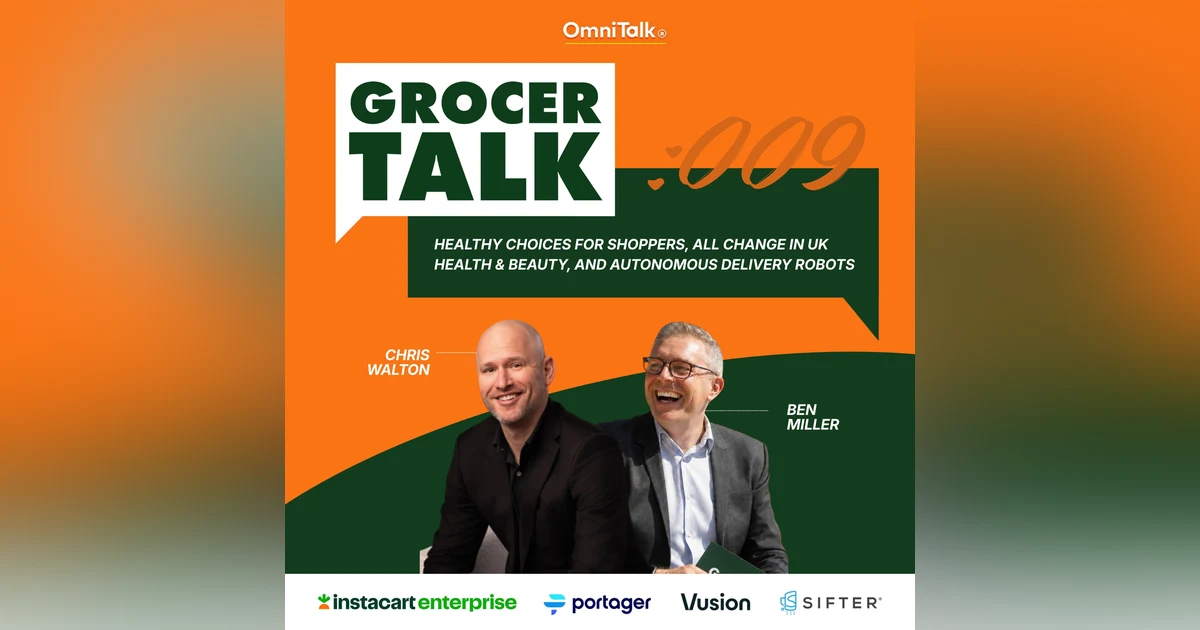

Chris Walton is back on GrocerTalk with Ben Miller, and this week, they're shaking things up a little!
From a major shakeup in UK health and beauty to the growing push for healthier grocery shopping and the rise of autonomous delivery robots, there's plenty to unpack. Sponsored by Instacart Enterprise, Portager, Vusion, and Sifter Solutions, Ben and Chris are taking on three big questions: Who stands to win in UK beauty? How can grocers help shoppers make healthier choices? And are sidewalk robots really the future of delivery?
Plus, Kevin Billings of Sifter Solutions joins Ben for Five Insightful Minutes to break down the latest SNAP waivers, what they mean for grocers and CPG brands, and why compliance is becoming increasingly important.
This week, they discuss:
UK Health & Beauty Gets a Shakeup
- The Weston family's $8.9 billion acquisition of Boots and whether new ownership can revive the retailer. (Source)
- Sephora's partnership with Marks & Spencer to bring premium beauty to 100 UK stores, and what the retailers can learn from Sephora's relationship with Kohl's. (Source)
- The latest M&A headlines, including Sainsbury's walking away from Morrisons merger talks (Source), rumors of a Starbucks and Chipotle deal (Source), and Tesco's reported interest in Majestic Wine. (Source)
Helping Shoppers Make Healthier Choices
- Sifter Solutions' Kevin Billings joins for Five Insightful Minutes to discuss SNAP waivers, compliance challenges, and what changing restrictions mean for grocers and CPG brands. (Source)
- The Giant Company's new GLP-1 grocery tours and whether nutrition-focused shopping experiences can scale. (Source)
- The ongoing debate over personalized pricing and electronic shelf labels, including the grocery industry's response to the FTC and how ESLs could help shoppers. (Source)
Autonomous Delivery Robots: The Next Big Thing?
- DoorDash and Deliveroo bringing sidewalk delivery robots to five UK cities and what the expansion means for autonomous last-mile delivery. (Source)
- Just Eat expanding robot delivery through its partnership with Morrisons and Starship Technologies. (Source)
- The bigger debate over sidewalk robots versus drones, including Serve Robotics' expansion with Grubhub (Source) and Starship's growing focus on grocery delivery. (Source)
Plus, a few more retail developments they're keeping an eye on.
P.S. Be sure to check out all our other podcasts from the past week here, too: https://omnitalk.blog/category/podcast/
Music by hooksounds.com.
00:00 - Untitled
00:21 - Main conversation begins — “Welcome back, Chris Walton”
02:48 - Health & Beauty Shake‑up: Boots Acquisition and Market Implications
21:59 - M&A roundup: Sainsbury's, Morrisons and the Starbucks–Chipotle rumor
26:49 - Grocers Helping Shoppers Make Healthy Choices
47:47 - Autonomous Delivery: Pavement Robots, Drones and the Last-Mile Case
Hello, and welcome to episode nine of Grocer Talk.
Speaker AI'm Ben Miller.
Speaker BAnd I'm Chris Walton.
Speaker AAnd today's episode is brought to you with the help and support of Instacart Enterprise, Portager, Viewsion, and Sifter.
Speaker AWelcome back, Chris Walton.
Speaker BThank you, Ben.
Speaker BIt's great to be here again.
Speaker BTwo weeks in a row, unplanned.
Speaker BI'm excited.
Speaker BI feel like such a.
Speaker ASuch.
Speaker BIt's such an honor to be with you two weeks in a row.
Speaker AIt's an honor to have you back.
Speaker AAnd I think it's also marks the end of your time on the road, does it not?
Speaker BOh, my God, yes, Ben.
Speaker BFour retail conferences in four weeks.
Speaker BVegas twice in 10 days.
Speaker BNot good for anybody.
Speaker BI'm glad to be back in Minneapolis and.
Speaker BAnd glad to be home.
Speaker BAnd it's.
Speaker BIt's been.
Speaker BIt's been a welcome respite, Ben.
Speaker BYes, it has.
Speaker AVery good, very good, very well.
Speaker AIt's good to have you back in your home studio.
Speaker AAnd look, Chris, this is.
Speaker AThis is episode nine of Gross at All.
Speaker AWow.
Speaker BReally?
Speaker ANine it already.
Speaker ANine it already.
Speaker AAnd I look two things.
Speaker ASo firstly, I just wanted to take the opportunity to thank everybody who's been involved in the last nine weeks.
Speaker ASo, look, thanks to our partners and sponsors.
Speaker AThanks particularly to everyone that's listened in and everyone who's given us feedback, who's been in touch.
Speaker AIt's been fantastic to hear from you and hear the conversations we're having is resonating.
Speaker ASo, like, number one, vote of thanks to everybody.
Speaker ANumber two, Chris.
Speaker AWe're going to do things a little bit differently today, aren't we?
Speaker BOh, okay.
Speaker BYeah, I guess so.
Speaker BYou're.
Speaker BYou're.
Speaker BYou're.
Speaker BYou're the captain of this ship.
Speaker BYou're the captain of this ninth voyage, Ben.
Speaker BSo, yes.
Speaker BTell me, Captain, what are we going to do today?
Speaker AWell, look, we decided because you're back for the second week running, it was a perfect opportunity to stick with a number of things that are exactly the same.
Speaker ASo what we're going to do, we're going to unpick the global grocery news of the week.
Speaker AWe're going to give it the same focus, we're going to give the same insight.
Speaker AWhat we're going to do, though, is just change the production a little bit so it might just sound and feel a little bit different.
Speaker ASo I think, think of this like a live a B test.
Speaker AYeah.
Speaker ASo we can compare this week to last week.
Speaker AAnd I'd love to know, listeners, what you think, whether you preferred Chris and I in this style.
Speaker BOr.
Speaker AOr should we just go straight back to normal?
Speaker ASo we're testing and learning, Chris.
Speaker AThat's what we're doing this week.
Speaker BWow.
Speaker BI've never been AB tested before, Ben.
Speaker BI hope it's as good for you as it is for me.
Speaker BMaybe I need a cigarette at the end of this one.
Speaker BI don't know, man.
Speaker BYeah.
Speaker BWow.
Speaker BA personal AB test.
Speaker BAll right, let's do it.
Speaker AAll right, let's do it.
Speaker AWell, look, this week we're gonna have three parts.
Speaker AIn part two, we're gonna talk all about how to help shoppers make healthy choices.
Speaker APart three, we're gonna dive into the very latest in autonomous delivery robotics.
Speaker ABut we're going to start with a significant potential reshaping of the health and beauty market in the uk with implications that stretch far beyond the UK borders.
Speaker BYeah.
Speaker BAll right, Ben.
Speaker BSo to do that, I've got two stories which I'm going to give you you to give your thoughts on and to let the audience in on what we're going to discuss today.
Speaker BSo two stories.
Speaker BNumber one, Ben, the Westin family has acquired Boots.
Speaker BAnd the second one, we also cannot forget that MNS is also partnering with Sephora because those two stories are closer than they appear in the rear view mirror.
Speaker BHere's the background on each.
Speaker BWhittington Investments Limited, which is out of Canada and is the holding company of the Canadian Weston family, which coincidentally is also the ultimate parent owner of Loblaw and Shoppers Drug Mart, two very big Canadian retailers.
Speaker BWell, they're going to own 50% with Fairfax Financial holdings holding the other 50%.
Speaker BBut Whittington will have operational control.
Speaker BThey're purchasing it from the PE firm, the famed PE firm Sycamore Partners, which seems to own a lot of things in retail, and the Pesina family for $8.9 billion.
Speaker BAnd the deal is expected to close in Q1 of 2027.
Speaker BSome of the debt is expected to be levered against the new Boots business.
Speaker BSo that's the watch out.
Speaker BBecause of decades of underinvestment in Boots, which Ben, I'm going to want to get your thoughts on now before I get to Sephora and M and S, however, what's your perspective on boots as someone native to the uk, how does it fit into the whole health and beauty landscape from where you sit across the Atlantic?
Speaker AYeah, great question, Chris.
Speaker AAnd what I really wanted to get into this topic because Boots is the clear number one in health and beauty retailer in the uk.
Speaker ASo depending on what flavor and look, you can cut health and beauty a number of different ways, depending on where it starts and where it stops, in terms of what you include in the total market and what you don't.
Speaker ABut it's somewhere in the region of 15 to 20% of market share.
Speaker ASo it's a dominant market leader.
Speaker ANumber two is Tesco.
Speaker ASo the grocers come straight in at number two in UK Health and beauty.
Speaker ASo you've got Boots as the standout leader and then you've got Tesco.
Speaker AAnd Tesco's got about 9% of the market.
Speaker ABoots has got.
Speaker AAgain, it has over 1800 stores across.
Speaker ASo there is a Boots, Chris, on almost every UK high street.
Speaker ASo Main street, the center of every town, city or shopping district has a boot.
Speaker ANow from there there's like a really long tail.
Speaker ASo as Watson has got a couple of brands, they've got Superdrug and Savers.
Speaker AThe department stores, like the John Lewis Partnership, have got a little bit of business, but you're Talking kind of 2, 3%.
Speaker AWhat you have, if you stand back and you look at UK health and beauty, is a big bit of the market with Boots, a big bit of the market with the supermarket and then a load of specialists.
Speaker AWhat it, what it actually doesn't have is, is a, is a premium player, is a premium option of scale outside the department stores and an online options.
Speaker BGot it.
Speaker BOkay, so that, that helps me.
Speaker BOkay, so that sets a table for me on why you pick this story.
Speaker BBecause health and beauty in the UK is basically synonymous with grocery.
Speaker BThat's what you're saying, Ben?
Speaker AYeah, very much so.
Speaker AVery much.
Speaker BCan't have one discussion without the other.
Speaker BOkay, so that, that's, that's great.
Speaker BAnd so Boots.
Speaker BSo I mentioned it before too.
Speaker BSo Boots has been kind of underfunded in the landscape too, is.
Speaker BHas it not, in terms of the investment that basically Walgreens, since it's acquired, since it acquired, it has been putting towards it.
Speaker AYeah, that's right.
Speaker ABoots has passed between multiple owners since it was taken off the UK stock market in 2006.
Speaker ASo it was merged with Alliance Healthcare.
Speaker AThat business was owned by kkr.
Speaker AIt was rolled into the wider Alliance Boots, Walgreen business and then split out again.
Speaker AYou know, Singapore Partners took it out in, in 2025.
Speaker ASo you've had a history of change of ownerships.
Speaker AAnd throughout that history, Chris, we, we talk about a lot of leverage buyout.
Speaker ASo there's a lot of debt has been put into that business.
Speaker ANow it look, Boots is a sizable retail chain, so it's about 10 billion US so 7 and a half billion UK to really big.
Speaker AIt's really big.
Speaker AIt's also, it's about as British as tea and the Queen.
Speaker CChris.
Speaker AIt is, it is, it is that it is a household name for everybody in the uk.
Speaker ASo everybody in the uk, no matter who they are, shops of Boots has been to Boots, knows where the local boots are.
Speaker AThe majority of pharmacies that are on UK high streets, main streets are, are run by Boots and then a number of competitors.
Speaker AWe'll come on to some of the challenges because they are that every man, every person proposition, which we know is not probably a terribly winning retail proposition right now.
Speaker ABut they have this market presence and this brand reputation in the UK, but for the past 20 years there's been an ongoing and which is now a legacy of underinvestment in, in those physical stores.
Speaker ASo 1800 stores.
Speaker AOne of the biggest challenges of the boots and when you think about what the Westerns are buying, is a real variety in the quality of the portfolio.
Speaker ASo they've got some very good units, some flagships in city centers, but they have a lot of stores that haven't had much investment.
Speaker ANow if I go into my local store, which is a 15 minute walk from me, I find paint flaking, I find strange adjacencies, I find there's three different floorings.
Speaker AIf you kind of in retail, you know how important it is to get your flooring right.
Speaker AAnd it's a great sign that people aren't spending money in their shops when you can walk around the store and see three different generations.
Speaker AAnd that's kind of the typical Boots experience.
Speaker ASo I mean, one of the things that I'm excited about, about this news is the boot is desperate for investment, you know, and I think when we come on to think about that Sephora.
Speaker CStory,.
Speaker AWe know how much beauty is changing and what it takes to be able to sell beauty.
Speaker AAt the moment.
Speaker ABoots have developed a, a specific beauty format.
Speaker AChris only got two stores in the whole of the UK of that footage.
Speaker ASo 1800 plus stores, they've got two that are specialist beauty stores.
Speaker AThey're way behind the eight ball on that.
Speaker BRight, right, right.
Speaker BOkay, so, so if I hear you, I hear what you're saying.
Speaker BSo you're saying like, so this actually sounds like the ideal acquirer for Boots.
Speaker BYou know, you've got, oh, a, a family owned operation which has a history in grocery, which as you said, is very aligned to this category in the uk and they also understand the Drug business as well.
Speaker BSo that seems like a good acquirer.
Speaker BAnd they're also buying what sounds like is kind of a distressed asset in a lot of ways too in terms of it's been underfunded.
Speaker BThere's probably a lot of low hanging fruit for, for an operator that knows what they're doing to come in and, and right.
Speaker BThe ship, so to speak.
Speaker BNow you could ask the question of, you know, why has it not been able to write it right.
Speaker BThe ship itself over the past few years.
Speaker BBut you know, as we've talked about on this show, a lot of times, private equity can sometimes work, sometimes can't when it comes to, you know, being able to accomplish what's required.
Speaker BSo this seems like the ideal acquirer.
Speaker BBen, would you, would you agree with that at this point in time?
Speaker AYeah, I am more optimistic about this owner from Boost and I have through from a couple of iterations.
Speaker AI think, look, I think distressed asset is pushing it.
Speaker AThey are still the market leader and they're holding that, that share.
Speaker AI think when I look at Boots, I am excited about the opportunity for a business that can do better if it has some support from its owner.
Speaker AAnd I think one of the things that is in its favor is they just in the process of bringing in a new CEO.
Speaker ASo literally starting at the moment, gentleman called Alex Baldock, who formerly ran Curries, which is the biggest consumer electronics business in the uk he's done a fantastic job with that business that he's leaving that business in a much stronger position.
Speaker ASo kind of a good leader, a good retailer and some owners that hopefully will be prepared to.
Speaker AI just hope the Westerns appreciate the fact that this is not a quick turnaround, this is not a quick feat they're going to have to spend.
Speaker AAnd I think the length of time that I'm aware they've been talking about making this acquisition and the fact that they were being able to bring the price down again from what was initially being offered makes me think that they know that they need to invest some time, effort and capital to really get boots, boots flying.
Speaker BYeah, right.
Speaker BThat's a great point too about the, the new CEO too.
Speaker BAnd, and particularly the other point I mentioned too is that, you know, he's from the UK because as all of us Americans sometimes like to think, Canada is not the UK either.
Speaker BAnd so the Canadians that are buying this country, buying this operation are going to have to come in and figure out how to run it from a UK perspective, which it sounds like, you know, like you said, it's as.
Speaker BAs ubiquitous as tea and crumpets, I think, is what you said.
Speaker BSo, like that.
Speaker BThat's an important factor.
Speaker BAll right, Ben, so I want to talk now about.
Speaker BI want to talk about the Sephora and M and S angle here too, because that's.
Speaker BBoots is an important backdrop to discuss the Sephora and M s partnership because of.
Speaker BBecause of the situation that Boots finds itself in.
Speaker BIt could or could not be ripe ground for the taking if MNS and Sephora do what they want to do and get this thing off the ground like gangbusters.
Speaker BSo.
Speaker BSo just to give everyone background on that, so Sephora is partnering with M and S to launch Sephora at M and S in store and online in the spring of 2027.
Speaker BAnd the partnership is going to feature curated brands and specialist advice in a hundred stores.
Speaker BBecause Ben mentioned before, Sephora has a very, very, very tiny presence in the UK at this point in time.
Speaker BBen, I want to ask you about this partnership, but before I do, give us a little bit more on the history of Sephora in the uk as much as you can.
Speaker AYeah, no, of course.
Speaker AAnd you know, this partnership shouldn't exist because the opportunity shouldn't, on paper, be there.
Speaker ABoots should have closed that down, but it.
Speaker ARight, doesn't, because of all the things we've just been talking about, there is an opportunity.
Speaker ALook, look, Sephora tried to come into the UK at about 2000.
Speaker AThey only opened six stores.
Speaker AIt was a time that the global support business was doing well.
Speaker AThere was bigger priorities.
Speaker AParticularly that was when it really, really ramping up its US business.
Speaker AIt never got behind the uk.
Speaker AIt never scaled.
Speaker AThe stores only lasted about four or five years.
Speaker AIt didn't make an impact.
Speaker AThey closed, they withdrew.
Speaker AWhat's really interesting, in 2021, they came back and Sephora bought an online, a pure play health and beauty retailer in the UK called Feel Unique.
Speaker ASo from that Feel Unique, they rebranded, they got the digital storefront, but crucially, they got the mating list.
Speaker ASo in 2022, rebranded to Sephora and then just kept building that name and that brand recognition.
Speaker AOpened their first physical store in 2023.
Speaker AIt's like a huge launch, Chris.
Speaker AIt's a super popular queues throughout the shopping centers, you know, throughout the malls that it went into.
Speaker AAnd that was fundamentally different.
Speaker AYou know, at the time, the UKMD of Sephora said that 50 of the potential customers that they surveyed already knew the Sephora brand before they'd launched into the uk.
Speaker ABecause, you know, when you think about how global beauty content on TikTok is talk to any teenager in the UK.
Speaker AThey all, they all know Sephora because they're seeing it, they're seeing it through the content.
Speaker ADoes that, does that brand awareness?
Speaker ASo look, they're back in the uk.
Speaker AThe relaunch has gone really well.
Speaker AThey're now up to 17 standalone stores in those three years.
Speaker ASo they're investing in that physical space and they're putting it into kind of major city centers and major malls as they grow.
Speaker ASo that, that sort of created the, the foundation for this completely next step that M and S might take them to.
Speaker BYeah, the, the other part that I think is interesting about it too is like going back to the boot story.
Speaker BLike you said, there's basically $10 billion of volume share up for grabs in this market.
Speaker BAnd you've said how you've told me as the, as the curious onlooker here that the grocery angle here is very important too.
Speaker BAnd M and S is now kind of an MNS and support together and now taking kind of this hybrid approach.
Speaker BI want you to talk a little bit about that too because I think it's, you've got an interesting perspective on that as well.
Speaker BTaking this hybrid approach of putting Sephora into their stores via shop and shop when Ms. Has been making a very good push into grocery as well, which allows it to create kind of this new cauldron of innovation in terms of what the next generation beauty experience in the UK can look like regardless of whether boots can actually right itself or not.
Speaker BBecause as you've said, that's also kind of a dowdy experience.
Speaker BYou know, it's been around forever.
Speaker BAnd is that still the experience that consumers want?
Speaker BEven if they get it turning and copying and whatnot?
Speaker BIs the, are they still at risk of losing share to this new model that potentially comes into play via MNS and Sephora?
Speaker BThat's, that's, I think the last, last question I have for you, Ben.
Speaker AYeah, and I think that, I think I've said this to you before.
Speaker AI think the, the turnaround of Fortune performance and particularly brand perception of Marks and Spencers is one like one of the retail turnaround case studies.
Speaker ASo for it is counterpoint to the department stories Dead conversation.
Speaker AThe number one that is a business that is a.
Speaker AIt.
Speaker AIt again it's as British as boots and tea.
Speaker AYou know it.
Speaker AIt's on every British high street.
Speaker AIt's so well known.
Speaker ABut you know, under Stuart Matu and his leadership team they have turned around the perceptions of that business.
Speaker AYou know, the, the M and S brand is really on the up in the uk.
Speaker AIt's incredibly highly thought of.
Speaker AThe stores are looking great.
Speaker ALook, there's a number of things going for it.
Speaker AThey've sort out the retail standards so the stores are looking good.
Speaker AThe food business is exceptional.
Speaker ASo this is one of the, one of the big differences between a UK or a European department store in the US department stores is that many UK department stores also have your food halls as they're known.
Speaker ABut it's basically super.
Speaker AIt's.
Speaker AIt's a supermarket within the.
Speaker ASo that drives the footfall and the Ms. Food business is, is about as well run as any chain grocery.
Speaker AYou will go into anywhere in the world at the moment and, and, and I genuinely, genuinely will stand by that that drives footfall.
Speaker AThe second thing is they are in fantastic locations.
Speaker AYou know when, when back in my old, you know, when I was working in location planning for, for grocers, if you looked at footfall data in the uk, where is the busiest point in any city center you would usually be where the M and S is located.
Speaker AThey've got the incred and they've extended that to.
Speaker ATo somebody else anchor units.
Speaker AThey've got in.
Speaker AIn the most da miles as well.
Speaker ASo they've got fantastic locations that the company is on a bounce.
Speaker ASo it's driving footfall.
Speaker AAnd then one of the things I think is super interesting Chris is they've talked about putting it into 100 stores, this Sephora partnership.
Speaker ARight, really quick sidebar.
Speaker AUK geography.
Speaker AUK you have, you've got one mega city which is London and London's got a population of over 8 million.
Speaker AThe next biggest city is Birmingham and Birmingham's got a population just over 1 million.
Speaker ASo you drop dramatically.
Speaker AThen you go to places that people will know, usually from the football clubs like Leeds and Liverpool and Glasgow and Edinburgh.
Speaker AThey've only got populations of about half a million.
Speaker AAnd then you suddenly drop to actually a lot of places with a population of around 100 to 200,000 and you probably got 70 odd of those for a hundred stores.
Speaker AYou can get nationwide coverage into every urban area of scale in the UK and your boots has tried to be on every shopping precinct in every town down to kind of 40, 30,000 people.
Speaker ASo for an Ms. With just 100 concessions can get pretty much nationwide coverage and that's really compelling I find incredibly compelling for them.
Speaker BSo net net, you like this, you like this partnership.
Speaker BYou given the backdrop of boots and everything that's going on there, you think they're share for the taking You're.
Speaker BYou're all in on this one.
Speaker BYou think one plus one equals three on this one, huh, Ben?
Speaker AYeah, I really do.
Speaker AI guess the one thing that I have in the back of my mind, and this is where I'd love to get your perspective on, Chris, is, you know, there's a.
Speaker AThere's a really big warning sign over this and that warning sign doesn't read here be dragons, Chris.
Speaker AIt simply says coals.
Speaker ASo I guess, ah, what I want to know is like, is there, is there any transferable learning?
Speaker AWatch out on knowledge from what's happened between, between support and Coles in the us?
Speaker BNo, I don't think so.
Speaker BIf anything, I think actually this gives credence to the fact that it probably is going to work over there because, you know, for the most part, Sephora has been like, basically the.
Speaker BWhat's.
Speaker BThe.
Speaker BWhat's the word I'm looking for?
Speaker AThe.
Speaker BThe what.
Speaker BWhat's.
Speaker BWhat is it when you lead something against a fence that's falling and collapsing and you're trying to hold it up?
Speaker BIt's been.
Speaker BI can't think of the word for that.
Speaker BIt's like the, you know, like it's, it's whatever's holding up the fence and, you know, it's, it's.
Speaker BIt's literally, it's literally.
Speaker BI mean, that's what.
Speaker BSephora has been to Kohl's.
Speaker BKohl's has got its own issues and that's, that's neither here nor there.
Speaker BKohl's.
Speaker BKohl's, to use a British parlance, could not be more chalk and cheese from Marks and Spencer than anything else in the world.
Speaker BLike, they're just that different.
Speaker BIf I'm going to translate for all the Americans listening, a support beam, it's.
Speaker BIt.
Speaker BI mean, it's basically buying a support beam for Kohl's.
Speaker BThat's what I was trying to say.
Speaker BAnd so, yeah, so I don't think.
Speaker BI don't think anyone should be concerned about that at all.
Speaker BI don't think anyone should be drawing comparisons with that.
Speaker BIf anything, it just tells Sephora how to run a shopping shop.
Speaker BWell, and don't forget, they were doing it with J.C. penney's for years and years before they went into Kohl's too.
Speaker BSo they've been doing this for a while, so they know how to do it now.
Speaker BThey just got to take it overseas and adapt it to the right model itself.
Speaker BIn terms of how the UK shopper wants to interact with the brand, which I think is still that's probably the biggest open question to me, Ben, is like, how does this sit inside the Marks and Spencer floor pad?
Speaker BHow do the sales associates work it?
Speaker BHow do the sales associates connect with the rest of the store?
Speaker BSo it doesn't feel like a one off shop and shop, but they can actually, you know, be briefed on everything that's happening in the store.
Speaker BHow do they feel like one cohesive experience.
Speaker BThose are the questions that are going to matter operationally.
Speaker AYeah, I couldn't agree more.
Speaker AAnd I think that's.
Speaker AYeah, that is really good to know and it doesn't dampen my enthusiasm for this partnership at all.
Speaker ASo, look, we've talked a little bit, a couple of bits of merchant acquisition, particularly the huge news about Boots.
Speaker AThere's been a few.
Speaker AA couple of other M and A stories that have been flying around this week.
Speaker AI just want to touch on before we.
Speaker ABefore we take a short break.
Speaker AFirstly, from a UK perspective, there's been a story that's done around that.
Speaker ASainsbury's and Morrisons, So that's the UK's number two grocer and kind of Morrison's about number six at the moment.
Speaker AThere was some merger talks.
Speaker ASainsbury's, the much bigger party, they've walked away.
Speaker AThey initiated and then they walked away.
Speaker APulling back.
Speaker AWe've talked a little bit about PE ownership.
Speaker AMorrisons has been in pe ownership since 2021.
Speaker AThey are looking for an exit.
Speaker AI think what you read through this is the Morrisons is in play, which I think everybody knew it was.
Speaker ASo this story isn't going to go away.
Speaker AIt's what happens next that we'll be keeping an eye on.
Speaker BSo is this like the dating analogy, Ben?
Speaker BLike one of them is playing hard to get and they just want to, you know, like, is that how this is going?
Speaker BIs that where.
Speaker BIs that what this is going to be?
Speaker BEventually they're going to consummate this relationship.
Speaker AYeah.
Speaker AAnd the problem is Sainsbury's has got quite close to going down the aisle recently with another partner with Asda, and that all that was public and that all collapsed.
Speaker ASo I think the current CEO Sainsbury's would probably be a little bit more cautious than his predecessor, who infamously, Chris, at the end of a BBC News interview about the merger, he thought the microphones had been turned off and was caught singing the show tune When we're in the Money live on a hot mic.
Speaker BOh, my God.
Speaker BI did not know that.
Speaker BWow.
Speaker BThat's crazy.
Speaker BWow.
Speaker BAll right, well, so for me you know, the story that I want to just make sure everyone's aware of too, because I think it's really funny that it actually broke in a lot of ways and it's been denied numerous times since it broke.
Speaker BBut for those in the US particularly too like Starbucks was reportedly looking at acquiring Chipotle, which was surfaced through the Financial Times, if I'm not mistaken.
Speaker BRight, Ben.
Speaker BAnd, and for those that are probably very much in the know, Starbucks current CEO Brian Nickel used to run Chipotle.
Speaker BUm, so you can see potentially what some of the rationale is there.
Speaker BBut the market caps are, you know, pretty sizably different.
Speaker BStarbucks 105 billion.
Speaker BChipotle 40 billion.
Speaker BIt would make it one of the largest restaurant mergers of all time.
Speaker BBut like I said, Starbucks came out flatly denying the rumors.
Speaker BAnd all I can say, Ben, I'm guessing you agree with me on this.
Speaker BAll I can say is thank fricking God.
Speaker BLike I just don't understand what burritos and selling coffee have to do with each other honestly, other than like back office scale.
Speaker BBut I don't, I don't think that's a reason for a merger.
Speaker AI don't.
Speaker ABut this would not be the first time that a story gets leaked so the parties can get a handle on what the potential market response might be.
Speaker AAnd I did, I'm not for one minute suggesting that this is what happened here, but I did, I did note one analyst note that this, describe this as Brian Nicholl potentially jumping the shark.
Speaker ASo on that basis it probably is no surprise that they're denying it.
Speaker AAnd I think that's the right.
Speaker AAnd look, one of the one that I'm keeping an eye on is, is Majestic.
Speaker AMajestic Wines is a, it's another PE owned business, but it's one, it's a specialist wine and spirits retailer.
Speaker AIt's got about half a billion dollars in annual revenue.
Speaker AIt's a good business that's been trading solidly.
Speaker AWhy I raised it, it is because one of the bidders is reported to be Tesco.
Speaker AAnd Tesco has recently been selling businesses that we've touched on previously in Grocer talk.
Speaker ASo an acquisition is interesting.
Speaker AI think the most interesting thing for them is probably the synergies between Majestics kind of wholesale division and Tesco's wholesale business.
Speaker ABooker.
Speaker AI think that's where the value will not there will be but I think that's one to keep an eye on because together significant market share in terms of one spirit in the uk.
Speaker AIn the uk.
Speaker ARight, Chris, on that Note.
Speaker AI think it's time to take a breather and take a quick break.
Speaker AGrocertalk is brought to you by Instacart Enterprise, which gives grocery businesses the technology to grow online and in store with one modular platform built for how grocery actually works and built to scale with you.
Speaker ALearn more at Company.
Speaker AAnd it's also sponsored by Sifter.
Speaker ASifter Solutions Powerful API seamlessly integrate advanced medically tailored dietary and nutritional filtering into virtually any grocery or wellness platform.
Speaker ASifter makes healthy outcomes possible.
Speaker ALearn more@siftasolutions.com okay Chris, in this section I want us to discuss how grocers can help shoppers make healthy choices in their food shopping.
Speaker AAnd to kick us off, let's hear first from Kevin Billings from our title sponsor Sifter Solution, who joins us for five insightful minutes on the very latest on SNAP waivers in the U.S. kevin, listeners will become increasingly familiar with the Sifter name pro through your sponsorship of grocertalk.
Speaker ASo can you start by just sharing a little bit about how you support grocers with their personalization?
Speaker CThanks for having me Ben.
Speaker CReally excited about our sponsorship with Grocer Talk.
Speaker CYeah, so a little bit of history if you don't know much about Sifter.
Speaker CWe are a Food is medicine food intelligence technology solution.
Speaker CWe've been around for five plus years now, but we've got a really deep grocery retail background.
Speaker COur founders Andrew and Thomas Parkinson along with Judy Sebold, our third founder.
Speaker CAndrew and Thomas are the founders of Peapod.
Speaker CSo the first online grocery store back in the day.
Speaker CSo have been innovators forever and ever.
Speaker CBut after they sold it to Iold Delhai's, they've always had a desire to make healthy eating easy for everyone.
Speaker CSo that was the kind of brainchild behind Sifter.
Speaker CCreate a technology that would help retailers do that.
Speaker CSo currently we're engaging with retailers to help them with better personalization any food is medicine strategies that they have and so we've been helping them for the last four or five years and doing all of those things.
Speaker AOkay Kevin, let's talk about SNAP waivers because they've been a really hot topic in our industry recently.
Speaker ASo scene setting for anyone outside the US SNAP is the US Supplemental Nutrition Assistance Program.
Speaker AIt's a federal government initiative that provides food purchasing assistance to low income households.
Speaker AThink of them as modern day food stamps.
Speaker ASo Kevin, can you describe for us what are the so called SNAP waivers and what's the latest on their state level implementation?
Speaker CA year and A half or so ago, there was a movement from states to ask for waivers from the USDA to not allow SNAP subsidies to be spent on foods and beverages that we know are causing chronic disease.
Speaker CSo think about sodas and candies, high fructose corn syrup as the first ingredient items.
Speaker CAnd over the last year or so, there are now 23 states that have active waivers.
Speaker CSome of them have been put on delay because of the USDA's desire to maybe have some open comment periods just to make sure that they're aligning on doing the right things.
Speaker CBut at the end of the day, we feel like even those delays are going to be diluted soon and most states will have a waiver.
Speaker CBut philosophically, the goal behind the waivers are to try to not have SNAP subsidies paid for things that we know are causing chronic disease.
Speaker ASo what do you see, Kevin, from your position as the potential impact for both grocers and CPGs of the waivers and what the retailers need to make sure they're doing to maintain their SNAP license?
Speaker CI mean, the USDA said, hey, if you're not compliant, you might lose your SNAP license.
Speaker CThat's not a good thing.
Speaker CFor many retailers, up to 30 to 40% of their revenue is coming from SNAP dollars.
Speaker CSo they definitely don't want that to happen.
Speaker CSo it's a big thing.
Speaker CAnd of course CPGs are impacted because if they happen to have products that are ineligible now, then they're obviously losing revenue.
Speaker CSo a lot of revenue at play here.
Speaker CBut interestingly enough, what we're hearing from retailers is as much as they were concerned about this movement at first, some retailers are telling us that because their margins are so low on some of their direct store delivery items that include the soda and candy, that now that Sifter is working with them to serve up alternative products that are eligible in these SNAP affected categories, their margins are actually higher on those products, so less of a revenue strain for them at this point.
Speaker CBut all in all, you know, the retailers have asked for two things.
Speaker COne, accurate restricted product lists to integrate into their POS so that they're in compliance, but also tools for their shoppers for nutrition education, better guidance, and opportunities for their shoppers to scan products in store to determine eligibility well before they get to checkout.
Speaker ASo I really want to get into a practical example of this.
Speaker AAnd we've been talking about SIFTA having recently announced a contract with the state of Arkansas for a SNAP waiver compliance service.
Speaker ASo can you tell me more about that and the impact that it's having on both retailers and Snap shoppers in the state.
Speaker CEarlier this year, the governor, Governor Huckabee Sanders, made a strategic decision and a conscious choice to pay for services that retailers of Arkansas could take advantage of, but also develop a Snap app for all of the Arkansas Snap shoppers to use and store to scan products for eligibility.
Speaker CSo we worked hard to win that contract and that's what we've created for the state, a data exchange for retailers to submit their assortment for us to do our analysis.
Speaker CAnd we're delivering the accurate, restricted product list back to them based on their assortment.
Speaker CAnd then the Arkansas Snap companion app is really being highly adopted by Snap shoppers across the state so that they can scan products to determine eligibility well before where they get to check out.
Speaker CThis is part of a large, healthy initiative for the state of Arkansas, but it's working really well.
Speaker CAnd our hope is that other states will adopt this same model in order to be able to serve the Snap shoppers of their state well along with the retailers of their state really well.
Speaker ASo, Kevin, just describe to us how the SIFTA solution which you designed to help shoppers make kind of active, healthy lifestyle choices.
Speaker AHow does it help retailers and CPG brands navigate this SNAP landscape?
Speaker CBecause of our food is medicine background and because of the way that we built our, our, our technology, our APIs, our processes, methodologies and algorithms around, you know, truly understanding the ingredients and nutritional makeup of all food and bever in the market, it set us up well for this.
Speaker CNow we'll say the, the complications around the SNAP waivers is that every state is different.
Speaker CSo, you know, some states are very straightforward.
Speaker CIt's like, hey, no more soda, no more candy.
Speaker CSome are way more granular.
Speaker CArkansas is an example.
Speaker CA juice that is less than 50% real juice is ineligible for Snap.
Speaker CBut if it's more than 50% real juice, it's eligible.
Speaker CSo, you know, some states are digging in a little bit deeper on their definition of a restriction.
Speaker CSo Sifter's in a unique position because again, we understand the nutritional makeup of all food and beverage products to be able to align the restrictions through our analysis to be able to accurately determine what UPCs are eligible or not.
Speaker CSo, you know, we feel that, you know, states should have the ability to make those determinations on their own, but we also feel that Sifter is the perfect partner to help them make sure that they're implementing accurately because of our unique abilities, as I defined just a few months ago.
Speaker AGreat.
Speaker ASo look, Kevin, if people want to hear more, if they Want to discuss this further.
Speaker AHow can they contact you?
Speaker CKevin.billingsiftersolutions.com or you can go to our website siftersolutions.com and track down to our SNAP page with more detail.
Speaker AAppreciate you joining us.
Speaker AThank you.
Speaker CKevin thank you so much.
Speaker AChris I'd love to hear your thoughts.
Speaker AWhat's kind of your reflection, what stood out from you in the conversation we just had with Kevin?
Speaker BFirst of all, I love that conversation.
Speaker BYou know, to me, if I step back from the conversation and I look at it, I look at what's happening in the grocery industry broadly from a 30,000 foot view, for lack of a better way to put it, I just think there's so much changing at the product level, like the small P product level too.
Speaker BBEN I'd say within grocery.
Speaker BSo like we talked about all the tech changes, but at the product level there's, the changes are just barraging the industry.
Speaker BBarraging is the term I would use.
Speaker BSo like first you've got, you've got SNAP waiver changes which Kevin talked about.
Speaker BYou've got the GLP1 impacts as well.
Speaker BYou've got the protein movement in general too, outside of GLP1.
Speaker BSo you know, we always hear, we always hear data, data, data.
Speaker BWell, that conversation proves that out, Ben because if, if you don't know how your product portfolio stacks up from an ingredients perspective, particularly with all of those changes, the confluence of all these changes happening at a product level, happening at one time, you're going to be left flying blind.
Speaker BThere's no doubt about it in my mind.
Speaker BAnd the other point I take away, BEN and this is important too, because you know, the grocery business is retail and it's CPG for the most part, you know, and then the technology companies support both of those.
Speaker BBut this is not just a retailer issue.
Speaker BWhat I'm talking about, the changes at a product level, it's also a CPG issue because the businesses are at risk, particularly if the SNAP laws continue to change and they continue to change on the trajectory that they're going to change and they're going to change state by state.
Speaker BYou could have a lot of business that you're used to doing at risk here if you're not careful and not in front of this.
Speaker BThat's what my takeaway is.
Speaker ABEN yeah, I couldn't agree more with that.
Speaker AAnd I think I thought Kevin's perspective was really helpful because some of the conversation about SNAP waivers is strongly suggesting that it's going to go away.
Speaker AAnd actually, Chris, I thought Kevin put a very compelling argument that actually it's not going to go away.
Speaker AThings might not be exactly as they're currently proposed, but the direction of travel is really clear and compliance within that 40% of sales.
Speaker AAs Kevin reminded us, for some retailers going through, you know, Snap products, that compliance issue is absolutely critical.
Speaker ASo no, I think it's, I'm really pleased that Kevin joined us because I think it's such an important topic that we should keep abreast of.
Speaker BYeah.
Speaker BAnd even, even the fact of like, if you think it's going to go away, that's like burying your head in the sand like an ostrich too.
Speaker BBen.
Speaker BBecause thinking it's going away means you're like kind of ignoring the zeitgeist of just what's happening, which is like people are starting to get the punchline to the joke that we need to eat more healthy food.
Speaker BSo if your business is, is devoted to these types of products now, wake up because in 10 or 20 years, that's not going to be the way it is regardless.
Speaker BMost likely.
Speaker AYeah.
Speaker ASo linked to this.
Speaker AChris, one story that really caught my eye this week and you know something that I've been keeping a close watch on is an activation from, from Giant, from the giant company.
Speaker ASo God bless US supermarkets where there's three or four different giants.
Speaker ASo this is giant company which is one of our whole Delez USA's banner.
Speaker AAnd this is the giant company from Carlisle, Pennsylvania.
Speaker ASo they've got about 193 stores across Pennsylvania and neighboring neighboring states.
Speaker AThey are starting to run tours, kind of one hour guided tours across six of their stores to help people understand the products that they have on their shelves that will help them when they're on a GLP1 diet.
Speaker AThey're going to talk them through strategies for choosing foods that are rich in protein, that are high in fiber and are nutrient dense.
Speaker AAnd I think it's really interesting they're also doing a whole series of online classes so hosted by their dietitians of pharmacists, really to help guide people who use GLP1s to make those choices, to support, support healthy eating and also to deal with the side effects of being on the drugs.
Speaker AAnd I mean, as a kind of interesting little side note, Giant is also offering loyalty points to people who sign up and join the online classes, which I thought was quite an interesting, interesting connection that we come back to.
Speaker ASo, I mean, Chris, I'd love to get your reflection on this.
Speaker AWe've seen a number of retailers trying to think about how to connect elements of their business, you know, their pharmacy, their dietitians and their in store.
Speaker AThis taking people on tours feels a very manual approach and it's a very small trial.
Speaker ABut as a principal, do you like it?
Speaker BI think if you put a gun in my head and say, no, I don't, I don't love it, I don't think it, I don't think it scales.
Speaker BI think, you know, it's a little, it's a, it's a little bit incongruous to me in Congress.
Speaker BTo me too, in terms of like staffing grocery stores is hard.
Speaker BYou're now going to put money towards this, which is taking away money from somewhere else.
Speaker BI think there's a lot of factors too in terms of psychology, of do I want to be on one of these tours, walking through my local grocery store, letting people know I'm on GLP1s.
Speaker BAnd so I just think about everything that you talked about with Kevin too, really in terms of if you get a hold of your item level data, you can scale that same effort so much, so much more readily through digital activations than you can through this type of activation.
Speaker BSo that's why I'd say, like I would be leading with that versus this.
Speaker BThis might give you some trial and experimentation.
Speaker BYou might learn some things.
Speaker BBut, but overall I think you've got to have your, your, your compass pointed in the right direction and that.
Speaker BAnd that's, that's, that's where I would go.
Speaker BSo I don't generally like these types of things.
Speaker BI've.
Speaker BPeople that follow my regular show probably know that.
Speaker BBut I'm.
Speaker BDo you agree with me, Ben, or not?
Speaker AYeah, I think that's where I'm coming from as well.
Speaker AAnd I think the.
Speaker AOne of the stats that was dropped in part this conversation is that, you know, there's now 11% of US adults who are on GLP1s and it's up from 3% just two years ago.
Speaker ASo we've seen significant growth.
Speaker AAnd I.
Speaker ALook, Chris, I read another bit of research recently that talked about how when people are on GLP1, they're discovering that the impact on food consumption and purchasing is actually focused really on that individual.
Speaker ASo they're still feeding the rest of their family kind of the same that they used to, particularly if they've got children feeding the children the same.
Speaker ASo there is something very personal about this journey.
Speaker ASo I get a community support element to it.
Speaker ABeing in a group walking around the store very visibly, I feel less comfortable with as, as a as an idea.
Speaker ABut looking, look, it might, it might work for some.
Speaker AI've seen if Publix put a brochure out that's a bit flat.
Speaker AI think the one that excites me a bit more is what Hyvee did.
Speaker AHyvee, where they were able to utilize, having the, all the dietitians they already have in store to have a dietitian led online program that helped people through it is a really big change to the diet.
Speaker ASo having that support and what that really nicely did was bring together the significant healthcare business that Hy Vee owns and the grocery business.
Speaker AAnd I think that's the value to unlock.
Speaker AAnd Hyvee is part of this nourishing change movement as these are whole delays.
Speaker ASo I expect as businesses they're probably talking to each other and there's got to be something that's more scalable than walking around.
Speaker BYeah.
Speaker BI mean, at the end of the day I just think this is like a tailor made use case for generative AI too.
Speaker BAnd people are very acclimated to doing that now.
Speaker BSo I would just get that capability lit up on your site to help people filter out their dietary needs if they're on GLP1s, given their preferences that they can put into a generative search engine.
Speaker BThat's what I would be doing.
Speaker BBen,.
Speaker AYou mentioned lighting up a site.
Speaker AWhat about lighting up the store, Chris?
Speaker ABecause one of the conversations that we've been tracking for the last couple of weeks is, you know, different use cases of ESL technology and shop to light.
Speaker AAnd it was something that, you know, when we were talking to Kevin, before we record that five insightful minutes, he said, well, what about getting your GLP1 relevant products or even SNAP compliant products to light up in an aisle whilst you're shopping, controlled by an, by an app.
Speaker ADo you think if that's a sort of idea that you could get behind?
Speaker BI think so.
Speaker BI mean, I've gone back and forth on this one.
Speaker BI think so.
Speaker BBecause like, if, if, like if I, if I walk through the flow, like, okay, I'm on GLP1s, I need help finding my assortment.
Speaker BI'm engaged in the mobile app.
Speaker BSo all this is working together and then I can identify those items that I've now put on my grocery shopping list and I want them to point me in the direction of where I can find them in the store because possibly many of them are new, I've never shopped for them before.
Speaker BI don't know where they potentially all are or I Want to save time in, you know, locating them, then?
Speaker BYeah, I think so.
Speaker BAnd the great benefit of that is you've got an engaged shopper on the mobile app and the capability is there to light up the shelf anyway, so it doesn't really cost you anything additional.
Speaker BAgain, provided that your item data is correct and you can point people in the right direction.
Speaker BThat's the.
Speaker BThe ultimate, you know, hook here that you have to be able to do.
Speaker BBut if you can do all that, it's an added benefit at a very low cost to your shopper.
Speaker BAnd the big question for me is just how many shoppers are going to want to do that?
Speaker BBut seems like a worthwhile experiment if it keeps people engaged in your mobile applications.
Speaker AYeah, really interesting.
Speaker AAnd look, before we move on, Chris, this is.
Speaker AI just want to touch on a developing story that's been live for the last 24 hours.
Speaker AYeah, because we've just been talking about ARO delays and we've touched on ESLs and some of their operating systems as we're recording.
Speaker AIt's so over the uk, it's late afternoon on Tuesday and it's kind of morning over with you guys.
Speaker AIn the us, there is an ongoing cyber attack.
Speaker AThe Ahold delays, their banners, their websites are down at the moment.
Speaker AIt appears potentially to be linked by a more widespread cyber attack of grocery retailers in France where they're operating, and particularly the refrigeration systems were targeted.
Speaker ASo, look, you know, Chris, I think one of the things we wanted to achieve with Grow To Talk is that we provided a bit of analysis and depth.
Speaker ASo, you know, if this is an ongoing story is one we're going to come back to.
Speaker AI think there's a couple of things I would say.
Speaker AI've had a couple of conversations with retailers who've been the other side of cyber attacks, and it's horrific when you're in the trenches on that.
Speaker ASo just like, the best of luck to everybody that's involved and I think for anybody that isn't, just make sure your firmware is up to date on your hardware.
Speaker AThat's kind of one practical thing that we think we can do.
Speaker ABut, Chris, have you got any other kind of thoughts before we move on on that one?
Speaker BNo, I just read that story right before I got on that.
Speaker BYeah, the refrigeration units have been, like, turned up to super high temperatures so that it's, you know, melting all the frozen and refrigerated food, which sounds.
Speaker BSounds horrible on so many levels.
Speaker BOne, because it means people can't eat what they want to eat and then two, I can't imagine the stores and what the cleanup of that is going to look like.
Speaker BAnd as a former store manager, my heart just goes out to anyone that's going to have to deal with that because it's terrible.
Speaker AYeah, agree, agree.
Speaker ARight, we're going to change tack quite dramatically.
Speaker AWe're going to discuss delivery robots.
Speaker ABut before we do that, it's just grab another quick break.
Speaker AGrocertalk is brought to you by proud sponsor Vuzion, the global leader in connected retail solutions, helping grocers improve productivity, execution and customer experience from shelf to checkout.
Speaker ASo visit vuzion.com and by portager, a groundbreaking purpose built AI platform for retail negotiations and joint business planning, helping merchants prepare smarter, negotiate stronger and maximize value.
Speaker AVisit Portager AI to learn more.
Speaker AOkay, Chris, section three, home straight.
Speaker AThird area that I really want to pick up and get and pick your brains on is around autonomous delivery.
Speaker ANow, we've talked quite a lot about drones on this show over the last couple of months.
Speaker AWhat we haven't really talked about is other autonomous routes, particularly pavement or sidewalk robots.
Speaker AAnd there's been a couple of stories this week that has really made me want to kind of focus on this, actually both of them for the UK.
Speaker ASo the first one is DoorDash.
Speaker ASo through its European subsidiary, Deliveroo is taking its pavement sidewalk delivery robots to five UK cities.
Speaker ASo delivery is expected to begin in the London area, in the city of London, the Canary Wharf in the next couple of weeks, with four other UK cities following soon.
Speaker AAnd these are areas where local councils have allowed robot deliveries.
Speaker AMilton Keynes, Leeds, Stockton upon Tees and Nottingham.
Speaker ASo that's with Coco Robotics.
Speaker AAlso this week, just eight have talked about expanding their robot delivery.
Speaker AAnd I think this is interesting because they are taking robots into a new area and partnering with Morrisons.
Speaker ASo Justy Takeaway works with Starship technologies that I'm sure many people are already familiar with.
Speaker AThey're scaling their operation and they've started trial in Camborne Town in Cambridgeshire.
Speaker AAnd this is the first location where just they didn't already have a grocery delivery, a delivery opportunity.
Speaker ASo it's.
Speaker ASo they're using it to go into new areas.
Speaker AAnd look, I guess what I'd really like to kind of take your perspective on, Chris, it's a couple of things.
Speaker ASo we've talked about drones a lot.
Speaker AWhat do you think is driving this current wave of experimentation and trial with pavement robots?
Speaker AWhat, what do you see as the business case for this one?
Speaker BI Mean, I think the business case for pavement robots and drones is, you know, pretty similar from the folks I've talked to over the years.
Speaker BYou know, it really comes down to two things.
Speaker BOne, you want to defray the last mile costs of the delivery, right.
Speaker BIs that such a significant portion of what we're talking about here?
Speaker BAnd then the other point too, that I don't think it's talked about enough is the quality of the food actually being delivered because the operators don't want the food sitting in the trunk of someone's car or the boot and of someone's car for 40 minutes while they're out delivering other orders.
Speaker BLike that's a real issue in terms of the quality, you know, of what's ultimately delivered to the customer.
Speaker BSo those are the two things that I think are driving it.
Speaker BAnd that's why you're seeing the QSR or the restaurant industry move the fastest towards this.
Speaker BParticularly when you're talking about sidewalk robots too, Ben.
Speaker AYeah, and I think that whole idea of why is it the restaurants that are driving this rather retail is really, really interesting.
Speaker AAnd I think a couple of thoughts I found on that one is one is distance.
Speaker ASo I read the stat that the median food delivery journey is, especially in the US is about two and a half miles.
Speaker ASo that's the sort of distance that plays into a relatively slow moving sidewalk robot versus for example, a drone which has got a much bigger, much bigger scale.
Speaker AAnd it's also one where you, those short distances are more expensive if you use kind of a, a motorbike courier or a cycle courier or, or a car.
Speaker ASo delivery from restaurant really nicely plays into that.
Speaker ANot only that, Chris, you've got density in terms of restaurant.
Speaker AYou know, where restaurants are found is usually 10.
Speaker AThere can be easy 10, 15 different options the people can choose from.
Speaker ASo you're kind of spreading that density of pickup spots to then be able to kind of frequently short deliveries.
Speaker AAnd I think that might play into why it's the restaurant delivery companies, they're taking a bit of a lead on this one.
Speaker AIf you were, if so, if you were a betting man, Chris, would you put your money on robots or drones or both being kind of core parts of an operator's last mile solutions?
Speaker BWell, this is a really good question and because you know, on the whole, as much as I've talked about drones and what Walmart's doing and, and, and been lauding it, I don't love either one that much as an idea overall.
Speaker BAnd the reason I don't love them is because they deliver one to one versus one to many.
Speaker BAnd so there's, there's no technology in the scale itself.
Speaker BBen that's how I'd put it.
Speaker BYou have to bring scale to the equation somehow.
Speaker BWhich is why I potentially like drones for Walmart because Walmart has the space and the strip mall locations to feed a drone, quote, unquote, drone hub.
Speaker BYou know, without that element, it gets really hard for me to see how either drones or sidewalk robots work because an individual restaurant, one, they can't own and operate their own drones.
Speaker BLike, you know, like how many drones are they going to be able to have in their store running deliveries?
Speaker BLike, it's just not possible.
Speaker BAnd two, even if it has Doordash or someone else or any of these robotic companies that you name Starship or whatever the heck Coco or Wing or whatever, even if they have someone else try to do it, you still have to get the orders to the drone or the sidewalk robot efficiently as well.
Speaker BAnd so that's still a big matzo ball that's hanging out there.
Speaker BSo I don't know if we get to the point where delivery robots, you know, particularly probably more so delivery robots than drones are more like a public good, akin to, you know, the vision of a Waymo or robotic taxis that are just out there running through the marketplace at any time and you just hail them to come to your restaurant.
Speaker BThen maybe I see this working, but I think it's a long way off.
Speaker BAnd to think it's anything more than a long way off outside of like the Walmart initiative.
Speaker BI think you're kind of, I think you're personally diluting yourself a little bit.
Speaker BThat's how, that's how I consolidated my thoughts on this topic of bone of drones for bones, drones versus delivery robots.
Speaker BBen that's, that's how I'm, that's how I'm piecing everything together in my head right now.
Speaker BI, I, I still don't think I'd be touching this if I was my average retailer or my average restaurant delivery option that I'm sorting through, you know,.
Speaker AAnd I think if you were going to take a look at it, you, you would go to Finland.
Speaker ASo that's the market where the reason this one go to Finland.
Speaker ASo S group or the biggest grocers in Finland, they've been working with Starship Technologies for a number of years now.
Speaker AThey say that 10 now Chris, of their ecom deliveries are with pavement robots.
Speaker AThey have two to 300 stores running a service.
Speaker AThey may, they've made Over a million and a half deliveries.
Speaker ASo that's the kind of the case study to have a look at.
Speaker AOkay.
Speaker AIf I'm going to really think about this, what do I want to see?
Speaker AI think, you know, we've got a lot of US Listeners.
Speaker AThere's a number of things.
Speaker AThere's a lot of things, Chris, that are different between Finland and the U.S. but one of the big things that the sidewalk robots need, they need continuous pavement and pedestrian infrastructure.
Speaker AThey also need a pretty high residential density as well as store densities over short distances.
Speaker AThat's not most of suburban US So I think there, I think there is far more limited geographies where it's going to work in, in the States.
Speaker ABut I think, yeah, S. Markham, Finland is where you need to head if you really want to see what a scaled version of this looks like.
Speaker BYeah, I'd love to see that Starship, if you're listening, let's go to Finland.
Speaker BLet's go check it out.
Speaker BThat you and I road trip to Finland.
Speaker BLove to see that.
Speaker BActually love to eat my words too.
Speaker BIf you can explain to me and I can better understand what the dynamics are that have to be true for this to take off in the US or even in the uk.
Speaker AYeah, I mean, that's absolutely right.
Speaker AOkay, Chris, so we get a wrap.
Speaker ABut before we do that, I just want to kind of check in on an.
Speaker AAnd finally, is there anything else in the world of grocery that you have been tracking this week that we haven't talked about?
Speaker BOh man, the thing that I'm really interested in is I've talked a lot with you personally and even on this show about the rise of marketplaces and which marketplace is going to steal the most share in the decade ahead.
Speaker BWould you bet on TikTok?
Speaker BWould you bet on Amazon?
Speaker BWould you bet on Doordash?
Speaker BAnd so with all of them going towards agentic commerce, again, going back to what we talked about before too, in terms of agentic commerce being tailor made for a lot of the grocery experiences that people want and desire.
Speaker BI think it's going to be interesting to see who ultimately gains the lion's share of people's interest and time as they're trying to make those decisions and going through that funnel process in their head.
Speaker BSo I'm interested in talking about TikTok shop this week on our show on the Fast Five and how they're activating agentic commerce and even talking about whether or not that plays in negotiating the long term.
Speaker AReally interesting.
Speaker AReally interesting.
Speaker AWell, in which case you should keep on your radar.
Speaker AAnd something that I'm keeping an eye on is the significant growth that Kaufland is investing in Europe in its marketplace.
Speaker ASo Kaufland, which is the large format supermarket hypermarket operation from the Svarts groups, that's Lidl's parent company, they are really going hard on their marketplace at the moment.
Speaker ASo they launched in the Netherlands just about a month ago.
Speaker AThe Netherlands, as well as Amazon, they've got ball.com which is our whole Dalesa's marketplace, which is a very, very good business.
Speaker ASo that's, that's aggressive.
Speaker AJust this week, they've launched a marketplace in Spain.
Speaker ASo they're scaling into a significant European marketplace of scale.
Speaker ASo that's.
Speaker BYeah.
Speaker ASo for your marketplaces, Chris, that's one I'd recommend from a European side for you, kind of keep an eye on.
Speaker AWow.
Speaker BGreat, Great tip, Ben.
Speaker BThank you.
Speaker AThere you go.
Speaker ARight, look, let's wrap this up.
Speaker AToday's podcast was produced with the help and support of LSEOD and is brought to you exclusively as part of the Omnitalk Podcast network.
Speaker AOmnitalk exists to highlight the trends, technologies and innovations shaping retail and gross Attention Talk does this specifically for the global grocery and CPG industry.
Speaker AThanks as always for listening in.
Speaker APlease remember to like and leave us a review wherever you happen to listen to your podcast on YouTube.
Speaker AAnd let Chris and I know.
Speaker AIf you've enjoyed our conversation today, you can follow us by Simply going to YouTube.com omnitorcurita so until next week, and on behalf of all of us at Grossertalk and Omnitalk, thanks for tuning in.