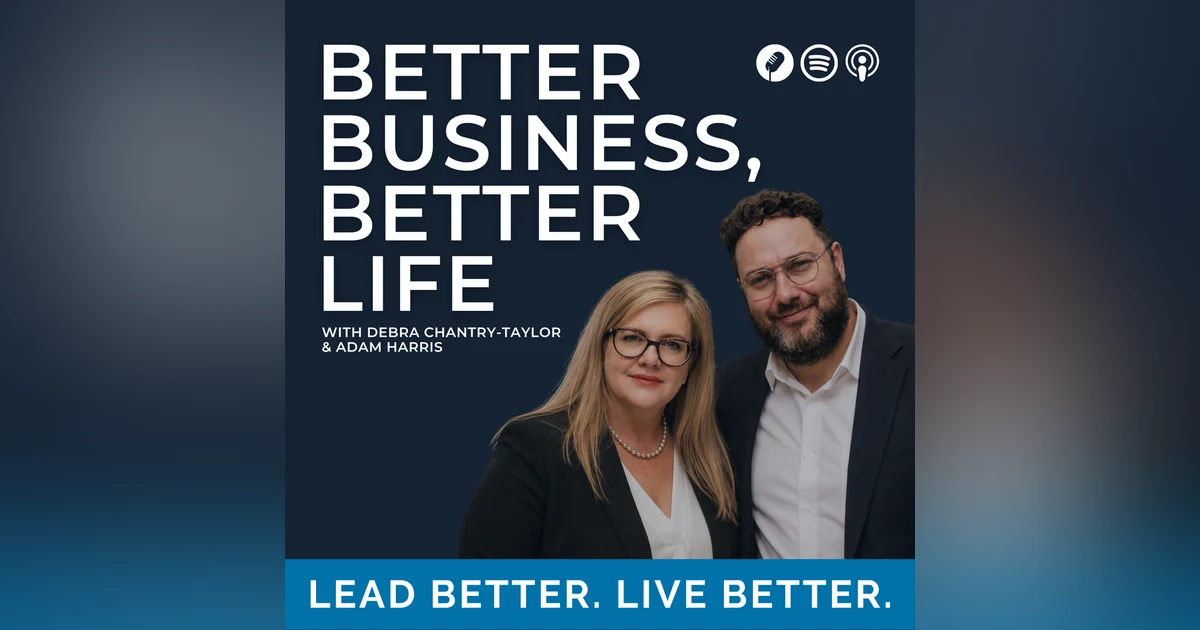
Debra Chantry-Taylor: Business Is a Game: What’s on Your Scoreboard
In this episode of Better Business, Better Life, Debra Chantry-Taylor explores why business is a game and how the principles of Formula 1 can help leaders create greater clarity, accountability & consistent performance.

 Spotify
 YouTube
 Amazon Music
 Apple Podcasts
 RSS Feed
 iHeartRadio
 PocketCasts
 RadioPublic
 In this episode of Better Business, Better Life, Debra Chantry-Taylor explores why business is a game and how the principles of Formula 1 can help leaders create greater clarity, accountability & consistent performance.
Debra compares running a business to competing in a Formula 1 championship, where everyone knows the rules, understands their role, knows the consequences & can see exactly what the scoreboard is measuring. She challenges leaders to look beyond individual wins, busy teams or one strong month and ask a more important question:
What championship is your business actually trying to win, and how do you know when you’re winning?
A major focus of the episode is the Scorecard. Debra explains why leaders need a small number of meaningful measures that show both what has happened & what is likely to happen next. Leading indicators such as quality sales conversations, appointments, proposals or demonstrations can provide an early warning when performance is heading off track, while revenue, profit & cash show the results.
The goal isn’t to punish people with numbers. It’s to use data to understand performance, spot problems earlier & make better decisions. The Formula 1 analogy also highlights the importance of clear roles & accountability. The leadership team acts like the pit wall, interpreting the information coming from across the business & giving the driver the right information at the right time. Clear ownership matters because when everyone owns a result, nobody truly does.
Debra also explores why this becomes particularly important in family businesses, where people can simultaneously hold family, ownership & employee roles. The episode looks at how businesses need to respond when conditions change, whether that’s a lost customer, changing interest rates, AI, regulation, tariffs or another unexpected disruption.
Like a racing team responding to a safety car or changing track conditions, strong businesses adapt without losing sight of the championship they’re trying to win.
This episode is a practical reminder that business is a game, but winning isn’t about one spectacular race. It’s about knowing what winning looks like, measuring what matters, making timely adjustments & consistently improving quarter after quarter.
CONNECT WITH DEBRA:
___________________________________________
►Debra Chantry-Taylor is a Certified EOS Implementer® | Entrepreneurial Leadership & Business Coach | Business Owner
►Connect with Debra: debra.chantry-taylor@eosworldwide.com
►EOS Worldwide Website: Debra Chantry-Taylor | EOS Implementer | EOS Worldwide
___________________________________________
Ep 292 Chapters:
00:00 – Introduction
02:07 – The Importance of a Scorecard
04:18 – Winning Races vs Championships
09:18 – Building High-Performing Teams
12:53 – Using Data to Improve Performance
15:47 – Executing Through Pit Stops
18:47 – Planning in 90-Day Cycles
20:30 – Managing Roles and Boundaries
22:14 – Defining Your Own Success
She is based in New Zealand but works with companies around the world.
Her passion is helping Entrepreneurs live their ideal lives & she works with entrepreneurial business owners & their leadership teams to implement EOS (The Entrepreneurial Operating System), helping them strengthen their businesses so that they can live the EOS Life:
- Doing what you love
- With people you love
- Making a huge difference in the world
- Bing compensated appropriately
- With time for other passions
She works with businesses that have 20-250 staff that are privately owned, are looking for growth & may feel that they have hit the ceiling.
Her speciality is uncovering issues & dealing with the elephants in the room in family businesses & professional services (Lawyers, Advertising Agencies, Wealth Managers, Architects, Accountants, Consultants, engineers, Logistics, IT, MSPs etc) - any business that has multiple shareholders & interests & therefore a potentially higher level of complexity.
Let’s work together to solve root problems, lead more effectively & gain Traction® in your business through a simple, proven operating system.
Find out more here - https://www.eosworldwide.com/debra-chantry-taylor
Debra Chantry-Taylor 00:00
Championships are won through consistency, race after race, point after point, week after week, quarter after quarter, doing the things that matter consistently. Clarity creates confidence. When people know where they're going, what winning looks like, and what their part in it is, they can get on with performing. Activity is not the same as progress. You can be incredibly busy while driving very quickly in the completely the wrong direction. Choose your championship. Don't accidentally enter somebody else's. Hello and welcome back to another episode of Better Business, Better Life. I'm your host Debra Chantry-Taylor and I'm passionate about helping entrepreneurs lead their best life through creating a better business. I am a certified EOS implementer, an accredited family business advisor, and also a trained leadership coach. And you may not know this; you may-I don't know-depends if you listen to the podcast before. But I love Formula One. I love all things fast, but particular Formula One cars, and I love racing cars, but we haven't talked about cars for a while, which frankly seemed a little bit remiss of me. So I thought it was time to talk a little bit about f1 and how it relates to business. If you've ever worked with me or you've seen me present on stage, you will hear me say a lot that business is just a big game, and I really mean that, and I don't mean it in a flippant way. It's not that business isn't serious. Obviously, there's livelihoods involved, there's money involved, there are families involved, and there are people who depend on us getting it right. But fundamentally, business is a bloody big game to me, and I think it should be. It should be fun. We should enjoy doing it. I always say that you know one of the reasons that we as human beings love sports so much is because because it's really simple to understand. There are rules in the game. We know exactly how we win and how we lose. We know how we can win points, score points. We know how we can get penalties. There are boundaries. There are guidelines, and there's a scoreboard that actually tells us how we're doing in comparison to others. There's a start, there's a finish, and there are absolutely consequences for the decisions you make, and penalties if you break the rules. But the most important thing is there's a bloody scorecard, right? So you do know whether you're winning, you know whether you're losing, you know how far ahead you are, you know how far behind you are, and you know what has to happen next. And that is how businesses should run. Business should have all of those things, and yet I walk into businesses all the time where nobody can answer one really simple question, and that is, are you winning? What I hear is, well, Debra, we're really busy, but that wasn't my question. Or I hear, we've got loads of opportunities. Lovely, go you. We've just hired three new people. Fantastic. Our customers seem really happy. Great, but are you winning? And if the answer is well, it depends what you mean by winning. Then we've already found our first problem, because if you don't know what winning looks like, how on earth do you expect your people to win? You've got to imagine running an F1 team is just like most businesses. Imagine this: you're driving an F1 car, you're doing 300 kilometres an hour. You're heading towards a corner, and you radio the pit wall. Guys, how are we doing? And someone replies, "Oh yeah, pretty good. What? Well, everyone seems quite positive. Brilliant. How far am I behind the car in front? Oh, not sure. We're probably low at the end of the next month. Excellent. And what are my tyres doing? Oh, we've got a meeting about that next Tuesday. Should I pit? Interesting question. Sarah's putting together a PowerPoint and some data on that. And Meil, meanwhile, you've driven to the bloody wall. It sounds ridiculous. I'm taking the piss because it is ridiculous. And yet businesses operate like this every single day. They're making decisions using information that is weeks and sometimes months old, or worse, they're making decisions based purely, entirely on feelings. They wait for the monthly management accounts to tell them what's happened six weeks ago, and that's not driving.
Debra Chantry-Taylor 03:50
That's looking in the rearview mirror and trying to steer. And if you think about it, Formula One is obsessed with knowing the score. One of the things I love about F1 is the extraordinary amount of information available. The driver knows what position they're in. They know the gap to the car ahead. They know the gap to the car behind. They know their lap time. They know whether they're gaining or losing every lap they're doing. The team knows what the tyres are doing. They know the temperatures. They know where the driver is gaining time. They know where they're losing it. They're watching the competitors. They're watching the weather. They're thinking about the pit windows. They're constantly asking, "What is happening right now, and what does that mean for what we should do next? Let's take the Hungarian Grand Prix as an example. Salando Norris won the race, right, and Max Verstappen finished behind second, 15.08 seconds behind him. Kimi Antonelli finished third, 18.728 seconds behind Norris, Charles Leclerc finished fourth 28.840 seconds behind, and Lewis Hamilton, which you should know is my favourite because he's British and he also drives a Ferrari. How does it get better than that? Well, he finished fifth 24.54 seconds behind. Nobody in that race crossed the finish line wondering. How do you reckon we went? They knew. Norris knew he'd won. Verstappen knew he was second, and Tanelli knew he was third. And I'll bet that was pretty disappointing for him because he's been doing reasonably well at the beginning of the season. But every single driver knew their position. Every team knew the result. There was no ambiguity. There was a scorecard, and yet here's where it gets really interesting, because winning that race is not the same as winning the championship. After Hungary, Kimini Antonelli is still leading the 2026 drivers' championship with 219 points. Lewis Hamilton, again my favourite, is second with 169. George Russell is third with 160. Charles Leclerc is fourth with 138. Lando Norris, despite winning Hungary, is fifth with 128. Max Verstappen is sixth with 109. Oscar Piastri is seventh with 92. So think about that for a moment. The person who won the most recent race is actually fifth in the championship, and the person who came third in that race is leading it by 50 points. And that is such a brilliant lesson for business, because there's a massive difference between winning a race and winning the championship. Same goes for business, right? One brilliant month doesn't make a great business, and businesses get very excited about individual races. We had our biggest sales month ever. That's brilliant, and you know me. I want to celebrate success. But what happened the month before? What happened the month after? We landed this enormous customer, fantastic. But how much of your revenue now depends on that one customer? Are you now got? Have you now got all your eggs in one basket, as I would say? We smashed our quarterly target again, excellent. And don't get me wrong, I want to celebrate success. But are you going to do it again? And one brilliant month does not make you a great business. One enormous customer doesn't make you a great business. One fantastic product launch doesn't make you a great business. One superstar salesperson doesn't make you a great business. Just like one race win doesn't make you world champion. Championships are won through consistency, race after race, point after point, week after week, quarter after quarter, doing the things that matter consistently, and actually quite often they're doing the boring stuff extraordinarily well. Whether you like it or not, that's business. And I know consistently doesn't sound very sexy. Nobody's making a Netflix series called doing the important stuff consistently every bloody week, but perhaps they should, because that's actually how great businesses are built. So, what championship are you trying to win? Let's link this properly back to your business. The first question is, what championship are you actually trying to win? And then, what does winning look like? Because there's something I see all the time. Businesses have goals, sort of. You know, we want to grow by how much? We'd like to be profitable. How profitable? We want a great culture. What does that actually mean? We want to be the best in our industry. According to whom?
Debra Chantry-Taylor 07:46
We want to give great customer service or excellent customer service. Measured how? None of these things are bad aspirations, but they're not a scorecard. If I put you in an F1 car and said your objective today is to drive quite quickly, you quite rightly think I was a bloody idiot. Quite quickly compared with what? What are we trying to achieve? What are the rules? Where are we going? How do we know with what? And using Adam and my favourite phrase, clarity creates confidence. When people know where they're going, what winning looks like, and what their part in it is, they can get on with performing. Without clarity, you get activity, lots and lots of activity. People running around, meetings, emails, projects, new initiatives, stuff. Everybody is terribly busy, but activity is not the same as progress. You can be incredibly busy while driving very quickly in the completely the wrong direction. And let's face it, there's always more than one scorecard. This year's F1 standings give us a really great, interesting lesson because it isn't just a drivers' championship. There's also a teams championship. After Hungary, Mercedes is now leading with 379 points. In fact, they've led almost the entire season. Ferrari is second with 307. McLaren has 220, and Red Bull Racing has 177. And this is where it gets really interesting from business perspective. So Kimi Antonelli is leading the drivers' championship for Mercedes with 219 points. His teammate George Russell is third with 160, and together they give Mercedes 379 points, and they lead in the team's championship. That's the organisation. That's the business. Because you can have an outstanding individual performer, but ultimately the organisation has to perform. The business has to perform, and that's where I see businesses getting it wrong all the time. They come, they become completely dependent on one superstar. One salesperson has all the relationships. One manager knows how everything works. One founder makes every decision. One person has all the technical knowledge, and that isn't strength. To be honest, that's a real risk. A championship-winning business needs the whole team contributing. Different people will contribute differently. They'll be absolute star performers, but the organisation cannot be entirely dependent on one person, and particularly not the owner. If your business cannot function properly without you, you haven't necessarily built a great business. You may have built yourself a very complicated job, and we tend to think of Formula One as an individual sport. We talk about the drivers, but even the driver cannot win alone. The driver is not the team, not even close. There are hundreds of people involved. We've got the engineers, the strategists, the mechanics, the designers, the data analysts, the people back at the factory, the people on the pit wall, the pit crew-everybody has a role, and everybody needs to understand what they're accountable for. Imagine a pit stop where somebody says, "Oh, I thought Dave was doing the left front tyre. Well, Dave thought you were doing it, was I? Not sure. Where is Dave? Oh, he's working from home today, again I'm taking the piss. But meanwhile, if that was a scenario, the car is still sitting there. The race is over, which just shows that roles matter and accountability matters. And this is exactly what happens in businesses when you have vague accountability. Three people are responsible for something, which generally means nobody is responsible for it. Everybody assumes somebody else was doing it. Everyone was copied into the email. Everyone attended the meeting. Everyone had an opinion, but nobody actually owned the result. And you need absolute clarity around who owns what, not who helps, not who contributes, not who attends the meeting, who owns the result. Because when everybody owns something, nobody owns it. Another analogy for you. I love this analogy. Your leadership team is your pit wall. The person driving cannot see everything, and I think this is really important, particularly for founders and business owners. I think this is particularly important for founders and business owners because some founders think they should see everything. They think they should know everything. They think every decision needs to come through them, but it doesn't. If you're driving the car at 300 kilometres an hour, you cannot also be watching every competitor, analysing weather patterns, calculating tire degradation, and deciding the optimal pit window.
Debra Chantry-Taylor 11:53
You need people you trust, and those people need information they can trust. Your leadership team should be looking at the business and asking, what are we seeing? What are we gaining? Where are we losing? What's changing? What do we need to do? What's coming around the corner? What does the driver need to know? And crucially, what does the driver not need to know? Because good communication isn't about dumping every piece of available information on someone. Imagine an F1 engineer spending four laps explaining a spreadsheet. Nope, the communication has been really clear, concise, relevant, useful. Less is more. That's what great leadership teams do. Now that brings us to one of my favourite business tools, and that is the scorecard. And let's face it, your scorecard is your dashboard. And I know the word scorecard doesn't exactly get the adrenaline pumping. No one's ever said Debra had the most incredible weekend, champagne, fabulous food, and then we finished it off with a really sexy spreadsheet. Although to be fair, I probably know a few people who might, maybe I'm more of them. But a good scorecard is incredibly powerful because your scorecard is your dashboard. It should contain a relatively small number of meaningful numbers that tell you whether the business is on track, not 97 numbers, not every possible metric you can drag out of your software, not a 14-page report that nobody actually reads, but the things that really matter: sales activity, conversion, revenue, margin, cash, customer satisfaction, delivery, productivity, staff retention, whatever drives your business. And again, if you've worked with me or seen me speak on stage, I talk about every single business: sells shit, makes shit, and bills for shit. That's what you have to do to run a business. Now, your shit can be whatever it might be. It might be a product, it might be a service. But that's what drives your your business. If they're the major functions of your business, is your dashboard telling you if those major functions are operating as they should. Is it telling you where there's issues in those major functions? And wherever possible, you want leading indicators, right? There's no point in telling me the things that have already happened because an F1 team doesn't wait until the car crashes before saying, "Ah, interesting. Apparently the tire was overheating. They're watching the signs and your business needs to do the same. You need to measure the things that predict the result. Revenue matters, profit matters, cash matters enormously. But many of those are results. They tell you what happened. That's the rearview mirror. What are the things that tell you what's going to happen? If you need a certain number of new customers every month, what creates those customers? Perhaps it's conversations, appointments, proposals, quotes, demonstrations, whatever it is. But let's say you know that if your sales team has 100 quality conversations each week, history tells you roughly what will happen next. Now we've got something useful. If that number drops from 100 to 60, we don't have to wait three months for revenue to fall. We know now the warning light on that dashboard has come on, and that is why numbers should never be used as a weapon. A red number isn't automatically who screwed up. A red number is what is this telling us, and that's a very different conversation. Is something changing? Is there a problem? Does somebody need help? Has the market moved? Is the process broken? Do we have the wrong person in the seat? Are we measuring the wrong thing? Number creates the conversation; it doesn't replace the conversation. So please stop punishing people with data. I think some people resist measurement because they've experienced it badly. I know I certainly have. You've worked somewhere where they use numbers to beat people over the head. You missed your target. You read. Explain yourself. That isn't accountability. That's lazy management. In Formula One, telemetry isn't there to make the driver feel bad. It's there to make the car go faster. Think about that. The data exists to improve performance, not to humiliate somebody, not to catch them out, not to give a manager something to shout about, but to improve performance, and if you can create that culture in your business, numbers become much less frightening. We can look at reality without immediately needing to defend ourselves.
Debra Chantry-Taylor 15:50
We can say, "Yep, that number is off. Great. Why? What do we learn? What do we need to change? What help is needed? So let's now talk about pit stops. What is pit stops? Because this one makes me laugh when I compare it with business. If an F1 team knows the problem with a tire, they don't say, "Let's keep an eye on it for the next six months. They don't put it on a list, then carry it forward to next week, then carry it forward again, and then discuss it again and discuss it again, and then eventually stop putting it on the list because everybody's sick of talking about it. They fucking deal with it. Excuse my language, but they deal with it. Obviously, they have to choose the right moment. Strategy matters, but they don't pretend the problem isn't there. But businesses do all the time. We know there's a people issue. We know there's a customer issue. We know the process doesn't work. We know the margin is disappearing. We know one part of the business is consistently underperforming. We know there's a bloody big elephant sitting in the middle of the meeting room that everybody has carefully agreed not to mention. We know, but we keep driving around the circuit hoping the tire will magically repair itself. Guess what? It won't. Sometimes you have to come into the pits. Sometimes you have to lose a little time now so you don't lose the entire race later, or worse, still lose a life, and that can mean making a difficult decision, changing a process, having the hard conversation, moving somebody on, stopping something, firing a customer, changing your strategy, spending money, not spending money. Great businesses solve issues; they don't just admire them. And sometimes in business, you need a safety car too, because sometimes circumstances change. There's an accident, weather changes, the safety car comes out, suddenly everybody's strategy changes in the race, and that's the same in business. COVID was a fairly spectacular safety car, interest rate changes, technology changes, AI changes what's possible. A competitor enters your market, a major customer disappears. We did that whole thing again. Let's face it, COVID was a fairly spectacular safety car, and there's others. Interest rate changes, technology changes, IA changes what's possible. A competitor enters your market, a major customer disappears, regulation changes, and all of a sudden your market shrinks substantially. Something happens on the other side of the world that suddenly affects your supply chain. Hate to say it, but look what's happening with the U.S. right now. I've got clients that have had major issues around the tariffs coming from the U.S. and we can't control all of these things. But you can control how quickly you recognise the race has changed. This is where businesses sometimes get themselves into trouble. They become so committed to the original plan that they ignore reality. Strategy matters, but strategy isn't blindly following a plan when the conditions have completely changed. Changed, but strategy isn't blindly following a plan when the conditions have completely changed. If it starts pouring with rain during an F1 race, nobody says. But our annual strategy says we're using slicks. Conditions have changed, we adapt, and that's what good businesses do. It's also I love working in 90 day periods. A year is too long. People say we'll achieve this by December. It's February. Lovely, but then suddenly it's September. Everybody goes. Oh shit! We said we're going to do that this year. 90 days gives you the urgency. It gives you a race within the championship. What are the handful of things we absolutely need to get done the next 90 days? Who owns each one? What does done look like? Are we on track? Then we review what worked, what didn't, what did we learn, what needs to change, and we go again, race after race after race, always contributing towards the championship. And you know, those of you who know me, I'm an avid reader. I just finished rereading the Rockefeller Habits a couple of weekends ago, and the the thing that I took from that and reminded myself of, there are only really two important things in business. There is the long term goal. What does winning look like? And if you don't know where you're going, any road will get you there.
Debra Chantry-Taylor 19:47
That's a saying that was kind of derived from Alice in Wonderland and the Cheshire Cat, but it really just says if you're not really clear about where you're going, then yeah, how do you know what you need to do to get there? And the second most important thing. The 90-day plan, because all the rest in between, let's be really honest, is a load of bollocks. We're pretty much guessing what's going to happen. It's the 90-day bite-sized chunks of things we absolutely have to do to make sure that we actually go towards our longer-term target. I'm not saying the one-year plan. We, of course, we have to understand what our one-year plan looks like. Of course, the three-year picture needs to be clearly defined. Of course, the three-year picture needs to be clearly defined. But it really is that long-term vision, that 90-day thing, is the championship and the race after race after race. So, a good reminder that if you can get those two things right, that's when you're going to win. So, what happens when somebody breaks the rules? I keep talking about rules about boundaries. That's why we love playing sport. So sport also has something that businesses sometimes struggle with. It has consequences. If you repeatedly exceed track limits, there's a consequence. If you break the regulations, there's a consequence. If you cause certain incidents, there can be a consequence. You don't get, oh well, he's been here for eight years. He's actually really quite a nice guy, so we're just going to ignore it. But businesses do that, especially family businesses, and this is where things can get really interesting, because in a family business, somebody might be wearing three different hats. There could be a family member, an owner, and an employee working in the business, and those are three completely different roles, and the expectations in each are different. Being dad's daughter doesn't automatically make you the best person to run sales. Owning shares doesn't automatically mean you should have an operational role. Being brilliant operationally doesn't automatically give you the right to make every ownership decision. And being mum, dad, brother, sister, son, or daughter doesn't mean normal accountability suddenly disappears. If you blur those boundaries, accountability becomes incredibly difficult because suddenly we're not talking about performance; we're talking about Christmas lunch, and nobody wants to upset mum. And this is why family businesses need even greater clarity around which hat people are wearing. Are we having a family conversation? Is it an ownership conversation or is it a business conversation? Clear roles, clear expectations, clear rules, clear consequences. And again, our favourite saying: clarity creates confidence. You also need to know which race you're running. There's another trap that I see business owners fall into. They're watching everybody else. The competitor has launched something. Someone on LinkedIn is doing this. Another company has opened another office. Somebody raised money. Somebody sold their business. Someone has 100 employees. So fucking what? Are they running your race? One f1 team cannot simply copy another team's strategy without understanding its own car, tires, drivers, and race situation. Your business is the same. Know your competitors absolutely. Pay attention, learn from them, but don't spend the entire race staring sideways. You need to know what your definition of winning is. Maybe you want $100 million business, brilliant. Maybe you want a highly profitable $5 million business that gives you enormous freedom, also brilliant. Maybe you want to build something that your children can own for another three generations. Maybe you want to sell it in five years. Maybe you absolutely do not want your children anywhere near it. Also, fine. There is no one definition of winning, but there does need to be your definition. Choose your championship. Don't accidentally enter somebody else's. And you're as the driver, you've got to trust your team. There's another huge F1 lesson, right? It's about trust. The driver has to trust the team, and the team has to trust the driver. They will disagree sometimes. The driver has information from inside the car. The pit wall has the information the driver cannot see, and neither has the complete picture alone. And great businesses are exactly the same. The person closest to the customer may know something the CEO doesn't. The person on the factory floor may see something the leadership team can't see.
Debra Chantry-Taylor 23:48
Your finance person may see a trend before anybody else does. Your salesperson may be hearing something from customers that hasn't yet shown up in the numbers. That information has to travel, and people have to feel able to say, Houston, we have a problem. I would much rather somebody tell me there's smoke coming out of the engine and wait until the bloody thing catches fire because they didn't want to upset me. That's where direct caring conversations matter. Sometimes caring about somebody means challenging them. Sometimes caring about the business means saying something uncomfortable, and that's what I mean when I talk about carefrontational change makers, we don't challenge people because we want enjoy confrontation. We challenge because we care about them, the business, and the results they want. Avoiding a difficult conversation isn't kindness if the problem continues to get worse. And winning doesn't mean winning every race. I want to come back to Kimi Antonelli for a moment because the current championship illustrates this so beautifully. He finished third in Hungary. Norris beat him. Verstappen beat him. But Antonelli walked away, still leading the championship with 219 points, 50 points clear of Lewis Hamilton in second. And actually, if you look at Lewis Hamilton, you know he hasn't actually done all that well in in a number of races. But he has got on the podium a few times, and he's in second place. Mercedes also walked away, leading the team's championship with 379 points, 72 ahead of Ferrari, and that's the bigger game. And business owners need to remember that you will lose sometimes, a competitor will beat you, a proposal will go elsewhere, a brilliant employee will leave, a product will fail, and a decision will turn out to be wrong. You're going to have a terrible month. You may have a terrible quarter. Again, welcome to business. One bad race doesn't make a bad season. What matters is what you do next. Do you understand why? Do you learn? Do you make the adjustment? Do you get back on the grid? Because resilience isn't pretending everything is fabulous. It's about being able to look at reality, learn from it, and keep going. So, are you actually winning? Here's what I want you to think about this week. If I walked into your business at 10 o'clock on Monday morning and asked, "Are you winning? Could you answer me? Not with a story, not with a feeling, not with a "we're really busy. Could you show me? Could your leadership team show me? Could your people tell me what winning means in their role? Do you have a handful of numbers that tell you whether you're on track? Do you look at them every single week? Do you have leading indicators that warn you when something is starting to go wrong? That's the yellow light on the dashboard. When something does go off track, do you actually solve it? Does everybody know what they're accountable for? Do you know your priorities for the next 90 days? Does everybody know the part they play? And ultimately, do you know which championship you're trying to win? Because business is a game. There's a destination. There are rules. There are players. There are competitors. There are consequences. There are wins. There are losses. And there should be a scoreboard. You don't need to win every lap. You don't need to win every race. But you absolutely need to know whether you're getting closer to winning the overall championship. So when you walk into work on Monday morning, stop asking how we're doing. Ask a much better question: Are we winning? And then use the follow-up. Show me the numbers, because once you know where you are, you can decide what needs to happen next. You can change strategy. You can make the pit stop. You can solve the issue. You can help somebody perform better. You can push harder. You can back off. You can change tires, and if you really need to, you can change drivers. But at least you're making an informed decision, and that is the point. The scorecard or the dashboard isn't there to make you feel good. It also isn't there to make you feel bad. It's there to tell you the truth through data. And the businesses willing to look at the truth every single week are the businesses that give themselves the best chance of winning.
Debra Chantry-Taylor 27:34
So go have a look at your dashboard. Ask yourself what championship you're trying to win. Ask your leadership team whether they know the score, and if the only warning light flashing at you is the fuel light in your actual car, you may have slightly missed the point. Hope this was helpful. Look forward to seeing you next time. And by the way, this was recorded a couple of weeks ago, so we've probably been we've probably had the next f1 race already. So please excuse if this is a little bit out of date, but I promise you'll be back to share some more lessons that we learn as the season continues. Have a great week. Enjoy driving.

EOS Implementer | Entrepreneurial Leadership Coach | Workshop Facilitator | Keynote Speaker | Author | Business Coach
Debra Chantry-Taylor is a Professional EOS Implementer & licence holder for EOS Worldwide.
As a speaker Debra brings a room to life with her unique energy and experience from a management & leadership career spanning over 25 years. As a podcast guest she brings an infectious energy and desire to share her knowledge and experience.
Someone that has both lived the high life, finding huge success with large privately owned companies, and the low life – having lost it all, not once but twice, in what she describes as some spectacular business train wrecks. And having had to put one of her businesses into receivership, she knows what it is like to constantly be awake at 2am, worrying about finances & staff.
Debra now uses these experiences, along with her formal qualifications in leadership, business administration & EOS, to help Entrepreneurial Business Owners lead their best lives. She’s been there and done that and now it’s time to help people do what they love, with people they love, while making a huge difference, being compensated appropriately & with time to pursue other passions.
Debra can truly transform an organisation, and that’s what gets leaders excited about when they’re in the same room as her. Her engaging keynotes and workshops help entrepreneurial business owners, and their leadership teams focus on solving the issues that keep them down, hold them back and tick them off.
As an EOS implementer, Debra is committed to helping leaders to get what they want and live a better life through creating a bet… Read More