Autism 1 in 31: What It Means for Profound Autism Families with Mike Carr
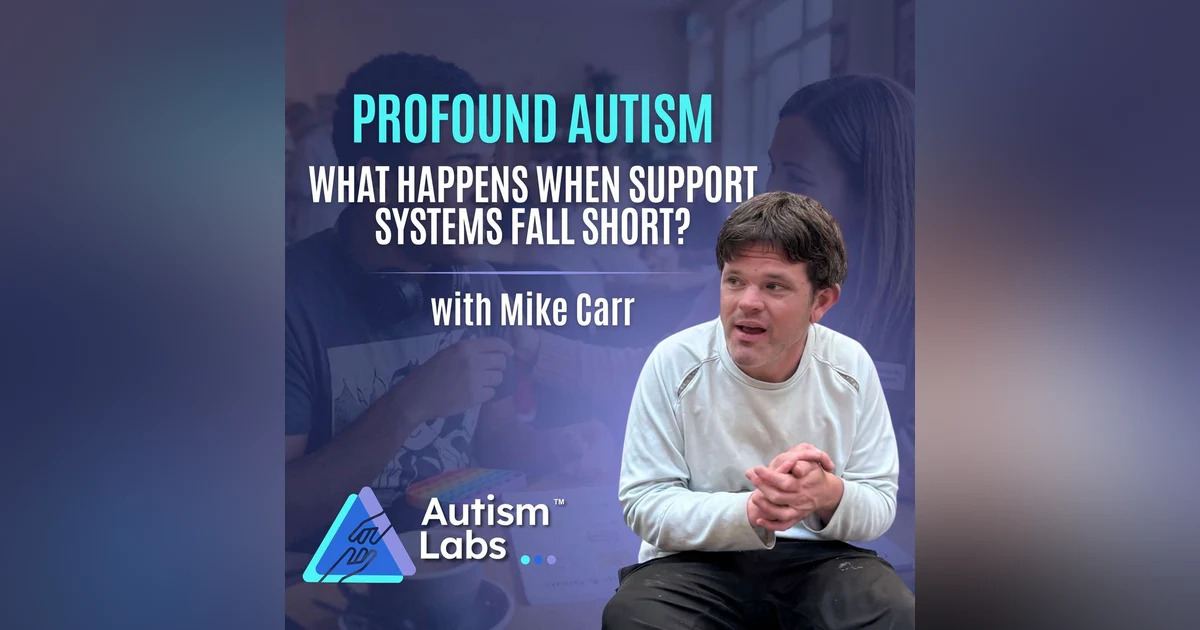

Autism 1 in 31: What Does It Mean for Profound Autism Families? Autism prevalence has changed significantly over the past several decades, but what do those numbers mean for families living with profound autism and significant support needs? In this episode of Autism Labs, Mike Carr examines the latest CDC autism prevalence data and reflects on his family's experience raising a son with profound autism. The CDC's Autism and Developmental Disabilities Monitoring (ADDM) Network estimated that a...


Autism 1 in 31: What Does It Mean for Profound Autism Families?
Autism prevalence has changed significantly over the past several decades, but what do those numbers mean for families living with profound autism and significant support needs?
In this episode of Autism Labs, Mike Carr examines the latest CDC autism prevalence data and reflects on his family's experience raising a son with profound autism.
The CDC's Autism and Developmental Disabilities Monitoring (ADDM) Network estimated that about 1 in 31 8-year-old children were identified with autism in 2022 across 16 U.S. surveillance communities. The CDC also reports substantial variation in identification rates across communities and notes that differences in evaluation and identification practices are an important part of the picture.
Mike goes beyond the headline statistic to discuss what these numbers could mean for families who need intensive, lifelong support.
He explores the challenges of profound autism, communication difficulties, behavior support, caregiving, adult services, and the transition out of the school system. He also discusses how AI, wearable technology, and skilled practitioners could potentially contribute to new approaches for supporting people with complex needs.
In this episode, you'll hear about:
• The CDC's 1-in-31 autism prevalence estimate
• Why autism prevalence statistics need context
• How autism identification has changed over time
• The unique support needs associated with profound autism
• Communication and behavior challenges
• Lifelong caregiving and adult services
• What happens when autistic students age out of school services
• The need for better support after age 22
• Technology, AI, and wearable tools in autism care
• Why clear and informed communication matters
Whether you're the parent of an autistic child, teen, or adult, a caregiver, family member, or professional working in autism services, this episode offers a personal look at some of the challenges families are navigating now and the questions we need to consider for the future.
🎙 ABOUT AUTISM LABS
Autism Labs helps parents and caregivers better understand autism, communication, behavior, caregiving, adult services, and the transition into adulthood.
Website: https://www.autismlabs.com/
Newsletter: https://www.autismlabs.com/add-a-post/blog/
00:00 - Introduction: RFK Jr.'s Comments on Autism
01:00 - Autism Rates Surge: 2020 vs. 2022
03:05 - The Role of Better Diagnosis vs. Rising Incidence
04:00 - What's Driving the Increase in Autism Diagnoses?
05:10 - The Impact of Severe Autism on Families
07:25 - Autism Labs and J13: Providing Better Outcomes
Mike Carr (00:05):
Well, this week I have to talk about something that's been in the press recently when it comes to autism, and that's RFK Junior's statements about autism as well as the c's, updated statistics. So let's talk about the statistics. And I also want to talk about one thing that's just hugely important that RFK Junior has gotten right. And I know there's a lot of controversy around a lot of what he said, and he's pissed off a lot of folks in the autism space. But this one statement is really worth thinking about. So what's the stat? The stat was back in 2020, the incidence rate of autism was one in 36 amongst 8-year-old children. That was how many 8-year-old children being diagnosed or how many 8-year-old children would have autism? And two years later, just two years later, 2022, the CDC, that's dropped to one in 31.
(01:02):
Huge increase, right? Going from one in 36 to one in 31 in just two years. Big deal. So RFK has said a lot of things. RFK Junior said a lot of things. But the one thing that he said, which I think is worth thinking about, and it has incredible implications, and there's also an insight to be gained, is autism is a more severe, a more urgent pandemic than even Covid. And that's not exactly what he said, but I think it's the gist of it, and that's put a lot of people off. But I think it's worth thinking about. Our son was born December 28th, 1989, and he was diagnosed a year later. Well, he wasn't diagnosed, but we had him. We had a lot of specialists look at him a year later. So in 1990, the incidence rate of autism was one in 10,000, one in 10,000.
(01:58):
Now since then, it's obviously increased exponentially. And a lot of people attribute, or some people attribute a great part of that increase to improved diagnoses, right? Well, now they understand what autism is, they understand how to check for it, how to diagnose it earlier. They're including other types of things that maybe weren't back in 1990, considered autism like Asperger's, higher functioning folks that can be more mainstreamed and maybe are savants or brilliance in certain areas, but have other challenges when it comes to social. And certainly part of the increase, I would agree, can be attributed to a better diagnosis or a broader diagnosis. But one of the points that I think RFK Junior makes and that we certainly would agree with is it's not just diagnosis. That it actually is truly increasing at a scary rate. And I can remember when our son was 2, 3, 4 years old and we were going to doctor's offices and no one had ever seen anyone with autism, and most educators hadn't either.
(03:06):
And so we'd take him to schools and say he's autistic, and they really didn't understand what that was. And so they'd stick him in a class with other people with variety of other challenges. But it was such a new beast because there were so few kiddos. This is in Dallas-Fort Worth. This is a major metropolitan area, even back in 1990. And we took him to the leading metabolic specialist in the metroplex, the autism expert who looked at him and tested him for a couple hours and flat said, he does not have autism. He was wrong. Today, if you look at the checklist, our son would've checked just about every box when he was two years old or three years old in terms of autistic tendencies and what you look for. But it was such a rare bird. So one of the things that's so compelling and so interesting to think about is if it is increasing exponentially, why is it increasing?
(04:04):
And what do we all need to do to further that diagnosis or that solution to autism if there is such a solution or understanding of what's causing the problem? Now, RFK JR put out a very ambitious goal of sometime this fall. They would hopefully have that answer. I don't think that's going to happen. I don't think most researchers think that's going to happen. But one of the things that I think is hugely important and something that will make a difference is clear communication, informed communication. And here are a couple examples about one fourth, maybe a little bit more. But let's say one fourth of those that are diagnosed with autism are severely autistic like our son, and they're much lower functioning nonverbal or limited verbal IQs typically have 50 or less, certainly 70 or less behavior problems, maybe fine most of the time. But then all of a sudden they run off the rails and they'll bite somebody or they'll throw a fist at somebody, they'll bang their head against the wall.
(05:16):
That percentage is a big deal because they're extremely expensive to care for. Our son qualifies for an HCS waiver. So he gets one-on-one care from the time he wakes up the time he goes to bed seven days a week, 365 days a year. That costs a lot of money. And we're fortunate enough that Medicaid picks up a lot of that and then we can pick up some too. And there are other kiddos like our son who qualify for even higher levels of care. So if you look at the lifetime of what that investment, what the taxpayer is have to pay, what we all are going to have to pay, it's millions of dollars for every person like that. And when you look at this exponential growth, one in 10,000 in 1990 to one in 30, one in 2022, so it's probably even higher today. And a fourth to 30% of those are severely or profoundly autistic.
(06:26):
And there's not going to be a cure, right? Once the brain's developed, I think the best practices, all the research shows, that's just the way they're going to be. You might be able to mitigate some problems with technology. You might be able to improve communications, and there's that communications word again, but you're never going to cure their autism. And so when we talk about communications, it's not just clearly understanding that autism is not the same for everybody that there are, it's on a spectrum, right? There are many shades of autism, and those at the lowest end are the ones that require the most empathy, the greatest degree of support. And that number is exploding. So in spite of some of the misstatements perhaps that RFK Junior made and the misinformation that he communicated, that portion of the population is aging out of the school system at 22, and it's like dropping off a cliff, right?
(07:26):
The parents don't know what to do, and it is a huge problem, and it's going to cost more money than the federal government has the states have with the current procedures, processes, solutions in place. So what we're trying to do through autism labs and through our boots on the ground nonprofit, J 13, is take technology, both AI technology and other types of technology wearables, and couple that with some of the best trained skilled practitioners and therapists, so we can provide a better outcome for those that are severely autistic, that have multiple IDDs at a lower cost. And we've only been doing this for a year or two, but we think we're onto something. We think we actually have a process that's working and we're going to start collecting more and more data and hopefully come back to you a year from now with some hard science and some hard numbers to show that we have something that really is scalable and it's going to work. So that's it for today. Thank you for joining us. We'll get back next week or next time with some more, I think, practical tips, but I had to speak to RFAK Junior's comments. I do think autism is arguably a bigger deal than covid because it's not cured and the increase is exponential, and it's not going down. It's only going up. But if we communicate clearly and if we communicate with an informed viewpoint, it's just going to help everybody. Have a great week. Talk to you again soon. Bye.


