Episodes
Feb. 10, 2025
An Historical Overview: The Growth of Marriage as Avenue of Holiness | Fr. Thomas Petri, O.P.
Fr. Thomas Petri provides a historical overview of the evolving understanding of marriage as a path to holiness within the Catholic Church, set against the backdrop of societal changes, medical advancements, and challenges to traditional Christian views...
Guest: Fr. Thomas Petri, O.P.
Feb. 7, 2025
Cosmological Apologetics: For and Against Creation | Prof. William E. Carroll
Does the Big Bang prove God? In this lecture, Prof. William E. Carroll explores how cosmological arguments for and against a creator often get it wrong by confusing creation with a temporal beginning, a mistake that Thomas Aquinas can help us avoid...
Guest: Prof. William Carroll
Feb. 6, 2025
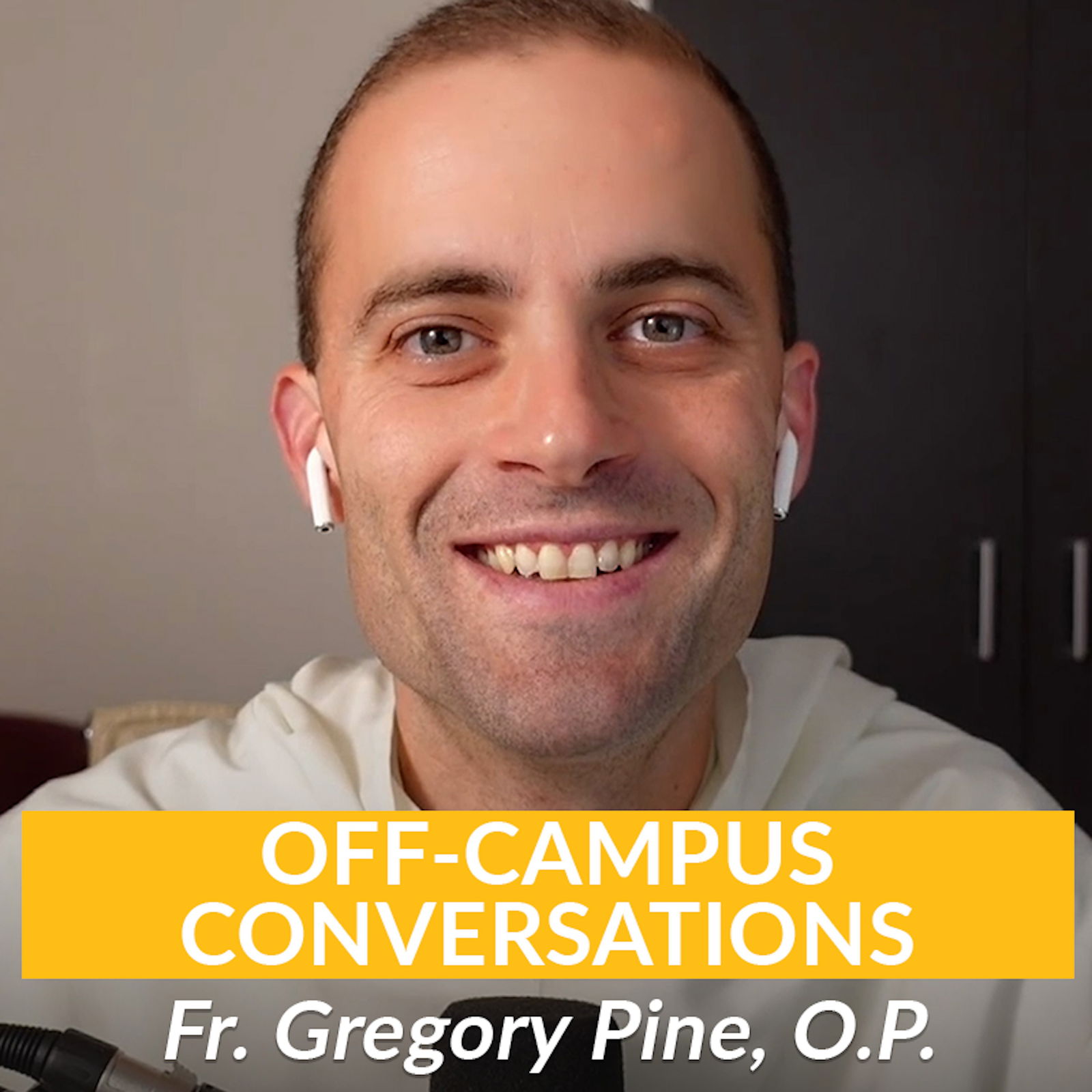
How the Sacraments Can Change Your Life w/ Fr. Gregory Pine, O.P. & Fr. Dominic Langevin, O.P.
What role do the sacraments play in human flourishing? Why do we need them? How can they change your life? Join Fr. Gregory Pine, O.P. of Aquinas 101, Godsplaining, and Pints with Aquinas for an off-campus conversation with Fr. Dominic Langevin, O....
Feb. 5, 2025
Aquinas's Shortest Way to God’s Existence, and How Darwinism Fits Within It | Fr. Stephen Brock
Fr. Stephen Brock explains Aquinas's Fifth Way, focusing on the governance of things and how natural bodies without cognition display goal-oriented activity, ultimately placing the Fifth Way into dialogue with Darwinism.
Guest: Fr. Stephen Brock
Feb. 4, 2025
Is Atheism Rational? | Prof. John O'Callaghan
Professor John O'Callaghan argues that atheism is not inherently irrational, exploring its varied historical meanings and proposing that, while not necessarily true, it can be a rational pursuit driven by a desire for truth.
Guest: Prof. John O'Callaghan
Feb. 3, 2025
More than Spiritual: Proofs for the Existence of God | Prof. Joshua Hochschild
Professor Joshua Hochschild argues that Aquinas' proofs for God's existence, specifically the first way, are simple, accessible, and not merely spiritual exercises, but rather starting points for a deeper understanding of God and the relationship b...
Guest: Prof. Joshua Hochschild
Jan. 31, 2025
Divine Causality and Human Freedom | Prof. W. Matthews Grant
Professor Grant examines the traditional Christian doctrine of divine universal causality, exploring how God can be the cause of all things, including human free acts, and how this relates to our understanding of freedom and responsibility.
Guest: Prof. W. Matthews Grant
Jan. 30, 2025
God's Response to the Problem of Evil | Dr. Medi Volpe
Dr. Medi Volpe explores God's response to the problem of evil by contrasting modern theodicy against the approach of early Christians, emphasizing the Incarnation and human action as integral to God's response.
Guest: Dr. Medi Volpe
Jan. 29, 2025
Creation: Mercy Beyond Justice | Prof. John O'Callaghan
Professor John O'Callaghan delves into St. Thomas Aquinas's understanding of God's mercy in creation, addressing the apparent paradox of extending mercy to non-existent beings by examining the transition from non-being to being.
Guest: Prof. John O'Callaghan
Jan. 28, 2025
God's Justice According to St. Thomas' Reading of the Apostle Paul | Fr. Andrew Hofer, O.P.
Fr. Andrew Hofer explores St. Thomas Aquinas's understanding of God's Justice as revealed in the Gospel and the writings of St. Paul, emphasizing its connection to grace, truth, and the conformity of creation to God's intellect.
Guest: Fr. Andrew Hofer, O.P.
Jan. 27, 2025
God's Mercy According to St. Thomas' Reading of the Apostle Paul | Fr. Andrew Hofer, O.P.
Fr. Andrew Hofer explores St. Thomas Aquinas's understanding of God's mercy in the writings of St. Paul, paying particular attention to Mercy's relationship to Divine justice and its transformative activity in Christian life.
Guest: Fr. Andrew Hofer, O.P.
Jan. 24, 2025
Catholic Feminism | Erika Bachiochi
In this lecture, Erika Bachiochi discusses Catholic feminism, her encounter with St. John Paul II's Theology of the Body and her subsequent intellectual journey, and the historical roots of feminism in Christian thought, particularly focusing on th...
Guest: Erika Bachiochi
Jan. 23, 2025
True Courage: On Facing Death with Fortitude | Fr. Gregory Pine, O.P.
Fr. Gregory Pine discusses the virtue of courage, exploring its complexities, its relationship to the passions, and its importance in living a complete and virtuous life.
Guest: Fr. Gregory Pine, O.P.
Jan. 22, 2025
What is the Separated Human Soul? Incomplete Person, Survivalism or Corruptionism | Prof. Daniel De Haan
Professor Daniel De Haan explores the Thomistic debate surrounding the nature of the separated human soul after death, contrasting survivalism, corruptionism, and incompletionism to understand whether the soul retains personhood after death.
Guest: Dr. Daniel De Haan
Jan. 21, 2025
What Happens After Death? | Prof. Jeffrey Brower
Professor Jeffrey Brower explores Aquinas's view of human nature, contrasting it with materialism and substance dualism, focusing on the relationship between body and soul and what happens at death.
Guest: Prof. Jeffrey Brower
Jan. 20, 2025
Politics and the Modern State: Understanding the Common Good | Prof. Brad Lewis
Professor Brad Lewis discusses the concept of the common good in politics, contrasting contemporary Catholic social teaching with Aquinas's view and addressing criticisms of both.
Guest: Prof. Brad Lewis
Jan. 17, 2025
Bored to Tears: Confronting the Taedium Vitae with Thomas Aquinas | Fr. Stewart Clem
Fr. Stewart Clem examines the concept of boredom ("taedium vitae") through the lens of Thomistic moral theology, defining it, exploring its subjective and objective dimensions, and distinguishing it from related concepts like sloth (acedia).
Guest: Fr. Stewart Clem
Jan. 16, 2025
The Seven Deadly Sins | Prof. Timothy Pawl
Professor Timothy Pawl explores the seven deadly sins according to Thomistic tradition, outlining what they are, what makes them deadly, how they are often misunderstood, their subdivisions, traditional ordering, and how to avoid them.
Guest: Prof. Timothy Pawl
Jan. 15, 2025
Augustine and the Quest for Self-Knowledge | Prof. Michael Foley
Prof. Michael Foley explores Saint Augustine's lifelong pursuit of self-knowledge, dividing it into intellectual, moral, and religious dimensions, each achieved through conversion and hindered by specific obstacles.
Guest: Prof. Michael Foley
Jan. 14, 2025
The Spiritual Life | Fr. Irenaeus Dunlevy, O.P.
Fr. Irenaeus Dunlevy discusses the fragmentation of the modern secular university and proposes that integrating one's spiritual life on campus involves rediscovering the meaningfulness of being, while cautioning against the disintegrating approache...
Guest: Fr. Irenaeus Dunlevy, O.P.
Jan. 13, 2025
The Moral Life | Prof. Michael Krom
Professor Michael Krom discusses Aquinas's approach to the moral life, emphasizing the pursuit of the good and the integration of faith, hope, and charity, while also addressing moral relativism and the importance of objective moral principles.
Guest: Prof. Michael Krom
Jan. 10, 2025
Christianity as True Philosophy: The Theology of St. Justin Martyr | Prof. Matthew Thomas
Professor Matthew Thomas examines the theology of St. Justin Martyr, arguing that Justin viewed Christianity as the culmination of both Greek philosophy and Jewish scripture, with Christ as the fulfillment of both.
Guest: Prof. Matthew Thomas
Jan. 9, 2025
The Error of Beginnings and the Beginning of Errors: Creation and the Origin of the Universe | Prof. William Carroll
Professor William Carroll explores the philosophical and theological implications of cosmological claims about the beginning of the universe, emphasizing the distinction between creation and scientific explanations and cautioning against the "error...
Guest: Prof. William Carroll
Jan. 8, 2025
The Christian Faith and Modern Science: Understanding and Correcting Models of Conflict | Prof. Christopher Baglow
Professor Christopher Baglow critiques the conflict model of science and religion, tracing its origins to the late 19th century and arguing that the Catholic intellectual tradition offers a more harmonious approach by keeping faith and reason toget...
Guest: Prof. Christopher Baglow