Apple Podcasts

 PocketCasts

 Spotify

 Overcast

 TuneIn

 RSS Feed

 YouTube

 Amazon Music
Carbon Emission Life Cycle Assessments 101, 102, and 103. Schools in session with John Beath
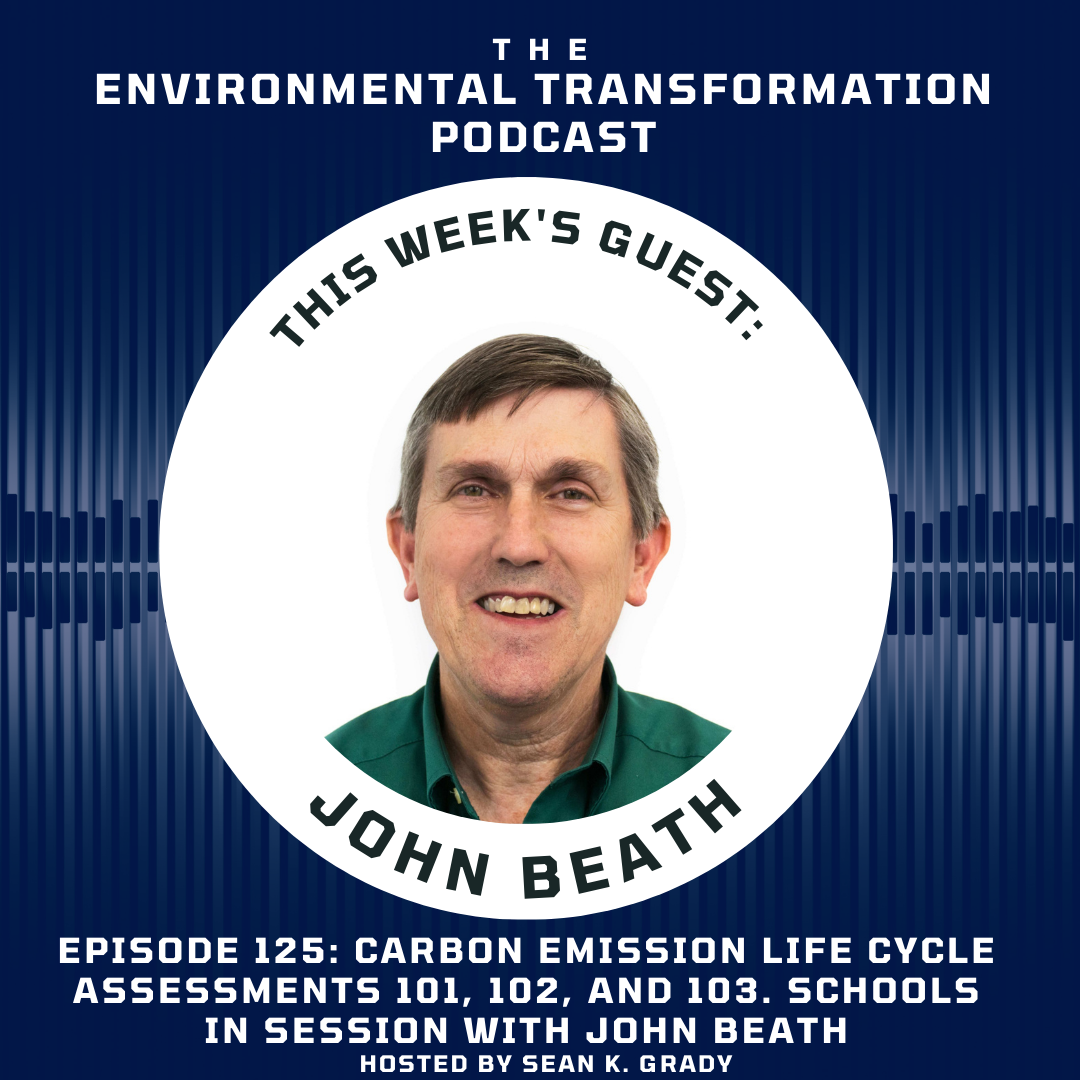
Sean Grady interviews John M. Beath, P.E. (TX), LCA-CP, CEO and founder of John Beath Environmental, LLC, on the Environmental Transformation Podcast. Beath explains life cycle assessment (LCA), carbon footprints and how companies evaluate emissions across raw materials, manufacturing, transportation and product use.
In this episode, Beath breaks down LCA basics for beginners, including emission factors, primary vs. secondary data and environmental databases. He also discusses LCA 101, LCA 102 and LCA 103, transparent Excel-based modeling, EV vs. internal combustion trade-offs, grid impacts, charging and temperature effects, EPDs, and why plug-in hybrids can be a practical near-term solution for reducing combustion-related air pollution in daily driving.
0:00 The advantage to the plug in hybrid is that you get the best of both worlds. You don't have to build all those charging stations necessarily, just charge it at home. When your charge runs out, you run off gasoline, but the advantage to it is you're addressing the air pollution problem from combustion while you're driving around town on your battery. Welcome to the Environmental Transformation Podcast, where we bring you interviews with industry leaders, climate champions, sustainability practitioners, EHS and hazmat professionals making an impact in their businesses today. Each leader solving complex challenges and delivering solutions within their areas of expertise. I'm your host, Sean Grady, and thanks for joining us today.
0:40 Before we jump in, make sure to follow us on your devices and visit my website at www.seankgrady.com and sign up for our newsletter and e-mail announcements. Now let's get started. Welcome to the Environmental Transformation Podcast. I'm your host, Sean Grady, and today's guest is John Beeth. He is a Life Cycle Assessment certified professional and a registered professional engineer in Texas. He's also has more than 20 years of experience in the sustainability industry as a consultant. He currently serves as CEO of a sustainability environmental consulting company. He's got a bachelor's degree in Chemical Engineering from Georgia Tech and has authored 3 short books on the various aspects of sustainability he currently serves.
1:22 As a member. Of the board of directors of the American Center for Life Cycle Assessment. So, John, welcome to the show. Thank you. Really excited to be here and good, good set of topics that you had picked out for us here, I think. Yeah, No, we're really happy to have you on and and you know, we connected through I think one of your marketing teams were looking to maybe get you on the show and and we're always looking for good guests. And so for those listeners out there that you've got an interesting topic you'd like to bring to the show, always interested to maybe interview those, those potential candidates and bring them on and, and educate our listeners. So John, before we get in, could you give us a little background on how you get started in life cycle assessments and or analysis and and also the sustainability business that you're running today?
2:11 Yeah, sure. It's been quite a journey for me. I tell people that I'm recovering process engineer. I got tired of designing things that were not destined to be built quickly, and that's what junior engineers and refinery do. I found out, and they never told me that when I moved into the profession to begin with. So I found a way to escape the environmental department and they convinced me that that wasn't where they sent old soldiers to die, that in fact you actually could have a role in the world. And it happened that that was back in the 80s and things were beginning to take shape in the environmental sector in in a bold new way. And I was able to do a lot of first of its kind sort of activities.
2:51 And Fast forward, I was the guy who turned out the lights of the refinery and sort of moved on into the consulting world and joined a big box consulting company, was there for quite a while. And while I was there, I had a client one day that called me and asked if we could do a life cycle assessment for them. And like most eager consultants, I accept the job. And then right after the call I called my colleagues in the UK and said what the heck is a life cycle assessment and how do I do 1 And that was, you know, that was in like 2006. So, you know, that was 20 years ago and a lots happened since then. I left that company at some point and founded my own company now just almost exactly 11 years ago.
3:37 And that company was just me at the time. And now it's a lot more than that. I wanted to focus on sustainability and life cycle assessment and carbon footprints and that sort of thing. And so that's what this company has enabled me to do. So that's. Great. That's good. I mean, yeah. So. So the punishment ended up being kind of like your passion. Yeah, absolutely. It's true. And maybe just a few more words on, you know, what happened with that experience, just to sort of round that out. So they told me that they wanted to prove that their solar panels that they were making were green. And I said to myself, well, of course they're green. And they said no, no, an investor told them the only way to do that was to do a life cycle assessment. So I rounded up a team, we went to the plant, we cataloged the raw materials, the utilities, the emissions, the waste, the Co products, the yields, all that stuff. And that's the kind of data you need to assess a product across its life cycle, from the removal of raw materials from the earth all the way through transportation, manufacturing, distribution, installation, use, maintenance, all that stuff. And people do carbon footprints as a streamlined version of that for lots of reasons.
4:46 But what's driving that business now is customer requests, investor demands in an effort to make claims to try to increase market share. So that's how the game has evolved over time, and that's the kind of exposure we get through our client work. Well, so, so let's break down for the, the novice here, because there's a lot of listeners who follow the podcast and join along who, you know, they, they may be practitioners in this space, but there's a lot who aren't, They're just kind of casual interested parties. They, they, they work in the environmental industry, but they maybe not in be involved in sustainability type activities where life cycle analysis is, is required.
5:27 So let's break this down. What's the process? How does this concept work, you know, in, in real practice? And and let's let's break this down so we can get them prepared for the rest of the conversation. All right. Well, you know, it is, it is a little bit complicated, I'll admit. But at the basis what you're really trying to do is take a flow rate of material and assign it to an emission factor and then end up with a result. So I call that A * B = C, and it's no different than in traditional environmental world how you would do an emissions inventory. What's different about this though is that if you're doing a carbon footprint, at least what you're chasing really is those instances where whatever you're doing creates a CO2, methane or N2O emission to the atmosphere. And most often that's combustion, unless you have a pipeline of methane and then methane is going to leak out of the pipeline directly.
6:30 You know, you don't need combustion for that. For most other things it you know, it's about combustion. And so if you're a manufacturing plant, it's pretty straightforward. You have fired process heaters. You can understand what that is. But when you look across the life cycle now, it's not just what you're doing inside your plant. Instead, I'm including the raw materials that are coming to you and how they were made. And so there's energy. Say you've got a bulldozer and it's going to mine that material out of the ground. Well, there goes some CO2 from that. And the next thing I'm going to do is I'm going to grind it up maybe, OK, there's some electrical energy that goes into that at the power plant. There's CO2 for that. Now I'm going to put it in the truck and I'm going to haul it.
7:10 And so guess what the the truck is burning some sort of fuel or it's electric, one or the other. In either case, it's energy. It ties back probably to combustion at some point. And so again, CO2, so we're an inventory that adds up all those steps down the line, even through the end of the manufacturing to distribution. Again, we got some trucks. Maybe it goes into the use phase. And if it's something simple like a plastic bottle, you might say, well, this doesn't really have a use phase, does it? Well, in reality it does because guess what? A lot of people like their drinking water and they like it cold. So what do they do? They put it in the refrigerator. Well, now that's part of the life cycle for your product as well.
7:51 Yeah. You know, when you think about that, Oh my gosh. I mean, all the actual inputs that you need to consider to assess a full, I guess, complete picture of the life cycle analysis, that could be pretty daunting just trying to understand all the inputs. And then how do you derive, you know, emission factors for all that work? Well, if you had to go get a CO2 meter and meter every single one of those things I just described, you'd bankrupt yourself. So the way it works is that people have already been there, done that. And so they're creating a library of information you can draw from.
8:32 And so there are environmental databases that store that kind of experience based data that you can then draw on. Probably the largest one of those is is called Eco Invent and they have thousands of factors in there for things you can't even imagine that you might need a factor for. And and that's not by any means the only place where you go and that's behind the paywall. So not everybody gets to use that. But the idea is you're, you're adding to some experience and you have what's called primary data because in some cases, you know how much what, what's the electric bill for your plant to make these plastic bottles? Well, OK, I know what my electric bill is. I know how many of these I made. So now I can give you what's called, you know, a really accurate primary database estimate of what my emissions for this was.
9:21 But if I'm a company and I don't make the polyethylene beads that are used to blow mold the plastic, then I have to trust some secondary data probably for that. And I might go to this database, I might go to the company and say, have you got a carbon footprint? And by the way, if you want me to buy your product, you know, I really want you to share that. Otherwise, I'm going to find somebody else who's willing to share that. And you know, I'll buy their product. Are you, are you when you're doing these assessments for clients and you're, and you're going through this process, are you finding that a lot of these suppliers of these raw materials are providing their carbon emission factors or input that for the impact of the product they're selling?
10:04 So that way every metric ton or whatever they're gallon that you can use that as an input. It's a mixed bag and I think it depends a lot on what industry sector you're in. In the building product space, you find a lot of people are embodying that into what's called an environmental product declaration or an EPD. Some of the building trades are more and more are beginning to see a requirement for you to not only share the data, but share it in that form. But in lots of other sectors, it's a lot more random in terms of, well, if I'm selling a product to another business, you know, they may make it conditional that you have to provide some data to me or or I'm not going to buy your product. As we move into consumer products, it's even more squishy there.
10:56 The reason people will do these kinds of studies is because they they maybe have an investor that wants to get data about that, or maybe they want to make a market claim. So if they're going to make a market claim, they're going to try to get as much primary data as they can, but they are going to find those firewalls that that you mentioned, you know, is the supplier willing to share? Well, that's a changing environment. And what you're finding is people that are outside the US where the regulatory environment environment is pushing faster. Yeah, more likely, like Europe and Asia as well. You'll find that much more likely to share that information because they've been conditioned by companies that are in those locations that that's how things are done. Right, right, right.
11:44 Well, that's, that's awesome. I mean, so when we look at, you know, your journey here, the catalyst of you starting of this business, you've been in the environmental, you know, business over 40 years as an engineer. What was the specific gap where the problem you were trying to solve in the industry that drove you to write these books that you you you wrote, you wrote three books. And once you share a little bit about your books and talk about that, and then, you know, what was the lack of understanding of the process or the prohibitive cost of the existing tool that was like you were trying to fix? Like what was? Tell us a little bit about this. Well, I, I won't try to pretend that I have the universal solution to that problem, but I took some steps down that highway.
12:25 And so, yeah, the, the thing that was in my mind was that one, I piled up a lot of experience. My company's piled up a lot of experience. I, I felt like, you know, I'm moving on in my career, it's time for me to start sharing some of that stuff. So that was definitely a motivator. But more importantly, a lot of the information that's out there is pretty hard to digest. You know, it's written for R&D engineers and nerdy science types. And if you want a nerd out and go to those detailed elements, that's great. But for people who aren't working in that space every day, they need a bit of a translator. And so that's the rule A. Little bit so the average guy who knows math can do some stuff.
13:07 Exactly. And so there were three books that ended up coming. And Full disclosure, I did them in part because that's how I continue to remain certified as a certified professional is you have to publish or parish to a certain extent. And so that was part of my pathway to, to holding on to my credentials. But I also wanted to do the things that I told you. So it's it's a balancing act. Anyway, three books. One was a specific need for a friend that we had who was an organic farmer. And I felt like all the things that have been written about how to footprint a farm were really hard to, to get your arms around. And so written so that a farmer could actually do their own footprint and need a master's in, you know, environmental engineering to be able to walk through that.
13:55 So it's very simplistic. It's very, pardon the pun, down to earth, but you know, that's the sort of thing that I felt like was really neat. So let me. Let me generate a direct real quick. Do you get any interest from, say, universities, agricultural universities that come and talk about this in a class or course or anything? Probably because not many of them go browsing around on our website and try to find that it, it is something that I'd love to be able to do. But frankly, no, that hasn't been an issue. We're kind of in our little silo, you know, we're, we're the company that nobody knows anything about and that's one of the reasons we're trying to change that is to get some of this information out there. So. Well, we'll help you do that, yeah. People will know who the translators are and and who they might be able to rely on. So that leads me to the second effort. And these are numbered by the way, LCA one O 1, LCA one O 2 and LCA one O 3.
14:45 Kind of tongue in cheek, but. It's like going taking my college courses, you know? Yeah, exactly. And that's that's the intent except college, not College in this case. SO1O2 is a little bit more of a heavy duty nature. And this was inspired because of the fact that there's so many come people that are coming into the electric vehicle space that have an agenda and they gather up some data and they try to to convince people that they're right and that here's why you should move in a certain direction. And I got really tired of that. And so we got hired by an oil company and by trade association to really look objectively into that.
15:28 And we did and we learned an awful lot about that. And so the book is a methodology. It's how do you analyze a situation in a very objective, scientific, comprehensive way and draw some good conclusions about the trade-offs that happened there. So that's what that book is about. The third one, LCA one O 3 was a horse of completely different color. This was I'm tired of people coming to me and saying, you know, I can't do carbon footprints because I I can't afford the the price of a big database, but I really want to have something I can roll around in and try some things. So one day the idea popped in my head that there's a database that's free from the government, that is environmental emission factors for all of the things that go into a car. And if you think about a car, it's plastic, there's metal, there's wire, there's glass, there's all this cool stuff. And all those factors are in that database. So I said, well, why don't I just extract those that information out there, put it in a table, put a nice little front end in it and create some examples where you actually footprint some comparisons and roll that into a book. And so that's what I did.
16:35 And so not only is the book out there, but also you have the ability to download the the workbook itself and actually play around with it yourself. Well, so how many companies can, you know, view the LCA as a black box and handle it by, you know, expensive specialist now? I mean it seems like there's a little big business in this space for that. How does your hands on approach solve the problem of accessibility for the average engineer or small business owner? Yeah, that's, that's a subject that's really near and dear to my heart. You really struck A chord when you got that. So the, the simple solution that I just described to you, LCA one O 3, the the little workbook I have only focuses on raw materials. It's a piece of that supply chain. But what we find is a lot of products that are made might find 90 or even more percent of the overall footprint might be in the raw materials.
17:28 So if you want to do comparisons, that's a good place to start. It is by no means a tool that's going to replace an LCA database because it's only looking at the front end of your problem. But it allows you to get in, roll around, understand the process. Now parallel from that, I, I am extremely concerned about working with black spot, black box LCA databases because I've been working with them throughout my career. And I don't like the, the way you can't really see the work. You can't really understand what it's doing. And so for the last 10 years, we've been working to develop a parallel solution. Basically, it's an Excel workbook that does everything that the Open LCA model does with a couple of restrictions, OK, But it does those calculations in the same detailed way, not just for for carbon, but for other environmental impacts like sidification, ozone depletion, energy toxicology, all the things that are part of these environmental impact factor sets. So we did that because we really wanted to be able to answer the question for our clients that say, OK, you got this answer from your database.
18:41 How do you know it's right? How do you check that? And so we said, OK, well, you know, what do you do normally when someone says to check that, well, you get a piece of paper and you write down some numbers and you look up the factors and you basically do manually, you know, a, a set of calculations for, you know, one of the elements, say a raw material to see if it looks like the box is doing its right way. Well, or you might use Excel to do that. And so that led to the leap of faith. Faith that was OK. Well, why don't we just do all those calculations and then we'll know for sure. We've checked everything. And then we said, well, if we're going to go to the trouble to do that, maybe there's a reason why our clients may want to do that. Because then it becomes a what if tool that's transparent. They can see all the activities, they can QA it, and they're going to get a huge amount of benefit from it by people using it who aren't people that are in the LCA database tool every day. Because that takes to be effective with those things. Any kind of complicated software, any kind of modeling software, if you're not working with it regularly, you're going to struggle.
19:46 But the nice thing with Excel is you can look at it, you know, I don't care what you were working on 30 minutes ago or for the last two months, you can look at that Excel and kind of go, yeah, I see what's going on here. OK, that's great. And by that transparency, it's also a really good QA tool on your data. So as you're looking at it and we have a tie to some graphs and tables so that when you put in the results, you can see right in front of you what's happening. And if you see things that you aren't expecting, you can you can drill down into them and then obviously you can make changes to it and see how the results play out. So we're really excited about it. We're doing our second project now to use that tool and we have.
20:28 Cross checked it against the open LCAA to see if we could get exactly the same results and we did. So that's where we are. Hello ET Nation, I want to thank you for listening to the podcast if. You're enjoying the interviews. We bring you Consider supporting the program by visiting my website at seankgrady.com and buy me a cup of coffee. Proceeds will go towards helping me continue producing timely content and offset production costs. I'd also like to take a moment and recognize a few of our sponsors of the show who have been amazing partners and our ET Nation legends. If you're looking for a drilling an environmental contracting firm to help you delineate the extent of contamination at your site, then look no further than Cascade Environmental.
21:11 Cascade has over 37 offices across the country and offers a huge range of environmental and geotechnical drilling, site characterization, and remediation services. With their huge fleet of equipment nationwide coverage, Cascade is a great choice to support your environmental and infrastructure needs. To learn more, check out their website at cascade-env.com. That's cascade-env.com. Hey, are you looking for an equipment rental company to help you with your next wastewater remediation or waste management project? E Tank is the only environmental equipment rental company in the industry that offers 100% guaranteed certified clean temporary liquid storage tanks at no additional cost. This protocol gives Peace of Mind for the previous customer by limiting their downstream liability as well as the future customer by preventing any cross contamination for all of their rental tanks.
22:08 E Tank also runs a one-of-a-kind complete maintenance program for all rental items including liquid tight roll off containers, fluid transfer pumps and filtration items. The next time you are presented with an environmental challenge, call E Tank to come up with the solution for your problem. I want to thank one of our sponsors, Wastelink. Wastelink is the all in one software platform transforming how environmental professionals manage waste, connecting generators, service providers, and disposal facilities in a way that is simple, connected, and transparent. Your platform helps streamline everything from waste profiling and routing to inventory management and billing, giving you the tools you need to operate more efficiently and reduce cost. Whether you're a generator looking for better options or a service provider seeking greater efficiency, Waste Link has you covered.
23:05 If you're ready to take control of your waste management processes and optimize your business, visit wastelink.com to schedule a demo today. Well, I mean, so why is this, why is the transparency of, you know, in formulas and the ability of the user to, you know, basically see the guts of this, this actual process and all the calculations that you put into the, you know, into the formulas there inside the Excel. Why is that so important and so vital for the credibility of the sustainability claims and so? You know, it is, it is just that. And what's interesting is that when you do a life cycle assessment, if you're going to share the results and make a claim, you're supposed to have a third party reviewed, which means theoretically someone's looking over your shoulder. Well, additionally, what has happened with that in large measure, and I have done third party review myself. So I speak from a little bit of experience, This centroid of how those reviewers tend to approach things is there's a list of things that ISO says have to be in your life cycle assessment, you know, has to have go and scope, has to have system foundry, has to have functioning and all these things that are supposed to be in your report.
24:13 And so it becomes a checklist. Got this, got this, got this, got this. OK, great. Therefore you have a great LCA report. I'm your reviewer. You met all the requirements and ISO. Have a nice day, right. I got a fundamental problem with that because you didn't say and by the way, I checked all the numbers to make sure that you really did the calculations in in a comprehensive and effective way. And the problem is when you have a model, the only way that you could really have a way to do that would be to literally take every step that the person who set up the model did. Well, who wants to pay for that twice? No one, right? So that's why having this transparent thing allows the auditor, the reviewer, to actually say, yeah, I actually checked the math. I can see what's going on.
24:57 I know that it's doing the A * B = C and it's got the right A's, it's using the right B's. And yeah, the C answer benchmarks. It looks effective. You know it it, you know it's the right answer, or within some range of accuracy anyway. Sure. Sure. No, that's good. I mean, and I think you, like I said, it just elevates the, the, the, the power of the tool and, and the credibility of the calculations and the outcome. So that's, that's excellent. If we talk about the, the, you know, selecting factors, you know, I think a lot of people are trying to always figure out where do I get this factors emission factor for a typical type of product or, you know, raw material.
25:38 But that seems like a major hurdle for for beginners and knowing which emission factor to use. So why do you anchor in your books the Argonne National Labs Greek model as as kind of like your main source of, you know, factors that you, you know, have the readers translate to the most complex data sets? Well, it doesn't hurt that I've been working with the people at Oregon lab for ever since Greek was, you know, first developed frankly. And we've actually contributed to some of that content. We created some tools that are are that slave off of the information that's in Greek that they have made part of their package actually. So we're extremely familiar with that. But that being said, you know, it's run by the government. It it's based on a lot of publicly available government data like from EIA and other government agencies. And it gets updated every year.
26:33 And it also gets peer reviewed fairly well. And so I have a lot of confidence in what's in there. Now the bad news is if this is not a material that goes in your car, then you're not going to find it in there. So you're going to have to go somewhere else to find those factors. And so a lot of what many people do is they just in today's world of AI, you just go to your computer and you say carbon footprint for shampoo and you're going to get some studies for that and trust but verify. It's amazing now how AI is going to be used to if for some of the work that we're doing in the environmental space. And yeah, you just prompted with a question.
27:16 It's going to give you kind of like, oh, here's all the raw materials that go into, you know, shampoo for a carpet and bam, you. Know yeah, and you'll get some answers too but the most important thing is it's going to point you to the sources. And so then then we do as scientists is we're going to open up that source by the way, if it's actually there every now and then you will find that it tells you that a source exists and it doesn't actually we have had that experience but if you open it up you're looking for things like was it peer reviewed? How did they do their what sort of assumptions do they make What sort of credentials even do the people have that that worked on that those are all things that you can do and then if you're like most people you want to try to benchmark that as well.
27:56 So I don't want just one study. I really want 2 studies that I can compare against each other. Now I'm feeling really good about it. And the third thing I might do as a practitioner, you know I, I have these in eco event factors. I have access to them all you know they're behind the paywall. I can use those to benchmark the study so that way the the client doesn't have to pay for the eco invent factor because here it is it's publicly available in this study you know and yeah, quietly I told the client by the way. I checked it against Eco Invent and I probably am not going to be able to say that in the report, but that gives the a little bit more confidence, yeah. Right, right. Absolutely. Well, you know, there's been a lot of going on in in the environmental world these days.
28:40 EPA has, interestingly enough, pulled back some new, you know, rules. The endangerment clause of air emission was recently rescinded, You know, so if we look at, let's say your LCAA one O yeah, one O 2, which is around the electric vehicles, you know, in your book in the in the electric vehicles, you challenge one-size-fits-all narrative in in electrification. So what are the most critical, often overlooked variables such as grid intensity, battery weight, you know, and what you know, can that completely be flipped with the results of you know, of the EV versus the the internal combustion engine comparison now or you know that we're these new rules are going to be affecting.
29:30 Well, first of all, the endangerment finding situation really doesn't impact much of anything. That said, in the book that we wrote, the fact that some people in the government have decided that greenhouse gases don't threaten, you know, human health and therefore they're they're not endangering us. You know, it's a completely separate issue. If if you're still interested in making an impact on carbon, then you still want to study the electric vehicle. You still want to figure out, you know, where it makes sense and where it doesn't. And not just with electric vehicles, but anything that is powered by a fuel source that's not fossil fuel. You know, these are the kinds of things that you may want to think about. But for the for the EV in particular, one of the things that struck me right on the head when I first started looking at it is the temperature impacts.
30:20 And people have always talked about them, you know, in terms of that being, you know, a strong part of the process. And it absolutely is, however, in ways that you might not think about directly. So people think about how the battery performs when it's hot outside. OK, that's great. But that's not really the the big effect that's that, you know, an internal combustion engine is heating up your cab when it's hot out or when it's cold inside, you want it to be hot inside. So you get that benefit of the internal combustion engine with an EV. Guess what, No combustion. So now that's it becomes a tax on your battery. Part of your power that you're counting on has to go into heating the vehicle. And that is a carbon footprint balancing act issue. But the one that I found even more intriguing than that was how you charge your car.
31:09 So that battery in order to protect itself, has temperature monitoring with it that says, hey, you're only allowed to charge me if the temperature is within a certain range. And if it's too cold, I'm going to activate a heating element and I'm going to heat up the area around the battery so you don't damage your battery. On the other side of the coin, if it's too hot out there in in where your your battery lives, I'm going to engage a fan and I'm going to try to cool down that battery. And I'm not going to let you charge it until I've cooled down the cargo space enough to where the battery is the right temperature. Well, you're not going to find those results on your EPA sticker for your EV. They're not part of what happens because they don't happen as you operate the vehicle.
31:54 They're not part of your efficiency, but actually they are if you take a life cycle approach to this. So those are really important things. Where you charge your vehicle is really important. Say you live in Chicago and your junks in your garage instead of your car. No one would ever let that happen, right? But if that's your case, then you're going to pay a huge tax for heating out this car outside, whereas instead, if you charge it in your car or in your garage, get rid of the junk. That would be a great place for you to be. And furthermore, if you really want to up your game even a little bit further, then you might insulate your garage also so that now you're not have to having to take that head start either when it's hot or cold.
32:37 Insulation will help you both ways with respect to that. So, but there are, there are things that matter a lot that were part of the study that we did and they're part of the book. The key thing obviously is the grid and what's going on in the state where you are operating. It's, it's no secret that as you look at the say the Eastern Seaboard state, so you can see, you know that West Virginia, Kentucky, they're a coal weighted grid. And so the, the electric vehicles aren't going to do as well there in terms of carbon reduction, right. And surprisingly, if you look at EV sales, one of the biggest places where EVs are selling right now is in California.
33:18 And unfortunately in California, the grid is really pretty good. So the net benefit of putting EVs, if you could pick wherever you want them, you wouldn't put them in California. You would put them, you know, every single vehicle you could replace in West Virginia, you'd try to. The problem is we have customers and customers have preferences and they have geographic locations. So are you going to get demand to line up with what is the best for the environment overall? Probably not. But at least you can understand what those forces mean and how to put them in perspective. And that's what the book tried to do. Yeah, cuz when you think about the grid, I mean not like you just mentioned, not all utilities are the same when it comes to delivering the power and, and their source of power and, and the emissions that are involved with generating that power for the utility.
34:11 And I, you know, having a grasp of that and where certain factors are going to play into the equation versus, you know, in a location that may be a hydropowered company or, or, you know, somewhere like that. That's that's like you got to really know your stuff. And actually just as a side note, I have to have to react to your the use of hydropower there because hydropower is uniquely different from wind and solar. They all have a burden that caused that results from, you know, the equipment part of it. And I haven't mentioned capital equipment, but that's also part of the footprint. Theoretically, it's typically a minor player, but with those people who are using hydroelectric power, one of the things that's been often overlooked is the impacts from the reservoir. So when you create a hydropower plant, typically there's a reservoir that's associated with it. When you bring that reservoir into being, what are you doing? Well, you're flooding land.
35:07 And as you do, the biological growth that was in that area that you flooded is going to off gas for years and years and years. And they are now starting to measure exactly what that is and therefore define the hydroelectric power plant footprint as not 0. It's it's certainly not like burning fossil fuels, but it's not 0. And so that's part of how the life cycle assessment science evolves over time as we learn things and we get a broader perspective, even more than we had before, about what really matters and what doesn't and how much. Well. OK, so let's, let's, let's take this other kind of interesting question because I think a lot of people are like, hey, it takes as much carbon and impacts to build an EV car as it does like a gas combustion, internal combustion car.
35:58 Or maybe it takes more, I don't know. But maybe through your experience, could you kind of shed some light on the pros and cons of this just cuz maybe the listener is just saying, I want to do what's best to buy the right car related to its carbon emission impact, say over its lifespan that I'm going to have the car versus me buying a internal combustion car and just buying fuel to power it, you know, over time. And then the cost benefit analysis, I mean, what what's your take on that? Because I'm sure you're kind of looking at that as well. Well, it, it definitely is complicated. First of all, a lot of people will raise their hand and say, oh, it's the battery. You know, that's the reason why these EVs, their, their footprint really isn't that great. And if you assess the battery, you'll figure out that, you know, whatever fuel savings there is gets weighed out by how carbon intensive it is to make the battery. Well, I, I think that's been, that's been gas lit and proven not to be the key aspect.
36:59 It, it is an important aspect, but in terms of percentage, the use phase and the use of the power plant or internal combustion is going to wet far outweigh that element of it. And we studied this in a very detailed way for a bus manufacturer. We built a, a carbon comparison tool for them, which basically compares diesel buses to CNG to hybrid to electric buses. And we did this because their customers really want to know if I'm if I'm buying a fleet of buses and I had diesel buses before and now I have CNG or now I have electric, what exact footprint am I going to difference am I going to make? Because say I'm a city or a university, they actually have carbon reduction plans and they have to literally fact factor this kind of information into it. So we worked with the manufacturer of the space of the year to collect a bunch of data and try to come to, you know, what's probably not the be all end all, but it's a, it's a good estimation tool to be able to say, yeah, pretty clearly this is and this is how it works out.
38:03 And as you might expect, the electric buses are pretty much always going to win the equation, but it's by how much? And it gets to, again, where, where is the footprint? But there's, there's another important aspect which I haven't brought in so far, but I will. And that's the role of the plug in hybrid vehicle, which is where I've been living in my own personal space for the last 10 years. I have personally driven a plug in hybrid vehicle and I believe that's the ultimate solution to the problem for the short term because the challenge electric vehicles have is the ability to have cruise range based on where the chargers are, the cost of what charging is and the time it takes to charge.
38:45 All those things are dramatic issues. And you know the IRA was going to fix all of that. Well, when that got rescinded. Now where's the money going to come from not only for the charging stations that we might need ultimately, but also so for the power plants. We're we're already competing for power plant bandwidth with the data centers and how AI is driving that to a higher level of power demand. That's the the EVs are going to report are going to compete for that. The advantage to the plug in hybrid is that you get the best of both worlds. You don't have to build all those charging stations necessarily. Just charge it at home. When your charge runs out, you run off gasoline. But the advantage to it is you're addressing the air pollution problem from combustion while you're driving around town on your battery.
39:32 And when you're out on the highway, you run out of battery and now I'm on fossil fuel. But guess what? They're you're you're not exhausting all that information into the breathing zone of people. So it's a, it's a really good trade off. So that's not going to get you to the goal as fast as an EV will, but it's going to put points on the board that much more quickly because we don't have the charging, we don't have the power plants to go all the way to the end of the tunnel. But we could pretty much convert every new vehicle to a plug in hybrid and we would get points on the board way, way faster if we did that. So when you did, you also factor in the cost of the vehicles and stuff we did because a lot of the EVs are a lot more expensive in a lot of cases than a normal internal combustion car. And I'm thinking average Family Guy who just, you know, needs to get a good, you know, $15,000 car to, you know, run for a good, you know, 100,000 miles or whatever, you know, until he's ready, whatever it is.
40:32 I mean, when I look at those types of decisions versus an EV versus like that, I start to go, it doesn't make as much sense as an EV versus that because I just feel like it seems like it's a better, more cost effective and less impact since you've already the car's already been built. Like I don't not buying a new car, I'm buying a used car, right? You know, type thing. Well, there's a lot to unpack with with that. One of the things about electric vehicles is the more the vehicle weighs, and I'm not talking about the weight of the battery, we're talking about the vehicle overall. The more it weighs, typically the the less well it's going to perform. So that the four door sedan, really small electric vehicles, which is kind of why Tesla went down that road.
41:19 The smaller the vehicle, the better it's going to perform in all those categories you just talked about. But if we're talking a Suburban, a Yukon, you know, even a pickup truck, that's a more challenging space. And that's why people have been really slow to conquer that marketplace. There's another really dramatic force here, and I don't know where that's going to happen, but it could be a shockwave for this. And that is the price of vehicles for electric in Asia is shockingly low. You can buy an electric vehicle in China for a small fraction of what things are here in the US, and of course those those Chinese vehicles are enjoying from coming into the US at this point.
42:03 If that were to change, this whole discussion we had might change dramatically. Yeah, well, I mean, I just saw that didn't didn't Ford going to start building a smaller unit type electrical car? It's like AI don't know 2 seater truck or something that's like. Ford is really conflicted and they they pulled away from the electric F-150, Yeah. And I was surprised to see that, but you know, I think they're, they're uncertain as a lot of people are. And and again, I I'm the voice for the plug in hybrid as the the hedge solution that will that you can do while the marketplace sorts itself out. The hybrid to me is the best choice. I I would, I would totally agree with you there, John. I think that, and I was looking to get a hybrid just recently, but ended up going a different direction, but I, I like the hybrid because of all the reasons you just mentioned. I mean it, you know, you get the benefit of battery charging and then you know, when you run out, you, you, you've got, you know, you can, you know, fuel, but.
43:06 Do what you want and, and just as an example, during COVID, when I had my previous vehicle, I went three months without buying gas. And that was really helpful when you're in COVID and you really didn't want to be roaming around, being around other people and so forth. So we could just run my errands, do my thing, come back to my house and I stayed within the battery's limits. Now I upgraded, now I have a, a Chrysler Pacifica minivan and it will do 33 miles instead of the 23 that I had before. So now when I'm in town, I almost never end up having to use fossil fuel. And when I go to Houston to go take a flight, I live in Beaumont, TX, that's 80 miles to that airport. I'm going to end up using some gas, but I don't do that all that often, so it fits my lifestyle. Well, I think the big challenge with a lot of the people adopting is the, the grid, the, the charging grid that's out there.
44:03 And and you know, I think that's the biggest I think limitation for growth right now is that. Absolutely. There's not enough charging ports. And I mean, just think of all the people that live in like apartments, you know, or rental things like they, they don't have the infrastructure to put that stuff in their their, in their living spaces. So you're just not going to get the big adoption. I don't think as much as we'd like to see, but. Yeah, this is a suburban solution. There's there's no other way to describe it. Yeah. Yeah, yeah. That's good. That's good. Well, let's keep going here. When we talk about, you know, this policy shift that's recently happened, you know, the greenhouse gas engagement finding being rebuild the federal motor vehicle standard for the federal motor vehicle standards, the regulatory landscape is shifting significantly.
44:52 In your view, does this make data-driven LCA more or less important for automotive manufacturer? I think the auto manufacturers are going to continue to be pressured by their consumers. Focus factors like Europe and others. Well, not just that, but their consumers focus. So just because the government thinks that climate change is not an issue, that doesn't mean the consumers feel that way, right? And and so as long as there's that universe of consumers that, you know, are willing to be open to the problem and open to the solution, but want to use that cost lens. And that's a really important part of LCA is it doesn't actually provide that cost lens. There was a phenomenon 15 years ago called life cycle cost, which basically was an LCA with a cost layer on top of it. And that never really caught on.
45:43 But at some point maybe it will come back in because just reducing carbon with a passion without contemplating carefully what the cost will be of that, that's not really sustainability because sustainability is, is this something that you can keep doing Well? If it's something that is hurting your lifestyle because you're spending too much money on it, then you went too far. So the balancing act is to say I want a carbon benefit, but I want to pay a fair price for it. And so that's, that's what the consumer should be thinking about, whether he's a business consumer, you know, whether he's buying a car or whatever. It's cost and benefit. That's how engineers are trained. That's how we should be thinking.
46:23 Well, do you think this policy policy shift is going to maybe produce more hybrids versus fully electrics? I think what's going to produce more hybrids is the fact that you really can't make a trip across the country in an EV without it being extremely inconvenient. And I think most people that buy cars have it in their mind they're going to take a vacation. And do they really want to plan their vacation around where the charging stations are? Some people will say, yeah, I'm, I'm all in the car, but I'm going to do that. But that's really not even my boat. So, you know, I think that's what's going to drive it more than anything else. And of course, the IRA was going to put those charging stations out there at a huge cost.
47:07 And for whatever reason, we don't have that part of the IRA. So that's not going to happen. So how quickly will we get the kind of charger density we need to make EVs ubiquitous without the government spend into that? I think it's going to be a slow process. Well, you know, so with EPA stepping back a bit on this with the greenhouse gas standards now, do you believe like independent environmental product declarations will become of the primary way mark the the market rather than the government determines which vehicles are truly green now? That's a good question. You know, only a few manufacturers have so far gone down the EPD route. In fact, they're, they're, I'm not aware of really many US manufacturers that have done it.
47:53 There are some foreign manufacturers that have. So will the EP DS become more more prevalent? I think as as people get more comfortable with how they're done and as we start to streamline the process, which there are efforts underway to do that by both consultants and program operators that are the, are the places where these EP DS are stored. That process is evolving pretty rapidly in part because people are using AI to streamline it to a small extent, although trust but verify. That's my watchword whenever you bring that up. But it it's, it is a changing landscape. I think people are still going to be involved with carbon for quite some time to come. And it's always been, you know, a roller coaster of up and down based on different events, kind of like the stock market. And I think that's going to continue. I, I don't think the endangerment finding is changing anybody's pulse, but maybe it just does under score that market face forces come and go all the time. And, you know, there's, there's a, an action reaction sort of thing that happens with, with consumers. The auto manufacturers definitely are are paying huge attention to their customers and they're paying attention to their their bankers and the private equities that control their supply chain.
49:16 And so it's a complicated landscape, but no one is completely closing their eyes to the carbon world because it impacts us, even if the government doesn't have rules for lots of reasons. Yeah, no, I I agree. So where do you think we go next with this whole, you know, carbon, you know, footprint life cycle assessment process, especially given the nature of your books being around, you know, car emission factors and and others. What? What do you think we're going to be, you know, moving forward? I think this. Because it seems like the market is really kind of like, oh, they're pivoting right now. I, I think the science is, is going to get better. I think the accuracy and defensibility and reliability of this work is going to get better because, you know, it is the evolving science still.
50:11 So that is going to change the role of EP DS and how important that's going to be is, is yet to be defined. And one of the things about EP DS that people don't really get is, is that that's only part of the process. So you quantify what your emissions are and you basically are checking a box saying, Yep, here's my emissions, I have an EPD. That is not a reduction plan. That is not a guarantee as to what your performance is going to be all the time. It is. It is a lot of different things, but you know where that's going to go exactly. It's kind of hard to say. Do you, do you feel like, you know, down the road here we'll see like cars, you know, like we see in our cars now you're driving and you get like, you know, metrics like average miles per gallon, you know, you, you, you know where you know what you're getting for your, your trips and things like that.
51:09 Do you think eventually we're going to start seeing CO2 emission factors pop up on your screen on your car and then showing you like on a weekly, daily, monthly, whatever yearly assessment of your impact on emission for by driving your car? I don't see any reason why that couldn't happen because, you know, in electric vehicles in particular and in plug in hybrids, all that data is there. It's just a matter of actually, you know, coding the the screens to actually display that, you know, it's it's customer demand driven. Are the customers going to want to see that? Are they, are they interested in carbon footprints for their meal when they go to a restaurant or, you know, supplies they buy in the hardware store That's, that's not going to happen tomorrow, the next day, you know, you're seeing it in Europe in increasing levels and to a certain extent in Asia as well. So.
51:58 Calories on the back of your your packaging. It tells you exactly. Exactly. And there was a move afoot in the UK to extend that packaging to include carbon footprint. And they got about 1/3 of the way down that highway and they just, they basically ran out of money and they stopped. So it, it is very costly to do that thing for, for some products, you know, for sure. But for EVs and, and even conventional gas combustion engines that have digital displays, you know, pretty easy to, to make that sort of information available. So, so yeah, I think, I think it's coming and, and I think it, it has a, a good place. If you have an EV, it coaches you on, on, you know what's equivalent to miles per gallon, you get kilowatt hours per mile. You, you get that readout.
52:45 I get that readout all the time as I'm real time as I'm driving. So it's not, it's not couched in carbon, but in my brain I know it, you know, if my efficiency is poor, then my carbon is higher. You know, it's a pretty direct relationship there. Well, you know, and then when I look at it and I think of it, there's a lot of companies that are putting their sustainability reports together and they, they, they track, you know, what's my carbon impact from my, you know, vehicle fleet that we have in, in the, in the, in the company. Well, how cool would it be if they could just like run the metrics right off the darn vehicles because it's already there. They don't have to go figure it out. They, you know, they actually get the actual number because they know how much was burned and they can pull that telemetry right out of there.
53:30 There there are some truck firms that are that are working with software that do that sort of thing. I believe Walmart has a pilot program in place where they're trying to do that with their company owned trucks at least. So yeah, that's that's definitely coming. Yeah, no, that's good. Well, John, what? What? What can How can listeners get copies of your books and learn more about your services? Yeah, well, there's there's several ways. The easiest is you can look for LCA 101-1021 O3 in Amazon. They're self published there for a ridiculously low price. But if you want to get them even cheaper or like for free, you can also go to our website if you can navigate through and find where the forms you fill out are.
54:14 Our website is beef dot US and you'll find a place where you can see downloads there. The the the third book is in a different place, which I'm trying to get moved. That's if you look under the LCA section and go all the way down to the bottom of the page. You'll see the links for that. And if you follow that link, the advantage to that is you get a zip file download of not just the the book and PDF form, but also the XL. The XL is there as well. OK, great. That's awesome. That's really good. Well, John, thanks for coming on the show today. We really appreciate you coming and talking to us about the life cycle analysis and what the great work you've been doing around developing this Excel calculation spreadsheet that can be used.
55:00 To to help people understand what their carbon impact is and I really appreciate that. Thanks for listening and watching the show. If you enjoyed the show then please share it with your friends and Co workers on social media and tell somebody in person. Thanks for being with us, ET Nation.

CEO
John Beath is a life cycle assessment certified professional and registered professional engineer in Texas. He has more than 20 years of experience as a sustainability consultant, currently serving as CEO of a sustainability and environmental consulting company. He has a bachelors’ degree in chemical engineering from Georgia Tech and has authored three short books on various aspects of sustainability. He currently serves as a member of the board of directors of the American Center for Life Cycle Assessment.
His consulting experience includes serving as a partner for a large consulting company for 14 years, and forming his own consulting company (JBE) ten years ago.
His industrial experience includes serving as a refinery environmental manager, and corporate regional manager for a major oil company.
His contributions to client sustainability have included developing numerous product carbon footprints, life cycle assessments and tools, serving as a third-party reviewer for life cycle assessments, and developing a comprehensive LCA training program.