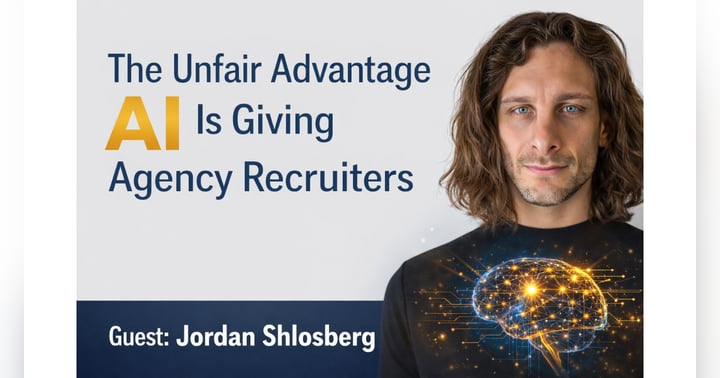
The Unfair Advantage AI Is Giving Agency Recruiters | Jordan Shlosberg
Welcome to The Elite Recruiter Podcast! In this episode, host Benjamin Mena welcomes Jordan Shlosberg, founder of Atlas, to explore the "unfair advantage" that AI is bringing to agency recruiters. Together, they dive deep into the rapidly shifting landscape of recruitment technology, revealing how AI is transforming everything from admin-heavy tasks to business development, and giving proactive recruiters a significant edge.
You'll hear Jordan Shlosberg share his journey from expert networking to building a cutting-edge AI-first recruitment platform, and discuss how harnessing conversational data and automating processes isn't just increasing speed—it's redefining what it means to deliver value as a recruiter. They tackle critical questions about the future of recruiting organizations, the widening income gap brought by tech adoption, and what agency leaders should be thinking if they're considering switching systems.
Whether you're a solo biller, team leader, or firm owner, this episode offers actionable insights on the skills you need to double down on, the habits driving high-performing teams, and how Atlas customers are unlocking explosive growth. It's a must-listen for anyone wanting to stay ahead in the AI recruitment revolution!







The AI race in recruiting has already started — and most recruiters don't even know they're losing.
Jordan Shlosberg isn't a recruiter. He's the founder building the technology that's about to separate the top 1% of agency recruiters from everyone else. And in this episode, he pulls back the curtain on exactly what's coming, what it means for your desk, and why the window to get ahead is closing fast.
Why This Episode Matters
The recruiting industry is on the edge of a fundamental power shift. Internal TA teams are shrinking. Agency market share is growing. And the recruiters who move now — building their memory, sharpening their BD, and leveraging AI as an unfair advantage — are going to capture most of that upside. This episode gives you the strategic roadmap straight from the person whose technology is driving that change.
What You'll Learn
- Why recruiters don't have a data problem — they have a memory problem, and how solving it creates a 100x service advantage over internal TA
- The exact reason Jordan believes agency recruiters will steal market share from in-house talent teams over the next 3–5 years
- The three skills every recruiter must double down on right now to win in an AI-driven market (hint: one of them is vibe coding)
- Why a 1–2 person agency team will soon be able to outbill a 20-person firm — and what that means for how you structure your desk
- The "speccing autopilot" coming to Atlas this summer that could generate placements from candidates you've already forgotten you have
About Jordan Shlosberg
Jordan Shlosberg is the founder of Atlas, the AI-first recruitment platform that's become the most talked-about CRM in the agency recruiting world. Before Atlas, he built ProSapient — an expert network — to $30M in revenue in five years. He brings a rare combination of deep technical expertise, founder-level product obsession, and an outsider's clarity on what's actually broken in recruiting.
Extended Value Tease
Imagine opening your laptop every morning to a system that's already ranked your best BD prospects, drafted your outreach, searched your entire candidate database without a single filter, and flagged the candidates most worth speccing today. That's not a fantasy — that's where the top agency recruiters are heading right now. This episode gives you the mental model and the tactical roadmap to be one of them. The recruiters who listen to this and act will look back on 2026 as the year everything changed. The ones who don't will feel it in their billings.
Timestamp
- 00:06:23 — "Recruiters don't have a data problem, they have a memory problem" — the insight that reframes your entire database
- 00:08:11 — Two agencies, same size: what the divergence looks like at 1 year, 3 years, and 5 years out
- 00:10:35 — Is a recruiting income gap coming? Jordan's bold prediction on where agency market share is heading
- 00:36:09 — Can a 2-person team outbill a 20-person agency? Jordan's answer and where the real bottleneck will be
- 00:38:37 — The 3 skills every recruiter must build now: sales, relationships, and vibe coding
- 00:48:35 — What the Atlas Top 100 recruiter rankings actually reveal about how elite billers are winning inbound business
🚀 Atlas – AI-First ATS & CRM Automates admin, syncs resumes and emails, and uses AI to build polished profiles and reports. Try it free or book a demo → https://recruitwithatlas.com
🎯 This Is Your Year — Recruiter Summit https://this-is-your-year-recruiter-summit.heysummit.com/
💼 Join the Elite Recruiter Community All summits, replays, Billers Club + split space https://elite-recruiters.circle.so/checkout/elite-recruiter-community
Tools & Links
Sign up for emails → https://eliterecruiterpodcast.beehiiv.com/subscribe
YouTube: https://youtu.be/1Nj7gA276Mg
Follow Jordan on LinkedIn: https://www.linkedin.com/in/jordanshlosberg/
Host Benjamin Mena: http://www.selectsourcesolutions.com/
Benjamin LinkedIn: https://www.linkedin.com/in/benjaminmena/
Benjamin Mena [00:00:00]:
Are you still trying to grow your recruiting desk or business on your own? Join the Elite Recruiter Community and connect with recruiters who know your challenges. Members get unlimited access to replays from the AI Recruiting Summit, Finish the Year Strong, and all our past events, plus biweekly roundtables where we dive into sourcing, business development, and mindset. You'll also tap into our Billers Club for accountability and a split space to partner on roles. Join the number one growth environment for recruiters for just $49 per month. You'll be part of a tight-knit group that pushes you to grow, and you can cancel anytime. Visit the link in the show notes and click Join Now to get started and start mastering your craft today. Coming up on this episode of the Elite Recruiter Podcast.
Jordan Shlosberg [00:00:40]:
The speed at which we're delivering like the initial POCs of products has gone up immensely, immensely. Things that would have taken me 6 weeks to build 3 weeks ago, now take 3 days.
Benjamin Mena [00:00:55]:
Where should a recruiter start really spending their time if tech is actually working?
Jordan Shlosberg [00:01:00]:
BD, relationships, being in person. I mean, that's going to be more and more important.
Benjamin Mena [00:01:08]:
Welcome to the Elite Recruiter Podcast with your host Benjamin Mena, where we focus on what it takes to win in the recruiting game. We cover it all from sales, marketing, mindset, money, leadership, and placements. You know, the resume never tells the full story. Candidates share what really matters during conversations, on calls and interviews, over email. Their motivations, salary expectations, plans to relocate. Most of that detail ends up buried in notes and forgotten. Atlas changes that. It's the AI-first recruitment platform built to eliminate admin.
Benjamin Mena [00:01:45]:
It captures every conversation automatically and turns it into something you can use. With Magic Search, you can ask Atlas questions like, "Who talked about wanting a 4-day week?" or "Who mentioned they're open to relocating next year?" It searches across your entire database and pulls the answers instantly. No keyword guessing and no digging through old notes. You get insight from real conversations, not limited resume fields. Atlas also makes BD easier. With Opportunities, you can track and grow client relationships, powered by generative AI and built into your existing workflow. If you want visibility, well, smart dashboards give you a clear view of the pipeline across your business. And that's not theory.
Benjamin Mena [00:02:22]:
Atlas customers have reported over 40% EBITDA growth and over 80% increase in monthly billings after adopting the platform. It's built for agencies that want to grow without adding more manual work. Don't miss the future of recruitment. Get started with Atlas today and unlock your exclusive listener offer at recruitwithatlas.com. I'm excited about this episode of the podcast because here's the thing: this guest and this company, I have seen when they jumped on the scene, everybody else has started to try to play catch-up because of what they're doing and how they've been on the forefront of an industry for many, many times. Is like, I always joked around, we are a decade behind every other industry. Well, this company jumped in, and now everybody is racing to try to catch up. So, Jordan, I am so excited to finally have you on the podcast.
Jordan Shlosberg [00:03:17]:
Thanks for having me, Ben. I'm, I'm excited to be here, to be honest.
Benjamin Mena [00:03:21]:
All right, real quick, 30-second self-introduction before we start diving in.
Jordan Shlosberg [00:03:26]:
Absolutely. So I am not a recruiter by training. Um, I founded my first business when I was 29 called ProSapient, which is an expert network. So if a recruiter places a candidate at a company, an expert network organizes a 1-hour call between said candidate and company. That was a wonderful, wonderful journey. We got that to something like 30 million, 5 years of revenue, 5 years, and it's gone on to heady heights since then, which is great. And then as GPT-2 came along, I realized, oh my goodness me, this is bananas good, this technology. And I wanted to make sure I could start from scratch really using this technology as the core.
Jordan Shlosberg [00:04:15]:
And so Atlas came along partially because it was the most similar software to what I'd done before. And you can kind of have to use every unfair advantage that you have really in this, in this tough old world. And aside from that, I've got 3 beautiful children and a lovely wife as well. So that is me in a nutshell.
Benjamin Mena [00:04:36]:
So with you being on the forefront of technology, you being deeper down the AI rabbit hole than probably just about anybody else that I know, I gotta ask, what is gonna happen to recruiters or recruiting organizations if they don't adopt AI right now?
Jordan Shlosberg [00:04:56]:
Recruitment is one of those jobs that is so full of admin and no one who's good at recruitment happens to be any good at admin either. You can't kind of have both. And so you don't do the admin. And oftentimes that's okay because, you know, you deliver and you bill the opportunities that you could have got with good admin. You don't really think about it at the time as they don't happen at the same time you're doing all this hard admin work. For those people, if they adopt AI in a really fundamental way, they will be able to spend a lot more time doing the things that they love doing, the things that actually build. For those who don't adopt it, it's going to be very, very difficult. And that's actually not too dissimilar from any other industry.
Jordan Shlosberg [00:05:41]:
If you don't adopt it, you're not going to be an attractive person in a company. And you're not going to be able to do your best work because it allows you a lot of things in fractions of times that you used to. So I think it's very clear to me now, and it's clear to most people, is that if you don't adopt it now and heavily, you're going to see yourself falling behind just tremendously.
Benjamin Mena [00:06:04]:
And I know recruiting is a lot of data. It's a lot of, you know, admin. It's all the stuff that like takes us away from the conversations and the relationships that actually what moves the needle. You said something on another podcast that really just kind of stuck out with me as saying recruiters don't have a data problem. They have a memory problem.
Jordan Shlosberg [00:06:23]:
That's absolutely correct. Recruiters have data that no one else has, which is all of the conversations that they have over time with candidates because they have them from an impartial basis to an extent. They're not tied to a company. They don't have to parrot the company's values. They are the people that have all the conversations with the candidates, but from the candidate side. And that information is unique and powerful. In fact, many recruitment firms will use the pitch that they've been in industry X for numerous years and they know way more about the industry than their peers. And like, that's factually, they may have been in the industry for a long time and yes, because of that, they might have the experience better, but they don't have the memory that allows them to make all of the use of all of these conversations.
Jordan Shlosberg [00:07:19]:
You know, we've got exec search firms that have reference calls dating back like 15 years and currently they're just buried away in CRM. So if you can, for the first time, actually use AI to retrieve all of that memory, then you can provide a service that is 100x better than what you could have even provided beforehand. And that data is not something that the talent acquisition people on the company side have access to really. So if they can be harnessed, then, you know, there is, there, you know, people are always finding what's the unique angle, what's the unique information to help make a decision. Recruiters have loads of it. They just, until at least a few months ago, they couldn't really access it.
Benjamin Mena [00:08:11]:
So picture this. You have two agencies. We'll say small to medium-sized teams. One is keeping as they have always been. Hey, it's working for us. So why, why change? And then you have another agency that is, hey, let's take advantage of every piece of AI tool that can actually help us move the needle. Where do you see the divergence 1 year from now, 3 years from now, and 5 years from now?
Jordan Shlosberg [00:08:39]:
Maybe a good metaphor is the horse riding and the car. The first person who's fantastic at horse riding because he can make the horse go really, really fast, he's like, it's working for me because it's really, really fast for me to get places. I can get from London to Birmingham in only 10 hours with my horse, whatever, and then someone comes with a crap car and is doing it 5 times faster, and suddenly you've gone from the belle of the ball and you're still doing the equivalent job that you are doing before. The difference is that someone else is doing a relatively better one. So if you are in recruiting, you're not using AI, the people that are gonna have access to the memory and they can use that to shape their proposition, communicate with those customers and do it way faster than you can do. So that's the one, the expectation of service delivery is simply going to jump much, much higher. That's what's going to happen. Like you can, you show someone that you can do something 5 times faster and the expectation becomes they can do that 5 times faster.
Jordan Shlosberg [00:09:43]:
It's amazing how we've only had this amazing technology for like 3 years now properly. And we already get frustrated if it takes too long to make a response. And you're thinking, well, hold on a second, you couldn't even do this 3 years ago. What are you getting frustrated about? I think that everyone is going to adopt, and in every industry you're going to adopt AI quite intrinsically. The hard thing is, is because recruiters are, you know, a service business on software, it's really hard to re-architect service. You know, if someone's done a, delivered a service for 20 years, it's hard to move that. If you've got a training program and the whole thing relies on what everyone else did back 10 years ago, to move everything is hard. That's the hardest bit, but you have to.
Jordan Shlosberg [00:10:27]:
No one's ever survived working on obsolete technology and processes because at one point it worked for them.
Benjamin Mena [00:10:35]:
Are we going to start seeing an income gap in the recruiting industry?
Jordan Shlosberg [00:10:40]:
Oh, so like at a high level, and maybe I'm going to answer your question in a kind of a long way, but what is going to happen with agency recruitment because there's two, you know, is it going to go really, really big? Is it going to shrink quite crazy? I'm obviously bullish. Partially I have to be bullish, but, but no, I logically I'm bullish too because I think that because obviously recruiters have information that internal talent doesn't have, my bet is that you're going to see internal talent teams shrink. And currently maybe 7% of permanent placements goes to agency. I think that will increase. On the other side of things, I think that you're going to see people saying, hey, Mr. Agency or Mrs. Agency, we want to use you for 10 software hires, but we ain't paying 15%. So this doesn't mean that it's all, you get way more roles at your 15%.
Jordan Shlosberg [00:11:37]:
What probably is going to happen is that the companies are going to say, we want to use you for the 10 software developers, but we're not going to pay you 15%. What will you do for us for the bulk? So I can see people saying, actually, it makes sense for us because these guys have information that our teams just don't have. And also, we may only, you know, hiring goes like this. So maybe we'll just say, look, it's better for us just to go to a really good recruiter for this portion of work. I think that is naturally the way it's going to go because The valuable information is in the recruiter's software.
Benjamin Mena [00:12:10]:
I want to dial this back. Like, how the hell did you even end up in this wonderful world of Misfit Toys recruiting?
Jordan Shlosberg [00:12:16]:
Once you've learned how to do something, just do the same thing. It's the unfair advantage. You know, ProSapien, my first company, was very similar to recruitment, or at least the software underneath it was very similar. You had a bank of candidates, we called them experts, had a bank of clients, Client gives a project in the same way that a recruiter gives a vacancy. You find the right expert for the project in the same way a recruiter finds the best candidate for the vacancy. So the first half, the mechanical part of recruitment, shares a lot of the similarities with expert networking. Now, obviously expert networking doesn't have to convince a software engineer to move to Dorset because it's a £20,000 pay rise. That's the hard bit, right? How do you convince someone to make these life decisions? Whereas for an expat network, it's just, do you want to make 500 quid for an hour? Sure.
Jordan Shlosberg [00:13:09]:
It's the easy sell. So obviously I'd done well there and I'd made a good business there. And when AI came out, obviously I really was thinking, okay, what could I do next? And I went, I did some, I came up with some really weird ideas like, legal tech was one thing. And I just thought, Jordan, you don't know anything about legal tech. What on earth, what right do I have to play in that industry? So I just thought, look, what have I done already? Where have I taken the most pain and learned the most lessons? So I won't repeat them as much. And obviously recruitment is the closest industry to expert networking. And that's pretty much the reason why.
Benjamin Mena [00:13:47]:
So you pretty much built a, almost like a technology staffing company before you realized that you were building a recruiting company. As you started doing a deep dive in recruiting, what did you see that was actually broken that you were like, hey, I can come in and fix this?
Jordan Shlosberg [00:14:03]:
What was broken? I'm not sure, like, what was broken? I don't think anything's broken really in anything because how can a $600 billion business be broken fundamentally? I think for me, it's just a bit like it was a technology changed substantially. And my thought was, I wrote a little graph that was like the number of phone calls you have per £1,000 you earn. So like which industries do the most phone calls or the most emails or communications for every £1,000 they earn? And my view was that the industries that are higher up on that scale would be impacted most by AI because The fundamental thing it does is store this information and can make sense of it at a massive scale. If you're not talking to anyone at all, there's no real point of using AI as much. And so like, you know, recruitment is like the top of that funnel. Recruiters are on the phone, on email all day long. It's one of the most communicative industries in the world. And so for me, it was like, this technology is perfect for this application because what we can do is we can remove a huge amount of the administrative work.
Jordan Shlosberg [00:15:17]:
From this particular industry. And again, you could do exactly the same thing in the expert network industry, just on a slightly smaller scale. But it's still, you know, if I wasn't in the expert network industry, I may have picked that one first. Who knows?
Benjamin Mena [00:15:30]:
One of the things that I have found most interesting about what you guys have been doing is the amount of updates that you guys make that move the needle. I got to ask, this is curiosity for me. Like, I feel like a lot of companies, they build a product and then it's like slow iterations of it that happen over time. You guys built the product and then I've literally watched like, hey, here's a new feature. Hey, here's something new. Here's something new. Like, why have you guys attacked so fast?
Jordan Shlosberg [00:16:01]:
Yeah, that's a great question. Necessity. Firstly, we have to build a full CRM. We had to build the full CRM to be able to sell it. There's a few things that are different though. Like our product team is really, really well built together and everyone says, oh, I hire really well and who really does. But when we think about who we've hired, A, I've hired people I know already and I know do a good job. Necessity is the first one.
Jordan Shlosberg [00:16:28]:
We have to, or I should say had to, it's past tense now, build the full stack as quickly as possible to unlock as much of the opportunity in the market as possible. But we're a very product-driven business. I'm an obsessive over product and I like to build new product. Like this period now is the best time for me personally because I like new things and new ways of doing things. And this technology enables all of that. We hire well, very well, I think. When it comes to engineering, the only two things I care about is IQ levels and internal locus of control. That's specific to engineers.
Jordan Shlosberg [00:17:04]:
That really matters. And I've been unashamedly looking for those two items. And the other thing of course is that I've donated half my equity to the team. So I thought also what best way to incentivize people than actually to say, look, we are going to give you a real stake in the company so that if we do get to an exit point, it's going to be a life-changing amount, not a nice amount, but you know, you're still working. So I think that's really, hiring the right people is really important. And to do that, you should become an elitist in how you want to hire. Now, not saying that Locus and IQ is the exact two things for every role, and it's not, but for engineering, it certainly is. But then I guess we just try to listen to the customers finally.
Jordan Shlosberg [00:17:54]:
Like we are building all the time that we're trying to build a lot of things all the time. And because there's a lot to build. And there's a lot of things that we want to do, like to get to this point of how can we get rid of the entirety of administration from our customers? There's a lot to do. So maybe that's it, just a lot of cool things you can build. And the kind of other final thing, which is, is you have to be very careful about, you know, what things you pick up because as you get bigger, more and more requests come. And a really thing that we've done quite well, I think, is we say no quite a lot. You know, we're trying not, you know, there's so many requests and a lot of them are valid, but some of them you just can't look after all of them. And if you start trying to build little tweaks for everyone, you end up building nothing for anyone.
Jordan Shlosberg [00:18:36]:
So we obviously, it's that balancing act of, on the one hand, improving iteratively, on the second hand, making big new features. And we've just opted a bit more on the big new features for now.
Benjamin Mena [00:18:46]:
I was going to ask, because I'm sure like as a newer company, you're getting hit up by like ideas nonstop from recruiters. Like, how do you like analyze like, hey, this can actually move the needle, or like, eh, that's not a good idea.
Jordan Shlosberg [00:18:58]:
Yeah, I mean, we've had some really like our customers are fantastic. Like they give us so many ideas and they really, they participate in a lot of things we do. For example, I had a call with 25 of them about a new dashboard product because I want to get their feedback to make sure I'm not missing things. But obviously like a lot of people, they want the feature that they need and recruitment, as I've learned, it's such a, it's so many ways to do the same job and everyone wants totally different things. And you have to look and say, okay, how many people ask for this feature or request? And the really tough thing is when, you know, you know that one or two people need something very specific that you just can't offer, but at the same time you're like, it's two seats. You know, that's the really hard thing. If you again commit to everything, you end up just not making anything. So we've tried to be pragmatic around the North Star of what things make the biggest impact to either reducing admin or billing.
Jordan Shlosberg [00:19:54]:
Increasing billing. And we try to frame everything that way. Like, how does this feature either A, increase billing, or B, reduce admin?
Benjamin Mena [00:20:04]:
And that kind of goes into like Magic Search that I'm excited about talking about. But I got to ask, was Magic Search an idea that you guys already had, or was it like a customer idea?
Jordan Shlosberg [00:20:15]:
That was one of ours because it's, yeah, it's It's a very new way of building a search engine. And that came because it's a more technical thing, right? You have all this unstructured data and you're like, how do I search this? How do I find the software engineer that likes Oasis? You know, based on my conversations, I want to find that one. It's not in a field anywhere. So how on earth do you make that searchable? And so what we wanted to do was to make this agent, and it is an agentic type system that hunts around your database through all of the relevant things, finds pieces of information that might be valuable, brings it back again, assesses it in the context of this is what the person wants, and then provides you the response. This is so, you know, it's funny, I've seen so many times that so many products have like this candidate match. So you put a job in and it says, right, the best candidates, and it's never right. In fact, the feedback I've had is like, yeah, they're like, oh, this product has got this, you haven't got it yet. And I said, well, is it any good? No, but that's beside the point.
Jordan Shlosberg [00:21:27]:
So I'm always like, you know, well, I think I've got the solution here, but we had to start building it in August. It's taken 6, 7 months to build, in fact, in the end. But the idea is, is that you should be able to just say what you want with your voice, or typing if you'd like. Don't have to bother about any filters at all. You just say what you want. You press go, you go make yourself a cup of tea, you come upstairs again, and all of the best fit people are there. Not 1,000 shit ones. But if there was only 5, there'll be 5.
Jordan Shlosberg [00:22:03]:
There were 10, there'll be 10. So you can say, I don't have to even bother looking at my database anymore because this is the full list of anyone relevant.
Benjamin Mena [00:22:13]:
Is it pulling from all the data that you already have or is it external also?
Jordan Shlosberg [00:22:18]:
Internal only. External is a different type of search completely. And there's some really good products that do external search. So I don't know if we are gonna tackle it. We might, but for this time, I think that there's just some really cool technology and integrate the best technology that's hard to build is probably the right pathway.
Benjamin Mena [00:22:38]:
And I've always joked around for years that recruiting databases are like a graveyard of great information. So like you can now literally type what you're looking for and it could dig through your former graveyard.
Jordan Shlosberg [00:22:55]:
Yep. It's wild. Yeah, I really, anything, it will find it. And it has been like in testing, we use on our data, we have 30 customers that are using it currently. It really has been like really, really, really sharp. The only thing is that it's very much gives exactly the people you want, doesn't overdo it, which is what we were trying to achieve.
Benjamin Mena [00:23:19]:
Now you guys have also been working on email drafting too.
Jordan Shlosberg [00:23:23]:
Yeah, it's one of those ones that are You write a lot of emails, right, as a recruiter. So it would be nice if you could not do that anymore, or at least shortcut that. And that's a hard one, right? Writing, ask AI to draft an email is actually quite easy, but asking it to draft an email that's in your tone of voice is not. The key metric, the key metric, and this product will come probably maybe by the time this comes out, I'm not quite sure, but the key metric is When it generates email, how many words does the person change before sending? That's the North Star. Zero is the ideal, right? So that's the goal, is if you generated an email and then someone had to spend a similar amount of time editing what you made, then you've actually just wasted time. The idea is I should not need to change much on these emails, and that's the goal.
Benjamin Mena [00:24:20]:
So wait, were you looking at this, like all these technologies that are being built in, like where should a recruiter start really spending their time if tech is actually working?
Jordan Shlosberg [00:24:30]:
BD, relationships, being in person. I mean, that's going to be more and more important because, you know, BD has always been the hardest thing to do, I think, because, you know, sourcing tools are great, but no one's ever said that I can't find candidates. Well, maybe some, and there's always one industry that's peculiar, but no, I think that it's BD that people should spend more time, but also it's the in-person. If you've got so much more time, it's a relationship business to an extent, and that's going to matter more in the future than less because people do like other human beings most of the time, and that you can forget about that easily.
Benjamin Mena [00:25:13]:
So with the way technology is moving, if I'm a $500K biller right now or a million-dollar biller right now, what should I be thinking about?
Jordan Shlosberg [00:25:28]:
You should be thinking what a great job you're doing, firstly. Obviously, if you're doing that so far, right, you have a process that works for you. And you should never, you know, it's not about replacing that process, it's about augmenting it. So in that process, you're still gonna be wasting time somewhere and that's where you should focus. There's obviously, if you're making that much billing, you're doing something right, you wanna do more of the right. No, so it doesn't change, you have more of the right. So, you know, what is it? Is it the fact that they have massive average deal size or the volumes are high, right? Don't know.
Benjamin Mena [00:26:02]:
All depends.
Jordan Shlosberg [00:26:03]:
There's a lot of both. Yeah, don't, you shouldn't, this isn't about like looking at it from scratch. It's about augmenting, right? The same rules will apply. It's just much easier and faster to do them and better.
Benjamin Mena [00:26:19]:
So if I'm also a firm and looking at this from a firm aspect, like this is going to sound like hard, but like moving over to a new product. Or a new system is such a heavy lift. It's the reason why like Workday is so big. Nobody can leave it. So like, if you're even thinking about changing ATSs or even looking at another ATS option, like what are some of the things that you should be thinking about because of all the data that you've had for all these years? Can that be moved over?
Jordan Shlosberg [00:26:52]:
Yeah. I mean, we've, we've got fully agentic migration now. It's brilliant. It knows every single system and we're literally to a point where we just say, can you please migrate this? And it will do it in 20 to 25 minutes. It's mad. It's like a huge product that no one sees, but it was needed for this. So migration has become much easier. Now the hard thing, because that's data, right? Data is data.
Jordan Shlosberg [00:27:16]:
The hard thing is it's the retraining and the management of the organization. That still takes time and that's why handholding is required. But it's a big decision. I understand, you know, the bigger you get as a company and the bigger the decision becomes. So you've got to decide, you have to be either augmenting what you've got currently with AI products that work in, that are beautifully naturally integrated and actually do the job of, or do a real, a real job, a real KPI for you. Or at some point you have to decide Okay, I can see what my CRM is doing or my broker is doing and it's not much. I can see what these guys are doing and it's a lot. What happens when I move that forward 2 years or 3 years? Because the tough thing, and this is going to be the most common thing, but it's unfortunately the not nice thing, is that people don't make a move until things start to hurt, right? No one says everything's great, let's move.
Jordan Shlosberg [00:28:14]:
You know, they usually start seeing things not working so well because the service level from people who are using new process, new tools will jump quite materially. So they'll be offering the same service they always have, which used to be the gold standard, but now the service level goes up a lot and they don't rise to meet it. And doing so under pressure is not as nice a thing to do because sometimes you also don't have when you're not coming from a strong place, you don't have the, well, we've got, you know, we've got some bullets in the bank. So then you could almost spiral out if you're not careful.
Benjamin Mena [00:28:51]:
I'm going to be honest with you. I really believe that 2026 is your year. I truly believe in you. I truly believe with everything in my heart that this is the year that you can own it. This is the year that you can hit your dreams. And to help you do that, we are kicking off a summit called This Is Your Year. You are elite. You were born to be elite.
Benjamin Mena [00:29:15]:
You were born to be the best. You were born to be the greatest. And I'm pulling together some of the industry's best speakers to help you get there. Going to be kicking off April 27th. You do not want to miss this. Make sure to run to the show notes, get registered. All the live sessions are free. I'm bringing in Mike Williams, Brianna Rooney, Mark Whitby.
Benjamin Mena [00:29:35]:
We have an entire week of stacked speakers that are going to help you achieve your dreams. This is going to be the industry event that you do not want to miss. I believe in you. I believe in you so much that I'm pulling the best to help you achieve your dreams. 2026 is your year. I'm still kind of amazed by this, uh, Agentic moving over transformation process, just because I, you know, I think it was like years ago when I was an internal employee, I was part of a, a 2-year process to move over to a new ATS. And I remember how painful that was. And you're saying now 25 minutes from the data point or the people point? Well, it was the data point that took 2 years.
Benjamin Mena [00:30:23]:
The people, that was another, that was a whole nother story.
Jordan Shlosberg [00:30:27]:
Jesus Christ. Yeah, 25 minutes, 30 minutes. We still don't say we're going to do it in a day because what typically happens is people, you know, what will happen is that we, the agent, so the way we structure our teams here, we've got a team on our, so the agent that does the migrations is built by data engineers and they maintain this engine the whole time. And then we have migration specialists who then work with the customers and run on that engine. And so the team running that product are always building and improving it. And if they see it does the wrong thing, they fix it up. It has its own QA, so it's self-correcting. So it will do this and say, okay, that doesn't quite work.
Jordan Shlosberg [00:31:08]:
I think I'm going to go back and change that. So it's literally migrating, testing it, migrating, testing it, and changing and updating on its own until it's like, yep, all the tests have passed, done. That takes about 25 minutes. Then you deliver the data to staging to like a separate environment. And then of course there'll be things that, you know, that weren't discussed. There's always one thing that someone forgot to mention, right? Oh, we've got this attribute that's kind of in this weird bit there. Can we have that? Or, you know, there is always something. So typically people will see the output and they'll say, oh, I forgot this table.
Jordan Shlosberg [00:31:40]:
I really wanted that table. Okay, we'll go back. We change it and push it again. And that's where the timing takes, you know, that's where the time, but it's so much faster now to, you know, and we really invested a lot of time and that was a lot of pain. 'cause, you know, no one sees this product. It's like a totally unknown product, but it has taken so many sleepless nights for me to build this product. And it's one of those things I think also that these products, because they're internal tools, they don't usually get the founder love. So, you know, you, you really need a founder to kind of say, I want to go tremendously differently because that's how, where the market is going to, that's how I'm going to make my, my message in the market.
Jordan Shlosberg [00:32:18]:
Whereas for a tool like a migration tool, most times it's like, I don't want to flipping touch it. I don't know. You look at one set of tables, like, oh my God, not going to go there. But for me, I'm like, this is the bottleneck, right? This is part of the sales process. If we can't figure out how to do 5 times more migrations per person, we can't grow like bananas big. So it was that we had to solve it. And it took months, you know, really took months to build it out and to train it. On all the models and all things it's got.
Jordan Shlosberg [00:32:49]:
It's a really sophisticated piece of kit, which is great. And now it's doing way over half of our migrations and we'll do all of them from probably next couple of weeks. But again, it still requires a team to build, maintain, and test. But yeah, it's a much different ballgame now. Now it's much, the difficulty is the people. The people migration is a tough one.
Benjamin Mena [00:33:11]:
Getting them trained up on how to use a new product or program.
Jordan Shlosberg [00:33:15]:
Exactly.
Benjamin Mena [00:33:17]:
I mean, you're, you're hands down like in problem solving, seeing where the pain is. What is next for you guys? Like, what are you guys building for recruiters next?
Jordan Shlosberg [00:33:27]:
Cool. I mean, the main one is the copilot. Now we have everything everyone has said, heard, read, or wrote. It's, I want to ask a question and, or on my data and just be able to have a conversation with my data. Which person wanted to move to Liverpool that I speak to in the last 2 weeks? Look at these interviews I've had in this project and tell me about this. It's now that, it's much more wholesale movement and assessment of data. But fundamentally, when I think about long run, you know, the long-term concept I have in my head, and I don't know where we're going to go here, but currently my view is between putting a job description into a system and having screening calls in your diary, I don't know if a human needs to do any work there. Honestly, I don't think they need to do anything now or answer a few questions from an agent.
Jordan Shlosberg [00:34:24]:
That is kind of in the project management side, the mecca. On the BD side though, which the thing is, I also think to myself, maybe BD is the right thing to focus on. It's like, I just want to spec out this candidate. Can I just have a spec button? And the system figures out what companies we should spec to, figures out the hiring managers, gets their email addresses, writes the campaigns, sends the campaigns, or at least asks your approval to send the campaigns. This is going to be like, we will launch this product by summer. It's actually a very, very short project. It's fine in doing basics currently. So I'm like, as much as I want to do it, it's going to, you know, we haven't got the, we want to do the basics first, but like, this is the kind of stuff I can see happening, right? You as a recruiter, you've got so many good candidates and you don't ever place a high percentage of them.
Jordan Shlosberg [00:35:15]:
So if you had a speccing autopilot that was just doing BD constantly, like that, if it's done right, is going to deliver placement value, real revenue value. Above and beyond what you currently have and recycling candidates you might not have placed. So these kind of things really, like, there's always going to be an orchestrator. A recruiter will be an orchestrator and the human at the front of house, but 90% of the work's going to be automated.
Benjamin Mena [00:35:49]:
So if we're talking about an AI that can NPC candidates, an AI that can help you find the right people in your database, an AI that can be a copilot for you. Do you think that a 1-2 person team in the near future can outperform a 20-person team?
Jordan Shlosberg [00:36:09]:
Oh, good question. It depends where the bottlenecks are, really. I wonder to myself, you know, when you get to the closing period, like, closing, I don't think is something that AI should be helping with because it's very, you know, it's very psychological and it's requires a lot of nuance and AI is terrible at that, really not good at that. So maybe the bottleneck will be how many closings can you manage if everything else is automated? You know, you get people through the pipeline, maybe you can manage 10 times more of them, all these conversations with different people, but like, sometimes you might hit like a limit where you're like, I can't manage all of these closing processes. And I think AI will help a bit less there. But I think that, yeah, absolutely. I think that you're going to see people bidding a lot more. Then the other thing is they might, you might see people as just essentially going really in the long run.
Jordan Shlosberg [00:37:04]:
If we can get our recruiters so much more productive, what's going to most likely happen is that they'll start, you know, the percent of placements that come from recruiters will increase because some will just say, right, I can go here to to this company and I'm gonna get 10 software developers, brilliant. And because then the amount of effort that the person has to do is much lower, they'll think about the pricing a bit differently too. So it's this balancing act, right? The problem is that unfortunately, if something becomes 10 times easier, very rarely do you make 10 times more money from it. What typically happens is the expectation goes up there and then those who go there first take the money from those that don't. But the economics line out now for recruitment, the macro good point here, right, is that, you know, we are still getting a very small portion of the permanent market, right? They're a very small portion. So actually you could well see a rising tide lift all boats because people said, don't want to have these massive internal talent teams. I'm very happy just to kind of pick the recruiters that I like for these industries and just give them these jobs because they're now way more productive and they're more affordable. And I think that's probably going to be where things go, or at least that's my bet.
Benjamin Mena [00:38:19]:
So with AI in the future handling so much admin, being able to do AI BD campaigns, what skill sets, like we'll say 1, 2, 3 skill sets are going to be the most important for a recruiter to double down on to actually win in this AI race?
Jordan Shlosberg [00:38:37]:
Sales. I think sales and that approach has always been and will continue to be the most important skill set. How do you bring business in is always the one when I speak to people, they're saying that's the one that's the hardest. That skill is not, it's gonna get more. And I think as people become more automated, like it's gonna, yeah, account management and the in-person stuff is gonna become much more important. Because you've got a lot— if your system is automating the background, you're still going to have a good relationship. People want to work with people they like, particularly in services. So social skills are going to become even more important in this industry.
Jordan Shlosberg [00:39:17]:
And the final thing is like, you want to start learning vibe coding because you can build anything now. We're all bringing out APIs to connect all the cool things you build. And that, you know, we're like, we are not going to build every product for every single person. No CRM will, but we will make sure that you can build the things onto your, onto your CRM that you want. And so that is going to become, I've already started seeing how a lot of people are building. I can count in the dozens, the people that are kind of waiting every day for the API to release. Um, cause they've got their stuff they've built.
Benjamin Mena [00:39:57]:
Okay. So I'm actually planning on hosting a hackathon. Later on this, this year, but like you're sitting there saying that vibe coding should be important for people to learn. Like, like for somebody that's never touched like Lovable or Replit or Cloud Code, like why do you think that's going to be important for somebody to master along with sales?
Jordan Shlosberg [00:40:20]:
Because every industry has its own unique taste, style. Way of delivery and you can extend out a platform to cater for that for your customers. You know, you really can. I mean, one guy I know is building like a candidate portal because that's really important, a really powerful Canva portal. Cool. One guy is, he's building like a website system so he can make the, integrate the website and all the sales metrics. Into Atlas. I just, I think that the customers are going to demand a lot more.
Jordan Shlosberg [00:41:01]:
Now that's the number 3 of my list, by the way. So it's not most important because at the end of the day, people want a relationship and want to be given a candidate that's the right candidate for them at the right time. That's pretty much always been the case. But there is a bit of sizzle in building a nice piece of tech that your customer can use that And that's a good differentiator. And being different sells typically. You know, if you can be different like this, you should do so.
Benjamin Mena [00:41:29]:
So I want to ask some like tactical questions, kind of like a little bit under the hood because of, I've seen some of your guys' customers and there's been some incredible growth with them. Looking at the customers that you have that are growing, like on the BD side, what are they doing right right now in 2026?
Jordan Shlosberg [00:41:50]:
So we, our inaugural entry into BD was we wanted to get rid of the core admin. And so our opportunities module was born and it's watching all of the comms in and out of the platform and grading, scoring in real time, every prospect you've opened a channel with. You know, how many times they view an email, it will decide how does that change the situation. So every morning you come in, you don't have to worry about anything to say, show me my prospects. It's going to rank them in a heat score. These are the best prospects you have. Why? Because I've seen every inbound and outbound and every email read. I've assessed them.
Jordan Shlosberg [00:42:34]:
I've looked at your playbook. This is what's happened so far. This is what you should do next. Every opportunity is AI, the close like it is already there. It's everything is AI powered, it's done for you. You come in the morning, it's there. So people can actually get a real nice picture of where they should focus their time on really quickly. Whereas if you're, you know, you're, you're outbound to hundreds of people, it's very easy to lose like what strategy is doing what and why.
Jordan Shlosberg [00:42:59]:
So we've used it there and that's been great. And I think hopefully because we're delivering we deliver a good product with AI, that people are, that they have the more time to do this kind of stuff, which grows the business at the end of the day.
Benjamin Mena [00:43:14]:
You mentioned in-person is going to be important for recruiters moving forward. Looking at your customer base, what are some of the things that they're doing that's helping win work?
Jordan Shlosberg [00:43:26]:
The common one which I see is the in-person events. They're just, they're like, they're like, it's a cheat code in recruitment, I think. You know, you take, you're in an industry, right? And everyone wants to become a more public persona, particularly in the day and age we are now. Look, we're here, we are on the podcast as an example. So you, you book an, uh, you book a, like a room, a pub or whatever. You find 3 or 4 interesting people in the industry that are kind of partially well-known but not famous by any and you just do a panel and you pay for the drinks. I'm a product recruiter, so I've got 3 product managers from companies you like and they're going to talk about how product is made. And then you'll get 20, 30, 40 people, customers, potential customers coming to that and it costs you about £1,500.
Jordan Shlosberg [00:44:17]:
But one, get one placement from it, you'll pay it back and then some. And people obviously when they come, there is an element of people like to, they feel they've received value. They like to give it back again in a way. So I think that's been one of the things I've seen that's been really, really, really useful.
Benjamin Mena [00:44:35]:
And then one more question about your teams and those are growing. What are some of the habits that you see for high performance teams? And can you see some of those habits underneath the hood?
Jordan Shlosberg [00:44:48]:
In my company or in recruiters?
Benjamin Mena [00:44:50]:
In recruiters.
Jordan Shlosberg [00:44:52]:
There's actually a very broad, broad spectrum of them. It's tough to answer that question really, because some people, they run really tight process and by doing so, they, they, they hack it with process. Others have personality and they know, they just intrinsically know where business might be. So they seem to just know what they need to do next. And it's never what you might think. It's a very different, I see how people operate in a way.
Benjamin Mena [00:45:25]:
It's gotta be interesting to see like under the hood of some of these companies and like what they're doing, the data and all that fun stuff and cool stuff.
Jordan Shlosberg [00:45:32]:
Yeah, I'm not gonna, I can't access it. And you know, I think even if I could, I don't know, it wouldn't be the right thing probably.
Benjamin Mena [00:45:40]:
Understand that. Well, before we jump over to the quickfire questions, is there anything else that you want to go deeper on? Or is there a question that I probably should have asked you?
Jordan Shlosberg [00:45:48]:
Apart from when I'm going to get a haircut? No, not really. When we hit 10 million. Don't tell my wife that.
Benjamin Mena [00:45:57]:
So when you guys hit 10 million ARR, I'm clipping this and sending it, putting it online.
Jordan Shlosberg [00:46:03]:
I'm going to get one next week, to be honest. She's made some very clear words that it's gone a bit too far.
Benjamin Mena [00:46:10]:
My little guy Gabe, his hair is about like Almost down to where you're at now.
Jordan Shlosberg [00:46:16]:
Beautiful. Oh, you're gonna keep it up?
Benjamin Mena [00:46:18]:
Right now my wife does not want to cut it. I think she's seeing how long it goes for him.
Jordan Shlosberg [00:46:23]:
I love it, man. Cool. How about that? No, I think we've covered a lot of it, really.
Benjamin Mena [00:46:29]:
Quickfire questions don't need to be quick answers. You've had the chance to talk to a lot of recruiters. If a recruiter hits you up and it's just like, hey, you've seen a lot in the industry, I'd love for some advice. I want to go from average to elite. What would you tell that recruiter?
Jordan Shlosberg [00:46:46]:
So it's a really hard question because obviously I'm not a recruiter. To go to elite, I think it's— it always again goes around to BD. It's the effort you put in to win business in is the leading to the output you're going to get out of it. So it's Step 1, look at what business development you're doing, what works, what doesn't work, and committing more so to doubling down the things that are actually working for you and not. If it's not working at all, that's the first place to start. And then it's really, it's about becoming a thought partner to your customer in a way. That's my view because recruiters that really understand things and find angles you don't, and organize things so you don't have to organize it are very, very helpful. So it's providing a level of service in and around the core is also, I think, an important thing.
Jordan Shlosberg [00:47:42]:
Are you like a waiter at the Ritz kind of thing, you know, where the water gets filled up, but you don't even know that it's been filled up? I think that if you can deliver a service level like that, where your customer is never needing to ask you what's happening, you're helping them. Then you're going to be providing a service that they say, well, the value is not just in the recruitment and the hiring, but my life's been made easier because of this process.
Benjamin Mena [00:48:03]:
So one of the things that you guys have partnered up with, another great recruiting podcast, the RAG Podcast with Hoxo, you guys have a, a top 100 list that goes out constantly and it's cool and everything, but I think a lot of people are underestimating what they can get out of that, that 100, the top 100 list. Cool. It's awesome to see the rankings, but what should a recruiter looking at those rankings be learning from the people that are high up on that chart?
Jordan Shlosberg [00:48:35]:
Yeah, I mean, look, it's designed and it's a very scientific one, so I've never been a fan of the Atlas People I Like the Most awards, which I've seen around. This is a very scientific— I can't bias it at all. And it's based on all of your social metrics. The concept is, is that the people at the top of that list are out there all the time and they have created a following in their niche. And when it comes to a hiring manager, like they will follow people that give good content. And if you got, for example, let's say if you're, if you're a software recruiter and you're writing really good content that your high manager will consume, over time they will follow you or you follow them and then they'll just get your stuff anyway. And over time you create in a lot of people without noticing it that you are the guy for this thing. So if that one high manager's thinking, right, I need to find a software manager, I need to hire a software engineer, but I haven't been able to do it myself, you are gonna be living in their mind rent-free at that point because they'll know that you are there again and again and again.
Jordan Shlosberg [00:49:43]:
And therefore they will likely come to you. So the people at the top of that list, that's what they are benefiting from. They are benefiting from the fact that they're probably getting inbounds now. And I speak to some of them, they definitely are because they are keeping good, consistent content, which engages the people that eventually can do business with them. And that is important.
Benjamin Mena [00:50:04]:
I love that you said that because a lot of people look at that like, oh, look at the ranking. And I'm like, no, no, no. Like, look what they're doing with branding. Like, I know some of the people on those lists that have $500,000 to over $1 million of incoming business because of it. Not because quote unquote the ranking, but because of what they're doing with the branding. And that's how they showed up on the ranking. Exactly right. So jumping over to Claude, and I know by the time this goes out, there'll be a new XY something dropping, but Cloud dropped Opus 4.6, and I've seen the entire industry, at least this tech world, react.
Benjamin Mena [00:50:39]:
Do you think that like these updates are going to really start impacting the rec tech market or the recruiting tech market?
Jordan Shlosberg [00:50:45]:
Yes. For the first time, our engineering team have said it's now a mid-level engineer. And more and more of my team, like my VP engineer has not written a line of code in the last month. Because it's so powerful now that he just directs it and it does a pretty damn good job. The speed at which we are delivering like the initial POCs of products has gone up immensely, immensely. Things that would've taken me 6 weeks to build 3 weeks ago now take 3 days. Like it very is a sea change. It is a sea change.
Jordan Shlosberg [00:51:26]:
And so you are going to see an acceleration of product from those technology-focused companies because they're the ones leaning into it the most. So it will have an impact to the positive for rec tech, in my opinion.
Benjamin Mena [00:51:42]:
How are you personally utilizing AI since you live in the AI world?
Jordan Shlosberg [00:51:47]:
Everywhere from, so I have from the basics of ChatGPT. So I've got a persona for every function in my company. And so if I'm thinking about the user experience of a product, I'll plop it into the UX expert and I will riff with it. And I've given it the prompt to kind of explain what I like to see, like give me the science behind UX decisions so I can rethink about why. If I want to ask an engineering question, I've made that. Marketing, I've made that. And so from the very present, that's been quite useful for like just playing around with basic ideas. And then because I look after the product side of the business still, the POCs, you know, the getting, building products has become, it used to be that I would build, you know, the core like user experience on Figma or a designing system and outline in a quite technical ticket what the product should do, you know, how should it be used.
Jordan Shlosberg [00:52:40]:
And now I'm building the whole application. And it's obviously like, it's not going to be as good, right? So it's more about, I'll build the whole thing because I can now. And then I'll ask Claude to say, look, this is the code convention of our main system. Can you please rewrite everything to match it? So it's easy to implement, but then I can give it to the engineers and say, look, I don't have to write a 30-pager. This is the feature. Turn it on and play around with it. This is what it does. And all your job is now is to help me turn this into a product.
Jordan Shlosberg [00:53:15]:
And it's way quicker. Way, way, way quicker. It's just gonna change heavily.
Benjamin Mena [00:53:19]:
Has there been a book that's had a huge impact on your career in life?
Jordan Shlosberg [00:53:23]:
Yes, 8 books or 9 books. There's 8 or 9 I really, really like. One, and to give you one that's on top of my mind currently, Choice or Chance, which is a book about locus of control, and it's the science around that. And I think it's the most important character trait that anyone can have. An internal locus of control means you're a person who you kind of just take responsibility for everything. Everything's your fault. That's the kind of person you are. Externally locus people are, oh, it was a crap project, crap client, crap this.
Jordan Shlosberg [00:53:55]:
It's always something else that's the cause, not yourself. And it's a book that outlines the science behind this and the actual impact this has on people's lives from a financial point of view, from a healthcare point of view. And it just shows how important it is to only hire those internally locus. And if you're externally locus, that maybe you would do well to shift that over time, because the data is not particularly kind on those external locus of control. So that is really foundational to how I've hired and how I think about talent in a way.
Benjamin Mena [00:54:36]:
And this is my, my last question before we let you go, Jordan. You've gotten a chance to talk to hundreds and hundreds of recruiters, firm owners over the last few years. I'm sure you get questions about like, you know, XYZ AI product, or what's the future of AI, or what can I do for business development? How can I help my team move the needle? In all those questions, do you ever wish, or all those conversations, do you ever wish they were like, hey, I'd love for somebody to ask me this question, but normally nobody ever does? What would be that question that you wish they would ask you, and what would be that answer?
Jordan Shlosberg [00:55:13]:
Oh, very good question. I don't, I can't think of an answer off my head for you on that one. I'm sorry.
Benjamin Mena [00:55:21]:
Well, maybe they'll have to hit you up later for that one.
Jordan Shlosberg [00:55:24]:
Maybe, maybe, maybe holding a little bit back. We'll taste.
Benjamin Mena [00:55:29]:
Well, so 2 more questions and I'll let you go. Actually, Jordan, if somebody wants to follow you or connect with you, how do they go about doing that?
Jordan Shlosberg [00:55:37]:
I'm only on LinkedIn, baby. So there, no tweeting, no Instagramming, no TikToking, nothing else.
Benjamin Mena [00:55:44]:
Is there anything else that you want to share with the listeners before I let you go?
Jordan Shlosberg [00:55:47]:
I think stay close to the Atlas story. We've finally got to the point where everything is stored and this year's products are really moving from the basics to things that you'd never thought you'd see in recruitment. And they will be coming from 2 weeks from now all the way through the year and onwards.
Benjamin Mena [00:56:12]:
Awesome. Well, Jordan, I just want to say thank you so much for jumping on, sharing. On top of that, sponsoring the podcast too. I truly believe that AI is going to be a game changer, and I've been talking about it for a few years. It's the reason why I started doing an AI summit, just because I feel like most recruiters are not prepared for what's coming at them. And those that are going to be prepared and those that are going to be ready are going to outperform everybody else by 2x, by 5x, and even by 10x. So this is your opportunity to ride the wave. Make 2026 be the year.
Benjamin Mena [00:56:46]:
Go all in on some of those skills that Jordan said is important. Sales, people skills, because AI is going— what? And vibe coding. And make this your year. Keep crushing it, guys. You know, the resume never tells the full story. Candidates share what really matters during conversations, on calls and interviews, over email, their motivations, Salary expectations, plans to relocate. Most of that detail ends up buried in notes and forgotten. Atlas changes that.
Benjamin Mena [00:57:16]:
It's the AI-first recruitment platform built to eliminate admin. It captures every conversation automatically and turns it into something you can use. With Magic Search, you can ask Atlas questions like, who talked about wanting a 4-day week? Or who mentioned they're open to relocating next year? It searches across your entire database and pulls the answers instantly. No keyword guessing and no digging through old notes. You get insight from real conversations, not limited resume fields. Atlas also makes BD easier with opportunities. You can track and grow client relationships powered by generative AI and built into your existing workflow. If you want visibility, wait, smart dashboards give you a clear view of the pipeline across your business.
Benjamin Mena [00:57:55]:
And that's not theory. Atlas customers have reported over 40% EBITDA growth and over 80% increase in monthly billings after adopting the platform. It's built for agencies that want to grow without adding more manual work. Don't miss the future. Of recruitment. Get started with Atlas today and unlock your exclusive listener offer at recruitwithatlas.com. Thanks for listening to this episode of the Elite Recruiter Podcast with Benjamin Mena. If you enjoyed, hit subscribe and leave a rating.