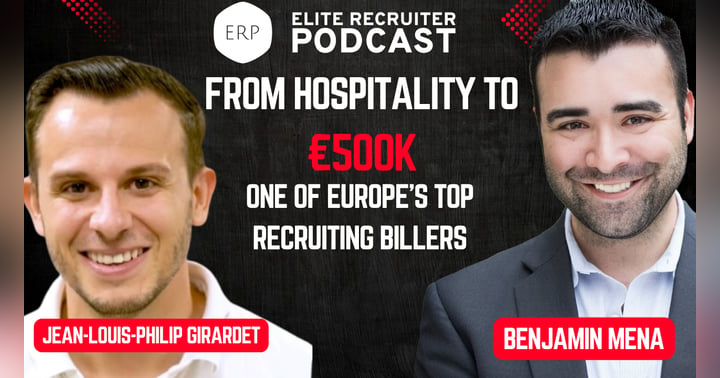
From Hospitality to €500K: One of Europe's Top Recruiting Billers
Welcome to another episode of The Elite Recruiter Podcast! In today’s show, host Benjamin Mena sits down with Jean-Louis-Philip Girardet, one of France’s top billers turned recruiting team leader. From luxury hospitality in Los Angeles and London to crushing €500,000 billing years—and now coaching new recruiters—Jean-Louis-Philip Girardet shares his unique path, insights, and strategies for building lasting relationships and delivering high-quality results.
They dive into what sets top billers apart, the challenges and opportunities within the French recruiting market, and how lessons from a career in hospitality have shaped Jean-Louis-Philip Girardet's distinctive approach to recruitment. Plus, you'll hear actionable advice for recruiters at every stage—from those just entering the industry, to veterans aiming to reach elite status. Tune in for a conversation packed with inspiration, practical advice, and a fresh perspective on what it takes to succeed and lead in today’s recruiting world.







He spent years managing luxury restaurants in Los Angeles and London. Then he walked into a recruiting office with zero industry knowledge — and became one of Europe's top billing recruiters. Jean-Louis-Philippe Girardet (JLP) didn't just cross industries. He rewired how recruiting gets done.
🎯 This Is Your Year — Recruiter Summit | April 27th | FREE Mike Williams, Brianna Rooney, Mark Whitby and a full week of the industry's best. All live sessions are free. 👉 https://this-is-your-year-recruiter-summit.heysummit.com/
Most recruiters burn energy chasing new clients when their next placement is already in their database. JLP proved it — 60% of his €500K billing year came from relationships he already had. This episode breaks down how he built it, how he led with luxury service standards in a sales-driven world, and what it really takes to go from top biller to team leader without losing what made you great.
What You'll Learn
- The luxury hospitality service standard JLP applied directly to his recruiting process
- Why 60% of his €500K year came from existing clients and how to replicate it
- The duo billing model that sustained 20–30 open assignments simultaneously
- The hardest truth about transitioning from top biller to team leader
- Why salary is taboo in France and what it reveals about building candidate trust
- The 20/70/10 framework he uses to lead, differentiate, and make hard calls
- What Jack Welch's Winning taught him about competing at the highest level
Jean-Louis-Philippe Girardet (JLP) billed €500K in a single year and $320K solo the year prior, specializing in legal and HR recruitment in France. A former luxury restaurant manager who worked at a Michelin-star restaurant in Los Angeles and the Waldorf Astoria in London, JLP now leads one of the top recruitment teams in his group in Montpellier.
When you treat every candidate like a five-star guest and every client call like a table that needs turning in under ten minutes, results compound differently. JLP didn't just bring a different background to recruiting — he brought an entirely different standard. Hit play. This one will change how you run your desk.
Timestamps
00:00 – The philosophy separating great recruiters from everyone else
03:13 – From biology student to luxury restaurant manager
09:18 – Landing in recruiting with zero industry knowledge
13:37 – What luxury hospitality taught him about winning the desk
16:57 – Breaking down the €500K billing year
18:32 – The duo model for managing 20–30 open roles simultaneously
20:01 – Why JLP walked away from billing to lead a team
21:45 – The hardest part of going from top biller to leader
22:43 – The 20/70/10 rule for managing team performance
27:35 – France vs. US: why salary is taboo and what it means for recruiters
45:41 – The question JLP wishes more recruiters would ask
46:42 – What BD looks like in France's unstable market right now
Sponsor:
🚀 Atlas — AI-First Recruitment Platform Candidates tell you everything on a call — then it gets buried in notes and forgotten. Atlas fixes that. It captures every conversation automatically and makes it searchable. Ask Magic Search "Who mentioned they're open to relocating?" and it pulls the answer instantly from your entire database. Atlas clients report 40%+ EBITDA growth and 80%+ increase in monthly billings. 👉 https://recruitwithatlas.com
💼 Elite Recruiter Community 👉 https://elite-recruiters.circle.so/checkout/elite-recruiter-community
🔹 Pin → https://www.pin.com/
📩 https://eliterecruiterpodcast.beehiiv.com/subscribe
▶️ https://youtu.be/Iqaii3vcGWo
🔗 JLP → https://www.linkedin.com/in/jean-louis-philip-girardet-7865b1b0
🔗 Benjamin → https://www.linkedin.com/in/benjaminmena/
Benjamin Mena [00:00:00]:
Are you still trying to grow your recruiting desk or business on your own? Join the Elite Recruiter Community and connect with recruiters who know your challenges. Members get unlimited access to replays from the AI Recruiting Summit, Finish the Year Strong, and all our past events, plus biweekly roundtables where we dive into sourcing, business development, and mindset. You'll also tap into our Billers Club for accountability and a split space to partner on roles. Join the number one growth environment for recruiters for just $49 per month. You'll be part of a tight-knit group that pushes you to grow, and you can cancel anytime. Visit the link in the show notes and click Join Now to get started and start mastering your craft today. Coming up on this episode of the Elite Recruiter Podcast.
Benjamin Mena [00:00:40]:
Your best year when you crushed it, 60% of your billings came from previous clients.
Benjamin Mena [00:00:47]:
So the relationships were already there.
Benjamin Mena [00:00:49]:
And so often we talk about the top of funnel, like finding new people, when in reality we should be focusing on the people we already know. One thing I didn't realize is like how taboo the subject of making money is in France.
Jean-Louis-Philip Girardet [00:01:03]:
In France, it's very indirect. We do not talk too much about salary.
Benjamin Mena [00:01:08]:
Welcome to the Elite Recruiter Podcast with your host Benjamin Mena, where we focus on what it takes to win in the recruiting game. We cover it all from sales, marketing, mindset, money, leadership, and placements.
Benjamin Mena [00:01:26]:
You know, the resume never tells the full story. Candidates share what really matters during conversations, on calls and interviews, over email. Their motivations, salary expectations, plans to relocate. Most of that detail ends up buried in notes and forgotten. Atlas changes that. It's the AI-first recruitment platform built to eliminate admin. It captures every conversation automatically and turns it into something you can use. With Magic Search, you can ask Atlas questions like, "Who talked about wanting a 4-day week?" or "Who mentioned they're open to relocating next year?" It searches across your entire database and pulls the answers instantly.
Benjamin Mena [00:02:00]:
No keyword guessing and no digging through old notes. You get insight from real conversations, not limited resume fields. Atlas also makes BD easier. With Opportunities, you can track and grow client relationships powered by generative AI and built into your existing workflow. If you want visibility, well, smart dashboards give you a clear view of the pipeline across your business. And that's not theory. Atlas customers have reported over 40% EBITDA growth and over 80% increase in monthly billings after adopting the platform. It's built for agencies that want to grow without adding more manual work.
Benjamin Mena [00:02:34]:
Don't miss the future of recruitment. Get started with Atlas today and unlock your exclusive listener offer at recruitwithatlas.com.
Benjamin Mena [00:02:43]:
I'm excited about this episode because here's the thing, there are big billers all across the world, and I'm excited to sit down with one of France's top billers.
Benjamin Mena [00:02:53]:
Absolutely crushed it, but it is now in a leadership role.
Benjamin Mena [00:02:57]:
Went from big billing to leadership. So I'm so excited that he's going to come on and share a story. And from what I've actually seen and the conversations I've been having across Europe, he has been one of the top builders that I've met. So JLP, excited to have you on the podcast.
Benjamin Mena [00:03:13]:
Good morning, Benjamin.
Jean-Louis-Philip Girardet [00:03:14]:
Good morning, everyone who is listening.
Benjamin Mena [00:03:17]:
It's a great pleasure to be here. As you mentioned, my name is JLP.
Jean-Louis-Philip Girardet [00:03:22]:
It's just to be short because I am Jean-Louis Philippe. So that's why it sounds like more a rap, you know, an American, a US rap. So I like JLP.
Benjamin Mena [00:03:33]:
I'm excited to be here.
Jean-Louis-Philip Girardet [00:03:34]:
Thank you very much for hosting me, Benjamin.
Benjamin Mena [00:03:36]:
So real quick, a 30-second self-introduction.
Jean-Louis-Philip Girardet [00:03:39]:
So as I said, GLP, I'm a French man living in south of France, exactly in Montpellier. I'm originally from Nîmes, so it's close to Montpellier. I have been doing, I mean, many, many, many things. I mean, I have two parts of my life. The first hospitality industry and then recruitment. Uh, we will expand, we will go through, uh, later on, uh, with that. And, uh, I hope to share some points that inspire your audience as it inspired me before.
Benjamin Mena [00:04:15]:
Well, it's definitely exciting to have you on here and excited that you're going to break down exactly how you were just absolutely crushing it with the billing numbers. But before we even get there, let's take a few steps back. How did you even end up in this land of misfit toys, this land of recruiting?
Benjamin Mena [00:04:31]:
Well, it can be a long story, but I will try to, to, to, to resume that.
Jean-Louis-Philip Girardet [00:04:36]:
It will be long as my first name.
Benjamin Mena [00:04:38]:
Let's go. Go ahead. So first I studied biology for 2 years.
Jean-Louis-Philip Girardet [00:04:43]:
Why did I study biology? Because my brother and my sister, they are researchers and I wanted to be like them. But after 2 years, I realized that was not for me. Something missed. And I talked to my father and my mom. And I said, I want something else. It was difficult at this time. I had at 20 years old to say, this is not what I want. Uh, was very difficult to tell them that I have this chance to travel with them a lot around the world to discover many places in hospitality industry and restaurant, because my father was a lover of restaurant or of food, you know, and I told them I want to study in hospitality industry, and that's where I start.
Jean-Louis-Philip Girardet [00:05:28]:
I study 4 years in hospitality industry in France. I've done many internship in Courchevel in the French Alps. I went to Potomac in Maryland, so that was my first experience in U.S. I went alone over there. I wanted to step into the bath, you know, uh, I didn't want to have English, French people around me. I wanted to be focused in English and that's the way I learned English as well. And then my last year of study for my master's degree, I did it in Los Angeles to have an MBA as well. I studied 2 days a week and I worked 4 days a week.
Jean-Louis-Philip Girardet [00:06:13]:
So I got only 1 day off per week and I was working in the Walt Disney Concert Hall. In Los Angeles where the LA Philharmonic is performing. It was a great restaurant. It was a Michelin-star restaurant. I learned a lot over there and my experience in Los Angeles was amazing. So after this year, I couldn't stay in US. So my aim was to come back in US, but by making some plans. So with my wife, we went to London to work in a hotel, the Waldorf Astoria.
Jean-Louis-Philip Girardet [00:06:45]:
Near to Covent Garden, so it's very central to London. And we work at the Hilton Group, so Waldorf Astoria Hilton Group. The aim was to come back with this group because it's a US group in the US, but the actual president, he had turned his first mandate, so he made the rule a little bit more difficult for foreigners to come in. In the US, so our plan was a mess. I mean, I would say it was over, so I couldn't come back to the US.
Benjamin Mena [00:07:21]:
And after 2 years, it's all right. I'm good in the south of France. Uh, after 2 years, we decided to come back to France because my father passed away and I wanted to be close to my mom.
Jean-Louis-Philip Girardet [00:07:34]:
And the hours we have done in hospitality, in hotels, were very difficult. We've done 300 hours per month of work. So that was a lot and too much, I think. So we decided to come back to the South of France. I applied to many jobs in the hospitality industry and I realized, wow, this is not for me anymore. My experience in the US or London were not, how can I say, were not, were like from nowhere. I didn't have experience from US and London when I came to France, and that's a shame, and we will talk later on that. So I had to start again from the beginning, and I couldn't do that.
Jean-Louis-Philip Girardet [00:08:19]:
I was a restaurant manager. I had 30 people with me. I couldn't start as a waiter again. So I decided to apply in many fields. I applied, honestly, I think I applied for 100 of job, I think.
Benjamin Mena [00:08:34]:
100 different jobs?
Benjamin Mena [00:08:36]:
I mean, not different job, but in the same field, but 100 different job.
Jean-Louis-Philip Girardet [00:08:43]:
I wanted to find something with the human side, but also the commercial side. And that's why I applied to something that I didn't even realize at this time.
Benjamin Mena [00:08:54]:
My boss will be, will be, will be surprised if I said that, but he knows.
Jean-Louis-Philip Girardet [00:08:58]:
He knows, I applied as a recruitment consultant and I didn't even know this job at all. I didn't even know this job at all. I didn't know what to do and what was the purpose of that. So voilà, how I end up in recruitment consultant.
Benjamin Mena [00:09:18]:
I mean, I feel like that's like all of us, or at least most of us. I know there's a few that like choose it, but most of us are like, what the hell is recruiting? Like, and then all of a sudden we're here. 7, 10, 20 years later, we're still here.
Jean-Louis-Philip Girardet [00:09:32]:
Really? Because it's a lovely, it's a lovely job. Honestly, it's a passion job.
Benjamin Mena [00:09:36]:
So like when you were in hospitality, you were in like the service industry, but now you flipped into what was really a sales position, like as recruiting. Were those first few months of learning recruiting super hard?
Jean-Louis-Philip Girardet [00:09:49]:
Honestly, it did not hold me back. Quite the opposite. When I joined the recruitment, I mean the pay job company or legal and HR, because it is legal and HR company, I had one week of training, one week of training before being thrown, being thrown in at the deep end. You know, my manager was about to, to leave in maternity, so I needed to become operational as quick as possible. I had one week, honestly. And that was the same in hospitality. For example, in London, when I start, I had barely arrived and 5 minutes after seeing my manager, I was on the floor because the hotel was experiencing a peak of activity. So I was ready for, I was ready for one week and then you were off to the sharks.
Jean-Louis-Philip Girardet [00:10:46]:
Yes. And I didn't know anything, any words.
Benjamin Mena [00:10:52]:
That was just like a new world. I couldn't understand anything, but okay, here we go. It's like in Potomac, you know, in US when I was in Potomac.
Jean-Louis-Philip Girardet [00:11:00]:
So that was the same. That was the same.
Benjamin Mena [00:11:03]:
So you kind of got used to being like thrown to the wolves and having to figure it out.
Jean-Louis-Philip Girardet [00:11:07]:
Yes.
Benjamin Mena [00:11:09]:
So when you first started, were you doing like just the recruiting side of the house or were you doing like Also in charge of finding clients too?
Jean-Louis-Philip Girardet [00:11:17]:
Both.
Benjamin Mena [00:11:18]:
So you were like one week of training, thrown to the wolves because your manager was leaving and you had to do a full 360.
Jean-Louis-Philip Girardet [00:11:24]:
Yes. Yes. I had this chance to be with her during one week because she was in south of France as well. She was working in Montpellier. So our company is working in full remote, but we have the headquarters They are located in south of France, in Montpellier, and my manager was working there. So I had this chance to be with her in the same office, sitting next to her, and during one week, I could hear what she was doing. So that helped me a lot. That helped me a lot to memorize and to apply that the next week.
Benjamin Mena [00:12:04]:
So you're off on your own week number 2.
Jean-Louis-Philip Girardet [00:12:07]:
Yes.
Benjamin Mena [00:12:07]:
How did you find your first 3 clients on your own?
Jean-Louis-Philip Girardet [00:12:12]:
So I had her clients first and then my clients. I mean, we have an internal tool where we can have all the activity of the company and let's go, go do the, go do the sale, go do the commercial on that. And, uh, that's the way I did. I call clients, even if I didn't know anything. but I pretend I knew.
Benjamin Mena [00:12:40]:
So like, as you're, as you are picking this up and, you know, learning the industry, calling clients that the team has worked with before, like how long did you think it felt for you to, for it to click? Like, I can do this. This is going to be something I'm going to be good at.
Jean-Louis-Philip Girardet [00:12:56]:
I could feel it right away. The next week I start, honestly. I could feel like, oh, I'm going to like this job because I was close to people. I still have this human side and, uh, I still have as well the sales part, which I like. So I could feel, oh, this is something new. This is something different. This is something I like, honestly. And I wanted to see more.
Jean-Louis-Philip Girardet [00:13:24]:
So I knew right away the next week I knew it was for me, this job.
Benjamin Mena [00:13:28]:
Well, that, that is awesome. I think it takes a lot of other recruiters a lot longer to figure that out.
Jean-Louis-Philip Girardet [00:13:34]:
Probably, probably. And I do understand why.
Benjamin Mena [00:13:37]:
I want to fast forward to like your really good billing years in a minute, but I want to kind of take a step back and, you know, you were in high-end luxury hospitality working at some of the best places, and now you're in the world of recruiting. What are some of the biggest things that you've taken away from that high-end luxury world that's really helped you succeed in recruiting?
Jean-Louis-Philip Girardet [00:14:03]:
In hospitality industry, in luxury industry, we have some, not commitment, we have some rules to respect, you know, to provide a great experience to the guests, to the clients. And, uh, I took these rules that I had, that I used to learn, and put it into the recruitment industry, but with the own world of the recruitment industry. So I apply what I learned from there to this recruitment industry, and that helped me a lot, honestly. Also caring about people. I think this is one thing not everybody I have, it's very difficult to care about people. So even caring about myself, it's difficult. So I do imagine to care about people, about others, it's really challenging, but I care more about others than me. So yes, these things help me as well in hospitality industry to recruitment.
Benjamin Mena [00:15:10]:
Do you think that's one of the things that helped really set you apart?
Jean-Louis-Philip Girardet [00:15:13]:
I would say yes.
Benjamin Mena [00:15:14]:
For somebody listening, like, that wants to, like, increase, like, what they're doing and how much they care, what do you think is one thing that, like, from what you've seen from other recruiters out there that you're doing different that they could take away and be like, hey, JLP's treating these people like guests, even though they're candidates. Like, what's a great takeaway that somebody can learn from you on that process?
Jean-Louis-Philip Girardet [00:15:43]:
Work with people, not with numbers. We're doing a sales, we're doing a sales job. We're realizing that and we have this pressure of doing margin and making profit, but we're working with people. That's the aim. You do not have to forget this aim that you are working with people and not with numbers. So that's my advice to everyone who is listening. Work with people, not with numbers.
Benjamin Mena [00:16:13]:
And it's so often like, it's easy to forget that. It's easy to go.
Jean-Louis-Philip Girardet [00:16:18]:
Yes, it is. Because you're always thinking, oh, I have, I have a recruitment. I can make 10,000. I can make 15 grand. You know, you're always thinking numbers, but you're forgetting your main purpose. Just to have people to find the right job and the client to find the right person to fill the position. That's, that's the aim. That's the first aim.
Benjamin Mena [00:16:43]:
Absolutely. Let's jump towards your— you billed €500,000, which is a great number for France. Like, what did that year look like? Like, when it came to your desk?
Jean-Louis-Philip Girardet [00:16:57]:
To put in the context, 500K versus the rest of the market, roughly speaking, I don't have the exact data, Benjamin, but an average recruitment consultant in France earns around $180K and an independent around $100K. I made this $500K back in 2022, and, uh, it has to be acknowledged that the post-COVID market was very favorable in 2022. It's true. It's true. It was, it was very true, but 60% of my business came from clients I already have and 40% coming from the group resources because we are a group and we're helping each other. We are very specialized into our field. I'm specialized in legal and HR position, but others are specialized in finance, commercial, and they could handle this, the job I was doing. So that's why we were to each other giving job.
Jean-Louis-Philip Girardet [00:18:00]:
Okay, I have a commercial for you, or I have an HR position for you. And there we go. That's one of our strengths in the group. I work as a duo and the person working with me was just as important for the recruitment. This is a unique aspect of the group. Uh, we can advance in pairs. In this group, which is very helpful to work in pair. And one person is focusing on the research, I mean on the search with the candidates, and the other one is directly with clients.
Jean-Louis-Philip Girardet [00:18:32]:
And I was directing with clients. But I came to this step because I win before. I made by myself in 2021, just by myself, $320K. $320K this year by myself. So that's why my, my direction, my, my boss told me, okay, you can have someone with you to help you to go further. So we ended between 20 and 30 assignments all the time, all the time. It was crazy. It was crazy.
Jean-Louis-Philip Girardet [00:19:10]:
The rhythm was very crazy. We had this goal of breaking records and reaching the top consultants in the group. They were part of the rise, I would say, as well, these consultants, because I have a competitive spirit as well. And, uh, thinking like, they can do it, I can do it, and I can even go further.
Benjamin Mena [00:19:35]:
So you, like, prior to that year, was like, you know what, I can go break some records.
Jean-Louis-Philip Girardet [00:19:40]:
Yes.
Benjamin Mena [00:19:41]:
And you just saw the marketers like, this is the year I could actually do that.
Jean-Louis-Philip Girardet [00:19:44]:
Yes, definitely. And I could do even later on, but in 2023, I stepped back into this leader role.
Benjamin Mena [00:19:52]:
Well, okay, let's talk about that. So you went from like big biller to getting somebody entertained to bill even more, to go even farther.
Jean-Louis-Philip Girardet [00:20:01]:
Yes.
Benjamin Mena [00:20:02]:
Why did you make the decision to go from billing to You know, I'm going to lead the team.
Jean-Louis-Philip Girardet [00:20:09]:
We wanted to expand, or we wanted to make legal and HR team bigger than it was that time. We were in 2022, we were only 3. And in 2023, uh, we had this vision to grow the company, to have more people. And that's why my boss told me, okay, you need to step up as a leader because you will have a lot of people under you. And that will be difficult to catch up with the market, with the results, because you will have a lot of people. And that was true. I mean, the, in 2023, 5 people came into my team. So that was very difficult to train them plus follow my clients and other things.
Jean-Louis-Philip Girardet [00:20:58]:
And we will go maybe later on, but with the quality, you know, so I didn't want to lose the quality with my client. I prefer to focus on training people because I succeed. And I think this is one of the role as a leader. When growing as a leader, you need to make success, but when you are a leader, you need to give this success to people. You need to grow people. And this is one thing I learned. So voilà why I used to become a team leader, but some points were very hard, honestly, some points were very hard.
Benjamin Mena [00:21:37]:
What was one of the hardest points about flipping from big biller to leading a team? Because I know that's a struggle that a lot of people have.
Jean-Louis-Philip Girardet [00:21:45]:
Being away from the field already.
Benjamin Mena [00:21:48]:
And I admit I miss it. I miss it.
Jean-Louis-Philip Girardet [00:21:50]:
I miss it a lot, but I still have some contact with clients, but I miss it.
Benjamin Mena [00:21:54]:
There's one other thing which is very difficult.
Jean-Louis-Philip Girardet [00:21:57]:
I was doing the recruitment and there's so many parts you do not manage because we are working with humans. So you do not manage all the part with clients. You do not manage the part with candidates, but you try at your scale to manage it. But then now as a leader, I have another step, I mean, another barrier, the consultant. So they are doing their own work, they are doing their own way, but I cannot tell them, oh, you need to do my way. They are doing their way.
Benjamin Mena [00:22:31]:
So this is one thing which is difficult.
Jean-Louis-Philip Girardet [00:22:34]:
I have to trust. I have to trust what they are doing.
Benjamin Mena [00:22:38]:
And the last thing. I would say differentiation.
Jean-Louis-Philip Girardet [00:22:43]:
When you are a leader, you need to make the difference between all the performance in your team, and you need to make choice. So differentiation is one of the hardest parts of being a manager, and also the most important part. You have this top 20% who wants to perform, who wants to overcome, who wants to break record. You have this top 70% which are the consultants who are doing the job, and then the bottom 10. And the bottom 10, this is where you need to make decisions, and sometimes it's not very easy at all. And I don't like, but it's business.
Benjamin Mena [00:23:23]:
So as you're training these, these recruiters and growing these recruiters and letting them find their own voice, like, how have you been able to also instill that and maintain these high standards that you have from the luxe hospitality world into your team?
Jean-Louis-Philip Girardet [00:23:46]:
We have some standards in the group already. Uh, when you are working with clients, you need to file with a complete meeting with the candidates. You need to give reference. You need to check the ID of the candidates. So we already have some standards. And working with HR and legal people give us the obligation to have high standards. These people, they're working in a high-level company, honestly, in a high-level position. So you need to step up into their job and you need to step up into their position.
Jean-Louis-Philip Girardet [00:24:26]:
So we couldn't, we couldn't be just like, okay, here we go, guys. We're just sending a resume to the HR.
Benjamin Mena [00:24:33]:
We do you not give anything, just let's go.
Jean-Louis-Philip Girardet [00:24:36]:
It couldn't be like that. You need to take over with the people and you need to, to have this high standard. And I also thought about doing a book with all rules, and I think it don't exist in recruitment, honestly. In hospitality industry, we have this— I don't know if you know— the leading hotel of the group. This is a branch, leading hotel. And this leading hotel, they have standards. And if you want to be part of the leading hotel, you need to respect these standards. For example, if a guest is sitting at the bar, you have 2 minutes to greet him.
Jean-Louis-Philip Girardet [00:25:11]:
Then after these 2 minutes, you need to present him the menu. Then 10 minutes later on maximum, you need to take the order. 5 minutes after, you need to bring the order, the drink to the guest. And then 20 to 30% of his glass, you you need to propose another glass. And that's all the standard. That's all the rule that we had. And I always thought about doing something like that for the recruitment. For example, if a client is calling you and you miss the call, in 5 minutes or 10 minutes later, you need to call back, even for candidates.
Jean-Louis-Philip Girardet [00:25:49]:
And that's the thing I thought. So I hope I answered your question because I know you don't already a little bit because I want to—
Benjamin Mena [00:25:58]:
I went wild. So, but I hope I stayed on the, on the field.
Benjamin Mena [00:26:01]:
I'm gonna be honest with you. I really believe that 2026 is your year. I truly believe in you.
Benjamin Mena [00:26:11]:
I truly believe with everything in my heart that this is the year that you can own it. This is the year that you could hit your dreams.
Benjamin Mena [00:26:17]:
And to help you do that, We are kicking off a summit called This Is Your Year. You are elite.
Benjamin Mena [00:26:24]:
You were born to be elite. You were born to be the best.
Benjamin Mena [00:26:27]:
You were born to be the greatest.
Benjamin Mena [00:26:30]:
And I'm pulling together some of the industry's best speakers to help you get there.
Benjamin Mena [00:26:34]:
Going to be kicking off April 27th.
Benjamin Mena [00:26:36]:
You do not want to miss this. Make sure to run to the show notes, get registered. All the live sessions are free. I'm bringing in Mike Williams.
Benjamin Mena [00:26:44]:
Brianna Rooney, Mark Whitby.
Benjamin Mena [00:26:46]:
We have an entire week of stacked speakers that are going to help you achieve your dreams. This is going to be the industry event that you do not want to miss. I believe in you.
Benjamin Mena [00:26:59]:
I believe in you so much that I'm pulling the best to help you achieve your dreams.
Benjamin Mena [00:27:05]:
2026 is your year.
Benjamin Mena [00:27:08]:
There's a book coming and that's the important thing, right?
Benjamin Mena [00:27:10]:
This is something I think, but let's go. I engage myself to do a book. Why not? There you go.
Benjamin Mena [00:27:17]:
So for like, and this is just kind of like a curiosity for like those listening. I have a huge listener base, mostly in the United States. And you've been to the US a few times. Like, what do you think is different when it comes to recruiting in France versus the US?
Jean-Louis-Philip Girardet [00:27:35]:
The foreign, foreign recruiters. Might misunderstand about the French talent market is the consciousness of both candidates and clients when it comes to decision-making. The market is more risk because commitments in France are more binding, backed by less flexible labor law, I would say, and the result in longer and more complex process compared to other countries, especially in Anglo-Saxon countries. But also the salary negotiations are also more delicate. In France, money remains a taboo subject. It's a taboo subject. Yeah, really.
Benjamin Mena [00:28:22]:
And discussions are indirect compared to Anglo-Saxon.
Jean-Louis-Philip Girardet [00:28:26]:
You can go to a bar, you can talk to someone and you can say, oh, I'm making '100K a year,' and this person is going to say, 'Oh, how do you make that? I want to know because I want to do that.' In France, it's very taboo to talk about salary. So that can be something that foreign recruiters cannot understand. And labor regulation as well. It's complex in France. It's very complex. You have the working hours, you have multiple levels of agreements.
Benjamin Mena [00:28:56]:
You have employee status, you have medical check and more, which is very difficult to understand. And the last one, it's the bill.
Jean-Louis-Philip Girardet [00:29:06]:
I mean, when you have your paycheck at the end of the month, good luck to understand why you're coming from that price to this price at the end. You have multiple lines of what you are paying and you don't even understand any line of of what you are paying and what for.
Benjamin Mena [00:29:25]:
So you're coming from the gross salary to the net salary and this is amazing.
Benjamin Mena [00:29:30]:
It's like, wait, where'd my money go?
Benjamin Mena [00:29:33]:
Yes, you don't know. It's going somewhere, but not in your pocket at the end.
Benjamin Mena [00:29:37]:
That is kind of funny. At least one thing I didn't realize is like how taboo the subject of making money is in France. Like, you know, when you're sitting there dealing with candidates in the US, you're like, we do the salary negotiation dance, but most of the time they're like, oh yeah, I'm making this or making that.
Jean-Louis-Philip Girardet [00:29:52]:
In France, it's very indirect. We do not talk too much about salary. And even in negotiation, when it comes to negotiation with candidates, we can feel we are walking on eggs. Honestly, we are walking on eggs, both us plus the candidate. This is crazy because the candidate is going to say, okay, I'm making 60, I want at least 60. But then it can create a frustration to the clients. Oh, okay, I'm going to make 55.
Benjamin Mena [00:30:26]:
Why?
Jean-Louis-Philip Girardet [00:30:27]:
I said I'm making 60.
Benjamin Mena [00:30:29]:
Why are you going to go to 55?
Jean-Louis-Philip Girardet [00:30:30]:
So this is our whole role to adapt that and to make sure the client is doing the right offer. But yes, we're walking on eggs. All the time we're talking about salary, we're working on X.
Benjamin Mena [00:30:42]:
Do you guys do contingent searches, or is a lot of the searches like retained?
Jean-Louis-Philip Girardet [00:30:47]:
No, we are working, um, success and non-exclusive, uh, non-exclusive contract. We are working most, most of them, because I think when you working exclusively, you are engaged, and this is something who can turn you to something very difficult at the end because you engage, you give money. I mean, they already gave you money and everything. I don't like, I prefer to work on success and non-exclusive contract.
Benjamin Mena [00:31:14]:
Ah, okay.
Jean-Louis-Philip Girardet [00:31:16]:
And they are challenging. They're competing. We are competing to, to other companies who are doing the same and which is good.
Benjamin Mena [00:31:25]:
Keeps the pressure on, right?
Jean-Louis-Philip Girardet [00:31:26]:
Yes, always. But pressure, but doing the right quality. Not with quantity, because this is something you can step into when you are working in success and non-exclusive. You want to give tens of resumes just to block this resume. Okay, I found this one. Okay, I found this one. This is not our aim. If the client is calling us, we need to make the work for him and just present 2 to 3 or 4 profiles maximum.
Jean-Louis-Philip Girardet [00:31:59]:
And then that's it. I'm just doing that because I think you have your candidates.
Benjamin Mena [00:32:04]:
Talking about pressure, it sounds like you, uh, get a lot of like pressure relief out of the recruiting chair and doing like stuff like HIROX. Your stress relief is HIROX.
Benjamin Mena [00:32:15]:
Yes, I compete in HIROX in Bordeaux just a few months ago, and that was a great experience. But why I went to HIROX, because this is a sport endurance.
Jean-Louis-Philip Girardet [00:32:25]:
And I like to challenge myself and I found resilience and strong mindset to do that.
Benjamin Mena [00:32:31]:
Talking about that, not iROCKS, but about work pressure.
Jean-Louis-Philip Girardet [00:32:35]:
We are not under pressure at work. I do not feel like that.
Benjamin Mena [00:32:38]:
I'm just in a way audience is talking, oh my word, he's working in an environment horrible. No, no, no, it's not true. We do not have the pressure in our industry. It's just the pressure to find the right candidates. The first, that's it.
Jean-Louis-Philip Girardet [00:32:53]:
That's it.
Benjamin Mena [00:32:53]:
Just in case.
Benjamin Mena [00:32:54]:
Good clarification.
Benjamin Mena [00:32:55]:
I'll get a call on that one. Just in case.
Benjamin Mena [00:32:58]:
So I know one of the things like I get some of my best ideas when I'm out for a run. What are some of the biggest things that like you've taken away from sports that you've put back in your recruiting desk?
Jean-Louis-Philip Girardet [00:33:11]:
As you said, I've done IROCs, but I've done as well Ironman and trail performance, trail sport. And the running brought me key lessons that I apply at work. Embracing the unknown, I would say, embracing the unknown and staying flexible. Also managing energy over the long term. It's a long job. You do not have to be a sprinter. You need to be a marathon. It's a marathon you are doing and developing mental resilience as well.
Jean-Louis-Philip Girardet [00:33:43]:
To overcome fatigue. And I don't know if you see, but in trail, every path is different. You have up and down, and you need to know when you can put your energy. And that's the same in recruitment. You need to know when it's the right mission, the right recruitment. Okay, do I lose my energy on this recruitment, or do I need to put on another one? And that's something that I learned also, the resilience, because You need to be very resilient, especially into this time, in the business time, which is very difficult. And you need to manage your frustration as well, because frustration, you always have frustration with working as a success and non-exclusive contract. You need to manage your frustration because most of the time you won't make the recruitment for the client.
Benjamin Mena [00:34:32]:
You won't make it.
Jean-Louis-Philip Girardet [00:34:34]:
So you're doing the job, you do everything you can, and then Okay, I didn't make it. For me, that's it. I pass to something else. So I manage my frustration like this.
Benjamin Mena [00:34:46]:
Running is a great place for that too.
Jean-Louis-Philip Girardet [00:34:47]:
So it is.
Benjamin Mena [00:34:49]:
When I jump back to like you and building your team, like, you know, going from a big biller to building a team, like what, and it sounds like you have figured out goals for every stage of your recruitment journey. Looking at the next 3 to 5 years, like what are some of the goals that you have for your future and for the team?
Jean-Louis-Philip Girardet [00:35:09]:
So if I'm making this team successful, it's because I give them responsibility and autonomy a lot. We know this sentence, you don't leave a company, you leave a manager. And I'm proud to work every day with these colleagues. And I believe the feeling is mutual because they are staying. Of course, we have some ups and downs. Always, like anywhere, like in our life as well. But the group is constantly evolving, always renewing itself, taking action and, uh, recessing as well. One step forward, two steps back.
Jean-Louis-Philip Girardet [00:35:46]:
Always. So our work, I mean, our work conditions as well are incredible. That's why I maintain people and that's why I bring them to the top. And I don't micromanage, you know, the people. I don't like that. And the industry, the recruitment industry is something that have this bad specter. We think we micromanage a lot the people, which is maybe true for the big group. I wouldn't say the name, but they are big recruitment group.
Jean-Louis-Philip Girardet [00:36:16]:
They are micromanaging the people, but me, I don't like, I give them the the responsibility and the autonomy and the liberty to express themselves.
Benjamin Mena [00:36:27]:
I think that's the way to do it, especially for finding top performers.
Benjamin Mena [00:36:31]:
It is.
Benjamin Mena [00:36:33]:
I think you can micromanage a top performer out.
Jean-Louis-Philip Girardet [00:36:36]:
I do not manage them. I leave them. I mean, my first, maybe sometimes it's them who managing me at the end.
Benjamin Mena [00:36:46]:
That's awesome. Well, before we jump over to the quickfire questions, is there anything else that you wanted to go deeper on?
Jean-Louis-Philip Girardet [00:36:54]:
Probably one experience that I have with one client. It was horrible experience. It was an horrible experience, but I will say why. And a lovely experience as well. I'm going to say why.
Benjamin Mena [00:37:09]:
That was part of my first clients.
Jean-Louis-Philip Girardet [00:37:11]:
I met the head of HR development and the legal director. And this gentleman, he knew my job because he'd done it before.
Benjamin Mena [00:37:20]:
He was a recruiter. He was a recruiter. He was a consultant before.
Jean-Louis-Philip Girardet [00:37:23]:
So I could feel from him, I know your job, man. I know your job.
Benjamin Mena [00:37:29]:
I felt during this meeting, oh, he's going to make me pay. He's going to make me pay. And he's going to be like, oh, have big muscle just in front of the legal director. He will have big muscle. And I'm gonna show you him. I know the job. So I was, for me, I was like, what I am getting myself into? It seems horrible.
Jean-Louis-Philip Girardet [00:37:52]:
But I went along step by step with him. I work with the man. I knew every day a bit more of this man, and the relationship starts. And yes, He became one of my best clients after that. I build every year between $60K and $80K with these clients every year. So if I advise everyone, the worst client that seems to be the worst client can be the best client at the end.
Benjamin Mena [00:38:26]:
And it's all about the relationship that you built with them over time.
Jean-Louis-Philip Girardet [00:38:29]:
Yes.
Benjamin Mena [00:38:29]:
And now we call. Each other on our personal numbers to catch up about everything and nothing.
Benjamin Mena [00:38:36]:
I think that's one of the things that like a lot of recruiters make the mistake of, and it's also one of the things that you said earlier in the podcast.
Jean-Louis-Philip Girardet [00:38:44]:
Mm-hmm.
Benjamin Mena [00:38:45]:
Your best year when you crushed it, 60% of your billings came from previous clients.
Benjamin Mena [00:38:52]:
So the relationships were already there.
Benjamin Mena [00:38:54]:
And so often we talk about the top of funnel, like finding new people, when in reality we should be focusing on the people we already know.
Jean-Louis-Philip Girardet [00:39:04]:
Really, really. And I will give you one more example. It was like 2 weeks ago. There's an HRD I called. She's a candidate, but I give you an example. I mean, I give an example to the audience. We talk about her experiences and then At one point I asked her, is there any industry you wouldn't like to work? And she told me the tobacco industry. I don't want to work in tobacco industry.
Jean-Louis-Philip Girardet [00:39:34]:
And at that point I jump into disinformation. I went further disinformation. Why you don't want to work in tobacco industry?
Benjamin Mena [00:39:43]:
You were a previous smoker?
Jean-Louis-Philip Girardet [00:39:45]:
I ask, I take this responsibility to ask. And she said, Yes, I was a previous smoker. And from that point, we start to talk about her. We start to talk about sport she's doing. She's doing a lot of trail as well, Ironman. And she will remember me. I'm sure when I call her back in 3 months and I talk about sports, she will say, oh, this is Gilles P., I remember him from that.
Benjamin Mena [00:40:15]:
I mean, definitely listening to where people's lives are changed.
Jean-Louis-Philip Girardet [00:40:18]:
Yes. So out of curiosity, not everyone can do it. And I do understand, you know, our job is to find candidates for clients. That's it. But for me, you need to go further with people if you want to mock the people and if you want to be a top bidder.
Benjamin Mena [00:40:37]:
When they do get that job, even when it's not from you, they remember who they had a good conversation with.
Jean-Louis-Philip Girardet [00:40:43]:
Yes, yes.
Benjamin Mena [00:40:45]:
Jumping over to the quickfire questions, and they don't need to be quick answers. So first of all, let's just say if somebody like brand new is coming from, we'll say, the hospitality world, they've never been a recruiter before, they give you a call up, sit down with you, it'd be like, hey, looks like you've had some success. If you can give me one piece of advice to have a successful recruiting career, because I've never been a recruiter before. What would you tell them?
Benjamin Mena [00:41:14]:
Two things I would say.
Jean-Louis-Philip Girardet [00:41:17]:
The first, we talked about earlier, work with people, not with numbers. This is one rule that I make, me, work with people, not with numbers. But also trust what you are selling. I was not selling something material. I was selling my experience, my advice to the people. You need to trust that you do not just sell, okay, I'm going to find the candidates for you. You're selling your experience. So you have to trust that, trust what you are doing, trust the person you are, trust on your work, trust what you are doing every day.
Jean-Louis-Philip Girardet [00:41:53]:
That's two advice that I would say to your audience.
Benjamin Mena [00:41:57]:
And let's just say you're sitting down with a recruiter or get a call from a recruiter that's been in the game for a while. And they've made the decision they want to go from good to great or good to elite. What advice would you give to them?
Benjamin Mena [00:42:11]:
So first, let's go together to break records. Uh, if you want to be from a recruiter to top bidder, let's go, let's go together. I will be more than happy to, to share with you this, this experience.
Jean-Louis-Philip Girardet [00:42:23]:
But, um, I will be honest with him.
Benjamin Mena [00:42:27]:
It's a lot of work.
Jean-Louis-Philip Girardet [00:42:28]:
It's a lot of energy. I wouldn't lie to them saying that it's easy. I would say you would have to, to work maybe more from 8 AM to 8 PM. You would have to work on different hours than others are doing. For me, just a quick example, my sales part, my commercial part, I was doing from 8 AM to 9 AM in the morning, then from 12 PM to 2 PM, and then from 6:30 PM to 8 PM. Never between, never during the morning, never during the afternoon, because most of the people were doing that at this time. So I was different. I was doing different.
Jean-Louis-Philip Girardet [00:43:09]:
So you need to be different than others as well. Think out of the box. Good.
Benjamin Mena [00:43:16]:
Has there been a book that's had a huge impact on your career?
Jean-Louis-Philip Girardet [00:43:19]:
Definitely. Winning from Jack Welch. Jack Welch was the previous CEO of General Electric, and I studied his book during my MBA. Gave me so many advices to become successful and to win, because winning is great. Winning is great. You drive progress and innovation.
Benjamin Mena [00:43:42]:
Do you have a favorite tech tool that you can't live without?
Jean-Louis-Philip Girardet [00:43:46]:
Our own tech tool, and people won't understand, but we have La Base, we call it La Base, and this is an internal tool that we develop in our company. And this tool is a Formula 1, is a Formula 1, honestly. When you are working on it, previous person who work in different industry, especially in recruitment, when they're coming to our company, they're saying, well, guys, this is amazing what you have done. And every single day. We developing, we grow this tool and this is very performing. So I will say our own tech tool from our company, from the group.
Benjamin Mena [00:44:28]:
I love that you guys have like built your own tech tool.
Jean-Louis-Philip Girardet [00:44:32]:
So we're not dependent on someone else. We are our own chief on that.
Benjamin Mena [00:44:39]:
I love that. So if you guys want to make a change, you can just make a change.
Jean-Louis-Philip Girardet [00:44:43]:
Really? A quick and imperfect decision today is better than a perfect decision on tomorrow. And that's where we are doing every single day. We're making the decision. We, we change something. And then the next day, if it doesn't apply, let's go back, guys. We go back.
Benjamin Mena [00:45:02]:
Super smart. Now you've had the chance to like chat with a lot of recruiters. You've had the chance to help grow recruiters. You've probably also talked to a lot of recruiters like within your company. So I'm sure like, you know, you get questions like, what's the best BD script that you use? Or what BD tool works the best? Or how does your BD work? Or how'd you run that time in the Ironman in reality? But when it comes to like all the questions that you get, Do you ever just wonder like, hey, I wish that recruiter would just ask me this, but they never do?
Jean-Louis-Philip Girardet [00:45:41]:
I would say put me in danger. Uh, but why I say that, I like when you give me time to answer to a question. So why should I choose you? You have 2 minutes. If someone is asking me this question, I will be like, oh, I need to be concise. I need to be precise. On what they will remember of me just in 2 minutes. You have this test, you know, when you crush fire and you let it burn and you have 30 seconds to do your speech or something. This is the same.
Jean-Louis-Philip Girardet [00:46:20]:
If I see a recruiter and he's asking me this question, why should I choose you? You have 2 minutes. I will be in pressure and I will be like, oh, I need to find the right words. For him. So yeah, that would be one question I would say to me.
Benjamin Mena [00:46:34]:
And I just, out of curiosity, maybe it's all the same, but what is working for business development right now in France?
Jean-Louis-Philip Girardet [00:46:42]:
You want me to say it's difficult?
Benjamin Mena [00:46:44]:
Is it difficult?
Jean-Louis-Philip Girardet [00:46:46]:
At this time, it is very difficult. It's a very unstable market. We have different political moments in France and across the world which make the company making difficult decision. So yeah, you need to be resilient and don't give up. Don't give up. It will work at the end. You still have some clients you need to find them, but it's a lot of work. Yes.
Benjamin Mena [00:47:14]:
So right now it's work harder.
Benjamin Mena [00:47:15]:
Yes, it's work harder, but we have a very good system in our company.
Jean-Louis-Philip Girardet [00:47:20]:
And if you work harder and you making money for the company, you will make also a lot of money for you. A lot.
Benjamin Mena [00:47:27]:
Awesome. JLP, two last questions before I let you go. If somebody wants to follow you or connect with you, how do they do that?
Benjamin Mena [00:47:37]:
Not with my IG, uh, with LinkedIn. It's fine. I will give you the link of my LinkedIn and you can connect with me and you can, uh, add me and, uh, text me.
Jean-Louis-Philip Girardet [00:47:48]:
That is one thing.
Benjamin Mena [00:47:48]:
I do not have an IG for trail or run anything. I'm someone who is not very present on social media.
Benjamin Mena [00:47:58]:
It's probably smart. And before I let you go, is there anything else that you would love to share with the listeners?
Benjamin Mena [00:48:05]:
Yes, just to thank everyone, just to thank you as well.
Jean-Louis-Philip Girardet [00:48:09]:
It has been a real pleasure to share my experience and my journey with you and with your audience. I hope some of it will inspire just as it inspired me. These insights aren't to revolutionize the world, honestly, but to grow people and perhaps behind one of the phrase or reflection that I gave, they will find their meaning and be able to apply it to their life.
Benjamin Mena [00:48:41]:
I love that. Well, JLP, I just want to say thank you so much for coming on. You know, it's one of those things that I've had the chance to see is just like maybe compared to the US market versus other markets, like top one, top billers are everywhere. People just crushing it are everywhere. But in reality, the fundamental principles of how to win are the same. But it's been so cool to hear your story where you went literally from the luxe hospitality world to the land of misfit toys and recruiting. To just being one of the top people in the company to now leading a team. Because there's, and I think that important thing is there are so many people that want to become a leader at their firm and you've taken the opportunity to step up and just do it.
Benjamin Mena [00:49:26]:
This has been a great conversation to learn from. So thank you. Thank you so much for joining. And for the listeners, make 2026 your year. Go out there, crush it. Just like GOP, have the dreams, have the vision, know exactly where you want to go. And put in the work. Make it happen.
Benjamin Mena [00:49:43]:
You know, the resume never tells the full story. Candidates share what really matters during conversations, on calls and interviews, over email. Their motivations, salary expectations, plans to relocate. Most of that detail ends up buried in notes and forgotten. Atlas changes that. It's the AI-first recruitment platform built to eliminate admin. It captures every conversation automatically and turns it into something you can use. With Magic Search, you can ask Atlas questions like, "Who talked about wanting a 4-day week?" or "Who mentioned they're open to relocating next year?" It searches across your entire database and pulls the answers instantly.
Benjamin Mena [00:50:17]:
No keyword guessing and no digging through old notes. You get insight from real conversations, not limited resume fields. Atlas also makes BD easier. With Opportunities, you can track and grow client relationships powered by generative AI and built into your existing workflow. If you want visibility, well, smart dashboards give you a clear view of the pipeline across your business. And that's not theory. Atlas customers have reported over 40% EBITDA growth and over 80% increase in monthly billings after adopting the platform. It's built for agencies that want to grow without adding more manual work.
Benjamin Mena [00:50:51]:
Don't miss the future of recruitment. Get started with Atlas today and unlock your exclusive listener offer at recruitwithatlas.com.
Benjamin Mena [00:51:00]:
Thanks for listening to this episode of the Elite Recruiter Podcast with Benjamin Mena. If you enjoyed, hit subscribe and leave a rating.

Originally from the south of France, I’ve followed a dual career path: first in hospitality and food service, both in France and the U.S., including Michelin-starred establishments and luxury hotels, and also spending two years in London, before returning to France to move into recruitment, where I progressed from consultant to director of a firm.
A high-level athlete in my youth, I continue to challenge myself by completing Ironman competitions and 50km (31 miles) trail runs.
I’m naturally curious, driven by intellectual growth, and deeply motivated to help others develop and succeed. I’ve always held onto the goal that one day, I’ll return to the U.S., where I loved my experience.