The AI Revolution in Recruiting: Are You Ready?
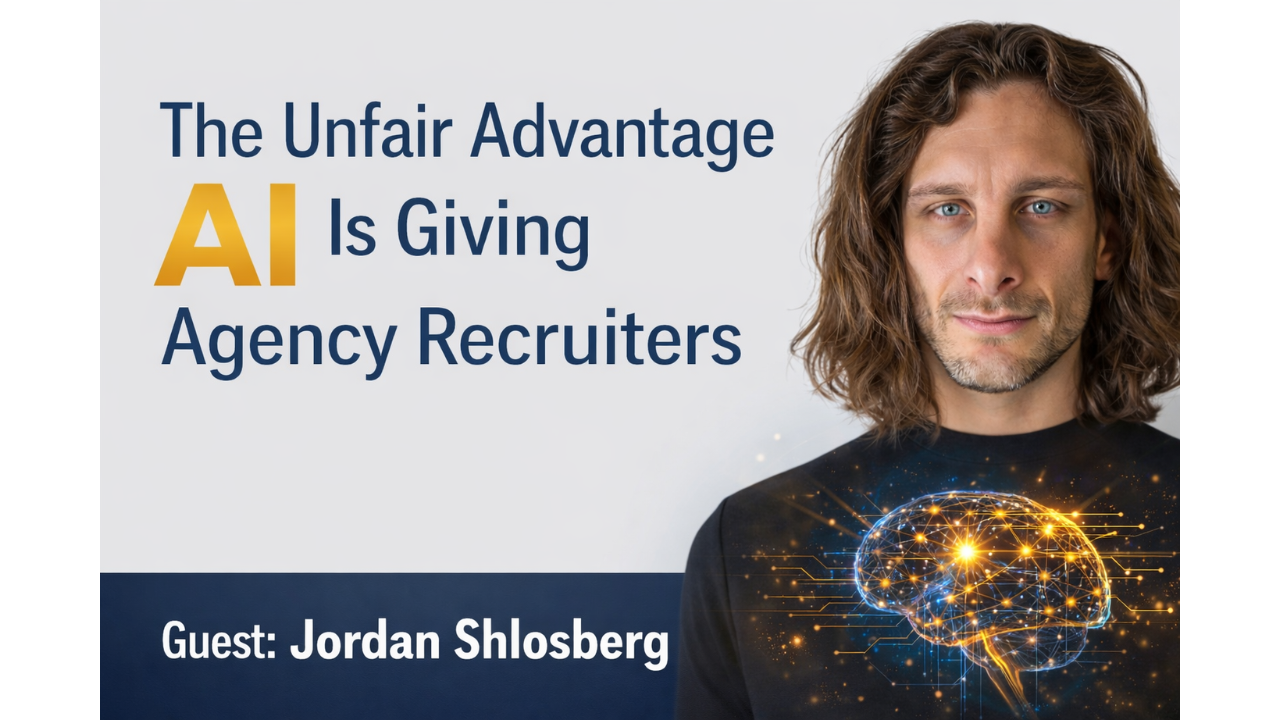
Welcome back to the blog! In our latest podcast episode, we delved deep into a topic that’s rapidly reshaping the recruiting landscape: Artificial Intelligence. The conversation was so compelling, so filled with insights, that I felt it deserved an expanded exploration right here. If you haven't had a chance to listen yet, you absolutely must check out The Unfair Advantage AI Is Giving Agency Recruiters | Jordan Shlosberg. This blog post is designed to unpack the core ideas from that episode and provide you with a roadmap to navigate this exciting, and frankly, inevitable, shift.
The central thesis we explored is simple yet profound: the AI race in recruiting has already begun, and many are still blissfully unaware. This isn't a future prediction; it's a present reality. For agency recruiters, understanding and adopting AI tools now isn't just about staying competitive; it's about survival and thriving in an environment where those who embrace the change will gain an insurmountable advantage. We’ll explore why this is the case, what the real problems recruiters face are, and how AI can unlock a service advantage that was previously unimaginable. Get ready, because the future of agency recruiting is here, and it’s powered by AI.
The AI Race in Recruiting: It's Already Started
It’s easy to get caught up in the day-to-day grind of recruiting. Resumes to review, calls to make, client needs to understand – the demands are constant. This relentless pace can make it challenging to step back and consider the tectonic shifts happening beneath the surface. But the truth is, the AI revolution in recruiting isn’t a distant hum on the horizon; it’s a full-blown race, and many are already miles behind without even realizing it.
The episode with Jordan Shlosberg powerfully illustrated this point. He argues that the traditional recruitment model, built on human effort and manual processes, is being fundamentally challenged. Agencies that were once able to compete on sheer volume and human bandwidth are now facing a new paradigm. AI isn't just an efficiency tool; it's a force multiplier that can perform tasks at a scale and speed that human recruiters simply cannot match. This means that the gap between those who are leveraging AI and those who are not is widening at an exponential rate. To remain relevant, let alone excel, understanding this shift is paramount. It’s no longer a question of *if* AI will impact your recruiting desk, but *how* quickly and *how* profoundly. The time to understand, experiment, and integrate AI into your workflow is not tomorrow, or next month, but right now.
The Problem Recruiters Actually Face: It's Not Data, It's Memory
One of the most eye-opening insights from our conversation with Jordan was the reframing of a core recruiting challenge. Many recruiters believe their biggest hurdle is a lack of data or the inability to effectively analyze the data they have. They invest in complex CRM systems, spend hours on filtering and sorting, and often feel overwhelmed by the sheer volume of information. But Jordan posits a more fundamental issue: it’s not a data problem, it’s a memory problem.
Think about it. You have thousands, perhaps tens of thousands, of candidates in your database. You’ve spoken to them, assessed their skills, understood their career aspirations, and noted their availability. This is invaluable, rich data. Yet, how often do you truly recall the nuances of a conversation you had six months ago with a candidate who might be a perfect fit for a role that just opened up today? Our human memory, while remarkable, is fallible and limited. We can’t possibly recall every detail about every candidate, every client interaction, every piece of market intelligence gathered. This is where AI shines. AI-powered platforms can act as an infallible, ever-present memory. They can instantly access and contextualize every piece of information you’ve ever gathered, presenting it to you when and how it’s most relevant. This allows recruiters to tap into their existing database with a depth and breadth that was previously impossible, transforming passive data into actionable insights and a true competitive advantage.
How AI Unlocks a 100x Service Advantage Over Internal TA
This reframing of the "memory problem" directly leads to an extraordinary service advantage for agency recruiters who leverage AI. Internal Talent Acquisition (TA) teams, while often possessing deep knowledge of their own company culture and needs, face inherent limitations. Their resources are typically constrained, and their scope is usually limited to their own organization’s hiring needs. They are often bogged down by administrative tasks and may not have the luxury of a comprehensive, easily searchable candidate database that spans multiple companies and industries.
Now, consider an agency recruiter equipped with an AI platform that acts as their perfect memory. They can instantly recall details about candidates they’ve interacted with across numerous past searches. They can leverage AI to identify the best potential fits for a new role based on a holistic understanding of the candidate's profile, not just keywords on a resume. This allows for hyper-personalized outreach and a level of responsiveness that internal TA teams often struggle to match. Imagine a client needs a highly specialized engineer for a critical project. An AI-powered recruiter can, within minutes, identify the top 5 candidates from their database who not only possess the technical skills but also align with the client’s cultural needs and have previously expressed interest in similar opportunities. This isn't just about finding candidates; it’s about delivering insights, speed, and precision that dramatically elevate the service offering. This translates into a 100x service advantage because you are no longer limited by your personal recall or manual search capabilities; you are augmented by a powerful, intelligent system that can recall and connect dots instantaneously, providing a level of service that feels almost prescient to the client.
The Future of Agency Recruiting: Market Share Shifts and Smaller Teams Winning Big
The implications of this AI-driven shift are profound, pointing towards significant market share changes and a new landscape where smaller, agile teams can outmaneuver larger, more established firms. Jordan’s predictions in the episode are bold but entirely logical given the trajectory of AI adoption. As AI tools become more accessible and sophisticated, the traditional barriers to entry and scaling in recruiting will crumble.
We're likely to see a significant migration of market share from internal TA departments to specialized agencies that can offer this superior, AI-augmented service. Why? Because agencies can offer a breadth of talent access and a speed of delivery that in-house teams, often constrained by budget and internal processes, simply cannot replicate. Furthermore, the playing field for agencies themselves will be leveled. A small, highly efficient team of 1-2 recruiters leveraging AI effectively will soon be able to generate more revenue and place more candidates than a 20-person firm operating with traditional methods. This is because the AI handles the heavy lifting – the searching, the initial screening, the data recall, the outreach drafting. This frees up the human recruiter to focus on what they do best: building relationships, understanding nuanced client needs, strategic business development, and providing that crucial human touch and strategic advice. The future belongs to the nimble, the technologically adept, and those who understand that AI isn’t a replacement for recruiters, but an indispensable partner.
The Three Essential Skills for Recruiters in the AI Era
If AI is handling much of the administrative and data-intensive work, what does this mean for the human recruiter? It means a shift in focus towards skills that AI cannot replicate, and in fact, are amplified by AI. Jordan highlighted three key areas that recruiters must double down on to thrive:
1. Sales Acumen and Business Development (BD)
With AI streamlining candidate sourcing and matching, recruiters will have more time and bandwidth to focus on the front end of the business. This means honing their sales skills, identifying new client opportunities, and building robust business development pipelines. AI can help identify potential leads and even draft initial outreach, but the art of persuasion, understanding client pain points at a strategic level, and closing deals remains a deeply human endeavor. Strong BD skills will be paramount for securing the mandates that AI can then help you fulfill with unprecedented efficiency.
2. Relationship Building and Empathy
While AI can process data and identify matches, it cannot replicate the genuine human connection, empathy, and trust that are the bedrock of successful recruiting relationships. Candidates and clients alike will still seek out recruiters they can rely on, who understand their aspirations, and who can offer nuanced advice. Building and nurturing these deep, long-term relationships will become an even more critical differentiator. This includes understanding not just skills, but also career goals, cultural fit, and the emotional nuances of career transitions.
3. "Vibe Coding" and Intuition
This is a fascinating concept that Jordan introduced. "Vibe coding" refers to the recruiter's ability to understand and assess the intangible qualities that make a candidate a great fit for a role and a company culture. It's the intuition gained from years of experience, the ability to read between the lines of a resume, to gauge a candidate's enthusiasm, potential, and long-term trajectory. AI can provide data, but it's the recruiter's human judgment and "vibe coding" that will make the final, critical determination. This involves understanding personality, motivation, and how someone will integrate into a team beyond just their technical qualifications. It's about recognizing potential and alignment on a deeper, human level.
Introducing Atlas: The AI-First Platform Revolutionizing Recruiting
To illustrate how these AI-driven shifts are manifesting in practical terms, it’s important to highlight platforms that are at the forefront of this revolution. Atlas, founded by Jordan Shlosberg, is precisely such a platform. It’s not just another Applicant Tracking System (ATS) or Customer Relationship Management (CRM); it's designed from the ground up as an AI-first solution for agency recruiting.
Atlas aims to tackle the "memory problem" head-on by intelligently organizing and surfacing every piece of information you've ever had about candidates and clients. Imagine opening your system and having it already suggest the best candidates for an open role, draft personalized outreach messages, and even identify potential matches from candidates you might have forgotten about. Atlas is built to automate the administrative burdens that plague recruiters, freeing them up to focus on those essential human skills of sales, relationship building, and strategic engagement. It represents the kind of technology that is enabling smaller teams to punch far above their weight and setting a new standard for what’s possible in agency recruiting. Platforms like Atlas are not just tools; they are the engines driving the future of the industry.
Your Roadmap to Leveraging AI: Don't Get Left Behind
The AI revolution in recruiting is not a wave you can surf; it’s a tide that will fundamentally alter the landscape. To avoid being swept away, you need a clear roadmap. Here’s how to start:
1. Educate Yourself Continuously
Like we've done here today and in our podcast episode, make continuous learning a priority. Stay informed about the latest AI developments in recruiting. Read articles, listen to podcasts, attend webinars. Understand the capabilities and limitations of different AI tools.
2. Identify Your Biggest Pain Points
Where are you losing the most time? Is it searching for candidates, writing outreach emails, scheduling, or data entry? Pinpointing these areas will help you determine which AI tools can provide the most immediate value.
3. Experiment with AI Tools
Don't wait for the "perfect" solution. Start experimenting with readily available AI tools. Many platforms offer free trials or freemium versions. Begin with tools that can help with tasks like resume parsing, content generation for outreach, or scheduling assistance. Even small integrations can yield significant time savings.
4. Focus on Developing Your Human Skills
As mentioned, AI enhances, it doesn't replace. Invest time in honing your sales, business development, and relationship-building skills. Practice active listening, empathetic communication, and strategic thinking. These are the skills that will differentiate you in an AI-augmented world.
5. Embrace the "Memory" Advantage
Actively work with AI platforms that help you leverage your existing database. Treat your CRM not just as a storage unit, but as an intelligent system that can resurface valuable past interactions and insights. Understand that your past efforts with candidates and clients are incredibly valuable, and AI can help you unlock that value.
6. Adapt Your Agency Model
If you run an agency, consider how AI can enable smaller, more specialized teams. Empower your recruiters with the right tools and training. The future is likely to favor agility, expertise, and technological leverage over sheer headcount.
The AI revolution in recruiting is an exciting and, for some, a daunting prospect. However, by understanding its implications, focusing on the right skills, and strategically adopting AI-powered solutions, you can not only stay competitive but thrive. The window of opportunity to gain an "unfair advantage" is now. Don't be the recruiter who looks back in a few years and wonders why their billings plateaued while others soared. Embrace the future, and get ready to revolutionize your recruiting practice.