The AI Gold Rush: How Agency Recruiters Will Dominate the Next 3-5 Years
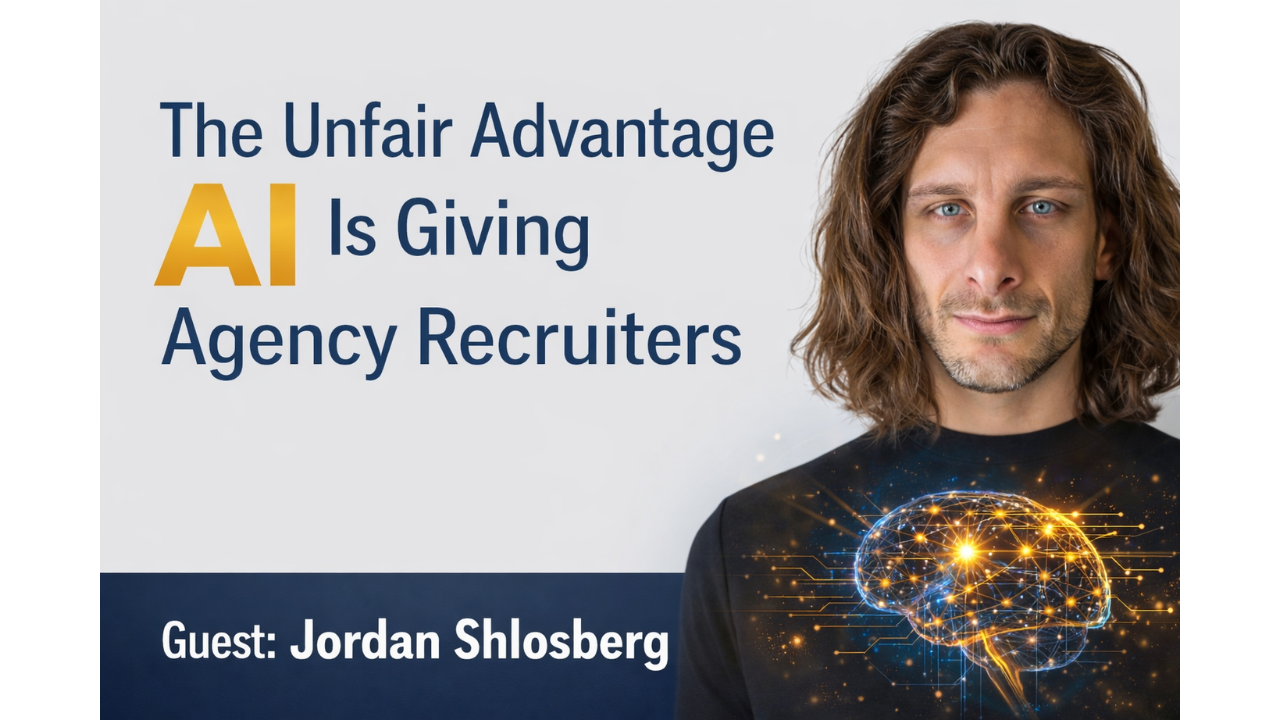
Welcome back to the blog! In our latest episode, we delved into a topic that’s sending ripples of excitement and perhaps a little apprehension through the recruiting world: the seismic shift in market share that’s poised to occur in the next three to five years, driven by the undeniable power of Artificial Intelligence. We had a fascinating conversation that explored how agency recruiters, often seen as the nimble underdogs, are about to gain an almost insurmountable advantage. If you haven't had a chance to listen yet, you can catch the full episode here: The Unfair Advantage AI Is Giving Agency Recruiters | Jordan Shlosberg. This blog post will expand on those crucial insights, breaking down the "why" and the "how" behind this predicted dominance.
The Shifting Landscape: In-House vs. Agency Market Share
For a long time, the narrative in talent acquisition has leaned towards the perceived stability and control offered by in-house recruiting teams. Companies would build out their internal departments, investing heavily in their own processes, tools, and people. Agencies, on the other hand, were often viewed as supplementary, brought in for niche roles or when internal bandwidth was stretched thin. However, the ground is shifting beneath our feet, and the winds of change are blowing strongly in favor of agencies. Our guest, Jordan Shlosberg, founder of Atlas, a leading AI-first recruitment platform, makes a compelling case: in-house TA teams are shrinking, while agency market share is growing. This isn't just a cyclical trend; it's a fundamental realignment driven by a confluence of factors, with AI at its core.
Why this shift? Several reasons contribute to this evolving dynamic. Firstly, the economic climate often forces companies to re-evaluate their operational costs. In-house teams, with their fixed overheads, can become a significant expense. Agencies, by their nature, offer a more variable cost model, allowing companies to scale their hiring efforts up or down as needed without the long-term commitment. Secondly, the sheer speed and complexity of the modern talent market demand agility that many large, bureaucratic in-house departments struggle to achieve. Agencies, typically leaner and more specialized, can often pivot faster, adapt to new market demands, and source candidates with a precision that’s difficult for internal teams to replicate consistently.
But the most significant driver of this impending market share redistribution is the advent of sophisticated AI tools. These tools are no longer a futuristic concept; they are here, and they are rapidly transforming how recruiting is done. The episode highlights a critical distinction: the problem isn't a lack of data, but a lack of *memory*. This is where AI truly shines, and it's an advantage that agencies are uniquely positioned to exploit.
The Memory Problem: Why AI is a Game-Changer for Recruiters
Jordan Shlosberg articulates a profound insight that forms the bedrock of his argument: recruiters don't have a data problem, they have a *memory problem*. Think about it. As recruiters, we interact with thousands of candidates, clients, and contacts over our careers. We receive resumes, conduct initial screens, have conversations, and build relationships. Over time, this vast pool of information becomes a labyrinth. Remembering specific details about a candidate from two years ago, their aspirations, their skills, or even their previous interactions with your firm, becomes an almost impossible task. This is where traditional CRMs and applicant tracking systems fall short. They store data, but they don't truly "remember" or intelligently surface it in a way that’s actionable.
AI, however, changes the game entirely. AI-powered platforms can analyze, categorize, and contextualize every piece of data within your database. They can recall not just names and contact information, but the nuances of past conversations, the progression of a candidate’s career, their stated preferences, and even their potential fit for roles they haven't even applied for yet. Imagine opening your system and being presented with a ranked list of candidates who are not only qualified for a new role but are also actively looking, have previously expressed interest in similar opportunities, and have a strong connection to your agency. This is the "memory" that AI unlocks.
This enhanced "memory" translates directly into a 100x service advantage over internal TA teams. An in-house recruiter might spend hours sifting through resumes or trying to recall past interactions. An AI-empowered agency recruiter, using a platform like Atlas, can instantly access a wealth of contextual information, allowing them to present highly relevant candidates to clients with unparalleled speed and accuracy. This dramatically reduces time-to-hire, improves candidate quality, and ultimately, leads to more successful placements. This isn't about replacing the recruiter; it's about augmenting their capabilities, allowing them to focus on high-value, strategic activities rather than getting bogged down in manual data management and recall.
The Unfair Advantage: How AI Empowers Small Agencies
The most exciting aspect of this AI revolution is its democratizing effect. While large, established agencies might have the resources to invest in new technologies, it’s often the smaller, more agile teams that can adopt and leverage these tools to their maximum potential. Our discussion highlighted how AI provides an "unfair advantage" precisely because it levels the playing field, and in some cases, even tips it in favor of smaller operations.
Consider a traditional 20-person agency. They likely have a complex infrastructure, multiple layers of management, and a slower decision-making process. Adopting new technology might involve lengthy evaluation periods, extensive training, and integration challenges across various departments. Conversely, a 1-2 person agency, driven by passionate and forward-thinking recruiters, can often integrate AI tools rapidly. They can adopt a platform like Atlas, which is designed with AI at its core, and immediately unlock its full potential. This means a small team can essentially operate with the efficiency, data recall, and strategic insights of a much larger organization, if not superior.
This agility allows smaller agencies to be more proactive in their business development. Instead of just reacting to job requisitions, they can use AI to identify emerging talent trends, predict market needs, and proactively engage with both candidates and clients. The "speccing autopilot" mentioned in the episode is a prime example. Imagine AI identifying candidates in your database who were previously overlooked or have since developed new skills, and then automatically drafting compelling outreach messages. This capability allows a small team to manage a much larger pipeline of potential placements, outperforming larger competitors who are still relying on manual processes.
Furthermore, AI enables smaller agencies to offer a highly personalized and data-driven service. They can provide clients with detailed insights into candidate pools, market trends, and their own recruiting process, fostering deeper trust and stronger client relationships. This level of sophisticated service, powered by AI, is what will allow these smaller, leaner agencies to capture significant market share from larger, less nimble competitors.
The Three Essential Skills for the AI-Driven Recruiting Market
As the recruiting landscape transforms, so too must the skills of the recruiters operating within it. Our conversation identified three critical areas that recruiters must double down on to thrive in this AI-driven future. These aren't entirely new skills, but their importance is amplified, and their application is fundamentally altered by the presence of AI.
The first is **Sales**. In an era where AI can handle much of the administrative and initial outreach tasks, the recruiter’s role shifts even further towards strategic sales. This means understanding client business objectives at a deeper level, building robust relationships based on trust and expertise, and effectively articulating the value proposition of their services. It’s about consultative selling, acting as a true partner to clients rather than just a transactional vendor. AI can provide the data and insights, but it’s the recruiter’s sales acumen that will close the deal and foster long-term partnerships.
The second essential skill is **Relationships**. While AI can automate communication and data management, it cannot replicate genuine human connection. The ability to build and nurture strong, authentic relationships with both candidates and clients remains paramount. This involves empathy, active listening, and a deep understanding of human motivations. In a world saturated with automated outreach, a personal touch and a trusted advisor can make all the difference. AI can facilitate the initial connection and provide relevant information, but it's the recruiter's relational skills that build loyalty and ensure repeat business.
The third, and perhaps most intriguing, skill is **Vibe Coding**. This term, coined and popularized by Jordan Shlosberg, refers to the ability to understand and articulate the cultural fit and overall "vibe" of a candidate and a company. AI can assess technical skills and experience, but it struggles to quantify intangible qualities like personality, cultural alignment, and leadership potential. Vibe coding involves using intuition, experience, and keen observation to assess how well a candidate will integrate into a team and contribute to the company's culture. It's about understanding the unwritten rules, the unspoken dynamics, and the intangible elements that make a hire successful beyond mere qualifications. As AI handles the more quantifiable aspects of recruitment, the recruiter's ability to "read the room" and assess cultural fit becomes a critical differentiator.
Vibe Coding and Beyond: Mastering New Recruitment Strategies
The concept of "vibe coding" is more than just a buzzword; it represents a fundamental evolution in how recruiters evaluate talent. While AI can efficiently parse resumes and LinkedIn profiles, identifying hard skills and quantifiable achievements, it often misses the softer, yet equally crucial, aspects of a successful hire. Vibe coding is the art of understanding the intangible. It’s about recognizing the nuances in a candidate’s communication style, their enthusiasm, their problem-solving approach, and their potential to collaborate effectively within a specific team dynamic.
To master vibe coding, recruiters need to cultivate a deeper understanding of organizational psychology and company culture. This involves asking insightful questions during interviews that go beyond standard behavioral queries, paying attention to non-verbal cues, and actively engaging with clients to gain a comprehensive picture of their workplace environment. It’s about building a "feel" for what makes a candidate a good fit, a skill that is honed through experience and a genuine interest in human dynamics. AI can provide the data points, but it is the recruiter's intuition and ability to interpret these points within a human context that truly seals the deal.
Beyond vibe coding, AI is enabling entirely new recruitment strategies. The "speccing autopilot" is a prime example. Instead of manually digging through past candidate records, AI can proactively identify individuals who may have been a good fit for a previous role and are now even more qualified, or who align with emerging needs. This means recruiters can be continuously seeding their pipeline with highly relevant talent, even for roles they haven’t been formally briefed on yet. This proactive approach significantly shortens the time-to-hire when a new requirement arises and allows for a more strategic, rather than reactive, recruitment process.
Another emerging strategy is AI-driven market intelligence. Recruiters can leverage AI to analyze vast datasets of job postings, salary trends, and candidate supply and demand. This allows them to provide clients with invaluable insights into the competitive landscape, helping them set realistic expectations and develop more effective hiring strategies. This elevates the recruiter from a mere executor to a trusted strategic advisor.
The Future of Agency Structure: Small Teams, Big Impact
The convergence of AI and the evolving market dynamics is not just changing *how* recruiters work, but also the very structure of recruiting agencies. The episode touches on a provocative idea: can a 1-2 person agency outbill a 20-person firm? The answer, powered by AI, is a resounding yes. This reality will redefine what it means to be a successful agency in the coming years.
The traditional agency model, with its emphasis on headcount, often leads to layers of management, administrative bloat, and slower decision-making. As AI takes over many of the repetitive and data-intensive tasks, the need for large teams diminishes. Instead, the focus will shift to smaller, highly skilled, and technologically adept teams. These teams will be empowered by AI tools to manage a significantly larger volume of work and deliver a higher quality of service than their predecessors.
Imagine a small agency, operating with the efficiency of a much larger organization. They can manage multiple complex searches simultaneously, provide clients with real-time data and analytics, and maintain deep, personal relationships with their candidates and clients. This is achieved not by simply adding more people, but by leveraging intelligent technology. The bottleneck will no longer be human capacity for administrative tasks, but rather the recruiter's ability to strategically manage their AI-powered tools, their client relationships, and their business development efforts.
This paradigm shift will likely lead to a rise in boutique agencies that specialize in specific niches or offer highly tailored services. These agencies, unburdened by the overhead of larger firms, can focus on delivering exceptional value and leveraging AI to create a truly differentiated offering. The future of agency structure is about impact, not just size. It’s about smart, lean, and technologically empowered teams that can deliver superior results.
Atlas and the Autopilot: Spearheading the AI Revolution in Recruiting
Central to this conversation is the role of platforms like Atlas. As the founder of this AI-first recruitment platform, Jordan Shlosberg is at the forefront of this revolution. Atlas isn't just an ATS or CRM; it's an intelligent operating system designed to empower recruiters with AI capabilities. The platform aims to automate mundane tasks, sync crucial data points (resumes, emails, etc.), and use AI to build polished candidate profiles and client reports.
The concept of the "speccing autopilot" is a tangible manifestation of this revolution. It signifies a move towards a more predictive and automated recruitment process. Instead of recruiters manually searching for candidates, the AI can analyze the database, identify potential matches for current or future roles, and even draft initial outreach messages. This frees up significant time and allows recruiters to focus on higher-value activities like strategic business development, client engagement, and nurturing key candidate relationships.
Platforms like Atlas are not just tools; they are enablers of a new era in recruiting. They provide the infrastructure for recruiters to build their "memory," to gain an "unfair advantage," and to operate with unprecedented efficiency and insight. As these technologies mature and become more accessible, they will become indispensable for any recruiter or agency aiming to stay competitive in the next 3-5 years.
Conclusion: Embracing AI for Dominance in the Next 3-5 Years
The insights shared in our latest episode, "The Unfair Advantage AI Is Giving Agency Recruiters | Jordan Shlosberg", paint a clear picture of the future of the recruiting industry. The predictions of a significant market share shift from in-house teams to agencies are not just conjecture; they are rooted in the transformative power of AI. As we’ve explored, the "memory problem" is being solved by intelligent platforms, empowering recruiters to access and utilize their data with unparalleled efficiency. This, in turn, grants an undeniable advantage to agencies, particularly smaller, more agile ones, allowing them to compete and win against larger, less adaptable organizations.
The key takeaway is that AI is not a threat to recruiters, but an immense opportunity. The recruiters who embrace this technology, who focus on developing the essential skills of sales, relationships, and "vibe coding," and who leverage AI-powered platforms, will not only survive but thrive. They will dominate the market, deliver exceptional value to their clients, and redefine what it means to be a successful recruiter in the coming years. The window of opportunity is now. Those who act decisively will be the ones reaping the rewards of this AI gold rush.