The 2-Person Agency vs. The 20-Person Firm: How AI Levels the Playing Field
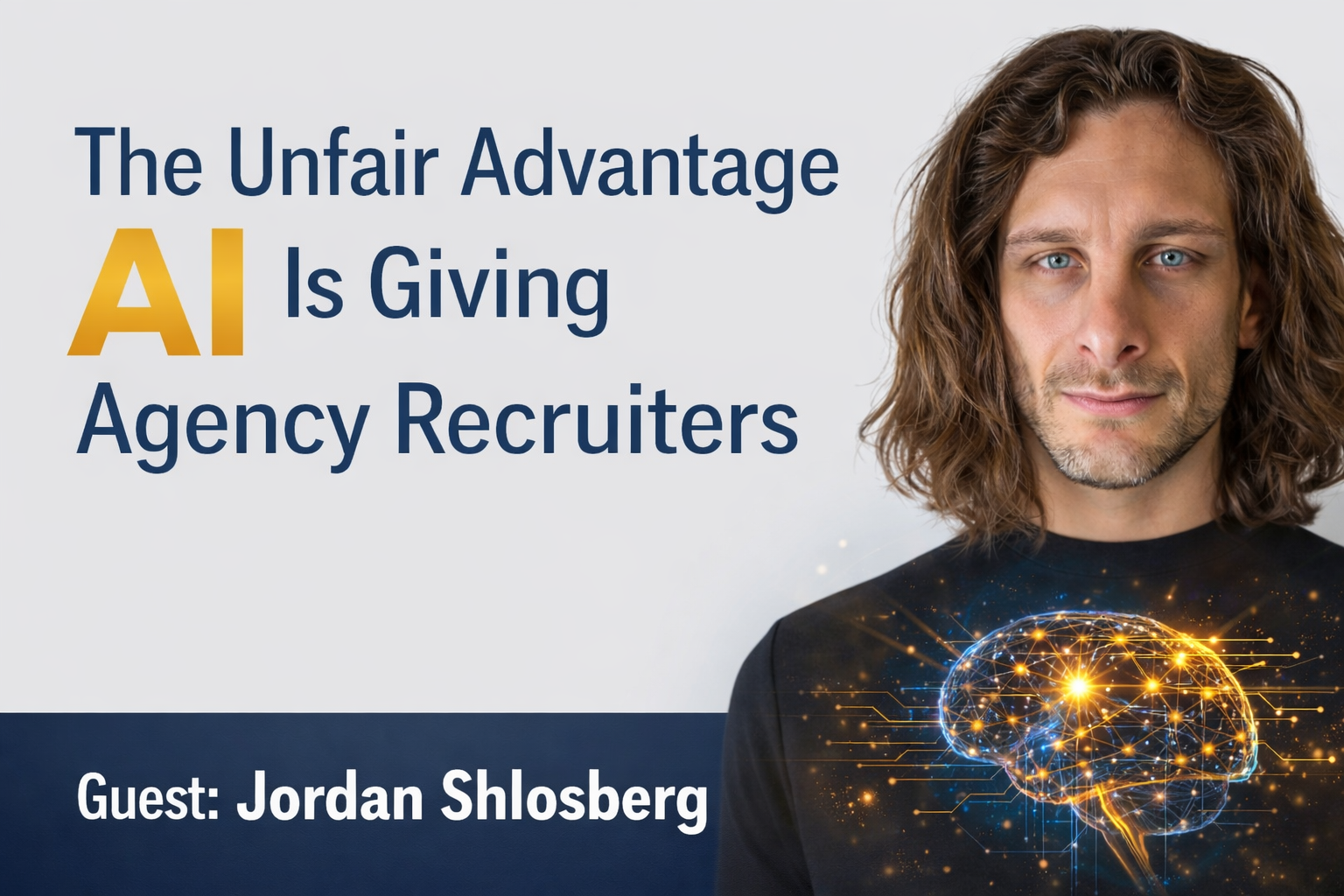
Welcome back to the podcast blog! In our latest episode, we dove headfirst into a truly provocative idea: the notion that small, incredibly agile teams, supercharged by Artificial Intelligence, are poised to soon outbill much larger, traditional recruiting firms. This isn't just a futuristic fantasy; it's a tangible shift happening right now, and in this post, we're going to unpack what it means for agency structure, explore how to optimize your own workspace for peak efficiency, and discuss the fundamental changes AI is bringing to the recruiting landscape. If you haven't listened to the episode yet, I highly recommend checking out "The Unfair Advantage AI Is Giving Agency Recruiters | Jordan Shlosberg". Jordan Shlosberg, the founder of Atlas, joins us to break down this seismic shift, and his insights are absolutely critical for anyone operating in the recruiting space today.
The AI Revolution in Recruiting and Agency Size
For decades, the established wisdom in the recruiting agency world has been that growth equates to size. More recruiters, more support staff, more offices – these were the markers of success and, by extension, higher billing potential. Larger firms could deploy more resources, theoretically covering more ground, building larger candidate pools, and managing more client relationships simultaneously. This model, while historically effective, has always come with significant overhead, complex management structures, and a certain inertia that can hinder rapid adaptation.
However, we are standing at the precipice of a revolution, fueled by the exponential advancements in Artificial Intelligence. AI is not just a tool; it's a fundamental disruptor. It's capable of automating tasks that once consumed vast amounts of human hours, augmenting human capabilities to an unprecedented degree, and providing insights that were previously unattainable. This technological leap is democratizing access to powerful operational capabilities, meaning that the advantage of sheer size is rapidly diminishing. The playing field is not just being leveled; it's being tilted in favor of agility, intelligence, and the smart application of technology. This episode and this post are all about exploring this new paradigm and understanding how small, dynamic teams can leverage AI to not just compete, but to dominate larger, more established players.
The 'Memory Problem' vs. The Data Problem: How AI Solves the Real Bottleneck
One of the most striking insights from our conversation with Jordan Shlosberg is the redefinition of the core problem facing recruiters. For a long time, the narrative has been about the "data problem." Recruiters lamented the vast amounts of data they collected but couldn't effectively manage, search, or leverage. We've been inundated with CRMs and ATS systems, each promising to tame this digital beast, yet the core challenge often remained: wading through mountains of information to find the needles in the haystack.
Jordan brilliantly reframes this. He argues that the real bottleneck isn't the data itself, but the human capacity to remember and recall the nuances within that data. This is the "memory problem." Think about it: how many potentially perfect candidates have slipped through the cracks because you met them at a conference three years ago, had a brief email exchange, and their profile is buried deep within your system, unsearchable by traditional keyword filters? Your database is a treasure trove, but without perfect recall, it's like a library where you can't find the books you need.
This is where AI, particularly the kind powering platforms like Atlas, becomes a game-changer. AI can go beyond simple keyword matching. It can understand context, infer relationships, and analyze the sentiment and nuances within candidate profiles, communication logs, and client interactions. It can essentially act as an extension of your own memory, but with an exponentially larger capacity and an unparalleled ability to sift through and connect information. AI can flag candidates you might have forgotten about who are now a perfect fit for a new role, identify patterns in client needs that you might have missed, and proactively surface opportunities based on sophisticated understanding of both your candidate pool and your market. This ability to overcome the "memory problem" is not just an efficiency gain; it's a monumental leap in service delivery, allowing recruiters to offer a level of personalized and insightful service that was previously impossible, even for large teams.
The Rise of the Small, Agile Agency: Why 2 Can Beat 20
The implications of AI solving the memory problem are profound, especially for the structure of recruiting agencies. The traditional model of scaling by adding more recruiters often leads to a dilution of quality, increased management overhead, and a slower response time. Each new hire requires training, onboarding, and integration into a larger system, and their individual impact can be masked by the sheer size of the organization. Moreover, a larger team often means more layers of communication, leading to potential misinterpretations and delays.
Now, imagine a two-person agency. With AI, these two individuals are not limited by their individual bandwidth or memory capacity. They are amplified. One person can focus on business development and client relationships, while the other can leverage AI to manage candidate pipelines, conduct sophisticated searches, and even draft initial outreach. The AI acts as their entire operations department, their research team, and their administrative assistant, all rolled into one. This allows them to operate with the speed and precision of a much larger entity, without the associated bureaucracy.
This isn't just about doing the same things faster. It's about doing *more* and doing it *better*. A two-person agency, armed with AI, can offer a level of hyper-personalized service and market insight that a 20-person firm, relying on traditional methods, might struggle to match. They can maintain deep, nuanced relationships with a smaller portfolio of high-value clients and candidates, powered by AI's ability to recall every interaction, every preference, and every subtle requirement. This creates an "unfair advantage" – a phrase Jordan uses compellingly – where efficiency and effectiveness are decoupled from headcount. The future of agency growth isn't necessarily about getting bigger; it's about getting smarter and more agile, and AI is the key enabler of this transformation.
AI as an Unfair Advantage: Redefining Agency Structure and Efficiency
The term "unfair advantage" is something we've discussed before on the podcast, and in the context of AI in recruiting, it's more relevant than ever. What was once an advantage derived from experience, network size, or market knowledge is now being augmented, and in some cases, surpassed, by the intelligent application of AI. For a small agency, AI isn't just a tool for efficiency; it's a strategic weapon that allows them to punch far above their weight class.
Consider the traditional agency structure. You have business development, resourcing, candidate management, client management, administration, and marketing – all separate functions, often with dedicated teams or individuals. With AI, these functions can be integrated and significantly automated. AI can assist in identifying high-potential leads through analyzing market trends and company data. It can draft personalized outreach emails and LinkedIn messages, saving hours of manual effort. It can screen resumes and candidate profiles with a level of sophistication that surpasses human capabilities, identifying not just keywords but also cultural fit and potential for growth. It can even help manage the interview scheduling and feedback loops, streamlining the entire recruitment lifecycle.
This radical redefinition of efficiency means that a small team can achieve a higher volume of high-quality placements with less effort. They can dedicate more of their precious human capital to the tasks that truly require human judgment and relationship-building – the strategic conversations with clients, the nuanced candidate coaching, and the critical negotiation stages. For a larger firm, adapting to this shift means re-evaluating their structure. Do they need 20 recruiters when a handful of AI-empowered individuals can achieve similar or better results? This could lead to leaner, more focused teams, with AI handling the heavy lifting of data management and initial candidate identification, freeing up human recruiters to focus on higher-value activities.
Key Skills for the AI-Driven Recruiting Market: Beyond Traditional Recruitment
As AI takes on more of the transactional and data-intensive aspects of recruiting, the skills required for success are evolving. The traditional recruiter was often judged by their ability to source candidates, manage a database, and build relationships. While these skills remain important, they are being augmented and, in some cases, redefined by the AI revolution. Jordan highlights three key skills that every recruiter must double down on to thrive in this new landscape.
Firstly, **Sales**. This might seem obvious, but in the AI-driven world, sales becomes even more crucial. While AI can identify leads and draft outreach, it cannot replicate the nuanced persuasion, objection handling, and rapport-building that a skilled human salesperson can achieve. Your ability to understand client needs at a deeper level, to articulate your value proposition compellingly, and to close deals is paramount. AI can provide the ammunition, but you are still the one firing the shots.
Secondly, **Relationships**. In an increasingly automated world, the human touch becomes a premium. AI can help manage relationships at scale, but it cannot replace the genuine connection, trust, and empathy that form the bedrock of strong professional relationships. Building and nurturing these connections with both clients and candidates is what will differentiate top recruiters. This means focusing on active listening, understanding individual motivations, and providing a truly human-centric experience.
Thirdly, and perhaps most intriguingly, is what Jordan calls **"vibe coding."** This refers to your ability to understand and interpret the intangible elements of a candidate's personality, their cultural fit, and their underlying motivations. AI can analyze resumes and even social media profiles, but it struggles with the subtle cues, the underlying energy, and the overall "vibe" that a human can pick up on during a conversation or through careful observation. This is about understanding not just what a candidate says, but how they say it, their body language (even on video calls), and their overall demeanor. It's about recognizing potential beyond the documented skills and experience, and being able to translate that intuition into successful placements. These three skills – sales, relationships, and vibe coding – are the human elements that AI cannot replicate, and they are becoming the cornerstones of elite recruiting in the AI era.
Atlas and the Future of Recruiting: Automating Processes and Unlocking Hidden Talent
Platforms like Atlas are at the forefront of this transformation, acting as the engines that power the AI-driven recruiting agency. The features Jordan describes are not futuristic concepts; they are rapidly becoming standard capabilities for forward-thinking recruiters. Imagine opening your laptop and being presented with a ranked list of your best business development prospects, with AI-generated outreach messages already drafted. This frees up your morning to focus on strategic outreach rather than administrative busywork.
Furthermore, the concept of "speccing autopilot" is a game-changer. This refers to the ability of AI to sift through your entire candidate database, even candidates you might have forgotten about, and identify those who are now a perfect match for current openings. This effectively unlocks the latent value within your existing data, turning a dormant asset into a source of immediate placements. It’s like having a personal assistant who constantly mines your past interactions and files to find overlooked gems.
This automation of processes not only boosts efficiency but also enhances the quality of placements. By analyzing vast amounts of data and identifying nuanced connections, AI can help recruiters make more informed decisions and present candidates to clients who are not just qualified, but also a truly excellent fit. This is about moving beyond the transactional nature of recruitment and towards a more strategic, consultative approach, where AI handles the heavy lifting of data management and initial screening, allowing human recruiters to focus on building deeper relationships and providing more insightful guidance.
Conclusion: Embracing AI to Thrive in the Evolving Recruiting Landscape
The conversation we had with Jordan Shlosberg on the Elite Recruiter Podcast, which you can find at "The Unfair Advantage AI Is Giving Agency Recruiters | Jordan Shlosberg", is not just an episode; it's a roadmap for the future of recruiting. The central idea – that small, AI-powered agencies can soon outbill larger, traditional firms – is not hyperbole; it's a realistic projection of the seismic shifts occurring in our industry.
We've explored how AI is tackling the "memory problem," turning vast datasets into actionable insights and unlocking hidden talent. We've seen how this empowers small, agile teams to operate with unprecedented efficiency, creating an "unfair advantage" that redefines agency structure and maximizes productivity. The key skills for success are evolving, with sales, relationship-building, and "vibe coding" becoming paramount as AI handles the more routine tasks. Platforms like Atlas are demonstrating the tangible benefits of this AI integration, automating processes and enabling recruiters to focus on higher-value activities.
The future of recruiting is here, and it's powered by AI. Embracing this technology is no longer an option; it's a necessity for survival and success. The recruiters and agencies that understand and adopt these new tools and methodologies will not only thrive but will likely define the next era of talent acquisition. It's time to lean into the AI revolution, optimize your desk, and harness the power of artificial intelligence to build a more efficient, effective, and ultimately, more profitable recruiting business.