Beyond the Database: Why Memory is the Recruiter's New Superpower
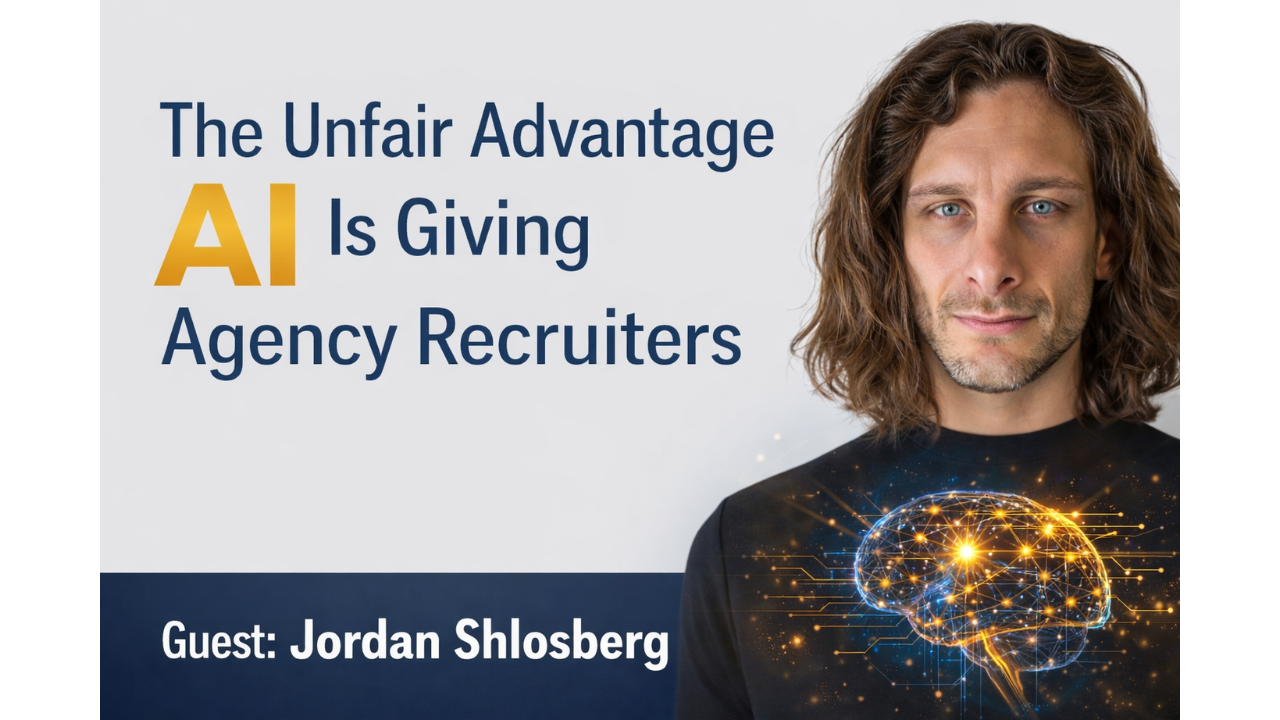
Welcome back to the podcast! In our latest episode, we sat down with Jordan Shlosberg to discuss a truly groundbreaking concept: the idea that recruiters don't suffer from a *data* problem, but rather a fundamental *memory* problem. This episode, "The Unfair Advantage AI Is Giving Agency Recruiters", is a must-listen for anyone looking to stay ahead in the evolving recruitment landscape. This blog post dives deeper into those core ideas, exploring how artificial intelligence can help us overcome this inherent memory deficit and unlock unprecedented efficiency and success. We'll uncover why this shift is already impacting market share and what it means for the future of recruiting.
The Recruiting Blind Spot: Why It's a Memory Problem, Not a Data Problem
For years, the mantra in recruitment technology has been about managing data more effectively. We've invested in sophisticated Applicant Tracking Systems (ATS), Customer Relationship Management (CRM) tools, and vast databases of candidate information. The assumption has been that if we just had *more* data, and *better* ways to filter it, we'd be more successful. But what if that's the wrong lens through which to view our challenges? What if the real issue isn't the absence of data, but our inability to effectively *remember* and *leverage* the data we already possess? Think about your own experience. How many times have you found a fantastic candidate in your database, only to realize they’re completely wrong for the *current* role, but would have been perfect for a role you filled six months ago? Or perhaps you had a candidate who wasn't quite ready for a senior position, but would have been ideal for a more junior opening that just landed. Without an exceptional, near-perfect memory, these connections are lost. They become buried under the sheer volume of interactions, searches, and placements. This is the core of the "memory problem." It's not that the information isn't there; it's that our human capacity to recall, connect, and strategically deploy that information across an ever-growing pool of candidates and roles is inherently limited. We rely on filters, keywords, and manual searches, which are all essentially proxies for true memory recall. They help us find *what we're looking for now*, but they rarely help us remember *who we've met before* and *what their potential might be in a different context*. This limitation creates a significant blind spot. We might have a candidate who interviewed for a role two years ago, had a great rapport with the hiring manager, but ultimately wasn’t the right fit due to a specific skill gap. That gap might have been filled by now, or the candidate might have developed that skill elsewhere. But without a system that actively "remembers" that past interaction and flags the candidate when a relevant opportunity arises, that valuable connection remains dormant. This is where traditional recruiting, heavily reliant on human memory and manual data recall, falls short. We are essentially operating with a fragmented and incomplete recollection of our own professional history with candidates.
Beyond Filters: How AI Reconstructs Your Candidate History
This is where artificial intelligence steps in, not just as a tool to manage data, but as a powerful engine for reconstructing and enhancing our candidate memory. AI-powered platforms, like the ones Jordan Shlosberg is building, are designed to go beyond simple keyword searches and basic filtering. They can analyze the nuances of past interactions, understand the context of conversations, and identify subtle connections that a human recruiter, even with the best intentions, would likely miss. Imagine an AI that can not only scan resumes for keywords but also understand the sentiment of email exchanges, the feedback from previous interviews, and even the career trajectory of a candidate over time. This system can then proactively surface individuals who might be perfect for a new role, even if their profile doesn't perfectly match the immediate search criteria. It's like having a personal assistant with a photographic memory for every candidate you've ever interacted with. For instance, if a recruiter spoke with a candidate about their desire to move into a management role in the future, an AI could flag that candidate when a team lead or managerial position opens up, even if their current resume doesn't explicitly state "manager." It can draw upon the entire history of interactions, providing a richer, more contextual understanding of each candidate. This goes far beyond the static nature of traditional databases. It's about bringing the past to life and making it relevant to the present and future. AI can reconstruct your candidate history by: * Analyzing Communication Patterns: Understanding the tone, intent, and key discussion points within emails, messages, and call notes. * Tracking Career Progression: Monitoring changes in roles, responsibilities, and skills acquired over time from resume updates and public profiles. * Identifying Relational Capital: Remembering who interviewed a candidate, the feedback provided, and the overall impression left by the interaction. * Contextualizing Skills and Experience: Recognizing that a "skill" might be expressed in multiple ways across different roles and industries. * Proactive Matching: Not just matching current job requirements but identifying latent potential based on past aspirations and capabilities. This level of reconstruction transforms a static database into a dynamic, intelligent entity. It allows recruiters to tap into a wealth of forgotten or overlooked information, turning potential missed opportunities into concrete placements. It's about creating a living, breathing record of every professional relationship, accessible and actionable at any moment.
The 100x Advantage: Outperforming Internal TA with Enhanced Memory
This enhanced memory capability, powered by AI, offers a staggering advantage, particularly when compared to internal Talent Acquisition (TA) teams. Internal TA often faces significant constraints: limited resources, a constant influx of requisitions, and a reliance on internal systems that may not be as agile or AI-driven as specialized external tools. Their "memory" of candidates is often confined to their immediate workload and the specific ATS they use. Agency recruiters, especially those embracing AI, can operate with a far more comprehensive and interconnected view of their candidate universe. When an agency recruiter can access an AI that has meticulously logged and understood every past interaction, every piece of feedback, and every candidate’s evolving aspirations, they gain a significant edge. They can quickly identify the "best fit" candidates not just for the current role but for a multitude of potential future roles. Consider a scenario: an internal TA team is struggling to fill a niche engineering role. They've been sifting through hundreds of resumes, running endless Boolean searches. Meanwhile, an agency recruiter, leveraging AI, can instantly recall a candidate from two years ago who expressed a keen interest in this specific type of engineering, even though they were in a different industry at the time. The AI might have flagged that candidate based on their engagement with industry publications or a past conversation about seeking innovative challenges. The agency recruiter can then reach out, knowing this candidate is not only qualified but also has a demonstrated interest that aligns with the opportunity. This is a 100x service advantage. It’s not about working harder; it’s about working smarter, with an almost perfect recall of your professional network. This doesn't mean internal TA teams are obsolete, but their challenges are amplified without these advanced tools. They are often tasked with a broader scope of responsibilities, including employer branding, internal mobility, and workforce planning, which can dilute their focus on pure candidate sourcing and engagement for specific roles. Agency recruiters, with a sharper focus on candidate generation and placement, are perfectly positioned to leverage AI memory to excel. They can present candidates who are not only available but also demonstrably interested and aligned, saving the hiring manager significant time and effort.
The Shifting Landscape: Agency Recruiters' Growing Market Share
The implications of this AI-driven memory advantage are profound, and they are already reshaping the recruitment landscape. As discussed in the podcast, the market share of agency recruiters is poised for significant growth, precisely because they are the ones most likely to adopt and benefit from these advanced technologies. Internal TA teams are facing budget cuts and restructuring in many organizations, making it harder for them to invest in the cutting-edge AI tools that agencies can readily deploy. This creates a virtuous cycle for agencies. The more they leverage AI for enhanced memory, the more successful they become. Their efficiency leads to more placements, which in turn generates more revenue, allowing for further investment in AI and talent. This propels them ahead of their competitors, including internal teams who are not similarly equipped. The trend toward smaller, more specialized agencies is also accelerating. A small team equipped with powerful AI can potentially outperform a much larger, traditional agency that relies on manual processes and less sophisticated tools. Their ability to quickly identify and engage the right talent, informed by a comprehensive and intelligently recalled candidate history, makes them incredibly agile and effective. This is a fundamental power shift, where the recruiters who embrace memory augmentation will capture a disproportionate share of the market. It’s about democratizing high-level recruiting capabilities, making them accessible to smaller, more nimble operations.
Building Your AI Superpower: Essential Skills for the Future Recruiter
To thrive in this evolving environment, recruiters need to cultivate new skills and embrace a new mindset. The "AI superpower" isn't just about the technology itself; it's about how recruiters learn to interact with and leverage it. This involves developing what are sometimes called "vibe coding" skills – the ability to understand and interpret the qualitative aspects of candidate interactions that AI can help capture and organize. Here are some essential skills for the future recruiter: * Strategic AI Integration: Understanding which AI tools best serve your recruitment process and how to integrate them effectively into your workflow. This isn't just about using a tool; it's about understanding its capabilities and limitations to maximize its impact. * Data Interpretation and Nuance: While AI handles the heavy lifting of data analysis, recruiters still need to interpret the outputs. This means understanding the context behind AI-generated insights and using human judgment to make final decisions. It’s about seeing the “why” behind the AI's recommendations. * Relationship Building in an Automated World: Even with AI, the human element of recruiting remains paramount. Recruiters need to excel at building rapport, understanding candidate motivations, and creating positive candidate experiences. AI can help identify the right candidates, but the recruiter's skill in engagement is what closes the deal. * Continuous Learning and Adaptation: The pace of technological change is relentless. Recruiters must commit to ongoing learning, staying abreast of new AI developments and adapting their strategies accordingly. This means being open to new tools and methodologies. * "Vibe Coding" and Qualitative Assessment: As mentioned in the podcast, understanding the "vibe" or intangible qualities of candidates is crucial. AI can help surface potential matches, but the recruiter’s intuition and ability to assess cultural fit, soft skills, and long-term potential remain vital. This is about synthesizing the AI's data with your own human assessment. Embracing these skills allows recruiters to move beyond the transactional nature of traditional recruitment and become strategic partners to their clients. They can offer a level of insight and efficiency that is simply unattainable through manual processes. It’s about augmenting human intelligence with artificial intelligence to create a truly formidable recruiting force.
The Future of Recruitment: Small Teams, Big Billings, and 'Speccing Autopilot'
The ultimate promise of AI-powered memory augmentation is the potential for small teams to achieve massive billing success. Imagine a 1-2 person agency team, leveraging sophisticated AI, who can provide the same, if not better, service than a 20-person firm. This isn't a distant fantasy; it's the emerging reality. This future is driven by capabilities like "speccing autopilot." This refers to AI systems that can proactively identify candidates from your past interactions who are likely to be a good fit for *emerging* roles, even before a formal job opening is posted. The AI essentially analyzes your candidate database and market trends to predict potential matches, essentially putting your "speccing" (identifying and pitching candidates for roles) on autopilot. This means that a recruiter might log in one morning to find a curated list of highly qualified candidates who are already known to them, with AI-generated summaries of why they are a good fit. This dramatically reduces the time spent on initial sourcing and allows recruiters to focus their energy on building relationships, engaging with clients, and closing deals. The bottleneck in recruitment will no longer be finding candidates; it will be about managing the quality of opportunities and the depth of relationships. Small, agile teams with this AI superpower can be incredibly efficient, serving a wide range of clients and generating substantial revenue. This shift challenges traditional agency structures and opens the door for entrepreneurial recruiters to build highly successful businesses with leaner operations. It’s about working smarter, not just harder, and achieving a level of productivity that was previously unimaginable.
Conclusion: Embracing Memory as Your Ultimate Recruiting Advantage
The conversation with Jordan Shlosberg in this episode, "The Unfair Advantage AI Is Giving Agency Recruiters", truly illuminated a fundamental truth about our profession: our greatest limitation isn't a lack of data, but a deficit in our ability to remember and leverage that data effectively. This blog post has expanded on that idea, exploring how AI is transforming this "memory problem" into a powerful advantage. By reconstructing our past candidate interactions, we can unlock unprecedented levels of efficiency, outperform traditional TA teams, and witness a significant shift in market share towards agencies that embrace these technologies. The future of recruiting belongs to those who can augment their human intelligence with artificial intelligence, creating a superpower that combines impeccable memory with sophisticated analysis. By developing the necessary skills, understanding the power of AI-driven insights, and embracing new operational models, small teams can indeed achieve big billings. The message is clear: start building your AI superpower today, and embrace the advantage that enhanced memory will bring. The recruiters who act now will be the ones leading the charge in the years to come.