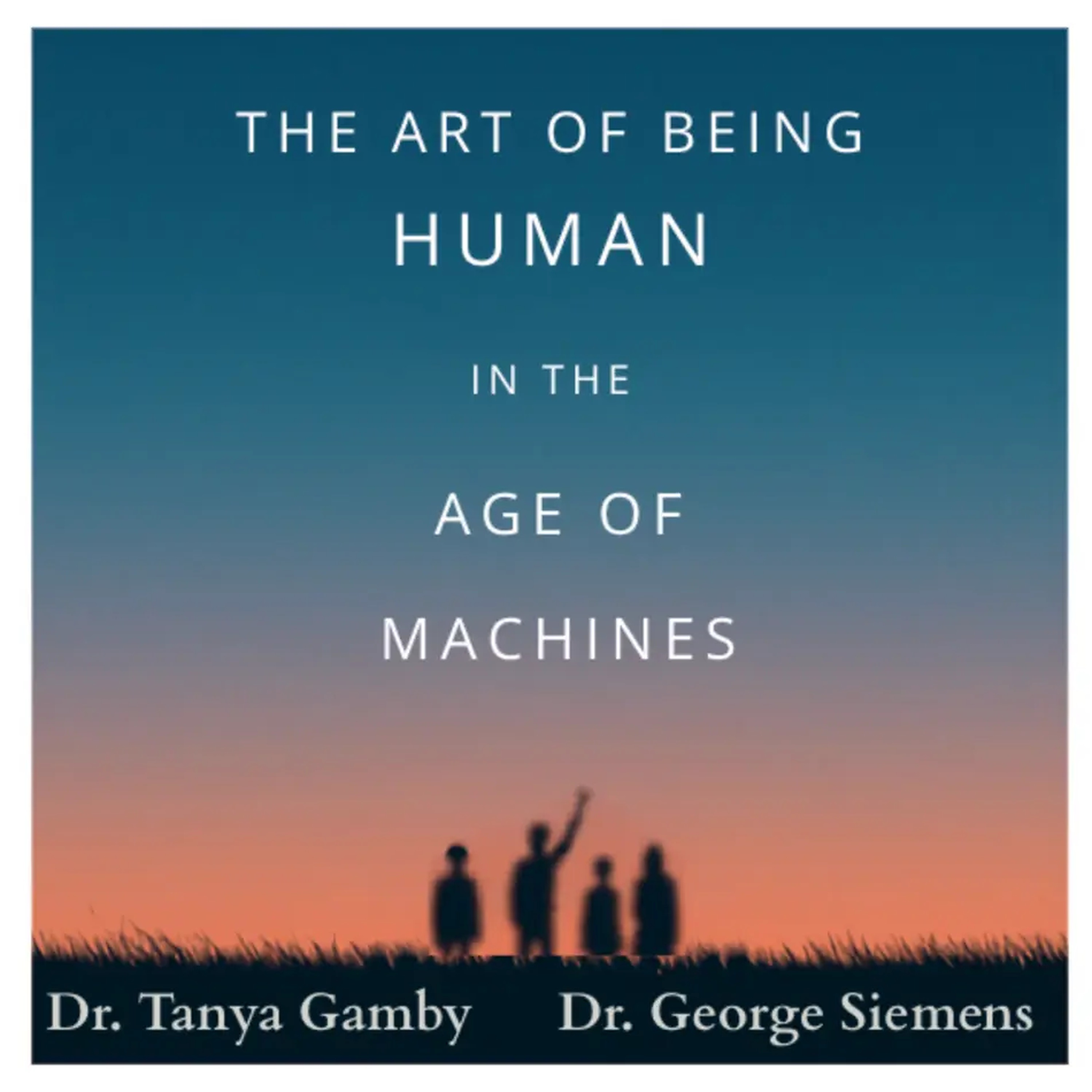
Welcome to The Art of Being Human in The Age of Machines!

Conversations for a Changing World

We’re living through a rare moment: communities are fracturing, machines are performing work once thought uniquely human, and AI is challenging long-held assumptions about intelligence, creativity, education, and human value. As technology reshapes how we learn, work, and relate, this podcast makes space for the questions that progress alone cannot answer—not only what we need to know, but who we want to become.

Join psychologist Dr. Tanya Gamby and learning sciences scholar Dr. George Siemens for conversations across the sciences, humanities, and arts about meaning, connection, and human flourishing.

Their work in education sparked the question: How do we prepare people for a world we are still learning to understand? Together with their guests, they explore what we might recover, rethink, or cultivate—for ourselves, our communities, and the living world we share.

Recent Episodes

3
Sept. 25, 2026

Howard Brodsky/Joan Brodsky

Howard Brodsky, co-founder of CCA Global Partners and creator of Principle Six, joins us alongside Joan Brodsky, founder of the New Hampshire Dance Collaborative, to explore how we might build a more human future in the age of AI. Moving between shared ownership and economic inequality, embodied experience, education, mentorship, and the importance of love and community, the conversation asks how technology might support rather than replace the relationships that give our lives meaning.
2
Sept. 11, 2026

Jeff Kovel

Architect and Skylab founder Jeff Kovel joins us to explore how physical spaces shape human connection, creativity, and learning in an increasingly digital and AI-driven world. Over three decades, Jeff has led the design of projects ranging from Portland landmarks such as the Hoke House—known to millions as the Cullen family home in the Twilight films— to the million-square-foot Serena Williams Building at Nike World Headquarters and work on Royal Caribbean’s Icon of the Seas. Drawing on that
1
Sept. 3, 2026

Andy Szybalski

Product designer, AI entrepreneur, and Tradewinds School co-founder Andy Szybalski joins us to explore how AI can help educators cultivate curiosity, personalize learning, and give students room to pursue their interests deeply—drawing on two decades of experience creating human-centered technology, including Google Street View and Uber Eats.

About the Hosts

Tanya Gamby, Ph.D. Profile Photo
Tanya Gamby, Ph.D.

Tanya Gamby, Ph.D. is a clinical psychologist, and Vice President of AI Learner Development at Southern New Hampshire University, where she designs next-generation learning and wellbeing systems for the AI era. Her work bridges psychology, neuroscience, learning science, and human-centered AI to rethink how people build the skills needed to thrive in a rapidly changing world.
With more than 25 years of experience across integrated healthcare, community mental health, and education, Dr. Gamby has consulted for the U.S. Department of Education and advised schools, universities, and healthcare systems on scalable, evidence-based approaches to human development. She co-owns an early intervention autism clinic and has supported individuals and families across the lifespan with a wide range of mental health and developmental needs. She is also an adjunct professor at the University of South Australia and a past president of the Hawaii Psychological Association.
Dr. Gamby leads work at the intersection of clinical psychology, learning analytics, behavioral science, and adaptive feedback to build AI-supported learning architectures that cultivate whole-person capabilities, including self-regulation, metacognition, communication, resilience, and ethical decision making. Her north star is human flourishing: creating learning experiences and technologies that help people grow more capable, more connected, and wiser in a post-AI world.

George Siemens, Ph.D. Profile Photo
George Siemens, Ph.D.

George Siemens is the Chief AI Transformation Officer at SNHU. He is the founding Director and Professor of the Center for Change and Complexity in Learning (C3L) at University of South Australia and developed the Masters of Science in Learning Analytics at University of Texas at Arlington. He has delivered keynote addresses in more than 50 countries on the influence of technology and media on education, organizations, and society. His work has been profiled in provincial, national, and international newspapers (including NY Times), radio, and television. He has served as PI or Co-PI on grants funded by NSF, SSHRC (Canada), OLT (Australia), Intel, Boeing, Bill & Melinda Gates Foundation, and the Soros Foundation. He has received numerous awards, including honorary doctorates from Universidad de San Martín de Porres and Fraser Valley University for his pioneering work in learning, technology, and networks. He holds an honorary professorship with University of Edinburgh. Dr. Siemens is a founding President of the Society for Learning Analytics Research (http://www.solaresearch.org/). He has advised government agencies Australia, European Union, Canada and United States, as well as numerous international universities, on digital learning and utilizing learning analytics for assessing and evaluating productivity gains in the education sector and improving learner results. In 2008, he pioneered massive open online courses (sometimes referred to as MOOCs). He is President of the Global Research Alliance for AI in Learning and Education (GRAILE– www.graile.ai).