

 Apple Podcasts

 Spotify

 Youtube Music

 Amazon Music

 iHeartRadio

 Podcast Addict

 PocketCasts
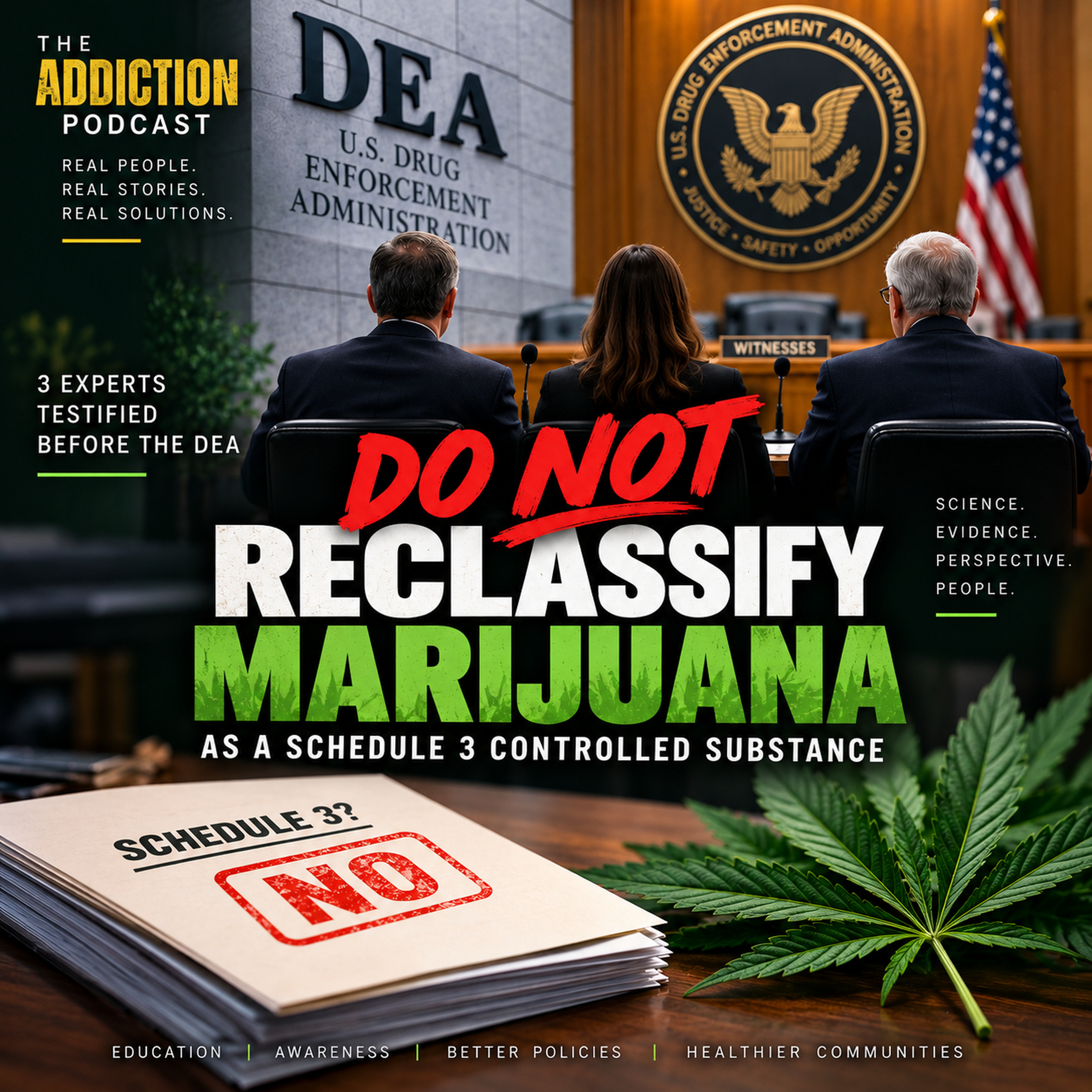
In this urgent episode, three nationally recognized physicians — Dr. Philip Drum, Dr. Ken Finn, and Dr. Karen Randall — testify before the DEA to oppose the proposal to move marijuana from Schedule I to Schedule III. Their expert witness statements reveal the medical, scientific, and public‑health dangers that rescheduling would create.
Dr. Philip Drum, a national expert on the Controlled Substances Act, explains why marijuana has never met the FDA’s requirement for “accepted medical use.” He cites more than 9,500 federally funded studies and $4.2 billion in taxpayer‑funded research — none of which resulted in a single FDA‑approved indication. He also exposes the false claim that cannabis “cannot be researched,” showing that marijuana is one of the most heavily studied substances in U.S. history.
Dr. Ken Finn, a pain physician with 30 years of experience, describes how marijuana consistently fails to treat pain, despite widespread belief. He reveals that the DEA’s own internal study — the one being used to justify rescheduling — is secretive, flawed, and cannot be reproduced. He also highlights the extremely low percentage of physicians who recommend cannabis in states where it is legal, comparing the pattern to the opioid pill‑mill era.
Dr. Karen Randall, an emergency physician and pediatric specialist, delivers some of the most alarming warnings. She describes the explosion of pediatric cannabis exposure, the rise of cannabis hyperemesis syndrome, and the growing number of children experiencing cannabis‑induced psychosis — including cases as young as seven years old. She shares a devastating case of a 13‑year‑old girl trading sex for marijuana, illustrating the real‑world consequences of liberalized drug policy and the false messaging that cannabis is “safe” or “healthy.”
Together, these expert witnesses argue that rescheduling marijuana to Schedule III will:
- Mislead the public into believing cannabis is safe
- Increase youth access and exposure
- Expand diversion
- Reduce regulatory oversight
- Ignore decades of medical evidence
- Create long‑term harm to developing brains
This is Part 1 of their testimony before the DEA. Part 2 will be released shortly.
⭐ Expanded Guest Bios
Dr. Philip Drum
Expert Witness – Controlled Substances Act & Drug Scheduling Dr. Philip Drum is a national expert on the Controlled Substances Act, drug scheduling, and FDA medical‑use standards. In his testimony to the DEA, Dr. Drum explained how Schedule I substances are defined, why marijuana has never met the FDA’s requirement for “accepted medical use,” and why the claim that cannabis “cannot be researched” is false. He cited more than 9,500 federally funded studies and $4.2 billion in taxpayer‑funded research on marijuana — none of which resulted in a single FDA‑approved indication. Dr. Drum also detailed the abuse‑potential differences between Schedule I, II, and III substances, and warned that moving marijuana directly to Schedule III ignores decades of scientific evidence.
Dr. Ken Finn
Expert Witness – Pain Medicine & Clinical Evidence Dr. Ken Finn is a pain physician with over 30 years of clinical experience treating patients in Colorado. He has evaluated thousands of patients using opioids and marijuana for pain and testified to the DEA that marijuana consistently fails to treat pain, despite widespread public belief. Dr. Finn highlighted that the DEA’s own internal study supporting rescheduling is secretive, flawed, and cannot be reproduced. He also noted that fewer than 5% of physicians in legal‑cannabis states have ever recommended marijuana, with a small number of doctors issuing the majority of recommendations — a pattern reminiscent of the opioid pill‑mill era.
Dr. Karen Randall
Expert Witness – Emergency Medicine & Pediatric Cannabis Harm Dr. Karen Randall is an emergency physician with specialized expertise in pediatric medicine and adolescent behavioral health. In her testimony to the DEA, she described the dramatic rise in pediatric cannabis exposure, including cases of cannabis‑induced psychosis in children as young as seven years old. She detailed the growing prevalence of cannabis hyperemesis syndrome, a condition causing uncontrollable vomiting that can lead to hospitalization, electrolyte imbalance, and even death. Dr. Randall also shared a devastating case of a 13‑year‑old girl trading sex for marijuana, illustrating the real‑world consequences of liberalized drug messaging and the false belief that cannabis is “safe” or “healthy.” She warned that rescheduling marijuana to Schedule III will increase youth access, worsen diversion, and send a dangerous message to the public.
Voiceover
The addiction podcast, point of no return.
Joanie Sigal
And I want to introduce you to our guests, Plural.Tonight we are going to be talking about marijuana.And first of all, we have Dr. Philip Drum.Dr.Drum, thank you for joining us tonight.You are an expert and thank you.And then we also have Dr. Ken Finn, who has been on the podcast before as well.And thank you for joining us.
Dr. Phillip Drumm
Dr. Finn, thank you for having me.
Joanie Sigal
Absolutely.And we have a new guest tonight and I am excited to hear from her.She is Dr. Karen Randall and she has her own perspective on marijuana and the rescheduling or hopefully not.Thank you for joining us.
Dr. Karen Randall
Thank you.
Joanie Sigal
Dr.Drum.You get to kick it off.We were talking about the scheduling of marijuana because that's a big subject today.So tell us what that means and why what they're trying to do is not a good idea.
Dr. Phillip Drumm
Very good.So just to start off with is that the Controlled Substance act is actually held under the Department of Justice and the Drug Enforcement Agency.And they're the ones that actually decide what level of controlled substance, the drugs that have been approved by the fda, what level to put them in if they end up being drugs of abuse and end up having issues with dependence.And so these are drugs that have an abuse potential and dependence.Dependence that have a psychological or physical withdrawal symptom syndrome that occurs if they stop taking the drugs.Okay, so these are the drugs and then have that special link to them that these drugs then get put in a classification of what they call CS1 through 5.So 1, 2, 3, 4, 5.Now, the difference between a CS1 and 2 through 5 is that it has to have a medical accepted medical use.Okay, so those drugs that do not have an accepted medical use include things like lsd, psilocybin, mdma, marijuana.These are drugs that do not have an accepted medical use.We have nothing from the Food and Drug Administration that says these drugs are accepted for medical use.And we still don't.The difference between a CS1 and a CS2 then are those drugs with the highest abuse potential and have then that dependence, the physical psychological withdrawal activity.So CS2 drugs then are that then have a medical indication include Vicodin, morphine, hydromorphone, pentobarbital and codeine above a certain amount.So a higher doses of codeine are a CS2.
Joanie Sigal
What about like Oxycontin, does that fall in there as well?
Dr. Phillip Drumm
Yes, it does.Oxycodone is in there.Yep, absolutely.And so CS3 drugs then are drugs that have a lower potential of abuse.Again, they have FDA approved indication, they have a lower incidence of adverse effects of the abuse potential as well as a lower incidence of dependence as compared to a CS2.So the 2 has the highest.The 3 is the next level down.And threes then include things like Tylenol with codeine and testosterone and ketamine.So those are CS3 drugs.The proposal is to move marijuana all the way from a CS1 down to a CS3.That's the proposal.CS4 have a lower abuse potential and again a lower incidence of then having the dependence, the withdrawal symptoms.So CS4 drugs then are drugs like Valium, Ativan.So the class of drugs called we call benzodiazepines, Librium, Clonazepam, Xanax, phenobarbital is also in the class of CS4.CS5s, then are the lowest level of drugs that have an abuse potential as well as then having those withdrawal symptoms.And these drugs include things like cough syrups that contain codeine that are for children, so very low amounts of codeine, pregabalin and opium like suppositories.So those are the drugs in a CS5.All your other substances that do not have abuse potential, then they're not controlled substances.And those are our general drugs.Again, we have drugs that are require a prescription, and then we have drugs that are for general use that are over the counter drugs as well.But these are drugs that are prescription drugs that have a high abuse potential and also have this dependence issue with them.
Joanie Sigal
And some of the ones that you mentioned.I'm gonna get off subject for just a segment.Some of the ones you mentioned as CS4, like phenobarbital, there's no way people can abuse phenobarbital.
Dr. Phillip Drumm
No, all of these drugs are abuse.Oh, all of these drugs are drugs of abuse.
Joanie Sigal
I got it.
Dr. Phillip Drumm
Okay.And it's just lower than, say, the abuse potential of testosterone and ketamine.
Joanie Sigal
Got it.
Dr. Phillip Drumm
Tylenol with codeine.Okay, so all of those drugs that I just mentioned are all controlled substances.They just have lower levels, as I was going down, of the abuse and the withdrawal.
Joanie Sigal
I got it.And then something like Tylenol is not even a controlled substance.
Dr. Phillip Drumm
Correct.Combined with codeine, it becomes a CS3.When codeine gets taken away and in a higher dose, codeine becomes a CS2.And actually what's interesting is dronabinol, which is delta 9 THC, the active component of marijuana, has been approved by the Food and Drug Administration and is a CS3.Now there's also.Then that's A gel filled capsule.So that's a CS3.That's THC alone.They are talking about marijuana, which contains over 100 cannabinoids and 200 plus terpenes and flavonoids that they're trying to make that plant material A CS3 like the THC is.But again, THC is only by itself.Now, what's very interesting is the Food and Drug Administration and DEA have Dronabinol Delta 9 THC in a liquid version as a CS2.
Joanie Sigal
Okay, why the difference?
Dr. Phillip Drumm
Why?Good question.And it's because the liquid version works quicker than that gel capsule and you get higher levels quicker, and that then raises the risk of abuse and dependence.And so a smoked version is much more quicker than a liquid version version.And so for them to jump from a CS1 all the way down to a 3 and bypassing that CS2, dronabinol, I told the judge, doesn't make sense to me because this is actually worse than that CS2 liquid version of Delta 9 THC that you approved.
Joanie Sigal
Wow.Dr. Finn, weigh in on this.
Dr. Ken Finn
I think Phil covered it very well.Currently, the FDA has not approved a single medical condition for raw cannabis.And as a pain physician and having practiced in Colorado for 30 years, I was seeing patients coming to me that were taking opioids, which is a whole other problem, and they were reporting very high levels of pain, and they were using marijuana for their pain.But so clinically it didn't make any sense.So when I pinned these patients down and I asked them, let's taper your opioids and you can smoke all the marijuana you want because it's supposed to be a great analgesic and an opioid substitute.Almost all of my patients said, I don't want that.The opioids work for my pain and the marijuana really doesn't work for my pain, despite the public opinion that it is a great analgesic or pain reliever, and the medical literature doesn't support it.And like Dr.Drum said, the raw plant has hundreds of active molecules in our body.So how can you really isolate what really works and what isn't working and moving it out of something that has an abuse potential?Because the FDA hasn't approved anything for the use of raw cannabis, not one single medical condition.It's a huge problem from my perspective as a pain physician, when patients are using this product, saying that it's going to help their pain when in actuality doesn't, and that's supported 100% by the medical literature, just doesn't work commonly accepted medical use as one of the things that we discussed, less than 5% of physicians in any state that has these programs has made one recommendation for the use of marijuana for whatever medical condition they think it's going to help.So there's a very small percentage of licensed health care providers across the country that are actually making these recommendations.And a lot of those states, like Colorado, one fourth of the physicians that are making recommendations made more than a quarter of all of the recommendations.So it's very reminiscent of the pill mills.
Joanie Sigal
Yes.Yep, yep.And so just to make it clear to our listeners, one of the reasons we're talking to Dr.Drum and Dr. Finn and Dr. Randall is because they recently spoke in front of the DEA on this whole subject of reclassifying marijuana.And Dr. Randall, thank you for being with us today and give us a perspective.What was your basic message here for the dea?
Dr. Karen Randall
So I had a two part basic message.First of all, from the point of being a prescriber, it's how do you prescribe a flower of marijuana?The plant, the concentration is different, the chemical makeup is different, so it's not consistent.So if somebody goes to the pharmacy to get a dose of high blood pressure medicine, every time they go and pick up, oh, say Metopolol, it's the same.It'll be 50 milligrams, it'll be the same.There'll be purity checks, FDA recalls.If there's side effects, there'll be black box warnings.However, if you're prescribing a plant, the plants are different, the dosing and the chemical content are different.So there's no way to regulate that.So as a prescriber, it's very difficult to regulate that.Plus, as a prescriber, I would never recommend that someone smoke a medication because clearly we've established that smoking is harmful.And the big message I have is that we are liberalizing the use of drugs in our communities, including cannabis.I think by taking it down to a Schedule 3, it sends a message to the public that, hey, these are safe, right?Our FDA has approved them.It's pretty safe.Let's the kids can have it and the kids are getting it.There was a recent paper out that showed that Kid exposure from 2009 to 2024 increased by 13,000%.And it's so our kids are getting it.And I was told by the DEA attorney that it was diversion.And it's maybe it's diversion for the little kids on the part of their parents, but everybody that's had A teenager knows that they're finding ways to get it and our kids are getting it.And it's particularly harmful for the growing brain.
Joanie Sigal
I'm sorry, Dr. Randall, what does that mean?It's diversion.Why is that an argument?
Dr. Karen Randall
They keep saying that the reason why cannabis is safe, but it's being diverted by parents giving it to their children.So we've seen several cases where babies come in and they're intoxicated with cannabis.And I think the parents are hearing the companies, that's safe, it's healthy, healthy, it's harm, harmless.And so they're giving it to their kids.There's a whole sites of ganja mama and let's give it to our children.It is particularly harmful for children and we aren't protecting our children.And the mission of the DEA says we're going to prevent diversion, but they haven't prevented it now.And to decrease the schedule to make it seem more safe and more appealing and more healthy to the public as a medicine is really doing our kids a disservice.
Joanie Sigal
I agree.And Dr.Drum, isn't the false thing that is said about why we want to change it to a Schedule 3 is so that it will be regulated and safe?Dr. Randall said.
Dr. Phillip Drumm
And something else that was said that I'd like to point out as well is that they claim that they can't do research.And this was said in the Oval Office as to why we have to move marijuana from a CS1 to a CS3 is because we cannot study marijuana.And that's completely 1000% false.And I just want to give you this is what I told the DEA judge, that as a CS1 substance, I've never seen any more drug that's been studied more than marijuana.And I showed him from what's called the NIH report order, you can go to it, you can put in marijuana as a search term and you will come up with over 9,500.When I did, it was 9,566 studies that have been performed on the term marijuana since 1985.9566 At a cost of $4.2 billion that the US government has paid for in those studies of taxpayer money.$4.2 Billion.And yet we still have no FDA approved indication.Well, let's compare that.And I compared that to a couple other analgesics because they want to claim that it could be used for pain.And so I compared it to morphine.Morphine had 10,000 studies at a cost of $2.8 billion.But one FDA approved indication for morphine.Let's do ibuprofen, which is Advil1100 at $336 million.And that has three FDA approved indications.And one last drug I'd like to compare it to in the number of studies is Ozempic semiglutide.I think a lot of people have heard of that drug.That's the weight loss drug also used for diabetes.There were 149 studies as compared to 9,500.Okay, 149 studies at a cost of 105 million, not 4.2 billion, that was spent on marijuana research.And Ozempic has six FDA approved indications.Marijuana has zero.So to claim that you have to move its status to be able to study it is completely false.
Joanie Sigal
And the fact that, yeah, it doesn't make any sense to me.Research already exists.And why would you move it to a Schedule 3 just to do research?I don't, I don't get it.Anyway, Dr. Finn, what you are seeing, what did you talk to the DEA about?Did you tell them, I know you.When you talked to us before, you talked about a lot of the evidence of marijuana psychosis.Was that pretty much what you focused on?
Dr. Ken Finn
No, I focused on a lot of things, including the study that they are relying on to reschedule it from a CS1 to a CS3 was somewhat secretive.I don't know who the primary author was.I know the study cannot be reproduced or duplicated.And actually, when they were looking at indications, particularly pain, two thirds of the studies of the DEA's own study showed that marijuana does not help pain.But they're relying on a very weak study that is, we don't know who did it, who they're referencing.And they also referred to another study out of the University of Florida that was terribly flawed on the fact that it doesn't help pain.And that's what the, the public opinion is, that it's a great analgesic or pain reliever or an opioid substitute and it just has fallen completely flat.And that those were one of the things that we talked about and also spoke about the commonly accepted medical use.Again, as Dr.Drum mentioned, the FDA has not approved a single medical condition for the use of raw cannabis for anything, despite all the studies and the billions of dollars that have been spent by the taxpayers on studying it, despite its current schedule.So I would agree with Dr.Drum that moving it to another schedule doesn't make any sense.And it's completely.It's a fallacy on what they're basing it on.
Joanie Sigal
Wow.
Dr. Phillip Drumm
I'd like to know where it's coming from.
Joanie Sigal
It's the money.Sorry.
Dr. Karen Randall
Oh, yeah, yeah.
Dr. Phillip Drumm
I just like to also go back to Dr. Randall.She's not only an emergency room doctor, but has an expertise in pediatric medicine.And so I'd like to have her kind of also speak to.What was it you told the DEA judge about pediatric use as well as the CHS that you saw in treatment?
Dr. Karen Randall
When they talk about studies, we have so many clinical trials, basically clinical trials of people using them.And we've been following these for years.They have years of study in the Netherlands about psychosis.And now we're seeing cannabis hyperemesis in kids.We're seeing psychosis in kids, and we're reporting these.We are writing them up.We are reporting them for a child who has cannabis hyperemesis.There's a recent study that says it takes about $77,000 to diagnose cannabis hyperemesis because it's a diagnosis of rule out.It's also what we call scromiding because they come in with a combination of screen vomiting.So we in the ER call it scromidine.And they get big workups.They get CTs and blood work admission.They can die from this.They can have electrolyte abnormalities.And.
Joanie Sigal
And Dr. Randall, I'm sorry to cut you off, but just for our listeners, in case they've never heard the term hyperemesis, just explain what that is.
Dr. Karen Randall
Oh, it's protracted vomiting that just doesn't stop.And the public is tuned to believe that it helps with nausea.Right.It's one of the things they say, oh, it's great for nausea.And it may be, but the doses that they use for nausea and chemotherapy are 2.5 milligrams.I'm seeing kids who are smoking 2,000 to 5,000 milligrams.
Joanie Sigal
Wow.
Dr. Karen Randall
More is not always better.And these kids are taking a hit.And then what happens is as the adolescent brain is growing, when they get here and they start with cannabis, they prune their brain and they become very prone to having lifelong problems with addiction and so continue to have addictive issues throughout the rest of their life.
Joanie Sigal
And isn't that interesting, because so many, so often, we have heard from the naysayers that marijuana doesn't lead to addiction.
Dr. Karen Randall
It's not the gateway drug.It's not the gateway drug.We hear that mantra all the time.And yet in clinical practice, it is 100% gateway drug.
Dr. Phillip Drumm
They said the same thing about nicotine.You can Go to the congressional hearings and listen to all the CEOs of the tobacco companies go down the line saying nicotine is not addictive.We've all seen it.And I think just a very important point to underscore, especially with what Dr. Randall does as a physician.Correct me if I'm wrong, Karen, but the youngest person that Dr. Randall has seen with cannabis psychosis was a seven year old girl, a seven year old.
Dr. Karen Randall
Boy who had cannabis psychosis and from chronic use.And he definitely got what the DEA would call diversion.His parents gave it to him because for some reason the industry is allowed to say, you'll see the little wheels of all the benefits that it does.And the industry is allowed to put out there that it treats nausea, treats Crohn's disease, it treats cancer.And if I took a regular, say I took Tylenol and I said, it treats cancer, it treats nausea, it treats this, the FDA would shut that down because it's not correct.Some reason the cannabis industry gets away with this.And then the public says, oh, it treats nausea, so I better take more because I'm throwing up.And this is a repetitive cycle when they get the repeated vomiting.And for kids with psychosis, we know it's really bad for their developing brains.And so what happens is if they get the first episode of psychosis and they stop, the likelihood is they may not ever have another episode of psychosis, but all too often they continue on with psychosis or continue on with the use of cannabis and develop recurrent psychosis.And we've seen multiple long term clinical trials that show that there's a 3 to 5% risk of psychosis increase over general population and then long term schizophrenia.
Joanie Sigal
Okay, so you're talking to the DEA and you are explaining that one of the, one of the key reasons or one of the big reasons why marijuana should not be reclassified as a Schedule 3 controlled substance.And you're saying that you've seen 7 year olds with psychosis and what do they respond to that?What did they say?
Dr. Karen Randall
Nothing.It was diversion.And the other interesting thing was I had, I saw, I present all this information and I had little pictures of marijuana guys on, on my.They were more interested in looking at those pictures to determine if they were AI or not.And I kept trying to say it doesn't matter whether the pictures on my slides of marijuana people are.The cartoons are AI or hand drawn.The.The fact is they're out there.This is what our kids are seeing.And I will just like really quickly present this one case, because this case to me sums it up.I say it every time I speak in sentence.I saw a 13 year old girl once in the ER.She was depressed and suicidal and her parents were with her.Her dad would not make eye contact with me.They heard it, they heard the message, it's healthy, it's beneficial.So they thought at 11 they would start letting their daughter use cannabis.So by the time she was 12, because we know it, very powerfully addictive in young brains.By the time she was 12, she was selling or trading the only thing she had consistently of value and so was trading sex for pot at middle school.And by the time I saw her at 13, she was suicidal and depressed.And here's the additional problem that we have that most people don't know in this country is that adolescent and children treatment beds are at a premium.The state of Colorado closed all over a thousand beds in the last decade of adolescent treatment programs and behavioral health programs.So these kids come in, they definitely need inpatient treatment because they need to be taken away from the environment that got them there in the first place.But most of people don't know.And I told this to these kids can sit for weeks in the er.We had a child, six weeks in the ER waiting for placement.And it's especially difficult for kids who come in psychotic because they're violent.A lot of the adolescent treatment programs are off site and you can't put a violent patient off site in a congregate setting for safety reasons.So these kids can wait a long time for placement.And oftentimes, as is the case with a 13 year old girl, we send them home to quote, get outpatient treatment if they can.And so it's usually a failure.But even if I put this kid in the best treatment facility, she will still have a lifelong issue with PTSD from trading sex for pot.And I'd like to say this is a one off story, but literally we see it day in and day out in the er.And every time I speak to any senator, any dea, I invite them to come spend a day with me in the emergency department.12 Hours to see what the endpoint of legislation, like what they're doing looks like on my side because they can sit in the sterile courtroom and think it's okay when I'm dealing with the kid who's psychotic, who needs to be restrained by six people and get antipsychotics to control behavior, who will sit in my ER for six weeks waiting for placement in an adolescent facility
Joanie Sigal
and none.
Joanie Sigal
Of them come and visit you, do they?
Dr. Karen Randall
No.I have.000 tapers.
Joanie Sigal
This is the end of part one of the interview with Dr. Philip Drum, Dr. Ken Finn and Dr. Karen Randall about their presentation to the DEA on the subject of marijuana.Part two will be coming shortly.
Voiceover
You have been listening to the Addiction Podcast Point of no Return.For more information reach out to us on Facebook or go to www.the addictionpodcast.com.Our email is the addiction podcastahoo.com.