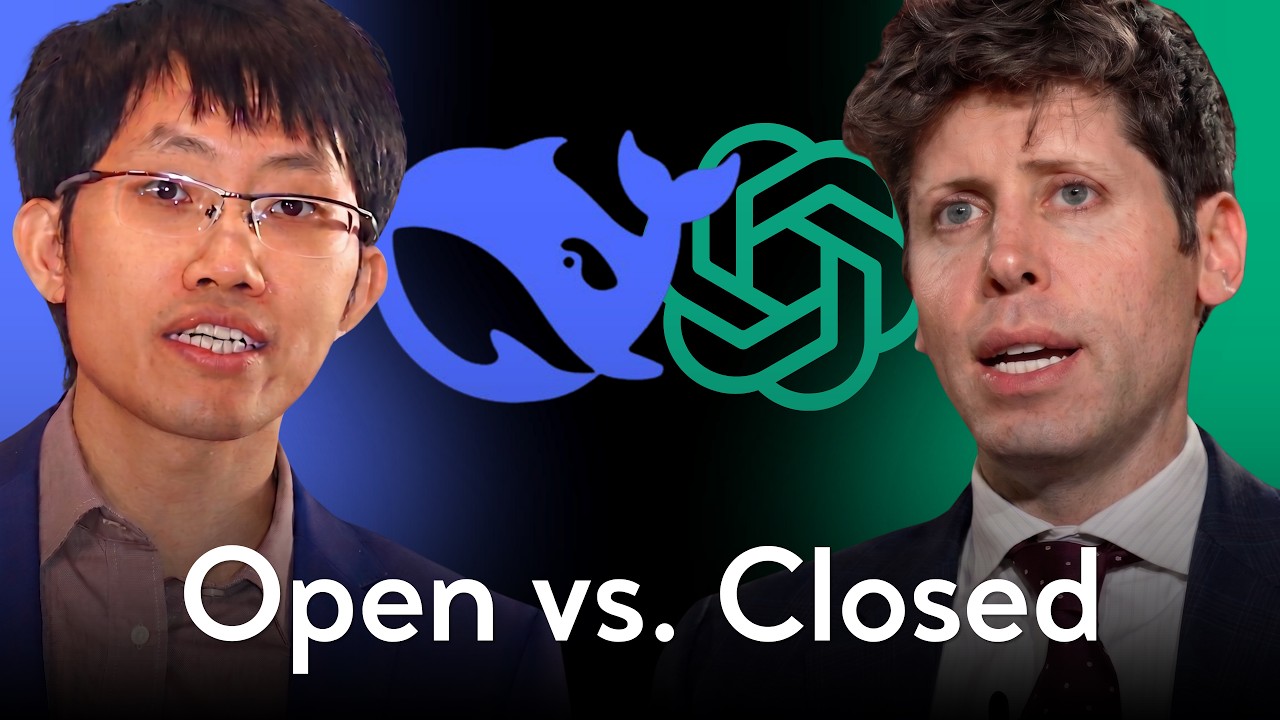
Beyond the Hype: Exposing 'Open Washing' by Big Tech
Welcome back, builders and innovators. If you have been following the artificial intelligence landscape over the last few years, you have probably noticed a massive linguistic shift. Every tech giant from Silicon Valley to Beijing is throwing around words like "open source," "open weight," and "democratizing AI." But if you peek behind the shiny marketing curtain, the reality of what these companies are serving up looks a lot less like a community-driven public utility and a lot more like a calculated corporate strategy. We are living in the era of open washing, and as developers, founders, and product managers, we need to get very good at separating genuine open-source innovation from clever corporate spin.
This blog post dives deep into the exact topics we covered on the podcast recently. To get the full audio experience, make sure you listen to Open AI vs Closed AI: Which Actually Wins in 2026? | Ep 4. In this piece, we are going to break down the real numbers behind model costs, look at where closed models still hold an advantage, tackle the scary rise of AI-generated malware, examine the geopolitics driving open washing, and give you a concrete framework for choosing your tech stack.
Introduction
The artificial intelligence ecosystem is experiencing an identity crisis. When Meta, OpenAI, Google, and other major players talk about their latest models, they want you to believe they are digital philanthropists, handing out billions of dollars worth of research out of the goodness of their corporate hearts. But let us be honest: Big Tech does not give away trillion-token training runs for free. There is always a strategy.
Open washing occurs when a company slaps the "open" label on a model or a product to gain the cultural and developer mindshare associated with true open-source software, while maintaining strict proprietary control over the weights, the training data, the pipelines, or the monetization. It is a brilliant PR move, but it leaves developers in a precarious position. Are you building on a foundation of sand, or are you truly utilizing decentralized technology? To answer that, we have to look past the press releases and examine the hard data, starting with the economics of running these systems in production.
The 13x Cost Gap in Real Numbers
Let us talk about money. When you are scaling an application from a prototype with fifty users to a production system serving fifty thousand active users, inference costs can make or break your business overnight. Not long ago, the conventional wisdom was that you had to pay the premium toll to the closed frontier labs if you wanted enterprise-grade performance.
That narrative has completely shattered. Recent data shows that the performance gap between open and closed models has essentially collapsed, shrinking from a staggering 17.5 percentage points down to a negligible 0.3 percent in a single year. Even more shocking? Free downloadable open models are now regularly outperforming the most expensive paid frontier lab models on complex software engineering benchmarks.
When you translate this technological parity into production unit economics, the gap widens dramatically. Running your workloads on self-hosted or optimized open-weight infrastructure delivers a jaw-dropping 13x cost reduction compared to routing every single API call through a closed frontier provider. For bootstrapped startups and enterprise engineering teams alike, a thirteenfold cost difference is not a minor line item optimization. It is the absolute difference between a sustainable business model and burning through your entire venture round just to pay your token bills. But before you completely ditch your closed API endpoints, we have to look at the other side of the ledger.
Where Closed Models Still Win
Despite the incredible rise of open-weight models and their undeniable cost advantages, it would be foolish to pretend that closed models are obsolete. The proprietary labs—companies like OpenAI, Anthropic, and Google DeepMind—still hold distinct, powerful advantages in specific domains.
Unrivaled Multimodal Integration
Closed models often feature deeply integrated, native multimodal capabilities that are painstakingly optimized from the ground up. While open models can process images, audio, and text, the seamless, low-latency cross-modal reasoning found in top-tier closed systems often feels a generation ahead. If your product relies on real-time, ultra-low-latency voice conversation with complex visual context parsing, the proprietary APIs are frequently the path of least resistance.
Managed Infrastructure and Zero Maintenance
When you use a closed model, you are paying for an ecosystem, not just a model. You do not have to worry about GPU cluster orchestration, vLLM tuning, quantization trade-offs, sudden memory leaks, or autoscaling infrastructure under heavy traffic spikes. For lean teams that want to focus purely on product-market fit without hiring dedicated machine learning operations engineers, the managed nature of closed APIs is a massive win.
Safety Guardrails and Enterprise Compliance
Closed labs invest billions in adversarial red-teaming, fine-grained safety classifiers, and legal compliance frameworks. For risk-averse enterprise buyers who require airtight indemnification, strict regulatory compliance certifications, and out-of-the-box content moderation, closed models provide a corporate comfort blanket that raw open weights simply cannot match on day one.
AI Generated Malware Breaks Old Defenses
As we democratize access to state-of-the-art intelligence through open-weight releases, we also democratize it for malicious actors. One of the most terrifying developments in the open versus closed debate is how AI-generated malware is actively breaking traditional cybersecurity defenses.
Historically, signature-based antivirus software and basic behavioral monitoring could catch the vast majority of threats because human hackers tended to reuse code patterns, libraries, and attack structures. Large language models change this dynamic entirely. An attacker can use an open-weight model running locally on consumer hardware—completely stripped of safety guardrails—to generate entirely novel, polymorphic malware variations on demand.
Every single payload can be uniquely written, obfuscated, and structured differently. Traditional signature databases are rendered virtually useless against code that has never been seen before and will never be seen again. Furthermore, bad actors are using LLMs to orchestrate sophisticated, multi-stage social engineering campaigns at a scale that human spear-phishers could never dream of achieving. This creates a massive dilemma for the open-source community: how do we preserve the freedom of open research and code distribution without handing a blueprint for digital destruction to state-sponsored hackers and cybercriminals?
Geopolitics and Open Washing
You cannot talk about open weights without talking about geopolitics. The battle between open and closed AI is no longer just a technical debate between software engineers; it is a global superpower struggle between the United States and China.
When American closed labs like OpenAI and Anthropic lobby governments for heavy regulation, claiming they are doing it out of safety concerns regarding existential risk, critics often point out a more cynical motivation: regulatory capture. By erecting high legal, compliance, and financial walls around AI development, they effectively pull up the ladder behind them, crushing smaller competitors and cementing their oligopoly.
On the flip side, we have seen an aggressive wave of open-weight model releases coming out of international players, including labs in China. By releasing powerful models with open weights, these labs bypass American export controls on chips, gain global developer adoption, and build international goodwill. However, this is where "open washing" gets fascinating. A model might be labeled "open weight," but when you look closer at the licensing agreements, you find restrictive clauses prohibiting commercial use above certain revenue thresholds, mandatory data-sharing backdoors, or usage restrictions tied to specific national jurisdictions.
Meta, too, plays the open-weight game masterfully. By releasing their models openly, they disrupt the monetization strategies of their biggest rivals like Google and OpenAI, commoditizing the underlying intelligence layer so they can continue to win on advertising and hardware distribution. It is a brilliant chess move, but developers must understand that Big Tech's version of "open" is always subservient to their bottom line.
The Three Lane Routing Framework
So, how do you navigate this chaotic landscape as a builder? How do you decide whether to bet your architecture on open-weight models or closed proprietary APIs? To cut through the noise, we use what we call the Three Lane Routing Framework.
Lane One: Commodity and High-Volume Tasks
This lane is for tasks like text summarization, data extraction, basic classification, formatting cleanup, and high-volume programmatic generation where latency requirements are flexible and cost is the primary constraint. The Choice: Open-weight models hosted on your own infrastructure or optimized serverless providers. The 13x cost gap makes closed APIs financially irresponsible here.
Lane Two: High-Stakes Reasoning and Coding
This lane is for complex multi-step reasoning, advanced agentic software engineering workflows, mathematical problem-solving, and deep logic tasks. The Choice: Here is where the open vs closed race is tightest. If you have the engineering talent to fine-tune and orchestrate, top-tier open models can match closed performance at a fraction of the cost. However, if you need immediate out-of-the-box reasoning with zero infrastructure overhead, routing to a closed frontier model remains a viable enterprise shortcut.
Lane Three: Regulated and Sensitive Domains
This lane covers applications handling sensitive healthcare data, proprietary enterprise intellectual property, financial records, or high-security national infrastructure. The Choice: Self-hosted, fully air-gapped open-weight models. You cannot risk sending sensitive corporate or patient data to third-party closed APIs where it might be logged, retained, or used for future training runs. Total data sovereignty is non-negotiable in Lane Three.
Conclusion
The debate between open and closed artificial intelligence is far from over, and the goalposts are moving faster than ever. While Big Tech continues to engage in open washing to capture developer loyalty and fend off antitrust regulators, the ground reality is clear: open-weight models have reached performance parity while offering an undeniable 13x cost advantage. Yet, developers must remain vigilant, balancing these incredible savings against emerging security threats like AI-generated malware and navigating the geopolitical currents shaping the future of global tech.
If you want to dive deeper into this topic with real-world examples, tactical breakdowns, and a fiery debate on whether we need a standard for open model disclosures, you need to listen to the full conversation. Check out the podcast episode Open AI vs Closed AI: Which Actually Wins in 2026? | Ep 4 right now. Build smart, stay secure, and do not let the marketing hype fool you.