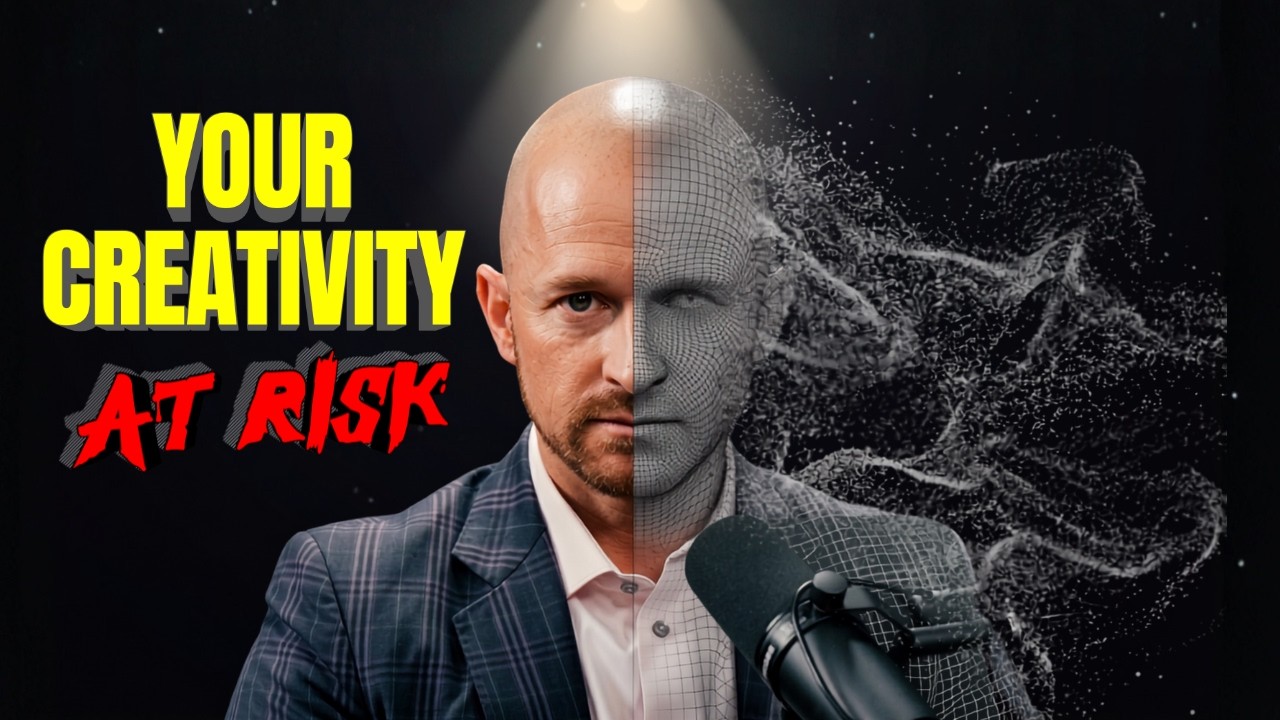
Are You Getting Sharper or Softer? The Hidden Cost of AI Dependence
Welcome back to the blog extension of the show! If you have been following along with the podcast, you know we love exploring the cutting edge of artificial intelligence. We talk endlessly about workflows, prompts, automations, and the incredible ways large language models can multiply our output. But lately, a darker, quieter question has been gnawing at the back of my mind. We are so obsessed with what AI can do for our productivity, our businesses, and our daily task lists that we rarely stop to ask a much more vital question: what is it doing to us?
We live in an era where writing an email, outlining a blog post, debugging code, or brainstorming marketing angles takes mere seconds. All you have to do is type a prompt and press enter. The machine does the heavy lifting, delivering polished, structured, and often surprisingly insightful results. It feels like magic. It feels like leverage. But every single time we offload a cognitive burden to a server farm, we make a subtle transaction. We trade a piece of friction for speed. And as we are starting to discover, friction might just be the very thing that keeps our minds sharp, resilient, and fully human.
This exact tension is at the heart of one of our most provocative and deeply human conversations to date. In episode five of the podcast, I sat down with Tyler Thompson, co-founder of My Instant AI. Tyler brings a perspective to the tech conversation that you almost never hear in Silicon Valley echo chambers. He spent thirteen grueling years roofing in the blistering, 115-degree Arizona heat before building software. That kind of environment teaches you something about human endurance that no software update can ever replace. If you want to dive deep into a conversation that challenges everything you thought you knew about productivity, you have to check out AI Isn't Taking Your Job. It's Taking Something Much Worse | Ep 5. Let's unpack the hidden cost of making our lives too easy.
The Productivity Trap: When Efficiency Costs Us Resilience
For the past few years, the tech world has been entirely consumed by a singular gospel: efficiency. If you are not automating your entire life, you are falling behind. If you are spending more than ten minutes on a task that an algorithm can handle in three seconds, you are wasting precious time. We track our output by the volume of content produced, the number of emails cleared, and the sheer velocity of our daily operations.
However, this relentless pursuit of maximum efficiency creates a dangerous productivity trap. We have come to view friction, struggle, and cognitive fatigue as enemies to be eradicated. If a writing prompt feels hard, we ask ChatGPT to draft the introduction. If a strategic plan requires deep, uncomfortable contemplation, we feed our notes into an AI agent and let it synthesize the bullet points. We smile as our productivity metrics skyrocket, assuming we are operating at the peak of our potential.
But efficiency is not synonymous with capability. When you hire a personal trainer, you do not look for the person who will carry the weights for you so you do not have to sweat. You look for the person who will push you toward the resistance because you instinctively understand that muscle only grows under load. The brain is no different. When we systematically remove all the heavy lifting from our daily workflows, we aren't just saving time—we are starving our cognitive muscles of the exact load they need to stay strong. When everything becomes effortless, we stop building the psychological tissue that helps us weather real storms.
Lessons from the Arizona Heat: Why Hard Things Matter
To truly understand why friction matters, we need to step away from the glowing screen for a moment and look at the physical world. In our conversation on the podcast, Tyler Thompson shared what thirteen years of roofing in 115-degree Arizona heat taught him about life, business, and resilience. Working on a scorching roof under a punishing desert sun is about as far removed from prompting a language model as you can possibly get. There are no shortcuts, no quick hacks, and no magic buttons to make the heat go away.
When you are up on that roof, you face direct, unfiltered reality. You learn what it means to grind through physical agony, exhaustion, and discomfort simply because the job has to get done. Tyler explained that this grueling background forged a mental framework that software development and entrepreneurship could never replicate. It taught him that enduring hard things changes your internal wiring. It builds a foundational grit that tells your brain you can survive discomfort, uncertainty, and exhaustion.
In contrast, modern knowledge work mediated by AI often insulates us from discomfort. The moment a task gets frustrating, we pivot to a chatbot. The moment an idea feels hazy, we ask an algorithm to clarify it. We are losing our tolerance for the messy, unpolished middle stages of creation and problem-solving. We want the finished product immediately, without having to earn it through cognitive sweat. But as Tyler learned under the blazing Arizona sun, the value is rarely just in the final product. The true value is in who you become while you are struggling to build it.
How ChatGPT Made a Founder Lazier
One of the most refreshing and startling moments of my conversation with Tyler was his radical transparency about his own relationship with technology. Despite being the co-founder of a global AI platform, Tyler made a confession that most tech founders would never dare utter aloud: ChatGPT actually made him lazier as a creator.
Think about that for a second. Here is a man building cutting-edge AI infrastructure, someone who understands the tech inside and out, openly admitting that having an all-powerful digital assistant at his fingertips began to erode his own creative drive. When you have a tool that can instantly generate clean prose, organize your stray thoughts, and write out your ideas in a fraction of the time it takes you to do it yourself, it is dangerously easy to stop trying.
Why sit and stare at a blank blinking cursor, wrestling with a stubborn sentence, when an AI can spit out five variations in three seconds? Why push through the mental fog of a complex creative block when a language model can serve up a neat narrative arc on a silver platter? The temptation to outsource the struggle is almost irresistible. But every time Tyler—and every time any of us—gives in to that temptation, we surrender a little bit of our independent creative sovereignty. We stop exercising the unique muscle of original thought. We become editors and prompter-in-chiefs rather than creators, slowly watching our own cognitive edge dull under the smooth veneer of automated perfection.
Atrophy of the Mind: The Skill AI Is Making Us Lose
When people talk about the skills AI is replacing, they usually point to things like basic copywriting, data entry, customer service scripting, or standard code generation. But Tyler and I dug much deeper into a far more alarming reality: the skill AI is making us lose is not a mechanical task; it is the capacity for deep, independent problem formulation and mental resilience.
Consider what happens when you rely on an AI to solve every complex problem you encounter. Over time, your brain adapts to the path of least resistance. The neural pathways associated with deep critical thinking, original synthesis, and sustained concentration begin to atrophy from sheer disuse. It is the mental equivalent of spending six months in bed and then trying to run a marathon. Your legs simply will not hold you up.
We are witnessing the early stages of cognitive atrophy in real-time. People are losing the ability to sit quietly with a complex problem without immediately reaching for a device. We are losing our patience for nuance, our stamina for deep research, and our faith in our own minds to generate brilliant ideas without machine validation. If you always need a chatbot to tell you what your strategy should be, or how your story should end, you are slowly outsourcing your identity. You are becoming a tenant in your own mind, renting your thoughts from a server owned by someone else.
Staying Grounded While Building in the Age of Automation
So, how do we navigate this brave new world without losing our minds—literally? How can we harness the undeniable power of artificial intelligence to accelerate our businesses and amplify our workflows without letting our cognitive muscles wither away?
The answer lies in intentionality and grounding. Building a platform like My Instant AI requires immense technological foresight, but staying grounded requires a deliberate commitment to analog reality and human effort. Tyler’s journey offers a powerful blueprint for this balance. Remarkably, even while co-building a global AI platform, Tyler chose to return to a W-2 construction job. Why? Because he needed to stay anchored to the physical world. He needed the grit, the sweat, and the unvarnished reality of manual labor to keep his feet planted firmly on the ground while his company built software in the digital clouds.
You might not need to take up roofing to stay grounded, but you do need to cultivate non-digital anchors in your life. Whether it is reading physical books without a screen nearby, writing rough drafts by hand on actual paper before opening a laptop, engaging in intense physical exercise, or simply forcing yourself to solve a hard problem without opening a browser tab, you must create deliberate friction in your routine. Protect the sacred spaces where you struggle, where you fail, and where you figure things out entirely on your own. That struggle is your anchor.
Advice for Anyone Feeling Left Behind in the AI Race
There is another side to this coin that weighs heavily on a lot of people right now. If you are reading this and feeling a crushing sense of inadequacy because you cannot keep up with the breakneck speed of the AI revolution, take a deep breath. Every day, a new tool drops, a new workflow emerges, and social media feeds are flooded with self-proclaimed gurus telling you that if you aren't using ten different AI agents by breakfast, you are already obsolete.
The pressure is real, and it causes widespread anxiety. But Tyler had some incredible, grounding advice for anyone feeling left behind in the AI race: stop panicking and focus on what makes you uniquely human. The technology will always change. Prompts will evolve, interfaces will shift, and models will get smarter. But the core human capacity for empathy, lived experience, authentic storytelling, and gritty persistence can never be automated.
You don't need to master every single AI tool the day it launches to be valuable. In fact, chasing every shiny object often pulls you further away from mastery. Instead, focus on deepening your expertise, building real-world resilience, and solving genuine human problems. The machines can generate infinite text, but they cannot live a life, feel the Arizona heat, or stand back up after getting kicked in the teeth by the market. Your humanity is your ultimate competitive advantage. Never trade it for a faster workflow.
Conclusion: Building Strength Without Ringing the Bell
As we wrap up this exploration, the core takeaway is simple: efficiency is a wonderful servant but a terrible master. Artificial intelligence is an extraordinary tool designed to multiply our output, but we must never let it replace our inner drive, our capacity for deep thought, or our willingness to embrace hard things.
In Navy SEAL training, there is a literal brass bell that trainees can ring whenever the physical and mental agony of Hell Week becomes too much to bear. The moment you ring that bell, your suffering ends, your warmth is restored, and you are out. But you also lose your chance at greatness. Tyler’s story reminds us that in the journey of building a business, a career, and a meaningful life, you must never ring the bell just because an AI makes it easy to quit.
If you want to hear more of this profound, unfiltered conversation—including why visualization matters, the one AI tool Tyler wishes he had, and how to maintain your edge when everything around you is getting automated—you need to listen to the full episode. Head over and listen to AI Isn't Taking Your Job. It's Taking Something Much Worse | Ep 5 right now. Stay sharp, embrace the friction, and keep doing the hard work that makes you truly human.