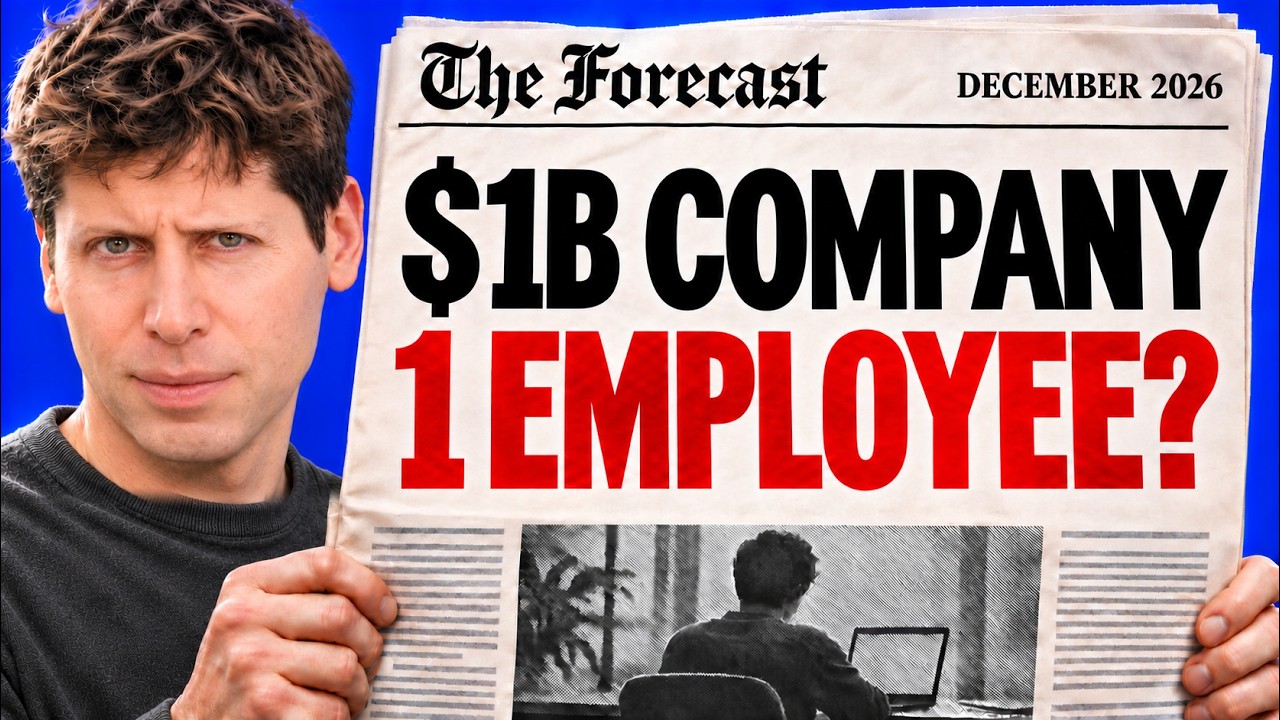
Stripe Data Reveals Solo Founder Revenue Dropped 23%: Why the One-Person Billion-Dollar Myth is Falling Apart
Discover the reality behind Silicon Valley's obsession with the one-person billion-dollar company. While tech leaders promise a future of zero-employee enterprises, fresh Stripe data reveals a 23 percent drop in solo founder revenue, exposing the hidden labor and outsourced contractors required to keep these lean businesses afloat.
Key Takeaways
- Stripe data from 2025 shows average solo founder revenue actually declined by 23%, contradicting the hyper-growth narrative.
- Widely cited 'one-person' billion-dollar companies like Medved's telehealth operation still rely heavily on external contractors, outsourcing, and legal infrastructure.
- Eliminating internal headcount does not eliminate labor; it simply shifts it to external third-party service providers.
- Small teams of exceptional people leveraging modern AI tools consistently outperform isolated solo founders in scaling complex businesses.
- Silicon Valley's obsession with the zero-employee metric misleads builders about the real operational requirements of running a scalable enterprise.
The Myth of the Zero-Employee Enterprise
For the past year, tech headlines have been dominated by a seductive prophecy: the arrival of the billion-dollar company operated by a single person. Industry titans like Sam Altman have fueled this narrative, while researchers at frontier labs like Dario Amodei have assigned staggering probabilities to the timeline of achieving this milestone by 2026. On paper, it sounds like the ultimate triumph of generative artificial intelligence. If an AI agent can write code, handle customer support, draft legal documents, and execute marketing campaigns, why would any founder ever need to hire a traditional staff?
Yet, when we pull back the marketing gloss and examine the actual mechanics of businesses held up as proof of this trend, the fantasy immediately begins to fracture. Take high-profile case studies like Medved's $401 million telehealth operation. At first glance, it is hailed as a monument to solo efficiency. But a closer inspection of the books reveals a very different operational structure. The founder may be the only full-time W-2 employee on the payroll, but the business runs on a massive invisible engine of external contractors, outsourced compliance specialists, third-party billing providers, and specialized technical consultants.
The people did not disappear. They were simply reclassified. Instead of sitting in cubicles under traditional employment contracts, they are working as freelancers, agencies, and vendors. The headcount dropped to one, but the actual human labor required to sustain a multi-hundred-million-dollar enterprise remained largely intact. This distinction matters because it changes our entire understanding of what AI is actually doing to the modern economy.
What Stripe Data Reveals About Solo Founder Revenue
The tech industry loves to highlight the extreme outliers—the hyper-talented individual who catches lightning in a bottle and scales a micro-SaaS product to millions in ARR with zero outside help. But looking at anecdotal success stories distorts reality. Comprehensive transaction and revenue data from Stripe paints a much soberer picture of the solo founder landscape.
According to Stripe's 2025 ecosystem data, average solo founder revenue actually declined by 23 percent year-over-year. While a tiny fraction of elite top-tier performers managed to leverage AI tools to multiply their output, the vast majority of solo operators saw their revenue drop. Why? Because building software has become commoditized, but running a resilient, growing commercial enterprise requires continuous strategic adaptation, complex integrations, and customer trust—things that are exceptionally difficult for a single human being to manage while wearing every single operational hat simultaneously.
The belief that AI tools allow one person to out-execute a coordinated team of ten is largely an illusion born of a specific type of software market. In reality, as businesses scale, the cognitive load and operational surface area expand exponentially. A solo founder relying entirely on AI agents often hits a hard ceiling where managing the agents, reviewing their errors, and handling edge cases consumes more time than a traditional team would spend executing the work directly.
The Hidden Costs of Outsourced Infrastructure
When founders boast about running a lean, one-person shop, they frequently ignore the compounding costs of external dependency. When you do not have internal engineering teams, HR professionals, or financial controllers, you are forced to purchase those capabilities on the open market from external providers.
This does not necessarily make the business cheaper to run; it often makes it more fragile. If an external contractor drops the ball, or if an outsourced service experiences downtime, the solo founder has no internal redundancy to absorb the shock. The obsession with minimizing direct employee headcount creates a false economy where payroll savings are immediately wiped out by skyrocketing vendor fees and the catastrophic cost of founder burnout.
Why Small Teams With AI Beat Isolated Founders
There is a massive difference between a company with one employee and a company that creates massive value. The current narrative treats employee headcount as a waste metric—something to be minimized at all costs to maximize profit per head. But this view fundamentally misunderstands the nature of innovation and scaling.
When you put a small team of five to ten exceptional people into a room together, and you superpower each of them with state-of-the-art AI tools, you do not get the linear output of ten people. You get an exponential compounding effect of diverse human perspectives, rapid creative collisions, and shared operational resilience. One person, no matter how brilliant or how heavily augmented by LLMs, is still constrained by biological limits: they can only hold so much context in their head at once, they can only make decisions sequentially, and they possess blind spots that no automated agent can correct.
The real opportunity of the current technological wave is not figuring out how to fire your last employee so you can claim the title of a solitary billion-dollar CEO. The real opportunity is discovering what tight, high-caliber teams of exceptional individuals can accomplish when artificial intelligence removes the friction of execution. Instead of chasing the vanity metric of zero headcount, builders should be focusing on leverage, team cohesion, and sustainable market expansion.
Conclusion
The goal of building a billion-dollar company entirely by yourself makes for incredible podcast fodder and viral social media posts, but it collapses under the weight of empirical data. As Stripe's metrics demonstrate, solo operations are facing mounting pressure, and the businesses celebrated as solo successes are almost always propped up by vast networks of hidden human labor. To truly succeed in the age of intelligent automation, founders need to look past the hype of the zero-employee unicorn.
To dive deeper into the hidden economics of modern AI startups and hear a contrarian take on Silicon Valley's favorite metrics, make sure to Listen to the full episode. Join the conversation and rethink what it actually takes to build a lasting, scalable enterprise in today's AI-driven economy.
Frequently Asked Questions
What did Stripe's 2025 data reveal about solo founders?
Stripe's 2025 data showed that average solo founder revenue dropped by 23%, with only top-tier performers managing to grow while the vast majority struggled to scale without a team.
Are one-person billion-dollar companies actually running without any human help?
No. Businesses frequently cited as solo-founder successes typically rely on extensive networks of external contractors, outsourced legal and financial professionals, and third-party infrastructure.
Why is the zero-employee metric misleading for AI startups?
The zero-employee metric is misleading because it only counts direct, full-time W-2 internal staff while ignoring the massive amount of external human labor required to keep the business operational.
How do small teams with AI compare to solo founders?
Small teams of exceptional people combined with modern AI tools possess distinct advantages in operational resilience, creative problem-solving, and execution speed compared to isolated solo founders.