
GenesisX's Josh Bruns - Ideas Aren’t the Problem: Scale Is
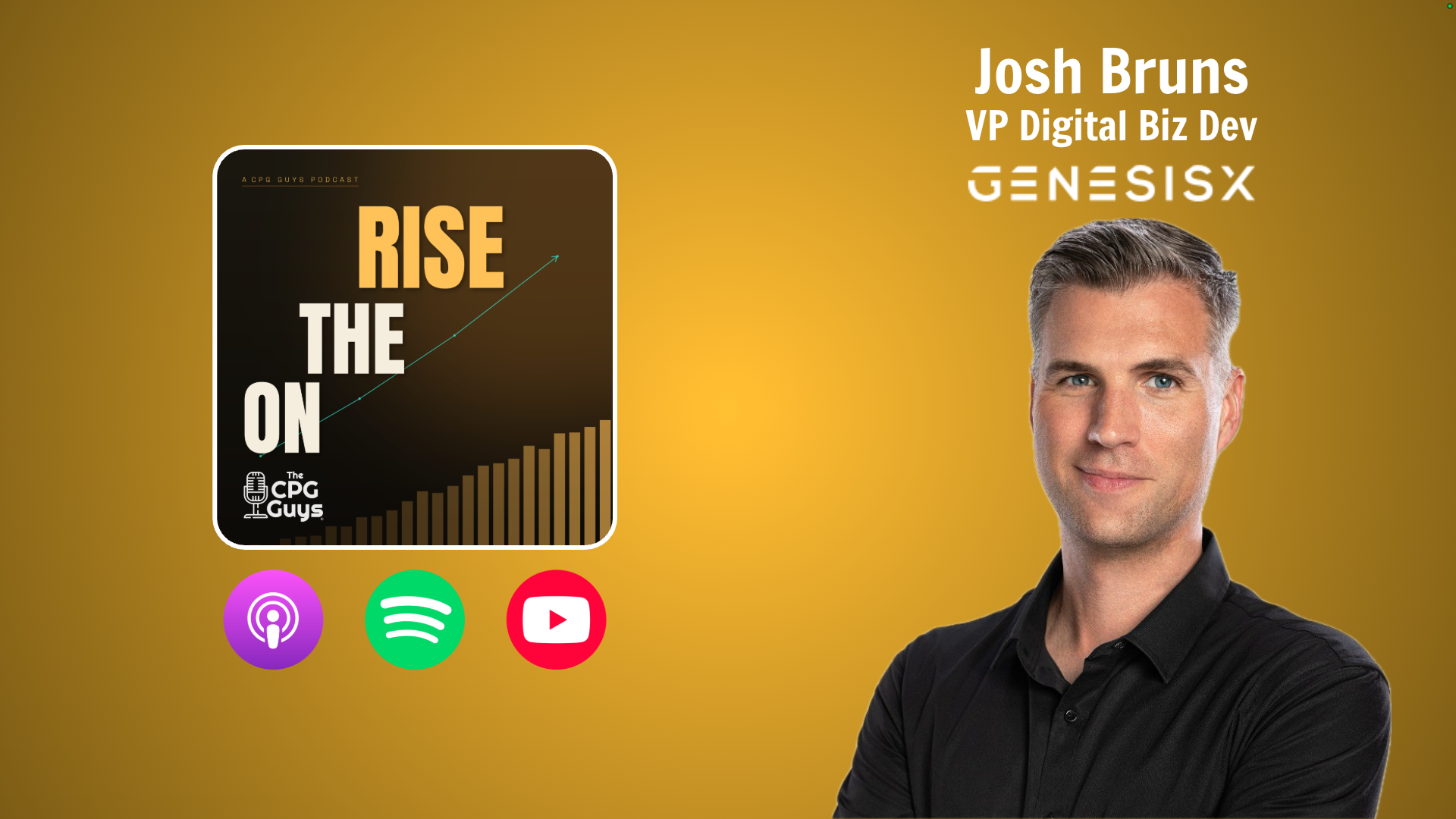


In this episode of The CPG Guys, we speak with Josh Bruns, Vice President of Digital Business Development at GenesisX, a tech-enabled creative studio built for retail media. Their creative strategists and producers bring years of craft and pair it with the latest in enhanced VFX to deliver cinematic-quality video at scale, versioned for every retailer, placement, and season. Brands use GenesisX to create, iterate, and deploy content that drives sales.
Follow Josh on LinkedIn at: https://www.linkedin.com/in/joshbruns/
Follow GenesisX online at: http://www.genesisx.com/
Josh ansered these questions:
- GenesisX has an interesting origin story— for our listeners who haven’t heard, can you walk us through how the company evolved into what it is today, and how you would describe what the company does in a single elevator pitch?
- From the start, let’s talk about the rapidly changing landscape of technology. Knowing that things are accelerating at an unprecedented pace, how do marketers keep up?
- So let’s take the first side of that. You mentioned ‘tech-enabled video content’. How does that impact a Retailer or Supplier’s strategy?
- Why do you think brands underinvest in Video Content?
- How does tech-enablement storytelling change what's creatively possible—not just cheaper or faster than a traditional agency workflow, but able to produce hyper-relevant, one-to-one brand stories at a scale that wasn't possible before?
- That's one half of the model. Walk us through the other half—your APP>LESS platform—what does it actually do, and how does it deliver a personalized, app-like experience without a download?
- Geo-targeted personalization is a big claim—what does that look like in practice for a Fortune 100 CPG brand launching a retailer-specific campaign?
- Walk us through your managed-service model: what does a brand actually hand you, and what does GenesisX's team take off their plate?
- You came into this role from the CPG and agency side rather than a software background—how has that shaped the way you sell and support GenesisX's platform?
- As a challenger going up against established shopper marketing agencies, what's been the biggest hurdle in getting Fortune 100 CPG brands to trust tech-enabled storytelling and media partner with their dollars?
- To close us out on On the Rise, if you could give one piece of advice to a founder or operator trying to bring tech-enablement into their own marketing organization, what would it be?
CPG Guys Website: http://CPGguys.com
DISCLAIMER: The content in this podcast episode is provided for general informational purposes only. By listening to our episode, you understand that no information contained in this episode should be construed as advice from CPGGUYS, LLC or the individual author, hosts, or guests, nor is it intended to be a substitute for research on any subject matter. Reference to any specific product or entity does not constitute an endorsement or recommendation by CPGGUYS, LLC. The views expressed by guests are their own and their appearance on the program does not imply an endorsement of them or any entity they represent.
Josh
Hi, I'm Josh Bruns, VP of Digital Business Development at Genesis X, and you're listening to On the Rise by the TPG Guys.
Announcer
Welcome to On the Rise, a podcast production from the CPG Guys. In each episode, we'll compete with a founder or leader from an emerging computer brand, service provider, or industry of DOT agent. seeking to scale their initial success into an iconic brand for the ages. What it's taking to make this go from a dream to a reality.
Sri
Hello folks, and welcome back to On the Rise, brought to you by the CPG Guys Network. I'm of course your host for this show, Shree, known in the trade as Papa Raj, co-founder of Think Blue Consulting, co-creator of the CPG Guys platform, of course. Every other week, my co-host of our flagship podcast, the CPG Guys and I will take turns to be the host. While our flagship show continues to bring you the massive C-suite powerhouses from Fortune 50 boardrooms, On the Rise was built with a singular mission to shine a bright spotlight on the boldest challenges, the disruptive founders, the agile D2C pioneers, and the emerging tech builders and the visionary organizations like Geniuses X today that are reshaping the future of our industry. If you are a founder scaling past your first few millions, a digital first brand taking over physical shelf space, growing fast in distribution or a tech platform driving category velocity, this is your playground. Welcome to On the Rise. Before we jump in though, do us a quick favor. Whether you're tuning in on Apple Podcasts, Spotify, YouTube, TikTok, wherever you're watching this, listening to this, smash that subscribe button, leave us a five-star rating just because we like the number five. Five is our favorite number. Peter says it again and again. It's not me, it's him. Do it for him. And drop a follow on LinkedIn so you never have to miss an episode off On the Rise. And so let's jump into our guest today. When I sat down to plan this episode of On the Rise, there was one name I couldn't wait to bring on. He spent his career on the front lines of shopper marketing, brand side, agency side, and now on the tech side. He's helping build one of the more interesting Gen AI native studios connecting a hyper-relevant brand story to a very specific consumer-to-drive business outcomes. And I'm talking none other than this guy, Josh Brohns, Vice President of Digital Business Development at Genie Sussex. For those who need the quick download on him and Genie Sus X, Josh has spent 20 plus years in shopper behavior, brand storytelling, e-commerce, sitting in nearly every seat of the table, from agency leadership at Sachi and Saatchi X, Geometry Global, Juggernaut accounts like PG, Kimberly Clark, and at Walmart and Sam's Club, to the supplier side leading shopper marketing e-commerce for brands like Coleman, Rawlings, PureFishing, as well as leading the shopper marketing team at Kraft Heinz for Walmart and Sam's. Today Josh leads business development at Genius X. His through line has always been the same, connecting great ideas to measurable business outcomes. Now he's helping brands and retailers transform commerce marketing through tech-enabled storytelling. The man himself, Josh, welcome to the CPG Guys on the Rise. How are you doing? Thank you. Pleasure to be here. Yeah, great. Yeah, it's Grocery Shop. I'm sure you're busy as heck, but fun we can do this together today and tell the story of Genius X as well. Genius X has an interesting origin story from what we've learned. For the listeners who don't know, can you walk us through how the company evolved into what it is today? How would you describe what the company does in I'm not your audience, elevated pitch? Let's do it.
Josh
Absolutely. So a kind of go back in time, we're a 30-year-old company, actually. And what's really great about what we've done is it's always been the saying, it's been about how do we connect a brand story with a hyper-relevant audience to drive a business outcome. That's what the company's been about the whole time. Now, it has taken an evolution, and as technology has progressed and as innovation has happened, we've been on the front edge of that. And so going back in history to in-store and connecting it at events and things to now where we're leading tech-enabled storytelling opportunities. And so really bringing forth video content and bringing forth great media opportunities. So as an elevator pitch, I like to tell people, you know, like I said before, we connect the brand story with a hyper-relevant audience to drive a business outcome. And how we do that is in two ways. Number one is through creative storytelling using tech enablement. And then number two is through media. And we do it as a pay for performance. And really that's a pay for performance. Pay for performance. Yeah. That's an innovative way that we've worked with companies in the past.
Sri
Awesome. So I want to get into the depth of all of this stuff. So let's get in right from the start into the rapidly changing landscape of technology. I mean, since COVID, I feel like we've advanced 50 years with technology. Pre-COVID, maybe 10 years of technology. Absolutely. Knowing that things are accelerating at paces that you and I cannot even comprehend at this point and what tomorrow holds, what the heck do you advise marketers to keep pace with this crazy change in pace of tech?
Josh
Yeah, it is a crazy change in pace. And I think that it's really important that we start looking back at this isn't new. Innovation isn't new. It's just the pace. It's just the pace.
Sri
Yeah. And so remember when I got my first iPhone back in 2007? I do too. And I've kept one piece of every one of those upgrades from one, two, three, four, all the way to 17 Pro.
Josh
That's amazing. I've still got my iPod and that I still have in the iPod mini.
Sri
I have the old hand me down, two lineages down in it's gonna be the biggest thing. It's gonna be the biggest thing.
Josh
Absolutely. Yeah, so keeping pace is something that's very important. But I think more than just keeping pace, it's how do we continue to keep focus? And focus that has to do with problem solving. And that's what it's always been about. For us, it's been about how do we find out what is it that our our suppliers and our retailer partners are dealing with in the moment. And then how do we take that innovation that's coming, that tech that's coming, and how do we build it into solving that key problem? And the great aspect of it now is that it is changing so fast, it's allowing everybody to have that opportunity to leverage democratizing tech. Democratizing tech.
Sri
That is absolutely true. That is crazy if you thought about it. The one thing I think of that is I've heard you say tech-enabled video content. Yes. So let's jump into that. So let's say you're now a retailer or a CPG vendor, CPG brand. What does that even mean to them?
Josh
Yeah, so we've taken that idea, and now instead of the old static way of doing things, that there was a process that took months and months and months, and it was really a a laborious process that had a lot of cost, and your output was one single thing. Now we can produce things at speed and with customization to reach that hyper-targeted audience. Is this more efficiency versus something transformative, or is it a bit about what I like to tell people is I think gone are the days where we need to start talking about efficiency. Efficiency is just doing something a little bit faster, a little bit better, a little bit cheaper. That's great. But with where we are in the progression of technology, we need to start thinking of transformation. And that is a whole new way. Well said, well said, is not just about any more the output. Well, the output's great because we can do it at speed with customization. That is fantastic. But now we need to think about how do we transform the process as well. And so we like to talk about having a video first strategy. And what I think that means is instead of the traditional process of taking the insights to an idea, to a mood board, to going and testing, and then you make some assets and some video imagery, and then you do a little bit of video after that, the one static video that you use for months and get stale, right? And that that takes you six months, a lot of money. Very used to that from my past brand lives. Absolutely. How do we now flip that strategy on its head and say, let's start with a video? And in fact, let's produce two or three different videos like testing concepts, testing concepts, and let's put them out live. Let's see which ones perform better from a sales list standpoint, and then from there, let's create a cohesive platform and asset guide that now talks to what was the one that won and how is it going to show up best in market? And then you can do that from seasons, from audiences, and just really have a lot of content that's going to drive your business a lot better and a lot more efficient as well.
Sri
Listening to you, one of the saddest things I observe in the industry now, I work a lot in AI in my other venture, and the industry is so obsessed about efficiency. They're not really thinking of AI as transformative. Now, I'm not talking about anthropic going into a black hole on routine and something. I'm talking about CPG brands and retailers. I work with them every day, right? And one of the things I've observed deeply with brands, which then impacts retailers, because all of that stuff is hosted on a retailer website, is they're obsessed about digital content, product detail pages, they're not obsessed about perfection in video. Or they're over-obsessed with perfection in video, where they create that one beautiful video, it takes them six months. Even in a world today where it should really take them this two weeks. Why do you think that's the case that brands are so over-obsessed on digital content, but underobsessed on video content?
Josh
It's a good question. I, you know, I really think that some brands, not all, I there are some great examples of brands and companies who are vertically integrated and they are doing this very well. But some brands are so focused on the digital because they think that has been told to them. That's the end-all be-all for the algorithms. And I think what we're seeing, or I know what we're seeing, is there's a change in those algorithms, not only from just a base standpoint for their rankings, but as we start thinking about how agentic is coming in and the content that's going to pull from, this is all gonna be tied to video as well. And so there needs to be a balance. It's it's not a either or it's a it's a balance of both.
Sri
So the brand's ability to take advantage of the transformation for video directly is proportional because the line goes through agencies. Because most large brands, medium scale brands, they all work with agencies and they outsource the creative element of what they do from an execution standpoint while the brand might still be writing the story. So, how does tech enablement storytelling change what's creatively possible? Not just cheaper and faster, like we've very early surfaced already, than a traditional agency workflow, which costs a lot of money at the end of the day, and then be able to produce hyper-relevant one-to-one brand stories at a scale that wasn't possible.
Josh
Yeah, I think we're gonna see a big shift in the market, just in how each company in each side of all the the silos, if you will, work together. And it's it has to come because of the the tech enablement. And I don't think it's a bad thing. I think it's just it's just a shift. There is still brand preference, there's still taste, there's still the agency's role is still so vital because of what they're bringing to the protection of the brand. But it's it's now about seeing what is the ethos of the brand and how do we protect that more than it is the process by which it comes. And so I see the agencies being a a protector of the of the brand ethos, and because they are a strategic partner to the supplier. And for us, we work on the back end, if you will, to be that somewhat production arm of that. So we work very closely with agencies, very closely with suppliers to be able to bring their vision to life. And I think now what you're gonna see is it's more about that creative vision, the ability to now bring that to life in a way that they haven't before. Because we're not lacking on ideas. Nobody is. It's we're lacking on the ability to execute it at scale. That's what Genesis X is bringing. That's what you're hidden bang on point.
Sri
The ability to do ideas at scale, not actually the ideation itself. That's right. So we've talked about the issue in the industry, what you'll offer from a top-line perspective. But let's get a little geeky and techy now. Okay. Let's talk about the other half of the model, the actual platform. Give us a name, first of all, share it with our audience. What does it actually do? And how does the app actually create a personalized app-like experience? And I believe you don't even have to download it.
Josh
Yes, correct. So, like I mentioned before, there's two sides to what we do. One is call it a creative only, where we're doing tech-enabled video content at scale. And so we work with suppliers and agencies in that way. But then the other side of it is we actually have a solution called Apple's, and that's the name of it. Or Victoria, yeah, it's app-like without the need to download one. What that does is we're able to hyper-target relevant audiences by age, by gender, by geography, by interests. We're able to target these audiences, and then we take them through an immersive experience where you know you can scroll, you can swipe, you're watching video content, you're engaging with that story that the brand's trying to tell. And then it has a direct call to action, whether it be by now, add to cart, is that direct commerce action. What's so special about what that is and how we use it is most companies out there that are doing media are doing it by impression and by click. Those aren't bad. They have their places, but the thing that that does not do is ensure that that relevant audience engages. You're hoping they do when it's impression-based with clicks. Well, 50 to 60 percent of clicks are misclicks. So that really is a barrier, and that that's waste. And so the whole targeting I hadn't thought about that, but now you're making me think. Yeah, so so the whole targeting aspect and in that hyper-targeting is to try to eliminate waste. Well, what we've done is said, okay, we will take on that burden because we're gonna hyper-target, but we're not gonna charge until somebody that hyper-targeted person that we've put an ad out there for has seen it, has clicked on it, and then has opened our interstitial and it loads and starts running. So we're ensuring that the audience that gets to us is hyper-relevant. If they're not, they're gonna bounce and we're not gonna charge for it. So somebody says, Hey, I've got to. That's the pay for performance. That's the pay for performance, right? So somebody says, Hey, here's my budget, and we'll say, well, here's what we'll guarantee from an activation standpoint. We only get to 80%. Strong word, man, guarantee. Yeah. If you only get to if we only get to 80%, you only pay 80% of the budget. So that's really how we bring that immersive content and that immersive storytelling to life in a way that really connects with audiences. And then we can customize that across audiences, across retailers, across interests and language and things. So we're now taking a very hyper-personalized approach to it so that it's relevant to the audience.
Sri
Speaking of relevance, one of the things I discovered was you actually have geotargeting. Yes, absolutely. Talk to us about geotargeting because if you're a Fortune 100 CPG brand, you work with super regional retailers, Mayer, H E Basure Publix, which only exist in one part of the country. Tell us about the capability.
Josh
Yeah, so so we're we're geotargeting what we serve to the areas, to the store lists that the client provides. And so that ensures that not only are we in the right location based on distribution too. I always advise clients. Some will come and say, Well, for instance, all Walmart stores, all Kroger stores. I think that's okay, but do you have distribution in all Walmart stores or Kroger stores or whatever it may be? And then they go, Well, no, no, we're actually only in, you know, 2000. Great, let's isolate to 2000. Do you have a more strategic way of looking at this? What are your top stores versus your bottom? What's the business objective you're trying to accomplish? Hence you're even narrowing down performance footprint to something meaningful. Absolutely. So then we take a store list, uh narrow down store list geographically, and then we start going into okay, what's the audience you want to reach? And so we narrow it down further. Now let's talk about what are the interests. And so we then can hit a market and say, do we want to hit Kroger and Walmart shoppers in this market? Well, great, and we'll isolate by those different retail preferences, and then what about language? You know, and so so we really narrow it down so that the relevance of what we're serving to the specific audience is there because that's so important. A fun study I saw, it's actually a little bit older study, was about what drives sales lift. And so this study had to do with Nielsen, and they had conducted it with a few other people. What that study showed was marketers believe there were like five different influences that they asked them. What do you think targeting's influence is, what do you think creative's influence is on sales lift, what do you think relevancy reach, all these different things. But I'll hit on targeting and creative because I think those were the two important ones. Most marketers said somewhere between 19 and 20% was the effect of targeting, somewhere between 19 and 20% is the effect of creative. That was what they projected in what marketers said. What they found was really different when they actually measured it. About 49% of the sales lift effect came from the creative ah yeah. Now, what that tells me is if you are sitting there and think about at shelf or on the digital shelf, if you see something that's irrelevant, your brain automatically discounts it. And you don't even see it. Especially in a world where the attention span is four seconds. That's right.
Sri
But if it is relevant to you, you'll actually look at it. Yeah, I mean, now that you're seeing it, it sounds logical, but it does having the numbers 49% kind of resonates pretty well.
Josh
I tell people all the time, I said, when I met my wife, if I'd have walked up to her and I stood in front of her and I just started spouting facts about guitars, because I I'm I like guitars. I'd say good luck. Yeah, she'd look at me and she'd go, okay, and she would have walked away. Why don't you try NFL stats? Right? So it that wouldn't have been relevant to her. It's the same with advertising. If it's irrelevant, it's noise and your brain's gonna automatically discount it because your brain can't handle all the inputs that are out there. There are millions and millions of inputs that your eyes see at one moment, but your brain can't handle that. So it it reduces that to a much smaller amount. And so relevance is what makes it creative relevance. Yes.
Sri
No, you know, debate. I mean, it sounds hyper logical to me, but when you back it up with the data, stats, the research, like this should be obvious to brands. But I want to talk about your operating model.
Josh
Yes.
Sri
So once a brand says, Yeah, I'm gonna work with Genesis X, how does that work? I believe you have a managed services model, like take us through the process, like who does what.
Josh
So we we like to tell people we're the easy button. And so what we try to do is make it super simple on our clients, whether it be led through the agency, whether it be led through the supplier, whether it be led through the retailer. And we need limited amount of information. So they give us the input of what's the key objective. And I always always advise whoever I'm working with, that is one of the most important things you can tell anyone is be very clear on your objective. What are you trying to accomplish? And what do you need us to take somebody from doing to doing? When we have that, we can be very dangerous. So they give us that information, they give us some parameters around their targeting that they're looking for, and they give us whatever assets they do have. And then we take that all in, and we have an internal creative team who is working very hard to deliver against that. But the supplier, the agency, the retailer are very involved in it from an approval standpoint, from a creative direction standpoint. So you do the work, we do the work, the brand does the approval process. That's it. And then they give you the input, of course, the creative input. They give us the input. But you're creating the assets. We we take care of everything and programming it and everything. Easy button and the easy button.
Sri
Absolutely. Awesome. Let's talk about you. Okay. You come from the CPG side, the agency background, and you're actually in the software business now.
Josh
Yeah. What does that mean? So I first of all I wouldn't quite call it the software business. We uh, you know, we're storytellers, we're on the vendor side and we partner with these companies. Well sad. That was a test. That was it. Okay, thank you. Hopefully I've asked. But I come from those backgrounds, and I really felt like I had done those different roles and loved it. I loved each side of that because what's interesting is I'm doing the same thing that I did at those roles. It's just now I get to do it from a different perspective. You're giving people the easy button to get that stuff done. That's what you're doing. Absolutely. And I'm I love being able to, so especially from uh from my role in the supplier side, I'm able now to go in and say, hey, here are the business challenges I faced. I bet you're facing the same evidence. We have been working on solutions for those challenges. Let me tell you about it. And so I I actually told, you know, our leadership, I said, listen, I am not a salesperson. I'm never going to be a salesperson. I hope that's okay. Because what I do is I come in and I help people solve their problems. And I feel like if I can do that, they're gonna be successful and I'm gonna be successful. Bravo.
Sri
It's about giving your clients the easy button at the end of the day and solving a problem. Absolutely. Because you're backing it up with pay for performance. That's right.
Josh
That's right. That's right. On that side is pay for performance, and we we backed that up and been very successful. In fact, before I was working for this company, I was a client of the company. I had such great results with them, and I was so excited about what they did. I actually called them and asked them for a job.
Sri
Bravo. Some of those stories work out the best in the industry. Absolutely. Speaking of the industry, you look at the landscape around you, it's filled with shopper marketing agencies who've actually been around forever. Absolutely. So when you look at these Fortune five hundred CPG brands that you want to work with, tell me more about you know what's been the biggest hurdle in getting to these companies to trust tech enabled storytelling and media partner with their investment dollars marketing budgets.
Josh
Yeah, I think trust is very important. And trust comes from seeing results. And we've been fortunate. We like I said, a 30-year-old company. We've worked with some of these top Fortune 100 companies. Worked with some. About all of them. And so that's been a very big benefit. And they have seen the progression of the company to say, we're still doing the same thing. We're still connecting a brand with a hyper-relevant audience and driving a business outcome. The difference is we continue to innovate and we continue to lead in how we're doing that. And as technology changes, as new opportunities come up to do that better, we're still taking those business problems and we're still trying to find ways to solve it. So nothing has changed in that aspect. So we've been able to connect and have long-term clients who we've worked with at many different places who are still working with us now in new ways with our new solutions. And so that's what's been very exciting about this. And again, that's why I came over and that's why I stay. Because it's just been such an enjoyable ride to say our company is fantastic in the way we're nimble, and the way we are changing courses to create solutions. And so that's been important to me.
Sri
Listen, man, just listening to you talking to you, I can tell the energy you're going to bring in this space is awesome. And the industry can use a lot of that, especially as we go through. You know, we started this conversation by saying massive transformation in a very short period with technology. And you need people who have the energy to discuss it, like you just did on this episode of the On the Rise by the CPG guys. So, Josh, the last question we ask a guest on every episode of On the Rise is for a piece of advice that you'd give out. I'm going to ask you a very specialized one this week. Yeah. And rather than ask you to talk to founders and other listeners of this, I want you to talk to brands. Okay. What's the one piece of advice you'd give brands when it comes to tech-enabled storytelling? What should they be thinking of tomorrow morning?
Josh
So, first thing that I always tell anybody, and this has not changed for my entire career, and I've been fortunate to work with experts in the industry who I feel like have taught me well in this. What's the business problem you're trying to solve? Kimberly Clark used to always say, What's the business problem preventing you from making money? Right? That question is such a great question. You feed that in. If you can understand that, if you can understand that and really understand what I'm trying to take an audience from doing to doing, or what I'm trying to take my business from doing to doing. So you understand what the outcome is you're trying to solve, then you can be very pinpointed in creating that solution. So, first of all, understand the business problem, refine it really well so that you know what you're trying to do.
Sri
Yeah, far too often, CPG brands, again, as I mentioned, 30 years and from a CPG background, not enough time is spent ideating on getting the business problem to perfection. That's right. If you do that, all the solutions will fall into place. And it'll just that easy button will genuinely be one slap of the easy red button.
Josh
And you feel amazed, like, oh, well, this is the logical outcome. This is what I'm supposed to do. Absolutely. And you don't have to really work at it and then question yourself at the same time. And the pay for performance will deliver as well if you find the problem accurate. That is absolutely right. And so so that's the first thing. And I think the second thing is just try. You said it earlier, and I think it's very well said about you know, technology is democratizing our abilities to go out and build things and you bet. And so at this stage in the game, you have the ability to build things to try it, but build it fast, try it fast, fail fast, and get rid of it if it doesn't work. And so there's that ability to do that. And so with I think the idea of transformation as well, you need to build that new format, that new way of going about it. And you need to lean in on it. And so for a brand, I'd just say lean in, test, learn, and then explore. Because those who aren't doing that are going to fall behind very quickly.
Sri
Very well said, Josh. Great insights from someone like you building at the intersection of CPG brands and technology. Josh, I want to thank you for making time and a busy conference to join us here on On the Rise by the CPG Guys. So thank you for doing that. Pleasure. Thank you. Anytime, man. To our listeners, check out the show notes for links to Genesis X. Follow Josh Bruns on LinkedIn and make sure to subscribe to On the Rise by the CPG guys, whether you're building on the next breakout challenger brand, scaling a DTC subscriber base, engineering the tech that really stands behind it all. Keep pushing, keep disrupting, because we need you in the industry. There just isn't enough of you. Genesis X is one of you. So well done indeed. And we'll see you on the next episode. I'm Shri signing off for On the Rise by the CPG guys. See you next time.