
Once Upon a Farm's John Foraker - Don’t Let Setbacks Become Permanent Obstacles
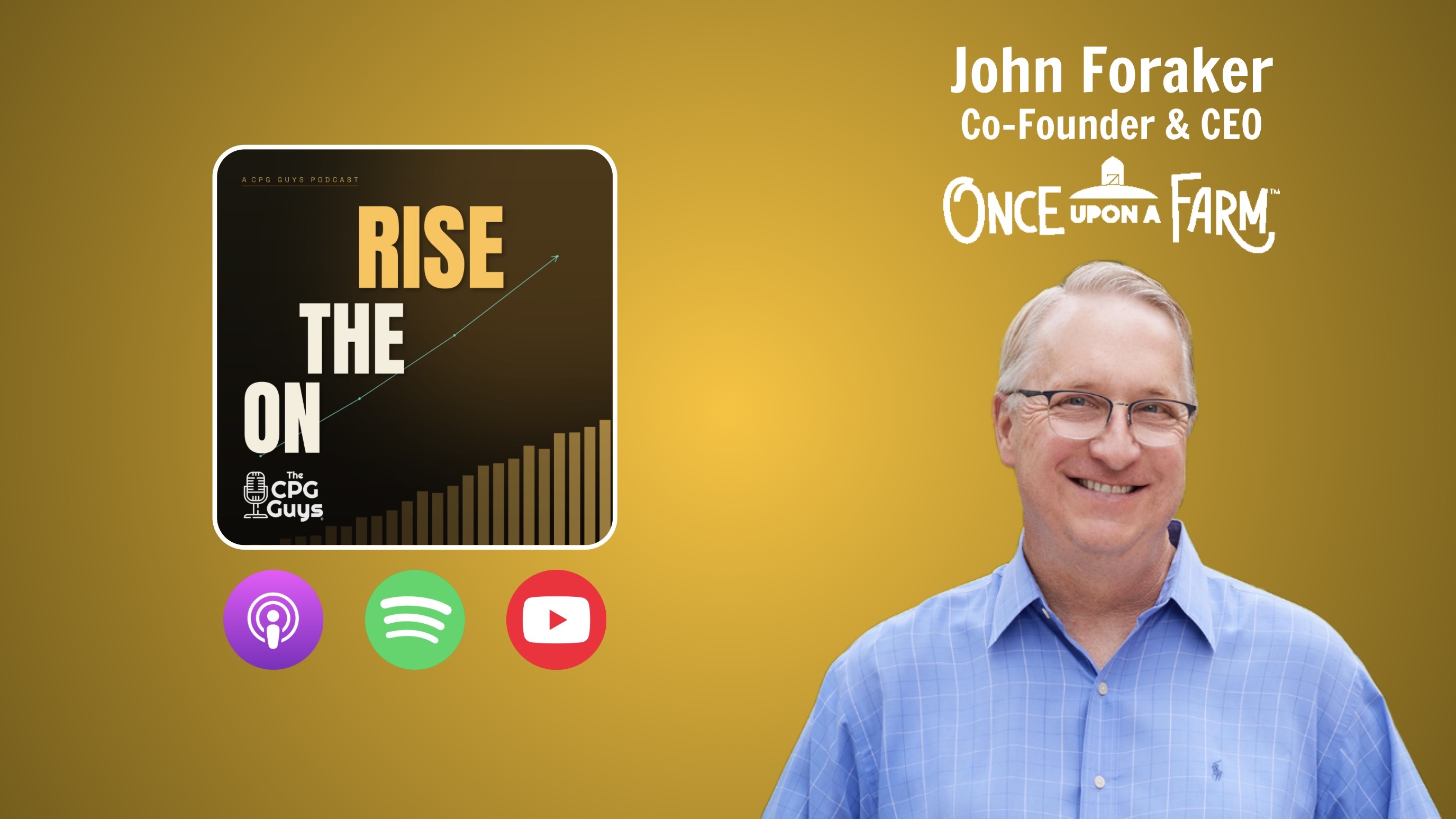


In our inaugural episode of The CPG Guys, we speak with John Foraker, Co-Founder & CEO of Once Upon a Farm, the next generation childhood nutrition company sold in more than 25,000 stores nationwide and online with a growing product portfolio of organic, farm-fresh snacks and meals for babies and big kids! John's co-founders are actress Jennifer Garner & Cassandra Curtis.
Follow John on LinkedIn at: https://www.linkedin.com/in/john-foraker-0061732/
Follow Once Upon a Farm online at: https://onceuponafarmorganics.com/
John ansered these questions:
- Let’s start with the obvious, you scaled Annie’s, sold it to General Mills, what inspired you to start Once upon a farm - I mean it takes guts.
- Let’s talk about life - starting, scaling and running a brand is 24X7 - or is it? What should founders think of this life of 24X7 - or is it our imagination that it’s 24X7?
- John, you took on the traditional center-store baby food aisle by demanding a fresh, cold-pressed cooler set in retail. When you’re an emerging founder trying to convince a retail merchant to create a brand-new physical space in their store, what is the pitch that actually breaks through?
- Once Upon a Farm has built a powerhouse omnichannel engine—a thriving Direct-to-Consumer subscription model alongside 22,000+ brick-and-mortar retail doors. How should early-stage founders balance their DTC capital spend versus scaling retail distribution early on?
- You’ve always operated with a sharp focus on sustainability, B-Corp standards, and social impact—working closely with organizations like Save the Children. How do you ensure that purpose and social responsibility are built into the financial DNA of a startup rather than treated as a secondary marketing tax?
- Having Jennifer Garner as an active co-founder brings tremendous organic reach. But as you know better than anyone, star power gets you a trial; it doesn't guarantee a repeat purchase. How do you bridge high-profile brand awareness with cold-hard velocity and unit economics on the shelf?
- Having scaled Annie's to an $820M exit and now driving Once Upon a Farm past $100M+, what is the #1 mistake you see early-stage founders make when they start scaling from $5M to $50M?
- John, this has been an absolute masterclass for every founder, operator, and retail practitioner listening today. To close us out on On the Rise, if you could give one piece of "Monday Morning" advice to a young founder reading their retail sales data or struggling to raise their next bridge round, what would it be?
CPG Guys Website: http://CPGguys.com
DISCLAIMER: The content in this podcast episode is provided for general informational purposes only. By listening to our episode, you understand that no information contained in this episode should be construed as advice from CPGGUYS, LLC or the individual author, hosts, or guests, nor is it intended to be a substitute for research on any subject matter. Reference to any specific product or entity does not constitute an endorsement or recommendation by CPGGUYS, LLC. The views expressed by guests are their own and their appearance on the program does not imply an endorsement of them or any entity they represent.
CPG Guys Website: http://CPGguys.com
Rhea Raj Website: http://rhearaj.com
Lara Raj Website: http://katseye.world
DISCLAIMER: The content in this podcast episode is provided for general informational purposes only. By listening to our episode, you understand that no information contained in this episode should be construed as advice from CPGGUYS, LLC or the individual author, hosts, or guests, nor is it intended to be a substitute for research on any subject matter. Reference to any specific product or entity does not constitute an endorsement or recommendation by CPGGUYS, LLC. The views expressed by guests are their own and their appearance on the program does not imply an endorsement of them or any entity they represent.
John (00:00)
Hello, I'm John Foraker co-founder and CEO of Once Upon a Farm, and you're listening to episode number one of On the Rise by the CPG Guys.
Sri (00:38)
hello and welcome to the official premiere episode of On the Rise brought to you by the CPG Guys. I'm of course your host for the show, Sri, known in the trade as Papa Raj, co-founder of Think Blue Consulting, co-creator of the CPG Guys platform. Every other week, my co-host of our flagship podcast is CPG Guys, and I will turn to be the host. While our flagship show continues to bring the massive, large, publicly traded fortune fifty boardrooms, on the rise was built with a singular mission to shine a bright spotlight.
On the boldest and brightest, what we would in the CPG industry and my guests today would also in a past life have called the challenger brands, the disruptive founders who change categories and mold categories and mold how brands operate in the ecosystem, the agile D2C pioneers, the digital leaders and the brand equity developers, the emerging tech builders, the visionary organizations. One of them, which was a must have for us on the CPG gas to kick off on the rise, is Once Upon a Farm.
Who's radically reshaping the future of our industry? If you of course are a founder scaling past your first few millions, digital first brand taking over physical shelf space, growing fast in distribution or tech platform driving category velocity, this is your playground. Welcome to On the Rise. Before we jump in, do me a quick favor. Whether you're tuning into Apple Podcasts, Spotify, YouTube, TikTok, smash that subscribe button, leave us a five star rating, you know five is our favorite number, and drop a follow.
On LinkedIn so you never miss an episode of On the Rise or the CPG guys. And now let's get to guest number one, our inaugural guest. When we were deciding who should sit in the hot seat for episode one of On the Rise, there was one name at the absolute top of our list: a legend in natural and organic CPG, a master of brand building, pioneer in taking purpose-driven products from niche startup concepts to multi-hundred million dollar category dominators.
I'm talking none other than John Farker's, co founder and CEO of Once Upon a Farm. For those who need a refresh on John's incredible track record and legacy, top what comes to mind is from my own alma mater, General Mills, the Annie's legacy. John spent nearly two decades as the longtime CEO of Annie's Inc. He took the company public in twenty twelve under the famous BNNY ticker, eventually that its acquisition by General Mills for a massive eight hundred and twenty million dollars in twenty fourteen.
Then the spark in twenty seventeen after seeing refrigerated pet food taking over retail coalers, John asked a disruptive question Is fresh pet food in eighteen thousand stores? If it is, why aren't we giving fresh coal pressed organic food to our babies and kids? What a fabulous question. And then the disruptor angle. He joined forces with co founders Cassandra Curtis, Ari Raz, and actress activist Jennifer Garner to scale once upon a farm. And let me talk to you about the scale today.
Today Once Upon a Farm is an high growth, purpose driven power brand in over twenty five thousand retail stores nationwide, complete with a massive D D C subscription model and a growing footprint across fresh snacking sets. John, welcome to the show. How are you doing? We're thrilled to have you in episode one kick us off on the rise.
John (03:45)
Thank you, Sri. I'm really excited to be here. I've been a longtime fan of CPG guys and I I'm really excited to talk today.
Sri (03:51)
We're honored you're here with us, so let me start with the obvious from our past lives, Annie's. You scaled it, sold it to General Mill. What inspired you after that to start once upon it for him? I mean it takes cuts to kinda get into this natural and organic space which is very crowded.
John (04:07)
So when I was at Annie's, we did a lot of consumer research and we talked to lots of families that were forming. A new kid was coming into the house. And as we were asking them what they were buying and what they were making, a lot of parents were telling us they were making their own baby food. And we asked them why. And they said, because nothing in this category meets my standards. And as a marketer, you know, we're like, wow, that's interesting. And then at the same time, we knew that fresh
Pet food was really evolving as a category and you could see it happening. It was kind of incredible what was happening in the disruption in that category. And I wonder why no one had done fresh baby food. So when General Mills bought Annie's, they allowed me to invest in other things as long as it wasn't competitive and I was transparent about it. And I wanted to invest in a fresh baby food company. I looked around, I couldn't really find one that was interesting to me. And then a year or so later the phone rang and someone introduced me to Aryan Cassandra.
Who had just started Once Upon a Farm down in San Diego and they had just created the brand and were really just getting going. And a couple days later I became their biggest outside investor. And then not that long after that, Jennifer Garner's team caught had contacted them and they connected us and we looked at each other and said, I mean, if if you're in, you want to work on this project, it was very, very early stage, very small company, but just super exciting opportunity. It is a little intimidating to go back from, you know, at the time I was
At Annie's in General Mills. I was in, you know, one of the largest food companies in the country and there was a lot of security in that and I had a great job, but it was really just the challenge of going after something so new and early and seeing if we could do it. And so we both dive in hit first on September of twenty seventeen and that's when I joined. Can you
Sri (05:49)
Can
you tell a little bit about the origin story of the name? What does once upon a farm actually mean? Where did it get its name from?
John (05:56)
Once Upon a Farm was a name that came up in ideation work that Ari and Cassandra were doing with a small firm in Southern California led by a guy named Greg, who I've known in the industry for a long time, who who came up with the the word talking to a design agency. And the design agency, I think, was that the one that came with the idea. Anyway, it was really interesting. It it and it notes kind of, you know, nostalgia with once upon a farm. It's kind of like uh fairy tale, but
But really tying into the farm and it that's really what it was about. It was recognizable. A lot of brand people said it was too long, but sometimes you shouldn't listen to brand people. Consumers really like the idea and and so they went with it. And that that's what we ran with.
Sri (06:41)
So the general thinking and notion is let's just talk about life. You know, starting skilling and running a brand is a twenty four seven job for the longest time, you know, obviously before one takes it public and things of that nature. Is it in the first place? Give advice to founders, please. They're gonna hear this episode, they're gonna get inspired, and they wanna get into this world of being a founder. Is it a twenty four seven job or is it our imagination?
John (07:03)
No, it's a twenty-four seven job, but not it not in the way some people think. Like, you know, you're not sitting at your desk twenty-four-seven a day. You're not necessarily standing out in front of demos at a farmer's market. Your brain is engaged on the business literally twenty-four-seven, because there's so much that has to be done and so much that has to be thought through. And really the earliest year or two of starting an emerging brand is the most important because you're really establishing the DNA of the business.
You're getting that very early learning and product market fit that's hopefully going to lead to something much bigger as you scale it down the road. It is not for the faint hearted. It's very hard work and you gotta be willing to take on the risk and the commitment that comes with it. It's just what it is.
Sri (07:46)
And John, when you say hard work, give us a kind of give our listeners here of this new podcast a feel for what does it actually mean? Is it more PL centric and you gotta worry about the numbers? Is it making the payroll every week? Is it about all the stuff that comes with the brand, including activists that want to talk to you? It's about sourcing, like is it seat to shelf, like what keeps you up?
John (08:08)
It's really all of that. Like I remember coming Any Z was a about a six million dollar a year business when I got involved with it and it ended up being quite a bit bigger over time. This business was less than a million dollars in revenue and was just starting. And I would spend time, you know, in spreadsheets working on costing models and then on the phone with potential retail partners and then
talking to Ari and Cassandra about how we wanted to talk about the brand and market it. Like it was it's just every angle, like everything at the beginning has to be figured out. Your first vision of what it's gonna be is never what it's actually gonna be. You're constantly learning and pivoting. It's like a rolling experiment. And so you have to be willing to be flexible and pivot when you learn something new. And so that's what it's like every day.
Sri (08:54)
And John, when you joined the company as an investor and eventually came on to uh run the operations as a CEO, how large was the team? It was about doing a million in sales is what you said.
John (09:04)
Yeah, at that time it was probably about six or seven people, which included some part-timers and contract people. And then we started scaling it up pretty quick in the first year or two. We raised some capital and we knew that it was gonna require a bigger organization and capabilities because we were planning on going national right away and getting real broad, and we needed to service all that distribution with a very high service level. So we grew pretty fast after that.
Sri (09:32)
Congratulations. And today, many years later, order of magnitude are are you over two hundred and fifty people or so?
John (09:38)
No, we're approaching two hundred now. You know, our our guidance for this year is in the, you know, mid three hundred and thirty million range on net revenue. So growing fast too. Thank you.
Sri (09:50)
Congratulations on all the growth. So the next thing that comes to mind is what you've done is you've taken on the traditional center store baby food aisle by kind of almost demanding a fresh, cold press cooler set in retail, which is really cool if you ask me. Also important for moms and for babies and for dads. When you're on an emerging founder trying to convince a retail merchant to create, this is what y'all have done, a brand new physical space in store. I having spent thirty years
Not the last two, but thirty years prior to that in I don't know, Johnson and Johnson, PepsiCo, Revlon, General Mills, that's an act of God. What's the pitch that cracked the kind of s class here and made it through and convinced the merchant he gotta do this?
John (10:32)
Well, when I when I first went out to my first sales calls, I thought what we were gonna do was fresh pet the baby aisle. Just like you said. I thought it was very clear this cooler had worked in another category and there was this real clear consumer need and wouldn't it be so great? And we talked to baby food buyers and they loved that idea. The problem is once they took it up to store operations and the more senior ups in the chain and they ran into all the complexity about where the power's gonna drop, who's gonna pay for this or that.
It got really complicated and we came to the conclusion it was gonna be really, really slow, but it that that was a great idea. So we pivoted right away. Ariane Cassandra had gotten some early distribution in the dairy set at Whole Foods in the Northeast with three SKUs and in the southern Pacific region with a few SKUs. And those were doing pretty well. So we said, you know what, let's build this first over in the kid yogurt set where there's refrigeration and we went in and we launched nationally there.
And then we tested coolers over the following years. We tested twice at Walmart, twice at Target, once at Kroger, and we failed on all of them. And these are like fifteen or twenty store tests. But each time we tested, we learned something about the assortment or our pricing or where the cooler should be located, what it should look like. And then around 2020, 2021, we started really getting onto a formula that worked and it really started taking off. And so we really started expanding coolers and
We'll finish this year with around five thousand coolers in market. And it's working exactly like Fresh Pet works in the pet aisle. When we put a cooler into the baby aisle, the whole category lifts by about ten points. We're about sixty percent or more incremental. And it just completely transforms the category and the shopper experience. And so it's a very exciting opportunity for the future.
Sri (12:19)
John, so when I think about that, right, like you s mentioned failures at Kroger, et cetera, talk to us about as a co founder the importance of failures, learning from it. It's got it must have been daunting to see two or three failures earlier. How did you all persist and just sustain through that and say we're going to break through?
John (12:37)
You just have to believe and we had a stubborn belief that this was the right thing for consumers and that it should work in this aisle. And we didn't look at each failure as a failure per se. We looked at it as learning. And it is true. Every time we did it, we learned something. And then like I said, it really started to work. And so that's the mindset you have to have. And it's it's not just about coolers in our case in the baby aisle. It's really about any emerging brand. You have to
view your business as a running experiment and you're gonna learn things and you need to be able to act on those and not view it as a failure. That's where all the great learning comes from. And if you think of all the really fantastic emerging brands that are emer coming around and some of them are getting really big in literally every single category now. Almost all of them have had experiences like that where they've learned and pivoted in the beginning and have become what they are.
Sri (13:28)
And then John, what about the fear that comes to, you know, you invested capital and it just became a failure? How does a founder and aspiring founder not look at that and not lose their minds and increase the cortice all over that?
John (13:44)
Well, I think they do um the they do increase their cortisol. It's like it is very stressful. I remember when I came over here, I had some credibility because I'd had some success before, which helped with investors and and talking to them. But in my early communication to the investors of this company, one of the first things I wrote to them was, Success is not guaranteed here. This is gonna be really hard. We're creating a new category. It's one of the hardest things to do in retail, especially if you're trying to do it in refrigerated and new new temp states in aisles and things.
as you alluded to earlier, we're gonna guarantee you maximum effort. And so that's what we said. And so the investors that were attracted to in the beginning understood that risk. We understood it and we went for it. And fortunately, knock on wood, we we got lucky and we made some good decisions and fortunately it's all worked out and we're just on a great growth path now. But it wasn't guaranteed ever in the beginning.
Sri (14:35)
Again, congratulations on all the success. So I look at you know, there's the in-store component, convincing a merchant to put a new space inside the store, but there's also the omnichannel piece, which seems to be the dominant mechanism to reach moms and dads these days for the products you'll make. So talk to us about that. You built a pretty powerful omnichannel engine, it's a thriving D D C subscription model, alongside twenty-two thousand plus pick and motor retail doors. So how should an early stage founder balance the D D C
energy, effort, capital, yada yada yada versus scaling retail distribution early on.
John (15:09)
Yeah, I think they're both very important. I think DTC is incredibly important. That's the very first place this stuff showed up. And really it's the closeness to the consumer, the learning, and really building the beginning of the business and what the brand stands for. We committed really early to retail. We thought retail was where the business was mostly going to be long term and have been kind of a retail first strategy with a strong DTC business being really important. But we've run this channel for two reasons. One for the consumer learning and closeness.
Very important and also to be a profitable channel. So it's growing. It's it's definitely not our biggest business at all. Retail is by far our biggest, but it's a very important channel to us. And the other thing that's emerged really since COVID, and you you guys at CBG guys have talked about this extensively, the online nature of all retail and how every store is a distribution center, and you have to be omnichannel available to consumers wherever they are, whether they're going to Walmart or Kroger or Whole Foods dot com.
or your own DTC site or they're walking into a store. And so we're a brand that's been in really investing and focusing on that since day one. And as a result, we way over index in online sales no matter where it's bought. And we think that's a really important thing, especially for parents.
Sri (16:22)
Talk that
online piece, right? So there's a part of completing the sale which is lower funnel, but there's a whole story on the upper funnel, keeping moms and dads engaged, keeping consumers engaged, the buyers in this case, 'cause consumers are younger for you. So talk to us about how you actually achieve that. On most of them are online these days. Talk to us about the demographics of who your number one purchaser is.
John (16:44)
Yeah, so our biggest group of purchasers are obviously parents that either have a kid or are about to have a kid or have a couple and they're digitally savvy, they care about they're aware of better food and organic and they clearly are trying to prioritize that for their kids. You know, consumers do a lot of research on what they're gonna buy for baby's first foods way before the baby gets to that stage. And they also talk peer to peer to a lot of their friends in social media networks and the like and learn that way as well.
So you need to show up in all of those places with all of those tactics. But we've been very committed to upper funnel since the very beginning. Obviously, having Jen Garner as one of our co-founders who's incredibly involved in this business every single day involved gives us the ability to raise a lot of awareness and really did early on. And we ended up shooting a national television ad with her that's been very effective. And we've been running it linear television as well as streaming and all that. We think the combination of upper funnel.
And all these tactics as you go down is is critical, especially if you're really trying to build a big brand across multiple categories like we are.
Sri (17:48)
You know, most brand founders will tell me they rely heavily on the digital side. You just mentioned linear TV. What's your advice to founders on the whole linear advertising piece? It very much hasn't gone away, including the old forms of digital like Google, Meta, etcetera. I'd just love to pick your brain on that.
John (18:05)
Yeah, so I mean, linear hasn't gone away. It's expensive and it's it's a lot of live sports and just broad, broad reach audiences. And we've had a lot of success with it. And you know, people will ask us, Lil, why are you running your ad on on an NFC championship game? And the reason is because there's such a broad reach audience there. And we've had a lot of opportunity to build awareness by doing that.
And awareness goes into conversion as we go down the the funnel. And our repeat rates on our brand have been growing every single year since I've been here. And so it's a really good investment. You have to be very thoughtful about it. And obviously you have to do it in a sustainable way. But we think linear plays a role. Obviously, streaming and other things are very important too and very efficient. So marketing has changed so much in the last five years, let alone the last two or three, even you have to constantly be adapting and
listening to pods like yours, CPG guys, and learning what's new and what's happening out there and engage with it. And that's what I encourage founders to do is just you gotta be modern in your marketing. And
Sri (19:09)
And
so John, you mentioned listening to the CPG guys, but what are some other forms of learning? Like how do you keep yourself abreast as a fan?
John (19:16)
I read a lot. I read a lot of short form stuff. I'm online. There are some good books out there for early stage founders, like um Ramping Your Brand by James Richardson is a book I've read and talked about to a lot of people about this early stage CPG stuff. Then I network and I talk a lot to you, especially in the early days when I I would talk to friends of mine in retail or friends of mine in other brands like ours that were trying to do something similar like that and tapping into networks like the naturally network across the US, these natural networks were
other CPG founders are going to, you know, events and talking to each other. You just have to learn. You have to constantly be curious and learn. That's a really important piece of advice. Yeah.
Sri (19:56)
I can't imagine that being a founder you can't have the like intellectual curiosity should be one of the number one traits, but somebody go towards sustainability, B Cop standards and social impact, that's a big purpose that once upon a farm brings. Yep. You work closely in fact with organizations like Save the Children. How do you ensure that purpose, social responsibility are built into the financial DNA of a startup rather than treat it as a secondary one percent marketing tax or something of that nature?
John (20:25)
Yeah. When I first came over here, that was the very first thing we did is Arya and Cassandra and Jen and I sat down and we really worked on what is the mission of this business. When Jen and I decided to get involved, we shook hands on on it. We said we only want to do this if we're gonna really try to drive some positive social impact in addition to a successful business. So we landed on a mission statement, which is to drive systemic change and childhood nutrition for a happier, healthier, and more equitable world.
And that's a really bold statement coming from a less than million dollar business. But we have baked that into everything we've done since the beginning. The types of products that we created, like for example, we brought a Wix certified women, infant, children certified fresh baby food product to market way before we probably should have otherwise, because we knew that was really important as we grew cooler, as we wanted that represented. Obviously, Jen has had a long relationship.
will save the children and has done incredible work there. And so a partnership with them was a natural thing. Then in twenty twenty one we converted from an LLC to a public benefit corporation. And in that public benefit corporation are you know our articles are things that are really important to us around organic agriculture or equitable access to food and the like. And so we just we view that it's incredibly important part of the brand. And that when consumers learn about the brand, obviously we have to win with like
product availability that's meeting their needs and that tastes great and their kids love it and they see value in it, right? Obviously you have to win there. But when they start scratching deeper on this brand, what they'll find is, you know, almost 200 people who care deeply about that mission statement I mentioned earlier. And we are doing things throughout our entire business, whether it's supply chain, social impact work, partnerships that are lined up to drive impact against that. We just think that that's critical to what we do. The success of this business
It's like the success of the economic success will will pull the impact train and it's all self compounding because we're building brand trust, which is helping us expand the brand into other places and consumers are following us.
Sri (22:31)
kinda given away the plot for self compounding right there, but you mentioned having Jen Ghana as a founder quite a few times. So having her as an active co-founder would probably bring tremendous organic reach on the social side. But as you know better than anyone, star power also gets you into somewhat of a trial mode. It doesn't guarantee a repeat purchase but a trial for sure. How do you bridge high profile brand awareness with cold hard velocity, you need economics of the shelf? I'm visualizing you and Jen having these conversations and then
How does the social media part of that work?
John (23:03)
So that's absolutely right. Like at the end of the day, you can having a celebrity partner like Jen can definitely raise a lot of awareness early on and did. In fact, when we launched nationally, we went from about three or four hundred stores to a very significant number, around over eight thousand in about a year. And Jen went on the morning shows and hit social media and all this stuff, and we generated, you know, well over a billion earned media impressions.
But we were like the world's most famous lemonade stand. We're so small.
Sri (23:34)
One billion media impressions. One billion with a B. Yeah.
John (23:37)
Yeah,
yeah, yeah. Yeah, exactly. The the impressions were crazy. But it raised enough awareness and we got enough trial. And so people tried it. It gave us credibility to go out and talk to retailers and get retail placements. It really just took about eighteen months to twenty-four months to really start getting the velocities really rolling. There were some things we had to learn. Jen and I and the team kept working it. You know, Jen and I probably did. We've probably done a couple hundred retailer calls over these years.
Together and you know, she's got a lot of buyers and category managers' phone numbers in her phone. You know, she's reaching out to them before category reviews. So having that just like really active celebrity co-founder has been amazing. She's on my leadership team meetings every week, and there's been many of those where she's been sitting in a chair. She's an incredible actor. Obviously, she has that career too. So she's sitting in a in a makeup chair, you know, worked on while while we're talking about supply chain. It's kind of fun.
But it's all about product. You gotta get the product right and it's gotta turn into a high repeat item, you know, hopefully with high frequency too.
Sri (24:39)
I can only imagine, but I gotta ask you, working with a celebrity kind of partner there and a co founder who's active, does it create pressure on the other co founders? Does it create pressure on the leadership team one level below? Is it intimidating?
John (24:53)
No, it's very inspiring. I mean, I had really never met uh very many celebrities before a meeting Jen and what I've learned quickly with her in the very beginning is that she's just all in on something that she cares about and I literally mean it. She's been she's on the phone all the time. She's in our Slack channels talking to our people every single day. She's calling on customers with me. We're doing top to tops. We were just at one last week. So we're doing all of this stuff and it's inspiring because you know that
you have a lot of awareness building potential that comes with it. And there's real buy into the culture that we've created and the mission that we have for this business. And it's inspiring to everybody around us.
Sri (25:34)
Let's go deep back into your past on the Annie side. So you scaled it, we talked about the eight hundred million plus exit. Now you're driving once upon a farm past a hundred million. You just gave a number, you know, over three hundred million in scale. What are some mistakes you see early stage founders make when they start scaling from that first million to let's say ten, fifty, et cetera?
John (25:57)
Yeah, the there are a number and I've made a number of these mistakes in my career, so I'm not pointing fingers at anybody. Especially at Anne's, I made a lot of these similar mistakes. But one of the most common mistakes you see is a brand gets going, it starts getting some traction. If you get to five or ten million dollars, there's definitely something happening there, right? And the biggest mistake I see is founders think that it's time to expand into another category with their brand.
versus just going deeper and building real depth and scale in what they started with or what turns into their, you know, their biggest business. That is a is a mistake that is often made and it very much distracts and it geometrically makes the complexity higher in the business. And it doesn't necessarily increase the odds of success at all. In fact, when I came over here at Annie's, I had made that mistake many times at Annie's.
And we had some things that got really big, which was great, but we had lots of things that didn't work and it was very hard on the business. When I came over here once upon a farm, I mean, we basically focused on these core baby and kid pouches for the first seven years and just pounded those. And by the time we expanded the brand into another category, that core business was well over a hundred million dollars. And we had millions of households that were aware of us. And so when we expanded into dry baby stacking, for example, that business
took off and got much bigger, much faster as a result of our patience in building the brand. And so that's the biggest piece of advice I'd give is stay focused on that first thing and really build it deep.
Sri (27:26)
So let me now close this out by asking you first of all, thank you for a master class. Thank you for giving us your inspiration vision of how the company came together and how you've been scaling. But if I would ask you for every founder, operator and retail practitioner listening today to close this out on On the Rise, give one piece of Monday morning advice. So they get up Monday morning after listening to this, young founders reading the retail sales data, struggling to raise the next bridge round. What would be that advice you'd give
John (27:55)
The advice I would give them is, you know, don't let setbacks become permanent obstacles. Like I said earlier, it's a natural progression in these businesses. You're gonna have days where you feel big wins, the ball moves down the field, and then you're gonna have times where something just absolutely doesn't work or a door shuts on you. Always look and be curious about what you can learn from that and just adapt. And just know that this is a very it's a very vibrant ecosystem out here. Consumers more
than ever are focused on health and wellness and moving in that direction. And so the opportunity to build big businesses is better than it's ever been. And so emerging brands are doing that in almost every single category. And you have, you know, as as good a shot as anybody to be one of the ones that breaks through. You just have to keep working at it and believe in yourself.
Sri (28:43)
So I w my takeaway from that one is believe in yourself. Yep. That's the big moment. So great to hear. Awesome phenomenal insights from a true industry icon, John Farriker. Thank you for making time to launch episode one with us. Thank you for being here on the on the rise by the CPG guys.
John (29:00)
Thank you, Shriya. I'm honored. Thank you very much. And good luck to everybody out there.
Sri (29:03)
Listeners,
check out the show notes for links to Once Upon a Farm, follow John Faracer on LinkedIn, make sure to subscribe to On the Rice by the CPG Guys, whether you're building the next breakout challenger brands, scaling a D D C subscriber base, engineering the tech that powers it all, keep pushing, keep disrupting. We'll see you on the next episode after all this industry needs you. I'm Sri signing off on behalf of On the Rice by the CPG guys. See you next week for another wonderful conversation.